HAL Id: hal-00763421
https://hal.inria.fr/hal-00763421
Submitted on 10 Dec 2012
HAL is a multi-disciplinary open access archive for the deposit and dissemination of sci-entific research documents, whether they are pub-lished or not. The documents may come from teaching and research institutions in France or
L’archive ouverte pluridisciplinaire HAL, est destinée au dépôt et à la diffusion de documents scientifiques de niveau recherche, publiés ou non, émanant des établissements d’enseignement et de recherche français ou étrangers, des laboratoires
Stéphane Ducasse, Nicolas Petton, Guillermo Polito, Damien Cassou
To cite this version:
Stéphane Ducasse, Nicolas Petton, Guillermo Polito, Damien Cassou. Semantics and Security Issues in JavaScript. [Research Report] 2012. �hal-00763421�
Sémantique et problèmes de sécurité en JavaScript Deliverable Resilience FUI 12:
7.3.2.1 Failles de sécurité en JavaScript / JavaScript security issues
Stéphane Ducasse, Nicolas Petton, Guillermo Polito, Damien Cassou Version 1.2 - December 2012
Copyright © 2012 by S. Ducasse, N. Petton, G. Polito, D. Cassou.
The contents of this deliverable are protected under Creative Commons Attribution-Noncommercial-ShareAlike 3.0 Unported license.
You are free:
to Share — to copy, distribute and transmit the work to Remix — to adapt the work
Under the following conditions:
Attribution. You must attribute the work in the manner specified by the author or licensor (but not in any way that suggests that they endorse you or your use of the work).
Noncommercial. You may not use this work for commercial purposes.
Share Alike. If you alter, transform, or build upon this work, you may distribute the resulting work only under the same, similar or a compatible license.
• For any reuse or distribution, you must make clear to others the license terms of this work. The best way to do this is with a link to this web page: creativecommons.org/licenses/ by-sa/3.0/
• Any of the above conditions can be waived if you get permission from the copyright holder. • Nothing in this license impairs or restricts the author’s moral rights.
Your fair dealing and other rights are in no way affected by the above. This is a human-readable summary of the Legal Code (the full license):
Deliverable: 7.3.2.1 Failles de sécurité en Javascript Title: Semantics and Security Issues in JavaScript
Titre: Sémantique et problèmes de sécurité en JavaScript Version: 1.2
Authors: Stéphane Ducasse, Nicolas Petton, Guillermo Polito, Damien Cassou Description de la tâche 7.3.2.1 / Task 7.3.2.1 Description:
Les environnements d’exécution Javascript comportent des failles de sécurité liées à la sémantique d’ECMAScript ainsi qu’à la présence de certains construc-teurs. D’autres failles sont liées à la mise en oeuvre pratique d’ECMAScript par les navigateurs. L’objectif de cette tâche est d’identifier et classer les types de failles de sécurité dans le monde Javascript. On consultera notamment les travaux de Miller autour de Caja et ainsi que les approches proposées par Seaside un framework pour le développement d’applications sécurisées en Smalltalk. L’objectif de la tâche est de formaliser les mécanismes de sécurité en Javascript de façon à augmenter la connaissance des partenaires et des utilisateurs de Javascript sur ce sujet.
Contents
1 Web architecture basics 2
1.1 Client-Server basics . . . 2
1.2 Web Browser window insfrastructure . . . 3
1.3 Cookies . . . 3
1.4 AJAX . . . 4
2 JavaScript object model in a nutshell 5 2.1 Objects: the basic building block of JavaScript . . . 5
2.2 Property access . . . 6
2.3 Functions: behavioral units . . . 7
2.4 Programmatic function evaluation . . . 7
2.5 Object methods . . . 8
2.6 Higher-order functions . . . 9
2.7 Object constructors . . . 9
2.8 Object core properties . . . 10
3 Key subtle JavaScript points 12 3.1 Variables and scope . . . 12
3.2 Thewindowobject . . . 12
3.3 this: an overly dynamic pseudo-variable . . . 13
3.4 Object constructors misuse . . . 15
3.5 Lexical closures and unbound variables . . . 16
3.6 Thewithstatement . . . 18
3.7 Lifted Variable Definitions . . . 19
3.8 Type coercion . . . 20
4 JavaScript programming practices 23 4.1 Defining prototypes . . . 23
4.2 Closures and ‘functional’ inheritance . . . 26
5 ECMAScript 5 28 5.1 Object creation . . . 28
5.2 Defining object properties . . . 29
6 Key Bibliography Elements 32
There is a plethora of research articles describing the deep semantics of JavaScript. Nevertheless, such articles are often difficult to grasp for readers not familiar with formal semantics. In this report, we propose a digest of the semantics of JavaScript centered around security concerns. This document proposes an overview of the JavaScript language and the misleading semantic points in its design. The first part of the document describes the main characteristics of the language itself. The second part presents how those characteristics can lead to problems. It finishes by showing some coding patterns to avoid certain traps and presents some EC-MAScript 5 new features.
Chapter1. Web architecture basics
In this chapter we present some basics principles of common web architecture and in which JavaScript applications are deployed.
1.1
Client-Server basics
The web is based on the client-server architectural pattern:
• the client role is played by a web browser with limited resources and tech-nologies – often HTML, CSS and JavaScript. Its usual main responsibilities are user interface and interaction as well as data validation.
• the server role is fulfilled by a program implemented in a wide variety of technologies, with a controlled set of resources. Its usual responsibilities are to serve pages to web-browsers, enforce business rules, and persist and validate data.
The client and server processes communicate though the HTTP protocol [Mog02]: the client makes HTTP requests and, for each, the server answers with an HTTP response, as illustrated in Figure 1.1. When the response arrives, the web browser normally discards the current content and loads the new one, causing a full refresh of the user interface. Since HTTP is a stateless protocol – requests are indepen-dent from each others – several mechanisms were built to maintain state between a client and a server (e.g., cookies, see section 1.3).
As computers running web browsers become more and more powerful, there is a tendency to move responsibilities from the server to the client (e.g., page cre-ation and business rules enforcement). These new responsibilites are mostly im-plemented in JavaScript and JavaScript-based languages.
Web Browser HTTP Server
1. Request
2. Response
Figure 1.1: An HTTP request and response between a web browser and a web server
window d o c u m e n t cookie 1 1 p a r e n t * frames
Figure 1.2: The JavaScript model of a web page
1.2
Web Browser window insfrastructure
A web page is composed of several html widgets including frames and iframes, which insert an existing web page into the current one. Frames and iFrames are considered web pages by themselves, therefore having the ability to contain other ones, following the composite design pattern [GHJV95].
While loading a web page, a web browser generates an internal structure of JavaScript objects. Each web page is represented as awindowobject referencing its parent and children through theparentandframesproperties.
Each web page also references a document object, which is the root of the DOM– Document Object Model – representation of the web page tags.
Web browser JavaScript implementation differences
As each web browser has its own implementation of the DOM and JavaScript, one of the hardest tasks of JavaScript development is to build browser-agnostic applications. There exist several libraries to reduce the difficulty of this task such as extJS1,jQuery2and scriptaculous.3
1.3
Cookies
A cookie is a string that is exchanged between the client and the server [MFF01]. Cookies are normally stored on the client machines to let web application state survive after the client process is stopped (i.e., the browser or the browsing tab is closed).
Cookies are key-value pairs associated with the equals character ’=’ and sep-arated from each other with a semi colon (e.g.,,
"name=john;expires=2013-01-1http://www.sencha.com/products/extjs/ 2
http://jquery.com/
3
15T21:47:38Z"). The expiration date tells the browser when to delete it. A cookie can contain other properties likedomainandpath, that tells the browser in which requests it should be exchanged, which by default are the current domain and path. Cookies can be changed from JavaScript code accessing thecookieproperty of the currentdocumentobject. Cookies can contain sensible data (e.g., emails and passwords) and must be studied for a security analysis.
1.4
AJAX
AJAXstands for Asynchronous JavaScript and XML: it is a mechanism to send XMLHttpRequest requests to a web server. XMLHttpRequest is used to retrieve data from a URL without reloading the complete web page [MvD07]. The re-quest is sent by the client through a JavaScript API and handled asynchronously. Formerly, AJAX was used to exchange information in XML format, but XML-HttpRequest can be used to transfer any kind of data. Nowadays, one of the most used formats is JSON,4which stands for JavaScript Object Notation.
Illustrated in Example 1.1, the "test.json" service is requested to the server via AJAX, and a function is used to determine how the response will be handled at the time it arrives.
$.ajax({
url: "http://www.webcompany.com/api/test.json", }).done(
// Function is evaluated after the json service responds:
function() {
// adds a 'class' attribute to current HTML node
$(this).addClass("done"); });
Example 1.1: AJAX request performed with JQuery Library
AJAX is becoming more and more popular as the client machines become more powerful and can perform heavier processing tasks.
Chapter2. JavaScript object model in a nutshell
In this chapter we present key aspects of ECMAScript 3 and 51to provide a com-mon context. This document has been written in the context of the Resilience project. This study is focused on the semantic aspects of JavaScript in the context of securing untrusted third party JavaScript code in a web browser. In this context, one of the key aspects is to forbid the access to thewindowobject (the global ob-ject of the web browser frame, see 3.2). Accessing thewindowobject of the frame would lead to possible page-data leak (windowis the root of the DOM of the page), sensitive information leak (from thewindowobject private information in cookies can be accessed), and even user actions sniffing (having access to DOM elements means that one can add listeners to DOM events2). In the next deliverable we will describe the state of the art of JavaScript sandboxing. One of the different as-pects in JavaScript sandboxing is to securely forbid access to potentially sensitive objects, includingwindow, the root object.
2.1
Objects: the basic building block of JavaScript
JavaScript is a loosely-typed dynamic programming language where every-thing is an object. Each object contains a set of properties (also named slots) that represent data (other objects) and operations (function objects). These properties are always public and can be accessed and modified using the dot or squared-bracket notation:
// We create a new empty object
var person = new Object();
// Write a property
person.age = 5;
person['age'] = 5; // equivalent
// Read a property and store it into some variable
var theAge = person.age;
var theAge = person['age']; // equivalent
Example 2.1: Property access
In this script we create a new object that we assign to the variable person. Then the expression person.age = 5 adds a property to the newly created object and stores the value 5 into it. Note that objects are hash tables. The expression{a:
1
ECMAScript is the standard JavaScript is based on.
2
0}thus creates an object with one property namedawith value 0. Because of this, properties can be accessed and set using both theperson[’age’] andperson.age
notations.
2.2
Property access
ECMAScript’s property lookup is done at runtime (see Example 2.2) and never throws errors. Example 2.2 defines an objectobjectcontaining two propertiesaand
bwith values 10 and 5 respectively. The functiongetis then defined. This function takes as argument a property’s name and returns the corresponding property’s value of the object. In the last line of Example 2.2, the functiongetis called twice to access the values of the propertiesaandb.
var object = {a : 10, b: 5}; var get = function(property) {
return object[property] };
get("a") + get("b"); // answers 15
Example 2.2: Property lookup at runtime
If a property does not exist, theundefinedobject is returned, as shown in Ex-ample 2.3.
var object = {a: 1, b: 2};
object.c // answers 'undefined'
Example 2.3: Property access for nonexistent properties
Example 2.4 shows how to update, create and delete properties. The first in-struction sets 10 to the propertyaof object{a: 0}. Therefore the expression returns an object with the propertyawith 10 as a value.
The second instruction shows that if a property does not exist then it will be created automatically. Hence,{a: 0}[b]=10returns an object with two propertiesa
andb.
Finally, the third instruction removes the property b of the object using the
deletekeyword.
// Updating a property
{a: 0}[a] = 10; // answers {a: 10}
// Creating a new property using the same syntax
// Deleting a property
delete {a: 0, b: 5}[b]; // answers {a: 0}
Example 2.4: Updating, creating and deleting properties
2.3
Functions: behavioral units
Functions are the behavioral units of JavaScript. A function performs a side effect (e.g., alters an object) and/or returns a value.
Functions can be defined via a function declaration or a function expression. A function declaration defines a function at compile time, as seen in Example 2.5. A function expression creates a new function at runtime. Function expressions are also called anonymous functions, since they are not associated with any name. The creation of a function from a function expression is illustrated in Example 2.6.
function sum(a, b){ return a + b; }
Example 2.5: A function declaration has a name
var sum = function (a, b){ return a + b;
}
Example 2.6: An anonymous function that is assigned to a variable A function can be called by passing arguments between parenthesis as shown in Example 2.7.
sum(1, 2);
someFunctionWithNoArguments();
Example 2.7: Calling a function
Functions are important because they constitute the basic building block of code execution in a JavaScript program.
2.4
Programmatic function evaluation
The built-incall()andapply() functions are two methods of theFunction ob-ject.3 These functions are thus called on other functions and execute them. These 3In JavaScript, the words ’method’ and ’function’ are equivalent. The former is particularly used
functions both take the receiver of the function to execute as first parameter and arguments of the function to execute as the other parameters. When using these methods, the pseudo-variablethisin the function to execute is bound to the first pa-rameter ofcall()andapply().call()receives the arguments of the function to execute as comma-separated values whereasapply()receives an array (see Example 2.8).
function someGlobalFunction(value1, value2){
this.value1 = value1;
this.value2 = value2; }
// The regular invocation binds 'this' to the global object as // we will see later on
someGlobalFunction(5,6);
window.value1 // answers 5
var someObject = new Object();
someGlobalFunction.call(someObject, 5, 6);
someObject.value1 // answers 5
someGlobalFunction.apply(someObject, [5, 6]); // equivalent Example 2.8: Theapply()andcall()methods
Turning text into function at runtime. Using theeval()built-in function, it is possible to evaluate a string at runtime. eval()makes static analysis of programs difficult [RHBV11]: at runtime a string can be composed and evaluated without restriction in the global environment and scope.
var a = 2;
eval('a++');
a // answers 3
Example 2.9: Evaluating code from a string
2.5
Object methods
In JavaScript, methods are just functions attached to an object as can be seen in Example 2.10.
var person = new Object();
person.name = 'John';
person.getFullName = function (){
return this.name + ' ' + this.surname; }
Example 2.10: Adding methods to an object
In a method, a developer can refer to the owner object using thethiskeyword. We will see later thatthishas a different semantics than in Java or Smalltalk since depending on how the function is accessedthiscan be bound to the object owner of the property or any other object (see section 3.3).
2.6
Higher-order functions
Functionsin JavaScript, as first class citizens, can be passed as parameters to functions and returned from functions. Higher-order functions are most commonly seen when implementing filtering, selection and sorting algorithms to make them independent of their content. In Example 2.11, we define a new property inherited by all arrays that is a function to filter elements of the receiver array according to a given criteria. Then, we define a function isEventhat will play the role of the criteria and an array of numbers. The last statement calls the new filter property function onarraywith theisEvencriteria.
Array.prototype.filter = function (criteria){
newArray = new Array();
for (var i = 0; i < this.length; i++) {
// we keep the elements of the array that respects // a certain criteria
if (criteria(this[i]))
newArray.push(this[i]); }
return newArray; }
var isEven = function(elem) { return (elem % 2) == 0; }; var array = new Array(9, 58, 42, 12, 1001, 1000);
array.filter(isEven); // answers [58, 42, 12, 1000]
Example 2.11: Extending Arrays with a higher-order filter function
2.7
Object constructors
Constructorsare used to structure object creation in ECMAScript 3[MMT08, GSK10]. A constructor is a standard function object whose name is by convention capitalized to indicate to the programmer that the function must not be directly called. Thenewkeyword is used to invoke a function as a constructor. Using the
new keyword instantiates an object and executes the constructor on that object, binding the pseudo-variablethisto the newly created object.
var Animal = function (name) {
this.name = name;
this.describe = function() {
return this.name + ', an animal'; }
};
//Invoking the constructor with the 'new' keyword
var animal = new Animal("pilou");
animal.name; // 'pilou'
animal.describe() // 'pilou, an animal'
Example 2.12: Thenewkeyword
2.8
Object core properties
There are three properties that are key to the execution of any JavaScript appli-cation:
• constructoris a property that contains the reference to the function that was used to create the object using the new keyword. In Figure 2.1, the ani-mal object has a propertyconstructorcontaining a reference to the Animal
constructor that was used to createanimal.
• prototype is a property that is used by constructors to initialize the inheri-tance chain (modeled by the__proto__property) of objects they create. This property only makes sense on function objects that are used as constructors. In Figure 2.1, the Animalconstructor has a propertyprototypecontaining a reference to an object (with anisAnAnimalproperty) that will be the parent of all objectsAnimalcreates.
• __proto__ is a property that contains a reference to an object (the parent) where properties will be looked up when not present in the receiver. When an object is created, the value of its__proto__property is initialized to the
prototypeproperty of the constructor function used to create this object. In Figure 2.1, the animalobject has as parent the object whose only property is isAnAnimal: this object is the prototype of theAnimal constructor. At-tention: this property is not always visible from a developer’s point of view depending on the JavaScript implementation: you should avoid manipulating
Function f u n c t i o n ( ) { } animal { n a m e : ' p i l o u ' } Animal constructor prototype undef { i s A n A n i m a l : t r u e } prototype __proto__ __proto__ constructor constructor
Figure 2.1: The 3 core properties of objects (constructor, prototype, __proto__). Boxes in gray represent objects created by the code of Example 2.13 whereas boxes in white represent objects provided by JavaScript.
Example 2.13 demonstrates that the __proto__ property is initialized to the constructor’sprototypeproperty value. First, a function is defined and assigned to a new variableAnimal. The prototype of new functions is always an empty object. In this case, we add the property isAnAnimal to this empty object. All objects created from the Animalfunction will then inherit the isAnAnimalproperty. The variableanimalis then set to a newAnimal. The rest of the statements describe the relationship betweenanimaland its constructorAnimal.
var Animal = function (name) { this.name = name; };
Animal.prototype.isAnAnimal = true; var animal = new Animal("pilou");
animal.constructor == Animal; // answers true
animal.__proto__ == animal.constructor.prototype; // answers true
animal.isAnAnimal; // answers true
Animal.isAnAnimal; // answers false, 'isAnAnimal' is not a property of // the constructor but of objects it constructs Example 2.13: Defining a constructor so that Figure 2.1 can show the core properties involved
Chapter3. Key subtle JavaScript points
In the following we present the subtle aspects of JavaScript that have an impact on security such as unbound variables [MMT08, Dav06].
3.1
Variables and scope
All objects inside a web browser frame share the same environment without any restriction. This is a security problem because it allows dynamic modifications of the program and full access to all the objects defined inside this environment.
To declare a variable local in a particular scope such as a function scope the
varkeyword is needed, as illustrated in Example 3.1. Here the variable myLocal-Variableis local and only accessible from within the body of the function myFunc-tion.
function myFunction(arg) { var myLocalVariable = arg + 5; return myLocalVariable; }
Example 3.1: declaring a variable local to the function
Not usingvarcauses our program to create a global variable (see Example 3.2) [MMT08, Dav06, GSK10].
(function () { globalVar = 'setting global'; })()
window.globalVar // answers 'setting global'
Example 3.2: using a global variable
In this example,globalVarbecomes a property of the global environment win-dow.
3.2
The window object
The window object represents the window of the current HTML document. Each web browser’s tab, frame, or window has its ownwindowobject.
The window object is the global object of the JavaScript environment. Each function that is not attached to another object is attached towindow, as illustrated in Example 3.3. This behavior combined with the dynamic binding of thethis pseudo-variable (see 3.3) can have deep side effects on security of your applications.
window.ping // answers 'undefined'
var ping = function (string) { return string;
};
window.ping; // answers the ping function
window.ping('foo'); // answers 'foo'
Example 3.3: A function not attached to an object is attached towindow
The example starts by checking that thewindowobject has no property named
ping. Then we define a new function at the top level, which is automatically added to thewindowobject. Accessingwindow.pingreturns thepingfunction. We check that we can effectively execute it.
3.3
this: an overly dynamic pseudo-variable
While at first sight, this may look like the pseudo-variable in Java, C# and Smalltalk (namedselfin this case), in JavaScriptthishas a special semantics. this
is a dynamically bound builtin pseudo-variable of JavaScript. When used inside a function scope, the value of the pseudo-variablethis is determined by the syn-tactic shape of the function invocation [MMT08, GSK10]. By synsyn-tactic shape, we mean thatthisis bound to a different object depending on the way the invocation expression is written.
In Example 3.4, while the same function is shared between two different ob-jects, depending on the function invocation,thisis bound to a different object.
var o = new Object();
// A new function is attached to 'o' on property 'f'
o.f = function() {return this;};
// f is invoked from o
o.f(); // answers o, so 'this' was bound to 'o'
var o2 = new Object();
// o2.f and o.f point to the same function object
o2.f = o.f;
// f is invoked from o2
o2.f(); // answers o2, so 'this' was bound to 'o2' Example 3.4: Function invoking
The behavior described by the previous example looks natural and similar to the one of Java and C# wherethisis bound to the receiver. However, the semantics
behindthisis more complex. Thus, depending on the way the function is invoked,
thismay not refer to the object which defines the function but to the global object
window. As explained in section 3.2, every object not attached to another object is implicitly attached to the global objectwindow.
The following example illustrates this behavior. First, a simple object, named
o, with a methodyourselfis created that simply returnsthis. When the expression
o.yourselfis executed,ois returned as expected. Then the variable yourselfFunc-tionis defined in the context of the global environment and its value is set to the methodyourself. Now whenyourselfFunction is executed, the global object win-dowis returned instead of the objecto, which defines the method.
We see that assigning a pointer to a function and invoking this function via this pointer changes whatthisis bound to inside the function.
// Creates a new object with a 'yourself' method
var o = {
yourself: function() { return this; } };
o.yourself() // answers o
//We attach o.yourself to window
var yourselfFunction = o.yourself;
yourselfFunction() // answers the 'window' object Example 3.5:thisandwindowinterplay
As can be seen in Example 3.5 taken from [GSK10], one of the dangerous side effects of thethissemantics is the ability to retrieve thewindowobject from a function.
In this example, an object, namedobj, is created with a propertyxand a method namedsetX:which mutatesx. The return value of the expressionwindow.xshows thatwindowdoes not have a propertyx. Then the expressionobj.setX(10)sets the value of the propertyxofobjto10. Then the variable namedfpoints to the mutator method of objectobj.
Executing the mutator via the reference throughfwith90as a value will add a variablextowindowand assign it90. Here the syntax of the method invocation binds this to the global object window instead of obj. The value returned from the expressionobj.xshows that the propertyxdid not change and is still holding
10. Finally, the value returned from the expressionwindow.xshows that the object
var obj = {
"x" : 0,
"setX": function(val) { this.x = val } };
window.x // answers 'undefined'
obj.setX(10);
obj.x // answers 10
var f = obj.setX;
f(90);
obj.x // answers 10 (obj.x was not updated)
window.x // answers 90 (window.x was created) Example 3.6:thisandwindow
This section has shown thatthisis dynamically bound and that its binding de-pends on the syntactic expression from which a function is invoked. In particular, imprecise use ofthismay lead to a security breach granting access to the top-level objectwindow(and thus any object of the web browser frame).
3.4
Object constructors misuse
Constructors used without new. When invoked without the new keyword, the function gets evaluated in the global context. this is then bound to the window
object as seen in Example 3.7.
var Person = function (name, surname, age) {
this.name = name;
this.surname = surname;
this.age = age; };
// Invoking the constructor as a simple function
var person = Person('John', 'Foo', 27);
person // answers 'undefined'
person.age // raises an error
window.surname // answers 'Foo'
Example 3.7: Not using thenewkeyword
Note that in Example 3.7,personis undefined since the constructor does not return the object. In additionwindowgets an additionalsurnameproperty as shown by the last statement of the example.
Objects created using the same constructor will not share functions and data set in the constructor. Each object will have its own copy of the initialization values. Sharing can be achieved using the prototype as will be shown in section 4.1.
Constructors returning objects.
Example 3.8 shows that values returned by functions invoked as constructors (with thenewoperator) are ignored by the compiler.
var Dog = function () {
this.name = 'milou';
return 3; // this statement is ignored by the compiler
}
var dog = new Dog();
dog; // answers {name: 'milou'} as expected
Example 3.8: Returning a primitive type from a constructor function Example 3.9 shows that when the returned object of a constructor function is not a primitive one, the constructor actually returns it. This behavior is unspecified by ECMAScript 5 and leads to misleading results. Constructor functions should never explicitly return anything. The new keyword takes care of returning the newly created object.
var Dog = function () {
this.name = 'milou';
return {name: 'tintin'}; // this statement is not ignored
}
var dog = new Dog();
dog; // unexpectedly answers {name: 'tintin'}
Example 3.9: Returning a non-primitive type from a constructor function
3.5
Lexical closures and unbound variables
JavaScript functions are lexical closures [MMT08, Dav06, GSK10]. Each lex-ical environment depends on its outer context. The closure scope grants access to the function arguments (accessed by value), as well as all variables accessible from the outer context scope, including all global variables.
In the Example 3.10, we show how a function has access to its outer scope’s variables. outerFunction is a function which returns another function whose role is to increment a private variablelocalToOuterFunctionand set the value to an ob-ject’s property someProperty. We can see that innerFunction has access to the
localToOuterFunctionvariable defined inouterFunction. We can also see that the two functions returned by the two calls toouterFunctionhave access to two differ-ent copies oflocalToOuterFunction.
function outerFunction(obj){ var localToOuterFunction = 0; var innerFunction = function(){
localToOuterFunction++;
obj.someProperty = localToOuterFunction; } return innerFunction; } o = new Object(); returnedFunction = outerFunction(o); returnedFunction(); returnedFunction(); o.someProperty // answers 2 o2 = new Object(); returnedFunction = outerFunction(o2); returnedFunction(); o2.someProperty // answers 1 o.someProperty // answers 2
Example 3.10: A function and its outer scope
A naive use of closures may lead to issues as described in Example 3.11 where all handlers will unexpectedly always return the value10.
var handlers = [];
for(var i=0; i < 10; i++) {
handlers[i] = function() { return i; }; };
handlers[3](); // answers 10
Example 3.11: Variable scopes in closures #1
In theforloop we iterate overi from0 to10. In each iteration of the loop a closure is created and stored into thehandlersarray. When one of these closures is evaluated (the fourth one here), the value returned by the closure is the current value ofi, not the value ofiat the time of the closure creation.
The Example 3.12 illustrates how to use closures to solve the issue described before. This example is the same as the previous one, only surrounding the closure creation with an additional closure capturing the value ofiinside theforloop. When one of the closures is evaluated, the expected number is returned.
var handlers = [];
for(var i=0; i < 10; i++) { (function (j) {
})(i); };
handlers[3](); // answers 3
Example 3.12: Variable scopes in closure #2
3.6
The with statement
As described in ECMAScript 3, the JavaScriptwithstatement adds all proper-ties of an object to the scope of thewithstatement as shown in Example 3.13.
var someGlobal = 'pilou'; var obj = new Object();
obj.propertyA = 1; with (obj) {
someGlobal = propertyA; };
someGlobal; // answers 1
Example 3.13: Mixing scopes
The scope of thewithstatement includes all the variables of its outer scope (in-cluding global variables) and the object properties, overriding outer scope variables as shown in Example 3.14. In this example, inside thewithstatement, there is po-tentially two targets for thepropertyAname: this name could be referring to either the global variable (with value’property’) or to the property ofobj(with value1). When usingwith, properties of the object passed as parameter towithalways take precedence.
var propertyA = 'property'; var someGlobal = 'pilou'; var obj = new Object();
obj.propertyA = 1; with (obj) {
someGlobal = propertyA; // 'propertyA' is the property of obj
};
someGlobal; // answers 1
Example 3.14: Overriding outer scope variables
Usingwithis not recommended and is even forbidden in ECMAScript 5 strict mode. The recommended alternative is to assign the object’s wanted properties to a temporary variable.
The dynamic nature of JavaScript combined with scope mixture lowers the predictability of JavaScript programs.
3.7
Lifted Variable Definitions
Local variables are automatically lifted to the top of the function in which they appear. For example in the following functionfoo(), the return statement has access to the variablexthat was defined inside the if branch.
function foo() { if (true) { var x = 10; } return x; } foo(); // answers 10
This happens because Javascript automatically rewrite the previous code to something like the following:
function foo() { var x; if (true) { x = 10; } return x; } foo(); // answers 10
Such behavior can lead to unintuitive results as demonstrated in the following example. function foo(x) { return function() { var x = x; return x; } }
foo(200)(); // answers undefined
The function returned by the functionfoo does not return the value passed to
foobutundefined(the value of unaffected variables). In this last example we might expect thexon the right-hand side ofvar x = xto reference the argumentxoffoo.
Nevertheless, due to lifting, all bound occurrences ofxin the nested function refer to the local variablexas is made clear in the following rewrite:
function foo(x) { return function() {
var x; // JavaScript splits "var x = x" in two statements
x = x; return x; }
}
foo(200)(); // answers undefined
The expressionvar x = xreads and writes back the initial value of x (i.e., un-defined).var x = xworks asvar x; x = x;hence the right-handxof the assignment refer to the local variablex.
3.8
Type coercion
JavaScript performs type coercion (implicit type conversion) over objects on, for example, comparisons andifstatements checks. The automatic type coercions performed by JavaScript are well known causes of bugs which lower the robustness of JavaScript applications.
The basic rules about type coercion are [ECM11]:
Boolean coercion. When expecting a boolean value, as in theifstatements, JavaScript transforms the result of our expression automatically into a boolean value. Values equivalent tofalsearenull,undefined,false,+0,-0,NaNand the empty string. The rest of the JavaScript objects are coerced to true.
var falsyValue = false; if(!"") {
falsyValue = true; }
falsyValue // Answers true
falsyValue = false;
if(0) {
falsyValue = true; }
falsyValue // Answers false
Equality coercion. When two objects are compared (as via the equality operator
==), depending on their types, none, one or both objects are coerced before being compared. After coercion, if both operands have the same type, the comparison is
finally resolved by the strict equality operator. Depending on the type, valueOf()
ortoString()may be implicitely performed on the compared objects. In addition, when performing an equality comparison, the following objects are considered as
false:null,0,false,”andNaN.
false == 0 // answers true
0 == false // answers true
"" == 0 // answers true
false == "" // answers true
{} == {} // answers false var n = { valueOf: function () { return 1; }, toString: function () { return "2"; } }; n == 1; // answers true n == "2"; // answers false var n = { toString: function () { return "2"; } }; n == 1; // answers false n == "2"; // answers true
[ [ [ 42 ] ] ] == 42; // answers true. valueOf() an array with one
element answers its element
true + 3; // answers 4
Example 3.15: Some unintuitive examples of type coercion
Strict equality coercion. The strict equality operator === compares both type and value of the operands, without performing type coercions. It only resolves to true, when both operands have the same type and value. The only exception are non-primitive objects, which are strictly equal if they are the same object.
false === 0 // answers false
0 === false // answers false
"" === 0 // answers false
false === "" // answers false
1 === 1 // answers true
Chapter4. JavaScript programming practices
This section presents different coding practices in JavaScript development (EC-MAScript 3) that result in robust, extensible and understandable sofware. In par-ticular, we stress the semantics of thenewconstructor and its impact on inheritance [Dou08].
4.1
Defining prototypes
JavaScript as defined in ECMAScript 3 is a prototype-based object-oriented language where each object has a prototype (referenced in the __proto__ core property). The object inherits all properties from it. Since the prototype is also an object, the prototype chain inheritance is similar to a class hierarchy in class-based object-oriented languages.
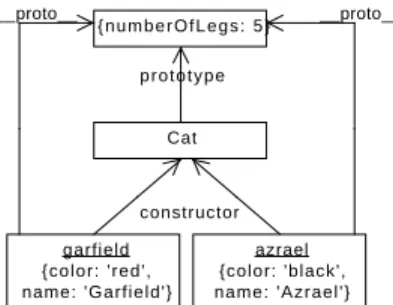
Constructors structure object creation and initialize properties. Each time an object is created, a different copy of each attribute specified in the constructor is assigned to the object. When sharing is needed between objects, the shared prop-erties must be defined in the constructor’s prototype as can be seen in Example 4.1 and Figure 4.1.
var Cat = function (color, name) {
this.color = color;
this.name = name || 'default name'; }
Cat.prototype.numberOfLegs = 4;
var garfield = new Cat('red', 'Garfield'); var azrael = new Cat('black', 'Azrael');
garfield.color; // answers 'red'
garfield.numberOfLegs; // answers 4
azrael.color; // answers 'black'
azrael.numberOfLegs; // answers 4
Cat.prototype.numberOfLegs = 5;
garfield.numberOfLegs; // answers 5
azrael.numberOfLegs; // answers 5
azrael.color = 'grey';
garfield {color: 'red', name: 'Garfield'} Cat { n u m b e r O f L e g s : 5 } prototype __proto__ azrael {color: 'black', name: 'Azrael'} __proto__ constructor
Figure 4.1: Sharing a property between objects (see Example 4.1)
azrael.color; // answers 'grey'
Example 4.1: Sharing a value between objects through their prototype (see Figure 4.1)
When a new object is created by calling a constructor, its__proto__core prop-erty is initialized to the constructor’sprototype property value. In Example 4.2 we set the prototype of functionDogto be an object created from functionAnimal
(see Figure 4.2). Note that we have to set the constructor of the prototype to be the functionDog. Then when an object created from the function Dogis asked for a property that it does not define locally, the lookup is performed following the prototype chain (i.e.,, looking inside the__proto__core property value). Here the propertyisAnAnimal is found in the prototype ofDogwhich is an object created from theAnimalconstructor.
var Animal = function () { };
Animal.prototype.isAnAnimal = true; var animal = new Animal(); var Dog = function () {};
// The prototype of Dog is set to a new Animal,
// so that future Dog objects will inherit from Animal.prototype
Dog.prototype = new Animal();
// We need to manually change Dog.prototype.constructor so that // future Dog objects will have Dog as constructor
animal Animal constructor { i s A n A n i m a l : t r u e } prototype __proto__ Dog prototype { i s A D o g : t r u e } constructor __proto__ d o g __proto__
Figure 4.2: Prototypical inheritance (see Example 4.2)
// (instead of Animal).
Dog.prototype.constructor = Dog;
// All Dog objects must share this property
Dog.prototype.isADog = true; var dog = new Dog();
dog.isAnAnimal; // answers true
dog.isADog; // answers true
Example 4.2: Inheritance in JavaScript prototypical programming (see Figure 4.2)
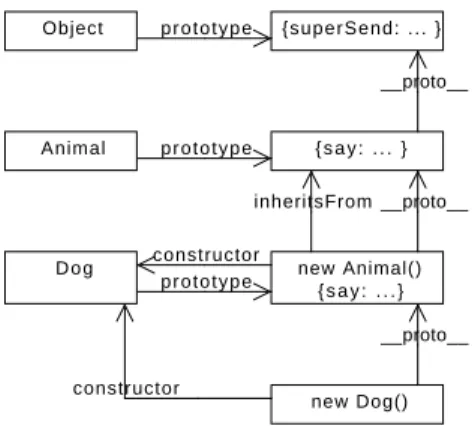
Accessing overridden functions. Other object-oriented languages have a message resend mechanism, often implemented as super sends. To perform super sends in JavaScript, the lookup must be explicitly forwarded to the prototype (see Exam-ple 4.3 and Figure 4.3).
// 'Object' being a function, we add a new method to all objects
Object.prototype.superSend = function (selector, args) {
// We use 'inheritsFrom' to reference the prototype and we search // the property in variable 'selector' from this prototype:
return this.inheritsFrom[selector].apply(this, args); };
var Animal = function () { };
Animal.prototype.say = function (string) { return 'hello ' + string;
Object prototype {superSend: ... } Animal prototype { s a y : . . . } Dog __proto__ new Animal() { s a y : . . . } inheritsFrom new Dog() constructor __proto__ __proto__ prototype constructor
Figure 4.3: Message resending – super sends (see Example 4.3)
var Dog = function () { };
Dog.prototype = new Animal();
// We add our own property to retain inheritance // without using the not standard __proto__
Dog.prototype.inheritsFrom = Dog.prototype.constructor.prototype;
Dog.prototype.constructor = Dog;
new Dog().inheritsFrom === new Dog().__proto__.__proto__; // answers true
Dog.prototype.say = function (string) {
return this.superSend('say',['wouf wouf']); };
new Dog().say("I'm a dog"); // answers 'hello wouf wouf' Example 4.3: Message resending – super sends (see Figure 4.3)
The dynamic capabilities of JavaScript allow the usage of this mechanism to extend existing objects like Arrays, Numbers, and Functions, through the addition of properties and methods to their prototype constructors.
4.2
Closures and ‘functional’ inheritance
We’ve previously shown an example of how to provide an inheritance-like re-lation in JavaScript using prototypes, allowing us to share properties and meth-ods between our objects. Unfortunately, the builtin inheritance mechanism of EC-MAScript 3 has several drawbacks: (1) it depends on many implementation details that could lead to several mistakes, (2) it does not provide any access protection
between objects, their prototypes, and the outer scope.
In Example 4.4 a JavaScript idiom appears showing how we can use closures to support visibility principles such as private attributes and inheritance [Dou08] instead of the typical prototype relationship we just described. The main idea is to create functions that create and initialize an object – declared asthatin the example – with default values and methods. The values set in the object’s properties will be public values. We can also define and use variables and functions with thevar
keyword to make them private to our object. To customize the initialization, we can also pass an object as a parameter to this function as a spec hash-table.
var animal = function (spec) {
// We take either the parameter or the empty object if // spec is null
spec = spec || {};
var that = {};
// Initialization
that.isAnAnimal = true;
// Private
var name = spec.name || 'unnamed';
// Public
that.getName = function() { return name;
};
return that; };
var dog = function (spec) {
spec = spec || {};
var that = animal(spec); // makes dog inherits from animal
that.isADog = true; return that; };
var aDog = dog({name: 'milou'});
aDog.isAnAnimal; // answers 'true'
aDog.isADog; // answers 'true'
aDog.getName(); // answers 'milou'
aDog.name; // answers 'undefined'
Chapter5. ECMAScript 5
We also present an overview of the features of ECMAScript 5 [ECM97, ECM11]. Released in June 2011, ECMAScript 5 defines the latest standarized version of the JavaScript language. This release includes improvements and clarifications compared to ECMAScript 4. In this section we propose a survey of two important aspects of ECMAScript 5: object creation and properties access. These aspects improve object encapsulation, giving a finer-grained object-property definition and thus improving security.
5.1
Object creation
ECMAScript 5 offers a new way to instantiate objects with the ability to specify the new object’s prototype and properties.
var objOld = new Object();
var objNew = Object.create(null); // new function from ECMAScript 5 // a.isPrototypeOf(b) checks if 'a' is in the __proto__
inheritance
// chain of b (i.e., b is derived from a)
Object.prototype.isPrototypeOf(objOld); // answers true
Object.prototype.isPrototypeOf(objNew); // answers false
objOld.toString; // answers a function
objNew.toString; // answers 'undefined'
Example 5.1: Creating an object with null as prototype
Example 5.1 shows how to create a new object named objNew that has no prototype and no inherited property.
When passed an argument,Object.createsets the__proto__property of the
ob-ject to the argument. As a result,new Object()is equivalent toObject.create(Object.prototype).
Object.createalso optionally accept a second argument that is an object whose properties serve to initialize the new object. In Example 5.2, the objectobjinherits all standard properties fromObject.prototypeand defines a new propertyfoowhose value is the string"hello".
var obj = Object.create(Object.prototype, {
foo: { writable: true, configurable: true, value: "hello" }, });
obj.__proto__ === Object.prototype; // answers true
obj.foo; // answers "hello"
Example 5.2: Creating an object with prototype and a property The keyswritableandconfigurableare described below.
5.2
Defining object properties
Security wise, ECMAScript 3 doesn’t have any concept of private properties.1 All object properties are publicly visible, inherited and modifiable at will. EC-MAScript 5 improves the situation by introducing a fine-grain protocol to define object properties.
Object.defineProperty is one of the core changes to JavaScript defined in
EC-MAScript 5. This function takes three parameters: the object on which the prop-erty is defined, a string (name of the new propprop-erty) and a descriptor object. The descriptor object can be a data descriptor or a getter/setter descriptor. A descriptor object can have the following optional keys:
• enumerable: iftrue, the property shows up during enumeration of the prop-erties of the receiver;
• configurable: iftrue, the property can be deleted, and the descriptor can be changed afterwards.
In case of an accessor descriptor, two keysgetandset can be used to define accessor methods to the property.
In case of a data descriptor, two keysvalueandwritablecan be used to respec-tively set an initial value and specify if the property can be written.
var dog = {};
Object.defineProperty(dog, 'name', {
enumerable: true,
configurable: false,
value: 'Pilou',
writable: false });
dog.name; // answers 'Pilou', the default value
dog.name = 'another name'; // tries to set a new value
dog.name; // answers 'Pilou' as the property is not writable
delete dog.name; // tries to remove the property from the object 1
dog.name; // answers 'Pilou' as the property is not configurable Example 5.3: Defining properties
Example 5.3 shows how to useObject.defineProperty. First an empty object
dogis created. A property’name’is added todogand set a default value of’Pilou’. This property is neither configurable nor writable. As a result, trying to change the value of the propertydog.nameor trying to delete it both fail.
Object.preventExtensions. ECMAScript 5 introduces two important functions
regarding object extensions: preventExtensionsand isExtensible, both available fromObject. As seen in Example 5.4preventExtensionstakes an object as argu-ment and prevents any further addition of properties. Existing properties may still be deleted though.isExtensibleis a testing function answering a boolean value that indicates whether properties can be added or not.
var dog = {};
Object.defineProperty(dog, 'name', {
enumerable: true,
configurable: false,
value: 'Pilou',
writable: false });
Object.isExtensible(dog); // answers true
Object.preventExtensions(dog);
Object.isExtensible(dog); // answers false
dog.age = 5; // tries to add a new property to 'dog'
dog.age // anwers undefined because 'dog' is not extensible Example 5.4: Preventing object extensions
ECMAScript 5 also introduces full immutability of objects throughObject.freeze, and can be tested withObject.isFrozen, and seen in Example 5.5.
var dog = {};
Object.defineProperty(dog, 'name', {
enumerable: true,
configurable: false,
value: 'Pilou',
writable: false });
Object.isFrozen(dog); // answers false
Object.isFrozen(dog); // answers true
dog.age = 5; // tries to add a new property to 'dog'
dog.age // anwers undefined because 'dog' is not extensible
delete dog.name // answers false
dog.name // answers 'Pilou'
Example 5.5: Object immutability
By adding the functions mentioned in this section (notablycreate, defineProp-erty, preventExtensionsandfreeze), ECMAScript 5 makes it possible for devel-opers to secure their objects.
Chapter6. Key Bibliography Elements
Here we present the key and limited articles that we encourage you to read if you want to get deeper into the semantics of JavaScript.
• Sergio Maffeis, John C. Mitchell, and Ankur Taly. An operational semantics for javascript. In Proceedings of the 6th Asian Symposium on Programming Languages and Systems, APLAS ’08, pages 307-325, Berlin, Heidelberg, 2008. Springer-Verlag. The paper presents a 30-page operational semantics, based directly on the JavaScript specification. The semantics covers most of JavaScript directly, but does omit a few syntactic forms. They discuss various differences between the standard and implementations.
• Arjun Guha, Claudiu Saftoiu, and Shriram Krishnamurthi. The essence of javascript. In Proceedings of the 24th European Conference on Object-Oriented Programming, ECOOP’10, pages 126-150, Berlin, Heidelberg, 2010. Springer-Verlag. In this article a core calculus is defined. Based on it, sev-eral aspects of JavaScript are described. Some badly designed features of Javascript are described.
• ECMAScript version 3.0 specification (188 pages).http://www.ecma-international. org/publications/files/ECMA-ST-ARCH/ECMA-262,%203rd%20edition,%20December% 201999.pdf
• ECMAScript version 5.1 specification (255 pages).http://www.ecma-international. org/publications/files/ECMA-ST-ARCH/ECMA-262%205th%20edition%20December% 202009.pdf
Chapter7. Conclusion
This deliverable has introduced an overall picture of JavaScript as defined in EC-MAScript 3 and ECEC-MAScript 5, focusing on security aspects of its semantics. We offered a detailed review of JavaScript subtle points concerning security and appli-cation predictability.
We have seen that thewindowobject is key to data privacy protection. Never-theless, we have pointed out how JavaScript exposeswindowto the entire environ-ment constraining any security approach.
We have described scoping issues and the possible resulting security leaks. For example, the thispseudo variable is bound to a different object depending on the way the function invocation expression is written (syntactic shape of the function invocation in which thisis used). This dynamic behavior can be exploited by an attacker to leak private objects. As another example, the fact that JavaScript lifts variable definitions inside functions (i.e., moves to the top) leads to unsuspected variable shadowing, dramatically lowering behavior predictability.
In the last chapter, we have proposed a description of ECMAScript 5 features regarding object declaration and property access that improve encapsulation, there-fore securing exposure of objects.
In the following deliverable, we will leverage this knowledge, detailing existing sandboxing techniques, and for each of them, we will review its advantages and weaknesses in different contexts.
Bibliography
[Dav06] Flanagan David. JavaScript: The Definitive Guide. O’Reilly Media, Inc., fifth edition, 2006.
[Dou08] Crockford Douglas. JavaScript: The Good Parts. O’Reilly Media, Inc., 2008.
[ECM97] ECMA, editor. ECMAScript Language Specification. European Com-puter Machinery Association, June 1997.
[ECM11] ECMA, editor. ECMAScript Language Specification version 5. Euro-pean Computer Machinery Association, July 2011.
[GHJV95] Erich Gamma, Richard Helm, Ralph Johnson, and John Vlissides. Design Patterns: Elements of Reusable Object-Oriented Software. Addison-Wesley Professional, 1995.
[GSK10] Arjun Guha, Claudiu Saftoiu, and Shriram Krishnamurthi. The essence of javascript. In Proceedings of the 24th European confer-ence on Object-oriented programming, ECOOP’10, pages 126–150, Berlin, Heidelberg, 2010. Springer-Verlag.
[MFF01] Lynette I. Millett, Batya Friedman, and Edward Felten. Cookies and web browser design: toward realizing informed consent online. In Proceedings of the SIGCHI conference on Human factors in comput-ing systems, CHI ’01, pages 46–52, New York, NY, USA, 2001. ACM. [MMT08] Sergio Maffeis, John C. Mitchell, and Ankur Taly. An operational semantics for javascript. In Proceedings of the 6th Asian Symposium on Programming Languages and Systems, APLAS ’08, pages 307– 325, Berlin, Heidelberg, 2008. Springer-Verlag.
[Mog02] Jeffery C. Mogul. Clarifying the fundamentals of http. In Proceedings of the 11th international conference on World Wide Web, WWW ’02, pages 25–36, New York, NY, USA, 2002. ACM.
[MvD07] Ali Mesbah and Arie van Deursen. Migrating multi-page web ap-plications to single-page ajax interfaces. In Proceedings of the 11th European Conference on Software Maintenance and Reengineering, CSMR ’07, pages 181–190, Washington, DC, USA, 2007. IEEE Com-puter Society.
[RHBV11] Gregor Richards, Christian Hammer, Brian Burg, and Jan Vitek. The eval that men do: A large-scale study of the use of eval in javascript applications. In Proceedings of Ecoop 2011, 2011.