Publisher’s version / Version de l'éditeur:
Proceedings 15th International Conference on Port and Ocean Engineering under Arctic Conditions, POAC'99, 1, pp. 454-463, 1999-08
READ THESE TERMS AND CONDITIONS CAREFULLY BEFORE USING THIS WEBSITE. https://nrc-publications.canada.ca/eng/copyright
Vous avez des questions? Nous pouvons vous aider. Pour communiquer directement avec un auteur, consultez la première page de la revue dans laquelle son article a été publié afin de trouver ses coordonnées. Si vous n’arrivez pas à les repérer, communiquez avec nous à [email protected].
Questions? Contact the NRC Publications Archive team at
[email protected]. If you wish to email the authors directly, please see the first page of the publication for their contact information.
NRC Publications Archive
Archives des publications du CNRC
This publication could be one of several versions: author’s original, accepted manuscript or the publisher’s version. / La version de cette publication peut être l’une des suivantes : la version prépublication de l’auteur, la version acceptée du manuscrit ou la version de l’éditeur.
Access and use of this website and the material on it are subject to the Terms and Conditions set forth at
Load attenuation through grounded ice rubble at Tarsiut Island
Timco, Garry; Wright, B.
https://publications-cnrc.canada.ca/fra/droits
L’accès à ce site Web et l’utilisation de son contenu sont assujettis aux conditions présentées dans le site LISEZ CES CONDITIONS ATTENTIVEMENT AVANT D’UTILISER CE SITE WEB.
NRC Publications Record / Notice d'Archives des publications de CNRC:
https://nrc-publications.canada.ca/eng/view/object/?id=aeb51a2e-394c-4e9f-8e6b-448f49a59c5f https://publications-cnrc.canada.ca/fra/voir/objet/?id=aeb51a2e-394c-4e9f-8e6b-448f49a59c5f
Proceedings 15th International Conference on Port and Ocean Engineering under Arctic Conditions, POAC’99, Vol. I, pp 454-463, Helsinki, Finland, August 23-27, 1999.
POAC 99
LOAD ATTENUATION THROUGH GROUNDED ICE RUBBLE AT TARSIUT ISLAND
G.W. Timco* and B.D. Wright**
*Canadian Hydraulics Centre National Research Council Ottawa, Ont. K1A 0R6 Canada
**B. Wright and Associates Calgary, Al., Canada
ABSTRACT
The Tarsiut Caisson Retained Island (CRI) was the first caisson island used for exploratory drilling in the Canadian Beaufort Sea. During the winter of 1982/83, it was used as a test platform to measure ice loads on Beaufort Sea structures, as part of the Tarsiut Ice Research Program (TIRP). The Tarsiut CRI was a hybrid sand and concrete-caisson structure that was approximately 100 m wide. It was deployed on a large sand berm in a relatively shallow water depth of 20 m. During the TIRP program, a large grounded rubble field formed around the CRI. A number of different parameters were measured throughout the winter as part of TIRP, including the ice loads, ice conditions, and general movement of the ice. In the spring, a number of strain-measuring devices were used to measure the strains in the ice sheet surrounding the grounded rubble field. From this information, loads could be determined both on the outer edge of the grounded rubble field and at the caisson structure itself. There were a few significant ice-loading events during this particular deployment. In all cases, the ice load directly measured on the caisson was substantially lower than the load on the outer edge of the grounded rubble field surrounding it.
This paper presents a brief overview of the test program and the measuring systems at Tarsiut. Three significant ice-loading events are described in detail and the attenuation of the ice load through the grounded ice rubble is described. It is seen that the grounded ice rubble acted as a protective barrier. The average global load was attenuated by more than 60% due to the presence of the rubble. The peak global load was attenuated by 85%.
INTRODUCTION
Tarsiut Island was the first caisson-type structure used in the Arctic. Compared to later structures such as the Molikpaq or SSDC, it was a shallow-water caisson structure. Gulf Canada Resources Ltd. operated this structure and drilled the Tarsiut N-44 well in 1981 and 1982. During the winter of 1982-83, it was left on-site and used as a test platform to
study ice interaction with a wide offshore structure. This project was known as the Tarsiut Island Research Program (TIRP).
The structure consisted of four individual concrete caissons. These caissons were floated to the drilling site and ballasted down with sand to form a square. They were placed on top of a very large sand berm that had been previously built on the site. Once the caissons were placed and connected together using steel gates, the inner core was filled with dredged material. This structure was not regarded as a "mobile" structure since the difficulty of resetting and connecting four caissons limited its mobility. The structure was about 100 m across at the water line and had a vertical outer surface. The caissons were 10 m high and rested on a berm that came to within 6 m of the water surface. The structure was extensively instrumented to measure ice loads both for operational safety reasons and for future design. The papers by Pilkington et al. (1983) and DePaoli et al. (1983) provide more details on the Tarsiut structure and ice conditions.
INSTRUMENTATION
Instrumentation comprised sensors to measure loads on the outer face, strain gauges embedded in the concrete and geotechnical sensors in the foundation and core (Graham et al., 1983). During the winter of 1982/83, there was no drilling activity on the structure but it was left in place and used as a research platform. The island was manned with typically about 6 people, and measurements of ice loads, ice failure behavior and ice movements were made on a systematic basis. A large grounded rubble field formed during the freeze-up period and completely surrounded the island (see Figure 1). The large size of the rubble field was a direct result of the very large sand berm that supported the structure. It was on the order of 50 m to 150 m radius from the edge of the caisson structure (see Figure 1). This grounded rubble field was itself surrounded by landfast ice throughout the winter.
Figure 1 Overhead view of Tarsiut caisson-retained island (CRI) showing the grounded rubble field surrounding the island (photo taken on March 2, 1983).
100 m N Tarsiut Island 21 MEDOF panels BP strainmeters
Figure 2 Illustration of the instrumentation during the TIRP project.
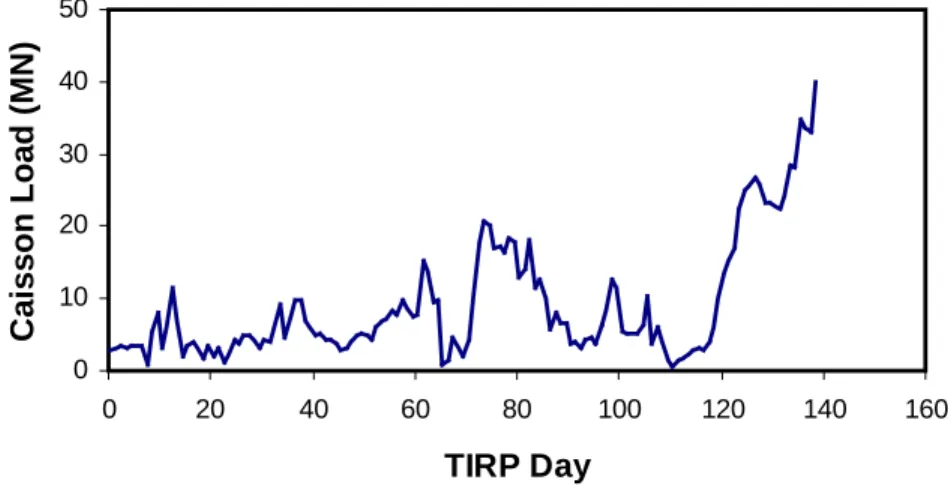
The ice load measurements on the caisson were primarily obtained from the vector summation of loads on 21 MEDOF panels that circled the structure (see Figure 2). In addition, a few panels were placed further out in the grounded rubble field. Empirical methods were used to account for the varying hardness of ice with depth. Baseline drift was corrected by using manual readings made daily. Figure 3 shows the calculated load on the Tarsiut caisson throughout the 1982-83 season.
0 10 20 30 40 50 0 20 40 60 80 100 120 140 160 TIRP Day C a isson Load ( M N )
Figure 3 Caisson Load on Tarsiut during the TIRP project. November 1, 1982 is TIRP Day 0.
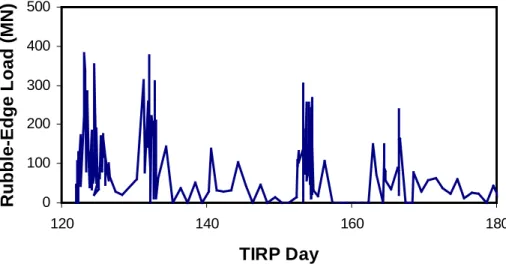
During March to May, measurements were made by British Petroleum (BP, 1983) around the grounded rubble field to provide information on the local strain and strain rates in the adjacent ice sheet. BP strainmeters were used to surround the grounded rubble field (see Figure 2). Based on this information, and assuming a constitutive relationship for ice, the global loads were inferred on the edge of the rubble field (BP, 1983). The measured loads on the edge of the rubble field are shown in Figure 4 for the full time frame in which measurements were made.
Since both the load on the edge of the rubble and the load on the caisson are known, it is possible to infer some quantitative information on the attenuation of the load through the grounded rubble field. This issue has been discussed in the literature in a qualitative sense (Sayed 1989; Croasdale et al. 1995), but the present analysis should provide some quantitative information. 0 100 200 300 400 500 120 140 160 180 TIRP Day Rubble-Edge Load (MN)
Figure 4 Global load on the edge of the rubble field. March 1, 1983 is TIRP day 120.
ICE LOAD EVENTS
There were a number of different loading events seen over the 2 years that Tarsiut Island was deployed and monitored in the Beaufort Sea. For most events, however, the information is not complete and various assumptions were required to calculate the load. In this paper, 3 Events are presented. Only a few data points per day were fully analyzed during a loading event and the time-series signature of the loading event is incomplete. It should be borne in mind, however, that these Events represent the loads reported on the first wide offshore structure deployed in the deeper waters of the Beaufort Sea in heavy first-year ice conditions.
March 6, 1983
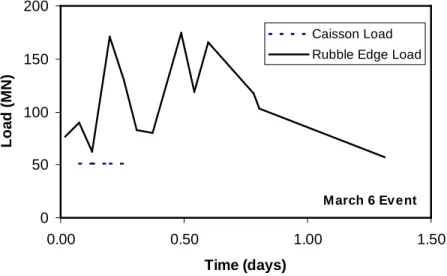
The first Event occurred on March 6, 1983 and lasted about 5 hours. Level ice of 1 to 1.3 m thickness slowly moved against the large grounded rubble field surrounding the caisson. The width of interaction was 300 m. Level ice failed forming 2 new ridges enclosing a wedge of ice 1.25 m thick. The more easterly ridge was 150 m long and was
formed by lateral shear of 1 m thick ice. The sail height was 1 m. The ice in the grounded rubble field moved towards the east causing a series of parallel cracks to develop within the rubble field. Figure 5 shows a sketch of the Event and Figure 6 shows the time-series record of the inferred ice load on the caisson as well as the rubble edge. It is clear that the load on the edge of the rubble is significantly larger than that observed on the caisson. 100 m Crack about 10 m long Rough ice Cracks 1 - 3 cm wide Tidal crack opens 1.2 m Flooding in depression caused by buckling Buckling Tarsiut Island x x x x x x x x x x x x x x x x x x x x x x x x x x x x x x x x x x x x x x x x N Ice movement direction
Figure 5 Ice conditions during the March 6, 1983 Event.
M arch 6 Ev ent 0 50 100 150 200 0.00 0.50 1.00 1.50 Time (days) Loa d (MN) Caisson Load Rubble Edge Load
Figure 6 Global load on the caisson and outer edge of the rubble field for the March 6, 1983 Event.
April 2-4, 1983
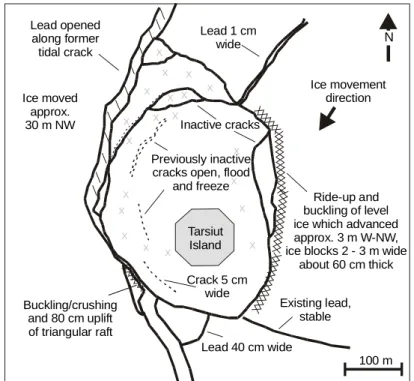
The second Event lasted approximately 3 days, from April 2 to 4, 1983. Level ice slowly encroached on the large grounded rubble pile from the NE. Movement rates were very low. The maximum load occurred with creep failure at a rate of 2x10⁻⁵ m/s. Ice on the west side of the island moved about 30 m west northwest forming a lead which followed the tidal crack on the west side. The ice to the NE, E, SE and S advanced 3 m WNW failing primarily in creep and bending by riding up the rubble pile. Ice failure with a considerable amount of crushing occurred on April 4, resulting in a load decrease. Figure 7 shows a sketch of the Event and Figure 8 shows the time-series record of the inferred ice load on both the caisson and the outer edge of the rubble field. Note that there were a number of load peaks on the outer edge of the rubble, but the loads on the caisson did not follow these load fluctuations proportionally. Also, similar to the previous Event, the loads on the outer edge of the rubble are much higher than those experienced by the caisson. 100 m Tarsiut Island Buckling/crushing and 80 cm uplift of triangular raft Existing lead, stable Inactive cracks Lead 1 cm wide Lead opened along former tidal crack Ice moved approx. 30 m NW Crack 5 cm wide Previously inactive
cracks open, flood and freeze
Ride-up and buckling of level ice which advanced approx. 3 m W-NW, ice blocks 2 - 3 m wide
about 60 cm thick x x x x x x x x x x x x x x x x x x x x N Lead 40 cm wide Ice movement direction
Figure 7 Ice conditions during the April 2-4, 1983 Event.
April 14-17, 1983
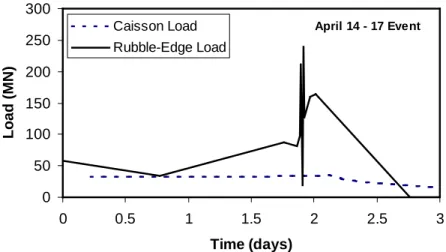
The third Event occurred between April 14 to 17, 1983, in which there was steady northwesterly advance of level ice against the large grounded rubble field. Movement rates were on the order of 1 m/day, indicating a thermal event. The caisson pressure panels responded to a cyclic series of peak loads that corresponded to daytime temperature highs or high tides. Slow creep buckling occurred in the floating ice in contact with the rubble field in the E, SE and SSE. This caused pressure ridges of 2-3 m height from ice 2-2.5 m thick. Some flood pools formed. Figure 9 shows a sketch of the
Event and Figure 10 shows the time-series record of the inferred caisson load and the load at the edge of the rubble. These time-series traces show the same behaviour as those observed for the other 2 Events.
April 2 -4 Event 0 50 100 150 200 250 300 350 0.5 1 1.5 2 Time (days) Load ( M N) Caisson Load Rubble-Edge Load
Figure 8 Global load on the caisson and outer edge of the rubble field for the April 2-4, 1983 Event. 100 m Tarsiut Island Buckling and ridge formed in thin ice Rubble formed by buckling and ride-up Compression ridge Flooding occurs along
entire tidal crack Inactive cracks
Compression ridges in 40 cm ice, height less
than 1 m Narrow tension cracks Frozen lead Level ice moved about 80 cm NW Extension of existing crack Compression ridge initiated by creep N Ice movement direction x x x x x x x x x x x x x x x x x x
April 14 - 17 Event 0 50 100 150 200 250 300 0 0.5 1 1.5 2 2.5 3 Time (days) Loa d ( M N ) Caisson Load Rubble-Edge Load
Figure 10 Global load on the caisson and outer edge of the rubble field for the April 14-17, 1983 Event.
DISCUSSION
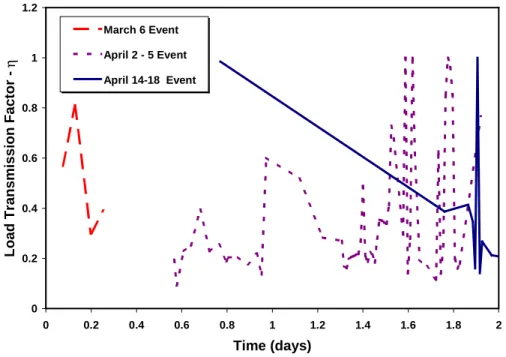
The comparison of the loads measured at the caisson with the load on the edge of the rubble field clearly shows that there is significant load attenuation. Further, it is clear that the load fluctuations on the outer edge of the rubble are not transmitted to the caisson. It is possible to quantify the load attenuation from the information available from these 3 Events. For this, a “Load Transmission Factor”, η, is defined as:
Edge Rubble at Load Caisson on Load = η
A low value for η implies that there is a large attenuation of the load due to the ice rubble and very little of the load gets transmitted to the structure. The values for η were calculated throughout the whole ice-loading event for all three Events. Figure 11 shows the calculated value for the 3 Events described in this paper. It should be mentioned that there were a few instances where η >1, when both the outer edge load and caisson load were small. Since these values represent a situation where the loads are low and division by a small denominator can inflate the value of η, these values were capped at a value of
η = 1. The average value of the Load Transmission Factor during the three Events was
η = 0.38. This means that, on average during the loading Events, only 38% of the load applied to the edge of the rubble was transmitted to the Tarsiut caisson.
Since the load on the caisson did not mirror the changes in the applied load at the edge of the rubble, the Load Transmission Factor for the peak load would be considerably lower than the value calculated during the whole Event. By taking the peak edge load and the corresponding load on the caisson, it is possible to determine the maximum load attenuation. These values are 0.30, 0.09 and 0.14, for each of the 3 Events. This means
that, for the 3 Events discussed here, only 30%, 9% and 14%, respectively of the peak load applied at the edge of the ice rubble was transmitted to the Tarsiut caisson structure.
0 0.2 0.4 0.6 0.8 1 1.2 0 0.2 0.4 0.6 0.8 1 1.2 1.4 1.6 1.8 2 Time (days) Load Tr ansmission Factor - η March 6 Event April 2 - 5 Event April 14-18 Event
Figure 11 Load Transmission Factor (η) calculated for all 3 Events. The average value during the Events was η = 0.38.
SUMMARY
This analysis of the loading on the Tarsiut caisson has provided some quantitative information on the ability of grounded rubble to protect an offshore structure. Three significant loading Events have been described in detail with information on the ice conditions as well as the loads on the edge of the grounded rubble and the caisson. The analysis has shown:
• The grounded rubble acts as a protective buffer from the advancing ice sheets;
• The rubble pile causes the ice action and failure to take place at the edge of the rubble and away from the caisson;
• This protective action limits overtopping of ice on the structure;
• The rubble pile shelters the caisson structure and effectively damps out any dynamics from the failing ice sheet;
• It appears that the load attenuation is rate dependent. The caisson experiences loads caused by slow changes in the applied load, but the higher frequency changes (even on the order of several hours) are effectively damped by the grounded rubble;
• For the large (50m to 150m radius) grounded rubble at Tarsiut, the attenuation of applied load was significant;
• During the 3 Events on Tarsiut, the average applied load was attenuated to approximately 40% due to the presence of the grounded ice rubble. However, for the
peak applied load, the attenuation is higher, such that only about 15% of the load was
ACKNOWLEDGEMENTS
The authors would like to thank Michelle Johnston and Ivana Skabova for assistance in preparing this paper.
REFERENCES
British Petroleum (BP) 1983. Total Ice Load Program, Tarsiut Island 1983 - Appendix D Total Load. BP New Technology Division Report, London, U.K.
Croasdale, K.R., Marcellus, R., Metge, M., Timco, G.W. and Wright, B.D. 1995. Overview of Load Resistance and Stability of Grounded Ice Rubble around Structures in Shallow Water. Proceedings 2nd Conference on Development of the Russian Arctic Offshore (RAO’95), pp 255-260, St. Petersburg, Russia.
DePaoli, S., Pilkington, R., Frosst, E. and McHenry, M. 1983. Field Observations around Tarsiut Island. Proceedings of 7th International Conference on Port and Ocean Engineering under Arctic Conditions Vol. III, pp. 97-109, Espoo, Finland.
Graham, B., Chabot, L. and Pilkington, R. 1983. Ice Load Sensors for Offshore Arctic Structures. Proceedings of 7th International Conference on Port and Ocean Engineering under Arctic Conditions Vol. IV, pp. 547 - 562, Espoo, Finland.
Pilkington, G.R., Blanchet, D., and Metge, M. 1983. Full Scale Measurements of Ice Forces on an Artificial Island. Proceedings of 7th International Conference on Port and Ocean Engineering under Arctic Conditions Vol. IV, pp. 818-834, Espoo, Finland.
Sayed, M. 1989. Transmissions of Loads through Grounded Ice Rubble. In 4th IAHR State-of-the-Art Report on Ice Forces, G.W. Timco, Ed., US CRREL Special Report 89-5, Hanover, N.H., USA.