Vous avez des questions? Nous pouvons vous aider. Pour communiquer directement avec un auteur, consultez la première page de la revue dans laquelle son article a été publié afin de trouver ses coordonnées. Si vous n’arrivez pas à les repérer, communiquez avec nous à [email protected].
Questions? Contact the NRC Publications Archive team at
[email protected]. If you wish to email the authors directly, please see the first page of the publication for their contact information.
https://publications-cnrc.canada.ca/fra/droits
L’accès à ce site Web et l’utilisation de son contenu sont assujettis aux conditions présentées dans le site LISEZ CES CONDITIONS ATTENTIVEMENT AVANT D’UTILISER CE SITE WEB.
READ THESE TERMS AND CONDITIONS CAREFULLY BEFORE USING THIS WEBSITE. https://nrc-publications.canada.ca/eng/copyright
NRC Publications Archive Record / Notice des Archives des publications du CNRC : https://nrc-publications.canada.ca/eng/view/object/?id=fae6927d-092c-4f00-bbff-5eae0a17f023 https://publications-cnrc.canada.ca/fra/voir/objet/?id=fae6927d-092c-4f00-bbff-5eae0a17f023
NRC Publications Archive
Archives des publications du CNRC
Access and use of this website and the material on it are subject to the Terms and Conditions set forth at
Teaching fire science and fire protection engineering to building
engineering students
Teaching fire science and fire protection engineering
to building engineering students
Torvi, D.A.
A version of this paper is published in / Une version de ce document se trouve dans :
inFIRE Conference, Ottawa, Ont., May 2000, pp. 1-11
www.nrc.ca/irc/ircpubs
Teaching Fire Science and Fire Protection Engineering to Building Engineering Students1
David Torvi, Ph.D., P.Eng. Research Officer Fire Risk Management Program Institute for Research in Construction National Research Council of Canada
Ottawa, ON K1A 0R62
Abstract:
In order to train fire protection engineers, many complete undergraduate and graduate programs in fire science have been developed. However, there are few credit courses that provide a broad overview of fire protection engineering for students in other fields of engineering. This paper describes an introductory course in fire science and fire protection engineering that was developed for building engineering students at Concordia University in Montreal. The process for selecting material for this particular course is discussed, along with the importance of videotape, fire test data, laboratory tours and the internet. The roles of fire libraries and information centres are also discussed, as well as suggestions as to how to improve the course in the future.
Introduction:
Concordia University in Montreal, offers the only accredited program in Canada in Building Engineering. Undergraduate and graduate students take courses in areas such as thermal performance of the building envelope, HVAC systems, energy efficiency, lighting and construction management. Traditionally, a course in fire and smoke control in buildings, BLDG 465/665, has also been offered to senior undergraduate and graduate students; however, the department has not been able to offer this course for several years, since the retirement of the faculty member who taught it. During the summer of 1999, the department approached the Institute for Research in Construction at the National Research Council of Canada, for assistance in offering the course, who in turn approached the author to teach this course as a part-time instructor.
In preparing for the course, information on existing courses in fire science and fire protection engineering was gathered from a number of sources, including the internet. It became apparent that while there are some complete undergraduate and graduate programs in this area, there are few credit courses that provide a broad overview of fire protection engineering, especially for students who have had little or no experience in fire science and fire protection engineering. The instructor also had to take into account the varying backgrounds of the students: some were taking classes part-time in addition to their regular jobs, while others were full-time undergraduate and graduate students. Some had undergraduate degrees in engineering, while others were architects by training.
1
Presented at the International Network for Fire Information and Reference Exchange (inFire) Conference, Ottawa, ON, May 11, 2000.
2
Address for correspondence after July 1, 2000 - Department of Mechanical Engineering, University of Saskatchewan, 57 Campus Dr., Saskatoon, SK S7N 5A9
In this paper, fire protection engineering courses and programs currently offered in Canada and other countries, will be briefly described. The process for selecting material for this particular course will then be discussed, along with the final course syllabus and methods of evaluation used. The importance of videotape, fire test data, laboratory tours and the internet will be discussed, including the role of fire libraries and information centres. Results of student and instructor evaluations and suggestions as to how to improve the course in the future are also discussed.
Other Fire Science Courses and Programs
An increasing number of complete undergraduate or graduate programs in fire protection engineering are offered at universities around the world. When the author began to prepare for this course, he first consulted the internet and other sources for information on these programs. Well-established programs include those at Lund University in Sweden, University of Edinburgh, University of Maryland, Worcester Polytechnic Institute, Oklahoma State University, Victoria University of Technology, University of Leeds, University of New Haven and University of California at Berkeley. Information on these programs is available on each of their websites. Representatives from some of these programs published an article in 1995 that defines the general areas of engineering and specific courses, which should be included in fire protection engineering programs [1]. The article also discusses some of the possible career paths for graduates of these programs and some of the unique challenges that face educators in these programs. Since this paper was published, the Education Subcommittee of the International Association of Fire Safety Science has developed a website with links to fire protection engineering courses and programs, as well as pooled material that can be used by instructors at other universities (http://www.brand.lth.se/iafss-es/iafss-es.html).
In terms of Canadian fire courses and programs, a Master’s program in Fire Protection Engineering began in 1994 at the University of British Columbia. Part-time and full-time
graduate students took courses in combustion, fire dynamics, fire suppression and alarm systems, and other areas of interest to fire protection engineering. While this program has now been phased out, a series of one to two day workshops, which began as part of the program, is continuing. These workshops have been designed to allow practicing engineers and building officials to learn about the fundamentals of fire protection engineering, in preparation for the introduction of objective and performance-based building codes in Canada. A recent workshop in February 2000 included such topics as performance-based building codes, fire dynamics, computer fire models, and smoke control in buildings. Future workshops are planned on topics such as fire resistance calculations, human behaviour and the use of specific fire models. Videos and copies of the proceedings are also being produced to allow the content of the workshops to be disseminated to a wider audience. More information on past and future workshops can be found on the organization’s website (http://www.global-window.com).
In Canada, there are also a few single courses that are offered in fire protection engineering. One of these courses is a graduate course in the Department of Civil and
Environmental Engineering at Carleton University in Ottawa. This course is taught by Dr. Jim Mehaffey, who was the founder of the UBC program. The course is intended to provide an introduction to the fire science and engineering principles that can be used to
conduct performance-based design of fire protection systems. Topics such as chemistry and heat transfer are discussed, along with ignition, fire growth and smoke movement. Some of the students in the class are practicing engineers in the fire protection area. Dr. Mehaffey’s goal is to
eventually offer other courses in the fire protection engineering area at Carleton, as demand warrants.
Another Canadian course is offered by Dr. Beth Weckman at the University of Waterloo’s Department of Mechanical Engineering. Fire Safety Engineering is a senior undergraduate course, which covers topics such as heat transfer, combustion, flammability, fire dynamics, smoke movement, suppression, detection and modelling. The department also has a fire research group, which is involved in firefighter training and fire modelling. Across Canada, there are a few other academics in engineering departments who are involved in fire research, the results of which are often discussed in other engineering courses, such as heat transfer and combustion. One of these academics is Dr. Doug Dale, who has conducted research at the University of Alberta in thermal protective clothing and estimating heat fluxes during fires and explosions.
Professional associations are also involved in putting on workshops and short courses throughout North America. Many of the provincial associations to which engineers in Canada belong to are in the process of implementing continuing education requirements for their members. Technical societies, such as the Society of Fire Protection Engineers (SFPE), have been offering an increased number of opportunities for engineers to learn about the fundamentals of fire protection engineering. For example, in 2000, SFPE will put on seminars and short courses in fire modelling, sprinkler and fire alarm design, smoke control, and performance-based design. Other groups have also introduced similar programs for practicing engineers. For example, the National Fire Protection Association (NFPA) has changed the format of educational sessions at their annual meeting, so that educational sessions feature relatively long presentations (e.g., 60 to 90 minutes), for which participants receive continuing education units.
Background of the Students in the Course
There were 27 students registered for the Concordia University course: 15
undergraduate and 12 graduate students. One of the graduate students audited the course, while one of the undergraduate students was a visiting student from another university in Montreal. All of the undergraduate students were in Engineering, and some of the graduate students had
Engineering degrees. Therefore, these students had some background in heat transfer, fluid dynamics and other topics of importance to fire science. Some of the graduate students had completed undergraduate degrees in architecture, and thus had more limited background in heat transfer, fluid dynamics and other important topics. None of the students had extensive
background in combustion or chemistry.
Many of the graduate students in the course were taking graduate courses part-time in addition to their regular jobs. These students were able to bring their real-world experience into the classroom, which enriched the experience for everyone. They also had very good suggestions as to material which should be included in the course. For
example, some of the students who were consulting engineers were very interested in learning how to provide fire protection for structural members in the buildings that they were designing.
There was one deaf student in the class. The university supplied someone to translate the lectures into sign language, and to help the student ask the instructor questions. The translator would also arrange to meet the student and the instructor during office hours, if the student needed help with the course. The student found that they needed to obtain a copy of the
course notes after each lecture, as it was sometimes difficult to follow the translator and to keep up with the notes that were being written by the instructor.
Selecting Material for the Course
In reviewing information on other fire protection engineering courses and programs, it became apparent that while there are some complete undergraduate and graduate programs in this area, there are few credit courses that provide a broad overview of fire protection engineering. Many of the courses that are offered are short courses from professional associations, and often these courses are intended for those who are in the fire protection engineering area. In addition, the students in this class had little or no experience in fire science and fire protection
engineering, and various technical backgrounds. Therefore, while it was useful to review what had been done at other universities, the course that was developed here had to be customized to meet the needs of the department and the students. While the general areas that were covered during the course were similar to other courses, the emphasis placed on each was different, as was the level of detail to which individual topics were covered. In the subsequent sections of this paper, the overall objectives for the course are described, along with the specific topics that were covered.
Course Objectives
The following overall objectives were communicated to the students in the course syllabus:
“In general, students will learn the basics of fire science, including important theory from heat transfer, fluid mechanics, themodynamics and other fields. Students will learn how to use simple fire models to design fire protection systems for buildings, such as sprinklers, detectors and building construction features. They will also learn about the main fire test methods in use today, and how to analyze data from these tests.”
In addition to these overall objectives, the students were provided with a list of 25 specific objectives for the course (Table 1). The lectures were then based on providing the students the information to meet these specific objectives. The assignments and tests were designed to allow the students the opportunity to prove to the instructor that they had met all of the specific objectives for the course, when the instructor was preparing the students’ grades for the course.
Table 1 – Specific Objectives for Students in BLDG 465/665
Specifically, upon successful completion of this course, students will be able to:
1. Define fire protection engineering and provide examples of areas in which fire protection engineers work.
2. Explain the differences between the roles of the National Building Code and National Fire Code of Canada.
3. Explain the differences between prescriptive, and performance or objective-based building codes.
4. Compare fire safety in Canada with other countries in the world, based on fire statistics. Discuss the importance of public fire safety education.
5. Locate sources of useful and reliable information on fire science in the technical literature and on the internet.
6. Describe the three sides of the fire triangle. Relate the fire triangle to fire suppression. 7. Use simple chemical equations to describe combustion. Discuss the differences between
these simple models and actual combustion chemistry. 8. Calculate flammability limits for fuels.
9. Explain the difference between pre-mixed and diffusion flames, and provide some practical examples of each.
10. Calculate the heat release rate in a fire using oxygen consumption calorimeter data. 11. Calculate the adiabatic flame temperature for a fuel, and discuss the differences between
these temperatures and actual flame temperatures.
12. Describe each of the three modes of heat transfer in a fire. Perform steady-state and transient heat transfer calculations related to fire.
13. Calculate the effects of fire on people using simple models. 14. Discuss important issues in the area of human behaviour in fires.
15. Calculate the required spatial separation between buildings to prevent fire spread. 16. Describe the main types of computer fire models in use today, and provide examples of
each type.
17. Describe the main stages in a compartment fire. Define flashover, and calculate the time required for a room to go to flashover using simple models.
18. Describe the main fire tests in use today, and their strengths and weaknesses. Discuss how results from these tests can be used in practice. Identify the main fire test standard organizations.
19. Define fire resistance rating. Use simple models to relate fire resistance ratings to estimate expected times to failure in actual fires.
20. Perform fire plume calculations to determine quantities such as temperatures and flame heights. Use these calculations to predict the activation time of sprinklers and detectors in a room.
21. Calculate the expected time required for piloted ignition of different solid materials. 22. Calculate the time-dependent heat release rate for materials using a t2 fire model. Use
these heat release rate calculations to estimate temperatures and heat fluxes in a compartment.
23. Discuss strategies for smoke movement in buildings and perform simple design calculations.
24. Discuss the role of the fire service in Canada, particularly in building design and operation. 25. Discuss the importance of protective clothing in an industrial setting.
Course Text and Other References
An Introduction to Fire Dynamics by Dougal Drysdale [2] was selected as the text for
this course. The second edition of this book had just come out, which included recent
developments in research and practice. While some of the discussion in the book was at a higher level than this particular class, it was thought that the book would serve as a good reference for those who may enter the fire protection engineering field in the future. As well, as it is
sometimes difficult to obtain fire science references in libraries where there is no fire protection engineering program, having a copy of the textbook gave the students at least one additional source of information beyond the course notes, which were designed to be self-contained. For example, although the SFPE Handbook of Fire Protection Engineering [3] was recommended to the students as an additional source of information, most students did not have access to this reference, as it was not in the university library’s collection.
Additional references for specific topics were also provided throughout the course. For example, the instructor prepared additional background information on fire testing and spatial separation calculations, which is not covered extensively in the course text. The instructor also encouraged the students to use the increasing number of excellent resources available on the internet. To start the students along this path early in the course, their first assignment was to find and rate 10 fire-related websites. The instructor then distributed a list of the students’ choices of “hot” sites when handing back the first assignment. As more students and practicing engineers become interested in fire protection engineering, on-line information will become increasingly important, especially for those who do not have regular access to the collections available at universities and institutes who conduct fire-related research.
Course Structure and Outline
Course lectures were held once a week, from 5:30 to 8:00 p.m., at Concordia’s campus in downtown Montreal. The department provided space in a part-time instructor’s office so that office hours could be scheduled from 3:00 to 5:00 pm, the afternoon of the lecture. The
instructor also used the office earlier in the afternoon for lecture preparation, during which time students would often drop in with their questions. As the instructor was only in Montreal one day a week, students were also encouraged to contact the instructor through electronic mail, if they had questions about the course. The instructor promised to try to answer any email messages received within 24 hours.
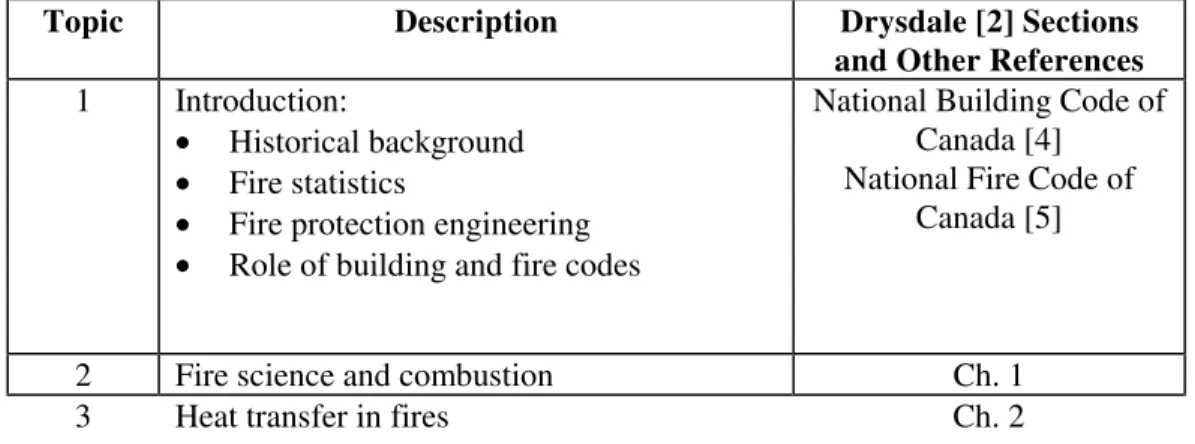
The specific topics covered in the course are listed in Table 2. Besides the regular lectures, a tour of NRC’s fire test facilities was scheduled. The students travelled in the morning by bus 200 km to Ottawa, where they were given a tour of NRC fire test facilities in Ottawa, and a guest lecture by Dr. Guylene Proulx, an NRC researcher in the area of human behaviour in fire. The students then travelled to NRC’s full-scale fire test facility in Almonte, ON, before returning home to Montreal that evening. During the visit, the group was able to witness one fire
Table 2 – Topics Covered in BLDG 465/665
Topic Description Drysdale [2] Sections
and Other References
1 Introduction:
• Historical background
• Fire statistics
• Fire protection engineering
• Role of building and fire codes
National Building Code of Canada [4]
National Fire Code of Canada [5]
2 Fire science and combustion Ch. 1
Discussion of the Course
The students generally felt that this was a very interesting course. They particularly enjoyed the tour of NRC’s facilities. The instructor found that the students were enthusiastic about the area of fire protection engineering, which many of them were being exposed to for the first time. While there were some problems associated with the instructor only being on campus one day a week, generally the students and instructor were able to work around this. Certainly the use of electronic mail allowed students to ask the instructor questions and to hand in their work if they could not make a given class. In the past, students may have been reluctant to try to get a hold of an instructor in another city if that meant a long distance phone call during the regular workday.
Having access to fire test facilities and fire test data was very beneficial. As mentioned earlier, the students felt one of the best parts of the course was the fire test facility tour. It is difficult for the students to have an appreciation for fire testing, without such a tour (or at least photographs or video of tests), even if they have done laboratories in combustion courses, as most of these laboratories are related to engines. Despite advances in fire modelling, the experimental side of fire science remains very important. The ability to show the students comparisons of heat release rates predicted by engineering correlations with heat release rates measured in tests contributed to their understanding substantially.
As more students and practicing engineers become interested in fire protection engineering, on-line information will also become increasingly important, especially for those who do not have regular access to the collections available at universities and institutes who conduct fire-related research. For example, many university libraries do not regularly receive fire journals or have copies of key fire science references. While researchers can use interlibrary loan services for obtaining papers, students taking courses may not have the time to wait for delivery of a reference book when studying for an examination. Video and other fire information available on the web can help to allow schools, which may not have large-scale test amenities, to still develop an appreciation of fire testing in their students. In this class, the students were given the address for NIST’s website, which contains video of fire tests of different products, from which the students could get a better appreciation of the magnitude of heat release rates, and the speed of fire growth. While not done in this course, students could have also been asked to characterize these real fires using a simple model, such as a t2 fire, in order to learn about the use of design fires.
The students were asked for feedback on how to improve the course in the future. Most of their comments centered around the textbook. While they may use it in the future in their jobs, they did not find that it was necessary for this particular course. Therefore, in the future, some additional effort could be made to make the notes even more self-contained, and therefore make Drysdale’s book a reference rather than the course text. While this may make it desirable to produce a set of class notes that students could purchase at a nominal cost, most of the students in the class were happy with simply copying the course notes as the instructor wrote them on an overhead. Another way in which to give the students access to additional reference material would be to develop a course website. This would also provide links to some of the key sites, where video or background reading material is available. The website would also be useful in disseminating information to the class – some of the students who were working found it difficult to come to campus in order to get copies of assignment solutions when they were preparing for exams. These could be posted on the website, rather than being housed in a central depository, where theft is also a possibility.
Conclusions and Future Work
This paper has described an introductory course in fire science and fire protection engineering, which was offered in the Fall of 1999 to building engineering students at Concordia University. This is one of the few credit courses that has been developed to provide a broad overview of fire protection engineering for students in other fields of engineering. The course objectives and outline were discussed, along with the importance of videotape, fire test data, laboratory tours and the internet.
The author is interested in teaching this course again in the future. This is a very real possibility as Canada is continuing to move towards objective and performance-based building codes. If the experience of other countries that have made this move is any guide, then there will be an increased demand for this and similar courses in all regions of Canada. Another area of interest is developing follow-up courses to this and similar courses across Canada. As the number of students currently interested in these courses may be small, some collaboration may be necessary between universities, research institutes and other interested parties, in order to best serve those in Canada who are interested. Experience from this course, where the students had limited on campus access to the instructor, could be useful as videoconferencing and other forms of distance learning may be necessary.
Acknowledgements
The author would like to thank the National Research Council of Canada for providing him with the opportunity to teach this course, and the faculty and staff of Concordia University for their assistance with the course. He would also like to thank the following colleagues, who assisted with the guest lecture and tour of NRC facilities: Dr. Guylene Proulx, Mr. John Latour and Mr. Bruce Taber. Assistance from Dr. Jim Mehaffey, Dr. Doug Dale and Dr. Beth Weckman, who discussed fire science courses they have been involved in, is also greatly appreciated.
References
1. Magnusson, S.E., et al., “A Proposal for a Model Curriculum in Fire Safety Engineering,”
Fire Safety Journal, Vol. 25, 1995, pp. 1-88.
2. Drysdale, D., An Introduction to Fire Dynamics, Second Edition, John Wiley & Sons, 1999 3. Society of Fire Protection Engineers (SFPE), The SFPE Handbook of Fire Protection
Engineering, Second Edition, National Fire Protection Association, Quincy, MA, 1995.
4. Canadian Commission on Building and Fire Codes, National Building Code of Canada, National Research Council of Canada, Ottawa, ON, 1995.
5. Canadian Commission on Building and Fire Codes, National Fire Code of Canada, National Research Council of Canada, Ottawa, ON, 1995.
6. NFPA 92B – Guide for Smoke Management Systems in Malls, Atria, and Large Areas, National Fire Protection Association, Quincy, MA, 1995.
7. “Fire and Smoke Management,” Chapter 51 in ASHRAE Handbook - HVAC Applications, American Society Heating, Refrigerating and Air Conditioning Engineers, Atlanta, GA,1999.