Publisher’s version / Version de l'éditeur:
Vous avez des questions? Nous pouvons vous aider. Pour communiquer directement avec un auteur, consultez la première page de la revue dans laquelle son article a été publié afin de trouver ses coordonnées. Si vous n’arrivez pas à les repérer, communiquez avec nous à [email protected]. Questions? Contact the NRC Publications Archive team at
[email protected]. If you wish to email the authors directly, please see the first page of the publication for their contact information.
https://publications-cnrc.canada.ca/fra/droits
L’accès à ce site Web et l’utilisation de son contenu sont assujettis aux conditions présentées dans le site LISEZ CES CONDITIONS ATTENTIVEMENT AVANT D’UTILISER CE SITE WEB.
First International Workshop on Wireless Communications in Underground and
Confined Areas (IWWCUCA 2005) [Proceedings], 2005
READ THESE TERMS AND CONDITIONS CAREFULLY BEFORE USING THIS WEBSITE. https://nrc-publications.canada.ca/eng/copyright
NRC Publications Archive Record / Notice des Archives des publications du CNRC :
https://nrc-publications.canada.ca/eng/view/object/?id=8534a949-ce18-46e9-a668-556e7e9141f0
https://publications-cnrc.canada.ca/fra/voir/objet/?id=8534a949-ce18-46e9-a668-556e7e9141f0
NRC Publications Archive
Archives des publications du CNRC
This publication could be one of several versions: author’s original, accepted manuscript or the publisher’s version. / La version de cette publication peut être l’une des suivantes : la version prépublication de l’auteur, la version acceptée du manuscrit ou la version de l’éditeur.
Access and use of this website and the material on it are subject to the Terms and Conditions set forth at
Advanced Wireless Networks for Underground Mine Communications
Institute for
Information Technology
Institut de technologie de l'information
Advanced Wireless Networks for
Underground Mine Communications*
Srinivasan, K., Ndoh, M., and Kaluri, K.
June 2005
* published at First International Workshop on Wireless Communications in
Underground and Confined Areas (IWWCUCA 2005). Val-d’Or, Québec,
Canada. pp.51-54. June 6-7, 2005. NRC 48303.
Copyright 2005 by
National Research Council of Canada
Permission is granted to quote short excerpts and to reproduce figures and tables from this report, provided that the source of such material is fully acknowledged.
2005 First International Workshop on Wireless Communication in Underground and Confined Area June 6-7, 2005, Val d’Or, QC, Canada
Advanced Wireless Networks for Underground Mine Communications
Kannan Srinivasan
(1), Moïse Ndoh
(1), Kadambari Kaluri
(2)(1) National Research Council Canada
Institute for Information Technology, Wireless Systems
Sydney, Nova Scotia, Canada. http://www.iit-iti.nrc-cnrc.gc.ca
E-mail: {Kannan.Srinivasan, Moise.Ndoh}@nrc-cnrc.gc.ca
(2) Cape Breton University
Sydney, Nova Scotia, Canada. http://www.capebretonu.ca
Email: [email protected]
ABSTRACT
In this paper we have introduced a concept of advanced wireless network architecture that can be used for efficient communications in complex confined media such as the one in mine galleries.
We have proposed hybrid wireless network topologies along with heterogeneous communication protocols to support high and low bandwidth applications.
1. INTRODUCTION
The necessity for wireless communications in underground mines is well understood [1,2]. However, underground mine galleries are known to be harsh environments for any wireless technology where diffraction, attenuation, multipath, scattering and fading phenomena are frequent [1,2]. This makes it very difficult to provide reliable and robust wireless communication that can be used for monitoring, surveillance, voice, localization and automation. Some have proposed networks and topologies based on Wireless LAN (WLAN) [3] for mine gallery communications recently [4-6]. However these networks and topologies propose the use of WLAN technology for both low bandwidth (sensor monitoring) and high bandwidth (voice and video) applications without any quality of service (QoS) considerations.
In the case of mine corridors, new protocols of communication and various hybrid networks are to be considered to target different requirements. This paper proposes possible advanced hybrid wireless networks and architectures that can be used for efficient underground mine communications supporting both high bandwidth and low bandwidth applications.
The paper is organized as follows. We briefly discuss possible applications with different bandwidth requirements in mines in Section 2. In Section 3 we propose different hybrid network topologies and protocols to support the applications specified in Section 2. We then conclude our paper with some useful remarks.
2. APPLICATIONS AND REQUIREMENTS
In a mine gallery there is a requirement for many types of communications. Among them voice communication among mine workers is very popular and critical. Video surveillance through infrequent snapshots in mine gallery is another application of interest and is used for data analyses using photogrammetry tools [6]. Remote control application is also of interest to the mine operators so that machinery operating in extreme conditions such as shearers can be controlled remotely. Wireless sensor monitoring is another application that is very crucial for the safety of mine workers. These sensors can monitor vital life signs of workers which may be very useful during emergency situations such as a mine collapse. These sensors can also monitor physical parameters in the mines such as temperature, pressure, coal gas leakage, etc so that abnormalities can be detected and may be used to predict calamities.
Among these applications, some require high bandwidth, some require moderate bandwidth and some require very low bandwidth. For example, voice communication requires very high bandwidth and also has strict time delay constraints. Video surveillance sending only snapshots once every few seconds does not require bandwidth as high as voice and is more flexible with time delays. On the other hand wireless sensor monitoring and remote control applications may require only a small portion of the overall available bandwidth. While sensor monitoring may not have strict time delay constraints remote control applications may have some time restriction. Hence it is necessary to consider and support the above-mentioned applications even if they were to have different bandwidth and time requirements. We propose advanced hybrid network architectures in the following section keeping these requirements and applications in mind.
3. PROPOSED ADVANCED HYBRID NETWORKS
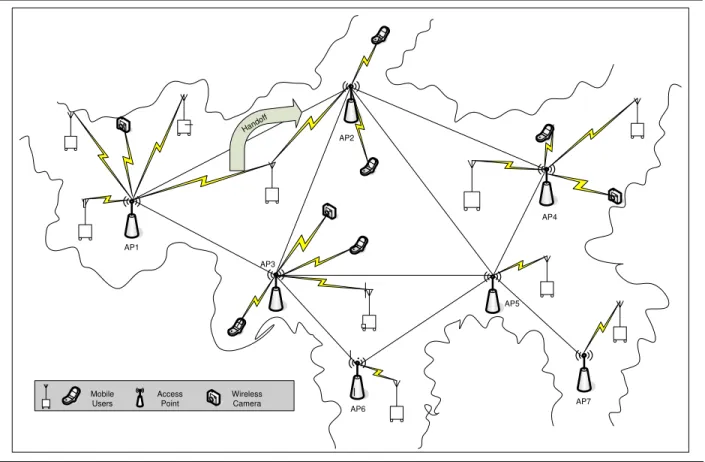
Our first proposal [refer to Figure 1] involves a hybrid network topology using WLAN and can be used for high bandwidth applications such as voice and video snapshots. This topology
AP1 AP2 AP3 AP4 AP5 AP6 AP7 Mobile Users Access Point Wireless Camera Hand off
Fig. 1. WLAN Mesh Topology with Quality of Service and Inter Access Point Protocol
has the WLAN Access Points (APs) to be connected using mesh architecture while the WLAN nodes that do voice and video communications are to be connected to one of the APs using a star topology. The main advantage of a mesh network for APs is to have redundant routes, which is especially desirable in a dynamic environment where link failures are frequent as in the mine galleries. This approach is somewhat similar to what is proposed in [7].
In [7] authors do not address quality of service (QoS) and handoff issues which are important when the network has to support high bandwidth traffic such as voice and when the nodes could be mobile. We propose to use 802.11e (a variant of 802.11 that has QoS support) [8] for communication between WLAN nodes and APs. 802.11e includes different contention technique compared to the one presented in 802.11b [3] to support different priority class traffics. 802.11e provides this through Enhanced Distributed Coordination Function (EDCF) and Hybrid Coordination Function (HCF). In EDCF, on an average higher priority traffic has lower time delays than the lower priority traffic. On the other hand, HCF is more intelligent in controlling access to the medium and so may be recommended for mine galleries. In either case (EDCF or HCF); voice traffic due its requirements can be assigned the highest priority class while other traffic can be assigned lower priority classes.
It is important to note that the WLAN nodes can be mobile and so raises the issue of handoff. We propose to use 802.11f [9] Inter Access Point Protocol (IAPP) to handle handoff of a WLAN node from one AP to another without losing IP-connectivity. For 802.11f to work the APs need to be connected to a centralized RADIUS server. Any handoff within the network (no change in IP address) called intra-network handoff does not involve layer 3 (IP layer) handoff. If there is a need for inter-network handoff (change in IP address) then this can be handled using Mobile IP (MIP) [10-12] or Wireless Internetworking Protocol (WIP) [13]. It would be desirable to keep the network architecture simple without the need to have inter-network handoff.
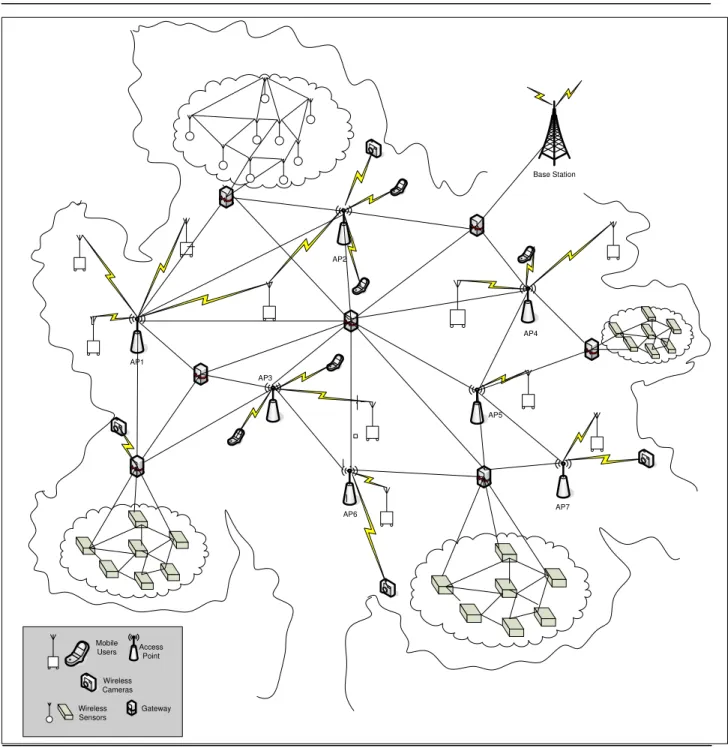
Our second proposal [refer to Figure 2] is when high bandwidth applications and low bandwidth applications such as sensor monitoring are both needed. For sensor monitoring we propose to use a technology different from WLAN. This wireless sensor technology should be low power unlike WLAN [14] such that these nodes can survive on batteries for extended periods. This is mainly because wireless sensor nodes will be monitoring vital life parameters of workers and so would be desirable to continue monitoring these parameters even if there is a power outage due to mine collapse. These vital life parameters are especially of interest to rescue workers after such a mine collapse.
2005 First International Workshop on Wireless Communication in Underground and Confined Area June 6-7, 2005, Val d’Or, QC, Canada AP1 AP2 AP3 AP4 AP5 AP6 AP7 Base Station Mobile Users AccessPoint
Wireless Sensors
Gateway Wireless Cameras
Fig. 2. Advanced Heterogeneous Hybrid Wireless Network
We propose to have a mesh topology of WLAN APs as before but some of the nodes in this “backbone” mesh have the capability to participate in both WLAN and in wireless sensor network and are called gateway nodes. It should be noted that the wireless sensor part of this gateway should be able to operate without any external power other than the batteries
while the AP part of the gateway can be mains-powered. This is necessary so that these gateways can still send/forward wireless sensor monitoring data even if there is a major power outage.
Apart from the gateways there are other wireless sensor nodes that do not have WLAN capability in them and can only
participate in the wireless sensor network. These wireless sensor nodes are individually capable of sending, receiving and forwarding monitored data. These nodes will thus form a complete mesh topology among themselves. Each wireless sensor network can connect to at least one gateway so that the sensed data can be effectively forwarded to the base station. These nodes can be queried and reprogrammed through the base station.
There are many proprietary technologies [15,16] and a standard based technology called Zigbee [17] for low power wireless sensor monitoring. These nodes currently cost about $200 per node [15,16] but the price of is expected to drop substantially in the near future.
There are many MAC, routing, security and in-network processing protocols [18-23] proposed in recent research in the area of low power wireless sensor networking. These protocols can be considered for our advanced network proposed here to monitor workers’ vital life parameters such as heartbeat, body temperature, etc. These parameters are very useful to track and detect workers that still may be alive after a mine disaster. These sensor nodes can also monitor coal mine parameters such as temperature, pressure, gas leakage, etc. which can be used for timely prediction of any such disasters in the mines. It should be noted that the data collected by these nodes will be input to such analysis and prediction facility that may be located remotely. In this case the monitored data will be forwarded to the remote site through the base station that connects to the Internet.
4. CONCLUSIONS
Advanced heterogeneous hybrid networks proposed here for mine galleries support high bandwidth applications such as voice communication using WLAN mesh networking. To provide QoS we propose to use 802.11e and for handoffs between APs we propose 802.11f. For low bandwidth applications we recommend low power wireless sensor network technology. This wireless sensor technology will be very critical during power outages and mine collapses.
5. REFERENCES
[1] M.Ndoh, G.Y.Delisle and R.Le “A novel approach to propagation prediction in a confined rough surfaces”, The International Journal of Numerical Modelling, Electronical Network, Devices and Fields. JNM:521, vo.16, pp.535-555, Dec. 2003.
[2] M. Ndoh, “Modélisation de la propagation des ondes électromagnétiques dans un environnement minier”, thèse de Ph.D., Département de génie électrique et génie informatique, Université de Laval, Québec, Canada, 27 avril 2004.
[3] Telecommunications and information exchange between systems - local and metropolitan area networks - specific requirement. Part 11: wireless LAN medium access control (MAC) and Physical layer (PHY) specifications, IEEE Std
802.11b-1999/Cor 1 – 2001, Nov. 2001.
[4] http://www.sm.luth.se/csee/courses/smd/147/projects/LKA B_project.pdf
[5] G. A. Einicke, D. L. Dekker and M. T. Gladwin, "A Robust WLAN for Survivable Emergency Communications", Proc. 1997 IEEE Region 10 Conference (TENCON 97), vol. 1, pp. 101 - 104, Brisbane, Australia, Dec., 1997.
[6] G. Einicke, E. Duff, D. Reid, J. Ralston, J. Cunningham, D. Hainsworth and P. Corke, “The Application of Wireless LANs in Mine Automation”, Proc. Evans Conf. Creating the Virtual Enterprise, pp. 2.2.1 – 2.2.10, Sydney, Aug. 2002.
[7] V. Navda, A. Kashyap, S. Das, “Design and Evaluation of
iMesh: an Infrastructure-mode Wireless Mesh Network,”
IEEE International Symposium on a World of Wireless, Mobile and Multimedia Networks (WOWMOM), Italy, Jun. 2005.
[8] WiFi Multi Media QoS Whitepaper, Wi-Fi Alliance, Sep. 2004.
[9] IEEE trial-use recommended practice for multi-vendor access point interoperability via an inter-access point protocol across distribution systems supporting ieee 802.11 operation, IEEE Std 802.11f, pp. 0_1 – 67, 2003.
[10] C. E. Perkins, “Mobile IP,” IEEE Communications
Magazine, vol. 35, issue 5, May 1997.
[11] C. E. Perkins and K.-Y. Wang, “Optimized smooth handoffs in Mobile IP,” Proc. IEEE International
Symposium on Computers and Communications 1999
(ISCC’99), 6-8 July 1999.
[12] C. E. Perkins, “Mobile networking through Mobile IP,”
IEEE Internet Computing, vol. 2, issue 1, Jan.-Feb. 1998. [13] K. Srinivasan, J.M. Chung, “Wireless Internetworking
Protocol (WIP),” Proc. of 45th IEEE MWSCAS’02, Tulsa, OK, Aug. 2002.
[14] W. Ye, J. Heidemann, and D. Estrin, "An energy-efficient MAC protocol for wireless sensor networks," in INFOCOM 2002.
[15] http://xbow.com [16] http://ember.com [17] http://zigbee.org
[18] Lewis. F, Wireless Sensor Networks. Smart Environments: Technologies, Protocols, and Applications, John Wiley, New York (2004).
[19] Madan. R, Cui. S, Lall. S, Goldsmith. A, Cross-Layer Design for Lifetime Maximization in Interference-Limited Wireless Sensor Networks, IEEE INFOCOM, March 2005. [20] S. Michell and K. Srinivasan, “State Based Key Hop
(SBKH) Protocol: A Lightweight Security Protocol for Wireless Networks,” ACM Workshop on Performance
Evaluation of Wireless Ad Hoc, Sensor, and Ubiquitous
Networks, PE-WASUN’ 2004, Venice, Italy, Oct. 2004.
[21] K. Srinivasan and S. Michell, “State Based Key Hop (SBKH) Protocol,” Proc. of the Sixteenth International
Conference on Wireless Communications, Wireless 2004,
Calgary, Canada, Jul. 2004.
[22] K. Srinivasan and S. Michell, “Performance of State Based Key Hop (SBKH) Protocol for Security on Wireless Systems,” IEEE Vehicular Technology Conference Fall
2004, Los Angeles, CA, Sep. 2004.
[23] I. F. Akyildiz, W. Su, Y. Sankarasubramaniam, E. Cayirci, “Wireless sensor networks: a survey,” Computer Networks, vol. 38, Issue 4, Mar. 2002.