Stewart C. Myers Saman Majd
#1462-83 May 1983
Revised: August 1983
DRAFT: PLEASE DO NOT QUOTE OR DISTRIBUTE WITHOUT THE
n--- a Cw -- .1 ----AT U> IrotT
rLrKMIlbluN r ne auinuvA.
Calculating Abandonment Value Using Option Pricing Theory
Stewart C. Myers* and
Saman Majd**
Sloan School of Management, M.I.T.
May 1983
(revised: August 1983)
ABSTRACT
Conventional capital budgeting procedure values investment projects as if they will be undertaken for a given economic life, and assigns a prespecified salvage value to the assets at the end of the life. This ignores the value of the option to abandon the project early.
This paper models the abandonment option as an American put option on a dividend paying stock, with varying dividend yield and exercise price. A general procedure for calculating the abandonment value is presented, along with some numerical examples illustrating its practical importance.
Calculating Abandonment Value Using Option Pricing Theory
Modern finance advocates the use of net present value in evaluating capital investments. The net present value (NPV) of a capital investment project is the present value of its expected after-tax cash flows. Most of the work on capital budgeting has concentrated on the difficult problem of specifying the appropriate discount rate. Modelling the cash flows to the project is equally important, however.
Consider the choice between two production technologies. Technology A employs standard machine tools which have an active second hand market. Technology B uses custom designed, specialized equipment for which there is no second hand market. The two technologies produce an identical product and identical revenues, but technology B is more efficient and has lower operating costs. Production continues until the machines are worn out and scrapped. If the two alternatives' cash flows are projected under these assumptions and discounted at the same rates, then the NPV of B is greater than that of A. These calculations would presume that the duration of production is known. But it is not known: if production may be halted "early" (before the machines are worn out) then technology A's
present value of using it.
Standard capital budgeting procedure assigns an expected salvage value to assets at the end of their (pre-determined) project life. However, salvage value also affects the value of an investment because of the option to abandon the project early. The project will be abandoned if the value of continuing is less than the salvage value at that time. Conventional capital budgeting fails to take this option into account.
The true value of a project includes its abandonment value, which depends on the salvage value and the optimal time to abandon. The optimal time to abandon is of course not known when the project is undertaken, but will depend on subsequent performance.
Robichek and Van Horne [16] provide an early analysis of abandonment value. They recognise that the option to abandon a project early can be valuable, and illustrate the option's practical importance. Their examples, however, assume that the project will be abandoned as soon as the salvage value exceeds the present value of the remaining expected cash flows. Dyl and Long [4] emphasise that the optimal time to abandon the project
will not, in general, be the first instance where salvage value exceeds the present value of the remaining expected cash flows. Rather, the abandonment decision at each point in time must recognize that, if the project is not abandoned, the firm
retains the option to abandon in the future.
Unfortunately, Robichek and Van Horne's solution procedure (as corrected by Dyl and Long) is not practical when applied to realistic situations. The subsequent finance literature has not provided a practical approach to solving for the value of the abandonment option and the optimal time for abandonment.
The option to abandon a project is formally equivalent to an American put option and can be valued by applying the
1/
techniques developed to value options on stocks . However, it is not a simple put option: the project yields uncertain cash flows and has an uncertain salvage value. These factors significantly complicate the solution procedure. 2
This paper presents a general procedure for estimating the abandonment value of a capital investment project. The next section specifies the abandonment option as a contingent claim, and discusses some of the important factors that affect its value. Section II describes our simplifying assumptions and valuation procedure, and section III presents some numerical
The option to abandon a project is formally equivalent to an American put option on a dividend-paying stock: the exercise price of the put is the salvage value of the project; the cash flows from the project are equivalent to the dividend payments on the stock. Also, the project can be abandoned at any time during its life.
Each of these factors affects the abandonment value of the project, and to solve for the abandonment value, each must be explicitly modelled. This section discusses how these factors affect the abandonment value. The specific assumptions we make to implement the solution technique are described in section II.
A. Cash Flows and Payout Ratios
In the classical model of stock valuation, the value of a stock is the present value of its expected dividends. Similarly, the value of a project is determined by the present value of its expected cash flows. Since expectations about future cash flows are revised as new information randomly arrives, the value of the project varies randomly about its
---expected value. The uncertainty in the value of the project is therefore related to that of the cash flows, although the relationship is generally complex.
To apply the contingent claim valuation techniques to our problem we must specify the stochastic process generating the value of the project. However, in capital budgeting we normally focus on the process generating the cash flows. Project cash flow, rather than project value, is the natural state variable. However, we can express cash flow as a function of asset value: t = Ct/Vt . These "payout ratios" ( y ) can be functions of time and project value.
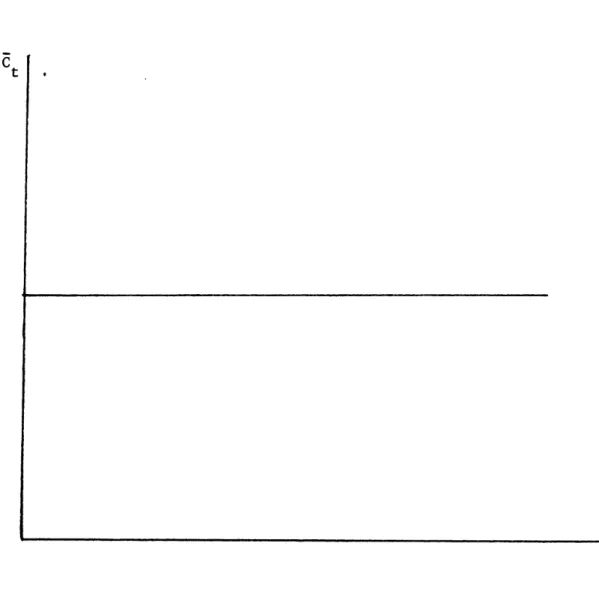
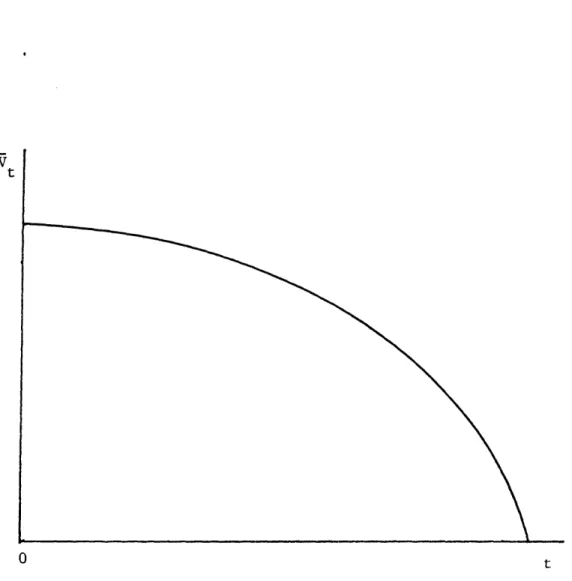
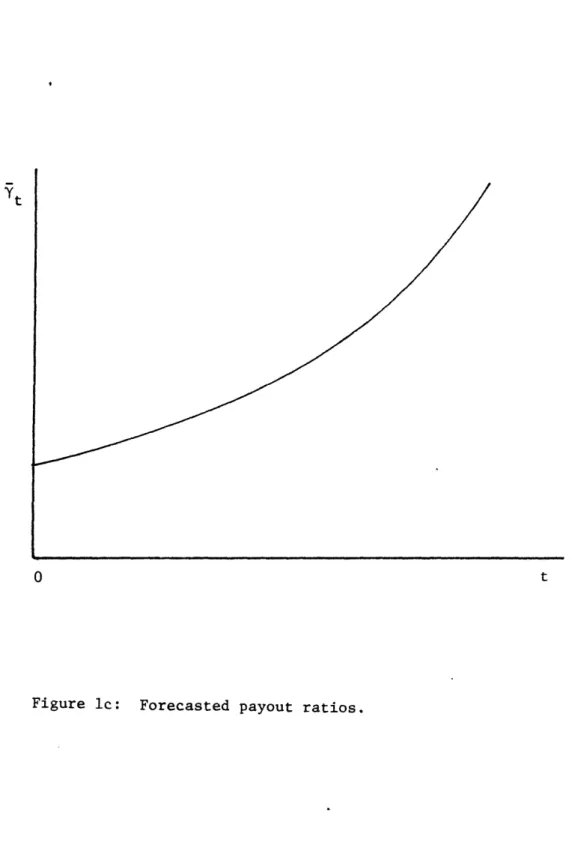
The following simple example shows how we restate the forecasts of cash flows in terms of payout ratios. Suppose that cash flows are forecasted to be constant over the life of the project, so that it resembles a simple annuity (Figure la). Since the value of the project at any time is the present value of the remaining cash flows, we can derive the expected path of the project value over time from the forecasted cash flows. The project value will decline over time as in Figure lb. From these two sets of forecasts we can forecast the payout ratios implied by the expected path of project value: in this example the payout ratios will increase over time (Figure c).
Suppose there is a forecast error in the cash flow. What happens to the conditional forecast of the payout ratio? A simple assumption is that the payout ratio is constant. That is, the percent forecast error in the cash flow, =[c(- Etl(Ct)] /Et 1(Ct) , causes the same percentage
t t t-1 ( ]
change in project value: Vt= Et-1(Vt) [1+Et] . Hence the forecasted payout ratio is unchanged.
If the assumption that payout ratios are independent of project value seems unduly restrictive, note that it is necessary for using a single risk-adjusted rate to discount
future cash flows, which is standard procedure in capital
3/
budgeting .
Other assumptions about the effect of forecast errors in the cash flows on forecasted payout ratios are possible. A mean-reverting cash flow, for example, causes forecasted payout ratios to be functions of both time and project value. More complex specifications of payout ratios as functions of time and project value are also possible.
The payout ratios used in the numerical valuations below are constant or functions of time only.
B. Asset Life and Salvage Value
Conventional capital budgeting treats salvage by assigning a prespecified salvage value to the asset at the end of some predetermined life. But what determines the 'life' of a project?
The physical life of an asset depends on the time at which it will wear out and must be replaced. This is the maximum life of the asset. Physical life could be infinite or very long.
4/ For example, think of land or a hydroelectric facility .
The economic life of the asset is the length of time during which the asset is being used. Thus even if the project is terminated, if the asset is still being employed in an alternative use, its economic life continues.
The project life is not fixed, but is determined by the decision to abandon. It is solved for simultaneously with the value of the option to abandon. The determinants of the abandonment value will therefore also determine the project life.
---A project may never be abandoned. In that case the project life, the economic life and the physical life will all be equal. Generally, however, the project life is less than the economic life, which is less than the physical life.
If the decision to abandon determines project life, what determines the life of the abandonment option? In principle, the project can be abandoned at any time during the asset's physical life, therefore this is the appropriate maturity for the abandonment option.
The salvage value of an asset can vary over time and may not be known in advance. Standardized assets, for which there is an active second-hand market and which experience little technological change, may have a relatively stable and predictable salvage schedule. Assets subject to rapid technological change may have unpredictable salvage values.
The salvage value at any time is the market value of the asset in its next most productive use. It is net of any costs of converting from one use to the other, and incorporates the value of any subsequent options to abandon. Some assets with several possible uses may be abandoned several times during their physical life. Most land, for example, has many different productive uses and infinite physical life. In such cases, the
option to abandon (i.e., to switch from one use to another) is like an 'option on an option': if the project is abandoned before its economic life is over, its salvage value includes the value of terminating its next tour of duty, and the next user gets another abandonment option. Therefore a complete specification of the stochastic properties of salvage value, including its relation to project value, is not an easy thing to write down or analyze. However, we can cope with uncertain salvage values under the assumptions described in section IV.
II. Solution Procedure
Valuing an option requires solving a partial differential equation whose boundary conditions define the nature of the
5/
contingent claim . Sometimes the equation and boundary conditions allow for a closed-form solution, as in the classic Black-Scholes equation for the value of a European call option. More generally, however, a closed-form solution does not exist, forcing us to seek a numerical approximation.
The partial differential equation for the abandonment value is:
½
o2App + [rP-y(P,t)] A -rA + A = 0,where P is the value of the underlying project, o is the standard deviation of the rate of return on the project, r is the riskless interest rate, Y(P,t) is the payout ratio, and A is the abandonment value.
Two boundary conditions specifying the nature of the abandonment option are: (1) if the value of the project is zero, the value of the option is the salvage value at that time: A(P=O,t) = S(t); (2) as the value of the project becomes infinitely large, the value of the option tends to zero: lim A(P,t) = 0.
A third condition applies when the option is exercised: the value of the project is the greater of the salvage value or the value of continuing (but with optimal future abandonment). This condition is invoked at each point in time, and thus the optimal abandonment schedule is solved for implicitly.
Finally, a terminal boundary must be assigned, where the value of the project is taken as zero. This boundary is the physical life of the asset, and the boundary condition at maturity of the option is: A(P,t=T) = max[S(T)-P(T),O].
The most general specification of the abandonment option does not allow a closed-form solution because: (1) the future salvage values are uncertain and are related to the project value in a (generally) complex manner; (2) the future payout ratios, as defined in the previous section, are uncertain and can depend on time and project value in a (generally) complex
6/
manner; (3) the abandonment option is an American option for which early exercise will generally be optimal, and the timing of early exercise must be jointly determined with the abandonment value.
We focus first on the uncertainty regarding future cash flows and project values by assuming a deterministic salvage value. Specifically, we assume that the initial salvage value
is known and subsequently declines at a known constant rate. We also assume that the payout ratios are constant over the entire physical life of the asset. This allows the cash flows to be uncertain but couples their uncertainty to that of the
7/
project 7/
Since there is no closed-form solution to even this simple formulation of the abandonment problem, we must use a numerical approximation technique. Several techniques for such approximations are available. We employ an explicit form of the finite difference technique .
This numerical approximation results in a relationship between the value of the abandonment option in any period and its values in the next period. We can employ this relationship recursively, starting with the values at the terminal boundary, and working back to the abandonment values at the start of the project. In addition, the procedure dictates the optimal abandonment decision. Since the project present value (PV) is a sufficient statistic for the value of the future cash flows, optimal abandonment is expressed as a schedule of project PVs over time. Should the project PV fall below this schedule at any time the project will be abandoned. This schedule will not be equal to the present value of remaining cash flows (as in Robichek and Van Horne) because our recursive procedure includes
the value of optimal future abandonment at each point. Thus the current abandonment decision implicitly accounts for optimal
III. Numerical Examples for the Simplified Abandonment Problem
For the base case calculations we assume a constant payout ratio (constant Y ), and also that:
1. The initial project present value (PV) is 100.
2. Project cash flow and PV are forecasted to decline by 8 percent per year. Hence in the absence of salvage, the project would be perpetual (i.e., economic life = physical life = m ). However, we arbitrarily terminate the physical/life of the asset in the distant future (after 70 years) . This is the terminal boundary where the project value is zero.
3. The initial salvage value is 50, declining exponentially by 5 percent per year.
4. The standard deviation of forecast error of project PV is 20 percent per year.
5. The real risk-free rate of interest is 2 percent per year.
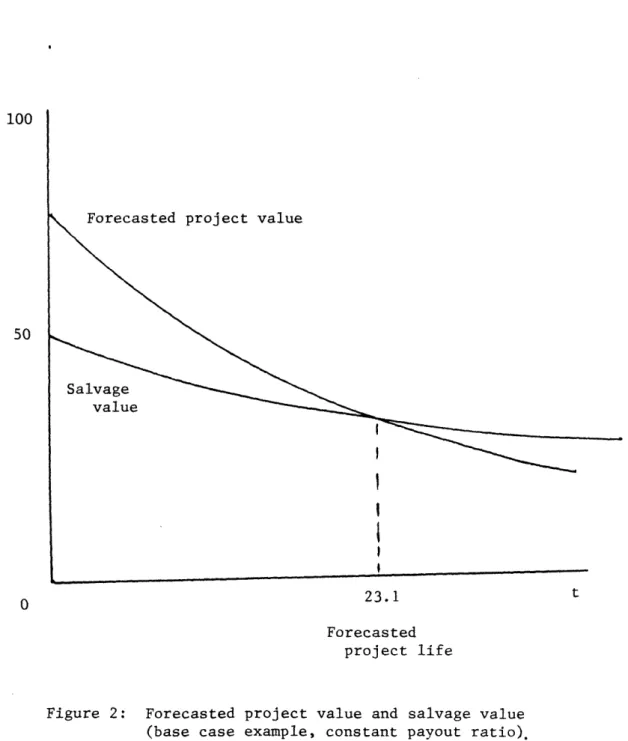
Figure 2 shows how the forecasted project PV and salvage value change over time. Note that the initial PV of 100 is based on the assumption that the project will never be abandoned prior to the end of the asset's physical life, and therefore does not
include any allowance for salvage value, even at the terminal date. Therefore the abandonment value we calculate is the extra value due to the option to abandon in favor of the salvage value at any time during the project life.
---16
Table I shows the results of the base case calculations. Each entry in the table is the abandonment value given project value. The first column gives the abandonment value at the start of the project for different initial project values. Thus, since the initial forecasted PV is 100, the abandonment value is 5.63, or approximately 6 percent of project value. If this project required an initial investment of 100, making its NPV (without any salvage) zero, the abandonment value would make the project worthwhile.
The optimal abandonment decision is also indicated in Table I: if at any time the project value falls below the PV corresponding to the line drawn in the table, the project should
be abandoned. In our base case, for example, if the project value in year 2 is less than 24.53, the project should be abandoned. Similarly, if the project value is less than 20.09 in year 9, the project should be abandoned.
The direction of the change in abandonment value can be predicted from standard option pricing theory: (1) an increase in the salvage value (exercise price) will increase the value of the abandonment option (put option); (2) an increase in the volatility of the value of the project (the underlying asset) will increase the value of the option; (3) an increase in the forecasted project PV (the current value of the underlying
asset) will decrease the value of the option; (4) a decrease in the physical life (the maturity of the option) will decrease the value of the option. These results were verified numerically and are presented graphically in Figure 3.
The abandonment value calculated by our procedure is added to the present value of cash flows (without any salvage) to obtain the total project value. In our base case, for example, the present value of cash flows without salvage is 100, the abandonment value is approximately 6, making the total project value 106. How does this differ from the conventional calculation of project value?
The conventional approach assumes that the project will be terminated when the salvage value equals the present value of the remaining cash flows (i.e., when the salvage value equals the forecasted project value without savlage). The conventional project value is therefore the present value of the forecasted cash flows up to the termination date plus the present value of the forecasted salvage value at that date. Since the termination date is the time when the salvage value equals the present value of remaining cash flows, the conventional project value will not change when salvage value is substituted for the value of remaining cash flows. In our base case the forecasted project life is 23.1 years (see Figure 2). The present value of
cash flows up to this termination date is 96, and the present value of salvage at this date is 4, making the total project present value 100. This is also the project present value without any salvage.
The forecasted project life can be changed by varying the initial salvage value. The smaller the initial salvage value, the longer the forecasted project life, the larger the present value of cash flows up to termination, and the smaller the present value of salvage. The total project value, including salvage, remains constant at 100, as described above. These results are shown in Table II for a range of forecasted project lives.
Also shown in Table II is the corresponding abandonment value calculation. The project present value without early abandonment or salvage is 100. The abandonment value is the extra value due to the option to terminate the project early, and this is added to the present value of cash flows to get the total project value. The results show that the project value with conventional allowance for salvage can be very different from the project value with allowance for the abandonment option.
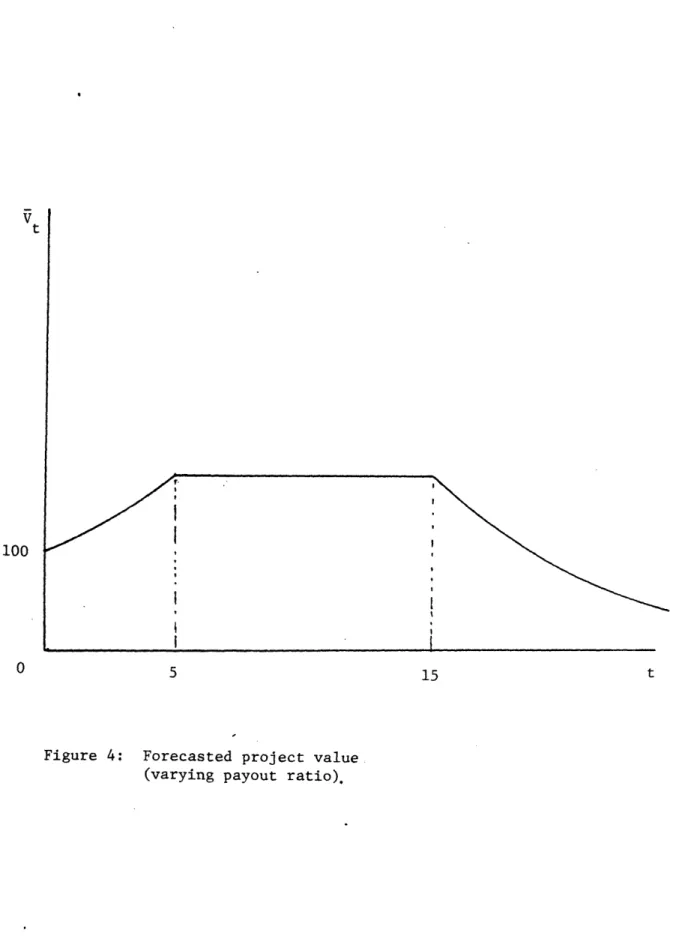
We also performed an illustrative calculation assuming varying payout ratios. Specifically, we assumed that the project payout ratio is zero in the first five years, 2 percent in the next ten years, and 20 percent per year thereafter. This implies the pattern for the forecasted project value shown in Figure 4. In this example, if the initial forecasted PV is 100, the abandonment value is 3.54, or approximately 4 percent of
project value.
IV. Modelling Uncertain Salvage Values
Abandonment can occur more than once during an asset's physical life: the asset may be switched from one use to another several times. Included in the salvage value each time abandonment occurs is the option to abandon again. Hence the abandonment option is an option on a sequence of options. Unfortunately, this makes complete specification of the stochastic properties of the salvage value extremely difficult.
As a first step towards introducing uncertainty in the salvage value we make two simplifying assumptions. The first is that identical assets are being used elsewhere, and that these assets are traded. Thus the salvage value is a market price. Second, we assume that the stochastic processes for the project value and the salvage value are:
dP/P = (a - Yp) dt+ a dZ ,
p p P p
and,
dS/S = ( - Y) dt = s dZs
S S S S
Here P is the project value, a the expected rate of change of P
P, Y the project payout ratio, the standard deviation of the rate of change of P, and dz the standard Weiner process
P
11/
generating the unexpected changes in P . The parameters for the salvage value, S, are similarly defined. The project and
salvage values are correlated, with instantaneous correlation coefficient P .
Margrabe [9] has valued an option to exchange one risky asset for another. The assumptions above make our framework similar to his, where the stochastic salvage value can be interpreted as one of his risky assets. However, since his analysis assumes no payouts from the assets, it would not
12/ strictly apply to the abandonment option
However, we can use the valuation procedure developed earlier to value the abandonment option with uncertain salvage value. The appendix derives the differential equation for this option, and shows that after suitable transformation, the option's value obeys the same differential equation as applies in the case of deterministic salvage. This transformation is as follows: (1) Redefine the state variable as the ratio of project to salvage value (X=P/S). (2) The standard deviation of
2 2 2
this new state variable is a = a -2po a +o (3) Set the X P ps s
exercise price equal to unity. (4) Substitute Y for the riskless interest rate. With these four adjustments, abandonment with uncertain salvage is reduced to an equivalent option with known and constant exercise price.
Table III presents results of abandonment calculations when salvage value is uncertain. As the results indicate, the abandonment value is sensitive to changes in both the correlation between salvage and project values and the standard deviation of salvage value.
V. Conclusions
It is easy to think of the abandonment option as an American put option, and somewhat more difficult to put that insight to practical use. This paper discusses problems of application in some detail and presents numerical estimates of abandonment value for halfway realistic examples. The obvious next step is to expand the numerical valuation program to allow project payout ratios (i.e., cash flow to value ratios) to depend on project value as well as time.
Such a program could help solve a variety of other problems. Here is one example. Suppose you expect to need a new plant ready to produce turbo-encabulators in 36 months. If design A is chosen construction must begin immediately. Design B is more expensive, but you can wait 12 months before breaking ground. Figure 5 shows the cumulative present value of construction costs for the two designs up to the 36-month deadline. Assume the designs, once built, are equally efficient and have equal production capacity.
A standard discounted cash flow analysis would rank design A ahead of B. But suppose the demand for turbo-encabulators falls and the new factory is not needed: then, as Figure 5
24
shows, the firm would be better off with design B provided the project is abandoned before month 24 13/
This is also an abandonment value problem. The underlying asset is the present value of the turbo-encabulator project assuming the firm must complete construction of the plant. Think of putting the present value of required construction expenditure in an escrow account. The account would of course be larger for design B than design A. If either design is abandoned before month 36, however, its 'salvage value' is the unspent balance in the escrow account. This is the exercise price at which the firm can 'put' the turbo-encabulator project between month zero and month 36.
We are back to a standard abandonment option, where the exercise price is determined by the pattern of cumulative investment in the design being valued. Project net present value is equal to (1) project present value assuming a
14/
commitment to complete construction , less (2) the present value of construction costs assuming this commitment, plus (3)
the present value of the option to abandon before construction is completed. The value of (3) reflects the option to recover part of the construction costs comprising (2).
Design B could be more valuable than A, if B's abandonment value outweighed its higher cost.
It would be interesting to analyse the choice between gas turbines, coal, and nuclear power plants using this option pricing framework.
26
APPENDIX
This appendix derives the partial differential equation (PDE) for the abandonment option when the salvage value is stochastic, and shows that with suitable transformation, the option value is also a solution to the PDE for deterministic salvage.
The derivation follows the methodology of Merton [12] and the reader is referred to his references for the supporting literature. For simplicity, the derivation that follows assumes a European type abandonment option; the extension to an American type option is straightforward. (The numerical results reported in section IV of the text refer, of course, to the American abandonment option.)
The stochastic processes describing the project value without salvage, P, and the salvage value, S, are:
dP/P = ( - yp)dt + a dZ , and,
dS/S = ( - Ys)dt + dZs
The rate of change of P has expectation Ua and standard P
deviation ac , the project payout ratio is yp, and dz is the standard Weiner process generating the unexpected changes in P.
--The parameters for S are similarly defined. The project and salvage values are correlated with instantaneous correlation coefficient P.
Let F(P,S,t) be the solution to the PDE:
2
P2 F pp+pap a PSFp+2S2 F SS+(r-p)PFp+(r- ) SFrF+Ft =O
PP P PSS PP S
subject to the boundary conditions: F(P=O,S,t) = S(t),
lim F(P,S,t) = 0,
Pi*W
and F(P,S,t=T) = max[S(T)-P(T), 0].
From Ito's lemma,
2 2 dF:[F + (a -Yp)PFp+(as-Y)SFs+ ½ o P F + pa a PSF t p p p S S p pp ps +½ o S2F ] dt+ [pPFp] dz + [SFs] dz s P P P 5 5
S
Substituting from the PDE above, we have,
dF = FpdP + FdS + [rF-(r-yp)PFp-(r-YS)SFs]dt.
Consider the portfolio formed by investing the fractions x in P, y in S, and the remainder in riskless Treasury bills. The dynamics for the portfolio are,
dY = xY (dP + ypPdt)/P +yY (dS + ysSdt)/S + (-x-y)Yrdt. Choose the investment proportions according to the rules: x=FpP/Y and y=FsS/Y. Then,
dY = F (dP + ypPdt) + F (dS + YSdt) + (Y-F -F S)rdt = dF + (Y-F)rdt.
28
If the amount initially invested in the portfolio is Y(t=O) = F(P,S,t=O), then it is clear that Y(t) = F(P,S,t) at all subsequent times. Further, the value of the portfolio, Y, is equal to the function F(P,S,t) at the boundaries given above, which by construction are identical to the boundaries for the
abandonment option. Since the portfolio has the same payoffs as
the abandonment option, then to avoid dominance, the value of the abandonment option must be given by A(P,S,t) = Y(t) = F(P,S,t).
The PDE for the abandonment option above can be simplified by the transformation: G(X,t) = A(P,S,t)/S, where X=P/S. This leads to the PDE:
2
½2x XC2G + ( - Yp) XG - Y G + G = 0,
where x = Up -2p2p + The new boundary conditions are: G(X=O,t) = 1,
lim G(X,t) = 0,
X-tCO
and G(X,t=T) = max[1-X(T), 0].
This is identical to a formulation of the abandonment option with deterministic exercise price (equal to unity), and with the riskless rate replaced by Ys .
The intuition behind this transformation is clear: think of the salvage value as the numeraire. In these units, the
project value is P/S (=X), and its variance is
-2 2 2
ax = ap -2Paps +os. The exercise price is now known and
constant.
To see why Ys replaces the riskless rate, consider the portfolio that is used to replicate the option. When the salvage value is uncertain and is represented by a traded asset, this asset is used to hedge against changes in the exercise price. The salvage asset earns a fair total rate of return which includes the cash flows to the asset. However the exercise price changes only as the price of the salvage asset. The difference between the total return to the salvage asset and the rate of change of exercise price is the opportunity cost of holding an option on the salvage asset rather than holding it directly. This difference is the payout ratio Y which enters the PDE instead of the riskless rate.
·
---FOOTNOTES
* Professor of Finance, Sloan School of Management, MIT.
** Doctoral candidate, Sloan School of Management, MIT.
1.
Scholes article,
For the seminal works on option pricing, see Black and [1] and Merton [11]. For a comprehensive review see Smith [18].
2. Kensinger [8] analyses project abandonment as a put option. However, his analysis assumes that the option is of the 'European' type with a non-stochastic exercise price. This is equivalent to assuming that the project can only be abandoned at one time, and that the salvage value is known with certainty. This misses important features of the option.
·---3. For a discussion of the assumptions necessary for using a single risk-adjusted discount rate, see Myers and Turnbull [14].
4. Here is another example of an asset with very long physical life. Consider a fleet of trucks of different vintages. There is a program of maintenance and replacement which maintains the fleet's productive capacity. The fleet could live indefinitely. However, it has abandonment value: its owner may decide to get out of the trucking business.
5. Black and Scholes [1] and Merton [11] were the first to derive such partial differential equations for financial options. Much of the subsequent literature on option pricing has followed their methodology and assumptions.
6. Options on stocks with uncertain dividend payouts can be valued given specific assumptions about the joint distribution of stock price and dividend payout ratio. See Geske [6].
7. Note that this is not a causal relationship between the value of the project and the cash flows. The causality runs the other way, from cash flows to value.
8. For a discussion of numerical methods for solving partial differential equations and examples of their application to problems in financial economics, see Brennan and Schwartz [2] and 3], Mason [10], Parkinson [15], and Schwartz [17]. Geske and Shastri [7] provide a useful summary of the major numerical methods.
9. Because our solution procedure starts at a terminal boundary and works back recursively, we need a finite horizon for our calculations. Since the base case has an infinite horizon, we approximate this by setting the boundary far in the future, at 70 years. Sensitivity analysis shows that this does not induce a significant error in the initial abandonment value.
10. This implicitly assumes that there is no abandonment option for the salvage asset. If there is, then the market value of the salvage asset includes the value of this option,
appropriate. In particular, as will no longer be constant and may depend on S in a complex manner.
11. For underlying the
Merton 131.
option pricing [11]).
a detailed discussion of the assumptions use of such processes in financial economics see The use of these processes is standard in the literature (see Black and Scholes [1] and Merton
12. Fischer 5] also values a European call option with stochastic exercise price. He also describes how the Capital Asset Pricing Model can be used to infer the equilibrium expected return on a security perfectly correlated with the salvage asset if this security is not traded. Stultz [19] extends Margrabe's results to more general European options on the maximum or minimum of two risky assets.
13. We assume for simplicity that construction outlays are totally lost if the project is abandoned before construction is complete. Our story is easily adapted if some of the outlays can be recovered.
-14. This present value would include the present value of abandoning after month 36.
REFERENCES
1. Black, F., and M. Scholes, "The Pricing of Options and Corporate Liabilities", Journal of Political Economy, May/June
1973, 637-659.
2. Brennan, M., and E.Schwartz, "Finite Difference Methods and Jump Processes Arising in the Pricing of Contingent Claims: A Synthesis", Journal of Financial and Quantitative Analysis, September 1978, 461-474.
3. Brennan, M., and E.Schwartz, "Savings Bonds, Retractable Bonds and Callable Bonds", Journal of Financial Economics, August 1977, 67-88.
4. Dyl, E., and H. Long, "Abandonment Value and Capital Budgeting: Comment", Journal of Finance, March 1969, 88-95.
5. Fischer, S., "Call Option Pricing When The Exercise Price Is Uncertain, And The Valuation of Index Bonds", Journal
of Finance, March 1978, 169-176.
6. Geske, R., "The Pricing of Options With Stochastic Dividend Yield", Journal of Finance, May 1978, 617-625.
7. Geske, R., and K. Shastri, "Valuation By Approximation: A Comparison of Alternative Option Valuation Techniques", Working Paper 13-82, Graduate School of Management, U.C.L.A., 1982.
8. Kensinger, J., "Project Abandonment as a Put Option: Dealing With the Capital Investment Decision and Operating Risk Using Option Pricing Theory", Working Paper 80-121, Edwin L.
Cox School of Business, Southern Methodist University, 1980.
9. Margrabe, W., "The Valuation of an Option to Exchange One Asset for Another", Journal of Finance, March 1978, 177-186.
10. Mason, S., "The Theory of the Numerical Analysis of Certain Free Boundary Problems Arising in Financial Economics",
unpublished Ph.D. dissertation, chapter 3, Sloan School of Management, M.I.T., 1979.
11. Merton, R.C., "Theory of Rational Option Pricing", Bell Journal of Economics and Management Science, Spring 1973,
141-183.
12. Merton, R.C., "On the Pricing of Contingent Claims and the Modigliani-Miller Theorem", Journal of Financial Economics, November 1977, 2 41-249.
13. Merton, R.C., "On The Mathematics and Economics Assumptions of Continuous Time Models", in "Financial Economics: Essays in Honor of Paul Cootner", edited by W. Sharpe and C. Cootner, Prentice-Hall, 1982.
14. Myers, S.C., and S.Turnbull, "Capital Budgeting and the Capital Asset Pricing Model: Good News and Bad News", Journal of Finance, May 1977, 321-333.
---38
15. Parkinson, M., "Option Pricing: The American Put", The Journal of Business, January 1977, 21-36.
16. Robichek, A., and J. Van Horne, "Abandonment Value and Capital Budgeting", Journal of Finance, December 1967, 577-590.
17. Schwartz, E.S., "The Valuation of Warrants: Implementing a New Approach", Journal of Financial Economics, January 1977, 79-93.
18. Smith, C., "Option Pricing: A Review", Journal of Financial Economics, January/March 1976, 1-51.
19. Stulz, R., "Options on the Minimum or Maximum of Two Risky Assets: Analysis and Applications", Journal of Financial Economics, July 1982, 161-185.
t
Figure la: Forecasted cash flows.
___
----F
Figure b: Forecasted project value.
t
Figure c: Forecasted payout ratios.
100
50
0 23.1
Forecasted project life
Figure 2: Forecasted project value and salvage value (base case example, constant payout ratio).
t
-O -O >C. '- J * - t - FJ- C o b M F J -e N C\ J Lc O O a O O tC- N i' ) J 0 N O 0 0 ON UN Ln O CN N 0D N L -O -O 1 C O t CO- 0CO 0- cO O '' _- N ; Li _ - OD ; 0 00 O -- ,---CM 00 C -N 0\ J- T N- t--- M - J O OJ M n N C; U LC o IC 0O C' C li o ar C- - N I'\ .o M .0 oM MC 0 OT 0 -0 O .0-- O - O IZ'CO --t - C -O O fO O ,- -- -T O 00 CJ -- -o ' NJ N y J L- 0 t C N C M O C N N - N o -' C 0 C L -c t J) O 0".0 O N N 0 o %D Ln t - M o .- . *;, L* C O ) -I \O L( 0'0 0 O '-N M s In LC O-O w- V M mt L2 P O C Ln oD -oo,;-o Lo'1D M t \O o u co o I CO cO t- -Ln oO t- - O D *_: *o *N l Ln \0 00 CM C COr \0o c C y; tJ N~-Lc;;Ct U' CY) f t-C-N -CO -o -f -0 - 0' 0 M' O C O o0 I t-O M .; in O 0 ,~ M Ln *~
~
*1-**~ ~ ~ ~ ~~1-
*,- - * '* 0T I) O C; 0~ C- t-C; JZ -, 0) =f M \ 00 * .. *~ * . LSE f O MCT vD 0 N CEJ g N M M t-o t-LC Ccj C-N --· --N CY) o0 0 N -T - U) 00 L) .- '-C oL i VN oo M M Un 00 C M, 00 O CU U cJ t_ m (m ) N'.COMC(Y I0 0O L 0 01 O '0 o O )O=oo 0 N N) ogl N -O N LfC C' ( COrMM I) C C- -Ln (3 pc 08 Ln O^\ aJ f) W r=:r o. -o =r * OUL CT N L* * * C ' NN NU mmm_ L 0 C - Ln O N t 0\ UI U' 0 U 0 a\oo o q)o N N N mm M' = o N) O CO NJ L\ cr :T lSN C C Y) ) rf O LC__ cJ~1
m (< )~ Jj JJ CY) 0 C O t--rN - U- C) J N N t- ICc r C\j M M M -t- c O-C 0 - Ln 0C O J aN L('1 n 0 % 0 O U 0y; 1 fJD AJ Cm C N vz M M M J U J J 0 1 M N _-Z kD oD I Co ; ( Cr U') - M C C C -- O : 9 : 5 C\ O 0C In -, *,-) C 4 0. 0 3) CO O O0 *4O Uc o gul ss:* . Hl CJ O E EH '-4 .0 (U H-4O C) *-0 a) 0 r-cO L' (0 , x w \ ON 00 C\--oJ -oN1 O .:Nc ____1_111___11_1__1__I___-_s____--- r-L~o C, a a) 00 4 O) a) rt cn c s *I-4 '* W -r > >0 U bo 60 a) co a0 ) ) 4 U 0) H Fl b U) w coi C)2 -~~~1 ,H Uq c H cn 6r ci 4- 4~-J e rlr 4- , a II -4 Cf Q u g
~o
C 5 a ¢ : 0 i-H O C') O 0 O C) "I O o O 0 C OC' t 0 ---' ---' -I ---r -, .-. _ _ _ _ , , _ _ _ _ ., _ _ _ _ ._ _ _ _ , , , _ _ _ I. ---- r. ..._ --- · --H £0 a H un I C 0 H H H4 H4 H4 H H %, 0 H Ln Sf4 0 0 0 0 0 0o o 0 0 o o 0 0 0 0 o 0 0 0 o < -i a% H _. cn 0 0 ,. . '. _ ^ QIoOC· o ,, V1 V0 144 0 00 wC 0 r143 00 0. 0 0 c o t O Ai 0 O C c coo . H o 0 H COn o co O 0 i H 0 0) H 0.0 0o X O 0 4. H4 * 0a 03 '.0 0o1 v0ia~ 00 0J OHl 0.44~ 00a 1400 0 4 0 1 .0 *H 0. 00. U C, H H o 0 n o o 2 Ai .r. 4) 10044 c o · > 0 c >H0 C 0 H o P4 0 I 0 $4 c.) 00 fil 00 41 0 0.000 0l .0 3P4 ad 41 0 0 4c 0¢ 0 "Io O 0 0 0 0 o Ac c o 4 0 0 H 41 0 ,4 p-'0 tol O 0) 0 0 4. 0 14to H0 0 0 C: H 410 0 U H @ X 410 O 0 i 14 H w H 14.1 0 1.4H> > a) cc co O a p U Vi 4 o) 0 &. P 14 -B A.u1 0 .1I 0 I i 40 P 0 0 0) O 4 0 0 a 0 .-4 Cl 4.o 0 0 0 0C. 0 0, a -H -H 0-0 0 44 4i Ai0 C) 0 0 4' P w 0 04 44 14 4) C1o bo to V > H 0 H 0n 0
--hrbi···BPCB·O1111··1111·118·11
.·.·-l-P
·III 11
100
0 5
Figure 4: Forecasted project value (varying payout ratio).
15 t I I I I I I I
~~~~~`-"-~~~~~~~"~~~~~~~~~~~'~-
· T- -1 1- , ,- -1 - - -- -- -, - --- -- .. -· --- --Total cost of design B ne (months) 0 Start A Figure 12 24 36
t
Start BCumulative construction cost of two plant designs.
variance of salvage value ( 2): S 0.00 0.04 0.08 0.12 +0.9 5.55c 2.18 3.75 3.88 correlation coefficient +0.5 0.00 -0.5 5.55 5.55 7.80 9.85 5.55 5.55 b (0) -0.9 5.55 8.83 11.45 13.13 11.45 14.63 16.18 13.50 16.53 19.63
a. For these calculations, we assume Ys = 0.07. Otherwise the assumptions are those of the base case with deterministic salvage.
b. The variance of the rate of change of project value in units of salvage value,
x=P/S, is 02 2 - 2 + 2
x P ps s
c. When the uncertainty in salvage value is zero, the problem reduces to our base case with deterministic salvage. The difference between the abandonment value when = 0 in
s
this table and our base case solution is due to round-off error.