HAL Id: hal-01922692
https://hal.archives-ouvertes.fr/hal-01922692
Submitted on 14 Nov 2018
HAL is a multi-disciplinary open access
archive for the deposit and dissemination of
sci-entific research documents, whether they are
pub-lished or not. The documents may come from
teaching and research institutions in France or
abroad, or from public or private research centers.
L’archive ouverte pluridisciplinaire HAL, est
destinée au dépôt et à la diffusion de documents
scientifiques de niveau recherche, publiés ou non,
émanant des établissements d’enseignement et de
recherche français ou étrangers, des laboratoires
publics ou privés.
Molecular tests to assign individuals within the
Cacospylla pruni complex
Jean Peccoud, Gerard Labonne, Nicolas Sauvion
To cite this version:
Jean Peccoud, Gerard Labonne, Nicolas Sauvion. Molecular tests to assign individuals within the
Ca-cospylla pruni complex. PLoS ONE, Public Library of Science, 2013, 8 (8), pp.e72454.
�10.1371/jour-nal.pone.0072454�. �hal-01922692�
Cacopsylla pruni Complex
Jean Peccoud, Gérard Labonne, Nicolas Sauvion
*INRA, UMR 0325 Biologie et Génétique des Interactions Plantes-Parasites, Campus International de Baillarguet, Montpellier, France
Abstract
Crop protection requires the accurate identification of disease vectors, a task that can be made difficult when these vectors encompass cryptic species. Here we developed a rapid molecular diagnostic test to identify individuals of
Cacopsylla pruni (Scopoli, 1763) (Hemiptera: Psyllidae), the main vector of the European stone fruit yellows
phytoplasma. This psyllid encompasses two highly divergent genetic groups that are morphologically similar and that are characterized by genotyping several microsatellite markers, a costly and time-consuming protocol. With the aim of developing species-specific PCR primers, we sequenced the Internal Transcribed Spacer 2 (ITS2) on a collection of C. pruni samples from France and other European countries. ITS2 sequences showed that the two genetic groups represent two highly divergent clades. This enabled us to develop specific primers for the assignment of individuals to either genetic group in a single PCR, based on ITS2 amplicon size. All previously assigned individuals yielded bands of expected sizes, and the PCR proved efficient on a larger sample of 799 individuals. Because none appeared heterozygous at the ITS2 locus (i.e., none produced two bands), we inferred that the genetic groups of C.
pruni, whose distribution is partly sympatric, constitute biological species that have not exchanged genes for an
extended period of time. Other psyllid species (Cacopsylla, Psylla, Triozidae and Aphalaridae) failed to yield any amplicon. These primers are therefore unlikely to produce false positives and allow rapid assignment of C. pruni individuals to either cryptic species.
Citation: Peccoud J, Labonne G, Sauvion N (2013) Molecular Test to Assign Individuals within the Cacopsylla pruni Complex. PLoS ONE 8(8): e72454.
doi:10.1371/journal.pone.0072454
Editor: Valerio Ketmaier, Institute of Biochemistry and Biology, Germany Received May 31, 2013; Accepted July 18, 2013; Published August 19, 2013
Copyright: © 2013 Peccoud et al. This is an open-access article distributed under the terms of the Creative Commons Attribution License, which permits
unrestricted use, distribution, and reproduction in any medium, provided the original author and source are credited.
Funding: Jean Peccoud was funded by a post-doc grant from the Institut National de la Recherche Agronomique project SDIPS (Speciation & molecular
Diagnostic of Insect Pest Species complexes). This project also funded the sequencing. Exchanges of materials between laboratories were made possible thanks to the COST Action FA0807 (Integrated Management of Phytoplasma Epidemics in Different Crop Systems) (http://www.costphytoplasma.eu/), and a bilateral project France-Turkey (PHC BOSPHORE-2010). The funders had no role in study design, data collection and analysis, decision to publish, or preparation of the manuscript.
Competing interests: The authors have declared that no competing interests exist.
* E-mail: [email protected]
Introduction
Psyllids, or jumping plant lice, are small (1-5 mm) phloem-sucking insects with a worldwide distribution and which breed almost exclusively on perennial dicotyledonous hosts [1–3]. Psyllids typically present very narrow host ranges corresponding to low-level plant taxa, either a specific plant family, genus or species (not considering “shelter plants” on which many psyllid species overwinter) [4]. There are about 3,500 described species of psyllids but twice that many may actually exist [5]. Psyllids belong to the superfamily Psylloidea, a sister clade of all other Sternorrhyncha [6,7].
The taxonomy and phylogeny of psyllids are primarily based on morphological characters (e.g., [8]). Extant jumping plant lice constitute morphologically well-defined groups [9], although, in general, only specialized taxonomists are able to interpret certain subtle characters that distinguish taxa. This is particularly true for the 239 known and validated species of
Cacopsylla [10], due to the lack of an identification key for the genus [11]. This difficulty becomes problematic for the pests or the vectors of plant pathogens, including Cacopsylla species that feed on fruit trees and that transmit bacteria known as phytoplasma. Hodkinson [12] highlighted major problems on the taxonomic status of the various species of west Palaearctic Pyrus-feeding psyllids. In their revision, Burckhardt and Hodkinson [1] estimated that European economic entomologists have generally applied the species names, Cacopsylla pyri (Linné, 1758) and Cacopsylla pyricola (Foerster, 1848) (described as vectors of Pear decline phytoplasma in Europe and North America, respectively), to all members of the complex and have failed to recognize morphological and biological differences between the seven known species feeding on Pyrus. Confusion is also possible between vectors of Apple proliferation phytoplasma, Cacopsylla melanoneura (Foerster, 1848) and Cacopsylla affinis (Löw, 1880), which are often found together on their wild
host plants (Crataegus) or on their overwintering shelter plants (conifers). C. pruni, the only known vector of the European stone fruit yellows phytoplasma on cultivated Prunus [13,14], was proved to be a complex of two genetic groups that are not yet distinguished morphologically [15]. The difficulty to identify economically important psyllids with traditional taxonomic characters demonstrates the need for a new approach.
DNA-based identification constitutes a reliable, cost-effective and accessible solution to assign individuals to cryptic species. The mitochondrial gene encoding cytochrome c oxidase subunit 1 (COI) has been proposed in the ‘DNA barcoding’ approach as the best marker for a global bioidentification system in animals [16]. The ribosomal DNA (rDNA) second internal transcribed spacer (ITS2) is another frequently used marker. This fast evolving nuclear region has proved its benefits for phylogenetic analysis within genera or for discrimination of cryptic species within complexes (e.g., [17,18]).
The aim of the present work was to develop a molecular identification method to distinguish the individuals of the genetic groups A and B of the C. pruni complex. A previous population structure analysis based on 310 specimens from western and southern France and northern Spain showed the existence of two clearly differentiated genetic groups that occur sympatrically in most sites [15]. Because no morphological differences have yet been found to distinguish the two groups, the only way to identify them required the use of several microsatellite markers, a costly and time-consuming method [19]. Consequently, in order to assign a greater number of individuals, in particular, to determine the geographical distributions and host ranges of the two groups, we developed an easy and reliable molecular test based on the ITS2 region. This marker offers some advantages over the bar coding gene COI in designing species-specific primers due to the higher G-G content and the presence of insertion-deletions (indels) between species. Such primers were designed to efficiently assign the individuals to each group with a single polymerase chain reaction (PCR) and no DNA sequencing.
Materials and Methods
Psyllid samples used in molecular procedures
Twelve C. pruni samples (i.e., insects from the same locality) used in this study, mostly from France, are described in Sauvion et al. (2007) (Table 1, Figure 1). These samples constitute 310 psyllids (males or females) genotyped at nine microsatellite loci and previously assigned to groups referred to as A and B (Table 1). We aimed to increase our dataset with 14 additional samples in order to cover the known distribution area of C. pruni to the greatest extent possible [14]. The individuals of seven of these 14 samples were genotyped: three samples from France and four samples from Serbia, Italy, Germany and Spain (samples 13 to 19, Table 1). All microsatellite genotypes were assigned to a group using the Bayesian admixture procedure described in Sauvion et al. [15]. In all the 19 genotyped samples, two individuals assigned to either group were selected for ITS2 sequencing (detailed below). As outgroups, we sequenced one individual from
Cacopsylla fulguralis (Kuwayama, 1908) and one individual from Psylla alni (Linné, 1758). Eight individuals of the 19 previously described samples plus seven other samples were analyzed at the diagnostic PCR (see below) to test the reliability of this test on individuals of diverse origins. Our aim was to test four individuals from each group.
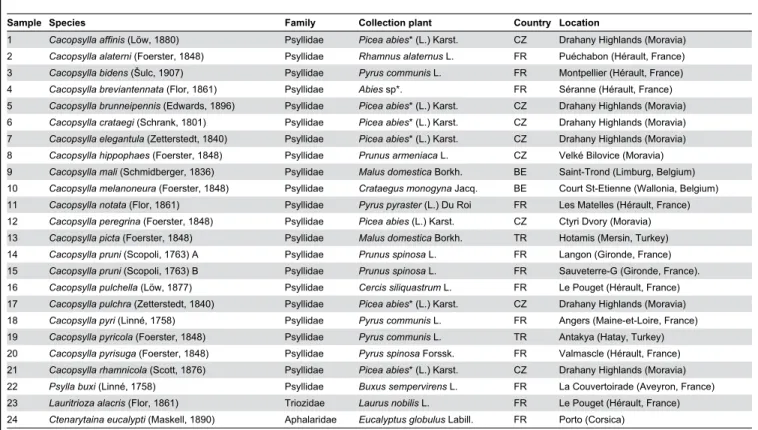
Finally, in order to ascertain that the diagnostic PCR amplified only C. pruni DNA, we performed it on individuals of 18 species of Cacopsylla, including all those known to transmit phytoplasma to Rosaceae, one species of Psylla, one species of Triozidae, and one species of Aphalaridae (Table 2), according to the recent classification of Psylloidea [10,11]. Four to five individuals per species were first amplified at the ITS2 locus using generic primers (see below), to ascertain DNA quality at this locus. For each species, one individual that yielded good amplification was then tested with the diagnostic PCR.
All psyllids were stored in absolute ethanol until DNA extraction. DNA of individual psyllids was purified from whole bodies using either the CTAB (cetyltrimethylammonium bromide) method [20] in individual 1.5 ml tubes, or the High-Salt method based on TNES (Tris, NaCl, EDTA, SDS) buffer [21] in semi-deep well plates. DNA was diluted in 60 µL of water.
Internal Transcribed Spacer 2 (ITS2) DNA sequencing and phylogenetic analysis
The ITS2 spacer and parts of the rRNA 28S and 5.8S genes were amplified with primers CAS5p8sFcm (5’-CGAACATCGACAAGTCGAACGCACA-3’), adapted by E. Jousselin for aphids (com. pers.) from Ji et al. [22], and CAS28sB1d (ID: S50426), specific for Hemiptera (5’-TTGTTTTCCTCCGCTTATTAATATGCTTAA-3’) [22]. The PCR was performed in a final volume of 25 µL containing: 2.5 µL of QIAGEN Coraload buffer (containing 45 pmol MgCl2), 0.05 mM
of each dNTP, 3 mM of MgCl2 (Qiagen), 0.7 µM of each primer,
0.625 U of Taq DNA Polymerase (Qiagen) and 2 µL of DNA extract. The PCR cycles were as follows: initial denaturation at 94°C for 3 min; followed by 40 cycles at 92°C for 30 s, 48°C for 1 min and 72°C for 1 min, with a final 10-min extension period at 72°C. Purification of PCR products and Sanger sequencing with both primers were performed by the GENOSCOPE (Évry, France).
Sequences were analyzed with Geneious Pro 5.4 [23]. Chromatograms from DNA sequences were assembled for each individual and then aligned with the Muscle algorithm and visually inspected. A neighbor-joining tree [24] was constructed using the PAUP* 4.0b10 [25] plugin in Geneious. We used the unequal-frequency Kimura 3-parameter + gamma model of nucleotide evolution [26], as suggested by MODELTEST [27]. Node support was calculated from 1,000 bootstrap replicates.
Primers for diagnostic PCR
The reciprocal monophyly of the two C. pruni groups (see results) permitted the development of specific primers. We used the Primer3 web interface (http://bioinfo.ut.ee/primer3/ Accessed 2013 July 19) to design three sets of primers, each comprising a “universal” primer binding the sequence of both Molecular Characterization of Cacopsylla pruni
groups, and two specific primers, each binding the ITS2 of one group only (Figure 2). This specificity was ensured by the presence of indels that differentiated groups at the primer binding sites. These binding sites were chosen at distant positions so that a triplet of primers made it possible to identify groups by sizing the amplicon produced in a single PCR. In the following, the name of a group-specific primer comprises the letter A or B to specify the genetic group that it targets. For the first set, the universal primer was Cp480R (5’-TACATCCGAGGGTCGGTATC-3’), and the specific primers were CpA300F (5’- GGCCAGTAGTTAAACCGGACT-3’) and CpB120F (5’-TCCACGGGGTCCGCGATA-3’). For the second set, the same universal primer Cp480R was used with the specific primers CpA50F (3’-TTGTGTCTGTGTTTCGAGAGC-5’) and CpB350F (3’-AATCCAAACCCCGCGATG-5’). For the third set, the universal primer was Cp135F (3’- ATACGCGCTCGATCTGACAT-5’), and the two specific primers were CpA425R (3’-TCGACTCTCTCGCCTCTCTT-5’) and CpB315R (3’-TTAACCGCTGGGGCTAGG-5)’.
PCR was performed in a final volume of 12 µL containing: 1.1 µL of QIAGEN Coraload PCR buffer (containing 45 pmol
MgCl2), 0.05 mM of each dNTP, 2.5 mM of MgCl2 (Qiagen),
0.2 µM of each primer (10 µM), 0.625 U of Taq DNA Polymerase (Qiagen) and 2 µL of DNA extract. Due to the high yield of this PCR, DNA template was diluted 30 times before being added to the mix. The PCR cycles were as follows: initial denaturation at 94°C for 5 min; followed by 30 cycles at 94°C for 30 sec, 65°C for 20 sec and 72°C for 30 sec, with a final 5-min extension period at 72°C. Amplicons were submitted to a 100V, 40 min electrophoresis in 2% agarose gels stained with ethidium bromide for visualization under UV light.
Results
Phylogeny of C. pruni at the ITS locus
Figure 3 shows the neighbor-joining tree of ITS sequences from C. pruni individuals with different origins (two to four individuals tested in 18 samples, Table 1), and from C. fulgaris and P. alni (the latter used as the outgroup). The sequencing was unsuccessful for only eight individuals out of the 58 tested, three from Tordera (sample 1, two individuals from group A and one from group B), three from Romette (sample 10, two individuals from group A and one from group B), and two
Table 1. Samples of C. pruni used in this work.
Sample Country Location Latitude Longitude µsat Sequence ITS set 1 ITS set 2 ITS set 3
A B A B A B null A B null A B null 1 ES Tordera 41°46'20.93″N 2°45'33.44″E 9 18 0 1 4 4 0 4 3 1B 4 4 0 2 FR Prades 42°37'12.59″N 2°26'8.03″E 28 2 2 2 6 2 0 6 2 0 6 2 0 3 FR Torreilles 42°44'28.46″N 2°59'6.05″E 16 10 2 2 4 4 0 4 4 0 4 4 0 4 FR Montagne-Noire 43°22'4.43″N 2°18'5.58″E 12 18 2 2 4 4 0 4 4 0 4 4 0 5 FR Prades-le-Lez 43°42'17.75″N 3°51'0.78"E 23 7 2 2 4 4 0 4 4 0 4 4 0 6 FR Larzac 43°56'57.79″N 3°16'47.71″E 34 0 2 0 8 0 0 8 0 0 8 0 0 7 FR La Tieule 44°23'13.02″N 3°7'27.64″E 27 2 2 2 6 2 0 6 2 0 6 2 0 8 FR Vesseaux 44°39'9.95″N 4°26'39.62″E 29 3 2 2 5 3 0 5 3 0 5 3 0 9 FR Coursegoules 43°47'41.69″N 7°2'18.45″E 21 9 2 2 4 4 0 4 4 0 4 4 0 10 FR Romette 44°34'55.18″N 6°6'24.37″E 3 2 0 1 4 4 0 4 4 0 4 4 0 11 FR Bellac 46°6'24.58″N 1°4'45.66″E 0 7 0 2 0 7 1B 0 8 0 0 8 0 12 FR Montgamé 46°44'1.84″N 0°30'36.72"E 2 28 0 2 2 6 0 2 6 0 2 6 0 13 FR Angers 47°29'13.43″N 0°37'9.71"W 12 0 2 0 7 0 1A 8 0 0 7 0 1A 14 FR Versailles 48°50'13.79″N 2°1'19.88″E 3 14 2 2 3 5 0 3 5 0 3 5 0 15 FR Montmarault 46°21'3.26″N 2°59'21.87″E 0 28 0 2 0 8 0 0 8 0 0 8 0 16 RS Čačak 43°53'9.39″N 20°20'45.17″E 0 23 0 2 0 8 0 0 8 0 0 8 0 17 IT Udine 46°22'24.01″N 13°8'7.49″E 0 25 0 2 0 8 0 0 8 0 0 8 0 18 DE Neustadt 49°24'8.03″N 8°13'6.86″E 0 24 - - 0 8 0 0 8 0 0 8 0 19 ES Moia 41°49'29.78″N 2°11'38.40″E 50 0 2 0 8 0 0 8 0 0 8 0 0 20 FR Grabels 43°39'36.73″N 3°49'11.44″E - - - - 5 3 0 5 3 0 5 3 0 21 FR St-Jean PdP 43°14'30.97″N 1°18'6.76″W - - - - 4 4 0 4 4 0 4 4 0 22 FR Farcheville 48°24'37.33″N 2°17'20.11″E - - - - 4 4 0 4 4 0 4 4 0 23 IT Torino 45°7'0.14"N 7°23'43.24″E - - - - 3 3 1A1B 2 3 2A1B 4 4 0 24 CH Martigny 46°7'46.42″N 7°3'46.52″E - - - - 3 3 1A1B 3 4 1A 4 4 0 25 CZ Velešovice 49°10'28.54″N 16°51'39.48″E - - - - 0 8 0 0 8 0 0 8 0 26 TR Erzurum 40°37'14.0″N 41°57'02.22″E - - - - 0 8 0 0 6 2B 0 8 0 Columns on the right list the number of individuals of each genetic group (A or B) genotyped at microsatellites (µsat), sequenced at the ITS2 locus (sequence) and tested with each of the three primer sets. The “null” column indicates the number of individuals (A or B) showing no amplification with the diagnostic primer sets. Country codes are defined in ISO 3166-1.
individuals from group A from Montgamé (sample 12). Two highly divergent clades strictly correspond to previously characterized microsatellite genotype clusters, so that each cluster is monophyletic at that locus (Figure 3). Sequence
divergence within a clade is low in comparison to divergence between clades. Sequences are available under Genbank accession numbers KF305120 to KF305171.
Figure 1. Origin of C. pruni individuals used in this work. The 12 samples previously genotyped and assigned to groups A or B in Sauvion et al. [15] are shown in black. The 14 samples added to cover the known distribution area of C. pruni are shown in gray. See Table 1 for details on each location.
doi: 10.1371/journal.pone.0072454.g001
Table 2. Origin of the 24 psyllid species used in this work.
Sample Species Family Collection plant Country Location
1 Cacopsylla affinis (Löw, 1880) Psyllidae Picea abies* (L.) Karst. CZ Drahany Highlands (Moravia) 2 Cacopsylla alaterni (Foerster, 1848) Psyllidae Rhamnus alaternus L. FR Puéchabon (Hérault, France) 3 Cacopsylla bidens (Šulc, 1907) Psyllidae Pyrus communis L. FR Montpellier (Hérault, France) 4 Cacopsylla breviantennata (Flor, 1861) Psyllidae Abies sp*. FR Séranne (Hérault, France) 5 Cacopsylla brunneipennis (Edwards, 1896) Psyllidae Picea abies* (L.) Karst. CZ Drahany Highlands (Moravia) 6 Cacopsylla crataegi (Schrank, 1801) Psyllidae Picea abies* (L.) Karst. CZ Drahany Highlands (Moravia) 7 Cacopsylla elegantula (Zetterstedt, 1840) Psyllidae Picea abies* (L.) Karst. CZ Drahany Highlands (Moravia) 8 Cacopsylla hippophaes (Foerster, 1848) Psyllidae Prunus armeniaca L. CZ Velké Bilovice (Moravia) 9 Cacopsylla mali (Schmidberger, 1836) Psyllidae Malus domestica Borkh. BE Saint-Trond (Limburg, Belgium) 10 Cacopsylla melanoneura (Foerster, 1848) Psyllidae Crataegus monogyna Jacq. BE Court St-Etienne (Wallonia, Belgium) 11 Cacopsylla notata (Flor, 1861) Psyllidae Pyrus pyraster (L.) Du Roi FR Les Matelles (Hérault, France) 12 Cacopsylla peregrina (Foerster, 1848) Psyllidae Picea abies (L.) Karst. CZ Ctyri Dvory (Moravia) 13 Cacopsylla picta (Foerster, 1848) Psyllidae Malus domestica Borkh. TR Hotamis (Mersin, Turkey) 14 Cacopsylla pruni (Scopoli, 1763) A Psyllidae Prunus spinosa L. FR Langon (Gironde, France) 15 Cacopsylla pruni (Scopoli, 1763) B Psyllidae Prunus spinosa L. FR Sauveterre-G (Gironde, France). 16 Cacopsylla pulchella (Löw, 1877) Psyllidae Cercis siliquastrum L. FR Le Pouget (Hérault, France) 17 Cacopsylla pulchra (Zetterstedt, 1840) Psyllidae Picea abies* (L.) Karst. CZ Drahany Highlands (Moravia) 18 Cacopsylla pyri (Linné, 1758) Psyllidae Pyrus communis L. FR Angers (Maine-et-Loire, France) 19 Cacopsylla pyricola (Foerster, 1848) Psyllidae Pyrus communis L. TR Antakya (Hatay, Turkey) 20 Cacopsylla pyrisuga (Foerster, 1848) Psyllidae Pyrus spinosa Forssk. FR Valmascle (Hérault, France) 21 Cacopsylla rhamnicola (Scott, 1876) Psyllidae Picea abies* (L.) Karst. CZ Drahany Highlands (Moravia) 22 Psylla buxi (Linné, 1758) Psyllidae Buxus sempervirens L. FR La Couvertoirade (Aveyron, France) 23 Lauritrioza alacris (Flor, 1861) Triozidae Laurus nobilis L. FR Le Pouget (Hérault, France) 24 Ctenarytaina eucalypti (Maskell, 1890) Aphalaridae Eucalyptus globulus Labill. FR Porto (Corsica)
Plants marked with an asterisk (conifers) are used by psyllids for overwintering and not for reproduction.
Diagnostic PCR
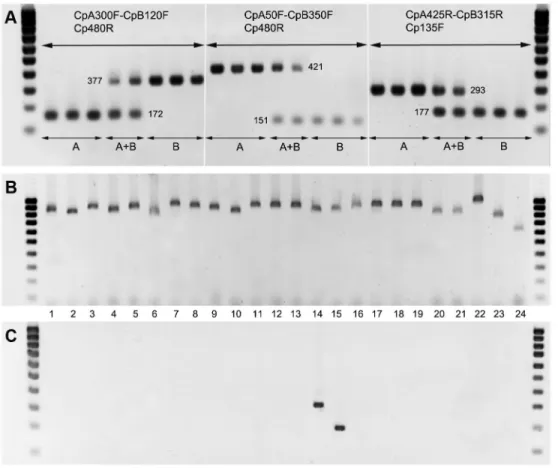
Figure 4A shows typical bands obtained by electrophoresis of PCR products from each C. pruni group using the three primer sets designed to amplify the ITS2 region. For primer set 1, the expected PCR products are 172 base pairs (bp) for group A and 377 bp for group B. For primer set 2, the expected PCR products are 421 bp (A) and 151 bp (B), and for primer set 3, the expected PCR products are 293 bp (A) and 177 bp (B). The mixtures of group A DNA and group B DNA (holes A +B on Figure 4A) resulted in two bands of the expected sizes.
Eight individuals per sample (males or females assigned to groups A and/or B based on their microsatellite genotype) were tested with the three primers sets. All amplicons obtained were of the expected sizes (Table 1). Seven, eight and two individuals resulted in no band for the primer sets 1, 2 and 3, respectively. For each sample, the remaining individuals (178 from group A and 103 from group B) were tested with at least one primer set. Only 2% produced no fragment in one PCR, but all of the 799 individuals produced expected amplicons in at least one PCR. None produced two bands. The amplification
with primer set 2 seems less efficient for the individuals in group B: the fragments appeared to be the faintest with set 2 than with set 1 or 3 for almost all of the individuals that we tested. Amplification of DNA from C. pruni males and females revealed no difference.
The specificity of the three primer sets for C. pruni was evaluated by performing PCR assays on individuals of 22 other psyllid species. All were amplified at the ITS2 region with the generic primers (Figure 4B), but none showed amplification with any of the primer sets designed for C. pruni. Indeed, amplicons were obtained only for the C. pruni individuals, corresponding to lanes 14 and 15 in Figure 4C, which shows results for primer set 3 (results not shown for primer sets 1 and 2).
Discussion
The perfect match between microsatellite clusters, ITS2 clades and amplicon sizes demonstrates that ITS2 is a reliable marker to identify groups of C. pruni that remain Figure 2. Positions of the primer binding sites in the internal transcribed spacer 2 (ITS2) of C. pruni groups A and B. Primers are shown in black for set 1, gray for set 2 and white for set 3.
undifferentiated morphologically. Because no individuals of the 799 tested produced amplicons of both sizes, there is no Figure 3. Neighbor-joining phylogeny of ITS2 sequences from individuals of C. pruni. Tip labels indicate the sample number of each insect (as defined in Table 1), followed by its sampling locality, individual number, sex (m for males) and assignment to genetic group corresponding to microsatellite genotype cluster A or B, according to Sauvion et al. [15]. Bootstrap support is indicated next to nodes when it exceeds 95%.
doi: 10.1371/journal.pone.0072454.g003
evidence for successful hybridization or introgression of ITS2 alleles between the genetic groups often found in sympatry, since such events would lead to heterozygous individuals. This result indicates that the genetic groups of C. pruni constitute biological species. Furthermore, divergence between ITS2 alleles within each C. pruni species is much lower than between species (Figure 3). Such deep reciprocal monophyly suggests that the C. pruni species did not exchange ITS2 alleles for a relatively long time [28]. Absolute estimates on the timing since complete isolation would require a molecular clock, which is not available in psyllids.
The failure to amplify the ITS2 locus in other species with our diagnostic primers probably results from mutations in primer binding sites, which were chosen for their polymorphism within C. pruni. In these conditions, it is extremely unlikely for an individual that produces one band of a certain size to be erroneously assigned. The fact that some C. pruni individuals failed to amplify with one given set of primers may result from technical errors or null ITS2 alleles. The use of several sets of primers will ensure successful identification of such individuals.
The diagnostic PCR developed here is a fast, cost-effective and reliable tool to assign individuals of C. pruni to genetic groups that appear to constitute divergent species. This tool will greatly facilitate studies that investigate the distribution areas of these species, their host plants and their ability to vector phytoplasma pathogens.
Figure 4. Amplicons from PCRs using the ITS2 primer sets designed for the characterization of C. pruni individuals. Panel A: typical bands obtained from single individuals belonging to groups A or B, and of pools of two individuals of each group (A+B) with each set of primers. The rightmost and leftmost lanes used a 100 bp DNA ladder. Numbers indicate the expected sizes of the amplicons. Panels B and C: PCRs using generic ITS2 primers FCM/B1D and the primer set 3 (Cp135F / CpB315R / CpA425R), respectively, on single individuals from the 24 psyllid species described in Table 2.
Acknowledgements
We are very grateful to Josiane Peyre for her valuable technical assistance, and the following individuals for their contributions of specimens of C. pruni and other psyllid species: Olivier Lachenaud (INRA-Montpellier, France) for providing C. bidens, C. melanoneura and C. notata from France; Philippe Robert (INH-Angers, France) for providing C. pyri from France; Snezana Tanaskovic (Faculty of Agronomy, Cacak, Serbia) for providing C. pruni from Serbia; Luigi Carraro (Dipartemento di Biologica Applicata, Udine, Italy) and Rosemarie Tedeschi (Di. Va.P.R.A. Entomologia e Zoologia applicate all’Ambiente, Univ. Torino) For providing C. pruni from Italy; Barbara Jarausch (RLP AgroScience GmbH, AlPlanta, Neustadt, Germany) for providing C. pruni from Germany; Patrik Kehrli (Station de Recherche Agroscope Changins-Wädenswil ACW, Nyon, Switzerland) for providing C. pruni from Switzerland; Renata Fialova and Milan Navratil (Fac
Sc. Palacky Univ., Olomuc, Czech Republic) and Pavel Lauterer for providing C. pruni, C. affinis, C. brunneipennis, C. crataegi, C. elegantula, C. hippophaes, C. peregrina, C. pulchra and C. rhamnicola from the Czech Republic; and Çiğdem Ulubaş Serçe (Mustafa Kemal Üniversitesi, Antakya/ Hatay, Turkey) for providing C. pruni and C. pyricola from Turkey. Exchanges of materials between laboratories were made possible thanks to the COST Action FA0807 (Integrated Management of Phytoplasma Epidemics in Different Crop Systems) (http://www.costphytoplasma.eu/ Accessed 2013 July 19).
Author Contributions
Conceived and designed the experiments: JP NS GL. Performed the experiments: JP NS. Analyzed the data: JP NS. Wrote the manuscript: JP NS.
References
1. Burckhardt D, Hodkinson ID (1986) A revision of the west palearctic pear psyllids (Hemiptera, Psyllidae). Bull Entomol Res 76: 119-132. doi: 10.1017/S0007485300015340.
2. Hodkinson ID (1974) The biology of the Psylloidea (Homoptera) : a review. Bull Entomol Res 64: 325-339. doi:10.1017/ S0007485300031217.
3. Hodkinson ID (2009) Life cycle variation and adaptation in jumping plant lice (Insecta: Hemiptera: Psylloidea): a global synthesis. J Nat Hist 43: 65-179. doi:10.1080/00222930802354167.
4. Burckhardt D, Lauterer P (1989) Systematics and biology of the Rhinocolinae (Homoptera, Psylloidea). J Nat Hist 23: 643-712. doi: 10.1080/00222938900770371.
5. Mifsud D, Burckhardt D (2002) Taxonomy and phylogeny of the Old World jumping plant-louse genus Paurocephala (Insecta, Hemiptera, Psylloidea). J Nat Hist 36: 1887-1986. doi: 10.1080/00222930110048909.
6. Campbell BC, Steffen-Campbell JD, Gill RJ (1994) Evolutionary origin of whiteflies (Hemiptera: Sternorrhyncha: Aleyrodidae) inferred from 18S rDNA sequences. Insect Mol Biol 3: 73-88. doi:10.1111/j. 1365-2583.1994.tb00154.x. PubMed: 7987524.
7. Shcherbakov DE (2007) Extinct four-winged precoccids and the ancestry of scale insects and aphids (Hemiptera). Russ Entomol J 16: 47-62.
8. White IM, Hodkinson ID (1985) Nymphal taxonomy and systematics of the Psylloidea (Homoptera). Bull Br Museum Nat Hist Entomol 50: 153-301.
9. Ouvrard D, Burckhardt D, Azar D, Grimaldi D (2010) Non-jumping plant-lice in Cretaceous amber (Hemiptera: Sternorrhyncha: Psylloidea). Syst Entomol 35: 172-180. doi:10.1111/j. 1365-3113.2009.00499.x.
10. Ouvrard D (2013) Psyl’list - The World Psylloidea Database. Available: http://www.hemiptera-databases.com/psyllist. Accessed 2013 July 19. 11. Burckhardt D, Ouvrard D (2012) A revised classification of the jumping
plant-lice (Hemiptera: Psylloidea). Zootaxa 3509: 1-34.
12. Hodkinson ID (1984) The taxonomy, distribution and host-plant range of the pear feeding psyllids. IOBC/WPRS Bulletins 7: 32-44.
13. Carraro L, Ferrini F, Ermacora P, Loi N (2004) Transmission of European stone fruit yellows Phytoplasma to Prunus species by using vector and graft transmission. In: G Llacer. . In: Proceedings of the XIXth International Symposium on Virus and Virus-Like Diseases of Temperate Fruit Crops: Fruit Tree Diseases. pp. 449-453
14. Steffek R, Follak S, Sauvion N, Labonne G, MacLeod A (2012) Distribution of 'Candidatus Phytoplasma prunorum' and its vector
Cacopsylla pruni in European fruit-growing areas: a review. Bull OEPP/
EPPO Bulletin 42: 191-202
15. Sauvion N, Lachenaud O, Genson G, Rasplus JY, Labonne G (2007) Are there several biotypes of Cacopsylla pruni? Bulletins of Insectology 60: 185-186.
16. Hebert PDN, Cywinska A, Ball SL, DeWaard JR (2003) Biological identifications through DNA bar codes. Proc R Soc Lond B Biol Sci 270: 313-321. doi:10.1098/rspb.2002.2218. PubMed: 12614582.
17. Farris RE, Ruiz-Arce R, Ciomperlik M, Vasquez JD, Deleón R (2010) Development of a ribosomal DNA ITS2 marker for the identification of the thrips, Scirtothrips dorsalis. J Insect Sci 10: 26. PubMed: 20578948. 18. Liu D, Trumble JT, Stouthamer R (2006) Genetic differentiation between eastern populations and recent introductions of potato psyllid (Bactericera cockerelli) into western North America. Entomol Exp Applicata 118: 177-183. doi:10.1111/j.1570-7458.2006.00383.x. 19. Sauvion N, Lachenaud O, Mondor-Genson G, Rasplus J-Y, Labonne G
(2009) Nine polymorphic microsatellite loci from the psyllid Cacopsylla
pruni (Scopoli), the vector of European stone fruit yellows. Mol Ecol
Resour 9: 1196-1199. doi:10.1111/j.1755-0998.2009.02604.x. PubMed: 21564874.
20. Milligan BG (1998) Total DNA isolation. In: AR Hoelzel. Molecular genetic analysis of populations: a practical approach. 2 ed. Oxford, UK: Oxford University Press. pp. 43-44.
21. Sambrook J, Russell DW (2001) Molecular Cloning: A Laboratory Manual. Cold Spring Harbor Laboratory Press.
22. Ji YJ, Zhang DX, He LJ (2003) Evolutionary conservation and versatility of a new set of primers for amplifying the ribosomal internal transcribed spacer regions in insects and other invertebrates. Mol Ecol Notes 3: 581-585. doi:10.1046/j.1471-8286.2003.00519.x.
23. Drummond AJ, Ashton B, Buxton S, Cheung M, Coope RA et al. (2010) Geneious v5 Available: http://www.geneious.com. Accessed 2013 July 19.
24. Saitou N, Nei M (1987) The Neighbor-Joining method - a new method for reconstructing phylogenetic trees. Mol Biol Evol 4: 406-425. PubMed: 3447015.
25. Swofford D (2002) PAUP*. Phylogenetic Analysis Using Parsimony. (* and Other Methods). p. 4.0b10 ed. Sunderland, USA: Sinauer Associates.
26. Kimura M (1981) Estimation of evolutionary distances between homologous nucleotide-sequences. Proceedings of the National Academy of Sciences of the United States of America-Biological Sciences 78. pp. 454-458.
27. Posada D, Crandall KA (1998) MODELTEST: testing the model of DNA substitution. Bioinformatics 14: 817-818. doi:10.1093/bioinformatics/ 14.9.817. PubMed: 9918953.
28. Avise JC (2000) Phylogeography, the history and formation of species. London: Havard University Press. 447pp.