CONTEXT AND STRATEGY FOR LOCAL HOUSING INITIATIVES: THE BOSTON LINKAGE PROGRAM
by Paul R. Poston
M.A. Economics, Tufts University (1983)
B. A. cum laude, Harvard College (1975)
Submitted to the Department of Urban Studies and Planning in Partial Fulfillment of the Requirements
for the Degree of MASTER OF SCIENCE in Real Estate Development
at the
Massachusetts Institute of Technology September, 1991
© Paul R. Poston, 1991. All rights reserved
The author hereby grants MIT permission to reproduce and to distribute copies of this thesis document in whole or in part.
Signature of Author _______________________
Dejartffieni of Urban Stibies andPlanning September, 1991 Certified by
Langley Keyes Professor, Urban Studies and Planning
Thesis Supervisor Accepted by
Gloria Schuck Chairperson, Interdepartmental Degree Program in Real Estate Development
MA "SACUETTSNSTITU TE OF TCNOi (GY
CONTEXT AND STRATEGY FOR LOCAL HOUSING INITIATIVES: THE BOSTON LINKAGE PROGRAM
by Paul R. Poston
Submitted to the Department of Urban Studies and Planning on September, 1991 in partial fulfillment of the requirements for
the Degree of Master of Science in Real Estate Development
ABSTRACT
The use of impact fees imposed on downtown office and commercial
development to help finance construction of housing affordable to low- and moderate- income urban residents emerged in the 1980's as a major local housing policy in selected cities, including San Francisco and Boston. During the development boom of the 1980's, programs based on these fees generated and disbursed substantial local subsidies for the construction of affordable housing units. These programs are viewed as politically important to city administrations and urban planning and redevelopment authorities, and the funds generated are considered by non-profit developers, community-based housing activists and others as a critical source of project finance for
affordable housing developments.
Both the economic and political environments have changed substantially in the ten years since the linkage programs were enacted. These changes, along with the potential for legal challenges, present risks for the programs. The objective of this thesis is to examine the impact of these changing
circumstances on the linkage program in Boston. How have these changed circumstances impacted the structure, financing and objectives of these programs? What is the outlook for the Boston linkage program in a changed real estate market? What strategies have been implemented or are available to local officials and non-profit developers to assure continued funding of the linkage program?
Thesis Supervisor: Prof. Langley Keyes
Acknowledgements
Thanks to my thesis supervisor, Prof. Langley Keyes, whose counsel and critical commentary were crucial to keeping this work focused. Thanks also to my editor, Marcia L. Smith, for her careful good eye and, as ever, good
humor.
I gratefully acknowledge the generosity of the Center for Real Estate Development at MIT and the RREEF Funds for their financial support. This work was sponsored in part by the Mitsubishi Research Institute. I am deeply indebted to my family for their support, patience and
perseverance with me through both the thesis and the year. When the days got long, and the nights longer, the love and encouragement of Marilyn, Kem and Liana kept me going. I could not have done it without them.
This is dedicated to them and to my mother, Mrs. Eloise M. Poston, and to the memory of my father, Dr. Paul L. Poston.
Table of Contents
Chapter 1. Introduction and Statement of the Problem...1
Why is Linkage Important?... 2
Statement of the Problem... 3
O verview ... 7
Chapter 2. The Lineage of Linkage Programs: A Literature Review...9
Development Exactions: An Historic and Regulatory Context...14
Inclusionary Zoning and Linkage Programs ... 20
Development Rights and Community Benefits: Other Linkages...21
Chapter 3. The Boston Linkage Program... 26
An Overview of the Boston Linkage Program...26
The Politics of Linkage in Boston...27
The Structure and Organization of the Boston Program...34
Performance of the Boston Linkage Program, 1985-1990 ... 41
Chapter 4. Linkage and the South End Neighborhood Housing Initiative: A C ase Study... 53
Background on SENHI... 53
Financing Affordable Housing Projects in Boston...56
The Role of Linkage in the SENHI Projects...57
Chapter 5. Planning for Survival: The Boston Linkage Program in the 1990's...65
C apitalization of the Trust... ...66
Commercial Development in Boston in the 1990's: The Outlook...72
Implications of Development Forecasts for the Linkage Program...73
Chapter 6. C onclusions... 78
A p p en d ices... ... 81
Appendix 1. Types of Development Impact Fees: A Summary...82
Appendix 2. Inclusionary Zoning: An Historical Perspective...84
List of Tables
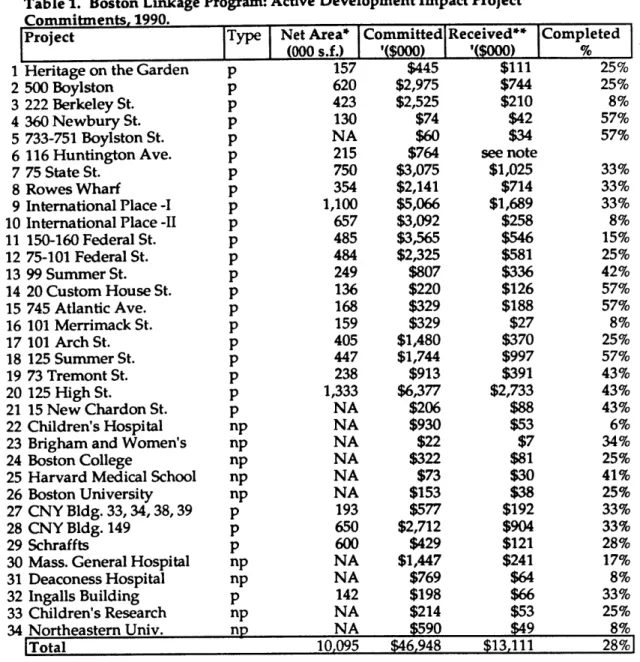
Table 1. Boston Linkage Program: Active Development Impact Project
C om m itm ents, 1990 ... 43 Table 2. Boston Linkage Program: Number of Units Created and Funds
Expended.Through October, 1989...49 Table 3. Taino Towers Condominium Source of Funds...62 Table 4. Neighborhood Housing Trust Revenue and Expense,
1987-1990...---... .. ---.... ... ---... . . ... 70
List of Figures
Figure 1. Relationship of Development Exactions to
Housing-Com m ercial Linkage Program s... 12 Figure 2. Relationship of Housing-Commercial Linkage Programs to
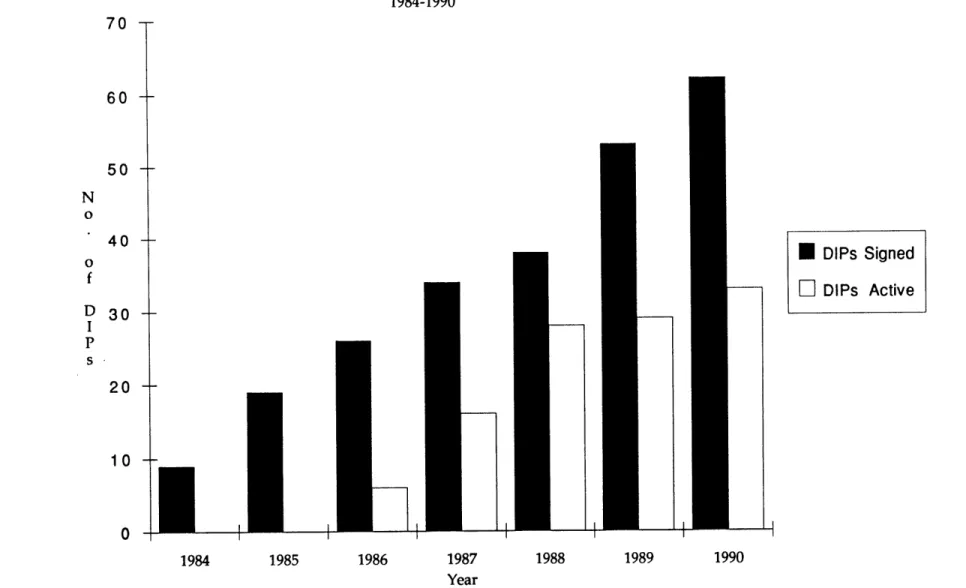
Other Forms of Land Use Regulation ... 14 Figure 3. Development Impact Project Agreements Signed and Active
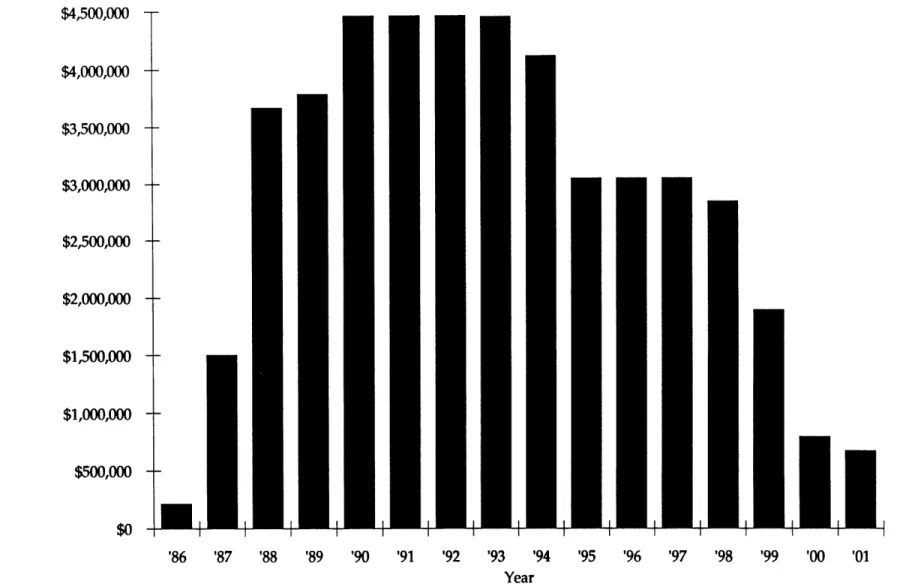
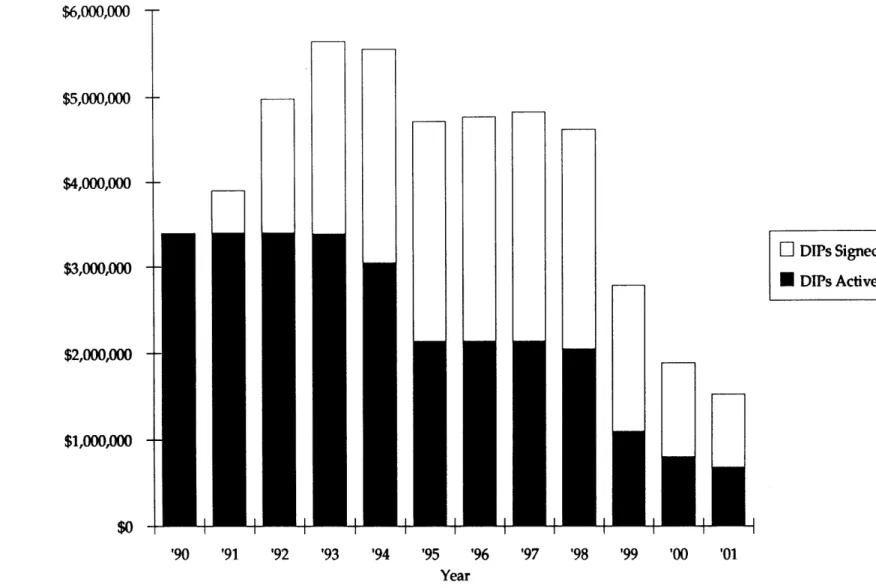
by Year, 1984-1990... ---... -.. --... ... 45 Figure 4. Development Impact Project Agreement Payments: 1986-2001...74 Figure 5. Projected Linkage Revenue, 1991-2001...76
Chapter 1. Introduction and Statement of the Problem
In the 1980's, a number of municipalities in the U.S. instituted new policies which defined a more activist and progressive role for local government in the housing field. These policies yielded a set of programs, generally referred to as "linkage", which imposed fees on commercial development to help finance affordable housing projects. Linkage policies emerged as a response of selected local governments to a perceived imbalance between the pace of commercial development in the downtown core and the declining availability of housing affordable to low- and moderate-income urban residents. Principal U. S. cities implementing these linkage programs are Boston, Massachusetts and San Francisco, California.
Cities enacting linkage programs share certain common characteristics. A robust commercial development sector is fundamental, as it is this climate which both creates the conditions requiring the programs and generates fees used to help create new affordable housing. Second, there must exist a critical need for such housing. This need may be indicated by low vacancy rates; physical deterioration of an aging housing stock; rising property values; and housing costs rising faster than incomes, particularly low incomes. It is these circumstances which constitute the need for the programs and which also foster the political climate necessary for passage of the programs (Keating, 1986a).
Third, there must be an organized, sophisticated housing activist and non-profit development community which promotes the program concept. This core is essential for placing the need for the programs on the political agenda and in producing housing under program auspices. Finally, there must be
sufficient political will among elected officials, and votes among the
electorate, to support enactment of the programs. Whether formally initiated by amendment to the zoning code or by referendum, creation of the programs is fundamentally a political act.
Why is Linkage Important?
Linkage has become in the last decade both a source of revenue for cash-strapped municipal governments and a politically popular, although highly controversial, policy instrument. As a result, programs based on the San Francisco and Boston models have been developed and implemented in several urban areas, such as Santa Monica, Seattle and Princeton N.J.
(Keating, 1986a; Gallogly, 1987). Such programs have also been the source of contentious debate and have eventually been rejected in other localities, including Chicago and Cambridge, Massachusetts (Keating, 1986).
The use of this off-budget source of public finance has attracted considerable attention in the development community because of its potential impact on new commercial and affordable housing development projects. Commercial developers, housing activists, local officials and real estate lawyers are all vitally concerned with how the programs are implemented for both
economic and political reasons. To private commercial developers, linkage payments are often viewed as a tax on new development, which drive up project costs, increasing finance charges and rents, while driving down land values and rendering new projects uncompetitive with existing buildings or alternative sites not subject to the same requirements (Porter, 1988). To non-profit developers of affordable housing and other housing advocates, linkage funds are considered a crucial source of gap financing, that have taken on
housing projects have diminished. To local politicians in municipalities where housing affordability has emerged as a significant political issue and where there is a well-organized activist core focused on this issue, linkage has assumed substantive importance as a policy matter.
Linkage has also garnered attention in the legal and planning communities because of its implications for land use regulation and the planning process1. While the application of housing-commercial development linkage
programs may be limited to selected U.S. cities, these programs continue to spawn debate and study in both academic and development circles. Linkage programs pose legal, political, financial and other challenges for commercial
development. They also face similar challenges as a source of municipal finance, gap financing for affordable housing projects and social policy. These programs have, and will continue to have, an impact on urban development in the 1990's and beyond.
Statement of the Problem
At its core, linkage is a policy instrument of local government designed to address the issue of housing affordability. The programs seek to implement this social policy by identifying a new source of revenue and directing that revenue to write down the construction costs for new or rehabilitated housing units. This form of subsidy, combined with other local, state and Federal resources, has helped create and maintain thousands of housing units affordable to low- and moderate-income urban residents over the last decade (Keating, 1986a; Goetz, 1989; BRA, 1989).
1. See, for example, the Journal of the American Planning Association Volume 54, Number 1,
In Boston, the linkage investment of about $24 million over 5 years has been a small but significant part of a total investment of nearly $250 million in mixed-income housing in Boston. This investment has served primarily households with incomes at or below metropolitan area median income
(BRA, 1989).
Linkage funds have not by any means replaced or supplanted other forms of government intervention in housing markets. At best, program funds supplement state and other resources for affordable housing. Nor do the funds generated through the program represent a financially significant element of the total City budget (in Boston, annual developer payments under the program constitute only about 0.2%-0.5% of annual City
expenditures)2. However, the impact of this revenue source extends beyond the financial leverage realized, and is more than merely symbolic. The
program is an important source of political capital for the City administration, and is a key local investment in what might be termed the social
infrastructure.
A principal thrust of the City's overall shelter policy has been the
preservation and promotion of housing affordable to low- and moderate-income households (Drier and Ehrlich, 1991). The linkage program has been a central component of this local housing policy; and it has been crucial to specific policy objectives of the Boston Redevelopment Authority (BRA), the
2. Estimate based on $1 billion annual city budget (excluding school system budget) and $2 million annual developer payments. Developer payments under the linkage program are revenue to the Neighborhood Housing Trust, a trust fund established by the City, and are not
city agency that regulates the development process and which plays a key role in administering the Boston linkage program. Despite its success in
generating new housing opportunities, this key policy instrument is flawed in several important respects. These flaws are primarily structural in nature,
and could place this important program at risk. This risk exposure has the potential to undermine the success of the program over the long term. The sources of risk to the program are threefold. The first of these may be termed legal risk. This risk parameter stems from the regulatory nature of the program and its foundation in the municipal zoning code. The linkage
program originates from a set of municipal zoning practices, called
development exactions, concerning which an extensive body of case law has been developed primarily at the state court level. However, more recent
decisions by the U.S. Supreme Court have begun to transform the standards established by the lower courts. Linkage has yet to be measured by these new
and changing standards. To date, the Boston program is one of the few similar programs to have been subjected to legal challenge. That challenge was
turned back on procedural, not substantive, grounds (Garrity, 1986; Gallogly, 1987). Although the matter has not been pursued further in the courts, the basis of the challenge, and of the program, remains unresolved.
Some steps were taken following the suit to correct substantive deficiencies in the program, including an express authorization from the state legislature for the required zoning code amendments3. Although the Boston program has
3. The Massachusetts enabling statute contains language under its inclusionary zoning provisions
authorizing local actions such as the linkage program. Zoning in the City of Boston, however, is enabled under a separate act. See Andrew and Merriam, 1988; and Gallogly, 1987.
operated for several years without legal challenge, the fact that the issues raised in the earlier suit were not resolved raises the possibility that other suits may be filed at a later date (Garrity, 1986).
The second source of risk to the program stems from its origin as a response of elected officials to certain economic and political conditions. The program was created, is sustained and is used in a political context, to achieve political objectives. Changes in the conditions or context which gave rise to the
program will result in changes to, or possibly the demise of, the program. The Boston linkage program, while the legacy of one mayoralty, has operated
entirely under only one city administration. This administration has been characterized as sympathetic to the issues and needs of low-income housing; yet the management of the linkage program, particularly in its early years, was subject to criticism from the housing activist community. These
circumstances indicate the need for independent monitoring of the program. They also raise questions of how the linkage program will fare politically after the term of the administration which has operated it exclusively. These
factors characterize the political risk which the program faces.
The third, and most current, source of risk to the program is economic risk. The program depends almost exclusively on large-scale commercial
development as its revenue source. Since the late 1980's, the pace of new development in Boston has slowed substantially. Only one major project is scheduled to come on line between 1992 and 1996 (BRA, 1991). While several other large projects are proposed, the timing of their entries on the market is uncertain. The uncertain future of these projects creates volatility in the
dedicated revenue stream on which the City relies for its principal housing creation initiative.
These sources of programmatic risk - legal, political and economic - present different kinds of challenges and require different kinds of responses. In the design of and revisions to the Boston linkage program, efforts have been made to mitigate certain aspects of these risk factors. Nonetheless, the Boston program is still subject to significant risk exposure. To the extent that the
Boston program will be sustainable over the long term and represents a model for other municipal programs linking commercial development with that of affordable housing, these risk factors must be recognized and
understood. Overview
This thesis seeks to explore these factors and related questions concerning linkage programs as they currently function in selected U.S. real estate markets. The thesis stems from a more general understanding of the basis and structure of linkage programs, but will focus primarily on the
programmatic experience of Boston, Massachusetts. The exploration of these issues begins with an understanding of the legal and regulatory contexts
within which linkage programs are structured. The examination of the literature concerning the legal and regulatory basis for development exactions will lead to brief consideration of the political and economic contexts within which exactions are imposed. The evolution of linkage policies in the 1980's as a new form of development exaction will be described.
This contextual background provides a basis for more detailed consideration of the genesis, structure, operation and performance of the Boston linkage
program. Though not a critical evaluation, this examination of the Boston program will focus on the conditions under which that city's linkage program was promulgated and highlight the potential impact of such programs on production of affordable housing and commercial development. These
impacts will be more clearly illustrated through a brief case study of the use of linkage funds as gap financing for a mixed-income housing production
program sponsored by the Boston Redevelopment Authority, the quasi-independent planning and regulatory agency which provides certain administrative services in support of the City's linkage program. The case study will be used to illustrate the relative importance of linkage as a source of project finance for affordable housing projects.
The final chapters will consider how the outlook for downtown development in Boston will impact the achievement of the linkage program's goals. The strategic responses of the City administration and housing activists who are most concerned with advancing the affordable housing agenda will be considered.
Chapter 2. The Lineage of Linkage Programs: A Literature Review
In spite of the degree of controversy which enactment of linkage programs has engendered, there is a relatively limited body of literature pertaining to this subject. This reflects the relatively recent emergence of such programs, but may also be indicative of the limitations on their applications in other urban contexts. The literature which exists on linkage programs directly has been developed primarily in two sources: in the professional journals on planning and public policy; and in the popular press around specific events in the development and implementation of the programs. In addition, there is
a small but substantial body of material, both in case law and law journals, bearing on the questions posed by municipalities requiring cash or in-kind contributions from new development as a condition of regulatory approval. Few of the linkage programs currently operating have been subjected to extensive challenge in the courts. As a consequence, case law concerning fundamental constitutional issues raised by linking commercial development and the need for affordable housing has not been written yet to any great extent. These issues have nonetheless been of concern to lawyers and legal
scholars who focus on real estate law and municipal finance (See Babcock, et. al., 1987; Major, 1987; Henning, 1990).
Planning professionals and policy specialists have given attention to the issues raised by linkage programs. The use of such programs to support affordable housing and other social policy objectives is a fairly recent manifestation of the regulatory power of local authorities over land use. Because linkage programs have been perceived as an innovation in local land
use regulation, they have been the subject of study and debate in the planning literature (See Frank and Rhodes, 1987; Goetz, 1989; Huffman, et. al, 1988).
The origins and foundations of linkage programs have been considered generally from the perspective of local government's power to regulate land use through zoning and other regulatory devices. In part, this derives from a
municipal finance perspective and involves local government's concern with the ability to finance essential public services, a portion of the demand for which is created by new development. (Smith, 1987; Alterman, 1988). This view has been extended by the debate over local housing policy. A fundamental concern here is with the adverse affects of racial and economic discrimination on society, and with how land use regulation may exacerbate or be used to address these important issues (Mallach, 1984; Alterman, 1988). Analysis and critique of linkage programs has focused on the use of zoning as a tool of municipal finance and housing policy. In addition to the control exercised under zoning, municipalities also use their regulatory powers to leverage community benefits by negotiation with prospective developers.
The municipal finance issue stems from the practice of local government requiring new development to bear its associated infrastructure costs. This practice is known generally as development exactions. Typical examples of these exactions are requirements that commercial developers, set aside land within a subdivision for schools or provide connections to water and sewer systems. As an alternative to dedications, developers have been required to make in-lieu cash payments enabling municipal government to finance capital improvements or public services without strict reliance on the property tax or general obligation bonds. Exactions shift the burden of
financing capital improvements to those most directly benefitting and are designed to assist the community as a whole to absorb the consequences of new development.
Frank and Rhodes, in their introduction to the volume Development Exactions (Frank and Rhodes, 1987), defined exactions as "development regulations that require a builder or developer to give something to the city or county... or regulations requiring something be turned over to a common
maintenance entity...", such as a homeowners' association. They included in this definition mandatory land dedications, cash payments in-lieu of land, facility donations, impact fees, impact taxes and linkage payments to support affordable housing programs. As is evident from the Frank and Rhodes definition, the term exactions covers a broad range of policy instruments. Among these there are some quite clear distinctions, as between a land
dedication and cash payment. Distinction between some of these instruments, however, is more subtle, as between an impact fee and impact tax4. It is
further evident that these development regulations give municipalities broad power over new development, with important implications for landowners,
developers, existing residents and the tenants or residents of new commercial or residential projects. Figure 1 serves to illustrate the relationship between
linkage programs and more widely used and recognized forms of exactions.
4. Under a land dedication, a developer conveys to the municipality a parcel or parcels for a specific purpose, e.g. schools. Cash payments may be permitted in-lieu of the dedication, or charged as a fee or tax. An impact fee is assessed under the regulatory powers of the
municipality. Levying of a tax generally requires express authorization from the state legislature. See Heyman and Gilhool (1964) and Smith (1987) for more on these distinctions.
Linkage programs have also been considered in the context of how zoning regulations are used to achieve other local policy objectives, specifically concerning residential development, as opposed to use of the regulations as revenue generating mechanisms. This view, though not as widely subscribed in the literature, describes housing-commercial development linkage
programs as stemming from more recent innovations in land use regulation, particularly inclusionary zoning programs (see Mallach, 1984; Merriam, et. al.,
1985). Inclusionary zoning emerged as a regulatory tool to combat racial discrimination enforced through suburban zoning requirements in the 1960's and 1970's (Mallach, 1984). A summary of this view is presented in Figure 2.
Figure 1. Relationship of Development Exactions to Housing-Commercial Linkage Programs
The traditional exactions view of linkage programs focuses on the nature of the programs as a public finance mechanism used by municipalities to
generate local revenue. This view also implicitly compares the types of public benefits derived from traditional exactions policies, e.g. infrastructure
improvements, with a new concept of public benefits, i.e., affordable housing. Considering linkage programs in the context of inclusionary zoning
incorporates issues of social justice and equity in the debate. Inclusionary zoning requirements, however, have primarily addressed this issue in
suburban residential development which, through minimum lot size or other regulatory artifice, seeks to exclude more affordable housing options. Inclusionary zoning schema have been imposed with less frequency on commercial development as a requirement to contribute to or provide housing to the low and moderate income. However, the application of inclusionary zoning in downtown areas provides additional mechanisms to address housing needs of low- and moderate-income urban residents.
Other forms of linkage between commercial development and community needs, including housing, have been proposed and implemented in some
cities. These linkages have been implemented through other zoning mechanisms, such as incentive zoning and allocation of density bonuses. Negotiations between local regulators and private developers often serve as the basis for these linkages. Some commentators have suggested that such negotiations may achieve more benefits for a community than a formula-based approach by providing a more flexible and a more defensible basis for attaining the objectives of a linkage program (Susskind and McMahon 1988).
Planned Unit Development
Figure 2. Relationship of Housing-Commercial Linkage Programs to Other Forms of Land Use Regulation
[Adapted from Bosselman (1985)]
Development Exactions: An Historic and Regulatory Context
A fundamental change in land use regulation in the U.S. occurred with the introduction of zoning as a tool with which local governments could shape and control the character of land use. Prior to adoption of zoning regulations, which became widespread in the 1920's, municipalities had primarily
exercised control over uses through the application of nuisance law. The landmark Village of Euclid vs. Ambler Realty decision in 1926 set the stage for a number of subsequent court decisions which transformed the basis of local regulation of land use from nuisance principles to the exercise of the police power. It is this constitutional principle under which government is empowered to act to protect the health, safety, morals and general welfare of the public.
Much of the controversy surrounding development exactions generally and, by implication, linkage programs is whether the regulations under which such programs are promulgated are properly within the police power of local government (Smith, 1987). In addition, imposition of development exactions raises several fundamental constitutional issues. These concern equal
protection under the law; due process; taking of private property; and just compensation (Heyman and Gilhool, 1964). To the extent that linkage
programs are, because of their controversial nature, subject to legal challenge, these issues are critical.
As a tool of subdivision regulation, development exactions initially consisted of compulsory improvements required only on-site. These improvements included, for example, dedications of land for street construction. These early land dedications were of benefit to the developer, as the assumption by the municipality of responsibility for maintenance and repair expenses relieved the developer of these costs.
Two types of regulation later emerged for off-site improvements. These included capacity charges, e.g. requirements that water and sewer lines have
sufficient excess capacity to accommodate growth; and requirements to construct improvements outside the subdivision, such as widening an abutting street (Smith, 1987).
Some subdivisions because of size, location or other considerations, were unable to make land dedications sufficient for needed public improvements. In these cases, cash payments in-lieu of dedications were employed as an alternative mechanism. This approach was applied where available land was too small or otherwise inappropriate to meet anticipated needs.
A new class of exactions, called impact fees, was later introduced as a
mechanism by which municipalities could help finance the cost of growth. These fees were distinguished from the cash-in-lieu of land dedication
approach in that the fee was not tied to the acquisition of land for the purpose of building roads or sewer lines (see Appendix 1). Stroud defines these fees as consisting. of:
a cash payment.. .usually calculated on the basis of the development's impact on specific public facilities such as roads, parks, or drainage. The community earmarks the payment to be used for expanding the capacity of the specific facility (Stroud,
1987).
Since their introduction, exactions of all types have been the subject of legal challenges. To date, linkage programs have not been challenged extensively in the courts. The constitutional and legal bases of other types of exactions provide an understanding of how linkage programs are structured and how legal challenges to the programs may occur in the future.
Legal Basis for Exactions
Heyman and Gilhool (1964), in their article on the constitutional basis for subdivision exactions, make clear the fundamental bases for the analysis of development exactions as regulatory tools; that is, whether the ability of local government to require exactions derives from the police power or the power to tax. This distinction provides the basis for understanding how local
governments are empowered to require exactions generally, and linkage programs specifically.
One of the central questions raised in numerous court cases challenging the land use regulations of local and state governments has been whether the
exercise of the police power is reasonable. Smith (1987) notes that state authorizing statutes under which local governments have required land dedications have been upheld on constitutional grounds if they are shown to be reasonably related to the achievement of legitimate governmental
objectives founded in the public welfare, and therefore within the police power of the state. This reasonableness test was articulated by the Supreme Court in Associated Home Builders vs City of Walnut Creek (Smith, 1987).
Heyman and Gilhool identify four principles on which the courts have based decisions in land use cases concerning the proper exercise of the police power. These include whether a given regulation is arbitrary, confiscatory,
discriminatory, or constitutes a taking of private property.
Land dedications for streets, sewers, and other infrastructure are generally upheld in the courts, so long as they have not been found to be arbitrary, confiscatory or discriminatory. Dedications of land (e.g., for streets) have also not been deemed as taking of private property so long as "...there is some rational relation between the needs normally generated by a use and the conditions imposed on a use..." (Heyman and Gilhool, 1964).
Land dedications for school and park sites and imposition of fees to finance the acquisition of such sites introduced new principles for measuring the legality of exactions. A case in the Illinois Supreme Court, Rosen vs Village of
Downers Grove, introduced the notion that costs "specifically and uniquely
attributable" to a subdivision may be required to be borne by the subdivision. A subsequent case, Pioneer Trust and Savings Bank vs Village of Mount
Prospect, citing Rosen, raised this notion to the level of constitutional
required that exactions directly benefit the subdivision to which they are related. This represented a departure from the conventional police power analysis (Connors and High, 1987).
The Florida court, in Wald Corporation vs. Metropolitan Dade County articulated the rational nexus test, which further requires that there be a connection between the exaction required and the benefits received by those who bear the burden of the exaction (Smith, 1987). The Wisconsin court, in
Jordan v. Menomonee Falls, is also credited with first applying the rational
nexus test (Snyder, 1985; Gallogly, 1987). The development of this test stems from the work of Heyman and Gilhool cited above. Stroud (1985) observes that the rational nexus test is a cost accounting approach used to balance local government's revenue needs against the private developers cost concern. The purpose of the test is to ensure that public benefits for which the public would ordinarily pay are not unfairly imposed on new development (Major, 1987).
These land use decisions have primarily been the province of the state courts. The U.S. Supreme Court rendered a recent decision which may set a new standard for land use regulation, and which has implications for linkage programs. In overturning a land dedication upheld by the lower courts, the Supreme Court in Nollan vs. California Coastal Commission articulated as a new standard that a land use regulation must "substantially advance a
legitimate state interest". Andrew and Merriam note that the Nollan decision has implications for linkage programs in that there must be "sufficient evidence in the record of the required nexus between the need advanced and the proposed prohibitions, exactions and conditions" which accompany a linkage program (Andrew and Merriam, 1988).
The thrust of these principal court decisions has been that there must be a clear relationship demonstrated between the requirements imposed on new development and the costs which new development creates for the
community. The standards which these decisions have established have been fairly inflexible, as in the "strictly and uniquely attributable" test; or have required precision in the allocation of costs imposed, as in the use of cost accounting techniques which underlie the development of the rational nexus test. The newer "substantially advances" test of Nollan may constitute a new, more rigid constitutional standard which a linkage program must meet. Considering linkage programs as an exaction on commercial development requires that the design of the programs meets these crucial tests of legal validity. In particular, program design must be prepared to specifically address the question of the affect of commercial development on housing availability
and affordability. The focus of this design consideration may need to be at the project level, demonstrating how a particular project impacts the community and how the mitigation measure offsets those specific impacts.
Development exactions came to prominence as a regulatory tool in the context of residential development, where their principal application was in financing infrastructure. They had not been considered as an instrument of local housing policy until the advent of linkage programs.
Zoning regulations have, however, been used in other contexts as
instruments of housing policy. Inclusionary zoning is an example of this application which, in its basic goals and objectives, is closely associated with development of programs linking housing and commercial development.
Inclusionary Zoning and Linkage Programs
Inclusionary zoning programs and the ordinances on which they are based are a relatively recent innovation in land use planning and practice. Like
development exactions, they developed primarily in a suburban context, but their focus is not so much on the provision of public services but with the composition of the community. The goal of such programs is to increase housing opportunities for the low- and moderate-income of all races in all communities (See Appendix 2).
Inclusionary housing programs have been instituted in a number of states. Local governments in New Jersey and California have been leaders in enacting these programs, but they have been applied in other states as well, including Massachusetts. These programs were instituted in response to a
practice in certain suburban communities of using zoning regulation to maintain the homogeneous character of the community. By imposing
restrictions on lot size (and therefore house price), housing design (restricting lower cost design or multi-family structures) or other forms of growth
control, zoning regulations were used for the sole purpose of excluding racial or ethnic minorities and lower income households (Mallach, 1984).
Legal Basis for Inclusionary Zoning
Inclusionary housing programs and ordinances must pass the same constitutional muster as development exactions. Inclusionary zoning ordinances, properly authorized, derive from the police power and government's legitimate interest in the community's general welfare (Mallach, 1984). Mandelker observes that the principal objections to inclusionary ordinances are, as with development exactions, based on
constitutional questions of substantive due process and taking of property without just compensation (Mandelker, 1985).
The due process objection to inclusionary zoning is based on the argument that it is designed to achieve socioeconomic, rather than physical objectives. Mallach dismisses this objection, citing the most significant legal decision on inclusionary housing, Southern Burlington County NAACP vs. Township of Mt. Laurel, where the New Jersey Supreme Court argued that zoning, as a rule, has either a socioeconomic impact or motivation (Mallach, 1984).
Mandelker sees Mt. Laurel applying to commercial development: Office development in downtown areas can affect the housing market by removing housing units from the housing stock, and by creating employment opportunities for lower income households who need housing close to where they work. An inclusionary zoning ordinance that requires office developers to include lower-income housing units in their projects, or to pay in lieu fees to the municipality to help meet the lower income housing needs their projects generate, is a proper use of the zoning power. (Mandelker,
1985).
Inclusionary zoning has not been treated as an exaction by the courts. Mandelker (1985) notes that the "purpose served by inclusionary zoning is
new, but it falls in the family of land-use controls that regulate the use to which land is put. " Bosselman comments that this analysis fails to recognize that courts have required, at minimum, that a reasonable relationship be shown between requirements imposed on new developments and the needs they create (Bosselman, 1985b). Inclusionary programs, including linkage, if challenged in court, may need to meet this crucial test.
Development Rights and Community Benefits: Other Linkages Out of the land use regulatory process have emerged other tools to
and inclusionary zoning. These tools are also derived from the control which municipalities exert over land use through zoning, and are used to obtain a wide range of community benefits, including, in some circumstances,
construction of or contributions toward affordable housing. How the tools are applied depends on factors such as the economic climate driving
development and the ability of local officials to negotiate effective deals. These tools include incentive zoning and negotiated development.
Incentive Zoning
Under incentive zoning, a local regulator may permit a developer to exceed established height limits or development densities set forth in the zoning code where this approval is conditioned on the provision of certain
community betterments. This policy was used extensively in New York and other cities in the 1950's and 1960's to obtain public amenities, such as open space 5. Density bonuses have also been used as an incentive for residential developers to include low- or moderate- income housing under inclusionary zoning schemes (Mallach, 1984). In the commercial development context, it does not appear that the awarding of density bonuses or other incentives has been used on a widespread basis to promote affordable housing or other goals.
Negotiated Development
Negotiated development is a process in which the regulating authority places everything 'on the table'. It is important to distinguish exactions of the type defined by Frank and Rhodes (1987) from other contributions required of developers, and specifically to distinguish linkage programs from other
policies with similar effects. For example, as Keating (1986b) points out, density bonuses may be conditioned on provision of amenities or, in some cases, construction of affordable housing. Often the nature of the amenities sought or obtained are not determined by any fixed criteria. These negotiated linkages differ from the programmatic ones in their case-by-case application.
Other Forms of Linkage
Local authorities may link development activity with other requirements of a commercial developer. In Boston, for example, a policy emerged at about the same time as the linkage program requiring a percentage of jobs created during a project's construction phase be awarded to Boston residents,
minorities and women. The policy is enforced under municipal ordinance.
Other contributions or community benefits may be required of developers. Examples of such contributions, in addition to the linkage payment for
affordable housing projects in Boston, include payments for improvements to a public park, widening of streets and sidewalks, payments for archaeological studies at the construction site, an outreach and education program for local youth, and construction of facilities for public services, to name a few6.
These contributions are also often negotiated on a case-by-case basis. Their scope, the types of benefits received and the costs to the community and the developer can vary widely. The value of benefits to the community depends largely on the relative negotiating skills of public officials and private
developers.
The West Coast Experience
Formal programs linking commercial development with the housing needs of low- and moderate-income communities emerged first on the West Coast. Major (1987) credits the City of Palo Alto, California, with formulating the first such program in 1980, in response to a development proposal by one of
the city's largest corporations. In 1981, the City of Santa Monica, in Southern California, instituted a program requiring commercial developments to pay impact mitigation fees to be used for affordable housing development and open space as well (Keating, 1986a). Perhaps the most well-known program was instituted in San Francisco in 1980 (Gruen, 1985; Keating, 1986a; Goetz, 1989). The San Francisco program was initially targeted to increasing housing production generally, and later toward affordable housing in particular. In addition, the City of San Francisco imposes transit impact and other fees on new development.
The basis for the San Francisco program was originally derived from the California Environmental Quality Control Act, with provision of housing required to mitigate the adverse impacts of commercial development on the socioeconomic environment. This program rationale may have been
borrowed from legislation proposed (but not enacted) in Massachusetts which would have required large-scale development to undertake impact mitigation measures. In any event, the cross-fertilization of ideas between the West and East coasts led to consideration of the San Francisco approach to linking downtown and neighborhood development and adoption of a similar model in Boston.
The literature on development exactions and inclusionary zoning provides a number of guide posts for the proper design of programs linking commercial development with affordable housing. The tests of validity established in case law on development exactions make clear the importance of empirical
evidence demonstrating the need for affordable housing created by new development activity. Without such evidence, it is doubtful that a linkage program would survive if challenged in court.
Inclusionary zoning, under which local authorities use their zoning powers to help preserve and create affordable housing opportunities, may serve successfully as a basis for a linkage program. However, such programs must meet similar constitutional tests as development exactions.
The impact of the Supreme Court decision in Nollan has not yet been measured on linkage programs. It remains to be seen whether municipal efforts to promote affordable housing through imposition of linkage fees
"substantially advances" a legitimate state interest. This uncertainty, as well as the need to design programs to meet more established constitutional tests of validity, poses an element of legal risk in the design and operation of linkage programs.
Chapter 3. The Boston Linkage Program
Boston was one of the first U.S. cities to enact a program linking commercial development and neighborhood needs, and it has pursued the program with vigor since it was proposed officially in 1983. While the program concept as implemented in Boston drew from the earlier experiences on the West Coast, there are aspects of the program which are unique to the political and
economic climate in Boston.
An Overview of the Boston Linkage Program
The Boston linkage program was created as a result of the fortuitous, though perhaps troubling, confluence of a political watershed and divergent
economic trends: the election, after 16 years, of a new mayor; and the persistence of poverty amidst the continued economic growth of the City. The sophisticated community of local housing activists was organized to make linkage a political issue; a slate of local progressive candidates likely to support a linkage proposal was about to come to power; the City had
weathered the economic recession of 1981-82, and real estate values and development activity, particularly downtown, were accelerating rapidly.
At the same time, there was a desperate need for lower cost housing. Selected indicators serve to characterize the magnitude of the problem. The waiting list at the Boston Housing Authority exceeded 6000 households in a city of only 540,000 (Advisory Group, 1983). The City of Boston median income in
1980 was among the lowest of the 50 major U.S. cities. Median rents in Boston in the mid-1980's were among the highest in the country (BRA, 1983;
Gallogly, 1987). Conditions were right in 1983 for positive action on a linkage proposal.
The Politics of Linkage in Boston
In 1983, Kevin White, Mayor of Boston since 1967, announced that he would not be a candidate for reelection. White's tenure had seen turbulence and controversy, innovation and, at one brief juncture, a brush with national politics. White had initially been elected as a reformer, bringing new vision
and new direction to a city that had become a victim of the prosperity of its suburbs. His regime had presided over successful efforts at downtown revitalization, among the most publicized of which was the enormously popular Fanueil Hall Marketplace. Yet it was also under his administration that the struggle for desegregation of the public schools resulted in the exacerbation of racial tensions and the imposition of court orders over daily operation for the nation's oldest school system. The local public housing authority was also operating under receivership and the city's finances were decimated, a result in part of the tax-cutting Proposition 2 1/2. At the end of his four terms, White was also leaving office under the cloud of federal and other investigations probing his activities and those of his close associates. The political stage was set for a marked change of direction in city
government.
The field of announced candidates to succeed White was initially crowded, but by the end of the primary election season it had narrowed to two principal
contenders: Melvin H. King, a former state representative who espoused a progressive political agenda; and Raymond Flynn, a City Councillor who cast himself in the populist tradition. The succession of either of these two to the mayoralty all but guaranteed dramatically new direction, including action on a linkage proposal.
King, who had unsuccessfully run against White four years earlier, had solid progressive credentials. A former youth worker and head of the Boston
chapter of the Urban League, he had long been active in local politics espousing a broadly inclusionary philosophy. The preservation and
promotion of affordable housing was a principal focus of his work. Among his legislative accomplishments during his tenure in the state legislature were sponsorship of bills to create a community development finance agency, which provides seed money and short-term lending to locally-based
community development corporations. King had also filed a bill (H-5236) in 1979 which adapted the environmental regulatory approach of impact assessment to urban development, requiring preparation and approval of Neighborhood Impact Statements for new development. Local officials and prospective developers would have been required to assess displacement and other adverse effects of major state or city actions, including issuance of zoning variances, implementation of urban renewal programs, or other
actions; and to implement impact mitigation measures. This was one of the first legislative attempts in Massachusetts to link new development with community needs.
A native of South Boston, Flynn also had an extensive record in local politics including serving terms in the Massachusetts House of Representatives as well as on the Boston City Council.
The campaigns of both candidates adopted a distinct neighborhood, as opposed to downtown, orientation. In this regard, the positions of both candidates on the linkage question were similar. Both candidates supported enactment and implementation of a linkage program emphasizing use of the
funds for low- and moderate-income housing. Both candidates supported a per-square-foot charge for most commercial development, although with some minor differences (e.g., how non-profit institutions such as hospitals
and universities would meet the obligation). Both candidates also supported adoption of an inclusionary zoning policy, under which new market-rate housing development would be required to include units affordable to low-and moderate-income households.
Underscoring local interest in creation of a linkage program, Bruce Bolling, a City Councillor, had proposed in March of 1983 a Home Rule petition
authorizing an Office/Housing Production Program modeled on the San Francisco program of the same name. The resolution was adopted
unanimously by the City Council. This backdrop - a long-time mayor allied with downtown business interests leaving office under a cloud; a pair of contenders to succeed him both strongly supporting the concept of linkage; and broad-based support for the program concept in city government - created a political climate conducive to creation of a program linking commercial development and affordable housing.
The Mayor's Advisory Group
Acknowledging the will of the City Council and recognizing that the outcome of the mayoral election would likely result in enactment of a linkage
proposal, Kevin White acted in the waning days of his administration to shape the new policy. In June of 1983, he appointed a commission composed of business and development interests, elected and appointed city officials and
selected housing activists, with a charge to evaluate the feasibility of alternative linkage proposals and to present an action recommendation.
The Majority Recommendation
Following a process of study, internal debate, and a series of public hearings at which various experts and community interests presented testimony, the Advisory Group issued its report to the Mayor. In summary, their
recommendation was:
[Tihat the linkage program be implemented city-wide and that new construction and substantial rehabilitation projects of more than 100,000 square feet in the aggregate be subject to the requirements of the program...The majority of the Advisory Group recommends that the developer contribute a fee of $5.00 per square foot. To mitigate the impact of this fee on project feasibility.. .the Advisory Group recommends that this contribution be paid over 12 years, beginning at the time of the granting of the certificate of occupancy or 24 months after granting the building permit, whichever occurs first. (Advisory Group, 1983).
The Advisory Group further recommended that the program be enacted through an amendment to the zoning code. This amendment would create a Development Impact District and require that projects needing zoning relief
which exceeded the 100,000 square-foot threshold would pay the $5.00 per square foot impact fee over 12 years.
The Dissenting Opinion
Two members of the Group issued a dissenting recommendation to the Mayor (Achtenberg and Wallis, 1983). In this dissent, they articulated some of the weaknesses of the Commission's recommendation. One consequence of the 12-year payment term was to reduce the contribution on a present value basis. The approach therefore minimized the funds available at any time to support affordable housing projects, which the fund was designed to achieve. Also, the wording in the recommendation did not restrict the uses of the
fund to subsidizing affordable housing development. Achtenberg and Wallis felt that the fund should be used particularly for the benefit of low-, as
opposed to moderate- income households.
The Changing of the Guard: The 1983 Mayoral Election
In an election replete with issues - including jobs, race, crime, and education to name a few - linkage emerged as one of the key issues, although there was general consensus among the candidates that a program would be adopted. In an outcome clearly divided along racial lines, Flynn won the 1983 mayoral election. While the changes to the zoning code promulgating the linkage
program were issued by the out-going White Administration, it would be the responsibility of the new mayor to implement the program.
Drier and Ehrlich (1991) note that the adoption of the linkage program, along with a number of similar initiatives, is indicative of a new order in urban politics, in which "non-elites" participate in development policy decision-making. They argue that development policy can be shaped in a democratic process, and use the linkage to illustrate how policy-making in Boston has been influenced by broader citizen participation. Their focus is on the importance of a governing regime which fosters, and is receptive to, such participation. However, housing activists working outside the administration have played an important role in the linkage program in Boston.
The Boston Linkage Action Coalition
Outside of the official structures, a group of housing activists organized to shape the terms of the debate on the linkage question. This group, called the Boston Linkage Action Coalition, was composed of tenant organizations, housing advocates, organizers and others concerned with the issue. Through
a strategy of attendance and testimony at public hearings, public pressure and use of the media, the Coalition focused public attention on the need for up-front payment of the fee, on the financial consequences for their constituents of deferring payment over a longer term, and on the issues of community representation and accountability of the Neighborhood Housing Trust, which would be empowered with distributing funds collected under the program.
The Coalition also challenged the City on the criteria used to award linkage funds. The specific concern was whether funds were being used to increase the stock of affordable units or were being directed to subsidize market rate units and for-profit developers (Reinert, 1986b; Boston Linkage Action Coalition, 1987). As a result of this scrutiny, the bulk of linkage funds are directed to non-profit development organizations, and one of the chief yardsticks used to measure the success of the program is the percentage of
affordable units created through linkage grant awards.
The involvement of the Coalition in setting the terms of the debate on the substance and implementation of the linkage program highlights the
underlying political nature of the program. It also clearly indicates the
potential problems which may arise with a program such as this, even when administered by an ostensibly sympathetic local government. An open
political process for programs such as linkage may be administratively inefficient, but it is essential to ensure adherence to program objectives.
The Legal Challenge: The Bonan Decision
The Boston program was subject to a legal challenge in 1985, one of the few linkage programs to be so challenged. Although the case was decided in favor of the plaintiff in the lower court, the decision was overturned on appeal,
largely on procedural grounds. In rendering its decision on appeal, the Supreme Judicial Court did not resolve the substantive question of the legality of the program. It can therefore be said that no linkage program has yet withstood a legal challenge on its merits.
The facts in this case, Bonan vs. City of Boston, involved the Massachusetts General Hospital, an operating subsidiary of the General Hospital
Corporation, seeking approvals to expand, with the scale of the proposed project meeting threshold criteria to invoke the linkage requirement. In response to this application, a Boston developer, one of whose projects is in proximity to the Hospital, sued on the basis that the size of the payments due
under the linkage program biases decision-making on zoning or other relief. The lower court accepted this argument, ruling that the enabling act did not authorize the zoning amendment and that the variance granted the Hospital was invalid (Gallogly, 1987). However, the decision was overturned on appeal on the basis that the developer had no standing to bring suit before the Court (Connors and High, 1987).
While this procedural victory ensured the continuation of the linkage program, it failed to settle any of the fundamental questions concerning the
legal basis for the program.
The challenge brought under Bonan identified a key weakness in the structure of the Boston program. At the outset, political expediency dictated that the program be promulgated through a change to the zoning code (Achtenberg, 1985). As a result of the inclusionary zoning debate in
Massachusetts, there is language in the general enabling statute which can be interpreted to permit fees such as that proposed under the linkage program.
was passed for the City of Boston in 1956; zoning in the City was therefore authorized under legislation distinct from that governing the rest of the state
(Gallogly, 1987). The inclusionary language present in the general statute was not also separately inserted into the enabling statute for Boston. As a result,
the need for a home rule petition, which had been thought a potential impediment in the development of the program, emerged as a key to the ability of the program to withstand any subsequent legal challenge.
In response, a home rule petition was filed in the state legislature amending the enabling act for Boston. The language in this petition specifically and expressly authorized the City of Boston Zoning Commission to:
Adopt zoning regulations or amendments thereto for the purpose of mitigating the effects of new large-scale commercial real estate development on the health and welfare of low- and moderate-income residents of Boston due to the unavailability of affordable housing in the City of Boston (M.G.L. Acts of 1986, Chapter 371).
The statute specifically authorizes the City to adopt a program in the form currently used, including imposition of fees based on floor area for the purposes of creating affordable housing and jobs training programs.
The Structure and Organization of the Boston Program
The fundamental features of the organization of the Boston linkage program are: (i) its regulatory basis under the zoning code; (ii) the use of the
Neighborhood Housing Trust as the intermediary for receipt of payments and distribution of funds; and (iii) the roles which the Boston Redevelopment Authority (BRA) plays in administering the funds, including the contractual relationship with commercial developers. As noted above, in light of the legal challenge which the program faced, the City also sought and has been
granted express authorization for the zoning code amendments under which the program is legally constituted.
Original Zoning Requirement
The recommendation of the Mayor's Advisory Group served as the basis for an amendment to the zoning code for the City of Boston, which was
promulgated on December 29, 1983. This code amendment, Article
26-Development Impact Projects, invoked the City's police power to promote the public health, safety, convenience and welfare as its authority and stated as its purpose to "increase the availability of low- and moderate-income housing by requiring developers ...to make a development impact payment to the
Neighborhood Housing Trust or to contribute to the creation of low- and moderate-income housing" (Boston Zoning Commission, 1983).
Article 26
Article 26 defined a "Development Impact Project" based on the 100,000
square-foot threshold in the Advisory Group's recommendation. Section 26-3 of the amendment required that no "variance, conditional use permit,
exception or zoning map or text amendment" shall be granted for a
development impact project unless the applicant had entered an agreement to pay the development impact project fee for each square foot of gross floor area above the 100,000 square foot threshold (Boston Zoning Commission, 1983).
The article also created as an alternative to cash payment a Housing Creation Exaction, under which a developer could build low- and moderate-income housing units at a cost equal to the amount of the payment exaction.