Publisher’s version / Version de l'éditeur:
Association for Preservation Technology Bulletin, 11, 2, pp. 60-75, 1979
READ THESE TERMS AND CONDITIONS CAREFULLY BEFORE USING THIS WEBSITE. https://nrc-publications.canada.ca/eng/copyright
Vous avez des questions? Nous pouvons vous aider. Pour communiquer directement avec un auteur, consultez la première page de la revue dans laquelle son article a été publié afin de trouver ses coordonnées. Si vous n’arrivez pas à les repérer, communiquez avec nous à [email protected].
Questions? Contact the NRC Publications Archive team at
[email protected]. If you wish to email the authors directly, please see the first page of the publication for their contact information.
NRC Publications Archive
Archives des publications du CNRC
This publication could be one of several versions: author’s original, accepted manuscript or the publisher’s version. / La version de cette publication peut être l’une des suivantes : la version prépublication de l’auteur, la version acceptée du manuscrit ou la version de l’éditeur.
Access and use of this website and the material on it are subject to the Terms and Conditions set forth at
Notes on dichromatic brickwork in Ontario
Ritchie, T.
https://publications-cnrc.canada.ca/fra/droits
L’accès à ce site Web et l’utilisation de son contenu sont assujettis aux conditions présentées dans le site LISEZ CES CONDITIONS ATTENTIVEMENT AVANT D’UTILISER CE SITE WEB.
NRC Publications Record / Notice d'Archives des publications de CNRC: https://nrc-publications.canada.ca/eng/view/object/?id=b4862dc4-0c6f-4c3b-a927-62921480f466 https://publications-cnrc.canada.ca/fra/voir/objet/?id=b4862dc4-0c6f-4c3b-a927-62921480f466
Ser TH1
N21d
I
$
National Research Conseil nationalCouncil Canada de recherches Canada
10.863 top. 2
.
it; ANOTES ON DICHROMATIC BRICKWORK
IN ONTARIO
P ~ ' A r , m
by
T.
RitchieReprinted from
The Association for Preservation Technology Bulletin VoL XI, No. 2, 1979
p. 60.75
DBR
Paper No. 863Division of Building Research
ABSTRACT
The u s e of d i c h r o m a t i c brickwork ( b r i c k s of two c o l o u r s ) f o r t h e d e c o r a t i o n of b u i l d i n g s was f a s h i o n a b l e i n O n t a r i o i n t h e l a s t c e n t u r y . The f a s h i o n f r e q u e n t l y i n v o l v e d t h e u s e o f b u f f o r yellow b r i c k s a t t h e c o r n e r s and around window and door openings of r e d b r i c k b u i l d i n g s , and a r r a n g e d i n decora- t i v e d e s i g n s i n t h e w a l l s . Examples a r e g i v e n of v a r i o u s d e c o r a t i v e f e a t u r e s used i n d i c h r o m a t i c brickwork, i n c l u d i n g diamonds, z i g z a g s , bands and c r o s s e s .
Le b r i q u e t a g e dichromatique ( b r i q u e de deux c o u l e u r s ) u t i l i s g pour d 6 c o r e r les b z t i m e n t s 6 t a i t P l a mode a u c o u r s du s i s c l e d e r n i e r . La mode d i c t a i t souvent l a pose de b r i q u e s c o u l e u r chamois ou jaune, dans les c o i n s e t a u t o u r d e s f e n s t r e s e t d e s o u v e r t u r e s de p o r t e s de b g t i m e n t s e n b r i q u e rouge, que l ' o n d i s p o s a i t e n p a t r o n dGcoratif dans l e s murs. Divers exemples de modPles d 6 c o r a t i f s ~u t i l i s 6 s dans - ~ -.- ~-. l e b r i q u e t a g e dichromf - ' l o s a n g e s , de z i p
NOTES ON DrCHROMATlC BRICKMORK I N ONTARIO by T. R i t c h i e
*
Examples o f d i chromatic brickwork ( b r i c k s o f two c o l o u r s )
,
usual l y o c c u r r i n g as w a l l s of r e d b r i c k w i t h b u f f b r i c k s a t the corners and around window and door openings, are common i,n Canada, p a r t i c u l a r l y i n Ontario where many b u i 1 di:ngs f e a t u r i n g t h i s decorative treatment were constructed i n t h e 1870's and l a t e r . The use of such brickwork, according t o ~ o w a n s , ~ followed a fashion f o r the use o f polychromatic brickwork and masonry t h a t came i n t o favour i n Engl i'sh a r c h i t e c t u r e o f t h e m i d-19th century.The polychromatic fashion of t h e 1 9 t h century was i n l a r g e measure a r e v i v a l o f t h e use of patterned brickwork t h a t had been introduced t o England i n mediaeval times. E a r l y brickwork, however, was o f subdued c o l o u r c o n t r a s t , achieved by s e l e c t i n g darker coloured b r i c k s and arranging them i n a simple diaper (diamond) p a t t e r n o r v a r i a t i o n s o f i t . The new fashion c a l l e d f o r sharply accentuated c o l o u r c o n t r a s t s such as b l a c k b r i c k s i n a background of b r i g h t r e d brickwork, as w e l l as the use of complex p a t t e r n s o r combinations o f patterns.
B u i l d i n g s designed b y W i l l i a m B u t t e r f i e l d d i d much t o promote t h e use o f t h e fashion i n England. The polychromati c decoration t h a t he employed i n A l l S a i n t s Church, London (comnenced i n 1849) a t t r a c t e d g r e a t a t t e n t i o n and
provided i n s p i r a t i o n f o r o t h e r a r c h i t e c t s . I t featured a background o f p i n k brickwork w i t h black b r i c k s forming b o l d s t r i p e s , bands and patterns, and a d d i t i o n a l b l a c k b r i c k s s e t i n diaper, zigzag and o t h e r decoration o f mediaeval i n s p i r a t i o n .
The new a r c h i t e c t u r a l fashion came i n t o use i n Canada w i t h s u r p r i s i n g r a p i d i t y , f o r many b u i l d i n g s erected i n the 1870's f e a t u r e d dichromatic b r i ckwork. I t s q u i ck appl i c a t i o n suggests t h a t Canadian a r c h i t e c t s and
b u i 1 ders kept up-to-date w i t h t h e 1 a t e s t developments i n English a r c h i t e c t u r e o r t h a t English a r c h i t e c t s and b u i l d e r s continued t o b r i n g w i t h them the c u r r e n t s t y l e s i n b u i l d i n g . I n Canada, however, dichromatic r a t h e r than
polychromatic brickwork was g e n e r a l l y employed; i t u s u a l l y consisted o f y e l l o w o r b u f f b r i c k s on a r e d background, except i n those regions where t h e c l a y f o r b r i ckmaking normal l y burned t o a ye1 low colour, i n which case r e d b r i c k s
provided the c o l o u r c o n t r a s t . Contrasting c o l o u r was a p p l i e d a t the corners o f b u i l d i n g s , along the sides o f door and window openings, i n arches, and i n decorative bands and p a t t e r n s .
*
M r R i t c h i e i s a research o f f i c e r w i t h t h e D i v i s i o n o f B u i l d i n g Research, National Research Counci 1 o f Canada.B u i
1 dings of di chromati c brickwork
i n Ontario show g r e a t d i v e r s i t y
i nthe way colour c o n t r a s t was used a s well as i n the e x t e n t of use.
I t s
application in many cases did not require any g r e a t s k i l l on the p a r t of the
bri ckl ayer; f o r example,
i na house
i nMerri ckvi 1 l e (Figure 1 (A)
)t h e col our
c o n t r a s t was obtained simply by the use of yellow headers t o c o n t r a s t
w i t hthe
red s t r e t c h e r s
i nbrickwork of Flemish bond.
In other buildings, however, more
i n t r i c a t e designs were often employed, such as
i nthe house a t Nobleton shown
i n
Figure 1
( B )with i t s s t r i k i n g , decorative use of zigzag corners, bands,
panels and arches.
Certain common f e a t u r e s o r p r i n c i p l e s of design observed
i nmany
examples of dichromatic brickwork a r e outlined
i nthese notes, which describe
buildings
i nOntario believed t o have been b u i l t
i nthe decades of the 1870's
and 1880's when di chromati c brickwork was very popular wi
t hbuil ders
.
Diamond and Zigzags
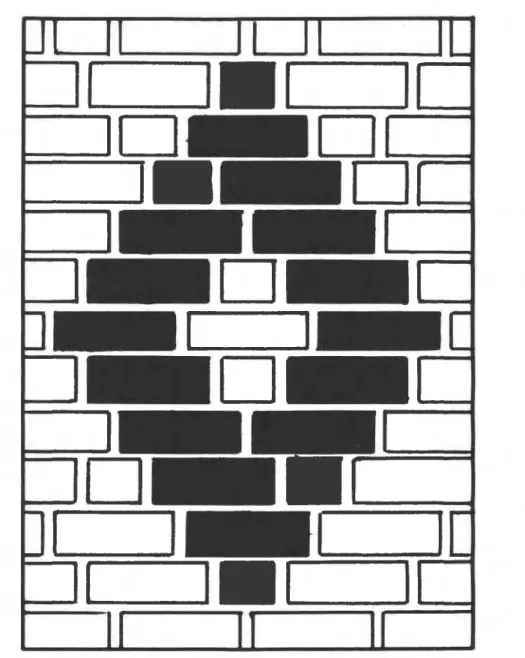
Much dichromatic decoration was based on the diamond p a t t e r n , which the
bricklayer could e a s i l y work i n t o a wall
;when he 1 aid a brick he located
i tnot d i r e c t l y over the brick beneath
it
b u to f f s e t from i t , usually by a half
o r occasionally a q u a r t e r of the b r i c k ' s length (112 lap o r 114 l a p ) . If he
selected c e r t a i n o f f s e t bricks of successive courses t o d i f f e r
i ncolour o r
shade from those of the
rest of t h e wall, t h e brick1 ayer could c r e a t e diagonal
l i n e s in the brickwork and these diagonals could be used t o form the diamond
pattern shown
i nFigure 2 , a t r a d l t i o n a l brickwork decoration; the amount of
overlap governs the slope of the l i n e s and thus the shape of t h e diamond.
By
reversing the slope of diagonals zigzag l i n e s could be formed, as in
Figure 3 ( a ) , a farmhouse b u i l t in 1873 near All i s t o n . The bricklayer
incorporated not only v e r t i c a l zigzag l i n e s
i nthe walls of
thisbuilding
b u ta l s o diamonds, crosses, and other embellishments. Decoration could a l s o be
based on half-diamonds and diamonds
w i t h i ndiamonds, as shown in Figure 3(B),
the wall of a building
i nBe1 levi 1 l e . Colour-contrasting bricks used without
being o f f s e t produced v e r t i c a l l i n e s
i na wall and when l a i d
i ncontinuous
courses formed horizontal bands.
Corners
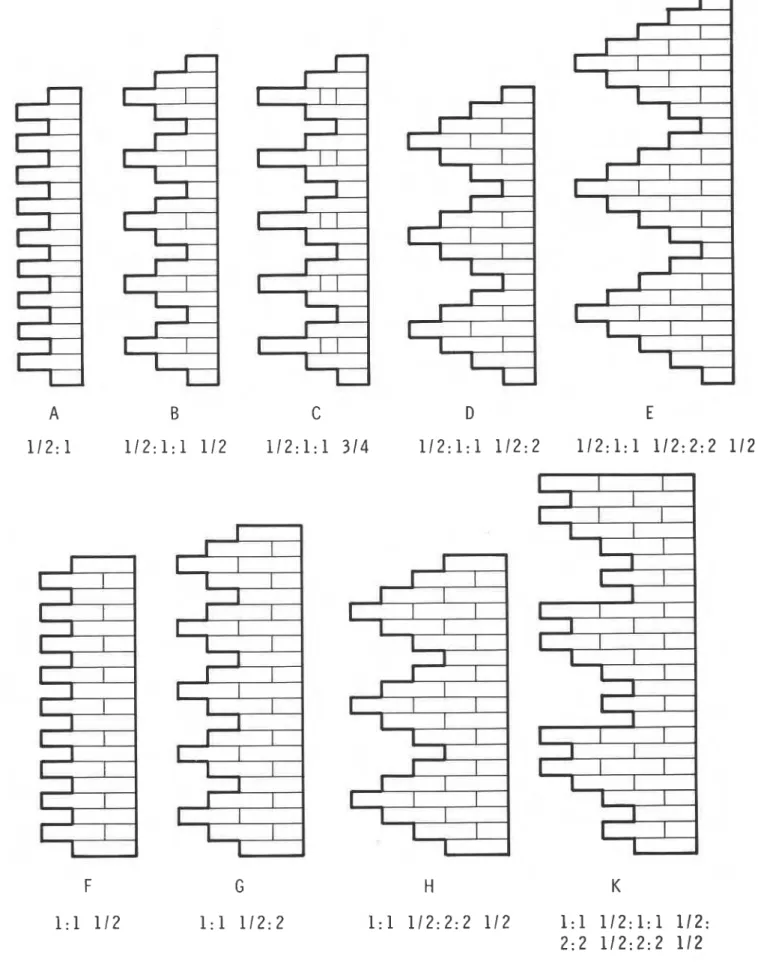
Various arrangements of colour c o n t r a s t a t the corners of buildings a r e
sketched
i nFigure
4.Those of t h e top row a r e based on a half-brick as the
s t a r t of the p a t t e r n ,
w i t hthe brick of the next course projecting beyond i t
by
a ha1 f-brick, except f o r an arrangement involving a t h r e e q u a r t e r brick
pro j e c t i on.
For the various arrangements a numeri cal expression
is given.
In t h i s way the pattern 112: 1
:1-112:
2s t a r t s with a half-brick and has
subsequent projections from the corner of one b r i c k , a brick and a h a l f , and
two bricks.
The corner arrangements shown
i nthe bottom row of Figure 4 s t a r t
w i t ha
f u l l brick and continue
w i t ha projection of a half-brick per course. All the
patterns except the l a s t of the bottom row a r e symmetrical.
Fig.
2Diamond pattern formed by the sloping lines made by
o f f s e t t i n g bricks of successive courses.
Fig. 1 (opposite)
( A )House a t Merrickville with dichromatic
brick of yellow header bricks and red s t r e t c h e r s in
Flemish bond.
( B )
Highly decorative di chromatic bri ckwork of house
a t Nobleton.
' SpUOUlP ~p-U!y7!M-SpUOUlP kp
pue spuowekp-4 Ley ~ J ! M a [ LnaL l a g uk 6u:pl knq JO u o g e ~ o ~ a a ( a )
In some buildings the corner design was a l s o used a t doors and windows.
For example, in the house a t Jasper shown a t the top of Figure 5, t h e pattern
i l l u s t r a t e d in Figure 4(A) i s continued
i nthe arches above windows and doors.
Another example of the use of one design a t corners, windows, and doors i s
shown
i nthe middle of Figure 5 , a farmhouse near Courtland
i nwhich the
pattern of Figure 4(C) may be seen. Another f e a t u r e of i t s brickwork
i sthe
s t r i n g of individual crosses, each centred beneath a s h o r t band o u t l i n i n g the
top of the walls.
In some cases the design used a t the corners was repeated
only in the upper p a r t s of the door and window openings, as i l l u s t r a t e d by
the bottom example of Figure
5,a house
i n Merrickvi l l e whose b u i l d e r used the
design shown
i nFigure
4(B).The use of d i s s i m i l a r designs a t the corners and elsewhere
i si l l u s t r a t e d in Figure
6 ,a farmhouse near Brownsville; i t s f o u r corners a r e
of the design shown
i nFigure 4 ( F ) , while around doors and windows,
i nthe
arches, and
i nthe bay p r o j e c t i o n s the design of Figure 4(A) was used.
Where corner designs of wide projection appear (Figure 4 ( E j ) ,
c o n t r a s t i n g bricks were sometimes f i t t e d
i n the projection t o accentuate the
diamond p a t t e r n . This may be seen
i nFigure
7 , a house a t Hagersvil l e whose
bricklayer did not c o r r e c t a mistake he made
i none of the diamonds (adjacent
t o the roof of the f r o n t porch). Crosses
i nthe gables and a form of double-
diamond pattern i n the w a l l s provide additional decoration of the brickwork.
Brick Quoins
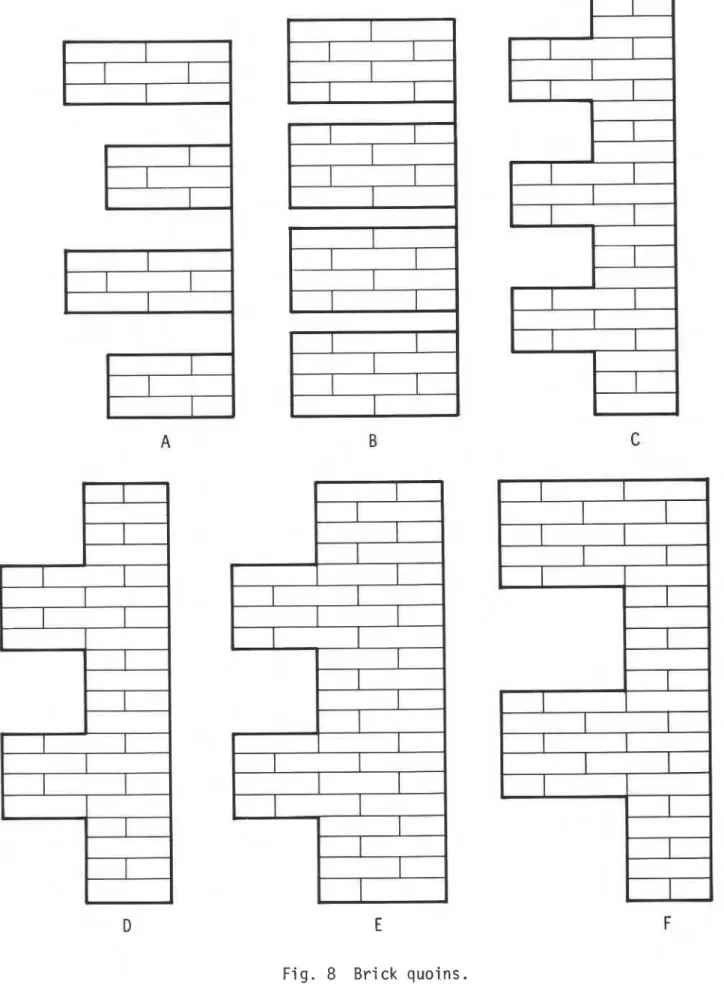
Various arrangements of brickwork used
i nimitation of the cornerstones
of masonry construction a r e sketched
in
Figure
8.Decorative treatments
i nconjunction
w i t hbrick quoins include zigzag
and diamonddecoration
such
as
t h a t
i nthe house shown in Figure
3 .I t has quoins
of thedesign depicted
i nFigure 8CC). Quoins of the design sketched
i n Figure 8(B) were used
i n afarmhouse near Bishop Mil 1s (Figure 91 t h a t
hasdecoration around windows and
doors of the type shown in Figure 4(A).
Other Corner Treatments.
The corners of c e r t a i n brick buildings were outlined with v e r t i c a l
s t r i p s of contrasting colour, as
i n the example shown
i nFigure 10, a bui 1 ding
in Brooklin th.at has corner s t r i p s two b r i c k s wide.
In addition, v e r t i c a l
s t r i p s one brick wide were provided alongside the top t h i r d of each door and
window, the tops merging i n t o th.e arch bricks. The bottoms of such s t r i p s
were provided
w i t ha s o r t of arrow-head design. Horizontal l i n e s were a l s o
provi,ded by a four-course band above the stone foundation and two
t h i nbands
a t the mid-height of th.e wall, one a s i n g l e course and the o t h e r a double
course.
Another band t h r e e courses hi'gh and incorporating d e n t i l s was placed
along the top of t h e walls.
A
s t r i king example of v e r t i c a l corner s t r i p s and di chromatic decoration
Fig
.
4Corner arrangements of col our-contras
t ing bricks
.
F i g . 5 Examples o f t h e same p a t t e r n used a t c o r n e r s , windows and d o o r s .
Fig.
6Dissimilar designs a t corners and elsewhere of a farmhouse near
Brownsvi'lle.
Fig. 8 Brick quoins.
s t r i p s have been used
i np a i r s a t the corners of the tower, a t the corners of
the building, and a t intermediate positions along the walls. Horizontal
bands connect each p a i r of s t r i p s , giving them a ladder-1 i ke appearance.
Other di chromati c decoration includes the e q u i l a t e r a l Gothic arches over
windows and doors and the s e r i e s of small l a n c e t arches along the tops of t h e
walls.
Arches
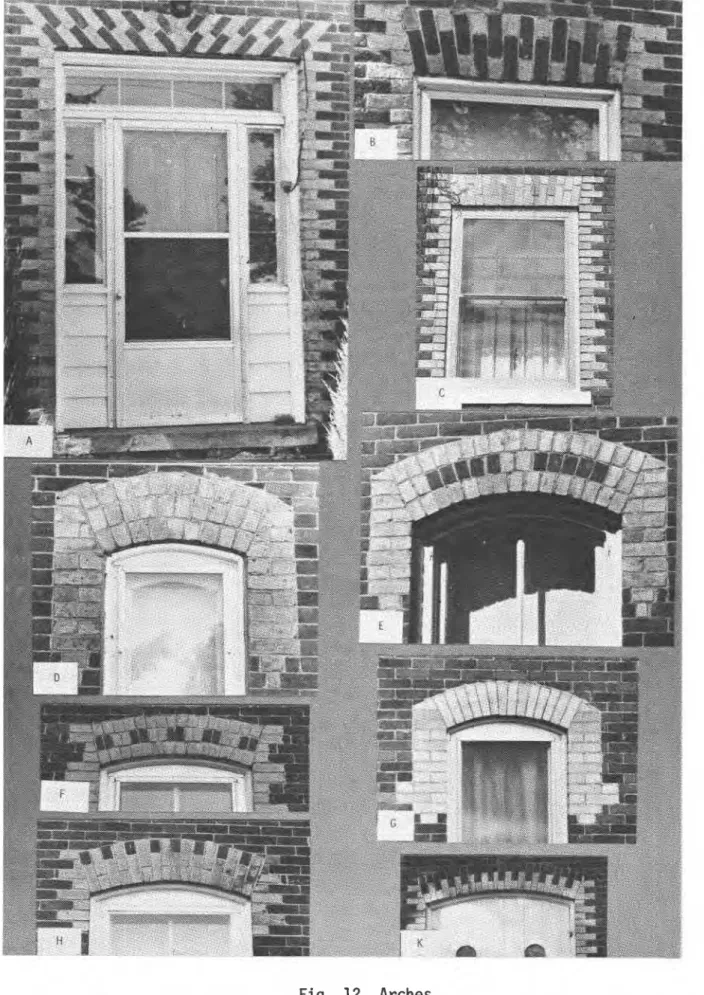
Examples of di chromatic treatment of arches include the 1 ightning
pattern (Figure 12(A)) derived from the arrangement of the bricks in a Dutch
arch over the door of a house near Merrickvil l e ; o t h e r examples of t h i s
decoration may be seen
i n houses
i nAlmonte and Morrisburg. The window
arches of the Merrickvil l e house a r e camber (jack) arches (Figure 12(B));
another treatment of
t h i ssame type of arch, without contrasting colour, i s
shown
i nFigure 12(C), an arch of a farmhouse near Pakenham.
Segmental arches shaped l i k e the segment of a c i r c l e were constructed
in various forms and with various col our e f f e c t s (Figure 12
(D-K) ).
In the
three-ring segmental arch of Figure 12(Dj no colour c o n t r a s t was used,
whereas in s i m i l a r arches of Fi'gures 12('Ej and 12(F) the central ring was
f i t t e d
w i t hb r i c k s providing colour c o n t r a s t . In the same way, the arch of
Figure 12
( G I ,without col our c o n t r a s t , may be compared
w i t harches of
s i m i l a r , a1 though s l i g h t l y deeper, construction (Figures 12(H) and 12(K)
)t h a t have been provided
w i t hcontrasting colours.
Brick Colour
The colour of the burned c l a y bricks used f o r dichromatic brickwork
came from the chemical and mineralogical composition of the c l a y , the
temperature of burning, and the kiln atmosphere. Many Ontario bri ckmakers
produced red and buff bricks according t o the location of the clay
i nt h e i r
deposit: clay taken from the top few f e e t , from which 1 ime had been leached,
burned red, whereas clay dug from the lower l e v e l s burned t o a buff colour.
Such was the case f o r brickmakers using the widely d i s t r i b u t e d "Erie Clay"
described by ~ a k e r 2
i nh i s 1906 study of the Ontario clay i n d u s t r i e s . The
upper, weathered portion, termed by Baker "red-top clay", burned red; clay
from lower l e v e l s of the same deposit burned buff o r white, thus affording
the bri ckmaker the opportunity t o manufacture bricks of both col ours.
Brickmakers using o t h e r Ontario c l a y s , p a r t i c u l a r l y the Leda clay of
the Ottawa area, found t h a t t h e i r bricks burned red regardless of where in
the deposit the clay was obtained, a s i t u a t i o n t h a t led a t l e a s t one
brickmaker t o a l t e r a r t i f i c i a l l y the normal colour of h i s burned clay. He
was Thomas Clark of Ottawa, who found t h a t by adding marl t o the clay he
could produce a white brick. In 1876 a
was issued t o
h i mf o r the
manufacture of white bricks from "a composition of matter composed of from
one-fourth t o one-third o r thereabouts, of s h e l l marl, and from three-fourths
t o two-thirds of aluminous c l a y o r thereabouts, the proportions varying
Fig. 11 (above) Decoration o f S t Paul
Is
Lutheran Church, Morrisburg, by means of v e r t i c a l " l a d d e r " and Gothic a r c h e s .Fig. 9 ( o p p o s i t e , t o p ) Brick quoins of farmhouse n e a r Bishops Mil 1 s .
Fig. 10 ( o p p o s i t e , bottom) Decoration of a house a t Brooklin by means o f v e r t i c a l s t r i p s and h o r i z o n t a l bands.
Fig.
12
Arches.according t o the quantity, more o r l e s s , of oxide of iron contained i n the clay." Another means of obtaining
a
white brick from red-burning clay was t o add ground 1 imestone t o i t . 4Conclusions
Not long a f t e r the polychromatic fashion was introduced t o English a r c h i t e c t u r e about the middle of the l a s t century, Canadian a r c h i t e c t s and bui 1 ders began t o use colour-contrasted brick construction f o r decorati ve e f f e c t s , usually w i t h buff b r i c k s on
a
red background. Such dichromatic work was p a r t i c u l a r l y populari n
Ontario in the decades of the 1870's and1880's. Although i t has continued t o be a p a r t of brick construction, t h e extent of its use has declfned, a s has the ornateness and complexity of the designs used i n such work.
Di chromati c decoration of bri ckwork incl udes a wi de v a r i e t y of t r e a t - ments of corners, window and door openings, arches, and o t h e r p a r t s of t h e building. Several of t h e designs were produced by o f f s e t t i n g bricks from one course t o the next t o form diamonds, half-diamonds and zigzags, while bands, crosses and other decorations were a l s o fonned from bricks of contrasting colour. Combinations of the various decorative e f f e c t s have produced buildings of s t r i k i n g appearance and have made dichromatic brickwork an i n t e r e s t i n g p a r t of the h i s t o r y of building.
References
1
.
A1 an Gowans,
Building Canada; An Architectural History of Canadian L i f e , Toronto, Oxford University Press, 1966.2. M.B. Baker, clay and t h e Clay I n d u s t q of O n t h o , Ontario Bureau
of Mines, Vol
.
X V , Part 11, 1906.3 . Canadian Patent Office Record, Yol. TV, No. 11, November 1876, Patent No. 6689.
4. S c i e n t i f i c Ameyn:cm Supplement, NO. 190, August 23, 1 879 ( p
.
3021 ).
This publication is being distributed by the Division of Building R e s e a r c h of the National R e s e a r c h Council of Canada. I t should not be reproduced i n whole o r in p a r t without p e r m i s s i o n of the original publieher. The Di- vision would be glad to b e of a s s i s t a n c e i n obtaining s u c h p e r m i s s i o n .
Publications of the Division m a y be obtained by m a i l - ing the a p p r o p r i a t e r e m i t t a n c e ( a Bank, E x p r e s s , o r P o s t Office Money O r d e r , o r a cheque, m a d e payable to the R e c e i v e r G e n e r a l of Canada, c r e d i t NRC) t o the National R e s e a r c h Council of Canada, Ottawa. K1A OR6. Stamps a r e not acceptable.
A l i s t of a l l publications of the Division i s available and m a y be obtained f r o m the Publications Section, Division of Building R e s e a r c h , National R e s e a r c h Council of Canada, Ottawa. KIA OR 6.