HAL Id: hal-00301731
https://hal.archives-ouvertes.fr/hal-00301731
Submitted on 29 Aug 2005HAL is a multi-disciplinary open access
archive for the deposit and dissemination of sci-entific research documents, whether they are pub-lished or not. The documents may come from teaching and research institutions in France or abroad, or from public or private research centers.
L’archive ouverte pluridisciplinaire HAL, est destinée au dépôt et à la diffusion de documents scientifiques de niveau recherche, publiés ou non, émanant des établissements d’enseignement et de recherche français ou étrangers, des laboratoires publics ou privés.
A look at aerosol formation using data mining
techniques
S. Hyvönen, H. Junninen, L. Laakso, M. Dal Maso, T. Grönholm, B. Bonn, P.
Keronen, P. Aalto, V. Hiltunen, T. Pohja, et al.
To cite this version:
S. Hyvönen, H. Junninen, L. Laakso, M. Dal Maso, T. Grönholm, et al.. A look at aerosol formation using data mining techniques. Atmospheric Chemistry and Physics Discussions, European Geosciences Union, 2005, 5 (4), pp.7577-7611. �hal-00301731�
ACPD
5, 7577–7611, 2005
A look at aerosol formation using data
mining techniques
S. Hyv ¨onen and ATMDM team Title Page Abstract Introduction Conclusions References Tables Figures J I J I Back Close
Full Screen / Esc
Print Version Interactive Discussion
EGU
Atmos. Chem. Phys. Discuss., 5, 7577–7611, 2005 www.atmos-chem-phys.org/acpd/5/7577/
SRef-ID: 1680-7375/acpd/2005-5-7577 European Geosciences Union
Atmospheric Chemistry and Physics Discussions
A look at aerosol formation using data
mining techniques
S. Hyv ¨onen1, H. Junninen2, L. Laakso2, M. Dal Maso2, T. Gr ¨onholm2, B. Bonn2, P. Keronen2, P. Aalto2, V. Hiltunen3, T. Pohja3, S. Launiainen2, P. Hari4,
H. Mannila1, and M. Kulmala2
1
Helsinki Institute of Information Technology, Basic Research Unit, Department of Computer Science, University of Helsinki, P.O. Box 68, FIN–00014 University of Helsinki, Finland
2
Department of Physics, University of Helsinki, P.O. Box 64, FIN–00014 University of Helsinki, Finland
3
Hyyti ¨al ¨a Forestry Field Station, Hyyti ¨al ¨antie 124, 35500 Korkeakoski, Finland
4
Department of Forest Ecology, Faculty of Agriculture and Forestry, P.O. Box 27, FIN–00014 University of Helsinki, Finland
Received: 13 June 2005 – Accepted: 20 June 2005 – Published: 29 August 2005 Correspondence to: S. Hyv ¨onen ([email protected])
© 2005 Author(s). This work is licensed under a Creative Commons License.
ACPD
5, 7577–7611, 2005
A look at aerosol formation using data
mining techniques
S. Hyv ¨onen and ATMDM team Title Page Abstract Introduction Conclusions References Tables Figures J I J I Back Close
Full Screen / Esc
Print Version Interactive Discussion
EGU
Abstract
Atmospheric aerosol particle formation is frequently observed throughout the atmo-sphere, but despite various attempts of explanation, the processes behind it remain unclear. In this study data mining techniques were used to find the key parameters needed for atmospheric aerosol particle formation to occur. A dataset of 8 years
5
of 80 variables collected at the boreal forest station (SMEAR II) in Southern Finland was used, incorporating variables such as radiation, humidity, SO2, ozone and present aerosol surface area. Data analysis were done using clustering and classification meth-ods. The aim of this approach was to gain new parameters independent of any sub-jective interpretation. This resulted in two key parameters, relative humidity and
pre-10
existing aerosol particle surface (condensation sink), capable in explaining 88% of the nucleation events. The inclusion of any further parameters did not improve the results notably. Using these two variables it was possible to derive a nucleation probability function. Interestingly, the two most important variables are related to mechanisms that prevent the nucleation from starting and particles from growing, while
parame-15
ters related to initiation of particle formation seemed to be less important. Nucleation occurs only with low relative humidity and condensation sink values. One possible ex-planation for the effect of high water content is that it prevents biogenic hydrocarbon ozonolysis reactions from producing sufficient amounts of low volatility compounds, which might be able to nucleate. Unfortunately the most important biogenic
hydro-20
carbon compound emissions were not available for this study. Another effect of water vapour may be due to its linkage to cloudiness which may prevent the formation of nu-cleating and/or condensing vapours. A high number of preexisting particles will act as a sink for condensable vapours that otherwise would have been able to form sufficient supersaturation and initiate the nucleation process.
ACPD
5, 7577–7611, 2005
A look at aerosol formation using data
mining techniques
S. Hyv ¨onen and ATMDM team Title Page Abstract Introduction Conclusions References Tables Figures J I J I Back Close
Full Screen / Esc
Print Version Interactive Discussion
EGU
1. Introduction
Atmospheric aerosol particle formation is observed in various environments: the upper atmosphere (Eichkorn et al.,2002), marine environments (O’Dowd et al.,2002b), urban air (M ¨onkk ¨onen et al.,2004;Dunn et al.,2004), remote areas (Koponen et al.,2002) and boreal forests (M ¨akel ¨a et al., 1997). A recent overview article discusses these
5
observations in detail (Kulmala et al.,2004a).
Despite the numerous observations, the fundamental cause of atmospheric particle formation remains in many cases unknown. Because of the physical and chemical complexity of the atmosphere, it is often a difficult task to focus on the most relevant process causing nucleation. But this focus is important, since without prior knowledge
10
it is difficult to identify the key variables. However, if a wide range of measurements is carried out for a long period of time in one location, it may be possible to detect sub-tle, previously unknown factors lying behind the atmospheric particle formation events. Currently, long-term atmospheric aerosol measurements are conducted only at a few stations (Ruuskanen et al.,2003;Sioutas et al.,2004;Aalto et al.,2001) or with a few
15
measured parameters like CO2(Keeling et al.,1982).
Even the few sets of long-term measurements have yielded many significant ad-vances in atmospheric sciences. Such a recent finding is the occurrence of new atmo-spheric particle formation taking place in boreal forest environments around 50–100 times a year. These newly formed particles affect the Earth’s radiation budget directly
20
by scattering and absorption (IPCC,2001) and indirectly by acting as cloud condensa-tion nuclei (Twomey,1974).
Many studies have investigated the physical mechanisms, meteorological conditions (Nilsson et al., 2001) and chemical compounds related to particle formation (Weber
et al., 1995; Korhonen et al., 1999; Birmili and Wiedensohler, 2000; O’Dowd et al.,
25
2002a;Bonn and Moortgat,2003;Kulmala et al.,2004a). Earlier attempts have demon-strated that favorable conditions for particle formation bursts include low atmospheric water content, low preexisting particle concentration and high solar radiation (Boy and
ACPD
5, 7577–7611, 2005
A look at aerosol formation using data
mining techniques
S. Hyv ¨onen and ATMDM team Title Page Abstract Introduction Conclusions References Tables Figures J I J I Back Close
Full Screen / Esc
Print Version Interactive Discussion
EGU
Kulmala,2002).
However, many previous studies have been based on preconceptions of which pa-rameters are important, in which case the role of other papa-rameters may have been overlooked. To avoid this, we have done a comprehensive study using data mining techniques. We have collected from the SMEAR II station a dataset of eight years with
5
around 80 parameters, which were averaged over 30 min. This dataset was studied using different classification and clustering methods. In Sect.2we describe our mea-surements and the quality control of our database. Due to the great number of previous studies we do not describe everything exhaustively. Some derived variables such as condensation sink are are discussed in more detail. The data analysis methods used
10
are described in Sect.3. We present the main results obtained by the application of these methods in Sect.4. Finally, in Sect.5we discuss our findings in the light of the physical and chemical processes involved in new particle formation, and draw some general conclusions.
2. Experimental
15
2.1. Sampling site
Measurements used in this study were performed during the years 1996–2003 at the SMEAR II station, which is located in the Hyyti ¨al ¨a Forestry Field Station of the Uni-versity of Helsinki between Tampere and Jyv ¨askyl ¨a in southern Finland (61◦510N, 24◦170E, 180 m a.s.l.). The station was designed to study mass and energy flows
20
in atmosphere-vegetation-soil continuum. Around the station, for about 200 m to all directions, there is a homogeneous 40-year-old Scots pine stand. The dominant stand height is about 14 m and the all-sided needle area is 7 m2m−2.Rannik(1998) describes the micrometeorology of the site.
ACPD
5, 7577–7611, 2005
A look at aerosol formation using data
mining techniques
S. Hyv ¨onen and ATMDM team Title Page Abstract Introduction Conclusions References Tables Figures J I J I Back Close
Full Screen / Esc
Print Version Interactive Discussion
EGU
2.2. Measurements
In this study we used the continuous measurements for concentrations of NO, NOx, SO2, O3, H2O, CO2 and CO, for the number size distribution of aerosol particles (dry diameter of 3–600 nm particles) and for meteorological data, such as temperature, pressure, wind speed, wind direction, humidity and radiation (UV-A, UV-B, PAR, global,
5
net, reflected global and reflected PAR). The measurements of gas concentrations and meteorological data were performed at different heights: levels of 4.2, 8.4, 16.8, 33.6, 50.4 and 67.2 m on the measurement tower. The number size distribution of aerosol particles was measured at 2 m height.
Flux measurements (sensible heat, latent heat, momentum, CO2, H2O, O3 and
10
aerosol particles) were carried out in a tower at the height of 23.3 m and partly at the height of 46.0 m using eddy covariance (EC) technique (Suni et al.,2003). Tempo-ral gaps in the CO2flux measurements were filled using the same method asAubinet
et al. (2001) and Falge et al. (2001). The details of the measurements performed continuously at the SMEAR II station can be found in (Vesala et al.,1998).
15
2.2.1. Condensation sink
The ambient aerosol population acts as a sink for other atmospheric constituents by serving as a condensation surface for low-volatility vapours and by scavenging ultra-fine aerosol particles by coagulation. To quantify these processes, we can calculate the condensation sink caused by the aerosol population (see for example (Pirjola and
20 Kulmala,1998)): CS = 2πD Z∞ 0 Dpβm(Dp)n(Dp)d Dp= 2πDX i βiDpiNi.
Here Dpi describes the diameter of the particle in the size class i and Ni is the par-ticle number concentration in the respective size class. D is the diffusion coefficient of the condensing vapour, and βm the correction factor for the transition and the free
25
ACPD
5, 7577–7611, 2005
A look at aerosol formation using data
mining techniques
S. Hyv ¨onen and ATMDM team Title Page Abstract Introduction Conclusions References Tables Figures J I J I Back Close
Full Screen / Esc
Print Version Interactive Discussion
EGU
molecular regimes (Fuchs and Sutugin, 1970). The condensation sink serves as an approximation of the coagulation sink, as it behaves identically, differing only in magni-tude. Because the ambient aerosol particle size distribution in Hyyti ¨al ¨a was measured using a Differential Mobility Particle Sizer (DMPS) at low relative humidities and thus in a dry state, the hygroscopic growth factor was taken into account by using the
param-5
eterization byLaakso et al.(2004), so that the calculated sink corresponds to ambient RH conditions. Thus, the condensation sink depends on the particle size distribution, temperature (via the diffusion coefficient) and RH. The RH dependency of the conden-sation sink is stronger than the temperature effect.
2.2.2. Event classification
10
To distinguish between days with new particle formation and days with no particle for-mation we used a database created by Dal Maso et al. (2005)1. The database was created by visual inspection of the continuously measured aerosol size distributions over a size range of 3–600 nm in Hyyti ¨al ¨a. Days displaying a growing new mode in the nucleation size range prevailing over several hours were classified as event days. Days
15
which were clear of all traces of particle formation were classified as non-event days. Days which could not unambiguously be classified as either event or non-event days were termed “undefined” days, and removed from the data pool used in this study.
3. Computational methods
The data mining methods that have been applied in this study are widely used ones. In
20
this section we briefly describe each method used, but for details we refer the reader to e.g.Hand et al.(2001);Hastie et al.(2001).
1
Dal Maso, M., Kulmala, M., Riipinen, I., Wagner, R., Hussein, T., Aalto, P. P., and Lehtinen, K. E. J.: Formation and Growth of Fresh Atmospheric Aerosols: Eight Years of Aerosol Size Distribution Data from SMEAR II, Hyytiala, Finland, submitted to Boreal Env. Res., 2005.
ACPD
5, 7577–7611, 2005
A look at aerosol formation using data
mining techniques
S. Hyv ¨onen and ATMDM team Title Page Abstract Introduction Conclusions References Tables Figures J I J I Back Close
Full Screen / Esc
Print Version Interactive Discussion
EGU
The computations were done on Matlab (Moler,2004). In some cases the Statistics Toolbox was used.
3.1. Preprocessing of data
The raw datasets obtained display very fragmented time series, 8 years of measure-ments every 30 min, with a large number of missing values. Using this large data set,
5
we calculated for each day the mean and standard deviation of each variable in a chosen time window. The mean and standard deviation were only calculated if there are more than 5 measured values in the appropriate window. Otherwise the values on that day were declared as missing. We chose to exclude each variable with more than 800 missing days (this includes particle flux and CO measurements) and after
10
that any day with any missing variable. We also chose to exclude the latent heat flux measurements, as their correlation with water vapour flux measurements is one.
The above treetop mast measurements were averaged to one variable (hi) and the below treetop measurements to another (lo). As these correlate strongly, we have frequently only included above treetop averages.
15
Before calculations the data was normalized so that each variable has zero mean and unit variance. The purpose of normalization is to make sure that all variables are of equal weight. Otherwise, when comparing days, variables with large numerical values will appear as more important.
After preprocessing and removal of undefined days we have around 500 days,
20
roughly half of which are event days, and around 60 variables. The data set consists of the measurements shown in Table1.
3.1.1. Selection of time window
It is not reasonable to calculate daily means and standard deviations of the variables for the whole 24 h, since in boreal regions such as Hyyti ¨al ¨a at 61 deg North the day length
25
depends strongly on time of the year. Thus, for example, the fixed time window from 7583
ACPD
5, 7577–7611, 2005
A look at aerosol formation using data
mining techniques
S. Hyv ¨onen and ATMDM team Title Page Abstract Introduction Conclusions References Tables Figures J I J I Back Close
Full Screen / Esc
Print Version Interactive Discussion
EGU
04:00 am to 04:00 pm includes lots of non-daylight hours in the winter. The window of fixed length of 6 h starting at sunrise includes the whole day in midwinter and just the early morning hours (04:00–10:00) in midsummer. These, among several other time windows have been tested in the course of this work to obtain the most useful parameters for nucleation. All time windows cover the late morning hours, because
5
this is the time nucleation usually occurs. Because of the variations in the length of the day, the window from sunrise to sunset seems a reasonable choice, and indeed it has the best classification performance (data not shown). We thus present the results for this window only. Selecting this window instead of one covering mainly hours preceding the usual nucleation occurrence time means our results are likely to reflect more on the
10
conditions under which aerosol particles keep growing rather than on factors initiating nucleation.
3.2. Clustering
In trying to understand what causes nucleation events a reasonable first approach is to cluster the days. In clustering one aims to divide the data into a number of clusters in
15
such a way, that data points (here days) in the same cluster are similar to each other, while data points in different clusters are dissimilar. A widely used clustering method is the K-means algorithm (MacQueen,1967). In the basic version one starts by picking randomly K cluster centers. One then repeatedly assigns to each cluster all points closest to the cluster center, and recomputes the new cluster center as the mean of
20
all points in that cluster. This is done until no changes in the centers occur. The most commonly used distance measure between points is the Euclidean distance.
When using K-means one first has to normalize the data and remove colinearities, otherwise variables with large numerical values or strong correlations will dominate the performance of the clustering algorithm. Elimination of correlations can be done
25
using principal components analysis as a preprocessing step. Principal components analysis (PCA) uses singular value decomposition (SVD) on the centered data matrix to find mutually orthogonal linear combinations of the original variables in such a way
ACPD
5, 7577–7611, 2005
A look at aerosol formation using data
mining techniques
S. Hyv ¨onen and ATMDM team Title Page Abstract Introduction Conclusions References Tables Figures J I J I Back Close
Full Screen / Esc
Print Version Interactive Discussion
EGU
that variance of the original data is preserved as well as possible (Pearson,1901). In many cases the variance captured by the last principal components is very small, and they can be left out. One can project the data onto the first few principal components, renormalize and do the clustering for this new data matrix. For this data the clustering done using the first six principal components, which capture 70% of the variance in
5
the data, resembles the clustering done on the original data matrix after a few strongly correlating variables are removed, so we present the results for the original data only. From the data used in clustering we have left out all radiation measurements except global radiation, as all of these correlate strongly.
There are several methods for choosing the number of clusters K. We have used the
10
Davies-Bouldin index (Davies and Bouldin,1979). It is a function of the ratio of the sum of within-cluster variation to between cluster separation, and therefore favors compact and well separated clusters.
3.3. Classification methods
An alternative approach to understand the occurrence of events is to consider the
15
setting as a classification problem: we want to use the data to classify each day as an event day or a nonevent day. In fact, we are not really interested in separating event days from nonevent days, but in understanding which variables one should use to separate the two groups.
A standard approach in estimating the performance of classification methods is to
20
use cross-validation. The data is repeatedly split into two independent sets, one of which is used as the training set to fit the model in question, and the other is used as the test set to to obtain an unbiased estimate for the classification error.
We evaluate the performance of the methods by computing the misclassification rate:
error=Nmi ssed + Nf al se
Ntotal · 100%,
25
where Nmi ssed is the number of event days classified as nonevents, Nf al seis the num-7585
ACPD
5, 7577–7611, 2005
A look at aerosol formation using data
mining techniques
S. Hyv ¨onen and ATMDM team Title Page Abstract Introduction Conclusions References Tables Figures J I J I Back Close
Full Screen / Esc
Print Version Interactive Discussion
EGU
ber of nonevent days classified as event days, and Ntotal is the total number of days classified. After cross-validation we report the average misclassification rate together with 95% confidence intervals. We frequently also list the proportion of missed events and false events:
missed= Nmi ssed
Ntotal · 100%, false= Nf al se
Ntotal · 100%.
5
Most classification methods require all classes to have approximately of the same num-ber of cases.
3.3.1. Linear methods for classification
For an important class of classification methods the boundaries separating the objects to be classified are linear. There are a number of methods to find a linear separating
10
hyperplane. We briefly describe some of them. For more details see e.g. the reference mentioned earlier.
In Linear Discriminant Analysis (LDA) the goal is to find a set of linear combinations of the original variables so that when the data is projected onto the subspace spanned by these vectors the within-class scatter is minimized and the between-class scatter is
15
maximized. Such linear combinations are called linear discriminants. In a two-class case such as ours we only look for one linear discriminant. The first linear discriminant is the normal of the hyperplane separating the two classes. It therefore also tells how event days are separated from nonevent days. LDA is closely related to multivariate analysis of variance (MANOVA).
20
One can use LDA for fitting quadratic boundaries by adding the second order terms to the data matrix. For example, in the two variable case we add to the variables x and y the second order terms x2, y2and xy. We then do LDA in this five-dimensional space with coordinates (x, y, x2, y2, xy) instead of the original two-dimensional one
with coordinates (x, y). We shall refer to this method as LDAQ.
ACPD
5, 7577–7611, 2005
A look at aerosol formation using data
mining techniques
S. Hyv ¨onen and ATMDM team Title Page Abstract Introduction Conclusions References Tables Figures J I J I Back Close
Full Screen / Esc
Print Version Interactive Discussion
EGU
Linear regression in turn predicts the output y via a linear model
y = β0+
n
X
j=1
βjxj,
where x=(xj)nj=1is our n−dimensional input data. This is usually used to predict quan-titative outputs, but it can be used for classification tasks too. In the classification case we define y to be one for event days and zero for nonevent days, and fit the regression
5
model accordingly. Our input data consists of the measurement vectors for each day. Logistic regression belongs to generalized linear models. Here we want to formulate a model for the probability that the output y is 1 given the input x: p(y=1|x). We could use a linear model for this, but this is not ideal. For example, a linear model can take values outside the interval [0, 1], which are not meaningful. Instead, we modify the
10
model by transforming the probability nonlinearly so that it can be modeled by a linear combination. In logistic regression this nonlinearity is the logistic function:
log p(y = 1|x) 1 − p(y = 1|x),
which is modeled linearly, i.e.
log(p/(1 − p))= β0+ n X j=1 βjxj. 15
Support vector machines (SVM) belong to kernel methods, in which the idea is to map the original data (usually nonlinearly) into a (higher dimensional) feature space and do e.g. classification there (Shawe-Taylor and Christianini,2004). When using a linear kernel this method falls into the category of linear methods. In this case we lose some of the potential of the method, but we are able to keep track of the
vari-20
ables. Sacrificing linearity (which in any case is probably too strict an assumption in our case) we have a choice of a wide variety of kernels. Most commonly used ones
ACPD
5, 7577–7611, 2005
A look at aerosol formation using data
mining techniques
S. Hyv ¨onen and ATMDM team Title Page Abstract Introduction Conclusions References Tables Figures J I J I Back Close
Full Screen / Esc
Print Version Interactive Discussion
EGU
include polynomial kernels and RBF (radial basis function) kernels. Polynomial kernels of degree two have been tried out in our study, but since the results for a wide variety of parameter choices were constantly worse than for linear kernels, the results for these are omitted. We have used the LS-SVM Toolbox for Matlab (Pelckmans et al.,2003). 3.3.2. Other classification methods
5
With the SVMs we already moved out of the realm of linear methods. Here we describe two other nonlinear classification methods that have been used.
K-nearest neighbor classification takes a point in the test set, compares it with all the points in the training set, and decides the class by looking at the class of the K nearest neighbors of the point. In our case, for K=10, the event status of a day in the test set is
10
decided by looking at the event status of the 10 days most closely resembling the day under inspection. This gives us a feel for how close the event days are to each other. However, we do not gain information about in what aspects the event days are similar to eachother.
Classification trees (Breiman et al., 1984) partition the feature space into a set of
15
rectangles, and then assign a constant class in each one. We first split the space into two regions, and assign a class to each one. The variable and the split-point are selected to minimize classification error. Then both regions are split into two more regions, and this process is continued until some stopping criterion is applied. This can be visualized as a tree, see Fig.1. The topmost variable (RH) is the single variable
20
with the best classification performance. On the left branch of the tree we have the condensation sink. This is the best variable (in terms of classification performance) in distinguishing event days from nonevent ones in the half plane RH<77. Compare this to Fig.4. The leftmost branch of the tree presented in Fig.1corresponds to the lower left corner of Fig.4.
ACPD
5, 7577–7611, 2005
A look at aerosol formation using data
mining techniques
S. Hyv ¨onen and ATMDM team Title Page Abstract Introduction Conclusions References Tables Figures J I J I Back Close
Full Screen / Esc
Print Version Interactive Discussion
EGU
3.3.3. Feature selection
A simple approach to gain insight on the importance of different variables in explaining events is to take all pairs of variables and see how well the days are classified as event or nonevent days on the basis of the values of each pair. The same can be done for each triplet of variables, but beyond that the complexity of the problem makes this
5
approach impractical.
Of course, it is hardly likely to find a satisfactory explanation for such a complex phenomenon by just using two or three variables. An alternative is to use a stepwise approach (Hand et al.,2001). In doing stepwise forward selection of variables we start with the variable which gives the best classification result by itself, and on each step
10
add the variable which results in the best classification. In doing stepwise backward selection of variables, we start with all variables, and on each step leave out one vari-able, chosen so that the classification result is optimized. In forward selection there is the risk that the combined effect of some set of variables is missed. In backwards selection it is possible that we discard a significant variable at an early stage. For our
15
data backwards selection performed poorly, so the results are omitted.
A tempting approach is to look at the weights given by linear regression for each variable, or the normal of the separating hyperplane in the case of linear discriminant analysis. One could argue that these tell about the relative importance of the variables. This, however, is not true when there are strongly correlating variables so one should
20
only use this approach with extreme caution: for our data set it was not applicable.
4. Results
4.1. Clustering
We used K-means clustering to cluster the days into four clusters. The results are very good: the algorithm does not use event information for clustering, yet it produces
25
ACPD
5, 7577–7611, 2005
A look at aerosol formation using data
mining techniques
S. Hyv ¨onen and ATMDM team Title Page Abstract Introduction Conclusions References Tables Figures J I J I Back Close
Full Screen / Esc
Print Version Interactive Discussion
EGU
clusters with very few event days, as well as one with over 90% event days.
The temporal distribution of these days is presented in Fig. 2. Note the temporal cohesion of the clusters, even though the calendar time is not used in the clustering. Cluster 1 consists almost solely of event days, whereas clusters 3 and 4 have almost no events. From top to bottom, the counts for days and event days for each cluster are
5
presented in Table2.
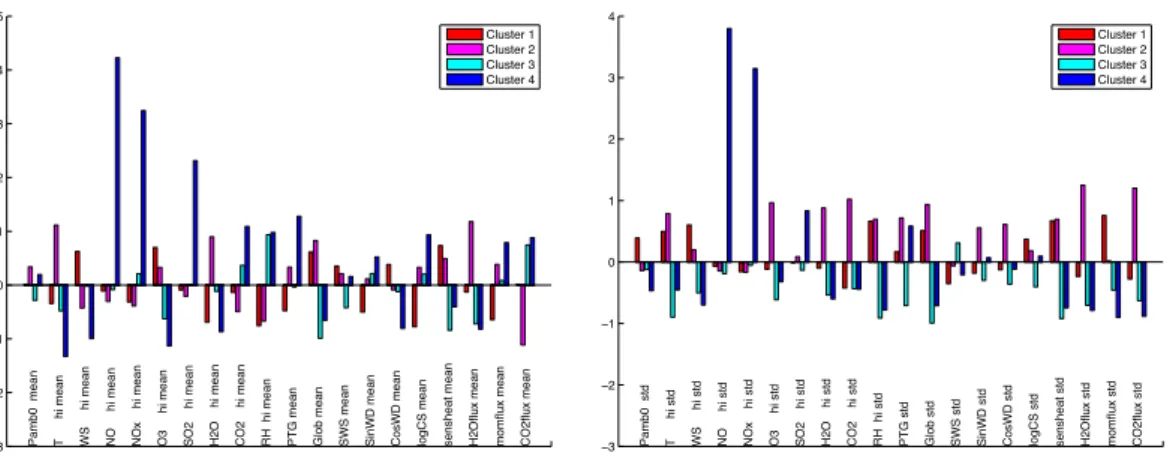
We observe four robust clusters: spring&fall days (cluster 1), summer days (clus-ter 2), cloudy days (clus(clus-ter 3) and polluted days (clus(clus-ter 4). The names describing clusters 3 and 4 are derived by looking at the cluster centers of these clusters. The cluster centers, describing the typical values of each variable in each cluster, are
pre-10
sented in Fig.3. One can see that the best parameters to separate the event clusters (1 and 2) from non-event clusters (3 and 4) are relative humidity, global radiation and sensible heat. Also the mean of ozone and carbon dioxide concentrations have a sep-aration power. Most of the event days fall in to clusters 1 and 2. The main difference between these clusters is the time of the year and the related physical parameters. The
15
summer days in cluster 2 have higher temperatures along with an elevated concentra-tion of water and higher daily variability of CO2, O3and H2O concentrations. Also the CO2 and H2O fluxes differ in clusters 1 and 2. The condensation sink has low values in the cluster with most of the events.
4.2. Results using classification methods
20
The main result given by the wide range of classification methods used is that the most important variables in explaining the nucleation events are the means of the relative humidity (RH) and the logarithm of the condensation sink. This is supported by a number of different approaches.
– When fitting a decision tree to the data, these are the top two variables selected
25
in most cases. Moreover, on the test set the tree involving only these variables (see Fig.1) performs frequently as well as more complicated trees, which tend to
ACPD
5, 7577–7611, 2005
A look at aerosol formation using data
mining techniques
S. Hyv ¨onen and ATMDM team Title Page Abstract Introduction Conclusions References Tables Figures J I J I Back Close
Full Screen / Esc
Print Version Interactive Discussion
EGU
overfit.
– These are also the two first variables selected when doing forward stepwise
se-lection of variables using any of the linear methods.
– These two variables form the best pair of variables. They also are almost always
included among the best three variables. The best pairs were sought after using
5
both linear regression and linear discriminant analysis. For the best triplets, only linear regression was used.
The performance of a number of methods using only RH and the logarithm of the condensation sink is summarized in Table3. Each method was run 1000 times using different training and test sets, and the average percentage of errors and 95%
confi-10
dence intervals for the errors were computed.
In Table 4 we have summarized the performance of a few of the top ranking pairs using LDA. We see that RH and the condensation sink have the best performance. The other methods yield similar results.
This can be compared to the performance of a few of the top ranking triplets using
15
linear regression, summarized in Table5. It is evident that there is no “best triplet” as the 95% confidence intervals of all of these overlap. In fact, for 127 triplets the 95% confidence intervals overlap with that of the best ranked one, topmost in this table, and 80 of these have confidence intervals which overlap that of the best pair; not one triplet is clearly better than the best pair.
20
We have demonstrated above that relative humidity and the condensation sink are the most significant variables explaining the nucleation events. All of the linear clas-sification methods had an error rate of approximately 12% when using only these two variables. It seems reasonable to expect, that adding variables to the model would improve classification results. But here we run into the problem demonstrated by the
25
best triplets: there are too many choices of variables with equal performance.
When using stepwise addition of variables together with any of the classification methods, different runs (using different training sets) yield different sets of variables
ACPD
5, 7577–7611, 2005
A look at aerosol formation using data
mining techniques
S. Hyv ¨onen and ATMDM team Title Page Abstract Introduction Conclusions References Tables Figures J I J I Back Close
Full Screen / Esc
Print Version Interactive Discussion
EGU
with approximately equal performance. The same is true for decision trees. It is not true that the two variable model could not be improved by adding variables, but the set of variables that can be added for improved performance is not unique. This is in fact quite a typical situation in data mining applications whenever there are correlations between variables. Table 6 presents the results for two sets of forward addition of
5
variables using LDA. After RH and the logarithm of the condensation sink are added the lists diverge. Yet the performance of the methods after 10 variables are chosen are not significantly different.
Finally, let us return to the two variables, RH and the condensation sink. We can project the data onto the first linear discriminant. The first linear discriminant is the
10
normal of the line separating events from nonevents in Fig. 4, so it is the direction giving optimal separation for events and nonevents. Points in one end of the linear discriminant are mainly event days, and points in the other end are mainly nonevent days. From this projected data we can compute the probability of having an event day at each point. This is done by first computing the proportion of events in each interval
15
of a fixed width, and then fitting a logistic model to this data. This is illustrated in Fig.5. We get the following nucleation parameter describing the probability of nucleation:
Pnucl = 1 1+ exp(β1log(CS)+ β2(RH)), (1) β1= 1.7 β2= 0.13. 5. Discussion 20 5.1. Condensation sink
Low condensation sink values favour nucleation due to two basic reasons (Kulmala
ACPD
5, 7577–7611, 2005
A look at aerosol formation using data
mining techniques
S. Hyv ¨onen and ATMDM team Title Page Abstract Introduction Conclusions References Tables Figures J I J I Back Close
Full Screen / Esc
Print Version Interactive Discussion
EGU
– The existing aerosol population depletes the ambient air of vapours by acting as
a condensation surface; if the sink is high, no vapour is available to grow the particles to larger sizes, and they are lost by coagulation and deposition. It is also possible that these vapours participate in the nucleation process itself.
– A higher condensation sink signifies also a higher coagulation rate of newborn
5
particles, meaning a shorter lifetime of these particles. The loss rate due to co-agulation is higher the smaller the particle is. Thus, a lower sink increases the likelihood of a nucleated particle growing large enough to survive.
These two processes work the same direction. 5.2. Relative humidity
10
Besides the impact of relative humidity on the condensation sink by forcing the present particles to grow by the uptake of water molecules and thus increasing the available surface area for condensable vapours, RH affects the solar radiation reaching the at-mospheric boundary layer. The effect of RH on solar radiation is due to its linkage to clouds, fog and rain, since there is a strong correlation between RH and cloudiness.
15
Thus, at least part of the reducing effect of relative humidity might be caused by the reduction of solar radiation. Linked to this is the effect of relative humidity on the gas-phase chemistry of compounds involved in the nucleation and the subsequent growth. Note that these reaction mechanisms can occur only during cloud free days, since the solar radiation is one of the key elements in the reaction chain.
20
When assuming that the nucleation process is started by the formation of clusters of either binary or ternary sulphuric acid (H2SO4) reactions (Kulmala et al., 2004b), including either water vapour or water vapour and ammonia, the formation of sulphuric acid is directly linked to the formation of OH. This depends on the amount of solar radiation and the amount of water vapour present, both of which increase the OH
25
concentration. However, the higher the water vapour concentration the lower the solar radiation reaching the atmospheric boundary layer. Consequently there is a maximum
ACPD
5, 7577–7611, 2005
A look at aerosol formation using data
mining techniques
S. Hyv ¨onen and ATMDM team Title Page Abstract Introduction Conclusions References Tables Figures J I J I Back Close
Full Screen / Esc
Print Version Interactive Discussion
EGU
production level between low and high relative humidity: increasing relative humidity will first result in an increase of sulphuric acid formation, but this will decline after the appearance of clouds.
A second possibility is that secondary organics, formed by gas-phase reactions of emitted reactive hydrocarbons, cause the initiation of nucleation. These compounds
5
can contribute via two different processes: by condensation on the clusters and thus activating them by growing to detectable sizes (radius of 3 nm) (Kerminen et al.,2004) or by forming new particles by themselves (Bonn and Moortgat,2003). The most im-portant ones are the reactive mono- and sesquiterpenes released by the biosphere. Smog chamber studies indicate that the reaction with ozone form the products of
low-10
est volatility, among the three possible oxidation reactions, competing at ambient condi-tions.Bonn et al.(2002) andBonn and Moortgat(2002,2003) have found that only the ozonolysis is affected by the presence of water vapour in nucleation and subsequent growth. This is caused by the reaction of water vapour with the so-called stabilized Criegee biradical (SCI), formed during the first reaction steps of the terpene. The
for-15
mer suppresses the formation of the nucleating agent by competition.
Since the impact of both relative humidity and the condensational sink are linked to each other, and furthermore to chemical compounds, there is currently no way to separate the contribution of possible nucleation mechanisms and causes based on our study.
20
5.3. Other parameters
Previous work has indicated that nucleation events are largely explained by three pa-rameters: temperature, water content and radiation (Boy and Kulmala, 2002). This study supports these findings with the exception of radiation. This might be due to the strong seasonal variation of the solar radiation. In our study we found two clearly
25
important parameters, relative humidity and the condensation sink. Radiation has an effect, but it is no more important than O3, SO2or NO. These variables appear among the best variables after relative humidity and condensation sink in different statistical
ACPD
5, 7577–7611, 2005
A look at aerosol formation using data
mining techniques
S. Hyv ¨onen and ATMDM team Title Page Abstract Introduction Conclusions References Tables Figures J I J I Back Close
Full Screen / Esc
Print Version Interactive Discussion
EGU
methods and in repeated runs, but there is no clear way to choose one over the others. One reason could be the internal correlations between the variables: selecting one of them explains the latent variable behind all of them. Alternatively, the variables are related to less important nucleation processes.
The variables we found to be important are related to the mechanisms that prevent
5
nucleation from starting and particles from growing to detectable sizes. This finding supports the hypothesis presented byKulmala et al.(2000) that there exists a reser-voir of thermodynamically stable clusters (TSC) in the atmosphere, which act as initial nuclei for particle formation. However, TSC grow to detectable sizes only under cer-tain conditions. The mechanisms for the growth of TSC are either self-coagulation of
10
TSC, condensation of vapours, or both. High relative humidity and a high condensa-tion sink decrease concentracondensa-tions of condensable gases in the atmosphere and thus prevent nucleation from starting and particles from growing. Similarly the high amount of preexisting particles act as a coagulation sink for the TSC and for freshly formed, below 3 nm particles. By coagulating onto preexisting particles the probability for
self-15
coagulation of TSC will decrease and the nucleation process will stop. Still, from the result of this study it cannot be concluded whether the TSC really act as initial nuclei for nucleation or whether some new clusters are formed.
6. Conclusions
In this study we found that aerosol particle formation events observed in boreal forests
20
are connected with two variables, the condensation sink and relative humidity. The unfavorable effect of the condensation sink is supposed to be due to uptake of freshly-nucleated clusters and condensing vapours.
The variables found to be important in this study are related to the mechanisms that prevent nucleation from starting and particles from growing to detectable sizes. The
25
outcome supports the idea of having processes that cause nucleation and processes that prevent nucleation. The preventing mechanisms are the more important ones, and
ACPD
5, 7577–7611, 2005
A look at aerosol formation using data
mining techniques
S. Hyv ¨onen and ATMDM team Title Page Abstract Introduction Conclusions References Tables Figures J I J I Back Close
Full Screen / Esc
Print Version Interactive Discussion
EGU
nucleation only occurs when the preventing mechanisms fail.
One possible explanation for the adverse connection of high relative humidity is due to its effect on terpene oxidation products. In the presence of water vapour the stabi-lized Criegee biradical (SCI) produce high volatility compounds, whereas with low RH chemical reactions lead to low volatility compounds. Such low-volatility compounds can
5
condensate onto nucleated clusters or nucleate by themselves. Also the effect of NOx and O3support this chemical reaction route. In addition to its effect on chemical reac-tions, high relative humidities increase the condensation sink due to the hygroscopic growth of aerosol particles. High relative humidity can also affect particle formation due to its linkage to clouds, fog and rain since reduced solar radiation may inhibit
pho-10
tochemical reactions related to nucleating vapours in the atmosphere.
Although we found a connection between the occurrence of nucleation and two key variables, the detailed chemistry still remains speculative. One missing link in our study is the concentration of biogenic Volatile Organic Compounds (VOC) emissions, which are expected to be of high importance even at the low concentrations. Unfortunately,
15
we were not able to measure VOCs since especially the more reactive compounds are extremely hard to measure with the current instrumentation.
One possible cause of confusion is the possibility of two or even more different nucle-ation mechanisms acting simultaneously in the atmosphere. One such combinnucle-ation is clear-air nucleation vs. pollution nucleation, another possibility is combination of neutral
20
and ion-induced nucleation.
References
Aalto, P., H ¨ameri, K., Becker, E., Weber, R., Salm, J., M ¨akel ¨a, J. M., Hoell, C., O’Dowd, C. D., Karlsson, H., Hansson, H.-C., V ¨akev ¨a, M., Koponen, I. K., Buzorius, G., and Kulmala, M.: Physical characterization of aerosol particles during nucleation events, Tellus, 53B, 344–358,
25
2001. 7579
Aubinet, M., Grelle, A., Rannik, A. I. U., Moncrieff, J., Foken, T., Kowalski, A. S., Martin, P. H., Berbigier, P., Clement, C. B. R., Elbers, I., Granier, A., Gr ¨unwald, T., Pilegaard, K. M. K.,
ACPD
5, 7577–7611, 2005
A look at aerosol formation using data
mining techniques
S. Hyv ¨onen and ATMDM team Title Page Abstract Introduction Conclusions References Tables Figures J I J I Back Close
Full Screen / Esc
Print Version Interactive Discussion
EGU Rebmann, C., Snijders, W., Valentini, R., and Vesala, T.: Estimates of the annual net
car-bon and water exchange of forests: The EUROFLUX methodology, Advances in Ecological
Research, 30, 113–175, 2001. 7581
Birmili, W. and Wiedensohler, A.: New particle formation in the continental boundary layer: Meteorological and gas phase parameter influence, Geophys. Res. Lett., 27, 3325–3328,
5
2000. 7579
Bonn, B. and Moortgat, G.: Sesquiterpene ozonolysis: Origin of atmospheric new particle
formation from biogenic hydrocarbons, Geophys. Res. Lett., 30, 1585–1588, 2003. 7579,
7594
Bonn, B. and Moortgat, G. K.: New particle formation during α- and β-pinene oxidation by O3,
10
OH and NO3, and the influence of water vapour: Particle size distribution studies, Atmos.
Chem. Phys., 2, 183–196, 2002,
SRef-ID: 1680-7324/acp/2002-2-183. 7594
Bonn, B., Schuster, G., and Moortgat, G. K.: Influence of water vapor on the process of new particle formation during monoterpene ozonolysis, J. Phys. Chem. A, 106, 2869–2881, 2002.
15
7594
Boy, M. and Kulmala, K.: Nucleation events in the continental boundary layer: Influence of physical and meteorological parameters, Atmos. Chem. Phys., 2, 1–16, 2002,
SRef-ID: 1680-7324/acp/2002-2-1. 7579,7594
Breiman, L., Friedman, J. H., Olshen, R. A., and Stone., C. J.: Classification and Regression
20
Trees, Wadsworth, 1984. 7588
Davies, D. and Bouldin, D. W.: A Cluster Separation Measure, IEEE Transactions on Pattern
Analysis and Machine Learning, 1, 224–227, 1979. 7585
Dunn, M. E., Pokon, E. K., and Shields, G. C.: Thermodynamics of Forming Water Clusters at Various Temperatures and Pressures by Gaussian-2, Gaussian-3, Complete Basis Set-QB3,
25
and Complete Basis Set-APNO Model Chemistries; Implications for Atmospheric Chemistry,
J. Am. Chem. Soc., doi:10.1021/ja03892, 2004. 7579
Eichkorn, S., Wilhelm, S., Aufmhoff, H., Wohlfrom, K., and Arnold, F.: Cosmic ray-induced aerosol formation: First evidence from aircraft-based ion mass spectrometer measurements,
Geophys. Res. Lett., 29, 14, 2002. 7579
30
Falge, E., Baldocchi, D., and Olson, R.: Gap filling strategies for defensible annual sums of net
ecosystem exchange, Agric. For. Meteorol., 107, 43–69, 2001. 7581
Fuchs, N. A. and Sutugin, A. G.: Highly dispersed aerosols., Ann Arbour Science Publishers,
ACPD
5, 7577–7611, 2005
A look at aerosol formation using data
mining techniques
S. Hyv ¨onen and ATMDM team Title Page Abstract Introduction Conclusions References Tables Figures J I J I Back Close
Full Screen / Esc
Print Version Interactive Discussion
EGU
Ann Arbour, London, 1970. 7582
Hand, D., Mannila, H., and Smyth, P.: Principles of Data Mining, MIT Press, 2001. 7582,7589
Hastie, T., Tibshirani, R., and Friedman, J.: The Elements of Statistical Learning, Springer,
2001. 7582
IPCC: Climate Change 2001: The Scientific Basis, Contribution of Working Group 1 to the Third
5
Assessment Report of the Intergovermental Panel on Climate Change, Cambridge University
Press, Cambridge, UK, 2001. 7579
Keeling, C. D., Bacastow, R. B., and Whorf, T. P.: Measurements of the concentration of carbon
dioxide at Mauna Loa Observatory, Hawaii, Oxford University Press, New York, 1982. 7579
Kerminen, V. M., Anttila, T., Lehtinen, K. E. J., and Kulmala, M.: Parameterization for
atmo-10
spheric new-particle formation: Application to a system involving sulfuric acid and
condens-able water-soluble organics., Aer. Sci. Technol., 38, 1001–1008, 2004. 7594
Koponen, I., Virkkula, A., Hillamo, R., Kerminen, V. M., and Kulmala, M.: Number size distributions and concentrations of marine aerosols: Observations during a cruise be-tween the English Channel and the coast of Antarctica, J. Geophys. Res., 107, 4753,
15
doi:10.1029/2002JD002533, 2002. 7579
Korhonen, P., Kulmala, M., Laaksonen, A., Viisanen, Y., McGraw, R., and Seinfeld, J.: Ternary
nucleation of H2SO4, NH3 and H2O in the atmosphere, J. Geophys. Res., 104, 26 349–
26 353, 1999. 7579
Kulmala, M., Pirjola, L., and M ¨akel ¨a, J. M.: Stable sulphate clusters as a source of new
atmo-20
spheric particles, Nature, 404, 66–69, 2000. 7595
Kulmala, M., Kerminen, V.-M., Anttila, T., Laaksonen, A., and O’Dowd, C.: Organic aerosol formation via sulphate cluster activation, J. Geophys. Res., 109, doi:10.1029/2003JD003961,
2004a. 7579
Kulmala, M., Vehkam ¨aki, H., Pet ¨aj ¨a, T., Dal Maso, M., Lauri, A., Kerminen, V.-M., Birmili, W.,
25
and McMurry, P.: Formation and growth rates of ultrafine atmospheric particles: a review of
observations, J. Aerosol Sci., 35, 143–176, 2004b. 7593
Kulmala, M., Pet ¨aj ¨a, T., M ¨onkk ¨onen, P., Koponen, I. K., Dal Maso, M., Aalto, P. P., Lehtinen, K. E. J., and Kerminen, V.-M.: On the growth of nucleation mode particles: source rates of condensable vapor in polluted and clean environments, Atmos. Chem. Phys., 5, 409–416,
30
2005,
SRef-ID: 1680-7324/acp/2005-5-409. 7592
ACPD
5, 7577–7611, 2005
A look at aerosol formation using data
mining techniques
S. Hyv ¨onen and ATMDM team Title Page Abstract Introduction Conclusions References Tables Figures J I J I Back Close
Full Screen / Esc
Print Version Interactive Discussion
EGU Joutsensaari, J.: Ion production rate in a boreal forest based on ion, particle and radiation
measurements, Atmos. Chem. Phys., 4, 1933–1943, 2004,
SRef-ID: 1680-7324/acp/2004-4-1933. 7582
MacQueen, J.: Some methods for classification and analysis of multivariate observations, in Proceedings of the Fifth Berkeley Symposium on Mathematical Statistics and Probability,
5
edited by: Le Cam, L. M. and Neyman, J., vol. I, University of California Press, 281–297,
1967. 7584
M ¨akel ¨a, J. M., Aalto, P., Jokinen, V., Pohja, T., Nissinen, A., Palmroth, S., Markkanen, T., Seitsonen, K., Lihavainen, H., and Kulmala, M.: Observations of ultrafine aerosol particle
formation and growth in boreal forest, Geophys. Res. Lett., 24, 1219–1222, 1997. 7579
10
Moler, C. B.: Numerical computing with MATLAB, Society for Industrial and Applied
Mathemat-ics, Philadelphia, PA, USA, 2004. 7583
M ¨onkk ¨onen, P., Koponen, I., Lehtinen, K., H ¨ameri, K., Uma, R., and Kulmala, M.: Measure-ments in a highly polluted Asian mega city: Observations of aerosol number size distribu-tions, modal parameters and nucleation events, Atmos. Chem. Phys. Discuss., 4, 5407–
15
5431, 2004,
SRef-ID: 1680-7375/acpd/2004-4-5407. 7579
Nilsson, E. D., Paatero, J., and Boy, M.: Effects of air masses and synoptic weather on aerosol
formation in the continental boundary layer, Tellus, 53B, 2001. 7579
O’Dowd, C. D., Aalto, P., H ¨ameri, K., Kulmala, M., and Hoffmann, T.: Atmospheric particles
20
from organic vapours, Nature, 416, 497–498, 2002a. 7579
O’Dowd, C. D., Jimenez, J. L., Bahreini, R., Flagan, R. C., Seinfeld, J. H., H ¨ameri, K., Pirjola,
L., Kulmala, M., Jennings, S. G., and Hoffmann, T.: Marine aerosol formation from biogenic
iodine emissions, Nature, 417, 632–636, 2002b. 7579
Pearson, K.: On lines and planes of closest fit to systems of points in space, London, Edinburgh
25
and Dublin Philosophical Magazine and Journal of Science, 6, 559–572, 1901. 7585
Pelckmans, K., Suykens, J., Van Gestel, T., De Brabanter, J., Lukas, L., Hamers, B., De Moor, B., and Vandewalle, J.: LS-SVMlab Toolbox User’s Guide, Tech. Rep. ESAT-SCD-SISTA
02-145, Katholieke Universiteit Leuven, 2003. 7588
Pirjola, L. and Kulmala, M.: Modelling the formation of H2SO4-H2O particles in rural, urban
30
and marine conditions, Atmos. Res., 46, 1998. 7581
Rannik, U.: On the surface layer similarity at a complex forest site, J. Geophys. Res., 103,
8685–8697, 1998. 7580
ACPD
5, 7577–7611, 2005
A look at aerosol formation using data
mining techniques
S. Hyv ¨onen and ATMDM team Title Page Abstract Introduction Conclusions References Tables Figures J I J I Back Close
Full Screen / Esc
Print Version Interactive Discussion
EGU Ruuskanen, T., Reissell, A., Keronen, P., Aalto, P., Laakso, L., Gr ¨onholm, T., Hari, P., and
Kulmala, M.: Atmospheric trace gas and aerosol particle concentration measurements in Eastern Lapland, Finland 1992-2001, Boreal Environmental Research, 8, 335-349, 2003.
7579
Shawe-Taylor, J. and Christianini, N.: Kernel methods for pattern analysis, Cambridge
Univer-5
sity Press, 2004. 7587
Sioutas, C., Pandis, S. N., Allen, D. T., and Solomon, P. A.: Special issue of Atmospheric En-vironment on findings from the EPA particulate matter supersites program, Atmos. Environ.,
38, 3101–3106, 2004. 7579
Suni, T., Rinne, J., Reissell, A., Altimir, N., Keronen, P., Rannik, U., Dal Maso, M., Kulmala,
10
M., and Vesala, T.: Long-term measurements of surface fluxes above a Scots pine forest in Hyyti ¨al ¨a, Southern Finland, 1996 – 2001, Boreal Environment Research, vol. 8, 287–301,
2003. 7581
Twomey, S.: Pollution and planetary albedo, Atmos. Environ., 8, 1251–1256, 1974. 7579
Vesala, T., Haataja, J., Aalto, P., Altimir, N., Buzorius, G., et al.: Long-term field
mea-15
surements of atmosphere-surface interactions in boreal forest ecology, micrometeorology, aerosol physics and atmospheric chemistry, Trends in Heat, Mass and Momentum Transfer,
4, 17–35, 1998. 7581
Weber, R. J., McMurry, P. H., Eisele, F. L., and Tanner, D. J.: Measurements of expected nucleation precursor species and 3-500-nm diameter particles at Mauna Loa observatory,
ACPD
5, 7577–7611, 2005
A look at aerosol formation using data
mining techniques
S. Hyv ¨onen and ATMDM team Title Page Abstract Introduction Conclusions References Tables Figures J I J I Back Close
Full Screen / Esc
Print Version Interactive Discussion
EGU
Table 1. Variables, symbols and measurement devices used in this study.
METEOROLOGICAL DATA
Temperature (4.2, 8.4, 16.8, 33.6, 50.4 and 67.2 m) T Ventilated and shielded sensor (Pt-100) Wind speed (six heights; see above) WS Cup anemometer (Vector)
Wind direction (17, 34 and 50 m) WD Vane (Vector)
Relative humidity RH Calculated from H2O concentration
Ambient pressure (0 m) Pamb0 Druck DPI260 barometer
Potential temperature gradient PTG Calculated from temperature and pressure Surface wetness sensor (18 m) SWS Raindetector (Vaisala)
GAS CONCENTRATIONS
O3concentration (six heights) O3 Gas analyser (TEI 49C)
SO2concentration (six heights) SO2 Gas analyser (TEI 43C)
NOxconcentration (six heights) NOx Gas analyser (TEI 42 CTL)
NO concentration (six heights) NO Gas analyser (TEI 42 CTL) H2O concentration (six heights) H2O Gas analyser (URAS 4)
CO2concentration (six heights) CO2 Gas analyser (URAS 4)
RADIATION
UV-A (18 m) UV-A Solar sensors
UV-B (18 m) UV-B Solar sensors
Global radiation (18 m) Glob Pyranometer (Reemann) Reflected global radiation (70 m) RGlob Pyranometer (Reemann)
PAR (18 m) PAR Li-Cor sensor
Reflected PAR radiation (70 m) RPAR Li-Cor sensor
Net radiation (70 m) NET Net radiometer (Reemann) AEROSOL INSTRUMENTATION (2 m)
Size distribution (3–10 nm) 10.9 cm Hauke-type DMA+ CPC (TSI 3025) Size distribution (10–500 nm) 28 cm Hauke-type DMA+ CPC (TSI 3010) FLUX DATA
Sensible heat (eddy covariance (EC); 23 m) sensheat Ultrasonic anemometer (Solent 1012R2) Latent heat (eddy covariance (EC); 23 m) latheat Ultrasonic anemometer (Solent 1012R2) Momentum flux (eddy covariance (EC); 23 m) momentumflux Ultrasonic anemometer (Solent 1012R2) Concentration fluctuations of CO2 (EC; 23 m) CO2flux High frequency gas analyser (Li-Cor 6262) Concentration fluctuations of H2O (EC; 23 m) H2Oflux High frequency gas analyser (Li-Cor 6262) Concentration fluctuations of aerosol particles (EC; 23 m) CPC TSI-3010
ACPD
5, 7577–7611, 2005
A look at aerosol formation using data
mining techniques
S. Hyv ¨onen and ATMDM team Title Page Abstract Introduction Conclusions References Tables Figures J I J I Back Close
Full Screen / Esc
Print Version Interactive Discussion
EGU
Table 2. Number of different types of days in each cluster.
cluster 4 3 2 1
days 20 218 164 151
event days 1 22 93 140
nonevent days 19 196 71 11
ACPD
5, 7577–7611, 2005
A look at aerosol formation using data
mining techniques
S. Hyv ¨onen and ATMDM team Title Page Abstract Introduction Conclusions References Tables Figures J I J I Back Close
Full Screen / Esc
Print Version Interactive Discussion
EGU
Table 3. Average error rates over 1000 runs and 95% confidence intervals for different
classi-fication methods using means of RH low and the logarithm of the condensation sink. 10-NN refers to the 10 nearest neighbor method.
Method error rate (%) false events (%) missed events (%)
LDA 11.9 ± 0.2 11.7 ± 0.2 12.2 ± 0.3 logistic regression 12.3 ± 0.2 11.3 ± 0.2 13.3 ± 0.3 linear regression 12.2 ± 0.2 14.8 ± 0.2 9.2 ± 0.2 SVM (linear kernel) 11.9 ± 0.2 11.7 ± 0.2 12.0 ± 0.2 10-NN 13.8 ± 0.2 14.6 ± 0.3 12.8 ± 0.3 LDAQ 12.7 ± 0.2 10.6 ± 0.3 15.0 ± 0.3 decision trees 14.2 ± 0.2 6.5 ± 0.2 23.1 ± 0.4 7603
ACPD
5, 7577–7611, 2005
A look at aerosol formation using data
mining techniques
S. Hyv ¨onen and ATMDM team Title Page Abstract Introduction Conclusions References Tables Figures J I J I Back Close
Full Screen / Esc
Print Version Interactive Discussion
EGU
Table 4. Average error rates over 40 runs for top ranking pairs of variables using LDA.
Variables error (%)
RH low mean, logCS mean 11.7 ± 0.7
RH high mean, logCS mean 12.1 ± 0.7
H2O low mean, RH high mean 13.4 ± 0.9
H2O high mean, RH high mean 13.5 ± 0.9
H2O high mean, RH low mean 13.8 ± 0.9
RGlob std, logCS mean 13.8 ± 0.7
H2O low mean, RH low mean 13.9 ± 0.9
RGlob mean, logCS mean 13.9 ± 0.8
Glob mean, logCS mean 14.0 ± 0.9
ACPD
5, 7577–7611, 2005
A look at aerosol formation using data
mining techniques
S. Hyv ¨onen and ATMDM team Title Page Abstract Introduction Conclusions References Tables Figures J I J I Back Close
Full Screen / Esc
Print Version Interactive Discussion
EGU
Table 5. Average error rates over 20 runs for some top ranking triplets of variables using linear
regression.
Variables error(%)
RH low mean, logCS mean, SO2 high std 11.6 ± 1.3
RH low mean, logCS std, H2O low mean 11.6 ± 1.5
RH low mean, logCS mean, SWS std 11.7 ± 1.4
H2O high mean, logCS std, Glob mean 11.8 ± 1.2
RH low mean, logCS mean, O3 low mean 11.9 ± 1.5
RH high mean, logCS mean, NO low std 11.9 ± 1.5
ACPD
5, 7577–7611, 2005
A look at aerosol formation using data
mining techniques
S. Hyv ¨onen and ATMDM team Title Page Abstract Introduction Conclusions References Tables Figures J I J I Back Close
Full Screen / Esc
Print Version Interactive Discussion
EGU
Table 6. Two sets of forward addition of variables using LDA. The variables are listed in the order they are added to the model. Each addition is done based on average error rate over
100 runs on different training and test sets, given in the second column. The 95% confidence
intervals are be about ±0.6. After the first two variables the lists diverge.
Set 1 Set 2
variable error variable error
RH high mean 17.8 RH high mean 17.5
logCS mean 12.1 logCS mean 12.4
T high std 12.3 SO2high std 12.0
logCS std 11.8 momflux std 11.1
CO2high mean 11.1 O3high std 11.0
O3high std 10.8 SWS std 10.7
RH high std 10.6 O3high mean 10.7
WS high mean 10.5 SO2high mean 10.8
SO2high std 10.2 SWS mean 10.5
ACPD
5, 7577–7611, 2005
A look at aerosol formation using data
mining techniques
S. Hyv ¨onen and ATMDM team Title Page Abstract Introduction Conclusions References Tables Figures J I J I Back Close
Full Screen / Esc
Print Version Interactive Discussion EGU RH logCS RH>77 RH<77 logCS>-5.5 logCS<-5.5 1 0 0
Fig. 1. A simple decision tree. Take a test day and start from the top of the tree. If RH is larger
than the value indicated, follow the right branch and conclude that the test day is not an event day. In the opposite case follow the left brach and come to the next variable: the condensation sink. If it is larger than the indicated value, again follow the right branch and conclude that the day is not an event day; in the opposite case the day is classified as an event day.
ACPD
5, 7577–7611, 2005
A look at aerosol formation using data
mining techniques
S. Hyv ¨onen and ATMDM team Title Page Abstract Introduction Conclusions References Tables Figures J I J I Back Close
Full Screen / Esc
Print Version Interactive Discussion EGU 0 50 100 150 200 250 300 350 400 1 2 3 4
Day of the year
Cluster number
Fig. 2. The seasonal distribution of days in each cluster. Each color represents a different
cluster. The topmost row shows the days in the cluster, below that extra marks denote the event days.
ACPD
5, 7577–7611, 2005
A look at aerosol formation using data
mining techniques
S. Hyv ¨onen and ATMDM team Title Page Abstract Introduction Conclusions References Tables Figures J I J I Back Close
Full Screen / Esc
Print Version Interactive Discussion EGU −3 −2 −1 0 1 2 3 4 5
Pamb0 mean T hi mean WS hi mean NO hi mean NOx hi mean O3 hi mean SO2 hi mean H2O hi mean CO2 hi mean RH hi mean PTG mean Glob mean SWS mean SinWD mean CosWD mean logCS mean sensheat mean H2Oflux mean momflux mean CO2flux mean Cluster 1 Cluster 2 Cluster 3 Cluster 4 −3 −2 −1 0 1 2 3 4
Pamb0 std T hi std WS hi std NO hi std NOx hi std O3 hi std SO2 hi std H2O hi std CO2 hi std RH hi std PTG std Glob std SWS std SinWD std CosWD std logCS std sensheat std H2Oflux std momflux std CO2flux std Cluster 1 Cluster 2 Cluster 3 Cluster 4
Fig. 3. The center of each cluster can be thought of as a prototype representative of the cluster. Here are the cluster centers. The data is normalized, so the values of each variable for each cluster only indicate whether the variable is above or below average. The colors are as in
Fig.2: from least to most eventful clusters blue, cyan, magneta, red.
ACPD
5, 7577–7611, 2005
A look at aerosol formation using data
mining techniques
S. Hyv ¨onen and ATMDM team Title Page Abstract Introduction Conclusions References Tables Figures J I J I Back Close
Full Screen / Esc
Print Version Interactive Discussion EGU −8.5 −8 −7.5 −7 −6.5 −6 −5.5 −5 −4.5 −4 −3.5 20 30 40 50 60 70 80 90 100 110
logarithm of condensation sink
RH
Fig. 4. Best predicting pair of variables, when means are computed for each day in the time
window from sunrise to sunset. Nonevents are blue and events are red. Also shown is the optimal separating line as given by LDA.
ACPD
5, 7577–7611, 2005
A look at aerosol formation using data
mining techniques
S. Hyv ¨onen and ATMDM team Title Page Abstract Introduction Conclusions References Tables Figures J I J I Back Close
Full Screen / Esc
Print Version Interactive Discussion EGU −5 −4 −3 −2 −1 0 1 2 3 4 5 0 0.1 0.2 0.3 0.4 0.5 0.6 0.7 0.8 0.9 1 log(CS)+0.077(RH) Pnucleation
Fig. 5. The proportion of events (light blue bars) along the first linear discriminant (x-axis) and
the logistic model Eq. (1) fitted to this.