HAL Id: hal-00302716
https://hal.archives-ouvertes.fr/hal-00302716
Submitted on 9 May 2006
HAL is a multi-disciplinary open access
archive for the deposit and dissemination of
sci-entific research documents, whether they are
pub-lished or not. The documents may come from
teaching and research institutions in France or
abroad, or from public or private research centers.
L’archive ouverte pluridisciplinaire HAL, est
destinée au dépôt et à la diffusion de documents
scientifiques de niveau recherche, publiés ou non,
émanant des établissements d’enseignement et de
recherche français ou étrangers, des laboratoires
publics ou privés.
Complex-network description of seismicity
S. Abe, N. Suzuki
To cite this version:
S. Abe, N. Suzuki. Complex-network description of seismicity. Nonlinear Processes in Geophysics,
European Geosciences Union (EGU), 2006, 13 (2), pp.145-150. �hal-00302716�
www.nonlin-processes-geophys.net/13/145/2006/ © Author(s) 2006. This work is licensed
under a Creative Commons License.
Nonlinear Processes
in Geophysics
Complex-network description of seismicity
∗
S. Abe1and N. Suzuki2
1Institute of Physics, University of Tsukuba, Ibaraki 305-8571, Japan
2College of Science and Technology, Nihon University, Chiba 274-8501, Japan
∗Based on an invited talk given by S. Abe at STELAB-WISER International Workshop on Nonlinear Dynamics in Earth-Oceans-Space (EOS 2005), 15–16 September 2005, Inuyama, Japan.
Received: 16 January 2006 – Revised: 22 February 2006 – Accepted: 22 February 2006 – Published: 9 May 2006
Abstract. The seismic data taken in California and Japan are mapped to growing random networks. It is shown in the undirected network picture that these earthquake networks are scale-free and small-work networks with the power-law connectivity distributions, the large values of the clustering coefficient, and the small values of the average path length. It is demonstrated how the present network approach reveals complexity of seismicity in a novel manner.
1 Introduction
Seismicity is governed by yet unknown dynamics of the earth crust as a complex system. Although seismology has a long tradition, only a few universal laws have been discovered. The celebrated examples are the Omori law (Omori, 1894) for the temporal pattern of aftershocks and the Gutenberg-Richter law (Gutenberg and Gutenberg-Richter, 1954) for the scaling re-lation between frequency and magnitude. Although there are some discussions about the theoretical bases of these laws, it seems fair to say that essentially they still remain empiri-cal. The situation shows how understanding physics of earth-quakes is far from maturity. And, there may be much to be explored even at the empirical level. This in turn suggests a possibility that approach from the viewpoint of science of complexity may shed new light on seismicity.
In the recent investigations (Abe and Suzuki, 2003, 2005a), we have analyzed the spatio-temporal properties of seismicity from the viewpoint of nonextensive statistical mechanics (Abe and Okamoto, 2001). Nonextensive sta-tistical mechanics is constructed based on the Tsallis en-tropy (Tsallis, 1988) and generalizes Boltzmann-Gibbs sta-tistical mechanics in order to treat complex systems. We have found that both the spatial distance and time interval
Correspondence to: S. Abe
between two successive earthquakes are well described by the q-exponential distributions, which are characteristics of nonextensive statistical mechanics and maximize the Tsal-lis entropy under appropriate constraints. The fact that two successive earthquakes obey such definite statistical laws im-plies that successive events are indivisibly correlated, no mat-ter how large their spatial distance is. In fact, there is a report (Steeples and Steeples, 1996), which shows that an earthquake can be induced by a foregoing earthquake more than 1000 km away. This means that the seismic correlation length may be enormously large, indicating a strong similar-ity to phase transition phenomena and making it inappropri-ate to put spatial windows in analysis of seismicity, in gen-eral. Thus, we are naturally led to a conclusion that the earth crust always stays in a critical state.
In this article, we discuss a novel method of describing complexity of seismicity, which has recently been introduced in the literature (Abe and Suzuki, 2004b, c). This method uses the concept of complex networks (Albert and Barab´asi, 2002; Dorogovtsev and Mendes, 2003), in particular, scale-free networks (Albert and Barab´asi, 2002) and small-world networks (Watts and Strogatz, 1998). We define the map-ping of the seismic data to a growing random graph and then study its topological properties. Such a network representa-tion ideally realize the above-menrepresenta-tioned fact that two succes-sive events are indivisibly correlated, irrespectively of their spatial distance.
The article is organized as follows. In Sect. 2, the method of constructing earthquake networks is explained. In Sect. 3, the results are presented for the connectivity distributions (or, the degree distributions) of the earthquake networks, which manifest the fact that the networks are scale free. In Sect. 4, an aspect of the earthquake networks as the small-world net-works is discussed employing the data in both California and Japan. We calculate the values of the clustering coefficient, and then perform full analysis of the average path length over the whole data, which improves and expands the previous
146 S. Abe and N. Suzuki: Complex-network description of seismicity
A
C B
Fig. 1
Fig. 1. A schematic description of the earthquake network. The
vertices represent the cells, in which earthquakes occurred, and the edges replace the patterns of complex event-event correlation. A,
B, and C are the cells containing main shocks and have the large
values of connectivity, playing role of hubs.
analysis using the method of random sampling only for the data in California (Abe and Suzuki, 2004c). Section 5 is de-voted to concluding remarks.
2 Mapping seismic data to a growing random graph
Seismic data basically consists of the series of a set of val-ues of occurrence time, hypocenter (or, focus), and magni-tude of each earthquake. It can therefore be seen as a field-theoretical system, in which magnitude as a field strength is defined on discrete spacetime points. Unlike ordinary field theories, however, both the field strength and spacetime points are inherently probabilistic in the case of seismicity.
A basic idea here is to represent seismic data by a growing random graph.
Our proposal for constructing an earthquake network is quite simple. A geographical region under consideration is divided into a lot of small cubic cells. A cell is regarded as a vertex if earthquakes with any values of magnitude occurred therein. Two successive events define an edge between two vertices. If two successive events occur in the same cell, they form a loop. This procedure enables us to map the seismic data to a growing random graph. This graph, referred to as the earthquake network, represents dynamical information of seismicity in a peculiar manner.
Several comments on this construction are in order. First of all, it contains a single parameter: the cell size, which is a scale of coarse graining. Once the cell size is fixed, the earth-quake network is unambiguously defined. However, since there exist no a priori operational rule to determine the cell size, it is of importance to examine how the properties of the earthquake network depend on this parameter. Secondly, it should be noticed that edges and loops efficiently repre-sent correlation between successive earthquakes, the crucial importance of which is emphasized in the preceding sec-tion. Thirdly, the earthquake network is a directed graph in its nature. Directedness does not bring any difficulties to statistical analysis of connectivity (degree, the number of edges attached to the vertex under consideration) since, by construction, in-degree and out-degree (Pastor-Satorras and Vespignani, 2004) are identical for each vertex. We shall not distinguish in-degree and out-degree from each other in the analysis of the connectivity distributions. However, di-rectedness becomes essential when the path length (i.e., the number of edges) between a pair of connected vertices, i.e., the degree of separation between the pair, is considered (Abe and Suzuki, 2005b). In the directed network picture, the path length corresponds to natural time of the newer vertex mea-sured from the older one. Recent investigations (Varotsos et al., 2002; Abe and Suzuki, 2004a; Tirnakli and Abe, 2004; Abe et al., 2005) show how the natural time representation plays a prominent role in analyzing complex time series. Fi-nally, directedness has to be ignored in the small-world pic-ture, and the path length in this case should be defined as the smallest value among the possible numbers of edges connect-ing the pair of vertices. Also, loops have to be removed and multiple edges are replaced by single edges. That is, an undi-rected simple graph has to be considered in the small-world picture.
3 Scale-free nature of the earthquake networks
An earthquake network thus constructed is schematically de-picted in Fig. 1. There, one sees that there are a few special vertices, labeled by A, B, and C, which have large values of connectivity. Such vertices are termed “hubs”. A striking feature we discovered from data analysis is that aftershocks
S. Abe and N. Suzuki: Complex-network description of seismicity 147 0.0001 0.001 0.01 0.1 1 1 10 100 1000 10000 100000 k P(k) (a) 2 . 1 −
k
0.00001 0.0001 0.001 0.01 0.1 1 1 10 100 1000 10000 k P(k) 5 . 1 −k
(b)Fig. 2
0.0001 0.001 0.01 0.1 1 10 100 1000 10000 100000 k P(k) (a) 2 . 1 −k
0.00001 0.0001 0.001 0.01 0.1 1 1 10 100 1000 10000 k P(k) 5 . 1 −k
(b)Fig. 2
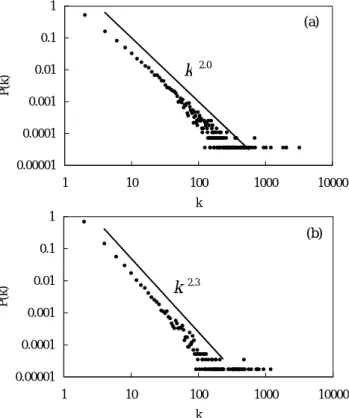
Fig. 2. The log-log plots of the connectivity distributions of the earthquake networks in California for the cell sizes (a) 10 km×10 km×10 km, and (b) 5 km×5 km×5 km. The total num-bers of vertices are (a) N =3869, and (b) N =12 913, respectively.
associated with a main shock tend to return to the locus of the main shock, geographically, making the vertex of the main shock a hub. This has an analogy with the preferential at-tachment rule for a growing network (Albert and Barab´asi, 2002; Dorogovtsev and Mendes, 2003; Pastor-Satorras and Vespignani, 2004). That is, a newly created vertex is con-nected to the ith vertex with connectivity kiwith probability
5 (ki) =
ki
P
jkj
. (1)
This rule is known to generate a scale-free network charac-terized by the power-law connectivity distribution:
P (k) ∼ k−γ, (2)
where γ is a positive exponent.
A scale-free network is in contrast to the Erd¨os-R´enyi clas-sical random graph (Erd¨os and R´enyi, 1959; Bollob´as, 2001; Dorogovtsev and Mendes, 2003), the connectivity distribu-tion of which is Poissonian.
The observation of the above-mentioned feature of after-shocks may lead to the reasoning that the earthquake network is a scale-free network. Below, we shall see that this is indeed the case. 0.00001 0.0001 0.001 0.01 0.1 1 1 10 100 1000 10000 k P(k) (a) 0 . 2 −
k
0.00001 0.0001 0.001 0.01 0.1 1 1 10 100 1000 10000 k P(k) 3 . 2 −k
(b)Fig. 3
0.00001 0.0001 0.001 0.01 0.1 1 1 10 100 1000 10000 k P(k) (a) 0 . 2 −k
0.00001 0.0001 0.001 0.01 0.1 1 1 10 100 1000 10000 k P(k) 3 . 2 −k
(b)Fig. 3
Fig. 3. The log-log plots of the connectivity distributions of the earthquake networks in Japan for the cell sizes (a) 10 km×10 km×10 km, and (b) 5 km×5 km×5 km. The total num-bers of vertices are (a) N =27 599, and (b) N =57 768, respectively.
We have constructed the earthquake networks from the seismic data taken in California and Japan. The data sources are i) the Southern California Earthquake Data Cen-ter (http://www.data.scec.org/), and ii) the Japan Univer-sity Network Earthquake Catalog (http://kea.eri.u-tokyo.ac. jp/CATALOG/junec/monthly.html). The time intervals are i) between 00:25:8.58 on 1 January 1984 and 22:21:52.09 on 31 December 2003, and ii) between 01:14:57.63 on 1 January 1993 and 20:54:38.95 on 31 December 1998. The regions covered are i) 29◦06.000N–38◦59.760N latitude and 113◦06.000W–122◦55.590W longitude with the max-imal depth 175.99 km, and ii) 25.730◦N–47.831◦N lati-tude and 126.433◦E–148.000◦E longitude with the maximal depth 599.9 km. The total numbers of events are i) 367 613, and ii) 123 390. The data in California contains no threshold for magnitude, but we exclude artificial “quarry blasts” from the data. On the other hand, the data in Japan contains only the events with magnitude larger than 2.
The connectivity distributions in California and Japan are shown in Figs. 2 and 3, respectively. There, we compare the results with two cell sizes: (a) 10 km×10 km×10 km, and (b) 5 km×5 km×5 km. The minimal case (b) is legitimate from the geophysical viewpoint regarding the typical size of
148 S. Abe and N. Suzuki: Complex-network description of seismicity
A
C B
Fig. 4
Fig. 4. Reduction of the network in Fig. 1 to the corresponding
undirected simple graph.
a fault. From them, we conclude that the earthquake net-works are scale-free netnet-works characterized by the connec-tivity distributions of the form in Eq. (2). As mentioned in Sect. 2, in-degree and out-degree are not distinguished here since they are identical for each vertex. The smaller the cell size is, the larger the exponent, γ , is. This is natural since the number of vertices with large values of connectivity de-creases as the cell size becomes smaller. However, the trend remains unchanged for the different cell sizes. We have also examined the effect of threshold for magnitude on the con-nectivity distributions by using the data in California. As expected, again the trend does not change for the threshold values: Mth=0∼3.
The result may physically be interpreted as follows. As already mentioned, aftershocks associated with a main shock tend to be connected to the vertex of the main shock, re-alizing preferential attachment. On the other hand, the Gutenberg-Richter law states that frequency of earthquakes
with large values of seismic moment decays slowly as a power law with respect to the value of moment. This implies that there appear quite a few giant components, and accord-ingly the network becomes highly inhomogeneous. How-ever, see also the comment on hierarchical organization in Sect. 5.
4 Small-world structure of the earthquake networks
Small-worldness is also an important ingredient of complex networks. To examine the small-world structure of earth-quake network, it is essential to notice the following point: loops have to be removed and multiple edges should be re-placed by single edges, and then directedness is ignored. This is because, in the small-world picture, we are concerned only with static pattern of whether vertices are connected or not. Consequently, the original earthquake network has to be reduced to an undirected simple graph. In Fig. 4, we show the reduction of the original network in Fig. 1.
Two important characteristics (Watts and Strogatz, 1998) of a small-world network are a large value of the cluster-ing coefficient compared to the Erd¨os-R´enyi classical ran-dom graph and a small value of the average path length (i.e., the number of edges connecting two vertices).
The clustering coefficient is defined as follows. Let
A=(ai j)be the adjacency matrix of a simple graph. ai j=1 if the ith and j th vertices are connected by an edge, whereas
ai j=0 if they are not directly connected. ai i=0 because of the absence of loops. Using the adjacency matrix, the clus-tering coefficient, C, is given by
C = 1 N N X i=1 ci, (3) ci = 1 ki(ki−1)/2 (A3)i i, (4)
where N is the total number of vertices. This quantity shows tendency of two neighboring vertices of a given vertex be-ing connected to each other. It is known (Watts and Strogatz, 1998; Albert and Barab´asi, 2002; Dorogovtsev and Mendes, 2003) that the clustering coefficient of a small-world network is much larger than that of the classical random graph of Erd¨os and R´enyi given by
Crandom=
< k >
N 1, (5)
where <k> is the average value of connectivity.
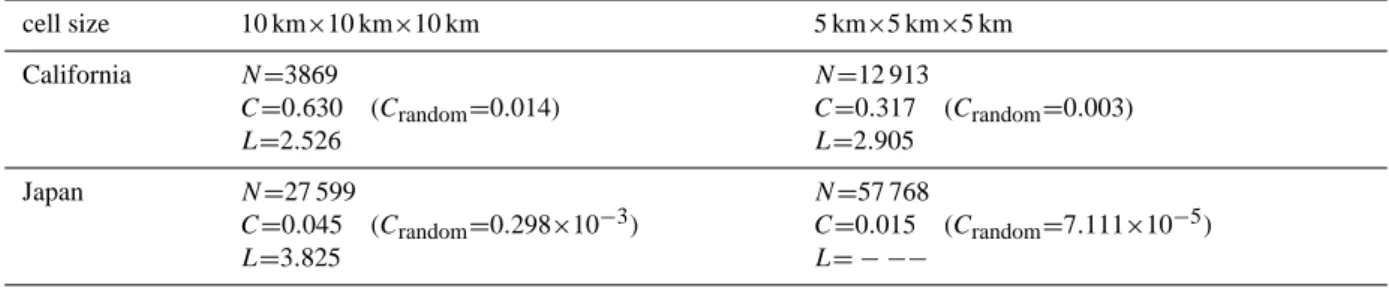
We have analyzed the same data as those in the discussion about the connectivity distributions in Sect. 3. In Table 1, we present the results obtained by performing full analysis (in contrast to the previous limited study of the average path length based on the method of random sampling only for the data in California; Abe and Suzuki, 2004c). (However, because of its heavy combinatorial-problem nature, still we
Table 1. The values of the number of vertices, N , the clustering coefficient, C, (compared with those of the classical random graphs,
Crandom) and the average path length, L. Because of the large number of vertices, the average path length of the earthquake network in Japan
with the cell size 5 km×5 km×5 km could not be evaluated (see the text).
cell size 10 km×10 km×10 km 5 km×5 km×5 km California N =3869 C=0.630 (Crandom=0.014) L=2.526 N =12 913 C=0.317 (Crandom=0.003) L=2.905 Japan N =27 599 C=0.045 (Crandom=0.298×10⁻³) L=3.825 N =57 768 C=0.015 (Crandom=7.111×10⁻⁵) L= − −−
could not obtain the definite value of the average path length for the data in Japan with the cell size 5 km×5 km×5 km, un-fortunately.) From it, one clearly appreciates that the values of the clustering coefficient are much larger than those cor-responding to the associated classical random graphs. The values of the average path length are also seen to be very small, between 2 and 4, taking into account the numbers of vertices. Thus, the earthquake networks are in fact small-world networks.
5 Concluding remarks
We have discussed the complex-network approach to seis-micity and have shown how such an approach sheds new light on complexity of the phenomenon. We have analyzed the topological properties of the earthquake networks con-structed from the seismic data in California and Japan. We have shown that the earthquake networks are scale-free net-works characterized by the power-law connectivity distribu-tions and have given a physical interpretation to this result based on network growth with the preferential attachment rule together with the Gutenberg-Richter law. Then, we have studied the small-world structure of the earthquake networks reduced to undirected simple graphs. Improving and general-izing the previous study using only the data in California, we have performed full analyses of the clustering coefficient and the average path length for the data not only in Californian but also in Japan. The values of clustering coefficient are found to be much larger than those of the classical random graphs. In addition, the values of the average path length are found to be very small. Thus, the earthquake networks are scale-free small-world networks.
There may be a number of important issues still to be addressed. Recently, we have studied the period distribu-tion of the directed earthquake network in California (Abe and Suzuki, 2005b), which show after how many events the earthquake returns to the initial vertex. This is of interest in view of earthquake prediction. There, we have found that the period distributions obey a power law, suggesting a
fun-damental difficulty of predicting the period. Such investiga-tions using data in other regions are of obvious importance. More recently, we have investigated the hierarchical structure as well as the mixing property of earthquake networks (Abe and Suzuki, 2006). We have discovered that the earthquake networks possess hierarchical organizations and assortative mixing. Assortative mixing means that vertices with large values of connectivity tend to be connected to each other. That is, a main shock induces other main shocks. These fea-tures are important due to the following reason: the hierarchi-cal organization cannot be realized by a simple combination of network growth and the preferential attachment rule, and, therefore, still there must be more physical mechanisms to be revealed.
The complex-network approach also enables one to exam-ine seismological models from a peculiar viewpoint. Recent works (Peixoto and Prado, 2004, 2006) discuss the complex-network approach to a self-organized-criticality model. It was shown that under certain conditions a scale-free network can in fact be realized by the model.
It is our expectation that the present complex-network ap-proach may lead to deeper understanding of physics of sis-micity.
Acknowledgements. The referee has drawn our attention to two
papers (Soares et al., 2005; Thurner and Tsallis, 2005), in which relevance of nonextensive statistical mechanics to scale-free networks is mentioned.
This work was supported in part by the Grant-in-Aid for Sci-entific Research of the Japan Society for the Promotion of Science. Edited by: J. Kurths
150 S. Abe and N. Suzuki: Complex-network description of seismicity References
Abe, S. and Okamoto, Y. (Eds.): Nonextensive Statistical Mechh-nics and Its Applications, Springer-Verlag, Heidelberg, 2001. Abe, S., Sarlis, N. V., Skordas, E. S., Tanaka, H. K., and Varotsos,
P. A.: Origin of the usefulness of the natural-time representation of complex time series, Phys. Rev. Lett., 94, 170 601, 2005. Abe, S. and Suzuki, N.: Law for the distance between successive
earthquakes, J. Geophys. Res., 108(B2), 2113, 2003.
Abe, S. and Suzuki, N.: Aging and scaling of earthquake after-shocks, Physica A, 332, 533–538, 2004a.
Abe, S. and Suzuki, N.: Scale-free network of earthquakes, Euro-phys. Lett., 65, 581–586, 2004b.
Abe, S. and Suzuki, N.: Small-world structure of earthquake net-work, Physica A, 337, 357–362, 2004c.
Abe, S. and Suzuki, N.: Scale-free statistics of time interval be-tween successive earthquakes, Physica A, 350, 588–596, 2005a. Abe, S. and Suzuki, N.: Scale-invariant statistics of period in di-rected earthquake network, Eur. Phys. J. B, 44, 115–117, 2005b. Abe, S. and Suzuki, N.: Complex earthquake networks: Hi-erarchical organization and assortative mixing, e-print cond-mat/0602076, 2006.
Albert, R. and Barab´asi, A.-L.: Statistical mechanics of complex networks, Rev. Mod. Phys., 74, 47–97, 2002.
Bollob´as, B.: Random Graphs, 2nd edition, Cambridge University Press, Cambridge, 2001.
Dorogovtsev, S. N. and Mendes, J. F. F.: Evolution of Networks: From Biological Nets to the Internet and WWW, Oxford Univer-sity Press, Oxford, 2003.
Erd¨os, P. and R´enyi, A.: On random graphs, Publ. Math. (Debre-cen), 6, 290–297, 1959.
Gutenberg, B. and Richter, C. F.: Seismicity of the Earth and As-sociated Phenomenon, 2nd edition, Princeton University Press, Princeton, 1954.
Omori, F.: On the after-shocks of earthquakes, J. Coll. Sci. Imper. Univ. Tokyo ,7, 111–200, 1894.
Pastor-Satorras, R. and Vespignani, A.: Evolution and Structure of the Internet: A Statistical Physics Approach, Cambridge Univer-sity Press, Cambridge, 2004.
Peixoto, T. P. and Prado, C. P. C.: Distribution of epicenters in the Olami-Feder- Christensen model, Phys. Rev. E, 69, 025101(R), 2004.
Peixoto, T. P. and Prado, C. P. C.: The network of epicenters of the Olami-Feder-Christensen model of earthquakes, e-print cond-mat/0602244, 2006.
Soares, D. J. B., Tsallis, C., Mariz, A. M., and da Silva, L. R.: Preferential attachment growth model and nonextensive statisti-cal mechanics, Europhys. Lett., 70, 70–76, 2005.
Steeples, D. W. and Steeples, D. D.: Far-field aftershocks of the 1906 earthquake, Bull. Seismol. Soc. Am., 86, 921–924, 1996. Thurner, S. and Tsallis, C.: Nonextensive aspects of self-organized
scale-free gas-like networks, Europhys. Lett., 72, 197–203, 2005. Tirnakli, U. and Abe, S.: Aging in coherent noise models and
natu-ral time, Phys. Rev. E, 70, 056120, 2004.
Tsallis, C.: Possible generalization of Boltzmann-Gibbs statistics, J. Stat. Phys., 52, 479–487, 1988.
Varotsos, P. A., Sarlis, N. V., and Skordas, E. S.: Long-range corre-lations in the electric signals that precede rupture, Phys. Rev. E, 66, 011902, 2002.
Watts, D. J. and Strogatz, S. H.: Collective dynamics of ‘small-world’ networks, Nature, 393, 440–442, 1998.