Anomalous Transport in Complex Networks
by
Christos Nicolaides
Submitted to the Department of Civil and Environmental Engineering
in partial fulfillment of the requirements for the degree of
Master of Science in Civil and Environmental Engineering
MASSACHUSETTS INSTITUTE OF TECHNOLOGYat the
JUN 2 4 2011
MASSACHUSETTS INSTITUTE OF TECHNOLOGY
June 2011
1
-ARIES
@
Massachusetts Institute of Technology 2011. All rights reserved.
ARCHIVES
Author ...
...
Department of Civil and Environmental Engineering
May 7, 2011
Certified by...
. . . .
Ruben Juanes
Assistant Professor of Civil and Environmental Engineering
Thesis Supeyvisor
Certified by...
Tis-CUeto-Fgneroso
Postdoctoral Associate of Civil and Environmental Engineering
Thesis Supervisor
Accepted by...
...
MN
Heida M. Nepf
Chair, Departmental Committee for Graduate Students
Anomalous Transport in Complex Networks
by
Christos Nicolaides
Submitted to the Department of Civil and Environmental Engineering on May 7, 2011, in partial fulfillment of the
requirements for the degree of
Master of Science in Civil and Environmental Engineering
Abstract
The emergence of scaling in transport through interconnected systems is a conse-quence of the topological structure of the network and the physical mechanisms un-derlying the transport dynamics. We study transport by advection and diffusion in scale-free and Erdos-R6nyi networks. Using stochastic particle simulations, we find anomalous (nonlinear) scaling of the mean square displacement with time. We show the connection with existing descriptions of anomalous transport in disordered sys-tems, and explain the mean transport behavior from the coupled nature of particle jump lengths and transition times. Moreover, we study epidemic spreading through the air transportation network with a particle-tracking model that accounts for the spatial distribution of airports, detailed air traffic and realistic (correlated) waiting-time distributions of individual agents. We use empirical data from US air travel to constrain the model parameters and validate the model's predictions of traffic pat-terns. We formulate a theory that identifies the most influential spreaders from the point of view of early-time spreading behavior. We find that network topology, geog-raphy, aggregate traffic and individual mobility patterns are all essential for accurate predictions of spreading.
Thesis Supervisor: Ruben Juanes
Title: Assistant Professor of Civil and Environmental Engineering Thesis Supervisor: Luis Cueto-Felgueroso
Acknowledgments
I am grateful to my research advisors, Prof. Ruben Juanes and Dr. Luis
Cueto-Felgueroso for their valuable guidance during this project; to Prof. Marta Gonzilez for her useful comments and advices; to my friends & fellow students, among them Birendra Jha, Michael Szulczewski, Chris MacMinn, Ben Scandella, and many others, for their camaraderie and occasional commiseration; to my fiancee, Elli Loizidou, for her encouragement; and to my parents, Andreas and Maria Nicolaidou, and sister, Joanna Nicolaidou, for their confidence in my abilities. Thank you!
Contents
1 Introduction 11
1.1 Structure Of Real World Nets . . . . 12
1.2 Dynamical Processes in Complex Networks . . . . 13
2 Potential Driven Diffusion in Spatial Embedded Complex Networks 15 2.1 Physical Setting . . . . 16
2.2 Potential-Driven Transport Process . . . . 16
2.3 Random W alks . . . . 18
2.4 The Continuous Time Random Walk Framework . . . . 23
3 Influential Spreaders in Air Transportation Network 27 3.1 Available Data .. . . . . . 27
3.2 Agent Mobility Model . . . . 28
3.3 Infection M odel . . . . 32
3.4 Numerical Simulations - Results . . . . 34
List of Figures
2-1 Schematic representation of our model network. . . . . 17
2-2 Pressure and velocity distribiutions . . . . 19
2-3 MSD as a function of time . . . . 21
2-4 The scaling exponent 3 as a function of the network size . . . . 22
2-5 Advection-Diffusion transition curves . . . . 23
2-6 Distribution of link lengths . . . . 24
2-7 Waiting Time distributions in advection-dominated transport in Scale-Free netw orks . . . . 26
3-1 World map with the location of the airports in the US database from the Federal Aviation Administration. . . . . 28
3-2 Waiting time distributions . . . . 30
3-3 Exploration and Preferential Visit . . . . 31
3-4 Snapshot of susceptible, infected and recovered agents during airline traffic-driven disease spreading . . . . 33
3-5 SIR Model: (left) The density of Infected agents (i = I/N) as a func-tion of time. (right) The maximum of density as a funcfunc-tion of R . . 35
3-6 SIR Model: The spatial spreading of infected agents (MSD) as a func-tion of tim e . . . . 36
3-7 SIR Model: The MSD and Entropy as a function of time at the early stages of the process . . . . 37
3-8 SIS Model: The MSD and Entropy as a function of time at the early stages of the process . . . . 38
3-9 Traffic-Connectivity properties of the airports of consideration . . . . 39 3-10 The wave front of infected agents 10 days after epidemic started from
LAX. ... ... 39 3-11 The wave front of infected agents at different times . . . . 40
Chapter 1
Introduction
Complex systems are very often organized under the form of networks with nodes and edges between them. During the last decade the idea of complex networks cause a breakthrough to the scientific community and have long been the subject of many studies in mathematics, mathematical sociology, computer science and genetics and medicine. Complex weblike structures describe a wide variety of systems of high technological and intellectual importance. For example, the cell is best described as a complex network of chemicals connected by chemical reactions; the Internet is a complex network of routers and computers linked by various physical or wireless links; fads and ideas spread on the social network, whose nodes are human beings and whose edges represent various social relationships; the World Wide Web is an enormous virtual network of Web pages connected by hyperlinks; metapopulation networks, where the nodes represent populations and the connections flows of indi-viduals between different areas, have used to study global epidemic spreading; cellular functions are carried out by a complex network of genes, proteins, and metabolites that interact through biochemical and physical interactions; These systems represent just a few of the many examples that have recently prompted the scientific community
1.1
Structure Of Real World Nets
The study of complex systems began with the effort to identify their structure and develop models that can reproduce their characteristics. The first model was pro-posed by Erdos and R6nyi [15] at the end of the 1950s and was at the basis of most studies until recently. They assumed that complex systems are wired randomly to-gether, a hypothesis that was adopted by sociology, biology, and computer science. It had considerable predictive power, explaining for example why everybody is only six handshakes from anybody else [38] , a phenomenon observed as early as 1929 and is well known as 'the six degrees of separation'. However, this model failed to explain the big clustering, a common property of social networks where cliques form, representing circles of friends or acquaintances in which every member knows every other member. This latter property is characteristic of ordered regular lattices.
The interest in networks was however renewed in 1998 by Watts and Strogatz [40], who extracted stylized facts from real-world networks and proposed a simple, new model of random networks. They proposed a model that interpolates between an ordered finite-dimensional lattice and a random graph. This model combines small average shortest path and big clustering, characteristics of a wide variety of social complex systems.
In the above models, the number of nodes a node is connected (node degree or connectivity) is more or less the same for all the nodes. More specifically, the degree distribution of a random graph is a Poisson distribution with a peak at P(< k >), where < k > is the average degree. However, one of the most interesting developments in our understanding of complex networks was the discovery that for most large networks the degree distribution significantly deviates from a Poisson distribution. In particular, for a large number of networks, including the World Wide Web [2], the Internet [16], or metabolic networks [19], the degree distribution has a power-law tail,
P(k) ~ k--. (1.1)
tail, often the functional form of P(k) still deviates significantly from the Poisson distribution expected for a random graph.
The origin of the power-law degree distribution observed in networks was first addressed by Barabaisi and Albert (1999) [3], who argued that the scale-free nature of real networks is rooted in two generic mechanisms shared by many real networks: Growth and Preferential Attachment: (i) Growth Starting with a small number (mo) of nodes, at every time step, we add a new node with m(< mo) edges that link the new node to m different nodes already present in the system. (ii) Preferential
Attachment When choosing the nodes to which the new node connects, we assume
that the probability that a new node will be connected to node i is proportional to the degree ki of node i, such that
II (k -) =. (1.2)
- kj
Numerical simulations indicate that this network evolves into a scale-invariant state with the degree of a node following a scale-free distribution with power 7YBA = 3.
1.2
Dynamical Processes in Complex Networks
Recent work has led to fundamental advances in our understanding of flow and trans-port properties of complex networks. These include the analysis of the conductance between two arbitrarily chosen nodes in scale-free or Erdos and Renyi networks [25]-an [25]-analysis that has been extended to the case of multiple sources [25]-and sinks [10, 9], and to weighted networks [23]. The dynamics of spreading through scale-free networks have been studied by means of diffusive random walks [32, 17, 8, 18, 5], which have led to scalings for the mean first passage time (MFPT) in terms of network central-ity [32] and modularcentral-ity [18]. Studies to date leave open, however, the question of how
directional bias impacts transport. Bias, or drift, occurs naturally in many network
systems, including advection from a flow potential [25], agent spreading in topologies with sources and sinks, such as utility networks [11] and freely diffusing molecules in
Chapter
2
Potential Driven Diffusion in
Spatial Embedded Complex
Networks
Here, we study the scaling properties of physical transport in scale-free and Erdos-Renyi networks. The fundamental question is whether the topology of the network, the underlying physical mechanisms, or both, control the scaling properties of trans-port in complex networks. Transtrans-port is physical in the sense that, as observed in most natural settings, the spreading process is conservative and driven by the inter-play between advection-which derives from a flow potential-and diffusion, which we model through random walks. We show that advection leads to anomalous (non-Fickian) transport, as evidenced by the nonlinear time scaling of the mean square displacement (MSD) of tracer particles migrating through the network. The simula-tion results suggest that a mean-field theory such as Continuous Time Random Walk (CTRW), which describes transport from a joint probability distribution of particle jump lengths and transition times [30, 35, 21, 28], may be used to capture the average transport behavior. We show that coupling between space and time [7, 14] is essential to describe advective transport in a complex network.
2.1
Physical Setting
To study the scaling properties of advection-driven transport, we construct scale-free networks, characterized by a power law connectivity distribution, P(k) ~ k--7, where
k is the number of links attached to a node, and -y is the characteristic exponent
of the network, with 2 < 7y < 4.8. We generate graphs following the Molloy-Reed scheme [29]. Given the size of the network (N nodes), the degree exponent -Y, and fixing the minimum degree to be kmin = 2, we use the relations from Aiello et al.
[1]
to obtain the degree sequence from a power law distribution. We then produce a list of ki copies of each node i, and attach links between nodes by randomly pairing up elements of this list until none remain. We disallow double links, as well as self-linked nodes. This algorithm generates networks of excellent accuracy for arbitrary exponents -y, even for relatively small network sizes. We generate an Erdos-Renyi network by attaching a link to each pair of nodes with probability p = 0.01. We assume for simplicity that the nodes in our model network are uniformly spaced in the unit square (Fig. 2-1). The positioning of nodes on a square lattice is an idealization of networks with spatial embedding that exhibit power-law connectivity, including power and distribution networks [11], and transportation and biological systems [39]. Networks embedded in metric spaces often exhibit a decay of nodal connectivity with distance [34, 24]-we have not included this distance-dependent connectivity in our study which therefore allows for long-ranged links.
2.2
Potential-Driven Transport Process
Flow through the network is driven by a scalar (potential) field, and satisfies conser-vation of mass. At every node i we impose
>3
ui = 0, where uij is the flux throughthe link connecting nodes i and
j.
The fluxes are given by-
P=1
P=o
X0
x
Figure 2-1: Schematic representation of our model network [31]. Nodes are distributed uniformly on the unit square. Their connectivity (represented by node diameter) follows a power law distribution. Flow through the network derives from a potential P that varies between 1 (left boundary) and 0 (right boundary).
where Pi and P are the flow potentials at nodes
i
andj,
respectively, and dij is the Euclidean distance between the two nodes. This problem is exactly analogous to the electric conductance model of [25, 10, 9, 23], except that in our model the relation between velocity and potential difference is modulated by the inverse of link length. Here, we assume that the conductivity is the same for all links, and takes a valueyj = 1. To elucidate the essential mechanisms governing transport, we study a simple
setting of flow from left to right by fixing the potential P = 1 at the inflow nodes (left boundary), and P = 0 at the outflow nodes (right boundary). Flow is confined
between the top and bottom boundaries. Inserting the flux equation [Eq. (2.1)] into the mass conservation condition at each node, and imposing the boundary conditions, leads to a linear system of algebraic equations to be solved for the flow potential at the nodes,
{P},
which are stationary and do not evolve in time. This system of equations is solved with a direct solution method such as Gaussian elimination.For different values of the degree exponent 7y, the distributions of nodal potential collapse in the range P E (0.4,0.6) [Fig. 2-2(a)]. Within this range, the flow potential seems to be normally distributed (dashed line). The velocity at the links, u, follows a distribution that exhibits a power law tail [Fig. 2-2(b)]. In the range -y E [2, 3.2], the exponent of the velocity power law distribution is well approximated as V ~y + 1 [Fig. 2-2(b), inset]. As a consequence of this behavior, a slower decay in network connectivity (smaller 'y) results in increased probability of observing large velocities at the links. Interestingly, the flow potential distribution for a random (Erdos-Renyi) network has a very different shape from that of scale-free networks, yet it also leads to a power law tail distribution of the link velocities. Note that for a regular lattice, the distribution of flow potentials is uniform, and the distribution of velocities is a double Dirac delta function.
2.3
Random Walks
We investigate the scaling properties of transport in scale-free networks through stochastic particle simulations. This allows us to explore the transition between the
01* . y=2.6=3.0 o y=3.4 4 y=3.8 + E-R
~OO
0
~
X ++++++++
++++
O+++++++
xo. *.Xo X*0** *** 0 XX X S *0~0 0 0 * i ** OX O*** * *.0 0** *00' (a) * 0 0.2 0.4 0.6 0.8 1P
. Y=2.0 0 *y=2.6 o y=3.2 x y=3.8 ei;
+ E-R 0-10~ 10-2 2.5 Y 10~Figure 2-2: (a) Pressure distributions, <k(P), for scale-free networks with different degree exponents, y, as well as for an Erd6s-Renyi network (E-R). The dashed line is a Gaussian fit with mean P = 0.5 and standard deviation up 0.08. We use networks
of size N = 8100 nodes, and the results are averaged over 250 realizations. (b) Velocity distributions, <D(u), for different network types. Inset: Exponent v of the velocity distribution power-law tail plotted against the connectivity exponent 7/ E
[2,3.2];
purely diffusive and advective regimes. Particles move along the links of the network according to the local advective velocity field obtained from the steady-state poten-tial solution, together with an additional random diffusive component sampled from a Gaussian distribution:
XN+1 = XN + 6XN,
(2.2)
6
XN = uijot +
12D
6t,
(2.3)XN+1 0
(2.4)
'where X denotes the coordinate along the link, D is the diffusion coefficient, and ( = N(0, 1). At t = 0, we inject particles at random at the inflow nodes. A particle located at node i at a given time step chooses one of the outgoing links to "walk" on it. Link selection is performed at random, with probability that is linearly proportional to the magnitude of the link velocity. The term outgoing refers here to links with velocity vectors pointing from the initial position of the particle (node i), to the destination connected nodes. Constraint (2.4) forces particles walking on a link ij to stay on it until they reach the destination node
j.
Particles are removed when they reach the outflow nodes.The key parameter in this stochastic process is the ratio between advective and diffusive jump lengths,
A =(2.5)
/2Do5t
where i is the characteristic velocity at the links. This computational quantity plays the role of the Peclet number (Pe =
ud/D)
in physical fluid flow, where d is the characteristic length of the links. The purely advective and diffusive limits correspond to A - oo and A = 0, respectively. A second computational parameter is euot/(Ad),
which measures the effect of the boundary constraint (2.4). By fixing the value of E, we impose a constant ratio between the number of advective jumps affectedby the constraint, and the average number of jumps needed for a particle to move
0 Scale-Free Networks 1.9 - E-R Network 1.8 - --- Ballistic Limit -- Normal Transport 1.7 1. 10 1.51 0-^1 2 CL { A ' 102 (1.4 1.3 v 10+ 1.2 + * E-R 1.1 10' 100 101 2 2.5 3 3.5 4 4.5 5 Y
Figure 2-3: The particle MSD follows a power law in time during early times, before it is influenced by boundary effects (inset). The main plot shows the scaling expo-nent
3
of the particle MSD, for advection-dominated transport(A
> 1) in scale-freenetworks, plotted against the connectivity degree exponent -y. Transport is
anoma-lous, and falls in the superdiffusive regime
(0
3 > 1). Shown also are the values of3
for an Erdo~s-Renyi (E-R) network-for which transport is also superdiffusive-and a regular lattice-for which transport is normal, 3 = 1. We use networks with
N
= 8100nodes, and set
A
=7
and E = 0.0014. We use 3000 particles and we average over100 realizations. Within each realization, we construct the network, solve the flow
potential equation, and advance particles by advection and diffusion, according to the flow field from the potential solution.
-particle tracking simulations. We analyze the Euclidean mean square displacement
(MSD, also known as dispersion, or variance of the particle plume) in the direction
of the mean flow: (Ax2(t)) = (X2(t)) - (x(t))2, where
()
denotes averaging over allthe particles.
In the advective limit (A
>
1, E<
1), the MSD follows a power law at early times,(Ax2(t)) - t0, and then saturates due to finite size effects (Fig. 2-3, inset). We
com-pute the scaling exponent
#
in the pre-asymptotic regime for scale-free networks with different exponents -y, as well as for an Erd6s-R6nyi (E-R) network. Our simulations show that advection-dominated transport on scale-free networks is anomalous, and exhibits superdiffusive behavior,#
> 1 (Fig. 2-3). The exponent#
increases mono-tonically with 'y. For large 'y, it asymptotically reaches the ballistic limit,#
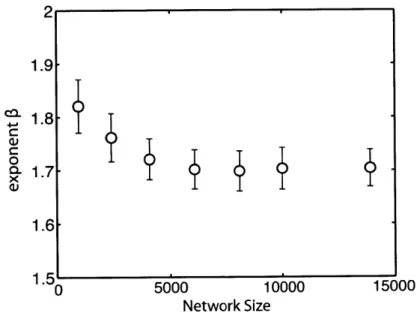
= 2. We have confirmed that our results are independent of network size for N > 4000 (Fig. 2-4). 2 1.9-41.8D1.7 .
1.6 1.51 0 5000 10000 15000 Network SizeFigure 2-4: The scaling exponent
#
as a function of the network size for scale-free network with connectivity exponent -y = 2.6. We use 3000 particles, parameters valueA = 7 and E = 0.0014, and we average over 100 realizations
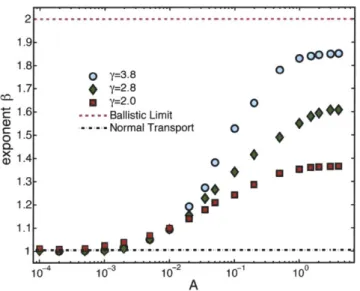
The scaling properties of transport in scale-free networks depend on the rela-tive dominance between advecrela-tive and diffusive mechanisms (Fig. 2-5). We perform simulations varying the ratio between the advective and diffusive jump lengths by
1.9-1.8o00 00 1.80- y=3 .8 0 1.7- + y=2.8 M y=2.0 1.6- - Ballistic Limit S1.5 - --- Normal Transport 0 (X1.4-0 1.3 0 1.2-1.1 - -10 103 10-2 101 10 A
Figure 2-5: Purely diffusive transport (A < 1) in scale-free networks leads to linear scaling of the mean square displacement (# ~ 1). As A increases, we observe a transition from normal transport to anomalous transport, with scaling exponents,
#,
that reach different asymptotic values in the superdiffusive regime, depending on the network topology (Fig. 2-3). We use networks with N = 8100 nodes, fixed E = 0.04, and 3000 particles. Simulation results are averaged over 100 realizations.
controlling the value of parameter A. For small values of A, transport is governed
by diffusion, while for large values advection dominates. The scaling exponent of
the MSD increases monotonically with A. This implies a transition from the normal scaling (# = 1) of purely diffusive transport, to anomalous scaling (# > 1) in the
advection-dominated limit. The asymptotic value of
#
as A -+ oc is controlled by the topology of the network (Fig. 2-3).2.4
The Continuous Time Random Walk
Frame-work
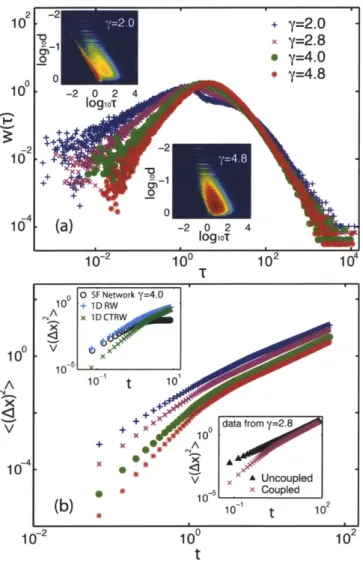
The observed scaling can be understood within the Continuous Time Random Walk (CTRW) framework [30, 35, 6, 20]. This model of transport assumes that the statis-tics of particle spreading can be fully characterized by a joint probability distribu-tion, $(X, T), of particle jump lengths, x, and waiting time between
jumps,
T, whose.
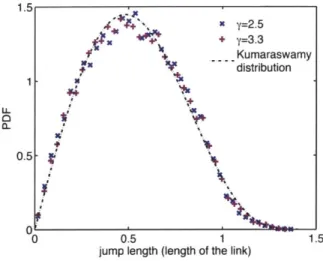
marginal distributions A(x) and w(T), respectively, can be derived by integration. It is well understood that broad distributions of jump lengths or transition times may lead to anomalous transport [30, 35, 6, 20]. To test the ability of CTRW to describe transport in scale-free networks, we perform ID random walks by sampling the empirical joint distributions @(x, T) recorded from our network simulations. In the advection limit, the jump length can be represented by the length of the link, d. Since the network is restricted to a finite domain, d is bounded and is found to be well approximated by a Kumaraswamy distribution [Fig. 2-6]. In contrast-and due
1.5 .i 1.5x y=2.5 X + y=3.3 Kumaraswamy distribution LL se0 0.5 0 0 0.5 1 1.5
jump length (length of the link)
Figure 2-6: Distribution of link lengths in our embedded Erd6s-Renyi and scale-free networks for different values of the degree exponent, -y = 2.5 and 3.3. This distribution
of link lengths is well approximated by a double-bounded Kumaraswamy distribution
<D(d)
~ (d/v
2)(1
-
(d//2)2)4
to the broad-ranged velocity distributions-the transition times between connected nodes, T = d/u, exhibit a wide range distribution with power law tail, w(r) ~. T(1±6) [Fig. 2-7(a)], where 6 ~ 1.9 for all degree exponents -y. In the case of decoupled CTRW
[@(x,
r)
= A(X)w(T)] in an infinite lattice under a bias, we would expect an asymptotic late-time scaling of the MSD, (Ax2(t)) t 1 [35, 36, 28], in contrastwith the observed scalings (Fig. 2-3) The lack of quantitative agreement between de-coupled CTRW and the scaling observed in our network simulations highlights the importance of the coupling between jump length and waiting time [Fig. 2-7(a), insets] in the MSD, especially at early times [Fig. 2-7(b), bottom-right inset]. A ID coupled
CTRW qualitatively recovers the monotonic increasing trend of the scaling exponent
#
as a function of 'y [Fig. 2-7(b)]. Quantitative agreement requires introducing addi-tional information from the network simulations, such as the possibility of back-flow, and linear interpolation of the particle positions between jumps [Fig. 2-7(b), top-left inset]. The transition to normal transport for small 7y (Fig. 2-3) is consistent with the convergence of the joint distribution of jump lengths and transition times towards the geometric limit T ~
d
2 [Fig. 2-7(a), top-left inset]. This unexpected diffusion-likescaling, whose origin appears to lie in the existence of very well connected nodes, is responsible for bounding anomalous transport behavior.
10-' -2 0 2 4 1
(
ggT -2 U-2 10 .+ = + /*0 10 (a) +0-2 0 24 logioT 10-2 100 102 10, T o O SF Network y=4.0 10 + 1D RW qA x 1D CTRW A 10-A 10 t 10 X + x+ 1 afromy2.8 + X ,0 A 1- 4 10 X X A e ,* 9 ,X A Uncoupled(b)
,10 10-1 t 102 10-2 100 102 tFigure 2-7: (a) Marginal distribution of waiting times for advection-dominated trans-port and different scale-free networks. Insets: Joint distribution V)(d, 'r) for two dif-ferent scale-free networks (y = 2.0 and 4.8). Link length and transition time exhibit strong coupling for -y = 2.0, for which the joint distribution collapses around the scaling r d2. The results are for network size N = 8100 nodes and over 300
realizations. (b) MSD for coupled and unidirectional CTRW, using data from dif-ferent network types. Bottom-right inset: MSD for coupled and uncoupled biased,
ID CTRW. Top-left inset: MSD from network simulations compared with the results
from ID coupled CTRW, and ID RW with back-flow and linear interpolation along the jumps. By back-flow we mean that the velocity along links in the network sim-ulations is predominantly in the positive x-direction, but the flow is 'backwards' for some links. The ID random walk simulations with backflow are based on taking a fraction of the jumps in the negative x-direction, to better approximate the actual
2D network simulations. In the classical CTRW framework, particles are assumed to
'wait' at a given location until they jump to a new one. By interpolation we mean that we post-compute the mean square displacement (MSD) at a given time as if the particles had experienced a constant velocity between jumps-a behavior that more closely resembles the setting of the 2D particle tracking network simulations.
Chapter 3
Influential Spreaders in Air
Transportation Network
The understanding of explosive spreading of infectious diseases is crucial to global population health, especially given the growing connectivity of an increasingly vul-nerable human mobility system. In this chapter, we build an agent mobility model using single-agent modeling strategy in which each individual is tracked in time. The system evolves following a stochastic microscopic dynamics and at each time step it is possible to record average quantities such as the density or the geographical spreading of infected agents. Each individual particle has its own itinerary based on real data, latest advances in understanding human mobility patterns and on a Continuous Time Random Walk framework with correlated waiting times. Individual mobility patterns are essential to capture the early time spatial characteristics of an epidemic outbreak.
3.1
Available Data
We have available data that count for flights from all airlines with at least one origin or destination inside US (including Alaska) for the period of time between January
2007 to July 2010 provided by Federal Aviation Administration 1. The data divided
in two datasets: A) T-100 Segment and B) T-100 Market. In Market, a passenger
Figure 3-1: World map with the location of the airports in the US database from the Federal Aviation Administration.
is "enplaned" and is counted only once as long as he/she remains on the same
flight
number up to the final destination. In segment, a passenger is "transported" and
is counted for each leg of the trip. Hence, from the Market dataset we can extract effective flows (not everything) from one airport to the other (W matrix), while from the segment database we can calculate exact traffic in each segment of the network (WT, matrix). We also have available itinerary data from a major US airline, that account for tickets have been bought for domestic travels during the period July 1
and October 3 1st, 2004 2.
3.2
Agent Mobility Model
The Air Transportation network consist of V Airports and E edges. The network characterized by the weighted matrix W where its entry wij gives the number of passengers travel from the airport i with final destination
j.
To each airportj
we assign a population given by the empirical relation Nj - T, where a = 0.5 andT =
Ej
wij is the total traffic of the airportj
[12].2Barnhart group (Transportation@MIT)
Each individual at a given airport choose a destination airport to travel [27] ac-cording to the effective fluxes W with probability:
Pij ~ Wij (3.1)
Based on the fact that W accounts only for travels where the individuals remain under the same flight number, i.e. does not reflect actual flows, we set a constant small probability for the agent to choose any other destination.
The individual travel to the final destination airport by choosing the route with the less total cost, ie the route that minimize
do .2*0.
C L= c 3 L jo.2. (3.2)
Where the sum is over all the segments (i,
j)
of the trip. This formula combines the need for small number of connection flights to the destination, routes with total large traffic and intermediate steps, in a sense somewhere between origin and destination. The noise I put there acounts for the different social-economic situation of each agent: rich people care only about minimize number of connections however poor people care about the money cost that is highly (negative) correlated with the flux in the links. The above model based on the currently explosion of usage websites that give many alternative choices of flight between an origin and a destination (Expedia, Orbitz etc).If the route is with intermediate stops, at the connecting airport, the agent will
wait for a short time period chosen by real data of scheduled waiting times at con-necting airports (Fig. 3-2) In general, when an agent is off ground, flights with the average plane velocity of u = 650km/h.
After the agent arrives to the destination, he/she choose one waiting time from a waiting time distribution (Fig. 3-2) and stays there. The way we assign populations in each airport as a function of total traffic, allow us to use same waiting time distribution for all agents.
When the waiting time elapse, the agent use the Back to Home rule: 98.5% of the agent itineraries include only one final destination and return home (i.e. at the
loca-0.18 -0- Connecting Airports 0.16 -0- Destination Airports 0.14 -0- HomeAirports a 0.12 0.1 a 0.08 L 0.06 0.04 0.02 0 10 10~ 100 102 104
Waiting Time (days)
Figure 3-2: Waiting time distribution at the connecting airports [4], at the final travel destinations (individual Ticket data from a major US airline between July 1st and September 30th, 2004 for domestic travels) and at the agent's home (artificial). We make use of the fact that the time spent an agent home is order of magnitude larger than the time spent at a travel destination
tion the agent assigned initially). 1.05% of the itineraries include 2 final destnation and 0.45% include 3 final destinations. For the above rule we use the individual ticket
data (- 2.5 million round trip itineraries) from a major US airline between July 01,
2004 and September 30, 2004 for domestic flights.
If the agent is at "home", or continue his travel, he choose one destination airport
using two recently applied rules for explaining human mobility patterns: Exploration and Preferential Visit [37]:
Exploration: the probability to visit a new airport is:
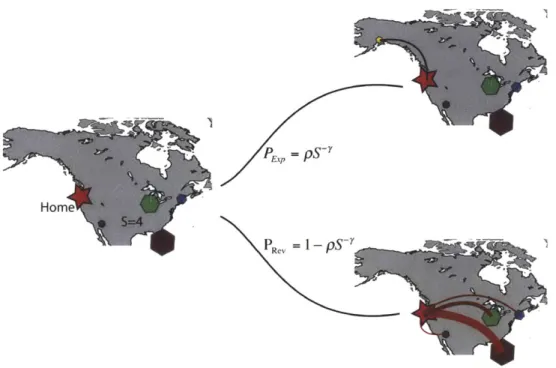
PNew = pS- (3.3)
where S is the number of unique airports an agent has visited in the past. We will use -y = 0.21 t 0.02 and p (p > 0) from a Gaussian distribution with mean p = 0.6
that fit the mobile phone data of human mobility [37]. ... ... .. ... ... .... I - , --- -
---=
pS-=1- 1
-pS-Figure 3-3: Exploration and Preferential Visit. With star is represented the home of the individual (Seattle) and with the hexagons, the already visited places. The size of the hexagon represents how many times is visited by the agent in the past.
Preferential visit: With complementary probability
PRet =
1
-PS'
(3.4)the agent will visit airports that already have visited. In this case the probability Hi to visit an airport i is chosen proportional to the number of previously visits at
location i,
fi
1i=
f
(3.5)We allow the agent mobility model to advance for a period of time (~ 1 year) in order to 'train' the agents and avoid early time instability that the exploration and preferential visit rules may cause.
3.3
Infection Model
We use the compartmental SIR Infected-Recovered) and SIS (Susceptible-Infected-Susceptible) models to study epidemic spreading in our mobility model. The SIR model is characterized by a set of reaction equations:
S +
4 21
1 4 R, (3.6)
while the SIS can be described by:
S+ I $ 21
I4 S (3.7)
The compartmental models above conserves the number of individuals and are characterized by the reproductive number R =
#/p,
which determines the average number of infectious individuals generated by one infected individual in a fully sus-ceptible population. The epidemic is able to generate a number of infected individuals larger that those who recovered only if R > 1, yielding the classic result for theepi-demic threshold [33]. On the other hand, if the spreading rate is not large enough to allow a reproductive number larger than one (that is
#
> p), the epidemicout-break will affect only a negligible portion of the population and will die out in a finite amount of time. This result is valid at the level of each subpopulation (airport) and holds also at the metapopulation level (network of airports) where R > 1 is a necessary condition to have the growth of the epidemic [13].
Under the assumption of homogeneous mixing within a city, contacts between Susceptible and Infectious individuals are uniformly distributed. Let
#
be the contact rate for each time step, defined as the average number of individuals with whom an infectious individual will make sufficient conduct to pass the infection in the time interval (t, t+
6t). The average number of new infections caused by one infectious* *
~l*quo
*.:Its 0" Susceptible " Infected
[ Recovered
Figure 3-4: Snapshot of susceptible, infected and recovered agents during airline traffic-driven disease spreading from Los Angeles Int. Airport (LAX), after ~10 days. In this particular simulation, we used an SIR model with parameters
#=0.01
(infection rate) and pi=0.004 (recovery rate), and a total of 50,000 agents.person in that city on that time (t, t
+
dt) is equal to3Sj(t)/Nj(t).
Therefore the expected number of newly infected persons in city i at the t+
Uf is:(3.8)
itMSi(t)
Ni (t)
One infected can be recovered during the time period between t and t +
oU
with a probability p,, where mu 1 is the typical duration of a decease. Hence, the expected number of newly recovered in city i at t+
Uf is:PIi (t)
(3.9)
The above formulation assume that the city is isolated and no infected come inside and out the city during the interval (t, t + t). The SIR model can be characterized
by the deterministic set of equations Sit+ t) = Sj(t) + (Sjtt)) -O # Ni(t) (3.10) Ni(t) Ii (t + 6t) = Ii (t) + Q (Ij (t)) + 0 Mt) i - P Ii t) (3.11) Ni (t) Ritt+6t) = Rjtt)+Q(Rjtt))+pIj(t), (3.12) (3.13)
where Q(Xi) is called transport operator and represents the net change in compart-ment X due to travel from/to city i. From the above system of equations we can extract (by adding them) the conservation equation for the population in each city:
Ni(t + 6t) = Ni(t) + Q(Si(t)) + Q(I (t)) + Q(Ri (t)) (3.14) Using the same formulation above we can write also down the equations that describe the SIS model:
Si(t + 6t) = S (t) + Q(S (t)) - # S2(t)Ii(t) + Ph1(t) (3.15)
Ni(t)
(3.16)
Ni (t)
(3.18)
3.4
Numerical
Simulations
-
Results
As we said before we allow the mobility model to run for a period of 1 year in order to avoid early times spreading instability that maybe will caused due to the exploration
and preferential return rules.
We choose particular values of the decease parameters
#
and y and we initialize the epidemic spreading model by assigning randomly 10 infected agents at the airport of consideration. We first consider the epidemic threshold when an epidemic starts from different airports. The epidemic threshold defined by the reproductive number abovewhich the epidemic causes an outbreak [Fig. 3-5]. It is very clear that the epidemic
Z
0.2-~ --4J, AT L .2 -0- SEA 02 -0-ANC 0.15 - '-O0- BOS0.1
0.1
-- MCO
0.05 -0 50 100 150 2 3 4 5 6 7 time (days) R=p/pFigure 3-5: SIR Model: (left) The density of Infected agents (i = I/N) as a function
of time for different values of
#
and y = 0.0412 when an epidemic started from Kansas City Int. Airport. Each Curve is averaged over 100 realizations and we use 105 agents for the mobility model. (right) The maximum of the desnsity imax as a function of the reproductive number R =#/p
of the process.threshold does not depend on the initial position of the infected agents since for all airports the reproductive number above which the epidemic causes an outbreak is the same for all airports and near to R = 1 [13].
We next use two quantities in order to quantify early time spreading ability of the different airports: Mean Square Displacement [31] and Entropy [12, 26]:
Mean Square Displacement: This quantity indicates the spatial spreading of the agents at each time and can be defined:
Ax2
(t) =< (x(t)- < x(t) >)2 >, (3.19)
where x(t) the position vector of all agents at time t and < . > indicates averaging over all the infected agents.
Entropy: measure of the level of heterogeneity of decease prevalence and defined
x 107
R=0.4808
x 107R=1.4423
- MCI 3 3 -ORDE
- LAX 2-- JFK 2 0 IAH () - SFO1
-- ATL 1 -- SEA 0 0 0 50 100 150 0 50 100 150 x 107R=4.3269
x 107R=7.2115
3 3 EY
2 200
1 1 0 50 100 150 0 50 100 150time (Days)
time (days)
Figure 3-6: SIR Model: The MSD of Infected agents plume as a function of time for different values of R =
#/p
where p = 0.0412 when an epidemic started from different airports in US. Each Curve is averaged over 100 realizations and we use 10' agents for the mobility model.as:
H( - p (t) log pi ( (3.20)
log
V
where p1(t) = ij(t)/ imm(t) and iy(t) = I3(t)/Nj(t) the prevalence in each city
j.
Entropy takes values between 0 at the initial time when only one city is infected, and
1 when all the airports in the world have the same density of infected agents (im = ii
for every m and 1).
We plot these two quantities as a function of time in the case of an SIR [Fig. 3-71
and SIS [Fig. 3-8] model for different airports of initialization and try to compare airports in terms of ability to spread in the space the decease. I also report properties like total traffic and connectivity of the airports of consideration [Fig. 3-9].
R=0.4808
cmJ E 10 1 C"j E 16~10
ci,
100 .4 n 1 0 00 10 1time (days)
R=0.4808
10 1 R=1.4423 106o
MCI k=1 99 10Co
ORDk34o
LAX k=329 OJFK k=332 IAH k=289R=7.2115
100
time (days)
R=1.4423
10
10
10
R=4.3269
10
100 10time (days)
1 10 0 0 10R=7.2115
100time (days)
10Figure 3-7: SIR Model: The MSD of Infected agent plume as well as the Entropy as a function of time for different values of R =
#/p
where p = 0.0412 when an epidemic started from different airports in US. Each Curve is averaged over 100 realizations and we use 10' agents for the mobility model. We concetrate at early time period between 1 and 10 days after the infected appeard in the airport of Consideration10
... ... . ... -... ...
1
R0.9524
SIS
R=1.4286
c 107 10 S106 10 C 1 10 L10 1 5!P 100 10 1 R=2.8571 100 101 R=4.2857 ORD 10 10 o SDF o MSP E 10 10 W 10 10 100 10 100 10'Time (days) Time (days)
R=0.9524 R=1.4286 10-1 10 CL 0
Uj
10 2 10 100 10 100 10 R=2.8571 R=4.2857 10 1 CL 1 2 10 -10 0 10 1 10 0 10 1Time (days) Time (days)
Figure 3-8: SIS Model: The MSD of Infected agent plume as well as the Entropy as a
function of time for different values of R =
#/p
where y = 0.0412 when an epidemicstarted from different airports in US. Each Curve is averaged over 100 realizations and we use 10' agents for the mobility model. We concetrate at early time period between 1 and 10 days after the infected appeard in the airport of Consideration
o AN 0ATI o F BOS AD 0OIAH-o MCI O PHX o LAX o SF0 I - .... ...
ATL ORD
V
LAXV
PHX SFO SEA VV
ANCV
BOSV
JFK IAHV
V
MSP
V
[ADV
250 300Connectivity
350 400Figure 3-9: Traffic-Connectivity properties of the airports of consideration
Figure 3-10: The wave front of infected agents 10 days after the epidemic started from Los Angeles International airport. We make use of the SIS model with parameters
#
= 0.01 and p- = 0.0412. Results are averaged over 100 realizatiosn and we use 105agents for the mobility model.
0.6-0.4
0.2[ McV
SDF7
T50
200 . . ... .. .... .. ..... . ... .... ... ... ... ..... IT=4 days
T=7 days
T=10 days
Figure 3-11: The wave front of infected agents at different times after the epidemic started from different airport locations. We make use of the SIS model with parame-ters
#
= 0.01 and p = 0.0412. Results are averaged over 100 realizatiosn and we use10' agents for the mobility model.
From the above plots it is clear that some airports dominates in terms of ability to spread a decease spatially around the world. This ability correlated with the con-nectivity and the total traffic. However these two properties cannot define, only by themselves, the ability of spreading. As future work, we will try rank all airports in the database in terms of their spreading potential, and we will propose improved measures of influential spreaders that incorporate the geometry, fluxes through the network and the link orientation.
- - - -_ __ -_____ -__ -_
Chapter 4
Discussion and Conclusions
The nonlinear scaling of spreading with time suggests that transport processes in complex networks are much faster than previously estimated using purely diffusive random walk models that neglect advective fluxes. In the presence of advection, the topology of the network plays a central role in the spreading dynamics, while for diffusion-dominated processes the scaling of spreading with time is independent of network connectivity. Our interpretation in terms of transition times links transport in complex networks with well-established models of effective transport through disor-dered systems, and opens the door to aggregate conceptualizations of biased transport processes in scale-free networks.
Moreover, the ability of a node to spread an information or a decease in the system cannot be only described by its connectivity or by the total weight of its links (traffic). However, we believe that a combination of properties like connectivity, total traffic, betweenness, k-core degree, spatial orientation and sphericity of the links are essential to define influential spatial spreaders in a complex system at the early times of an outbreak.
The identification of the most influential spreaders, and whether an outbreak will be short-lived or result in a pandemic, depend critically on our ability to predict, in a stochastic sense, the migration and contact dynamics of individuals through the network, which in turn must rely on a faithful characterization of the network topology, geometry, fluxes, and individual mobility patterns.
Bibliography
[1] W. Aiello, F. Chung, and L. Lu. A random graph model for massive graphs.
In Proc. of the 32nd Ann. ACM Symp. on Theory of Computing, Portland, OR, 2000.
[2] R. Albert, H. Jeong, and A.-L. Barabisi. Diameter of the world wide web.
Nature, 401:130-131, 1999.
[3] A.-L. Barabaisi and R. Albert. Emergence of scaling in random networks. Science, 286:509-512, 1999.
[4] C. Barnhart, D. Fearing, and V. Vaze. Modeling passenger travel and delays in the national air transportation system.
[5] A. Baronchelli, M. Catanzano, and R. Pastor-Satorras. Random walks on
com-plex trees. Phys. Rev. E, 78:011114, 2008.
[6] B. Berkowitz, A. Cortis, M. Dentz, and H. Scher. Modeling non-Fickian transport
in geological formations as a continuous time random walk. Rev. Geophys., 44(2):RG2003, 2006.
[7] B. Berkowitz and H. Scher. Anomalous transport in random fracture networks.
Phys. Rev. Lett., 79:4038-4041, 1997.
[8] E. M. Bollt and D. ben Avraham. What is special about diffusion on scale-free
nets? New J. Phys., 7:26, 2005.
[9] S. Carmi, Z. Wu, S. Havlin, and H. E. Stanley. Transport in networks with
multiple sources and sinks. EPL, 84:28005, 2008.
[10] S. Carmi, Z. Wu, E. L6pez, S. Havlin, and H. E. Stanley. Transport between
multiple users in complex networks. Eur. Phys. J. B, 77:165-174, 2007.
[11] R. Carvalho, L. Buzna, F. Bono, E. Gutierrez, W. Just, and D. Arrowsmith.
Robustness of trans-European gas networks. Phys. Rev. E, 80:016106, 2009. [12] V. Colizza, A. Barrat, M. Barthelemy, and A. Vespignani. The role of the airline
transportation network in the prediction and predictability of global epidemics.
[13] V. Colizza, R. Pastor-Satorras, and A. Vespignani. Reaction-diffusion processes and metapopulation models in heterogeneous networks. Nature, 2:276-282, 2007. [14] M. Dentz, H. Scher, D. Holder, and B. Berkowitz. Transport behavior of coupled
continuous-time random walks. Phys. Rev. E, 78:041110, 2008.
[15] P. Erd6s and A. R6nyi. On the evolution of random graphs. Publ. Math. Inst.
Hung. Acad. Sci., 5:17-60, 1960.
[16] M. Faloutsos, P. Faloutsos, and C. Faloutsos. On power-law relationships of the
internet topology. Comput. Commun. Rev., 29:251, 1999.
[17] L. K. Gallos. Random walk and trapping processes on scale-free networks. Phys.
Rev. E, 70:046116, 2005.
[18] L. K. Gallos, C. Song, S. Havlin, and H. A. Makse. Scaling theory of transport in
complex biological networks. Proc. Nati. Acad. Sci. USA, 104:7746-7751, 2007.
[19] H. Jeong, B. Tombor, R. Albert, Z. N. Oltvai, and A.-L. Barabasi. The
large-scale organization of metabolic networks. Nature, 407:651-654, 2000.
[20] P. K. Kang, M. Dentz, and R. Juanes. Predictability of anomalous transport on lattice networks with quenched disorder. Phys. Rev. E, 83:030101, 2011.
[21] J. Klafter and R. Silbey. Derivation of the continuous-time random-walk equa-tion. Phys. Rev. Lett., 44:55-58, 1980.
[22] K. C. Leptos, J. S. Guasto, J. P. Gollub, A. I. Pesci, and R. E. Goldstein. Dynamics of enhanced tracer diffusion in suspensions of swimming eukaryotic microorganisms. Phys. Rev. Lett., 103:198103, 2009.
[23] G. Li, L. A. Braunstein, S. V. Buldyrev, S. Havlin, and H. E. Stanley. Transport
and percolation theory in weighted networks. Phys. Rev. E, 75:045103, 2007. [24] G. Li, S. D. S. Reis, A. A. Moreira, S. Havlin, H. E. Stanley, and J. S. Andrade,
Jr. Towards design principles for optimal transport networks. Phys. Rev. Lett.,
104:018701, 2010.
[25] E. L6pez, S. V. Buldyrev, S. Havlin, and H. E. Stanley. Anomalous transport in
scale-free networks. Phys. Rev. Lett., 94:248701, 2005.
[26] P. Maynar and E. Trizac. Entropy of continuous mixtures and the measure
problem. Phys. Rev. Lett., 106:160603, 2011.
[27] S. Meloni, A. Arenas, and Y. Morenco. Traffic-driven epidemic spreading in
finite-size scale-free networks. Proc. Natl. Acad. Sci. USA, 106:16897-16902,
2009.
[28] R. Metzler and J. Klafter. The random walks guide to anomalous diffusion: a
[29] M. Molloy and B. Reed. A critical point for random graphs with a given degree
sequence. Random Struct. Algorithms, 6:161-179, 1995.
[30] E. W. Montroll and G. H. Weiss. Random walks on lattices.
II.
J. Math. Phys.,6:167, 1965.
[31] C. Nicolaides, L. Cueto-Felgueroso, and R. Juanes. Anomalous physical transport
in complex networks. Phys. Rev. E, 82:055101, 2010.
[32] J. B. Noh and H. Rieger. Random walks on complex networks. Phys. Rev. Lett., 92:118701, 2004.
[33] R. Pastor-Satorras and A. Vespignani. Epidemic spreading in scale-free networks.
Phys. Rev. Lett., 86:3200-3203, 2001.
[34] A. F. Rozenfeld, R. Cohen, D. ben-Avraham, and S. Havlin. Scale-free networks on lattices. Phys. Rev. Lett., 89:218701, 2002.
[35] H. Scher and E. W. Montroll. Anomalous transit-time dispersion in amorphous
solids. Phys. Rev. B, 12(6):2455-2477, 1975.
[36] M. F. Shlesinger. Asymptotic solutions of continuous-time random walks. J.
Stat. Phys., 10(5):421-434, 1974.
[37] C. Song, T. Koren, P. Wang, and A.-L. Barabisi. Modelling the scaling properties
of human mobility. Nat. Phys., 6:818-823, 2010.
[38] M. Stanley. The small world problem. Phys. Today, 1:60-67, 1967.
[39] A. Tero, S. Takagi, T. Saigusa, K. Ito, D. P. Bebber, M. D. Fricker, K. Yumiki,
R. Kobayashi, and T. Nakagaki. Rules for biologically inspired adaptive network design. Science, 327:439-442, 2010.
[40] D. J. Watts and S. H. Strogatz. Collective dynamics of 'small world' networks.
Nature, 393:440, 1998.
[41] S. R. Yu, M. Burkhardt, M. Nowak, J. Ries, Z. Petrisek, S. Scholpp, P. Schwille, and M. Brand. Fgf8 morphogen gradient forms by a source-sink mechanism with freely diffusing molecules. Nature, 461:533-536, 2009.
![Figure 2-1: Schematic representation of our model network [31]. Nodes are distributed uniformly on the unit square](https://thumb-eu.123doks.com/thumbv2/123doknet/14014022.456746/17.918.224.660.348.730/figure-schematic-representation-network-nodes-distributed-uniformly-square.webp)


![Figure 3-2: Waiting time distribution at the connecting airports [4], at the final travel destinations (individual Ticket data from a major US airline between July 1st and September 30th, 2004 for domestic travels) and at the](https://thumb-eu.123doks.com/thumbv2/123doknet/14014022.456746/30.918.260.607.129.410/waiting-distribution-connecting-airports-destinations-individual-september-domestic.webp)