HAL Id: cea-02437052
https://hal-cea.archives-ouvertes.fr/cea-02437052
Submitted on 13 Jan 2020
HAL is a multi-disciplinary open access
archive for the deposit and dissemination of
sci-entific research documents, whether they are
pub-lished or not. The documents may come from
teaching and research institutions in France or
abroad, or from public or private research centers.
L’archive ouverte pluridisciplinaire HAL, est
destinée au dépôt et à la diffusion de documents
scientifiques de niveau recherche, publiés ou non,
émanant des établissements d’enseignement et de
recherche français ou étrangers, des laboratoires
publics ou privés.
sub-assemblies
T. Beck, N. Chapoutier, J.-M. Escleine, L. Gauthier, D. Occhipinti, , M.
Phelip, C. Venard
To cite this version:
T. Beck, N. Chapoutier, J.-M. Escleine, L. Gauthier, D. Occhipinti, et al.. Conceptual design of
ASTRID radial shielding sub-assemblies. International Congress on Advances in Nuclear Power Plants
(ICAPP - 2017), Apr 2017, Fukui and Kyoto, Japan. �cea-02437052�
CONCEPTUAL DESIGN OF ASTRID RADIAL SHIELDING SUB-ASSEMBLIES
T. Beck1, N. Chapoutier2, J-M. Escleine1, L. Gauthier2, D. Occhipinti2, B. Perrin2, M. Phelip1, C. Venard3
1 CEA Cadarache, DEN/DEC/SESC, F-13108 Saint-Paul-lez-Durance, France, [email protected] 2 AREVA-NP, 10 rue J. Récamier, 69456 Lyon Cedex 06, France.
3 CEA Cadarache, DER/SPRC/LEDC, F-13108 Saint-Paul-lez-Durance, France.
The French 600 MWe Advanced Sodium Technological Reactor for Industrial Demonstration (ASTRID) project reached in 2015 the end of its conceptual design phase. The core design studies are being conducted by the CEA with support from AREVA and EDF. Innovative design choices for the core have been made to comply with the GEN IV reactor objectives, marking a break with the former Phénix and SuperPhénix Sodium Fast Reactors.
One of the biggest challenges of the last five years was to propose a consistent design for the reflectors and neutron shielding sub-assemblies surrounding the fuel core in order to fulfill ASTRID requirements of minimising the secondary sodium activity level. Heavy iterative studies on both core and sub-assemblies were necessary to propose and evaluate different solutions following a strict value analysis process considering neutron shielding performances, life duration, maturity levels, washing and manufacturing capability, and qualification needs. Evaluated options were reflectors sub-assemblies made of steel or MgO rods, and radial neutron shielding sub-assemblies made of B4C or borated steel, with different configurations in the design and in the core layout.
This paper presents the iterative engineering studies, conducted by CEA and performed by AREVA-NP, concerning the radial shielding sub-assemblies for ASTRID core, from the selection of possible solutions to a final consistent conceptual design.
I. INTRODUCTION
The conceptual design phase (AVP2) for the ASTRID prototype reached its end in 2015 (Ref. 1, 2). One of the biggest challenges of the last five years was to propose a consistent design for the reflectors and neutron shielding sub-assemblies surrounding the fuel core in order to fulfill ASTRID requirements of minimising the secondary sodium activity level. Extensive 3D Monte-Carlo calculations were conducted to optimise the ASTRID core shielding, considering the best “performance vs. cost” ratio as well as other criteria: life
duration, safety, maturity levels, washing and manufacturing capability, and qualification needs. This consisted in identifying the best arrangement and proposing a design for the reflector, moderator and absorber radial sub-assemblies.
This paper presents the iterative engineering studies, conducted by CEA and performed by AREVA-NP, concerning the radial shielding sub-assemblies for ASTRID core, from the selection of possible solutions to a final consistent conceptual design.
II. REQUIREMENTS
Fast neutron reactor cores are necessarily surrounded by thick shielding structures to minimise damage to reactor internals and activation of surrounding circuits. In the case of pool-type reactors, an important design issue is the activation of the secondary sodium in the Intermediate Heat eXchangers (IHX) which must be limited to an appropriate level. More specifically, these radial shields have to reduce the production of 24Na by activation of
23Na which is the main contributor to external exposure
doses (Ref. 3). Practically, the upper and lower axial shields – ensured respectively by the upper neutron shielding and the lower blanket in the fuel S/A – also play a major role towards this objective. This point, as well as the tritium production in the core, which is another contributor to secondary circuits activity, are not discussed in this paper.
The specification for ASTRID is a target 24Na activity level below 20 Bq/cm3 in the secondary sodium circuits. This value is equivalent to a maximum surface dose rate of 7.5 µSv/h at the contact of circuits thus ensuring that the ASTRID steam generator building remains classified as a non-controlled area. To take some margins regarding the uncertainties, the target value in neutron transport calculations is set to ≤ 10 Bq/cm3. This objective is much more severe and also more difficult to meet than for SuperPhénix because of the distance between the IHXs and the core that is reduced.
Regarding the internal structures, the neutron damage must be limited to 1 dpa over the reactor life-time (60
years) to remain compliant with design and construction codes. Concerned structures are mainly the above core structure (rotating plug) and the diagrid. It has been showed that this criterion is met as soon as the requirement on the secondary sodium activity level is fulfilled.
To summarize, radial shielding sub-assemblies must be designed to limit the neutron flux at IHXs locations to an acceptable value consistent with the secondary sodium activity criterion. Another function assigned to the reflectors S/A – which are immediately surrounding the fuel S/A – is to provide a flat power profile across the core. Different configurations in the core layout and in the radial S/A design were considered since the beginning of the project; those are described in the following sections. III. FIRST CONFIGURATION – PRECONCEPTUAL DESIGN
III.A. Core layout CFV v1 & v2
Initial design choices made at the beginning of the ASTRID project were based on former French SFRs feedback and studies. The radial shielding of the ASTRID core during the pre-conceptual design phase (AVP1) was composed of:
• 3 rows of reflectors S/A made of stainless-steel,
• 4 rows of neutron shielding S/A made of boron carbide (B4C).
Steel S/A were used as reflectors and radial shields in PX and SPX1. SPX2 and EFR projects also considered reflectors made of steel, but studied radial shielding made of B4C. Considering that steel S/A was a cheap and
widely used design and that boron carbide is one of the best neutron absorber, this configuration was justified for ASTRID and adopted for the CFV core designs v1 (version 1) and v2.
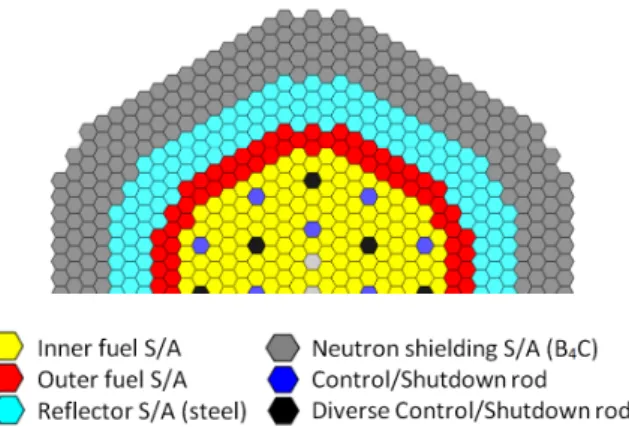
Fig. 1. Layout of ASTRID core CFV v2.
At the end of the pre-conceptual design phase (Ref. 4), the layout of the CFV v2 core comprised 355 fuel S/A (Fig. 1), which was 64 more than for CFV v1. This change was possible thanks to the duct-wall thickness and inter-assemblies gap reduction.
III.B. Sub-assemblies design
The reflectors S/A for CFV v1 core are made of EM10 steel arranged in a bundle of 19 rods separated by a helical spacer wire. EM10 has been chosen as the material for the hexagonal wrapper tubes of all sub-assemblies in ASTRID. This martensitic 9%Cr-1%Mo stainless steel exhibits excellent dimensional stability under irradiation (Ref. 5). A record dose of 155 dpa was reached on the EM10 wrapper tube during the BOITIX-9 experiment in Phénix, with a very low irradiation swelling. The steel rod’s diameter is 34 mm and the maximum temperature inside the rods was evaluated to 580°C which is well acceptable for EM10. The surface fraction of EM10 in the S/A is 75%. The expected life-time, defined with respect to the dose criteria, is 24 years for the first row of reflectors S/A and 60 years for the other rows.
The radial neutron shielding S/A comprise a bundle of 37 pins filled with natural B4C (19.78% of 10B). The
cladding is made of 15-15Ti AIM1 austenitic stainless steel (Ref. 5) for standardization with the fuel pins cladding. This special 15%Cr-15%Ni cold-worked austenitic steel demonstrated a low swelling up to high dose rates in Phénix. The pins have a diameter of 24.7 mm and are separated by a 1 mm-diameter helical spacer wire. B4C pellets have a surface fraction of 31%
and are confined by a stainless steel shroud. The B4C pins
are leaktight as a preliminary design. The helium produced due the 10B(n,α)7Li neutron capture reactions leads to a pressure of 150 bars inside the pins over 20 years. The pins were designed with an upper and a lower plenum of 50 cm each.
III.C. Performance evaluation
Neutron transport simulations have been performed thanks to MCNP Monte-Carlo code for the CFV v1 core with a modelisation of the control plug lower plate, the diagrid and one IHX. The neutron damages calculated on the diagrid and the control plug were largely below the objective of 1 dpa. However the secondary sodium activity was calculated at ~1400 Bq/cm3 which was significantly above the target value (10 Bq/cm3). Simulations showed that 35% of this activity level was due to lower axial neutron leakages, and 60% of the activity was due to radial neutron leakages. It also showed that 38% of the total activity level was generated inside the plenum of the IHX. These results demonstrated the need to optimize the radial and lower shields of the core.
Those parametric studies are described in the following section.
IV. PARAMETRIC STUDIES
Designing ASTRID core shielding consisted in identifying the best arrangement of reflector, moderator and absorber materials in the available space. The global problem is fully three dimensional because of the specific azimuthal locations of the IHXs in the reactor vessel and their relative elevation as compared to the core source.
At the core level, the neutron shielding located at the top of the fuel sub-assemblies provides neutron absorption in the upper axial direction. Many studies have been made for designing the B4C upper shielding of fuel
S/A (Ref. 6) but those are not discussed here because upper neutron leakages are of a secondary importance. The lower neutron shielding in the fuel S/A is also less of an issue because of the presence of a lower fertile blanket. However, preliminary simulations (see section III.C) showed that lower axial leakages in the radial S/A area contributed for 1/3 in the secondary sodium activation. This was imputed to the presence of lower plenum inside the B4C radial S/A. Further optimizations should thus
consist in minimizing the plenums height. In the radial direction, where neutron leakages are preponderant, a thickness of about 2 m remains available from the core boundary to the diagrid outer periphery. Within such a distance up to 7 more rows of radial S/A can be implemented without impact on the vessel size.
The ASTRID core shielding studies are detailed in Ref. 3 and summarized in this section. Parametric and iterative studies have been performed between core and S/A designers to identify an acceptable configuration. The search of the best radial shielding materials and arrangement and the shield of the IHX were parts of these studies.
IV.A. Radial S/A materials and arrangement
Regarding materials provided in the radial sub-assemblies, many candidates have been selected to fulfill the different functions: reflection, moderation or absorption. Apart from EM10 steel which was initially considered for reflectors S/A, evaluations were made on: SiC, MgO, MgAl2O3, 11B4C, B4C (10B enriched or not),
vanadium alloy, Hf, Hf11B2 or borated steel.
B4C is obviously the best neutron absorber and
benefits from a large feedback in SFR applications (absorber rods). However, material inventories involved in the shielding zones are potentially significant and cost aspects must be considered in the analysis. Besides neutron performances of each configuration, other criteria were consequently evaluated: behavior under irradiation, life duration, chemical compatibility, safety, maturity
levels, availability, washing and manufacturing capability, qualification needs.
Despite a very efficient reflector-moderator effect,
11B
4C and Hf11B2 have been finally excluded due to
prohibitive manufacturing costs regarding the enrichment in 11B. Hafnium has been excluded due to a possible large-scale limited availability. Moderation hydride compounds (YH2) have been excluded for safety
consideration (hydrogen risk in accidental conditions). The reflector function is only required in the radial direction at the fissile core boundary. Considering that ASTRID core does not include any radial fertile blanket there is an incentive to maximize neutron economy. For this purpose SiC, MgO and MgAl2O3 appeared as the best
candidates and benefited from R&D done at CEA as inert matrix for minor actinides transmutation. Regarding the manufacturing and cost points of view, MgO was finally preselected as the reflector S/A material in the first rows just surrounding the fissile core.
For the remaining regions, which are radially behind the MgO reflectors S/A, a large number of configurations have been calculated with the objective of limiting the amount of B4C – especially enriched in 10B – as long as
possible. Providing the suppression of upper and lower plenums in the radial S/A to reduce axial leakages, MCNP calculations showed that the alternation of moderation and absorption zones provided satisfactory attenuation factors. Good results were obtained with successive alternations of 3 rows of MgO and 3 rows of natural B4C;
this configuration was then selected for the next studies (see section V). Calculations exhibited that radial neutron leakages were largely reduced but highlighted that the main contributor to the secondary sodium activity became neutrons leaking axially above the core and bypassing lateral shields. Thus, even with an efficient upper neutron shielding fully made of B4C in the fuel S/A, the secondary
sodium activity reached ~70 Bq/cm3, which represent a reduction by a factor 20 compared to first design, but was still significantly above the target value.
IV.B. IHX shielding
Since increasing the distance between the core and the IHXs was not an option regarding the vessel size, it has been proposed to implement neutron shields on the IHXs, especially at the elevations subjected to high neutron leakages – not in front of the lateral shielding S/A – i.e. the upper and lower parts. Reactor and equipment designers proposed solutions to implement 25 to 50 mm-thick borated steel plates – grade 304B7 with 2% natural boron – to envelop the upper and the lower zones of the heat exchangers. MCNP calculations demonstrated that the IHX shielding decreased the secondary sodium activity by a factor ~10 which permitted to reach the objective of 10 Bq/cm3.
The figure 2 shows an overview of the neutron streaming in that configuration. The main contribution at the IHX level is now coming from the axial upper and lower pathways. Compared to these axial pathways, the radial pathways are totally mitigated which demonstrates the good efficiency of the radial shielding.
Fig. 2. MCNP calculation of neutrons streaming from core to IHX.
V. SECOND CONFIGURATION – CONCEPTUAL DESIGN
V.A. Core layout CFV v3 & v4
Parametric studies on radial S/A materials and arrangement (see previous section) finally led to a core layout based on successive alternation of MgO and B4C
sub-assemblies providing enhanced radial neutron absorption.
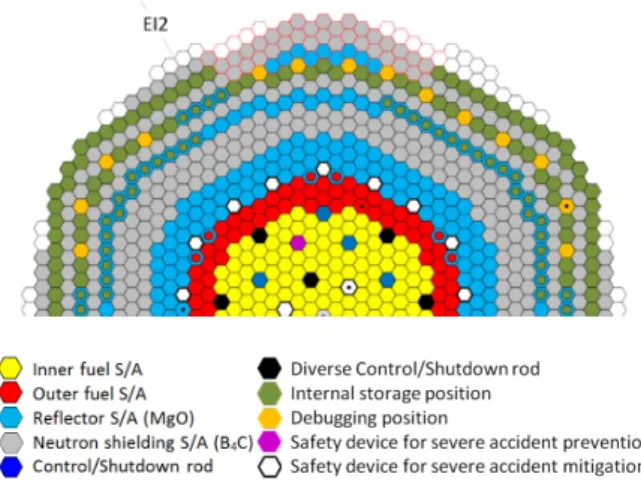
The CFV v3 core architecture (Ref. 2) consists of 180 inner fuel S/A and 108 outer fuel S/A, surrounded by 3 rows of reflector S/A with MgO, 3 rows of shielding S/A with B4C, 3 rows of shielding S/A with MgO, and 2 last
rows of shielding S/A with B4C (Fig. 3). Core radial
shielding is thus made of 11 rows of S/A – which is 4 more than previous core CFV v2 – without impact on the vessel size.
Fig. 3. Radial shielding of ASTRID core CFV v3.
The layout of the CFV v4 core (Ref. 7, Fig. 4) remains the same as the v3 core. Major changes integrated into v4 concern the design of the upper shielding of the fuel S/A – which has been made removable (Ref. 6) – with no significant impact on the core performance levels.
Fig. 4. Layout of ASTRID core CFV v4 with internal storage.
Since CFV v3 core it has been decided to host about 150 S/A positions in the radial shielding area to serve as an internal fuel storage and debugging purpose. Several configurations of internal storage have been studied; the impact of its presence on the secondary sodium activity is very low (Ref. 3).
V.B. Sub-assemblies design
In CFV v4 core there are 344 reflectors S/A managed in 5 rows, 3 of them being immediately at the periphery of the fissile core. They comprise a bundle of 19 pins filled with MgO pellets at 96% relative density. The cladding, made of 15-15Ti AIM1 steel, has an outer diameter of 33.6 mm and a thickness of 1 mm. Pins are separated by a 2 mm-diameter helical wire. The surface fraction of MgO is 52% inside the bundle. As MgO does not produce gas under irradiation, pins are leaktight and filled with helium at atmospheric pressure. The other parts of the reflector S/A, such as the wrapper tube, the lifting head and the spike, are similar to those of fuel S/A (Ref. 6). The first row of reflectors, adjacent to the fuel S/A, is subjected to the highest loadings. Those are maximal for the pin which is closest to the fuel: power dissipation in MgO pellets and dose rate in cladding reach respectively ~8 W/cm3 and ~11 dpa/year at core mid-plane. The loadings decrease exponentially as it goes radially through the pins and they are divided by a factor ~4 for the second row of S/A. Due to the high loading radial gradient in the first row, we have studied several management scenarios – to be done during fuel reloading periods – to increase the S/A lifetime by limiting the damage on the cladding and
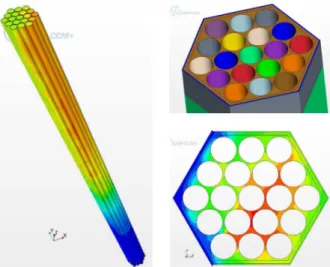
the arcing of the duct. Some of them, consisting in turning S/A of first row by 180 degrees and/or permuting S/A between different rows, can increase the lifetime between 10 and 30 years for the first row, and up to 60 years for the other rows. Preliminary thermal-hydraulic calculation have been performed with the STAR-CCM+ CFD code to verify the need of feeding the reflectors S/A with cold sodium (Fig. 5). It has been found out that the first row would require a sodium flow of ~0.6 kg/s to respect thermal criteria on claddings, while the others rows could be cooled by natural convection.
Fig. 5. Thermal-hydraulic simulation of MgO-pins bundle.
The radial shielding S/A are 550 in the CFV v4 core and managed in 5 rows behind the reflectors S/A. They comprise a bundle of 19 pins filled with natural B4C
pellets. Parametric studies showed that neutron leakages could be reduced thanks to the suppression of upper and lower plenums in the radial S/A (see section IV). For this purpose B4C pins were made non-leaktight, thus avoiding
any excessive pressurization – by allowing produced helium to be continuously released out of the pin – and taking advantage of the high thermal conductivity in the sodium bond. The height of the B4C column was
increased to ~3.3 m with this design, which was one meter more than the previous CFV v2 leaktight-pin design.
V.C. Performance evaluation
Considering the above described radial shielding S/A and providing the IHXs are shielded with borated steel sleeves, the best estimate results from the MCNP calculations were a 24Na activity in the secondary loops of ~7.7 Bq/cm3 without an internal storage, and ~9 Bq/cm3 with an internal storage as described for CFV v4 core (Fig. 4).
These results were compliant with the ASTRID specification but the studies were not finished yet. If MgO sub-assemblies did not show any concern in the preliminary design, two issues have been raised concerning the radial shielding S/A composed of Na-bonded B4C pins. These absorber pins comprise a lower
and an upper porous vent through which helium is released and sodium flows inside the pins. Due to B4C
fragmentation under irradiation, small fragments may plug the micrometric pores of the vents and hinder pin draining. This is made even more difficult when considering the sub-millimetre cladding-pellet gap inside the pins. It is thus well-known that the sodium inside the Na-bonded absorber pins cannot be totally removed after draining. Yet this non-negligible amount of Na trapped inside the pins engenders unacceptable safety risks during the S/A washing phases due to possible uncontrolled exothermal sodium-water reactions.
In addition, Na bond favours carbon diffusion from B4C to the cladding and the shroud. The resulting
carburization causes the embrittlement of the steels and limits the life duration of the pins. Moreover, experimental feedback in Phénix for Na-bonded pins is limited to ~2 years, which is far from minimum target lifetime of 20 years for these S/A in ASTRID.
Regarding these issues, the conceptual design phase ended in 2015 with the observation that the radial shielding S/A design for CFV v4 core was not acceptable. It has been decided to pursue studies to make realistic the design of leaktight B4C pins.
VI. BASIC DESIGN
Conceptual design studies performed on the CFV v4 shielding S/A demonstrated the need to make B4C pins
non-leaktight in the first row of S/A to avoid any unacceptable pressurization or lifetime reduction. It has been shown also that leaktight design became realistic, for example for other S/A rows, as long as neutron captures in B4C – i.e. helium production – were decreased by a
decade.
VI.A. Core layout CFV Basic Design
Neutron transport calculations were performed on the core with the objective of reducing by a factor ~10 the neutron captures in the B4C radial S/A. This objective was
reached by adding 2 MgO reflectors rows between the fissile core and the B4C S/A. The new core configuration
was then composed of 5 rows of MgO reflectors S/A and 6 rows of B4C radial shielding S/A in which the internal
storage is hosted.
A configuration with alternation of 2 B4C rows, 2
MgO rows and 2 B4C rows has also been evaluated but
did not show advantage compared to configuration with 6 B4C rows.
VI.B. Sub-assemblies design
The design of MgO reflectors S/A is identical to the one of CFV v4 core (see section V.B).
The design of shielding S/A relies on a single leaktight cylinder filled with natural B4C annular rings
and helium at atmospheric pressure. The sealed cylinder is made of 3.5 mm-thick 15-15Ti AIM1 cladding, capped by two welded plugs, and inserted inside the hexagonal wrapper tube (Fig. 6). This design confers the advantage, compared to a pins bundle, to arrange a plenum inside the B4C rings instead of placing it at upper and/or lower ends.
This avoids reduction of absorber column height while increasing the plenum volume and reaching an acceptable B4C surface fraction of 40%. A small plenum is arranged
at the top of the sealed cylinder to enable differential dilatation between B4C and cladding. B4C rings density is
80% which can be obtained by pressureless-sintering in order to minimize manufacturing costs. The other parts of the S/A, such as the wrapper tube with spacer pads, the lifting head and the spike, are similar to those of fuel S/A (Réf. 6).
Fig. 6. Basic design of B4C radial shielding S/A.
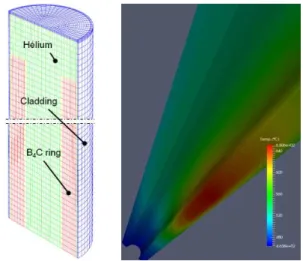
Finite element calculations have been done using the LICOS code (Ref. 7) based on the CAST3M solver within the PLEIADES fuel simulation platform (Ref. 9). Power dissipation and neutron captures distributions were defined in the B4C column thanks to MCNP transport
calculations at the core level. Helium release was defined on the basis of one He atom produced per one neutron capture, with 100% releasing out of B4C. The dose
reached in steel structures over 60 years is less than 5 dpa which is negligible regarding swelling. For S/A in the first row – behind 5 rows of MgO reflectors – the maximum temperature in B4C and the inner pressure reached over 20
years are respectively 650°C and 42 bars (Fig. 7). These conditions are compatible with criteria on primary and secondary mechanical constraints in the cladding. For the other rows of S/A, loadings decrease rapidly and the design can be proposed up to 60 years lifetime.
Fig. 7. Finite element thermomechanical simulation on B4C sealed cylinder.
Besides the B4C design which is the reference,
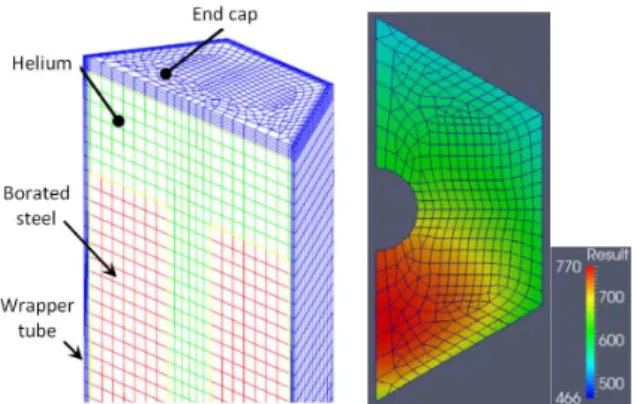
another option based on shielding S/A made of borated steel has been evaluated. This design consists of a 304B7 borated steel hexagonal blocks inserted in the wrapper tube. The wrapper is sealed and the center of the block is empty to arrange a gas plenum (Fig. 8). 3D calculations have been done with LICOS code for a S/A in the first row according to the same approach.
Fig. 8. Design of borated steel shielding S/A. Results showed that the temperature reached in the borated steel block is 770°C while the pressure in the wrapper tube is 3.5 bar over 20 years (Fig. 9). The end-of-life pressure is acceptable regarding primary constraints but the temperature reached in the block appears high regarding the hypothesis of a negligible helium release. According to these results and because of the lack of irradiation feedback for borated steel as core material structure in SFR, combined with manufacturing questions, this option was not selected.
Fig. 9. Finite element thermomechanical simulation on borated steel block.
VI.C. Performance evaluation
A last round of neutron transport calculations was launched with the radial shielding sub-assemblies described above – 5 rows with MgO and 6 rows with B4C
annular rings – and with borated steel sleeves provided on the IHXs. The best estimate result for 24Na activity in the secondary loops was ~10 Bq/cm3, compliant with the objective.
These recent studies showed several ways of optimization regarding the IHX shields and the radial sub-assemblies design. For example, possible increase in reflector and absorber column height and manufacturing costs reduction are identified and will be studied during the on-going Basic Design phase.
VII. CONCLUSION
This paper describes the design studies on radial shielding sub-assemblies performed during the last five years to fulfill ASTRID requirement on the secondary sodium activity level. Design studies were part of heavy iterative core shielding studies which are summarized.
Six various reflectors and radial shielding S/A designs (steel, MgO, boron carbide pins or rings with helium or sodium bond, borated steel) have been evaluated with three different core layouts. A strict value analysis process – considering criteria such as neutron shielding performances, life duration, maturity levels, washing and manufacturing capability, or qualification needs – has been followed from the selection of possible solutions to a final consistent design.
The ASTRID specification for 24Na activity in secondary loops (10 Bq/cm3 best estimate) is reachable with 5 rows of MgO reflectors and 6 rows of B4C radial
shielding surrounding the fissile core. It appears now that the conceptual design of these sub-assemblies is less of an issue. Other requirements, such as washing or manufacturing compatibility, are met. Some ways of
optimization have been identified and will be studied during the on-going Basic Design phase.
ACKNOWLEDGMENTS
The authors wish to thank all the teams involved in studies of the core and radial shielding S/A design at CEA and AREVA-NP for their support.
NOMENCLATURE
ASTRID Advanced Sodium Technological Reactor for Industrial Demonstration
AVP1/2 Conceptual design phase #1/2 CFD Computational Fluid Dynamics
CFV Low sodium void core (French acronym) dpa displacement per atom
EFR European Fast Reactor IHX Intermediate Heat Exchanger PX Phénix reactor
S/A Sub-assembly(ies) SFR Sodium Fast Reactor SPX SuperPhénix reactor
REFERENCES
1. J. ROUAULT et al., “ASTRID, the SFR GEN IV Technology Demonstrator Project: Where Are We, Where Do We Stand For?”, Proc. of ICAPP’15, Nice, France, May 3-6, 2015, Paper 15439, SFEN (2015).
2. C. VENARD et al., “The ASTRID Core at the Midterm of the Conceptual Design Phase (AVP2)”,
Proc. of ICAPP’15, Nice, France, May 3-6, 2015,
Paper 15275, SFEN (2015).
3. N. CHAPOUTIER et al., “ASTRID Core Shielding – Design Studies and Benchmark Analysis”, Proc. of
ICAPP’15, Nice, France, May 3-6, 2015, Paper
15305, SFEN (2015).
4. M-S. CHENAUD et al., “Status of the ASTRID Core at the End of the Pre-conceptual Design Phase 1”,
Nucl. Eng. Tech., 45, 6 (2013).
5. M. LE FLEM et al., “Status of the French R&D on ASTRID Core Materials”, Proc. of ICAPP’14, Charlotte, USA, April 6-9, 2014, Paper 14117, ANS (2014).
6. T. BECK et al., “Pre-Conceptual Design of ASTRID Fuel Sub-Assemblies”, Proc. of ICAPP’16, San Francisco, USA, April 17-20, 2016, Paper 16163, ANS (2016).
7. C. VENARD et al., “The ASTRID core at the end of the conceptual design phase”, Proc. of FR17, Yekaterinburg, Russia, June 26-29, 2017, IAEA (2017).
8. T. HELFER et al., “LICOS, a Fuel Performance Code for Innovative Fuel Elements or Experimental Devices Design”, Nucl. Eng. Design, 294, 117-136 (2015).
9. T. HELFER et al., “Recent Improvements of the Thermomechanical Modelling in the PLEIADES Platform: Applications to the Simulation of PWR Accidental Transient Conditions Using the Alcyone Fuel Performance Code”, Workshop NuFuel &
MMSNF, Karlsruhe, Germany, November 16-18,