HAL Id: inserm-00183642
https://www.hal.inserm.fr/inserm-00183642
Submitted on 31 Oct 2007
HAL is a multi-disciplinary open access
archive for the deposit and dissemination of
sci-entific research documents, whether they are
pub-lished or not. The documents may come from
teaching and research institutions in France or
abroad, or from public or private research centers.
L’archive ouverte pluridisciplinaire HAL, est
destinée au dépôt et à la diffusion de documents
scientifiques de niveau recherche, publiés ou non,
émanant des établissements d’enseignement et de
recherche français ou étrangers, des laboratoires
publics ou privés.
Fourth order approaches for localization of brain current
sources.
Laurent Albera, Anne Ferreol, Delphine Cosandier-Rimele, Isabelle Merlet,
Fabrice Wendling
To cite this version:
Laurent Albera, Anne Ferreol, Delphine Cosandier-Rimele, Isabelle Merlet, Fabrice Wendling. Fourth
order approaches for localization of brain current sources.. Conference proceedings : .. Annual
Inter-national Conference of the IEEE Engineering in Medicine and Biology Society. IEEE Engineering in
Medicine and Biology Society. Annual Conference, Institute of Electrical and Electronics Engineers
(IEEE), 2006, 1, pp.4498-501. �10.1109/IEMBS.2006.260063�. �inserm-00183642�
Fourth Order Approaches for Localization of Brain Current Sources
Laurent Albera, Anne Ferr´eol, Delphine Cosandier-Rim´el´e, Isabelle Merlet, Fabrice Wendling
Abstract— Two high resolution methods solving inverse prob-lems potentially ill-posed, named 4-MUSIC and 4-RapMUSIC, are proposed. They allow for localization of brain current sources with unconstrained orientations from surface electro-or magneto-encephalographic data using spherical electro-or realistic head geometries. The 4-MUSIC and 4-RapMUSIC methods are based on i) the separability of the data transfer matrix as a function of location and orientation parameters and ii) the Fourth Order (FO) virtual array theory. In addition, 4-RapMUSIC uses the deflation concept extended to FO statistics accounting for the presence of potentially but not totally coher-ent sources. Computer results display the superiority of the 4-RapMUSIC approach in different situations (two closed sources, additive Gaussian noise with unknown spatial covariance, ...) especially over classical algorithms.
I. INTRODUCTION
Electroencephalography (EEG) and magnetoencephalogra-phy (MEG) are two complementary techniques respectively measuring electrical potentials and magnetic fields produced by neuronal activity, at the surface of the head. Localization of neuronal activity sources requires to solve the inverse problem which is underdetermined in theory, as the number of sources is generally larger than the number of sensors, and so ill-posed. Conversely, when the number of sources is assumed to be lower than the number of scalp measurements, the problem is overdetermined and has a unique solution. In order to solve the EEG/MEG inverse problem both a model of neuronal sources and a model of the head are required. The current dipole is the most commonly used model for a source of electrical activity in the brain. Head models aim at representing geometrical and electrical properties of the different tissues composing the volume conductor. Various models were proposed going from concentric homogeneous spheres with isotropic conductivities to realistically shaped models with refined tissue conductivity values.
Numerous array processing methods were developed to estimate multidimensional parameters of sources, allowing among other things the localization of brain current dipoles from scalp measurements. Among subspace approaches, the Second Order (SO) MUSIC (MUltiple SIgnal Classification) method [10] was proposed for overdetermined mixtures of sources. This approach gave rise to several variants aimed at improving performances. On the one hand, among time
This work was supported in part by the Regional Council of Brittany (http://www.region-bretagne.fr) and it is protected by a patent whose refer-ence is no. 05.11668, DV326 (SAIC), November 17 2005.
L. Albera, D. Cosandier-Rim´el´e, I. Merlet and F. Wendling are with both research group INSERM UMR 642, Laboratoire Traitement du Signal et de l’Image (LTSI), and Faculty of Electrical Engineering, University of Rennes 1, F-35042 cedex Rennes, France.
A. Ferr´eol is with the THALES Communications group, 146 Boulevard de Valmy, BP 82, F-92704 Colombes, France
MUSIC-like methods, one can mention the extension of the original MUSIC algorithm to Fourth Order (FO) statistics
(so-called MUSIC4) able to deal with the case of
under-determined mixtures of sources [9]. One can also mention sequential approaches such [7], which are based on both SO statistics and deflation concept to increase localization resolution. In particular, the RapMUSIC algorithm [7] takes advantage of the factored matrix formulation of the trans-fer relationship between deep sources and scalp data by separating nonlinear (location) from quasilinear (orientation) source parameters in order to reduce computing time [3]. On the other hand, Time-Frequency (TF) approaches were proposed (see [1] for instance) to improve the resolution of the localization in the case of very closed sources with spectral nonstationary properties. Finally, besides subspace methods, other localization methods applied to EEG and MEG data were reported (review in [6]).
Three remarks can be made from this brief overview. First, most of the aforementioned array processing methods are based on SO statistics, which implicitly imply that sources are Gaussian. In practice, this assumption is not justified physiologically and information available at higher orders can be utilized. Second, TF approaches showed to be not applicable when sources have quasi-identical TF supports. Third, time SO techniques cannot deal with underdetermined mixtures of sources or with a Gaussian noise of unknown spatial covariance.
Higher Order (HO) methods inherently account for these limitations. However, to date, there is no attempt to propose a FO method that takes advantage of i) the separability of the data transfer matrix as a function of location and orientation parameters and/or ii) the deflation concept. The intent of the present paper is to describe two new FO MUSIC-like methods addressing these issues. These methods are referred
to as 4-MUSIC and 4-RapMUSIC, respectively. Both are
based on i) the factored matrix formulation of the data transfer function and on ii) the FO virtual array theory whose relevance has already been displayed in radiocommunica-tions contexts [2], and both account for the presence of possibly but not totally coherent sources.
II. ASSUMPTIONS ANDNOTATIONS
A. The Problem Formulation
We assume that a (N×K) realization of a N -dimensional
random process{x(k)} is observed. Moreover, each random
vector x(k) is given by:
x(k) = A(Θ) s(k) + ν(k) (1)
HAL author manuscript inserm-00183642, version 1
HAL author manuscript
Conf Proc IEEE Eng Med Biol Soc. 2006;1:4498-501
This material is presented to ensure timely dissemination of scholarly and technical work. Copyright and all rights therein are retained by authors or by other copyright holders.
All persons copying this information are expected to adhere to the terms and constraints invoked by each author's copyright. In most cases, these works may not be reposted without the explicit permission of the copyright holder.
where {s(k)} is a P -dimensional source vector process,
which observations are the time courses ofP current dipoles;
A(Θ) = [a(θ1) , · · · , a(θP)] is the (N × P ) static mixing
matrix that depends on Θ = {θ1, . . . , θP}, the collection
of the multi-parameters of the P sources; and {ν(k)} is
the noise vector process that is assumed to be Gaussian and statistically independent of the source vector process.
In EEG (or MEG) applications, each column vector a(θ)
of the static mixing matrix represents the electrical (or magnetic) field generated at all scalp sensors by a current dipole with a unit time course localized at a given position
ρ for a given orientation φ. Vector a(θ) can be written as
the product of a (N×3) gain matrix G(ρ) and the orientation
vector φ:
a(θ) = G(ρ) φ (2)
where the multi-parameter vector θ= [ρTφT]T
of the consid-ered current dipole includes the nonlinear location parameter
ρ and the quasilinear orientation parameter φ. Vector a(θ)
will be referred to as the source localizing vector in the sequel.
Although both methods we developed can be applied to both EEG and MEG data, and to both spherical and realistic head models, the present work is focused on the EEG context with a spherical head model. An analytic expression for the
gain matrix G(ρ) can be found in [8].
B. FO statistics
For the sake of convenience, the present work is limited
to stationary and ergodic data. In that case, the (N2×N2)
quadricovariance matrix [9] [2], Qx, of process {x(k)} can
be easily estimated from the scalp data. Given the
multilin-earity property of cumulants [4], Qxhas a special algebraic
structure, with several matrix redundancies. If statistical independency between sources and noise is assumed, this property can be expressed as follows:
Qx=
£
A⊗2¤Qs
£
A⊗2¤T = A QsAT (3)
where Qs, A⊗2def= A⊗A and ⊗ are the (P2×P2)
quadrico-variance matrix of{s(k)}, the Kronecker square of matrix
A and the Kronecker product operator, respectively.
III. ALGORITHM
A. The FO null-spectrum
Compute the Eigen Value Decomposition (EVD) of the
symmetrical matrix Qx as follows:
Qx= £ Es Eν ¤· Ls 0 0 0 ¸ £ Es Eν ¤T (4)
where Ls, Es, EνandR denote the (R×R) real-valued
diag-onal matrix of the non zero eigenvalues of Qx, the (N2×R)
matrix of the associated eigenvectors, the (N2×(N2−R)) matrix
of the eigenvectors associated with the zero eigenvalues
of Qx and the rank of Qx respectively. Since matrix Qx
is symmetrical, each column of Es is orthogonal to each
column of Eν. NowSpan{A} = Span{Es}, therefore each
column of A is orthogonal to each column of Eν. Given
θpthe location/orientation parameters of thep-th source and
a(θp)⊗2 def= a(θp) ⊗ a(θp) the FO virtual source localizing
vector, that is, the true localizing vector of thep-th source for
the corresponding FO virtual array [2]. The column vectors
a(θp)⊗2 (1 ≤ p ≤ P ) appear in matrix A, and so they are
orthogonal to each column of Eν. Thus the normalized FO
null-spectrum (null-polyspectrum) criterion can be defined as follows:
J1(θ) =
³£
a(θ)⊗2¤T Π0£a(θ)⊗2¤´/°°a(θ)⊗2°°2 (5)
where Π0= EνTEν is the noise subspace projector of matrix
Qx, and theP roots of J1correspond asymptotically to the
P vectors θp. Using properties of the Kronecker product,J1,
after inserting (2) into (5), becomes:
J2(θ) =
ΦTG(ρ)TΠ
0G(ρ) Φ
ΦTG(ρ)TG(ρ) Φ (6)
where Φdef= φ⊗2 and G(ρ)def= G(ρ)⊗2 are the FO source
orientation vector and the FO gain matrix, respectively.
Pa-rameters θp=
£
ρpTφpT
¤T
(1 ≤ p ≤ P ) can then be obtained by
i) looking for theP global minima ρpof the function in ρ
de-fined by the minimum eigenvalue of matrix G(ρ)TΠ
0G(ρ)
in the metric G(ρ)TG(ρ), and by ii) identifying each vector
Φp (1 ≤ p ≤ P ) as the eigenvector associated with the
minimum eigenvalue of matrix G(ρp)TΠ0G(ρp) in the metric
G¡ρp
¢T
G¡ρp
¢
[5]. An algorithm is proposed in section III-B in order to compute vector φ from Φ. Consequently the orientation parameters are deduced from the location
parameters, which modifies the6D-optimization of criterion
(6) to a 3D-optimization. Therefore, criterion (6) can be
concentrated with respect to ρ, leading to:
J3(ρ) = λ n [G(ρ)TG(ρ)]−1G(ρ)TΠ 0G(ρ) o (7)
where λ{B} denotes the minimum eigenvalue of matrix B.
The computational cost can considerably be reduced again
if criterionJ3 is replaced by the following criterion:
J4(ρ) =
det{G(ρ)TΠ
0G(ρ)}
det{G(ρ)TG(ρ)} (8)
where det{B} denotes the determinant of matrix B.
B. The4-MUSIC and 4-RapMUSIC approaches
In this section, we present the4-MUSIC and 4-RapMUSIC
methods based on i) the separability of the data transfer
matrix as a function of location and orientation parameters, and ii) the FO virtual array theory [2], using the low cost
function as defined in (8). In addition, the4-RapMUSIC
al-gorithm exploits the deflation concept that we have extended to FO statistics.
More particularly, the 4-MUSIC algorithm consists in
searching for global minimizers of criterion J4. Indeed, if
the noise subspace projector was estimated perfectly, such as
asymptotically, then theP source location vectors ρp would
be directly found as the P global minimizers of (8) over a
sufficiently densely sampled grid of the nonlinear parameter
space. Then each source orientation vector φp(1 ≤ p ≤ P ) can
be computed from the previous locations using both
follow-ing steps. First, let the FO source orientation vector Φpbe the
normalized quasilinear parameter vector that must multiply
G(ρp) on right to produce vector a(θp)⊗2. It has to be derived
from the eigenvector corresponding to the minimum
eigen-value of matrix £G(ρp)TG(ρp)
¤−1
G(ρp)TΠ0G(ρp).
Sec-ondly, the source orientation vector φp can be computed
from Φp, by i) remodeling it into one (N ×N ) matrix Bp
(then-th column of Bp is made up from the N consecutive
elements of Φp as from the[N(n−1)+1]-th one), and ii)
diagonalizing it. Indeed, the eigenvector associated with the
strongest eigenvalue of Bp, is, up to a sign factor, equal to
φp.
Nevertheless, for a finite number of samples, errors in our statistic estimate reduce (8) to a function with i) a single global minimum that corresponds for instance to the source
of maximum Signal-to-Noise Ratio (SNR), and ii)P−1 local
minima. Although the global minimum is easily identifiable,
it is more difficult to find theP −1 remaining local minima
since nonlinear search techniques may miss shallow or adjacent peaks and return to a previous peak. Algorithms have been proposed to solve peak-picking problem (review in [7]), but they rapidly become complex and subjective as
the number of sources and the dimensionality of vectors ρp
increase [7]. So, a computation strategy such as the following FO deflation concept has to be established to avoid this
peak-picking problem, giving rise to the4-RapMUSIC method.
This latter consists in localizing recursively theP sources.
Indeed, thep-th step of the 4-RapMUSIC method allows for
identifying the ξ(p)-th source location and orientation
vec-tors. The use of the permutation functionξ of {1, 2, . . . , P }
is necessary since theP source localizing vectors a(θp) may
be recovered only in the disorder. Indeed, equation (1) shows
that the order in which the components of s(k) and the
associated columns of A(Θ) are set does not change the
expression of x(k). The ξ(p)-th source location vector, ρξ(p),
can be achieved by searching for the global minimum root
of (8) replacing G(ρ) and Π0by A⊥p−1
⊗2
G(ρ) and the noise
subspace projector, Πp−1, of matrix [A⊥p−1
⊗2 ]Qx[A ⊥ p−1 ⊗2 ]T, respectively, where: ¯ ¯ ¯ ¯ ¯ ¯ ∀ j, 1 ≤ j ≤ p−1, a¡θξ(j) ¢ = G(ρξ(j)) φξ(j) Ap−1=£a¡θξ(1) ¢ · · · a¡θξ(p−1) ¢¤ A⊥p−1= IN − Ap−1 £ (Ap−1)TAp−1 ¤−1 [Ap−1]T (9)
Note that the rank of the data quadricovariance matrix
[A⊥p−1
⊗2
]Qx[A⊥p−1
⊗2
]T is strictly smaller than R. Indeed, the
multiplication of the initial quadricovariance Qx on left and
right by A⊥p−1⊗2 and [A⊥p−1
⊗2
]T, respectively, comes down to
remove the contribution of the p − 1 first localized sources
from Qx, and consequently to increased the dimension of
the noise subspace and so the capacity of source localization.
As far as the source orientation vector φξ(p) is concerned, it
can be computed from the source location vector ρξ(p), as
explained in the previous paragraph.
0 1 2 3 4 5 6 7 8 0.0 0.2 0.4 0.6 0.8 1.0 1.2
Dipole position on z−axis (cm)
RMSE 2−MUSIC and 2−RapMUSIC
4−MUSIC and 4−RapMUSIC
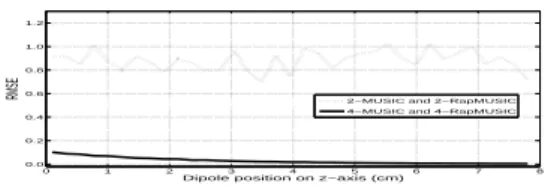
Fig. 1. Localization of 1 source with 10 electrodes.
IV. RESULTS
Performances of four MUSIC-like algorithms (2-MUSIC
[3], 2-RapMUSIC [7], 4-MUSIC and 4-RapMUSIC) were
compared in an EEG context, in three different situations.
Simulations were performed using a 3-shell spherical head
model (radii were8 cm for brain, 8.5 cm for skull and 9.2 cm
for scalp; brain and scalp conductivities were33.10−4 S/cm
and skull conductivity was40 times lower) and a set of ten
electrodes from10-20 standard (namely Fz, Cz, Pz, Fp2, F3,
F4, P7, P8, T7 and O2). Depending on the situation,P = 1 or
2 independent sources were considered. A
physiologically-relevant model, consisting in a network of coupled neuronal populations [12], was used to compute realistic source time
courses. TheP sources had the same SNR equal to 15 dB,
they were arranged in the samez-plane, and their orientations
φp (1 ≤ p ≤ P ) were randomly fixed such as
°
°φp
° ° = 1.
The background noise was considered as temporally and spatially white, except for situation IV-C. Simulation results
were averaged overM = 200 realizations.
Two criteria were used to quantify the quality of the source localization for each method. The first one is the Probability of Non Localization (PNL), which is defined by the ratio between the number of realizations for which all the sources
are not localized and the total number of realizations M .
The second one is the averaged Root Mean Square Error
(RMSE), which is defined, for sourcep, by:
RMSE(θp) = 1 M′ M′ X m=1 µ min 1≤j≤P n°° °θp− bθ (m) j ° ° ° o¶ (10)
whereM′(M′≤ M ) is the number of realizations for which
the localization method has succeeded in finding exactly
P solutions, and bθj(m) is the j-th source parameter vector
estimated during them-th realization.
A. Effect of the dipole depth on source localization The behaviour of the four MUSIC-like algorithms was studied in the presence of a unique source using only six scalp electrodes. Figure 1 displays the variations of the RMSE criterion of the four methods as a function of the
source location on the z-axis. It appears that both FO
methods localize more precisely the source than both SO methods, whatever source depth. Note that PNL criterion is not reported here because it was quasi-zero for all methods whatever source depth.
B. Localization of poorly spatialy separated sources The behaviour of the four algorithms was also studied in the case of two poorly spatialy separated sources. Figure 2
0 1000 2000 3000 4000 5000 6000 7000 8000 9000 10000 0 0.5 1 1.5 2 Samples RMSE Localization of Source 1 0 1000 2000 3000 4000 5000 6000 7000 8000 9000 10000 0 0.5 1 1.5 2 Samples RMSE Localization of Source 2 2−MUSIC 2−RapMUSIC 4−MUSIC 4−RapMUSIC
(a) RMSE criterion
0 1000 2000 3000 4000 5000 6000 7000 8000 9000 10000 0 0.1 0.2 0.3 0.4 0.5 0.6 0.7 0.8 0.9 1 Samples PNL 2−MUSIC 2−RapMUSIC 4−MUSIC 4−RapMUSIC (b) PNL criterion Fig. 2. Localization of 2 very close sources with 10 electrodes.
presents the RMSE and PNL criteria of the four methods as a function of samples for two sources using ten sur-face electrodes. Source location parameters were chosen as
equal to ρ1 = [0, 0, 0.8]T and ρ
2 = [0, 0, 1.12]T (values in
centimeters). It clearly appears on figure 2(b) that the
2-MUSIC and4-MUSIC methods have difficulty in localizing
both sources, whereas the 2-RapMUSIC and 4-RapMUSIC
algorithms succeed in finding two solutions. Nevertheless,
as displayed by figure 2(a), the 2-RapMUSIC method does
not localize as precisely both sources as the 4-RapMUSIC
algorithm.
C. The case of colored noise
Both FO algorithms were compared to both SO algorithms in the presence of a Gaussian noise with unknown spatial covariance using ten surface electrodes. Two sources were positioned in depth such that their location vectors were
given by ρ1 = [0, 0, 2]T and ρ
2 = [0, 0, 4.4]T respectively.
Figure 3 displays the variations of RMSE and PNL criteria for the four methods as a function of the noise spatial
covariance factor ρ. Note that the Gaussian noise model
employed in this simulation is the sum of an internal noise
νin(k) and an external noise νout(k), of covariance matrices
Rinν and Routν respectively such that:
Rinν (r, q)def= σ2δ(r−q)/2 Routν (r, q)def= σ2ρ|r−q|/2 (11)
whereσ2,ρ, Rν (r, q)def= Rin
ν (r, q)+Routν (r, q) are the total
noise variance per sensor, the noise spatial covariance factor
and the (r, q)-th component of the total noise covariance
matrix, respectively.
Figure 3(a) shows that both SO algorithms are sensitive to a Gaussian noise with unknown spatial covariance and are affected as soon as the noise spatial covariance increases
beyond0.1. Indeed, 2-MUSIC and 2-RapMUSIC would
the-oretically require a perfect knowledge of the noise covariance
[10], while 4-MUSIC and 4-RapMUSIC, since they use
FO cumulants, are asymptotically insensitive to Gaussian noise, regardless of its space/time color. Indeed, the computer
results show that4-MUSIC and 4-RapMUSIC localize both
sources with precision whatever the noise spatial covariance is. Nevertheless, figure 3(b) displays that, for a given number
of ten thousand samples, only 4-RapMUSIC succeeds in
localizing both sources at each time.
0 0.1 0.2 0.3 0.4 0.5 0.6 0.7 0.8 0 0.5 1 1.5 2 2.5
Noise spatial correlation
RMSE Localization of Source 1 0 0.1 0.2 0.3 0.4 0.5 0.6 0.7 0.8 0 0.5 1 1.5 2 2.5
Noise spatial correlation
RMSE Localization of Source 2 2−MUSIC 2−RapMUSIC 4−MUSIC 4−RapMUSIC
(a) RMSE criterion
0 0.1 0.2 0.3 0.4 0.5 0.6 0.7 0.8 0.9 0 0.1 0.2 0.3 0.4 0.5 0.6 0.7 0.8 0.9 1
Noise spatial correlation
PNL 2−MUSIC 2−RapMUSIC 4−MUSIC 4−RapMUSIC (b) PNL criterion Fig. 3. Source localization in the presence of a colored noise.
V. CONCLUSION
We proposed in this paper two novel algorithms for brain
current source localization, namely the MUSIC and
4-RapMUSIC methods. Computer results showed the
superior-ity of4-RapMUSIC over 4-MUSIC and classical algorithms
such as2-MUSIC [3] and 2-RapMUSIC [7] for both
overde-termined mixtures of sources and a small number of ten electrodes. Forthcoming works will display i) its superiority for larger number of electrodes as used in standard or higher resolution montages, ii) its capacity to localize more sources than surface observations, and iii) its behavior when applied to patients in whom strong hypotheses about localization of epileptic zones are available.
REFERENCES
[1] A. BELOUCHRANI, K. ABED-MERAIM, and M. G. AMIN, “Time-frequency music,” IEEE Signal Processing Letters, vol. 6, no. 5, pp. 109–110, May 1999.
[2] P. CHEVALIER and A. FERREOL, “On the virtual array concept for the fourth-order direction finding problem,” IEEE Transactions On
Signal Processing, vol. 47, no. 9, pp. 2592–2595, September 1999.
[3] E. FERRARA and T. PARKS, “Direction finding with an array of antennas having diverse polarizations,” IEEE Transactions On
Antennas Propagation, vol. 31, pp. 231–236, March 1983.
[4] P. McCULLAGH, Tensor Methods in Statistics. Chapman and Hall,
Monographs on Statistics and Applied Probability, 1987.
[5] F. R. GANTMACHER, The Theory of Matrices, vol. 1. New York:
Chelsea, 1959.
[6] C. M. MICHEL, M. M. MURRAY, G. LANTZ, S. GONZALEZ, L. SPINELLI, and R. GRAVE DE PERALTA, “EEG source imaging,”
Clinical Neurophysiology, vol. 115, no. 10, pp. 2195–2222, October
2004.
[7] J. C. MOSHER and R. M. LEAHY, “Source localization using Recursively Applied and Projected (RAP) music,” IEEE Transactions
On Signal Processing, vol. 47, no. 2, pp. 332–340, February 1999.
[8] J. C. MOSHER, R. M. LEAHY, and P. S. LEWIS, “EEG and MEG: Forward solutions for inverse methods,” IEEE Transactions On
Biomedical Engineering, vol. 46, no. 3, pp. 245–259, March 1999.
[9] B. PORAT and B. FRIEDLANDER, “Direction finding algorithms based on high-order statistics,” IEEE Transactions On Signal
Process-ing, vol. 39, no. 9, pp. 2016–2024, September 1991.
[10] R. O. SCHMIDT, “Multiple emitter location and signal parameter estimation,” IEEE Transactions On Antennas Propagation, vol. 34, no. 3, pp. 276–280, March 1986.
[11] P. STOICA, P. HANDEL, and A. NEHORAI, “Improved sequential music,” IEEE Transactions On Aerospace and Electronic Systems, vol. 31, no. 4, pp. 1230–1239, October 1995.
[12] F. WENDLING, J. BELLANGER, F. BARTOLOMEI, and P. CHAU-VEL, “Relevance of nonlinear lumped-parameter models in the anal-ysis of depth-eeg epileptic signals,” Biological Cybernetics, vol. 83, pp. 367–378, 2000.