Capturing and Measuring the Strategic Value in Corporate Venture Capital
byTimothy Chiang
B.S. Materials Science and Engineering (2007) University of Illinois - Urbana Champaign
SUBMITTED TO THE SYSTEM DESIGN AND MANAGEMENT PROGRAM IN
PARTIAL FULFILLMENT OF THE REQUREMENTS FOR THE DEGREE OF MASTERS OF SCIENCE IN SYSTEM DESIGN AND MANAGEMENT
AT THE
MASSACHUSETTS INSTITUTE OF TECHNOLOGY June 2018
( 2018 Timothy Chiang. All rights reserved.
The author hereby grants to MIT permission to reproduce and to distribute publicly paper and electronic copies of this thesis document in whole or in part in any medium now known or hereafter created.
Signature of Author:
__
__
ature redacted
Timothy Chiang System Design and Management Program May 9, 2018
Certified By:
Certifie By
Signature redacted
Professor of the
K r
Bill Aulet Thesis Advisor P ctice, Innovation, Entrepreneurship, and Strategic Management anaging Director, Martin Trust Center for MIT Entrepreneurship
Signature redacted
Certified By: Accepted By: MASSACHUSETTS INSTITUTE OF TECHNOLOGYJUN 2
0
2018
LIBRARIES
Jonathan Fleming Thesis Co-Advisor Senior L turer, Martin Trust Center for MIT EntrepreneurshipSignature redacted___
Joan Rubin Senior Lecturer Executive Director, System Design & Management ProgramCapturing and Measuring the Strategic Value in Corporate Venture Capital
by
Timothy Chiang
Submitted to the System Design and Management Program on May 10, 2018 in partial fulfillment of the requirements for the degree of Masters of Science in Engineering and Management
Abstract
Corporations are increasingly utilizing corporate venture capital (CVC) as a significant component of their external innovation strategy. Over the past several years, these CVCs have grown to contribute a large percentage of all startup funding in the US. The growing role of CVCs in the innovation ecosystem presents pressing questions around the structures, objectives, and stability of this particular source of funding.
After several decades of CVC history, nearly all CVCs have converged onto the dual objective of investing for both strategic and financial returns. It is the existential need to return strategic value back to the parent corporation that separates CVCs as distinct from institutional venture capital (VC) firms. While the survivability and growth of institutional VCs depend solely on financial return performance, the survivability and growth of CVCs depend on
demonstrations of both a respectable financial return, as well as relevant and significant strategic returns.
This research explores and examines the capture and measure of strategic value in CVC investments through a series of interviews with prominent CVC units representing a cross section of various industries. A framework for characterizing four taxonomies of strategic investment objectives is proposed and used to landscape a sample of CVCs in order to
determine whether the capture of strategic value in CVCs is emergent from the system design of a CVC's structure, practices, and organizational linkages. A survey on how CVCs measure direct and indirect strategic value revealed that the vast majority of CVCs were unable to, or do not attempt to measure the performance of this primary investment objective. Both
quantitative and qualitative treatments were given to the analysis of the research data on the structures, practices, and strategies related to value capture in strategic VC investments.
This research found a wide range of approaches towards capturing strategic value in
CVC investments. However, the measurement of such value remains elusive. Very few
significant funding source of US innovation largely unjustified by the lack of performance measurements on existential investment objectives.
Thesis Advisor: Bill Aulet
Title: Professor of the Practice, Innovation, Entrepreneurship, and Strategic Management; Managing Director, Martin Trust Center for MIT Entrepreneurship
Thesis Co-Advisor: Jonathan Fleming
Dedication & Acknowledgements
Dedication
It was 1992 when I told my science teacher that I wanted to go to MIT. I was a child, and my reason was because MIT was my name spelled backwards. 26 years later, that dream has become a reality, my motives more substantial, and myself now a husband and a father. This thesis is dedicated to my beautiful wife Rachel - you have encouraged me to pursue a dream, and took on a great deal of sacrifices to let me do so. And to my son Titus - you have been my buddy these past two years and you remind me to never stop exploring and building. You two are the loves of my life.
Acknowledgements
I want to thank my thesis advisor Bill Aulet - from the beginning of my time at MIT, you
have profoundly shaped my understanding and excitement for innovation and
entrepreneurship. And to my thesis co-advisor Jonathan Fleming - Thank you for the continual guidance and insights you have provided me along the way. You've been generously available and helpful on advising my research, and your career has been an inspiration to me.
The SDM program has truly been a journey, and I must thank my fellow journeymen. To the BeyondSDM crew - Ben, Justin, Adrien, Christian, and Jose, from our breakfast club
meetings to our Slack banter, you all have been the sanity check of my MIT experience.
To my church family, both in DC and in Cambridge - so many of you sent us off in love as we left our home of 8 years, and so many of you welcomed us in as we transitioned into a new home in Cambridge. I love you all dearly.
Last but not least, I want to thank my family for their love and support along the way.
My hope is that my children can grow up in a home where they feel enabled and supported to
Table of Contents
Abstract ... 3
Dedication & Acknowledgem ents ... 5
Tableof Figures ... 8
Background/Context ... 9
Brief context of CVC ... 9
CVC as vehicle for open innovation... 12
Com m on ways of approaching strategic value in CVCs ... 13
CVC as an options play for R&D:... 15
CVC as W hite Space Bets: ... 16
CVC as an access point to exclusive enabling technologies: ... 16
CVC as a window on technology: ... 17
Dimensions/variables in different CVC practices ... 17
Thesis hypotheses:. ... 19
W hat has been understood ... 19
W hat rem ains to be understood ... 20
Hypothesis . ... 21
Hypothesis 2... 21
Hypothes .is 3 ... 22
Hypothesis 4... 22
Strategic value definitions... 23
CVC Investment strike zones - strategic alignm ent and technology m aturity ... 23
Research M ethodology ... 28
Fram ework of questions... 28
CVC interviews/results and data ... 29
Data and Analysis ... 29
W indow on Technology ... 40
M apping CVC positioning ... 41
Outcomes ... 49
CVC Value Networks ... 51
Taxonom ies of CVC Structures ... 56
M arket Sustaining: Synergistic and Com plem entary ... 57
M arket Expansion (or M arket Orchestration)... 59
Financial Play ... 60
M ultiple "Funds" for M ultiple Investment Strategies... 60
The Challenge of M easuring Strategic Value... 61
Conclusions... 62
Table of Figures
Figure 1. US Corporate VC participation activity and % of total VC activity is on the rise (Pitchbook, 2018)
... 9
Figure 2. Majority of CVCs agree that both strategic and financial returns are top priorities... 10
Figure 3. Strategic Value of CVC (Napp 2009)... 15
Figure 4. The four ways of investing (Chesbrough 2002)... 19
Figure 5. Strategic Alignment and Technology/Market Maturity Framework for Investment Strike zones ... 2 5 Figure 7. CVC return objectives ... 29
Figure 8. CVCs and Corporate Organization Structure ... 30
Figure 9. Strategic Sponsorship Requirem ent... 31
Figure 10. CVC participation on startup boards ... 34
Figure 11. Business Unit participation in CVC investment function... 35
Figure 12. CVC investment on Business Unit competition ... 36
Figure 13. Percentage of CVCs Integrated or Separate from the parent corporation ... 37
Figure 14. Percentage of CVCs being funded by the corporate parent, or by the BU's... 38
Figure 15. Series Stage of Initial CVC Investment, separated out by industry focus ... 39
Figure 16. Window on Technology Funnel - CVCs as Market and Technology Sensors for Novelty... 40
Figure 17. Technology Readiness Scale ... 46
Figure 18. Mapping CVC along strategic quadrants. Note - participant CVCs have been anonymized.... 47
Figure 19. CV C Value Cycle ... 52
Figure 20. Direct CVC linkages between corporate parent and portfolio companies... 55 Figure 21. Indirect linkages in the broader entrepreneurial ecosystem beyond immediate CVC portfolio
Background/Context
Brief context of CVCIn 2017, Corporate Venture Capital (CVC) supplied $37.4B in venture investment,
making up 44% of all venture capital value deployed that year in the US (Pitchbook, 2018). This
continues the trend observed over the past several years of the increasing role of CVC in the startup funding space. Yet, while the funding function of CVCs reside under the umbrella of venture capital, alongside institutional VCs both from a funding category level, and at the
individual investment level, CVCs are a fundamentally different machine compared to institutional investors.
uS crporn VC parmipa actity
d C Vonb an1.2S3 674M
'mlii
US rnp n -m v pmticm~an % at tW v 45% --.cc% of~ Da OW e Mte '44.4% 2M% 25.7 20% MW0 MW0 2010 2011 2012 2013 2014 2D15 2016 2017 Pbe4CAVoubwe M -1Figure 1. US Corporate VC participation activity and % of total VC activity is on the rise (Pitchbook, 2018)
Confusion persists within the venture capital community, and without - amongst the
nature and value of CVC activity. This is in large part due to CVCs being taxonomically similar,
but metabolically distinct from their Institutional counterparts. The most apparent of these
distinctions is the CVC's existential purpose for extracting strategic AND financial returns. This
dual-objective of both financial and strategic returns is reflected in numerous industry studies,
including a survey conducted by CBInsights (CBlnsights, Inside the Minds of Corporate Venture
Capitalists, 2015).
Objectives and Motivations of CVCs
100% 90% 80% 70% 70% 60% 50% 47% 40% 30% 20% 24% 20% 12% 10%/
Strategically Listed financial increases the Establish early Increase sales Leverage align with returns as a ability to be a relationships or profits of the portfolio relevant and core objective thought leader with potential incumbent companies to
emerging in the category acquisition companies improve internal
companies targets efficiencies
Figure 2. Majority of CVCs agree that both strategic and financial returns are top priorities.
Capturing and measuring financial returns in venture capital investments is relatively
simple and well understood. Measuring the performance along the financial dimension follows
the same approach adopted by institutional VC firms. It is the strategic value extraction from
CVC investments that remains a perennial discussion within the industry. Understanding and
value is often a challenge within even the most seasoned of CVC outfits. The aim of this study is
to better understand the systems of strategic value capture in CVC investments, and to propose
a structure-value framework aligned with different stated CVC objectives. Such a study is
important because arguably half of the US startup innovation infrastructure is being financed by
this source. CVCs have a growing influence on what new technologies get developed and
commercialized, yet are susceptible to the ebbs and flows of both the market conditions, and
internal corporate politics.
The case for CVCs pursuing strategic returns dates back to the very start of CVC history.
Early on, corporations saw CVC as a vehicle for diversifying into new markets (CBlnsights, 16).
The motivation to attain strategic benefit from CVC activity include the unique opportunities
that corporations have to drive synergies that can further the performance of the corporate
parent. Strategic investments can improve the efficiency, performance, and sales of current
business offerings, and provide insight into the direction of rapidly changing markets and
technologies. This strategic motivation for CVC is additionally reinforced by the calculation that
for most corporations in a position to engage in CVC investments, even the best return rates
barely move the corporate's financial needle. For long-term survivability, CVCs must
demonstrate business relevance by returning a worthwhile strategic return.
Investing for financial returns can often be equal parts an internal necessity for
organizational autonomy, and external signaling. Internally, the short-term survivability of a
CVC outfit and performance measure is often financial in nature. This exists in the absence of
measure of strategic value. This assumes that the structures and execution of strategic value
exists.
Externally, the messaging of financial return priorities serves to sustain good standing
among the institutional investment community. Syndication and relationships with institutional
investors are necessary conditions for sourcing and orchestrating deals. CVCs do well to be
perceived as smart money within the VC community.
CVC as vehicle for open innovation
Corporations are increasingly recognizing the value of participating in, and contributing
to the entrepreneurial ecosystem, as evidenced by the rapid growth in the number of CVC
outfits, and the growing percentage of CVC contribution to all venture dollars deployed. From a
corporate growth strategy, CVCs are best understood as a vehicle for external, or open
innovation.
Open innovation can be defined as a corporation's systematic and broad exploration of
internal and external sources of innovative ideas and technologies, and an equally systematic
approach towards marrying these innovations with the company's unique set of strengths and
capabilities, driving towards the exploitation of such opportunities by way of
commercialization. In the midst of technology uncertainty and rapidly changing market
landscapes, many corporate organizations have recognized the need for more broad-based
innovation-focused functions to serve as breeding grounds for new products, services, and
business models. They recognized that the best ideas for the future state of their current
engage in external innovation efforts. One way in which Corporations often engage with
external innovation efforts is through venture capital investments on startup companies. Portfolio companies often act as R&D options that can be called with an acquisition if successful.
Numerous strategic motivations exist when CVCs fund startups that play within the
value chain of their current business offerings. Often, CVCs can provide valuable introductions
to sales partners, distribution partners, manufacturing capabilities, or significant initial orders
that can pave a path towards scaling a business. An options approach towards valuing the strategic and financial value of venture investments within a VC portfolio can be useful in informing decisions that CVCs will need to be able to make on active management of specific investments (startups) and the portfolio system as a whole.
Common ways of approaching strategic value in CVCs
"Strategic Value" may refer to different things to different corporations. Strategic value
in the context of CVC may mean access to new and enabling technologies, a "window on technology" to see what novel technologies, processes, or business models may be out there,
access to talent, technology scouting functionality, or even corporate branding. The scope of
this study will limit the discussion of strategic value to that which brings benefit to a company's
present or future product offerings. This primarily includes the CVC's function as access points
to exclusive early-stage technologies, and providing a window on emerging technologies.
Several ways exist in attempting to measuring strategic value in CVCs. For the sake of
value. Very generally, direct strategic value refers to the value extracted postinvestment
-typically in the form of access to new and/or enabling technologies exclusive to the invested
startup by way of partnerships or co-development agreements, or through a subsequent
acquisition of the startup. The measure of direct value may also involve the attempt to
calculate increases in revenue or improvement in profit margin attributed to the CVC.
Napp and Minshall proposes a 3-layer CVC framework for the capture and measurement
of strategic value, comprising a value delivery layer, an operational layer, and a metrics layer
(Johann Jakob Napp, 2009). Napp references Schildt, Maula and Keil in distinguishing between
Explorational and Exploitational value for the investing corporation.
Explorational value refers to the translation of information and opportunities beyond
the current positions of the corporation's current business offerings. They may include market
knowledge in an unfamiliar or new segment, a "window on technology" for emergent
technologies, or real options on R&D efforts.
Exploitational value refers to the extraction of value from a direct investment serving to
augment or enhance a current business position. This may include access to complementary
technology, enabling the leverage of own technologies, or tactical plays to expand into new
Value for the investing soipordion
Fearncial valwe 0 vegowuu
Return on nvestment
ii
EXP joAcces to
Murkut knowledge complemntrwy
_________________ otui es
Window on technology
J
eJ
Options Expnrsion of markets
Figure 3. Strategic Value of CVC (Napp 2009)
CVC as an options play for R&D:
Corporations are increasingly turning to external or open innovation efforts as an augmentation or virtualization of internal R&D efforts. Established companies that have been optimized for incremental innovation to maintain current business positions are often not good at seen the value in new technologies (Christensen, 2016). Companies that recognize an
inherent limitation on their own R&D efforts to develop disruptive technologies, turn to open innovation plays which serve to "pull" in new ideas and enabling technologies.
Measurement of value delivery can include the number of acquisitions made originating from a CVC investment, or the amount of revenue generated from an acquisition or partnership brought about from an initial CVC investment. Another approach that has been attempted involves real options pricing. However, obtaining accurate figures for how much it would have
cost for the corporation to pursue an alternative development effort in-house, including an
accurate conversion rate of attempts to success, has proven to be a challenge.
CVC as White Space Bets:
CVC investments can also be used as a vehicle for white space exploration. Market or
product segments that are currently unoccupied by a corporate's offerings may be of interest
to the company, but whether due to program risk or technology risk, funding for such internal
developments are unavailable. CVC investments allow for a low cost exploration of new
markets with low risk exposure.
Measurement of value in this class of CVC investments may be the number of new
products or new market offerings originating from an initial CVC investment, whether through
an acquisition or by way of a partnership or licensing agreement attached to an equity
investment.
CVC as an access point to exclusive enabling technologies:
CVCs are often the primary means of participating in the broader innovation ecosystem
beyond the walls of the corporation. One way to view the value in having this presence in the
ecosystem is in the way of providing access exclusive and enabling technologies for the parent
corporation. A new technology may be exclusive and inaccessible by other means because it is
novel and proprietary to the efforts of a particular startup.
Directly measuring the value of enabling technologies can be difficult as the risk of
double-counting is real. It is hard to separate how much additional revenue from sales of a
technology. Rather, a proxy measure of the value of access to exclusive and enabling
technologies is in the number of partnerships or co-development efforts resultant of an equity investment.
CVC as a window on technology:
CVC participation in the broader innovation ecosystems uniquely provide a corporation
a way to see what's ahead, and function as technology and market sensors for new and potentially disruptive technologies and business models. They function as a window on emergent technologies in a way no other function within the corporation is able to.
Measurement of this window on technology value may be in the number of novel
introductions to the parent organization. The corporation may concern itself with tracking the number of technologies and ideas introduced by the CVC outfit that were previously unknown to the company, and how many of those resulted in some sort of action, whether by way of
equity investment, or market research, or internal R&D exploration.
Dimensions/variables in different CVC practices
Industry publications such as those of the National Corporate Venture Capital (NCVC)
and National Venture Capital Association (NVCA), as well as publications by market intelligence
services such as CBInsights and Pitchbook have facilitated industry discussion over CVC value
capture.
In a 2008 report issued by the National Institute of Standards and Technology (NIST) on
the trends and common practices of CVCs, the researchers concluded that there was not a
assessment is largely dependent on the CVC's role in the corporation, it's mission, and the
corporate environment (Ian MacMillan, 2008).
Napp and Minshall proposes a three-layer framework for understanding strategic value
flow in CVC investments that includes a structural operational layer, a value layer, and a metrics
layer (Johann Jakob Napp, 2009). They conclude that more work is needed to refine and
validate the framework, particularly the metrics layer, and acknowledges that the quantitative
measure of strategic value remains a challenge from both the practical and academic
perspective.
In a 2002 Harvard Business Review article titled Making Sense of Corporate Venture
Capital (Chesbrough, 2002), Chesbrough proposes a 2x2 matrix for mapping a corporate's
strategic objectives along the catagories of either Strategic OR Financial investment objectives,
and Tight OR Loose link to operational capability. Chesbrough concludes that CVCs which aim
for strategic investment objectives with either tight links to operational capabilities - those that
drive advances in their current business, or with loose links to operational capabilities - those
that enable complementary strategies of current business, are best positioned to be successful.
Chesbrough argues that CVC investment objectives that trend more financial, at the cost of
strategic returns, generally do not survive market downturns due to the function's inability to
Mapping Your Corporate
VC Investments
cof porote
Cornbining an assessment of your company's ilwStaent corporate objective-strategic or Anancial-with
an analysis ofthe degree of linkage-tight or grou-gic finoncial loose- between your operation and a start-up
receiving your Ainding reveals the Wiur types and purposesofcorporateVC iruestments.
tighZ!
Driving Emergent atvances strateg allows aploraonof
Link to o(curent business potential new busInenes
operationol
capability Enabling Passive
compkrats strategy providesfinancal
dceurent businms reternsonly
Figure 4. The four ways of investing (Chesbrough 2002)
Some time has passed since this article, and the CVC world has changed a bit since the
initial articles publishing. Initial discussions with various CVCs appeared to suggest that a
dichotomy between Financial and Strategic investment return rarely exists in practice. Most
CVCs would state that they have both a Strategic AND Financial return objective.
Thesis hypotheses:
What has been understood
As stated earlier, most CVC's would claim both a Strategic and Financial return objective.
There are several reasons for this. For even the largest CVC funds, respectable financial returns
would represent but a small fraction of the overall returns realized by the business units. It is
often not enough to move the corporate financial needle in any significant sense. The
challenging assertion to back up. Shareholders today have access to other means of
diversifying their own investment portfolios and even have opportunities to invest in early
stage companies themselves.
Additionally, much as been written and understood regarding strategic value delivery
TO the CVC portfolio companies. The benefits that strategic investors bring to a startup include
branding value and positive signaling associated with an investment coupled with a partnership
deal, essentially, that a large corporation is willing to depend on small startup's product lends a
credible vote of confidence. CVCs may also provide startups with introductions to their
businesses and customers, as well as access to channel partnerships and resources that enable
scaling. CVCs bring market and technology knowledge that may otherwise require years of
industry experience to obtain, and can provide access to infrastructure to help develop new
products, and access to customers to test out new products. In short, it is well understood how
CVCs are strategic to a startup.
What remains to be understood
What is less understood is how CVCs are strategic for a corporation. The review of both
academic and industry publications reveal that additional research remains in understanding
the capture and measure of direct and indirect strategic value in CVC investments from the
perspective of the parent corporation. The following research question and hypotheses inform
the research and analysis direction of this study:
Research Question: How is strategic value best captured and measured in corporate venture
Hi. A CVC's stated strategic objectives are captured by the organizational structure,
investment practices, and strategies.
H2. CVCs investing for Market Anticipation and R&D options measure strategic value in
resulting number of M&A.
H3. CVCs investing for Market Sustainment or Market Expansion measure strategic value
in the number of partnerships, increase revenue, profit margin, new markets, or other assets. H4. CVCs investing to gain a window on new technologies measure strategic value the
number of novel technologies and ideas exposed to the parent organization. Hypothesis 1
Hypothesis 1 asserts that the strategic value delivery of CVC investments is funneled
through the CVC and can be captured in the way the CVC is organized, how the CVC approaches investment opportunities and executes on those investments, and the strategies that inform the CVC investment focus. If this is true, then there should be a measurement that quantifies this strategic value "flow" through the CVC organization. Technology maturity of investments will reveal what strategic opportunities are available in the CVC investment, and consequently the CVC's strategic objectives. One should be able to observe a CVC's stated objectives actually demonstrated in investment activities. To examine this, we use a 2x2 matrix of high-low
strategic/BU alignment and hi-low technology/market maturity.
Hypothesis 2
Hypothesis 2 looks to the number of M&A actions originating from a CVC investment as
follows that if an investment portfolio represents options on emergent technologies and
external R&D efforts, the measure of strategic value is in the number of product lines and
businesses acquired from the portfolio.
Hypothesis 3
Hypothesis 3 looks to measurable increases in parallel collaboration agreements,
revenue increases, profit margins, new markets, and other assets as a result of CVC investments
for the purpose of maintaining or expanding a corporation's market position. The hypothesis is
that CVCs providing access to exclusive and enabling technologies, or access to new markets,
should ultimately yield measurable increases in revenue. Portfolio companies may engage in
direct partnerships with a Business Unit, or can foster a favorable market environment for the
corporate offering, or open up new markets for the corporate offerings.
Hypothesis 4
Hypothesis 4 relates to the CVC function as a window on emergent technology and
market developments, and the value of such intelligence on frontier innovations that could
impact the corporates future market position. The hypothesis is that this intelligence can be
measured in the number of novel technologies and business models that the CVC exposes the
parent company to, and ultimately, the number of corporate actions instigated by this
technology and market intelligence. These actions are not limited to equity investments
through the CVC, but may also include a market exploration study, an internal R&D exploration,
Strategic value definitions
Direct Strategic Value - "direct strategic value" will mainly refer to the value extraction
of direct investments into portfolio companies, many of which are made with a partnership,
co-development, some form of working relationship, or simply access to IP that is of worth to the
corporate parent of the CVC. The extraction of this value is typically post-equity investment.
Indirect Strategic Value - in this paper, "indirect strategic value" will refer mainly to the
"window on technology" value the CVC brings to the parent organization. This value is
extracted prior to any investment event as the CVC participates and contributes in the external
innovation ecosystem and functions as the eyes and ears for emergent technologies, markets,
and business models. Indirect Strategic Value may also include the access provided by the CVC
to a broad network of other investors and the startups within their portfolios.
CVC Investment strike zones - strategic alignment and technology maturity
With the dual objectives of strategic and financial returns, a new framework is proposed
that assumes financial returns objectives and combines both the stated strategic investment
objectives with the strength of corporate operational capabilities into a spectrum of strategic
alignment. A second axis captures the spectrum of the technology or market maturity level of
targeted investments.
The spectrum of strategic alignment ranges from strong to weak. The strength of
strategic alignment considers factors such as organizational structure, frequency of
communication with business units, involvement of the business units in investment decisions,
CVC, but rather best extracted by the CVC's structures, processes, and implemented strategies. A CVC may choose to embody strong strategic alignment with the strategic aims of the
corporate parent and business units to the ends of delivery investments of immediate strategic
value to current business offerings. But a CVC may also choose to embody a weak strategic
alignment so as to better pursue "white space" opportunities less influenced by current or
planned business offerings.
The spectrum of technology/market maturity is proposed as the second dimension in
mapping CVC investment strike zones as the proximity to a commercializable product of
invested startups may vary from industry to industry, and would determine what strategic value
is available for extraction from an investment. Investments in startups working on nascent
technologies and markets may not supply opportunities for partnership and co-development
opportunities as investments in more mature startups, or startups working on technologies in
the latter half of the technology S-curve. CVCs that primarily focus on later stage startups and
mature technologies may take on technology scouting functions for the parent organization.
On the other hand, CVCs that invest in early stage companies, or nascent technologies often
Mature Technology/Market
Market Expansion: White Space and Ecosystem
Orchestration
Characteristics:
* Serves to Broaden Corporate Business * Leads to potential M&A
" Adjacent or new markets for the corporation
- Potential for product ecosystem orchestration
Financial Play
* Emulates institutional VC
e Very little to no strategic returns
Market Sustaining: Synergistic and Complementary
Characteristics
" Technology Scouting
* Partnerships and co-development
" Maintains and augments current market positions
* Reinforces current business strategy
U
Market Anticipation: Emergent and Disruptive
Characteristics:
" Technology/Market Scanning
- Functions as "virtualized R&D"
" Options play for new products/services
" hedge against disruption
03
Nascent Technology/Market
Figure 5. Strategic Alignment and Technology/Market Maturity Framework for Investment Strike zones
Figure 5 above provides a good framework for understanding different plays in CVC investments. A startup might either have a high or low alignment with the CVC company's current business offerings. The startup would also either be targeting an existing market sector that is relevant to the CVC company, or targeting a nascent market sector in a bet on an
*-0C 0 E C
emergence of a new market trend. Together, a quadrant of different categories of investments
can be classified, with different management decisions associated.
High Strategic Alignment & Nascent Technology/Market- these investments are often
on technologies that are emergent and potentially disruptive in nature to the CVC company.
However, synergies from strategic alignment exists. Investments in these startups involve CVC
assistance in establishing corporate partnership deals with the parent corporation, and
represent an option play on a shift in consumer needs in the market the CVC company currently
serves. These types of companies would be building products and services that would
otherwise require a high risk R&D effort to realize. Management of these investments aim to
both maximize NPV, and allow for lower financial return multiples. The investment can still be
considered a successful investment with lower return multiple as the potential exists for
greater future returns if the startup ends up being acquired, or informs a corporate decision on
an emergent technology or market segment.
Low Strategic Alignment & Nascent Technology/Market- these investments have little
in common with the strategic objectives of the corporate business units. Instead, these
investments are typically a purely financial play. CVCs would be looking for only a financial
return as strategic value does not exist. CVCs may end up investing in these deals because of
the desirability of financial returns, and sometimes as a means of establishing credibility in the
ecosystem of Venture Capital - fostering syndicate relationships with other VC's to ensure
access to future deals that may hold good strategic alignment. It is also possible that startups
Low Strategic Alignment & Mature Technology/Market- these investments have little
in common with the strategic objectives of the corporate business units. However, they likely present a "white space" opportunity to the CVC company for expansion into a previously
unoccupied space. A CVC may invest in these startups because they represent a potential
opportunity to fill gaps in the corporate product lineup, or enter a market segment that the
corporate hopes to expand into. Management of these investments aim to both maximize
NPV, but also acknowledges that the strategic value of the investment may allow for lower
financial return multiples and still be considered a successful investment as the potential exists
for greater future returns if the startup ends up being acquired or informs a corporate decision on a product strategy.
High Strategic Alignment & Mature Technology/Market- these investments present
opportunities to advance the current business strategies and market positions of the corporate
parent. Often involving technology scouting functions, equity investments can also include partnership agreements or licensing arrangements to secure access to enabling technologies exclusive to the startup. Management of these investments aim to maximize the strategic value delivered to the startup that improve the startup's chances of success, and to maximize the extraction of strategic value from the access to technology - leading to a competitive advantage for the corporation.
Research Methodology
In exploring the four hypotheses in this research, a series of interviews were conducted with
prominent CVC firms across multiple industry domains. The aim was to sample a reputable
cross-section of the CVC community to arrive at meaningful outcomes for the hypothesis. The
CVCs interviewed were associated with corporations in the electronic, semiconductor,
industrial, material, healthcare, biotech, and pharmaceutical industries. A 28 question form
was sent out prior to each CVC prior to in-person or phone interviews, and 17 CVC groups were
interviewed in total.
Framework of questions
The questions used for the CVC interviews generally revolved around the following three
categories:
" What organizational structures define the CVC group?
* What methods are used in the CVC investment process?
" What strategies inform the CVC investment behavior?
" What measures are used to quantify direct and indirect strategic value?
Further, questions related to the relative maturity levels of the technologies/markets invested
in were asked and discussed, using NASA's Technology Readiness Level (TRL) scale as a
reference point. A question on what round of fundraising the CVC typically enter in on (seed, A,
B, C, etc.) also lent towards determining relative technology/market maturities of the CVC's
CVC
interviews/results and data
Data and AnalysisStated CVC Return Objectives
Only for strategic return
d 11%
Only for financial return
6%
Primarily strategic, secondarily financial
39%
Figure 6. CVC return objectives
39% of the CVCs interviewed stated that their investment return objects were primarily
strategic and secondarily financial. 33% stated that their return objectives were primarily
financial and secondarily strategic. 11% stated that their return objectives were equally
strategic and financial. In total, the majority of CVCs (83%) claimed the dual objective of
by CBInsights (CBlnsights, Inside the Minds of Corporate Venture Capitalists, 2015), and
supports the framework assumption of this thesis research -that the existential dual purpose
of CVCs to deliver both financial and strategic returns.
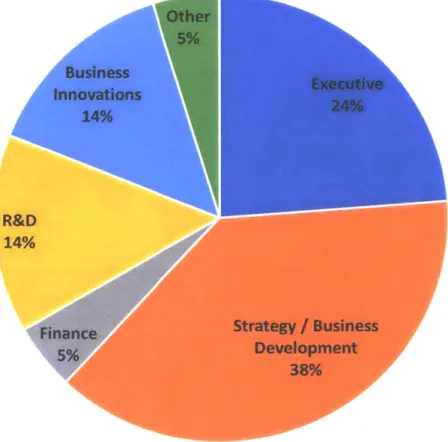
Under what corporate function does the CVC reside?
Other Business Executive Innovations 24% 14% 24% R&D 14%Finance Strategy / Business
5% Development
38%
Figure 7. CVCs and Corporate Organization Structure
Whether independent as a separate subsidiary, or integrated within a corporate
function, CVCs were asked what corporate function they most closely reside under. Particularly
with the independent CVC outfits, this organizational linkage was informed by the reporting
The majority (62%) of the CVCs interviewed fell under the Executive or Business
Development function, followed by R&D and Business Innovations at 14% each. The
recognition of the strategic value of CVCs can be observed from an organizational perspective
in where the function resides within the corporate parent.
Strategic Sponsorship Requirements for Investment
Deal
No sponsorship requirement 12% Soft sponsorship 41% Somewhat strong sponsorship requirement 24%Strategic investors will use some form of strategic alignment screening in evaluating
startups to ensure relevance prior to pursuing an investment. Interviewed CVCs were asked the
following question:
What strategic alignment screen is necessary for investment?
A. Strict strategic sponsorship requirement
B. Somewhat strong strategic sponsorship requirement
C. Soft strategic sponsorship requirement D. No strategic sponsorship requirement
A strict strategic sponsorship requirement takes the form of requiring an arrangement
or planned arrangement of partnership with one of the corporate business units for the vast
majority of CVC investments. This partnership may take the form of a co-development
agreement, a letter of intent to pursue such an agreement, a purchase order, or a similar
arrangement. 23% of CVCs interviewed indicated they had a strict strategic sponsorship
requirement as a strategic alignment screen prior to an equity investment.
A somewhat strong strategic sponsorship requirement calls for most investments to
require some form of partnership agreement, or that the business units support a concept of
future collaboration. 24% of CVCs interviewed indicated they had such a strategic alignment
screening prior to equity investment.
A soft strategic sponsorship screen merely involves a rational for why a target
investment is strategically aligned or relevant to the parent organization, devised in conjunction
identifying a business unit champion who would vouch for the startup's strategic relevance.
More CVCs indicated the use of this level of strategic screening than any other level of
screening, with 41% stating the use of a soft sponsorship requirement.
Only 12% of CVCs stated that they did not require any degree of business unit
involvement in pursuing an investment.
Of note, a few CVC's employed the use of multiple investment categories or "virtual
funds" aimed at different strategic objectives with different levels of strategic alignment
screening. One fund may be dedicated to investments requiring a somewhat strict strategic
sponsorship requirement with the business units, while another fund would be set aside for
investments requiring no sponsorship from the businesses and deployed on startups less
Board Participation
Only voting 9% Primarily observing 36%Figure 9. CVC participation on startup boards
Whether or not a board seat is taken can depend on a number of risk and financial
reporting factors. Most CVCs interviewed stated that the decision to take a board voting seat,
or a board observer seat, depends on a case by case scenario. The majority indicated primarily
taking voting seats (46%) or primarily taking observer seats (36%), as appropriate. It appears
for the most part that the decision of board participation is less informed by a CVC's strategic
imperatives, and more informed by risk avoidance and how to be most helpful to the startup.
Only a minority of CVCs have a strict observer only or voting only protocol for their
Business Unit Participation in CVC Function
100% 90% 80% 70% 60% 50% 40% 30% 20% 10% 0% op10 q4pOFigure 10. Business Unit participation in CVC investment function
The involvement of business units in the CVC investment process was used as one of the
indicators of the strategic alignment strength of the CVC unit. Strongly strategic alignments
have more business unit linkages exhibited by various means of involvement. CVCs were asked
how the business units were involved in the CVC function. In general, business units were
involved by informing strategic objectives and providing supporting resources prior and
post-investment. Typically, BU's did not have a vote on the investment, but were frequently asked
to contribute in other decision supporting ways such as in technical due diligence (78% of
reporting CVCs). 14 ell~ 4 c1 & ~e5' b
eo
411
-ICP d"i '04 1 tp 01Is the CVC allowed to invest in potential
competitors of current business offerings?
Yes
65%
Figure 11. CVC investment on Business Unit competition
The question of whether or not a CVC invests in a potential competitor of current
business offerings is aimed at determining how lock-step the CVCs are with current business
unit strategies. It is also aimed at revealing the degree of infiltration an external innovation
strategy is allowed to have within the corporation. More than half (65%) of CVCs interviewed
CVC Unit Integrated or Independent
Comnptetef Separate Subsidiary / Independent 39% Integrated with the Corporate Organization 61%Figure 12. Percentage of CVCs Integrated or Separate from the parent corporation
Of the CVCs interviewed, the majority (61%) were integrated with the corporate
organization over being a separate or independent subsidiary. Whether a CVC is independent
from, or integrated with the parent corporation, organizational structure at this level does not
appear to correlate with the average frequency of business unit interactions. Both categories
CVC Funding Source
Corporate parent
83%
I
Figure 13. Percentage of CVCs being funded by the corporate parent, or by the BU's
The majority of CVCs (83%) deploy capital provided by the corporate parent, most
commonly in the form of an "evergreen fund" or the ability to invest off the corporate balance
sheet. Only a handful of CVCs indicated that the business units were LPs of the fund(s). A
couple CVC's indicated having established traditional 10-year fund structures from corporate
Series Stage of Initial CVC Investment
16 14 12 10 8 6 4 2 0 Seed m Bio/Pharma A Healthcare 0 Industrial B C U Electronics/SemiconductorsFigure 14. Series Stage of Initial CVC Investment, separated out by industry focus
In plotting out the typical entry point of initial investments for all CVCs interviewed, and categorizing the CVCs along industry focus (Bio/Pharma, Healthcare, Industrial,
Electronics/Semiconductors) reveals a useful observation. In general, healthcare and
Bio/Pharma-focused CVCs are more interested in entering investments at earlier stages, and at higher risk. Further, the average technology readiness level of targeted investments in
Bio/Pharma and Healthcare are lower than investments in industrial or
electronics/semiconductor industries. Overall, most CVCs view Series A and B rounds as a preferred entry point on investment.
Window on Technology
One of the primary strategic values a CVC can bring back to the corporate parent is by
providing an "eyes and ears' function on the emergence of new technologies or business
models novel to the company. CVCs were asked:
* How many different startups/technologies are seen each year?
" How many startups/technologies were notably reported back to the parent corporation,
including but not limited to pre-reads for direct investment?
* How many of those were responded to as novel to the parent corporation?
* How many of these novel ideas instigated a corporate action (R&D exploration, tech
scouting, market exploration, investment for tech monitoring purposes, etc.)
% of startups that are notably reported back to Corporation
% of startups that
are responded to as Novel to the
Average: 1008 Startups seen corporation
each year by CVCs % of startups that
Instigate Action: lnvestrnent, Exploration, Market 17% Research, or R&D 10% 2%
Figure 15 illustrates the window on technology funnel. Out of 18 CVCs interviewed, only
9 groups reported tracking this metric. Nearly all understood the strategic value of providing
the parent organization with front-line technology and market intelligence. If not explicitly tracked, many CVCs explained that delivery of this value occurred implicitly through normal
interactions with the Corporate Parent or BU's.
The CVCs interviewed saw anywhere from 100 to 2000 startups each year, with an
average of 1008 startups considered for investment. Out of these, approximately 17% are
reported back to the parent organization as potentially interesting and new. This includes, but
not limited to startups that are recommended for initial investment due diligence. On average,
10% of the reported startups employ technologies or business models that are novel to the
corporation's corpus of knowledge. And from there, on average, 2% of the startups seen by the
CVC group instigate some form of action by the corporate parent, not limited to an equity
investment but also including market exploration studies, or R&D efforts.
Mapping CVC positioning
The data analysis conducted on interview responses from 18 CVCs also included the
mapping of CVC positioning along the spectrum of Strategic/Business Unit Alignment, and
Technology/Market Maturity, as shown in Figure 5. To do so, responses related to Strategic
Alignment and Business Unit Linkages were evaluated for each CVC were used to assign a
Strategic/Business Unite Alignment index value. Similarly, responses related to the technology
and market maturity of an investment "sweet spot" were used to assign a Technology/Market
CVCs were asked about their organizational and collaborative relationship with business
units, in the effort to approximate a relative degree of strategic alignment with present
business objectives. These questions included:
What returns objective does the CVC invest for?
A. Only for strategic return
B. Only for financial return
C. Primarily strategic, secondarily financial D. Primarily financial, secondarily strategic
What sponsorship screening is necessary for investment?
A. Strict sponsorship, ie. Partnership/co-development agreement, letter of
intent, PO
B. Somewhat strong sponsorship requirement, most investments requiring
some form of partnership agreement or concept of future collaboration.
C. Soft sponsorship, ie. Memo or rational of strategic fit, strategic fit
dashboard rating
D. No sponsorship requirement
Investment Committee: who votes?
A. Independent / autonomous - only CVC decision needed for investment
decision
C. BU
D. R&D E. CVC
What roll does the BU play?
A. Provides "hit list" of technologies/capabilities
B. Affirms/determines strategic alignment
C. Partnership/collaboration agreements D. "test bed" for new tech and products
E. Provides support and resources for startups post-investment
F. Due diligence
G. Vote on investment decision
H. none
What is the frequency of BU Interactions for deal and technology review, tech sourcing
needs, etc.)? A. Daily B. Weekly C. Monthly D. Quarterly E. Seldom F. never
Has/Would the CVC ever make an investment despite almost certain financial loss (for
the sake of strategic gain)?
A. Yes
B. No
Does the CVC invest in potential competitors of current business offerings?
A. Yes
B. No
A CVC with strong strategic/BU alignment can be characterized as one with frequent
interactions (weekly or daily) with the BU's, requiring strong or somewhat strong sponsorship
from the BU's for investment, where the CVC would never invest in potential competitors of
current business offerings and where the BU's have significant control and involvement before
the investment, on the investment decision, and after investment. Business Unit linkages of
lesser degrees of control over the investment process, or less frequent interactions between
the BU's and CVC units, or the ability for the CVCs to invest in startups that compete directly
with current company offerings indicate weaker strategic alignment.
CVCs were also asked questions related to the maturity level of the technology and
markets of typical targeted investments. These questions were used to approximate the
technology/market maturity levels of investments that land in a strike zone for initial
investment. Although almost all CVCs interviewed indicated that they have or would consider
investing in companies of almost many stages and technology maturity levels, most were able
maturity index for initial investments was determined from the answers for the following two
questions:
What series stage does the CVC typically make an initial investment?
* Seed 0 0 A B SC D+
On a TRL scale (1-9), the CVC invests in companies with maturity levels for:
* Technology
* Product
* Business Model
The Technology Readiness Level (TRL) scale shown below in Figure 16 was used as a reference
for identifying a target level, or range, or technology maturities associated with a startup
investment. The TRL scale concept was extended to product and business model maturity
TRL Scale
TRL 9 System ready for full scale deployment
TRL 8 System incorporated in commercial design
TRL 7 Integrated pilot system demonstrated
TRL 6 Prototype system verified
TRL 5 Laboratory testing of integrated system
TRL 4 Laboratory testing of prototype component or process
TRL 3 Critical function: Proof of concept established
TRL 2 Technology concept and/or application formulated
TRL 1 Basic principles observed and reported
Figure 16. Technology Readiness Scale
Each CVC was then assigned a relative strategic/BU alignment index value, as well as a relative technology/market maturity index value, and plotted on the two axis of Figure 5.
Mature Technology/Market Market Expansion: White
Space and Ecosystem Orchestration
Market Sustaining: synergistic
d Complementary
I
0
Financial Play U0
0
(
0
Market Anticipation: Emergent and Disruptive Nascent Technology/Market Biotech / Pharmaceutical0
Healthcare Industrial Electronics / Digital < 5 Investments per Year0
5-20 Investments per Year > 20 Investments per YearFigure 17. Mapping CVC along strategic quadrants. Note - participant CVCs have been anonymized.
E C 0 I-0 -J cn C k~
0
0
From the mapping of CVC positioning along the spectrum of strategic/BU alignment and
technology/market maturity shown in Figure 17, several key observations are made.
1. Industry domains inform a separation of technology risk tolerance. CVCs in the
Biotech/Pharma and Healthcare domains tend to invest at earlier stages both from a
funding series standpoint, as well as a technology maturity standpoint. The majority
of these biopharma and healthcare focused CVCs tend to invest in the Market
Anticipation quadrant (high strategic/BU alignment and low technology/market
maturity).
2. Industrial and Electronics/Digital domain focused CVCs tend to invest more mature
technologies, corresponding to partnership and co-development opportunities that
characterize the Market Sustaining quadrant (high strategic/BU alignment and high
technology/market maturity).
3. Relatively few CVCs appear positioned in the left two quadrants related to Market
Expansion and Financial Play. The lack of CVCs investing purely for financial returns
is not particularly surprising as it reflects the general response from the industry that
for survivability, a CVC must demonstrate at least some strategic return.
4. The lack of CVCs in the Market Expansion quadrant is surprising as the CVC structure
is uniquely equipped to drive value in pursuing white space opportunities at less risk,
Outcomes
Upon conclusion of the data collection and analysis above, the initial hypotheses are
revisited for final conclusions resulting from research.
Hi. A CVC's stated strategic objectives are captured by the organizational structure,
investment practices, and strategies.
From this research, Hypothesis 1 is proven true. The strategic objectives of the CVC is
revealed in the structure, practices, and strategies that shape the CVC, and one can map out
the CVC's objectives based on these observations, as shown in Figure 17. However, it is also
apparent that strategic value delivery is not contained within the CVC, and extends beyond the
system boundary of the CVC's investment activities. This warrants further exploration and
discussion.
H2. CVCs investing for Market Anticipation and R&D options measure strategic value in
resulting number of M&A.
From this research, Hypothesis 2 is proven false. For CVCs that are taxonomically
positioned for investment portfolios representing external R&D options and potential
disruptive technologies for future acquisition, this metric is rarely tracked. Very few CVCs could
claim acquisitions resulting from CVC investments, and of the few that could, the number of
acquisitions were typically very small.
CVC investment as a precursor for acquisition may have been at one point more
in a startup earns a company no upper hand in the acquisition of the startup, or that CVCs are
not ultimately investing for this purpose despite public perception that they do, or a
combination of the two. This thesis research does not show credible evidence that M&A
activity is a measure of strategic value for CVC investments aimed at anticipating new
technologies.
H3. CVCs investing for Market Sustainment or Market Expansion measure strategic
value in the number of partnerships, increase revenue, profit margin, new markets, or
other assets.
From this research, Hypothesis 3 is proven false. With the exception of a handful of
CVCs, the majority do not measure the number of partnerships, increased revenue, increased
profit margin, or new markets provided through the investment portfolio. While the number of
partnerships and new markets resulting from investments would be relatively easy to track, the
measure of resulting impacts to revenue, profit margin, was described as very difficult to
calculate. Further, CVCs may invest in companies that provide access to an enabling technology
which improves a component of the business offering in such a way that it would be highly
difficult if not impossible to separate out what fraction of any resultant revenue increase is
attributed to the enabling technology. Still, one prominent CVC indicated that confidential
calculations on revenue increase were used internally as a measure of success, and the rest of
the CVCs interviewed did not appear to measure or attempt to measure strategic value delivery
H4. CVCs investing to gain a window on new technologies measure strategic value the
number of novel technologies and ideas exposed to the parent organization.
From this research, Hypothesis 4 is proven true, however, not all CVCs track this
measurement. The window on technology function also appears to be less relevant to CVCs in certain industries where the innovation pipeline is very linear and slow, such as in the biotech and pharmaceutical industry. However, the organizational and process structures in place to convey the technology and market intelligence is usually incidental to those in place to support investment decisions.
CVC Value Networks
The term "ecosystem" is often used in the industry. An ecosystem can be defined as a dynamic network of resource exchange, resulting in systemic benefit of the whole, evidenced by the sustainment and growth of the system. This definition requires broadening of system boundaries to a level of abstraction such that a sustaining value delivery network can be
observed. At this point, value cycles - including strategic value - can be better understood and captured. The apparent difficulty of properly measuring strategic value of CVC investments at the portfolio level suggests that this system boundary is insufficiently broad to observe the strategic value of CVC activity.
In terms of the CVC structure and investment objectives, the focus should be on the establishment of the necessary conditions or environment for this ecosystem to be sustainably exploited - like any renewable natural resource. Measuring at the wrong points can lead to unsustainable extraction, or insufficient extraction.
A helpful start to better understand a CVC ecosystem is to begin by identifying the
reciprocating value cycle that explains the success or failure of a CVC at a high level of
abstraction. CVCs reside at the interface of two worlds - that of their corporate objectives and
linkages with the parent corporation, and that of their participation in the external innovation
ecosystems. This dynamic is illustrated in Figure 18 below.
... Ecosystem. Participation gft#nce-Qualty of *rategAcumen CVC Dom-in -. Signuicance of .K M. h. y. ..T .. . -. hsligence or co-muW . Lnkge .. .. . . . ...
Figure 18. CVC Value Cycle
Strategic Acumen describes the CVC's depth and breadth of insight on the corporate's
business and strategic objectives. This is informed by the CVC's linkages and interactions with the BU's, as well as the level of control the BU's have over investment decisions. Strategic