HAL Id: hal-00408538
https://hal.archives-ouvertes.fr/hal-00408538
Submitted on 13 Mar 2021
HAL is a multi-disciplinary open access
archive for the deposit and dissemination of
sci-entific research documents, whether they are
pub-lished or not. The documents may come from
teaching and research institutions in France or
abroad, or from public or private research centers.
L’archive ouverte pluridisciplinaire HAL, est
destinée au dépôt et à la diffusion de documents
scientifiques de niveau recherche, publiés ou non,
émanant des établissements d’enseignement et de
recherche français ou étrangers, des laboratoires
publics ou privés.
Detection of localized structures from multispacecraft
data: Adaptive correlation function
L. Rezeau, G. Belmont, F. Reberac
To cite this version:
L. Rezeau, G. Belmont, F. Reberac. Detection of localized structures from multispacecraft data:
Adaptive correlation function. Journal of Geophysical Research, American Geophysical Union, 1998,
103, pp.2319-2326. �10.1029/97JA02666�. �hal-00408538�
JOURNAL OF GEOPHYSICAL RESEARCH, VOL. 103, NO. A2, PAGES 2319-2325, FEBRUARY 1, 1998
Detection of localized structures from multispacecraft data:
Adaptive correlation function
L. Rezeau, G. Belmont, and F. Reberac
Centre d'rtude des Evironnements Terrestre et Planrtaires, Universit6 de Versailles Saint-Quentin, V61izy, France
Abstract. When several
spacecraft
pass
at different distances
from a localized structure
like a field-
aligned
current
tube, the corresponding
magnetic
signatures
recorded
on each spacecraft
generally
show different timescales,
due to the different "viewpoints"
of the spacecraft.
For this reason,
it is
impossible
to identify the presence
of a unique structure
from these
signatures
by using the
classical
correlation
functions.
In this paper, we present
an "adaptive
correlation
function"
which is
a new analysis
tool allowing to look for such "correlations"
whatever
the dilation factor is between
two signals.
1. Introduction
In space plasmas, many objects of physical significance are localized in space, and their signatures are thus concentrated in time along the spacecraft trajectories. A
paradigm for such structures can be a static cylindrical field-
aligned current tube (FAC), resulting for instance from the filamentation of a current sheet. As the magnetic field created by a FAC is easy to calculate, it is possible to search the magnetic field data for resembling signatures [Robert et al.,
1984]; when such a signature is visually picked out, one can
determine the few parameters of the model by a numerical fit
(intensity of the current, distance from the spacecraft, and relative velocity). The short large amplitude magnetic structures (SLAMS), [Schwartz et al., 1992; Dudok de Wit and Krasnosel'skikh, 1995], which are observed upstream of
quasi-parallel shocks, are other structures (more complex but
still quasi-static) which can also be investigated in the same spirit.
When trying to extend the above method, one comes up against two limitations:
1. There is no uniqueness of the interpretation and most
generally no means for testing the validity of the model chosen for the observed signature. This first limitation is met in particular when the structure can be supposed to have a temporal evolution, as in the case of kinetic Alfven waves
[Chmyrev et al., 1988, Rezeau et al., 1993]: the
eigenfrequency then mixes with the Doppler frequency because of the apparent motion and the number of independent data necessary to disentangle time and space variations becomes much larger. It is quite possible that the same event identified as a FAC from the only magnetic field data at one spacecraft can be interpreted as well by a kinetic Alfven wave or by a combination of both (Alfven solitons). The only way to go beyond this limitation is to increase the
amount of data comparable with the model, so decreasing the
probability of multiple interpretations (in particular by the use of multispacecraft experiments).
Copyright 1998 by the American Geophysical Union. Paper number 97JA02666.
0148-0227/98/97JA-02666509.00
2. Even when localized signatures can be picked out visually in different signals, the question of whether these signatures are due to the same structure or have independent
causes cannot always be answered. In particular, the use of
correlation methods often fails when the signals are recorded
on different spacecraft. We will try to bring a solution to this
specific problem.
In order to restrict the possibilities of multiple interpretations, especially to disentangle space and time variations, the best way thus appears to be the use of
simultaneous data from several close spacecraft. This was one
of the motivations of multispacecraft missions such as ISEE
or Interball, and a lot of work has been done in this field in
the frame of the CLUSTER project preparation. The data processing methods now exist to get decisive physical
information out of the data when the measurements are made
inside a structure with a typical scale larger than the
interspacecraft distance, e.g., intensity of the local current
imbedded [Robert and R oux, 1990] or a study of waves through an estimation of thewavenumber spectrum for each frequency [Pincon and Lefeuvre, 1991] or through recognition of the wave mode [Motschmann and Glassmeier, 1995].
Nevertheless, as discussed by Rezeau et al. [1990], when the
spacecraft remain outside of a small current structure (compared to interspacecraft distance), the magnetic signatures recorded on each of them present different characteristic scales and amplitudes because of the different viewpoints of the different spacecraft: as the magnetic field
created by a current tube decreases with the distance to the
source, a spacecraft passing by the tube at a short distance records a narrow and intense signature, whereas a spacecraft passing at a large distance records a wide signature with a weak intensity. Then, all classical tools such as correlation functions or spectral analysis fail in diagnosing the structure even in this simple case of a pure FAC. The same conclusions
came out of an experimental study performed on ISEE 1 and 2
data [Rezeau et al., 1993] in a case where the observations are
very similar on both spacecraft and where many indications show that it is most probable that the same localized structure
is observed on both spacecraft: the spectral analysis indicates
a frequency shift of the peaks in the power spectra, and
consequently the cross-correlation functions between the two
2320 REZEAU ET AL.: ADAPTIVE CORRELATION FUNCTION
spacecraft signals have a very weak maximum. These studies
indicate that a satisfactory method should take into account this viewpoint effect which is different from one spacecraft to another. A new method has been developed, the adaptive correlation function, which is derived from the wavelet analysis of signals. The application of the method to ISEE data will show its efficiency. It must be noticed that the present work is limited to the identification of signatures of different scales but similar shapes. It could be extended in the future to signals that are physically related (due for instance to the derivatives contained in the Maxwell equations) without having the same shape.
The method is obviously not limited to the particular case
presented here of magnetic signatures, it should be useful in
any case when geometrical effects around a localized structure
are to be taken into account whatever the data. It could be
applied to the density or the velocity of the plasma. 2. Data and Method Baseline
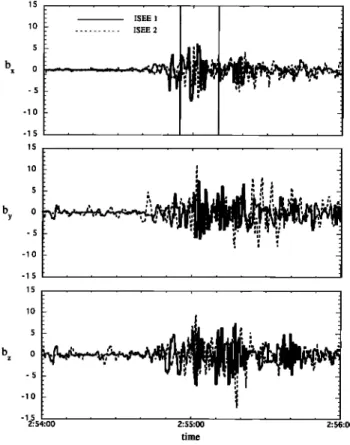
The method will be described and applied to the same case as in the work of Rezeau et al. [1993]: a localized structure observed on magnetic fluctuations at the inner edge of the boundary layer, with a small delay between ISEE 1 and 2 (November 8, 1977, around 0255 UT). The data are the flux gate magnetometers data since the ISEE search-coil magnetometers frequency range does not allow the exploration of the ultra-low-frequency range (Figure 1).
Nevertheless,
a filtering
by subtraction
of a running
average
over 5 s has been applied to eliminate the large-scale
lO 5 b x o -lO -15 15 b 0 y -5 -10 -15
. ! 1%,•
d mII
, ,; •,II
i
m m , ,, • . ;. 5 b z o -5 -10 -151 2:54:00 2:55:00 2:56:00 timeFigure 1. Waveforms of the magnetic fluctuations
(nanoteslas) observed on ISEE 1 and 2, projected in the
magnetopause LMN frame.
variations of the field (which are similar on both spacecraft) and keep only the fluctuations (which could be different from one spacecraft to another). It makes the inspection of the fluctuations clearer, but it is not a necessary step; the method presented here could be applied on the nonfiltered data. The results obtained by Rezeau et al. [1993] show that the signals
on the two spacecraft are correlated (the maximum correlation
(0.6) is obtained for a delay equal to 2 s) but that there is a
discrepancy in the spectral features (the relative maximum of
the spectrum is at 0.6 Hz on ISEE 1 and 0.8 Hz on ISEE 2. Nevertheless, they are likely to be interpreted as two
signatures of a unique structure convected by the plasma flow.
The baseline of the adaptive correlation method is derived from the wavelet analysis, but it is not a new wavelet theory.
The main properties of the wavelet transform with respect to
the Fourier transform are the localisation of the analyzing function and the self-similarity. For instance, if we consider the Morlet wavelet analysis, it can be compared to the Fourier transform: the elementary analyzing function is a limited complex exponential instead of an unlimited complex
exponential [Grossmann et al., 1989; Lagoutte et al., 1992].
The limitation is obtained by multiplication by a gaussian function with a width equal to a few periods of the complex exponential whatever the frequency. For this reason, the wavelet analysis is better adapted to the study of transient or localized signals than the Fourier transform. When applied to the signals of Figure 1, a wavelet analysis will emphasize
the fluctuations around 0255:00 UT on both spacecraft; it will
show that the maxima are observed at times slightly different
with close timescales, but it will obviously not give any indication on their possible correlation. The adaptive correlation function is a correlation function modified to get a localized diagnosis in the same spirit as in wavelet theory. The method consists in the following steps: (1) pick out an event on one component recorded on one of the two
spacecraft (the corresponding data will be referred hereafter as
RS, reference signal), (2) extract the desired pattem (supposed to be related to an interesting physical phenomenon) from it by filtering to prepare a reference function (similar to mother wavelet in wavelet analysis), (3) dilate (or contract) and delay this function to analyse another signal (AS, analyzed signal), generally the same component recorded on the other spacecraft. The result of this analysis will be a three- dimensional diagram similar to the wavelet scalogram, with
time as horizontal axis and scale (i.e. dilation relative to the
RS scale)as vertical axis. It will evidence the times when
signals are correlated on the two spacecraft, and the relative
time scales of the two viewpoints. From this comes the name adaptive correlation given to the method.
3. Description of the Method
The first step is the choice of the RS from the visual identification of an "event." On the example of Figure 1, we select about 10 s around 0255:00 UT on the B x component
recorded on ISEE 2. The simplest way would then consist in
taking the signal itself as analyzing wavelet. The tests that have been performed show that, because of the superimposed noise, this method is not efficient (see section 4). The signal
has to be filtered before use, and the method chosen here is
the singular-spectrum analysis (SSA). As it will be shown
below, this method is very efficient to separate trend and
oscillatory
part of the signal,
without
fixing an arbitrary
low-
RE7F•AU
ET AL.:
ADAPTIVE
CORRELATION
FUNCTION
2321frequency cutoff. The software used is the one developed by
Dettinger et al. [1995] and described by Vautard et al. [1992].
This spectral analysis method is dedicated to short and noisy
signals. It is a decomposition of the signal on
eigenelements, and the specificity of the method is that these
eigenelements are data-adaptive; they are not given as inputs
like in Fourier transform. After this decomposition on the
eigenvectors, called principal components, the signal can be
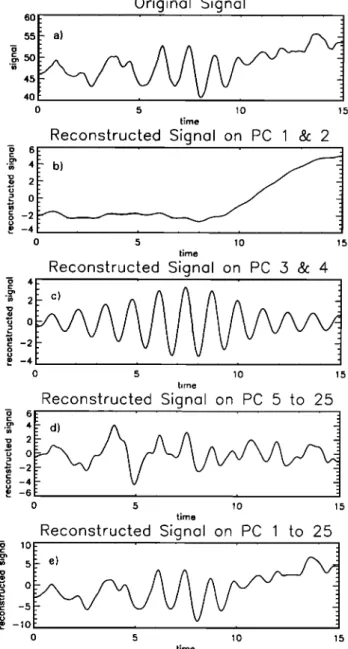
filtered by reconstructing it from only a subset of the principal components. On Figure 2, the method has been applied on the RS over 16 s beginning at 0254:54 UT. The original signal is displayed in Figure 2a (the running average filtering has not been applied before SSA analysis to bring out the capability of the method); in Figures 2b-2c, the
reconstruction of the signal on different subsets of principal
components are shown. It evidences the efficiency of the method for separating the trend (low-frequency part of the signal), the oscillatory part and the high-frequency noise of
the signal. The number of principal components on which the
signal is split is a free parameter called the "embedding dimension"; it has been chosen here equal to one fourth of the total number of points of the time series. From the previous study [Rezeau et al., 1993], it seems that a localized structure is the cause for the oscillatory part of the signal around 0255 UT; we therefore choose the reconstruction on principal
components number 3 and 4 as analyzing function.
Once the reference function g is chosen, we use it to analyse a signal. For that purpose, we compute a scalogram, which is similar to a spectrogram but with a computation window increasing with scale in the same way as in wavelet analysis [Grossmann et al., 1989]. A family of daughter functions is generated by dilation and translation in time:
ga,b(t) (see Appendix for details). Both dilation and
translation parameters are allowed to vary and sampled. The wavelet is translated with steps proportional to the width of th e wavelet, in order to increase the time resolution when thescale decreases. For each value of a and b the correlation
coefficient
Cg,s(a,b)
is computed
and displayed
with a color
code on the scalogram.
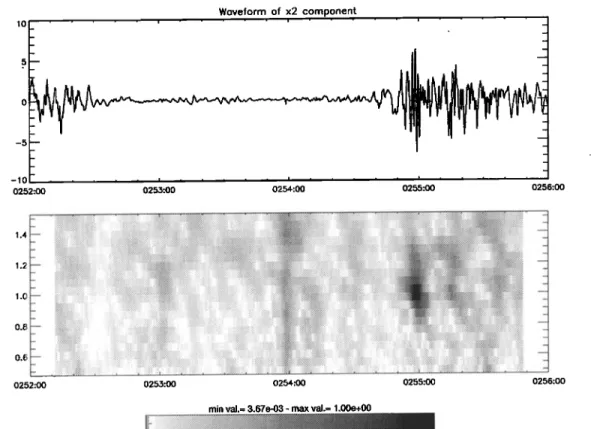
The result is shown in Figure 3b. The horizontal axis is time, the vertical axis is scale (or "dilation": scale is 1 for the mother wavelet); the maximum scale is at the top of the diagram. The pixel width increases with scale, it is equal to 5% of the wavelet width. As a test, the program has been first applied to RS. As expected the maximum of the correlation function is obtained for a dilation equal to 1, at time t = 0255:01.6, time of the maximum of the signal.
More interesting is the result shown on Plate lb, where AS
is the B x component recorded on ISEE 1 (Plate la). Four main
maxima are seen with the characteristics shown in Table 1 (in
order of decreasing value of the maximum). The first point is
that none of these maxima correspond to a dilation equal to 1,
which means that the viewpoints of the two spacecraft are actually different. One of the maxima (3) evidences the same delay as the classical correlation computation (delay equal to 2 s, [Rezeau et al., 1993]), it is obtained for a dilation equal to 1.3. This result is consistent with the spectral analysis performed in the same study, which gave frequency maxima at
0.6 and 0.8 Hz, which means a scale factor of
0.8/0.6= 1.33 between the observations on the two
spacecraft.
Plate lc shows the final form proposed for the visualisation of the result. This last change aims to answer
Original Signal
._ 55 50 ,45 ,40 o 5 lO 15 timeReconstructed Signal on PC 1 & 2
6
0 5 10 15
time
Reconstructed Signol on PC 5 & 4
'• -2 • --4 0 5 10 15 time
Reconstructed Si9nol on PC 5 to 25
0 5 10 15 timeReconstructed Signol on PC 1 to 25
lO 5 0 5 10 15 timeFigure 2. Singular-spectrum analysis (SSA) filtering. (a) Waveform of the reference signal (B x component measured by ISEE 2, total magnetic field). The horizontal axis is delay in
seconds from the beginning of the selection (0254:54). The
time period presented corresponds to the vertical lines on Figure 1 (top). (b)-(e)Reconstruction of the signal using different subsets of principal components determined by SSA. Figure 2e shows the reconstruction on the 25 first
components: it is identical to the original signal (Figure 2a),
except for the average which is lost by SSA.
the following difficulty: as the correlation coefficient has been calculated to be independent upon the power in the correlated signals, large values may correspond to very weak components in the analyzed signal. This property obviously increases the probability of spurious correlations between the analyzing wavelet and many small components of the signal which are not physically significant. To avoid cluttering the display with such parasitic correlations, Plate lb has been modified in the following way: instead of plotting the correlation coefficient, we only use it as a criterion to select the nonnormalized correlation function which is proportional
2322 REZEAU ET AL.: ADAPTIVE CORRELATION FUNC•ON
a)
b)
10 -5 -lO 0252:00 Waveform of x l component i i , , , .. ,, ... 0253:00 0254:00 2.0 1.8 1.6 1.4 1.2 1.0 0252:00 0255:00 0256:00 0253:00 0254:00 0255:00 0256:00min vaJ.= 5.53e-03 - max val.= 6.73e-01
c)
2.0 ' 1.0-- 0252:00 I I I 0253:00 0254:00 0255:00 timerain val.= 1.30e-03 - max vaL= 6.81e-02
0256:00
Plate 1. (a and b): Result
of the analysis when applied
to the same component
on the other spacecraft
(ISEE 1). The dilation scale
goes from 1 to 2. Four maxima
are observed,
they are labeled
from 1 to 4 with
decreasing
correlation.
(c) The normalized
correlation
is used
as a filter for the plot of the nonnormalised
correlation.
The colored
region
is the region where
the correlation
is higher than 0.4; inside this region the
color code goes from black to red with the amplitude of the signal.to the intensity of the correlated signals. In the regions of the plane where the correlation coefficient is lower than a given threshold (chosen equal to 0.4 here), the color plot of the nonnormalized correlation function is masked. When it is
plotted, this nonnormalized correlation is directly
proportional to the amplitude of AS since the analyzingwavelet is normalized. The interpretation of the four maxima
observed on Plate 1 b is modified by this analysis, two of them (2 and 3) appear more interesting since they are both correlated and intense events (they are identified by * in Table 1 and their intensities are respectively 0.0679 and 0.0681). Therefore, in addition to the maximum at 1.3 dilation (3), the maximum corresponding to 1.6 dilation (2) appears
significant although it was not evidenced by the classical correlation analysis, the other one was the already identified one. The result of this analysis is that the signature observed on ISEE 2 appears to be correlated with two signatures on ISEE 1. This is still to be physically interpreted, but this example shows that the improvement of the correlation method was necessary.
4. Discussion and Conclusion
We have shown in this paper that the classical correlation methods used to detect in different signals similar wave forms
with equal
timescales
cannot
be used
without
change
to detect
REZEAU ET AL.: ADAFI• CORRELATION FUNCTION 2323 Waveform of x2 component _ _ 0 i I i i i i i 0252:00 0253:00 0254:00 0255:00 0256:00 -113
0'8
I
0.6 0252:00 0253:00 0254:00 0255:00 0256:00min val.= 3.67e-03 - max val.= 1.00e+00
Figure 3. Result
of the analysis
when
applied
to the reference
signal
(Figure
3b). The horizontal
axis is
time. The dilation is shown on the vertical axis, with a linear scale from 0.5 to 1.5. As expected when
analyzing
the reference
signal,
the maximum
is obtained
for a dilation
equal
to 1.
the signatures
of a spatial structure
from different
spacecraft,
because of the different time scales implied by the differentviewpoints
of the spacecraft.
The method
proposed
makes
use
of a filtering of one of the signals by singular spectrumanalysis
(to isolate
the signature
to be correlated)
followed
by
a "wavelet correlation" with the second signal. Associatedwith an adequate
visualisation,
the method
has been shown
on
an example
to be powerful
and to allow the detection
of a
correlation between two signals with a scale ratio differentfrom 1.
An element of the method has still to be discussed: why
not to use the signal itself as an analyzing
wavelet?
It would
seem easier than performing the SSA filtering before theanalysis.
The reason
is that like the analyzed
signal, the
original signal contains
many components,
including
high-
frequency noise (and eventually trend). For the same reason as
in the preceding
section, keeping all of these components
Table 1. Characteristics of the Maxima Observed in Plate lb (labeled from 1 to 4 With Decreasing Value of the Maximum)
Maxima Time Delay (s) Dilation Correlation
1 0255:17.6 16 1.32 0.68 2* 0254:58.8 -2.8 1.58 0.57 3* 0255:03.9 2.3 1.32 0.49 4 0255:19.0 17.4 1.58 0.48 * events for which the nonnormalized correlation is the most intense (see Plate lc)
greatly
increases
the number
of spurious
correlations
between
the analysed signal and many small components of the original signal. When doing so, the result is thus again afigure
cluttered
by a lot of nonsignificant
high values
of the
correlation coefficient, varying substantially from onewavelet translation step to the next because
of the high-
frequency noise; the method would then demand a step as
small as possible
(sample
time) because
of these
artificial
fine structures.
With the filtered signal, on the contrary, a step
corresponding
to a fraction
of the length
of the analyzing
function is sufficient (4%). For a dilation equal to 1, in our
case,
this means
steps
of 12 sample
times and the obvious
consequence
is a significant
save in computation
time. It
must
be noted
that larger
pixels
still give the same
result,
and
we could have saved even more computation time.From the results obtained for the given example, it appears
that the interpretation
is still not straightforward
since
the
selected
signature
on ISEE 2 is correlated
with two signatures
on ISEE 1. Of course, we cannot grant that when two
signatures
are correlated,
they do correspond
to the same
event.
It is possible
that one signature
corresponds
to the
same event but that the other one is the signature of an event
that is similar
without
being
the same.
It is also possible
that
the second
event is seen by only one spacecraft
and not by
the other.
This could lead to conclude
that the mother
function
is so generic
that
it correlates
with any wave
packet:
this is
not true
since
only two events
are selected
by the method,
while a visual inspection
of the signals
after 0255:00 UF
evidences the existence of other wave packets that are not correlated with the mother function. However, the results
2324 REZEAU ET AL.: ADAPTIVE CORRELATION FUNCTION
obtained confirm that the signal processing tool that we propose is able not only to quantify correlations which are apparent by visual inspection but also to detect possible correlations which are less obvious at first glance.
The adaptive correlation function, in its present form, enables one to detect and identify the signatures that are due to the same localized structure when they are observed from the data of two different spacecraft, under the condition that the viewpoint effect does not modify the shape of the signature. This method appears as a necessary step before further developments, consisting in particular to directly correlate the data of more numerous spacecraft as in the CLUSTER project. As shown in the preceding study [Rezeau et
al., 1993], with two spacecraft the position of the structure
can be derived assuming it is stationary. The data from a third
spacecraft would either confirm this position, either evidence a temporal evolution of the structure. Three spacecraft limit anyway this interpretation to a plane, a fourth one is necessary to get the information in all directions (for instance, a kinetic Alfven wave might have a parallel propagation together with a perpendicular evolution, convection or expansion).
One of the referees has pointed out that the problem we are trying to solve here has some similarities with a radar problem: the echo of the emitted, and perfectly known, radar pulse is to be recognized in the return signal in spite of the Doppler effect induced by the motion of the target.
Techniques have therefore been developed by radar scientists
that are related to our adaptive correlation function, in particular the ambiguity function [Rihaczek, 1960]. Some authors [Bertrand et al., 1994, 1995] suggest that this
function can be computed using the Mellin transform; even if
the problem is not exactly the same in our case (the input signal is not controllable), the use of similar algorithms might also induce a save in computation time.
Appendix
Let x(t) be the reference signal (RS), on which a localized
structure has been identified by visual inspection. This observed signature is first isolated by picking up a portion of the original signal in a window [to - St, to + 8t]. The position and the width of this window are chosen in order to include the whole structure. The mother analyzing function is obtained
from SSA filtering
(using
the freeware
program
developed
by
Dettinger
et al. [1995]): g = KRCp_q[X],
where
K is a
normalization
constant
and RCp_q[X]
is the reconstructed
signal on principal components p to q. Both p and q are
chosen in order to reproduce the gross features of the observed
structure and, as long as long as the structure looks like a
wave packet, the value of g is generally small on the edges of
the window.
Nevertheless,
to make sure that no discontinuity
pollutes the correlation calculation, a taper (smoothing of the edges by a square cosine, applied to the first and last 10% of the window) is applied to the edge points of the motherfunction.
From
this mother
function
g, daughter
functions
ga,b
are
deduced: ga,o(t)
= Kag[(t- b)/a] where K a is another
normalisation constant, b is a delay and a the dilation. These daughter functions are used to compute the scalogram of a given signal s(t):
b + a•St
Cg,s(a,b)= lga,b(t)s(t)dt,
b-a•St
where the integration is limited to the width of the g function.
Cg,s
is proportional
to the amplitudes
of the signal
s(t) and of
the analyzing function; in order to calculate a normalizedcorrelation function we define
Cg,s(a,b)
= Cg,s(a,b)/•/E(ga,
b
)E(s)
,
where
E(s) and
E(ga,b)
are energies
contained
in s and
ga,b:
b + a•St
E( f ) = If2 (t)dt
b- a•St
is the energy.
With this
definition,
Cg,s
is smaller
than
1.
With regard to calculation of the normalization
coefficients K and K a, as in the wavelet theory, it is necessary
to have
K a = 1/x/-•, to ensure
the conservation
of energy
whatever the dilation of the function. To compute K, the reference signal itself is analyzed; the maximumb 0 + •St
Cg,
x(1,
bo)=
K/•/E(gl,t,o)E(x)
IRC3-4[x](t)x(t)dt
b o -•St
is obtained
for a -- 1 and a time bo. This time bo is exactly
the time to where the mother function has been extracted fromthe original
signal.
K is chosen
to set Cg,x(1,b
O) = 1.
Acknowledgments: The authors wish to thank C. T. Russell (UCLA) for
having kindly provided them with the ISEE magnetometer data. They
also acknowledge the careful reading of the manuscript by N.
Comilleau-Wehrlin and her useful comments.
The Editor thanks Steven Schwartz and Thierry Dudok de Wit for their assistance in evaluating this paper.
References
Bertrand J., P. Bertrand, and J-P. Ovarlez, Frequency-directivity scanning in laboratory radar imaging, Int. J. Imag. Syst. and
Technol., 5, 39-51, 1994.
Bertrand J., P. Bertrand, and J-P. Ovarlez, The Mellin transform, in The
TransJbrms and Applications Handbook, edited by A.D. Poularikas, chap. 12, CRC Press, Boca Raton, Fla., 1995.
Chmyrev, V. M., S. V. Bilichenko, O. A. Pokhotelov, V. A. Marchenko,
V. I. Lazarev, A. V. Streltsov and L. Stenflo, Alfven vortices and
related phenomena in the Ionosphere and the magnetosphere, Phys.
Scr., 38,841-854, 1988.
Dettinger, M.D., M. Ghil, C. M. Strong, W. Weibel, and P. You, Software expedites singular-spectrum analysis, Eos, Trans. AGU,
76(2), 12, 14, 21, 1995
Dudok de Wit, T., and V.V. Krasnosel'skikh, Wavelet bicoherence
analysis of strong plasma turbulence at the Earth's quasi-parallel
bow shock, Phys. Plasmas, 2, 4307-4311, 1995.
Grossmann, A, R. Kronland-Martinet, and J. Morlet, Reading and
understanding continuous wavelet transform, in Wavelets, Time- Frequency Methods and Phase Space, edited by J. M. Combes, A.
Grossmann, and P. Tchamitchian, pp. 2-20 Springer-Verlag, New
York, 1989.
Lagoutte, D., J. C. Cerisier, J. L. Plagnaud, J.P. Villain, and B. Forget, High latitude ionospheric electrostatic turbulence studied by means
of the wavelet transform, J. Atmos. Terr. Phys., 54, 1283-1293,
1992.
Motschmann, U., and K.-H. Glassmeier, Mode recognition of MHD
wave fields, Eur. Space Agency Spec. Publ., ESA SP-371, 103-106,
1995.
Pinqon, J.L., and F. Lefeuvre, Local characterisation of homogeneous
turbulence in space plasma from simultaneous measurements of
fields components at several points in space, J. Geophys. Res., 96,
1789-1802, 1991.
Rezeau, L., A. Roux, and C. T. Russell, Characterisation of small scale
structures at the magnetopause from ISEE measurements, J. Geophys. Res., 98, 179-186, 1993.
REZEAU ET AL.: ADAFIIVE CORRELATION FUNCTION 2325
Rezeau, L., A. Roux, and N. Cornilleau-Wehrlin, Multipoint study of
small scale structures at the magnetopause, Eur. Space Agency
Spec. Publ., ESA SP-306, 103-108, 1990.
Rihaczek, A. W., Principles of High Resolution Radar, McGraw-Hill,
New York, 1969.
Robert, P., and A. Roux, Accuracy of the estimate of J via multipoint
measurements, Eur. Space Agency Spec. Publ., ESA SP-306, 29-35,
1990.
Robert, P., R. Gendrin, S. Pertaut, and A. Roux, GEOS 2 identification
of rapidly moving current structures in the equatorial outer magnetosphere during substorms, J. Geophys. Res., 89, 819-840,
1984.
Schwartz, S. J., D. Burgess, W. P. Wilkinson, R. L. Kessel, M. Dunlop,
and H. Liihr, Observation of short large-amplitude magnetic
structures at a quasi-parallel shock, J. Geophys. Res., 97, 4209,
Vautard,
R., P. Yiou,
and
M. Ghil,
Singular-spec,tral
analysis:
A toolkit
for short, noisy chaotic signals, Physica D, 58, 95-126, 1992. G. Belmont, F. Reberac, and L. Rezeau, CETP/UVSQ, 10-12 avenue de l'Europe, 78140 V61izy, France. (e-mail: [email protected]) (Received December 27, 1997; revised September 9, 1997;