Appl Microbiol Biotechnol (2005) 69: 286–292 DOI 10.1007/s00253-005-1995-1
A P P L I E D G E N E T I C S A N D M O L E C U L A R B I O T E C H N O L O G Y
Qun Ren . Guy de Roo . Jan B. van Beilen . Manfred Zinn . Birgit Kessler . Bernard Witholt
Poly(3-hydroxyalkanoate) polymerase synthesis and in vitro activity
in recombinant
Escherichia coli and Pseudomonas putida
Received: 2 February 2005 / Revised: 5 April 2005 / Accepted: 5 April 2005 / Published online: 22 April 2005
# Springer-Verlag 2005
Abstract We tested the synthesis and in vitro activity of the poly(3-hydroxyalkanoate) (PHA) polymerase 1 from Pseudomonas putida GPo1 in both P. putida GPp104 and Escherichia coli JMU193. The polymerase encoding gene phaC1 was expressed using the inducible PalkB promoter. It was found that the production of polymerase could be modulated over a wide range of protein levels by varying inducer concentrations. The optimal inducer dicyclopropyl-ketone concentrations for PHA production were at 0.03% (v/v) for P. putida and 0.005% (v/v) for E. coli. Under these concentrations the maximal polymerase level synthesized in the E. coli host (6% of total protein) was about three- to fourfold less than that in P. putida (20%), whereas the max-imal level of PHA synthesized in the E. coli host (8% of total cell dry weight) was about fourfold less than that in P. putida (30%). In P. putida, the highest specific activity of polymerase was found in the mid-exponential growth phase with a maximum of 40 U/g polymerase, whereas in E. coli, the maximal specific polymerase activity was found in the early stationary growth phase (2 U/g polymerase).
Our results suggest that optimal functioning of the PHA polymerase requires factors or a molecular environment that is available in P. putida but not in E. coli.
Introduction
Poly(3-hydroxyalkanoates) (PHAs) are intracellular storage polyesters that are produced by many bacteria (Madison and Huisman 1999; Steinbuchel 2003). The best known PHA materials, for which the genetics and enzymology have been studied in detail and which have been produced indus-trially, are short-chain-length PHAs containing poly(3-hy-droxybutyric acid) (PHB) and/or poly(3-hydroxyvaleric acid) (PHV) (Sudesh et al.2000; Reddy et al.2003). Most other PHAs are referred to as medium chain length, or mcl-PHAs, because the monomers are generally 3-hydroxyalk-anoic acids with six or more carbon atoms (Steinbüchel and Valentin 1995). Mcl-PHAs have attracted considerable attention due to their potential applications in medicine and industry and as sources of chiral monomers (Ueda and Tabata 2003; Hrabak 1992). Therefore, research is being performed to gain insight into the physiology and biochemistry of mcl-PHA production to reduce production costs. One of the approaches is the use of recombinant Escherichia coli because this organism is well studied and utilizes a wide range of carbon sources. Furthermore, easy and cheap downstream processing techniques are available for E. coli (Fidler and Dennis1992).
Several enzymes are involved in the synthesis of PHAs, with PHA polymerases as the key enzymes. These incor-porate 3-hydroxyacyl moieties into nascent PHA chains, using coenzyme A (CoA)-linked precursors (Huijberts et al. 1995; Kraak et al. 1997a). Such CoA substrates may be synthesized by a variety of pathways (for a recent review, see Aldor and Keasling2003). When fatty acids are used as sole carbon source, the polymerase precursor 3-hydroxy-acyl-CoA is probably derived from the fatty acid β-oxi-dation pathway (Huijberts et al.1995; Qi et al.1998; Ren et al.2000a). Mcl-PHA has been successfully produced in E. coli by blocking or inhibiting theβ-oxidation pathway Q. Ren (*) . M. Zinn
Biocompatible Materials,
Materials Science and Technology (EMPA), 9014 St. Gallen, Switzerland e-mail: [email protected] Tel.: +41-71-2747688 Fax: +41-71-2747788 G. de Roo Catchmabs, Nieuwe Kanaal 7, 6709 PA Wageningen, The Netherlands
J. B. van Beilen . B. Witholt Institute of Biotechnology, ETH Hönggerberg, 8093 Zurich, Switzerland B. Kessler
ETH-Präsidialstab, ETH Zentrum, HG F 52.2,
(Langenbach et al.1997; Qi et al.1998; Ren et al.2000a,b). These studies showed that only one enzyme, namely PHA polymerase, is essential for synthesis of PHAs in E. coli.
There are two PHA polymerases that are encoded by phaC1 and phaC2 in P. putida (Huisman et al.1991). Both enzymes can independently lead to PHA accumulation in E. coli (Langenbach et al.1997; Ren et al.2000b). Unlike PHB polymerase (also called PHB synthase), which has been purified and studied in vitro in detail (Gerngross et al. 1993, 1994; Gerngross and Martin 1995; Rehm 2003), much remains to be learned about mcl-PHA polymerases, such as the relation between polymerase levels, polymerase activity and the final PHA level. Kraak et al. (1997b) have reported polymerase 1 levels in P. putida strains. However, the low amounts of polymerase (0.06–0.07% of total protein) make it difficult to study the effect of polymerase levels on polymerase activity and PHA contents in detail. Furthermore, no data have been reported for PHA poly-merase levels or activities in E. coli.
In this paper, a fine tuned expression system was used to produce PHA polymerase in both P. putida and E. coli. Sub-sequently, the synthesis of PHA polymerase in relation to its activity and PHA production was compared for both P. putida and E. coli.
Materials and methods
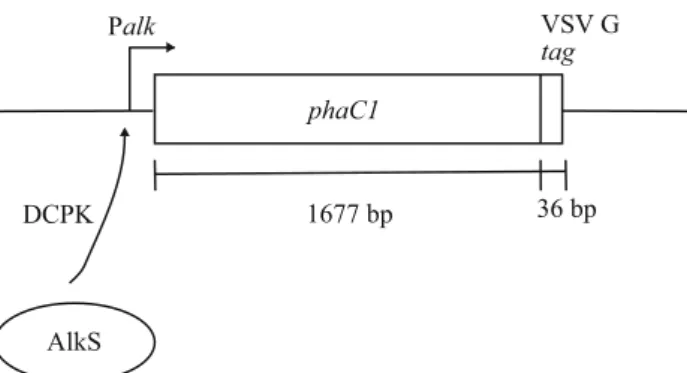
Bacterial strains and plasmids Strains P. putida GPp104 (Huisman et al.1991) and E. coli JMU193 (Rhie and Dennis 1995) were used in this study. Plasmids pGEc74 (Eggink et al.1987) or pAlkSCm (Panke1999), which contains the alkS regulatory gene, and pET702 (Fig.1; Ren et al.2000c), which contains phaC1 expressed from the PalkB promoter, were used for production of PHA polymerase. pET702 has a sequence coding for 12 carboxy-terminal amino acids of the vesicular stomatitis virus glycoprotein (VSV G), to which monoclonal antibodies are available.
Recombinant DNA techniques Isolation and analysis of plasmid DNA were carried out according to Sambrook et al. (1989). E. coli competent cells were transformed according
to standard procedures (Sambrook et al. 1989). Plasmids were transferred from E. coli donor strains to P. putida re-cipient strains by three parental mating as described by Ditta et al. (1980).
Media, growth conditions and cell disruption P. putida was precultured in complex Luria-Bertani (LB) medium at 30°C until the end of the exponential growth phase and trans-ferred with 1:100 dilution to E2 minimal medium (Huisman et al.1989) containing 15 mM octanoate as carbon source. E. coli was cultured at 37°C under the same conditions as P. putida except that 0.5% glycerol and 1 mM octanoate were used as substrates. If necessary, antibiotics were added: tetracycline, 12.5μg/ml; streptomycin, 100 μg/ml. Cell growth was monitored by measuring optical density at 450 nm (OD450) (Witholt1972).
To induce the PalkB promoter (Fig. 1), pGEc74 or pAlkSCm were cotransformed with pET702, and dicyclo-propylketone (DCPK) was added to the indicated concen-trations in the early exponential growth phase.
Recombinant P. putida or E. coli cells were harvested and washed once with Tris–HCl (50 mM, pH 8). The pellets were resuspended in the same buffer to OD45040–50. Cells
were disrupted by three passages through a precooled French pressure cell at 11,000 psi and 4°C.
Protein analysis and determination Proteins were separated by gel electrophoresis according to Laemmli (1970), and stained with Coomassie brilliant blue R-250. The amount of PHA polymerase relative to total protein was estimated by densitometric scanning (Molecular Dynamics). Total pro-tein was assayed with a Lowry-based method (Biorad DC assay) in the presence of SDS with bovine serum albumin as standard. Immunoblotting of polymerase using VSV G anti-bodies was carried out as previously described (Staijen et al. 1997).
Determination of PHA To determine the PHA content and composition, samples were subjected to methanolysis in the presence of 15% (v/v) sulfuric acid as previously de-scribed (Lageveen et al. 1988). The methanolyzed PHA monomers were analyzed using a 25-m ZB-1 capillary col-umn (Brechbühler AG, Switzerland) on a gas chromato-graph (Fisons, USA). Splitless injection, an attenuation of 1 and a range of 0 were used to reach maximum sensitivity.
Synthesis and purification of polymerase substrate 3-hydroxyoctanoyl-CoA Coenzyme A was coupled to R/S-3-hydroxyoctanoic acid (Sigma) using acyl-CoA synthetase (Sigma) as described previously (Gerhardt1989). The prod-uct R/S-3-hydroxyoctanoyl-CoA was purified by using a preparative C8-spherisorb-RP column (Bischoff, Germany) together with a preparative HPLC system (Labomatic liquid chromatography system, Allschwil, Switzerland) (de Roo et al.2000). After freeze drying the collected sample under a partial vacuum, the substrate was dissolved in 50 mM Tris– HCl (pH 8). A standard curve was made with 1 to 10 mM octanoyl-CoA (Sigma) to quantify the purified substrate. Palk phaC1 VSV G tag 1677 bp 36 bp DCPK AlkS
Fig. 1 phaC1 expression from plasmids pET702 (not to scale). The expression of phaC1 from the PalkB promoter is positively regulated by the AlkS polypeptide in the presence of an inducer such as DCPK
For this purpose, an analytical column (RP ODS-2 Hypersil, Hewlett-Packard) was used with conditions applied as de-scribed previously (Kraak et al. 1997a). PHA polymerase activity in crude cell extract was measured by following the depletion of 3-hydroxyoctanoyl-CoA using HPLC as de-scribed previously (Kraak et al.1997a). Non-induced cells were used as controls. One unit is defined as 1 μmol 3-hy-droxyoctanoyl-CoA depletion per minute.
Results
Selection of expression systems for production of PHA polymerase in both P. putida and E. coli To investigate PHA polymerase 1 (PhaC1) synthesis and PHA production in P. putida and E. coli, we have brought the polymerase encod-ing gene phaC1 under the control of Plac and Ptac promot-ers (Ren et al.2005). These constructs, however, resulted in very low levels of polymerase, less than 0.05% of total cell protein (data not shown). Previously we reported that expression of phaC1 from the PalkB promoter (Fig.1) led to 20–25% PhaC1 of total protein (w/w) (Fig. 2) and 30% PHA of total cell dry weight (cdw; w/w) in P. putida (Ren et al.2000c). Thus, in this study the PalkB–phaC1 expres-sion system was further tested in E. coli. Upon induction with DCPK, the E. coli recombinant efficiently synthesized PHA polymerase (Fig.2), and contained 3.6% PHA of cdw.
Influence of phaC1 induction on PHA production in both E. coli and P. putida Since full induction of a promoter does not always result in highest activity of the gene product (Hoffmann et al.1987; Giza and Huang1989; Elvin et al. 1990; Diederich et al.1994), we assessed the susceptibility to modulation of the PalkB–phaC1 constructs by measuring the amount of PHA polymerase formed and the PHA con-tent after induction with different concentrations of DCPK. In P. putida GPp104[pET702, pGEc74] (Fig. 3a), the PHA polymerase increased rapidly from 0.2 to 9% of total protein when the DCPK concentration increased from 0.005
A B 0 1 2 3 4 5 6 7 0 0.01 0.02 0.03 0.04 0.05 0.06 0.07 0 1 2 3 4 5 6 7 DCPK concentrations (v/v) 0 5 10 15 20 25 0 0.01 0.02 0.03 0.04 0.05 0.06 0.07 0 5 10 15 20 25 30 35 PHA ( % of c ell dry weight) PhaC (% of total protein) DCPK concentrations (v/v) PHA ( % of c ell dry weight) PhaC (% of total protein)
Fig. 3 Effect of DCPK concentrations on polymerase levels and PHA content in P. putida (a) and E. coli (b). P. putida GPp104 [pET702, pGEc74] and E. coli JMU193[pET702, pAlkSCm] were grown on E2 minimal medium. When cultures reached the early ex-ponential growth phase, DCPK was added to the indicated concen-trations. Cells were harvested after 10 h for polymerase measurement and after 36 h for analyzing PHA content. Data are the mean of duplicates from one experiment. The standard deviation was about 7%. Similar patterns were observed in at least three independent experiments + - + -1 2 p + - + -A B PHA polymerase 1 2
Fig. 2 Overproduction of tagged polymerase in P. putida and E. coli recombinants analyzed using VSV G antibodies. P. putida and E. coli recombinants were grown in minimal medium E2 as described in “Materials and methods”. In early exponential growth phase, DCPK was added to 0.03% (v/v) and incubation continued for 4 h.
Pro-duction of PHA polymerase was shown by SDS–PAGE (a) and Western blotting (b). +, induced;−, uninduced; P, partially purified PHA polymerase; Lane 1, P. putida GPp104[pET702, pGEc74]; lane 2, E. coli JMU193[pET702, pAlkSCm]
to 0.01%. At higher DCPK concentrations, from 0.01 to 0.07%, the polymerase level increased less dramatically, from 9 to 20% of total protein. Polymerase was not
de-tectable (≤0.1% of total protein) without induction. The effect of DCPK concentrations on the PHA content fol-lowed a different pattern from that of the polymerase. The
Time (h) OD450 0.00 1.00 2.00 3.00 4.00 5.00 0 5 10 15 20 25 30 35 40 B A C
Time after induction (h)
Time after induction (h)
0 5 10 15 20 25 30 0 1 2 3 4 5 6 7 8 9 35 0 0.02 0.04 0.06 0.08 0.10 0.12 0.14 PhaC
activity (U/g total protein)
0 5 10 15 20 25 30 35 40 45 0 5 10 15 20 25 0 0.2 0.4 0.6 0.8 1.0 1.2 Ph aC (% of total protein) PHA ( % of c
ell dry weight)
Specific activity (U/g PhaC)
PhaC
activity (U/g total protein)
PhaC (% of total protein) PHA ( % of c
ell dry weight)
Specific activity (U/g PhaC)
Fig. 4 Growth, polymerase synthesis, in vitro polymerase activity and PHA synthesis in P. putida and E. coli. P. putida GPp104[pET702, pGEc74] and E. coli JMU193[pET702, pAlkSCm] were cultivated in E2 minimal medium. In early expo-nential growth phase, cells were induced with 0.03% DCPK (for P. putida) and 0.005% DCPK (for E. coli). a Cell growth mea-sured by optical density. Open and closed triangles, uninduced and induced JMU193[pET702, pAlkSCm], respectively; Open and closed circles, uninduced and induced GPp104[pET702, pGEc74], respectively; Arrows, DCPK was added at this time point. b, c Polymerase levels, in vitro activities of polymerase, specific activities of polymerase and PHA levels after induction in P. putida (b) and E. coli (c). Data are the mean of duplicates from one experiment. The standard deviation was about 7%. Similar patterns were observed in at least three independent experiments
PHA content increased from less than 1% PHA without induction to about 30% as the DCPK concentration in-creased from 0 to 0.03% (Fig.3a). A further increase of the DCPK concentration resulted in a modest decrease of the PHA content, although the amount of the PHA polymerase continued to increase (Fig.3a).
In E. coli JMU193[pET702, pAlkSCm] (Fig. 3b), pro-duction of polymerase was more sensitive to the DCPK concentration than that in the P. putida recombinant. PhaC1 was induced very efficiently and near maximum polymer-ase (5.7% of total protein) was produced at only 0.01% DCPK. Higher concentrations of DCPK led to only slight increase of PhaC1 to about 6.4% of total protein (Fig.3b). Similarly, PHA production in E. coli was also more sen-sitive to DCPK than that in P. putida: cells produced up to 6.5% PHA (w/w) in response to 0.005% DCPK induction; further increase of DCPK concentration led to a significant decrease of PHA. At DCPK concentration of 0.07%, only 1% PHA (w/w) was detected. Experiments to test the tox-icity of DCPK induction to E. coli cells showed that DCPK concentrations below 0.07% (v/v) did not influence the final cell density.
PHA polymerase synthesis in P. putida and E. coli
Under optimal induction conditions for PHA accumulation (0.03% DCPK for P. putida and 0.005% DCPK for E. coli), the polymerase production was followed for 40 h in P. putida as well as in E. coli.
In both P. putida and E. coli recombinants, especially in P. putida GPp104[pET702, pGEc74], induction resulted in much higher cell optical density (OD450is about 4.3) than
without induction (OD450is about 1.4) (Fig.4a). The
ob-tained higher optical density of induced samples was prob-ably caused by PHA accumulation. This phenomenon has been observed repeatedly for P. putida and other organisms (Durner1998).
Polymerase levels were determined by following the appearance of the 62-kDa PhaC1 band on SDS –polyacryl-amide gels and by Western blotting (Fig. 2). Before in-duction, the 62-kDa band could be observed neither in P. putida nor in E. coli samples, not even after prolonged ex-posure times of Western blots. In P. putida GPp104[pET702, pGEc74], polymerase synthesis slightly lagged after DCPK induction (Fig. 4b), whereas in E. coli JMU193[pET702, pAlkSCm], a rapid increase of PhaC1 was observed imme-diately after the addition of DCPK (Fig. 4c). The poly-merase level rose to a maximum towards the end of the exponential growth phase in both strains: about 20% of total protein in P. putida recombinant (Fig.4b), and about 6% of total protein in E. coli recombinant (Fig.4c). The rate at which the polymerase content increased was close to 0.4% per hour for P. putida before the mid-exponential growth phase and 1.2% per hour afterwards. The rate was 0.62% per hour for E. coli.
In vitro PHA polymerase activities in P. putida and E. coli
We also investigated how synthesis of PhaC1 related to the polymerase activity in both strains. Before induction, PHA polymerase activity could not be detected (<0.1 U/g total protein) in either of the recombinants. Upon induction with DCPK, the specific in vitro polymerase activity in P. putida increased rapidly to a maximum of approximately 40 U/g polymerase in the mid-exponential growth phase (Fig.4b). Afterwards, PhaC1 activity decreased dramatically (Fig.4b). In E. coli, PhaC1 specific activity was detected in the late exponential growth phase after a lag phase (Fig.4c). It reached a maximum of 2 U/g polymerase at the early stationary growth phase (Fig.4c). Unlike the case in P. putida, PhaC1 activity in E. coli decreased only slightly as the growth reached the late stationary phase. The specific PhaC1 activ-ity in E. coli is about 20 times lower than that seen in P. putida. Non-induced control cultures showed no polymer-ase activity, as expected.
PHA synthesis in P. putida and E. coli
The kinetics of PHA production in P. putida and E. coli upon induction with DCPK was followed for 40 h as shown in Fig. 4. Before induction, PHA could not be detected in either of these recombinants. After DCPK induction, P. putida GPp104[pET702, pGEc74] immediately started to accumulate PHA exponentially until the late exponential growth phase to an amount of 25% of total cdw (Fig.4b). Then, PHA increased only slightly to 30% until the mid-stationary growth phase (Fig. 4b). In contrast, in E. coli JMU193[pET702, pAlkSCm] there was a lag phase for PHA accumulation after DCPK induction (Fig. 4c). The PHA production started in the late exponential growth phase and reached a maximum of about 8% of cdw at the late stationary growth phase (Fig.4c).
Discussion
Effect of DCPK concentrations on polymerase levels and PHA contents Tight control of expression helps to avoid deleterious effects of toxic proteins due to leaky gene ex-pression under non-inducing conditions. The PalkB pro-moter can be used for effective control of phaC1 expression and PHA accumulation in P. putida GPp104 and E. coli JMU193 recombinants (Fig.3).
PHA production in recombinant E. coli was more sen-sitive to DCPK concentration than that in recombinant P. putida (Fig. 3b). A possible explanation for this is that sufficient active PHA polymerase to process the available polymerase precursors is already produced at a DCPK con-centration of 0.005% in E. coli. Below this level, active polymerase is probably limited, thus reducing the total amount of PHA formed. When the DCPK concentration was higher than 0.005%, more polymerase was produced,
but less PHA (Fig. 3b). Apparently, overproduction of PhaC1 in E. coli negatively influences its activity, perhaps by initiating incorrect protein folding and inclusion body formation, or by indirectly influencing other cell processes.
Polymerase synthesis and activity in P. putida GPp104 and E. coli JMU193 recombinants Heterologous proteins are routinely produced in E. coli (Hockney 1994; Makrides 1996), and here we show that it is possible to produce PHA polymerase in large amounts in E. coli hosts. However, absolute polymerase levels were three- to fourfold higher in P. putida than in E. coli. It is known that specific foreign genes are expressed differently by various bacterial strains, and this clearly applies also for proteins under control of the PalkB promoter (Nieboer 1996). Staijen et al. (1997) reported that recombinant E. coli W3110 was able to produce AlkB, a P. putida monooxygenase, under PalkB promoter control to 10–15% of the total protein, whereas the native P. putida hosts produced only 1.5–2% AlkB relative to the total protein.
In P. putida, the highest specific in vitro polymerase ac-tivity was found at the early exponential growth phase. It started to decrease although the polymerase levels were not decreased. The following mechanisms for the loss of poly-merase activity in the stationary phase could be distin-guished: (1) protein instability, (2) protein inactivation, (3) an insufficient supply of energy and reducing equivalents.
The specific activity of the system with respect to PHA polymerase in E. coli was observed to be 20 times lower than that in P. putida (Fig.4), which indicates that there is a general systematic difference between E. coli and P. putida regarding the processing and/or assembly of a functional polymerization system or the functioning of this system. Similar results have been found for the production of PHB by E. coli phb+recombinants (Rhie and Dennis1995). Pos-sible reasons for this include subtle differences in the poly-merase structure, perhaps as the result of protein folding in a slightly different environment in E. coli, compared to P. putida. Another possibility is that the absence of phasins normally located on the surface of PHA granules in P. putida lowers the activity of PhaC1 in E. coli. It was reported that PHA phasins play an important role in PHA granule struc-ture and the enzyme activity of PHA polymerases (Potter et al.2002; Han et al.2004). Because E. coli does not have these phasins, co-expression of the phasin genes with phaC in E. coli could be a next promising step to study the dif-ferences of phaC expression and PHA production in Pseu-domonas and E. coli.
PHA production in E. coli recombinants E. coli pha+ re-combinants can be as active with respect to PHA accumula-tion as the wild-type host P. putida, based on the produced polymerase. However, the cloned enzyme system does not function as well in E. coli as it does in P. putida. In this study, compared with 30% PHA found in recombinant P. putida, only 8% PHA was achieved in E. coli recombi-nants through application of the PalkB–phaC1 system. As the in vitro assays indicate that the PhaC1 activity is clearly lower in E. coli, the lower polymerase activity is one of the
reasons for the lower PHA production. However, extrinsic factors such as the availability of substrates and cofactors cannot be completely ruled out. For example, the supply of PHA precursors might be rate limiting in E. coli, thereby limiting PHA production, or a necessary cofactor (or co-factors) might not be supplied sufficiently by E. coli host strains. Indeed, we have shown that substrate channeling from of the fatty acid degradation cycle resulted in addi-tional PHA production (Ren et al. 2000a,b). To further investigate the differences of PHA production in Pseudo-monas and E. coli the extrinsic factor(s) should be studied in more detail by generating or using other E. coli mutants that affect the availability of possible PHA precursors.
The results presented in this paper clearly show that the PHA polymerase can be synthesized effectively in E. coli recombinants. These recombinants can be as active as the wild-type P. putida with respect to PHA synthesis, but the specific activity of the polymerase is lower than in P. putida. Our results indicate that there are additional native host factors (components or processes) that are vital for optimal PHA production and polymerase function and that these are not or only partially present in E. coli hosts. Future charac-terization of these factors should help us to ultimately un-derstand the requirements for the correct assembly of a fully functional polymerization system in heterologous hosts. Acknowledgements We thank Prof. D. Dennis for providing E. coli strain JMU193, Dr. M. Nieboer for providing plasmid pAlkVSVG1, Prof. S. Panke for providing plasmid pAlkSCm and Prof. H. Ploegh for providing monoclonal antibodies to the VSV G tag. We thank Dr. M. Passarge for preparing partially purified PhaC1.
References
Aldor AS, Keasling JD (2003) Process design for microbial plastic factories: metabolic engineering of polyhydroxyalkanoates. Curr Opin Biotechnol 14:475–483
de Roo G, Ren Q, Witholt B, Kessler B (2000) Development of an improved in vitro activity assay for medium chain length PHA polymerase based on coenzymeA release measurements. J Microbiol Methods 41:1–8
Diederich L, Roth A, Messer W (1994) A versatile plasmid vector system for the regulated expression of genes in Escherichia coli. BioTechniques 16:916–923
Ditta G, Stanfield S, Corbin D, Helinski DR (1980) Broad host range DNA cloning system for gram-negative bacteria: construction of a gene bank of Rhizobium meliloti. Proc Natl Acad Sci U S A 77:7347–7351
Durner RA (1998) Feast and Starvation: accumulation of bioplastic in Pseudomonas oleovorans. PhD thesis, Swiss Federal Institute of Technology Zürich, Zürich
Eggink G, Lageveen RG, Altenburg B, Witholt B (1987) Controlled and functional expression of the Pseudomonas oleovorans alkane utilizing system in Pseudomonas putida and Escherichia coli. J Biol Chem 262:17712–17718
Fidler S, Dennis D (1992) Polyhydroxyalkanoate production in recombinant Escherichia coli. FEMS Microbiol Rev 103:231– 236
Gerhardt H (1989) Peroxisomes and fatty acid degradation. Methods Enzymol 148:516–525
Gerngross TU, Martin DP (1995) Enzyme-catalyzed synthesis of poly [(R)-(−)-3-hydroxybutyrate]: formation of macroscopic granules in vitro. Proc Natl Acad Sci U S A 92:6279–6283
Gerngross TU, Reilly P, Stubbe J, Sinskey AJ, Peoples OP (1993) Immunocytochemical analysis of poly-beta-hydroxybutyrate (PHB) synthase in Alcaligenes eutrophus H16: localization of the synthase enzyme at the surface of the PHB granules. J Bacteriol 175:5289–5293
Gerngross TU, Snell KD, Peoples OP, Sinskey AJ, Csuhai E, Masamune S, Stubbe J (1994) Overexpression and purification of the soluble polyhydroxyalkanoate synthase from Alcaligenes eutrophus: evidence for a required posttranslational modification for catalytic activity. Biochemistry 33:9311–9320
Giza PE, Huang RC (1989) A self-inducing runaway-replication plas-mid expression system utilizing the Rop protein. Gene 78:73–84 Han J, Qiu YZ, Liu DC, Chen GQ (2004) Engineered Aeromonas hydrophila for enhanced production of poly(3-hydroxybutyrate-co-3-hydroxyhexanoate) with alterable monomers composition. FEMS Microbiol Lett 239:195–201
Hockney RC (1994) Recent developments in heterologous protein production in Escherichia coli. Trends Biotechnol 12:456–463 Hoffmann I, Widstrom J, Zeppezauer M, Nyman PO (1987)
Over-production and large-scale preparation of deoxyuridine triphos-phate nucleotidohydrolase from Escherichia coli. Eur J Biochem 164:45–51
Hrabak O (1992) Carbohydrates in industrial synthesis. In: Clarke MA (ed) Proceedings of the symposium of the division of carbohydrate chemistry of the American Chemical Society. Verlag Dr. Albert Bartens, Berlin, 18–26
Huijberts GNM, de Rijk TC, de Waard P, Eggink G (1995)13C nu-clear magnetic resonance studies of Pseudomonas putida fatty acid metabolic routes involved in poly(3-hydroxyalkanoate) synthesis. J Bacteriol 176:1661–1666
Huisman GW, de Leeuw O, Eggink G, Witholt B (1989) Synthesis of poly-hydroxyalkanoates is a common feature of fluorescent Pseu-domonads. Appl Environ Microbiol 55:1949–1954
Huisman GW, Wonink E, Meima R, Kazemier B, Terpstra P, Witholt B (1991) Metabolism of poly(3-hydroxyalkanoates) (PHAs) by Pseudomonas oleovorans. J Biol Chem 266:2191–2198 Kraak MN, Kessler B, Witholt B (1997a) In vitro activities of
granule-bound poly[(R)-3-hydroxyalkanoate] polymerase C1 of Pseudomonas oleovorans: development of an activity test for medium-chain-length-poly(3-hydroxyalkanoate) polymerases. Eur J Biochem 250:432–439
Kraak MN, Smits THM, Kessler B, Witholt B (1997b) Polymerase C1 levels and poly(R-3-hydroxyalkanoate) synthesis in wild-type and recombinant Pseudomonas strains. J Bacteriol 179:4985– 4991
Laemmli UK (1970) Cleavage of structural proteins during the as-sembly of the head of bacteriophage T4. Nature 227:680–685 Lageveen RG, Huisman GW, Preusting H, Ketelaar P, Eggink G,
Witholt B (1988) Formation of polyesters by Pseudomonas oleovorans: effect of substrates on formation and composition of poly-(R)-3-hydroxyalkanoates and poly-(R)-3-hydroxyalkeno-ates. Appl Environ Microbiol 54:2924–2932
Langenbach S, Rehm BHA, Steinbüchel A (1997) Functional ex-pression of the PHA synthase gene phaC1 from Pseudomonas aeruginosa in Escherichia coli results in poly(3-hydroxy-alkanoate) synthesis. FEMS Microbiol Lett 150:303–309 Madison LL, Huisman GW (1999) Metabolic engineering of
poly(3-hydroxyalkanoates): from DNA to plastic. Microbiol Mol Biol Rev 63:21–53
Makrides SC (1996) Strategies for achieving high-level expression of genes in Escherichia coli. Microbiol Rev 60:512–538
Nieboer M (1996) Overproduction of a foreign membrane monooxy-genase in E. coli: relation to membrane biogenesis. PhD thesis, University of Groningen, Groningen
Panke S (1999) Production of (S)-styrene oxide with recombinant bacteria. PhD thesis, Swiss Federal Institute of Technology Zürich, Zürich
Potter M, Madkour MH, Mayer F, Steinbuchel A (2002) Regulation of phasin expression and polyhydroxyalkanoate (PHA) granule formation in Ralstonia eutropha H16. Microbiol 148:2413–2426 Qi QS, Steinbüchel A, Rehm BHA (1998) Metabolic routing towards polyhydroxyalkanoic acid synthesis in recombinant Escherichia coli (fadR): inhibition of fatty acid beta-oxidation by acrylic acid. FEMS Microbiol Lett 167:89–94
Reddy CSK, Ghai R, Rashmi, Kalia VC (2003) Polyhydroxy-alkanoates: an overview. Bioresour Technol 87:137–146 Rehm BHA (2003) Polyester synthases: natural catalysts for plastics.
Biochem J 376:15–33
Ren Q, Sierro N, Witholt B, Kessler B (2000a) FabG, an NADPH-dependent 3-ketoacyl reductase of Pseudomonas aeruginosa, provides precursors for medium-chain-length poly-3-hydroxy-alkanoate biosynthesis in Escherichia coli. J Bacteriol 182: 2978–2981
Ren Q, Sierro N, Kellerhals M, Kessler B, Witholt B (2000b) Proper-ties of engineered poly-3-hydroxyalkanoates (PHAs) produced in Escherichia coli recombinants. Appl Environ Microbiol 66: 1311–1320
Ren Q, de Roo G, Kessler B, Witholt B (2000c) Recovery of active medium-chain-length poly-3-hydroxyalkanoates polymerase from inactive inclusion bodies using ion exchange resin. Biochem J 349:599–604
Ren Q, van Beilen JB, Sierro N, Zinn M, Kessler B, Witholt B (2005) Expression of PHA polymerase genes of Pseudomonas putida in Escherichia coli and its effect on PHA formation. Antonie van Leeuwenhoek 87:91–100
Rhie HG, Dennis D (1995) Role of fadR and atoC(Con) mutations in poly(3-hydroxybutyrate-co-3-hydroxyvalerate) synthesis in re-combinant pha+Escherichia coli. Appl Environ Microbiol 61: 2487–2492
Sambrook J, Fritsch EF, Maniatis T (1989) Molecular cloning: a laboratory manual. Cold Spring Harbor Laboratory, New York Staijen IE, Hatzimanikatis V, Witholt B (1997) The AlkB
monooxy-genase of Pseudomonas oleovorans—synthesis, stability and level in recombinant Escherichia coli and the native host. Eur J Biochem 244:462–470
Steinbuchel A (2003) Production of rubber-like polymers by mi-croorganisms. Curr Opin Microbiol 6:261–270
Steinbüchel A, Valentin HE (1995) Diversity of bacterial polyhy-droxyalkanoic acids. FEMS Microbiol Lett 128:219–228 Sudesh K, Abe H, Doi Y (2000) Synthesis, structure and properties of
polyhydroxyalkanoates: biological polyesters. Prog Polym Sci 25:1503–1555
Ueda H, Tabata Y (2003) Polyhydroxyalkanoate derivatives in cur-rent clinical applications and trials. Adv Drug Deliv Rev 55:501– 518
Witholt B (1972) Method for isolating mutants overproducing nico-tinamide adenine dinucleotide and its precursors. J Bacteriol 109: 350–364