
PAEDIATRIC ANAESTHESIA
Gastric pH and residual volume after 1 and 2 h fasting time
for clear fluids in children
†A. R. Schmidt
1*, P. Buehler
1, L. Seglias
1, T. Stark
1, B. Brotschi
1, T. Renner
1, C. Sabandal
1, R. Klaghofer
2,
M. Weiss
1and A. Schmitz
11
Department of Anaesthesia, University Children’s Hospital, Steinwiesstrasse 75, Zurich CH-8032, Switzerland
2Department of Psychiatry and Psychotherapy, University Hospital, Zurich, Switzerland
* Corresponding author. E-mail: [email protected]
Editor’s key points
† The main objective of this study was to compare gastric pH and residual gastric volume after 1 vs 2 h pre-anaesthetic clear fluid fasting in children. † Similar gastric pH or
residual gastric volume indexed to body weight were found after 1 vs 2 h of clear fluid fasting. † One hour fluid fast did not
reveal relevant advantages concerning hunger and thirst, induction quality, recovery, and parental satisfaction compared with 2 h of clear fluid fasting. † The data presented do not
provide evidence against fluid fasting shorter than currently recommended.
Introduction.Current guidelines suggest a fasting time of 2 h for clear fluids, which is often exceeded in clinical practice, leading to discomfort, dehydration and stressful anaesthesia induction to patients, especially in the paediatric population. Shorter fluid fasting might be a strategy to improve patient comfort but has not been investigated yet. This prospective clinical trial compares gastric pH and residual volume after 1 vs 2 h of preoperative clear fluid fasting.
Methods.Children (1– 16 yr, ASA I or II) undergoing elective procedures in general anaesthesia requiring tracheal intubation were randomized into group A with 60 min or B with 120 min preoperative clear fluid fasting. To determine gastric pH and residual volume, the gastric content was sampled in supine, left and right lateral patient position using an oro-gastric tube after intubation. Data are median (interquartile range) for group A or B (P,0.05).
Results.In total, 131 children aged 1.01–16.23 yr were included; gastric pH was determined in 120 cases. Patient characteristic data were similar between the two groups, except for gender (46/33 males in group A/B; P¼0.02). Despite significantly shorter fasting times for clear fluids in group A compared with group B (76/136 min; P,0.001), no significant difference was observed regarding gastric pH [1.43 (1.30 –1.56)/1.44 (1.29 –1.68), P¼0.66] or residual volume [0.43 (0.21 –0.84)/0.46 (0.19 –0.78) ml kg21, P¼0.47].
Conclusion. One hour clear fluid fasting does not alter gastric pH or residual volume significantly compared with 2 h fasting.
Clinical trial registration.The study was approved by the local ethics committee (KEK-ZH-Nr. 2011-0034) and registered with ClinicalTrials.gov (NCT01516775).
Keywords:anaesthesia; anaesthesia recovery period; clinical trial Accepted for publication: 11 October 2014
Pre-anaesthetic fasting is the main strategy used to avoid peri-operative pulmonary aspiration in elective procedures requir-ing general anaesthesia. Current international guidelines provide fasting rules that consider safety and also patient hy-dration, homeostasis and comfort (i.e. 2 h for clear fluids and 6 h for light meals and non-clear fluids).1–3Nevertheless, chil-dren still suffer from prolonged preoperative fasting for various reasons like communication problems, organizational delay (re-scheduling, incalculable duration of preceding procedures), or not being woken up for a drink if their procedure is scheduled early in the morning.4–6Data from volunteer studies indicate that the gastric emptying half-life after clear fluid intake is
short, with gastric volumes returning to baseline within 1 h after drinking.7However, clear fluid fasting shorter than 2 h has not yet been investigated in a clinical setting.
The main objective of this study was to compare gastric pH and residual gastric volume after 1 vs 2 h pre-anaesthetic clear fluid fasting in children undergoing elective procedures with general anaesthesia.
Methods
The study was approved by the local ethics committee (KEK-ZH-Nr. 2011-0034) and registered with ClinicalTrials.gov †Preliminary results of the study were presented at the 2012 SGAR meetings in Basel, and subsequently published as an abstract.
(NCT01516775). Written parental consent was given after oral and written information during the pre-anaesthetic visit.
Inclusion criteria in this prospective randomized clinical trial were: age 1 –16 yr, ASA physical state I or II without gas-trointestinal disorders (including oesophageal reflux, hiatus hernia, or gastritis), and elective procedures requiring general anaesthesia with tracheal intubation. To ensure correct fluid fasting times, children were scheduled first or second with a predetermined anaesthesia starting time. Exclusion criteria were any violation of the prescribed fasting times with respect to the amount of fluid (drinking 50% more than the prescribed liquid volume) or time, and refusing to drink any prescribed clear fluid according to the protocol.
Primary outcome measures were the gastric pH and residual gastric volume (GFVw) after 1 h of clear fluid fasting compared
with that after 2 h. Secondary outcome parameters were self-reported hunger and thirst, patient behaviour during induction of anaesthesia and in the recovery room, and also parents’ satisfaction with fasting period, anaesthesia induction, and awakening.
Patients were randomized into groups A and B with 60 and 120 min, respectively, of fasting time after clear fluids. Ran-domization was stratified in two age groups (age ,6 yr and 6 yr or older) using random lists (www.random.org) for alloca-tion to groups A and B within blocks of eight numbers. The amount of recommended clear fluid intake before anaesthesia was 5 ml kg21body weight, limited to a maximum of 150 ml. The anaesthesia team, which also performed sampling of gas-tric fluid, and also recovery room nurses were blinded to the duration of clear fluid fasting. Neither solid food nor non-clear fluid was allowed for at least 6 h before anaesthesia.
The amount and time of clear fluid intake were noted, and children were pre-medicated with midazolam per os or rectally. Before induction of anaesthesia, patients were asked to rate their feeling of hunger or thirst, if not too sedated because of the midazolam premedication. Anaesthesia was induced by the inhalation route using sevoflurane in nitrous oxide and oxygen followed by i.v. cannula placement and the application of atracurium (0.5 mg kg21) or by the i.v. route using alfentanil (10 –20 mg kg21), propofol (3– 4 mg kg21), and atracurium (0.5 mg kg21). A venous blood gas sample was taken immediately after i.v. access was established, and analysed for pH, blood glucose, base excess, and lactate (ABL 800 Flex blood gas ana-lyser, Radiometer Medical ApS, Brønshøj, Denmark). Gastric fluid was aspirated with a 10 ml syringe via the oro-gastric tube (size 10/12/14 Charrie`re for children weighing ,15/15 –25/. 25 kg, respectively) in supine, left-lateral, and right-lateral positions. Placement of the oro-gastric tube was confirmed by ausculta-tion of the stomach and optimized in each posiausculta-tion. The total aspirated volume was recorded and the sample was analysed for gastric fluid pH (pH-Meter Orion 230A, Thermo Fisher Scientif-ic, Chelmsford, MA, USA), with a minimum sample volume of 1 ml required.
In the recovery room the quality of awakening including agi-tation and pain, incidence of postoperative nausea and vomit-ing, and application of antiemetic therapy were recorded. The parents were asked to answer structured questions regarding their satisfaction with the fasting period, induction, and awa-kening of their child.
Assuming that a shorter fasting time for clear fluids before anaesthesia might elevate gastric pH, power calculation sug-gested a sample size of at least 63 participants in each group
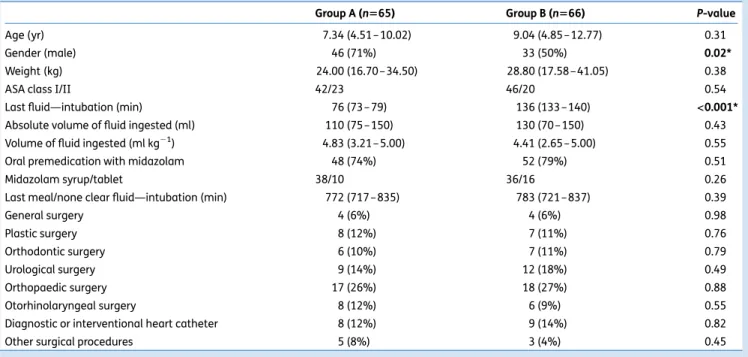
Table 1 Patient characteristic data, characteristics of pre-anaesthetic oral intake, and procedures performed. Group A¼60 and group B¼120 min of clear fluid fasting. Data are median (IQR) or count (%). *Significant with P,0.05
Group A (n565) Group B (n566) P-value
Age (yr) 7.34 (4.51 – 10.02) 9.04 (4.85 –12.77) 0.31
Gender (male) 46 (71%) 33 (50%) 0.02*
Weight (kg) 24.00 (16.70 –34.50) 28.80 (17.58 – 41.05) 0.38
ASA class I/II 42/23 46/20 0.54
Last fluid—intubation (min) 76 (73 –79) 136 (133 –140) <0.001*
Absolute volume of fluid ingested (ml) 110 (75 –150) 130 (70 – 150) 0.43
Volume of fluid ingested (ml kg21) 4.83 (3.21 – 5.00) 4.41 (2.65 –5.00) 0.55
Oral premedication with midazolam 48 (74%) 52 (79%) 0.51
Midazolam syrup/tablet 38/10 36/16 0.26
Last meal/none clear fluid—intubation (min) 772 (717 –835) 783 (721 –837) 0.39
General surgery 4 (6%) 4 (6%) 0.98 Plastic surgery 8 (12%) 7 (11%) 0.76 Orthodontic surgery 6 (10%) 7 (11%) 0.79 Urological surgery 9 (14%) 12 (18%) 0.49 Orthopaedic surgery 17 (26%) 18 (27%) 0.88 Otorhinolaryngeal surgery 8 (12%) 6 (9%) 0.55
Diagnostic or interventional heart catheter 8 (12%) 9 (14%) 0.82
to detect a difference in gastric pH of at least 0.5, with a two-sided significance of a¼0.05 and a power of 80%. Data were recorded using SecuTrialw(InterActive Systems Berlin, Germany,
technical support by Clinical Trial Centre, University Hospital, Zurich), a software that supports ‘good clinical practice’ re-quirements, and monitored by a person not otherwise involved in this trial. Data were analysed using Microsoft Excel 2003 (MicrosoftCorporation,Redmond,WA,USA)andSPSS17.0(SPSS, Inc., Chicago, IL, USA). Spearman-Rho was used to detect cor-relation between non-parametric data. Where not declared otherwise, median and interquartile range (IQR) were used to describe non-parametric and ordinal data. The differences in gastric pH and residual gastric volume between the two groups are shown as mean difference and 95% confidence interval (95% CI). The level of significance was tested with Whitney– Mann U or x2test for categorical data, with P,0.05 considered to be statistically significant.
Results
In total 149 children were enrolled. Of these, 18 patients had to be excluded from analysis for the following reasons: prolonged fasting for clear fluid compared with the prescribed drinking time, including refusal to drink before operation (13 children), violation of minimal fasting time for food or non-clear fluid (3 children), placement of oro-gastric tube not possible (1 child), and amount of clear fluid allowed exceeded by .50% (2 children).
The characteristics of the remaining 131 patients did not significantly differ between groups A and B except for gender and—as intended by the protocol—the clear fluid fasting time (Table1). Anaesthesia technique including mode of induc-tion, midazolam premedicainduc-tion, and application of opioids or prophylactic antiemetics was also similar in both groups.
Absolute gastric sample volumes ranged from zero to a maximum of 91 vs 85 ml [13 (5 –26)/14 (5–21) ml, P¼0.69] in groups A and B, respectively, with gastric pH being analysed in 120 patients (group A¼61, group B¼59). In 11 patients gastric pH could not be measured because the sample volume was ,1 ml. Gastric pH and residual gastric fluid volumes indexed to body weight are presented in Table 2. There was no significant difference between 1 and 2 h of pre-anaesthetic clear fluid fasting for either gastric pH (P¼0.66;
50 75 100 125 150 175 t (min) 4.0 3.5 3.0 2.5 2.0 1.5 1.0 0.5 0.0 GFV w (ml kg –1 )
Group A — 60 min Group B — 120 min
Fig 1Gastric residual volume (GFVw; ml kg-1) vs time (minutes)
between last clear fluid intake and intubation (fluid sampling). Statistical details provided in Table2..
Table 2 Gastric pH and gastric residual volume (GFVw; ml kg21)
between last clear fluid intake and intubation (fluid sampling). Group A¼60 and group B¼120 min of clear fluid fasting. Significant if P,0.05. IQR, interquartile range;SD, standard
deviation; CI, confidence interval. Gastric pH not available in patients with a sample volume of ,1 ml
Gastric pH Group A (n559) Group B (n561) P-value
Median 1.43 1.44 0.66
IQR 1.30 – 1.56 1.29 –1.68
Range 0.51 – 2.20 0.35 –5.93
Mean (SD) 1.44 (0.26) 1.55 (0.68)
CI 1.37 – 1.50 1.37 –1.72
GFVw(ml kg21) Group A (n565) Group B (n566) P-value
Median 0.43 0.46 0.47 IQR 0.21 – 0.84 0.19 –0.78 Range 0.00 – 3.39 0.00 –1.89 Mean (SD) 0.64 (0.63) 0.50 (0.40) CI 0.48 – 0.79 0.40 –0.60 50 75 100 125 150 175 t (min) 6 5 4 3 2 1 0 Gastr ic pH
Group A — 60 min Group B — 120 min
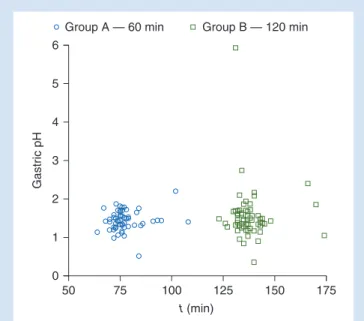
Fig 2 Gastric pH vs time (minutes) between last clear fluid intake and intubation (fluid sampling). Statistical details provided in Table2.
mean difference 0.10, 95% CI 20.30– 0.07) or GFVw(P¼0.47;
mean difference 0.14, 95% CI 20.04– 0.32). The distribution of gastric pH and GFVwvalues in relation to the recorded
inter-vals of fluid fasting is depicted in Figures1and2. The residual gastric fluid volume varied considerably in both groups, with GFVw.1 ml kg21in 13 (20%) and 5 (7.6%) children in groups
A and B, respectively (P¼0.039).
Gastric pH showed very weak but statistical significant negative correlations with age and weight (r¼20.25/P¼ 0.007 and r¼ 20.27/P¼0.003). There was also a very weak but statistical significant correlation between gastric pH and amount of last fluid intake (r¼0.19, P¼0.04) for which fluid fasting (i.e. 60 vs 120 min) seemed to be a moderator (r¼ 0.37/P¼0.003 in group A vs r¼0.068/P¼0.6 for group B). GFVw
did not correlate with age, weight, or amount of last clear fluid intake.
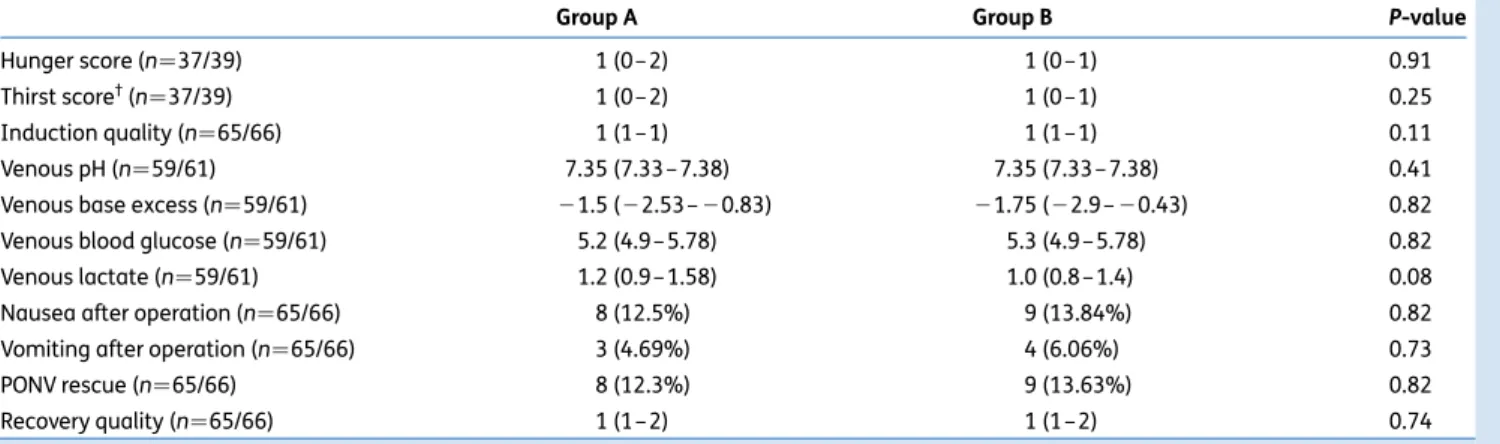
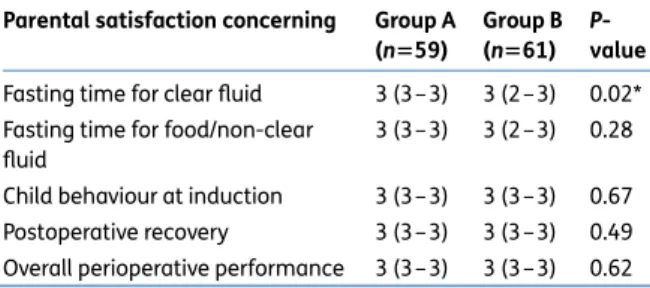
Hunger and thirst at the time of anaesthesia start if evalu-able, blood gas analysis at the time of induction, quality of induction and recovery, and also incidence of postoperative nausea and vomiting were not significantly different between groups A and B, see Table3. Parental satisfaction according to a structured interview was similar between the two groups except for ‘satisfied with fasting time for clear fluid intake’, see Table4.
No child experienced perioperative regurgitation or aspir-ation. Symptoms like dyspnoea, desaturation, or respiratory distress did not occur during recovery.
Discussion
This study compared gastric pH and residual gastric volumes after 1 vs 2 h of pre-anaesthetic clear fluid fasting in children undergoing general anaesthesia. Compared with previous studies investigating different fasting times, this study is the first to investigate a fluid fasting time as short as 1 h. As a main finding, no significant difference was observed for
either gastric pH or residual gastric volume indexed to body weight after 1 vs 2 h of clear fluid fasting. While the 95% CI indi-cates that the gastric pH difference between the groups is smaller than the predefined value of 0.5, and thus certainly clinically irrelevant, the 95% CI of the GFVwdifference may
give rise to controversial discussion. Parents’ satisfaction was greater when fluid fasting was shortened to 1 h.
While many clinical trials have been conducted to consolidate the existing ESA and ASA anaesthesia fasting guidelines2 3 8 (e.g. by comparing 2 h fluid fasting with more conservative concepts), shorter fasting times than currently recommended have, to our knowledge, not yet been investigated in a clinical setting. The Scandinavian recommendation explicitly deals with shorter clear fluid fastening times, allowing up to 150/ 75 ml of water in adults/children, respectively, given with pre-medication 1 h before anaesthesia start.9 So far only data from volunteer children undergoing magnetic resonance imaging have been used to demonstrate that gastric residual volumes decline to the range of overnight fasting baseline values within 1 h after drinking clear fluid.7
Median gastric residual volumes after 1 or 2 h clear fluid fasting in this study were within the range of previously observed values after 2 h fluid fasting, as summarized by Brady and colleagues.8 In comparison, gastric content volumes were slightly higher in children undergoing diagnostic magnetic resonance imaging,4one reason for which may be that fasting times for non-clear fluids and food were shorter than in the actual data. Another possible reason is that gastric fluid sampling via oro-gastric tube may underestimate true gastric volume, despite gastric fluid being aspirated three times in different patient positions. Repetitive aspiration in supine or changing positions has been shown to enable a sam-pling of up to 96 or 97% of gastric fluid volume, respectively,10 11 whereas only 53 or 78% was recovered in other studies.12 13
Gastric pH values tended to be within the lower range of the studies reviewed by Brady and colleagues,8 which used
Table 3Self-reported hunger and thirst, induction quality, blood gas analysis, and patient behaviour in the recovery room.†Ratings defined as
follows: hunger/thirst: 0¼not at all hungry/thirsty; 1¼little hunger/thirst; 2¼hungry/thirsty; 3¼very hungry/thirsty; Induction quality: 1¼satisfied and cooperative; 2¼anxious but cooperative; 3¼reluctant and uncooperative; 4¼crying; 5¼having a tantrum; Recovery: 1¼satisfied and cooperative; 2¼experiencing pain but cooperative; 3¼agitated; 4¼emergence delirium; 5¼emergence delirium requiring droperidol. PONV rescue, postoperative nausea and vomiting requiring rescue medication. Group A¼60 and group B¼120 min of clear fluid fasting. Data are median (IQR) or count (%)
Group A Group B P-value
Hunger score (n¼37/39) 1 (0– 2) 1 (0 –1) 0.91
Thirst score†(n¼37/39) 1 (0– 2) 1 (0 –1) 0.25
Induction quality (n¼65/66) 1 (1– 1) 1 (1 –1) 0.11
Venous pH (n¼59/61) 7.35 (7.33 –7.38) 7.35 (7.33 – 7.38) 0.41
Venous base excess (n¼59/61) 21.5 (22.53 – 20.83) 21.75 (22.9 – 20.43) 0.82
Venous blood glucose (n¼59/61) 5.2 (4.9– 5.78) 5.3 (4.9 –5.78) 0.82
Venous lactate (n¼59/61) 1.2 (0.9– 1.58) 1.0 (0.8 –1.4) 0.08
Nausea after operation (n¼65/66) 8 (12.5%) 9 (13.84%) 0.82
Vomiting after operation (n¼65/66) 3 (4.69%) 4 (6.06%) 0.73
PONV rescue (n¼65/66) 8 (12.3%) 9 (13.63%) 0.82
different pH tests, such as pH paper, pH meter,14–16 Digital ionalyser pH meter,17–19pH radiometer,20or electrode,21the latter also being used for the data presented here. The weak correlation between the amount of fluid drunk and gastric pH in group A suggests that fluid intake may indeed have a positive short-term effect on gastric pH. However, the correlation is very weak, non-existent after 2 h, and, with median gastric pH values similar in group A and B, it thus remains speculative as to whether drinking clear fluid has a dilutional effect on gastric pH.
In this study, a 1 h fluid fast did not reveal relevant ad-vantages concerning hunger and thirst, induction quality, re-covery, and parental satisfaction compared with 2 h of clear fluid fasting. This contrasts with other studies that showed sig-nificant disadvantages of a regimen prescribing ‘nil per os after midnight’ compared with shorter fluid abstinence of 150 and 180 min.22 23As the interval between the two groups in this study differed by only 1 h, thirst may not have had as much impact on children’s behaviour. Furthermore, in the two groups actual fasting times corresponded with those pre-scribed (i.e. they were as short as possible according to group allocation). In clinical practice, such optimal fasting times are difficult to realize and current international recommendations (ESA, ASA) are often considerably exceeded.4–6
Some limitations to this study have to be addressed. Aspir-ation of gastric fluid via oro-gastric tube may underestimate re-sidual gastric volume as mentioned above. In some patients, the amount of gastric juice was not sufficient to measure gastric pH, thus the sample size required was slightly missed (re-ducing calculated power to 78%). As this study included only children classified ASA I or II without gastric disorders and undergoing elective surgery, the results cannot be directly trans-ferred to other populations. Furthermore, the final amount and type of clear fluid intake was controlled but not strictly standar-dized. The outcome parameters gastric pH and residual gastric volume are only surrogate parameters for the risk of pulmonary aspiration, which is in itself not an adequate outcome measure because of its low incidence. This investigation covers a wide paediatric age range, like many similar published studies.8 24–26 Differences in gastric emptying half-life according to age have been observed in preterm vs term infants but have not been inves-tigated for the age groups beyond.27
However, like previous investigations,4 this study clearly demonstrates once again that gastric residual volumes vary substantially in ‘normal’ physiology and an empty stomach cannot always be expected. This implies that a safe and smooth anaesthesia technique to prevent regurgitation by coughing, pressing, bucking movements, or hiccups is just as or even more important in minimizing the risk of pulmonary aspiration. On the other hand, prolonged fasting in the absence of gastrointestinal impairment cannot further reduce gastric volumes or increase safety,4 8but rather leads to unnecessary inconvenience for children and their care-givers and should therefore be avoided. Because, in current clinical practice, the recommended fasting times are often exceeded, a reduction to 1 h for clear fluids would allow the child to drink until hospital admission or even until a ‘stop drinking’ order of the anaesthe-tist in charge of the child is given (‘stop drinking on demand’). Further studies are required to investigate shorter fluid fasting than currently recommended by the ASA or ESA, and future research should also analyse whether such a shortened fasting time can optimize preoperative care in daily practice. Alternative study designs including non-inferiority or equiva-lence studies may be useful to demonstrate that gastric pH and residual gastric volume stay within acceptable limits when the fluid fasting time is reduced.
Conclusion
When 1 vs 2 h of clear fluid fasting in healthy children are com-pared, neither gastric pH nor residual gastric volume show signifi-cant differences. Parental satisfaction may even be improved by a shortened fluid fasting time. The data presented do not provide evidence against fluid fasting shorter than currently recom-mended with respect to safety and comfort aspects, but data from a larger paediatric population are required.
Authors’ contributions
A.R.S.: patient recruitment, clinical execution, data analysis, and interpretation, manuscript writing; P.B.: patient recruit-ment, clinical execution, and manuscript revision; L.S.: patient recruitment, clinical execution, and manuscript revision; T.S.: patient recruitment, clinical execution, and manuscript re-vision; B.B.: patient recruitment, clinical execution, and manu-script revision; T.R.: patient recruitment, clinical execution, and manuscript revision; C.S.: study protocol, clinical organization and assistance, and manuscript revision; R.K.: data analysis and interpretation, and manuscript revision; M.W.: study ception and manuscript revision; A.S.: study idea, study con-ception, study protocol, data analysis and interpretation, and manuscript writing.
Declaration of interest
None declared.
References
1 Schmidt A, Ruland P, Seglias JS, et al. Gastric pH and residual volume after 1 versus 2 hours fasting time for clear fluids in children. Swiss Med Forum 2012; 42: 8S
Table 4 Parental satisfaction as median (IQR). 0¼not at all satisfied; 1¼less satisfied; 2¼satisfied; 3¼very satisfied. Group A¼60 and group B¼120 min of clear fluid fasting. *P,0.05 was considered significant
Parental satisfaction concerning Group A (n559)
Group B (n561)
P-value Fasting time for clear fluid 3 (3– 3) 3 (2 –3) 0.02* Fasting time for food/non-clear
fluid
3 (3– 3) 3 (2 –3) 0.28 Child behaviour at induction 3 (3– 3) 3 (3 –3) 0.67 Postoperative recovery 3 (3– 3) 3 (3 –3) 0.49 Overall perioperative performance 3 (3– 3) 3 (3 –3) 0.62
2 Santhsoh J. Practice guidelines for preoperative fasting and the use of pharmacologic agents to reduce the risk of pulmonary aspiration: application to healthy patients undergoing elective procedures: an updated report by the American Society of Anesthesiologists Com-mittee on Standards and Practice Parameters. Anesthesiology 2011; 114: 495– 511
3 Smith I, Kranke P, Murat I, et al. Perioperative fasting in adults and children: guidelines from the European Society of Anaesthesiology. Eur J Anaesthesiol 2011; 28: 556– 69
4 Schmitz A, Kellenberger CJ, Neuhaus D, et al. Fasting times and gastric contents volume in children undergoing deep propofol sedation—an assessment using magnetic resonance imaging. Paediatr Anaesth 2011; 21: 685– 90
5 Engelhardt T, Wilson G, Horne L, Weiss M, Schmitz A. Are you hungry? Are you thirsty? Fasting times in elective outpatient pediatric patients. Paediatr Anaesth 2011; 21: 964 –8
6 Arun BG, Korula G. Preoperative fasting in children: an audit and its implications in a tertiary care hospital. J Anaesthesiol Clin Pharma-col 2013; 29: 88– 91
7 Schmitz A, Kellenberger CJ, Lochbuehler N, et al. Effect of different quantities of a sugared clear fluid on gastric emptying and residual volume in children: a crossover study using magnetic resonance imaging. Br J Anaesth 2012; 108: 644–7
8 Brady M, Kinn S, Ness V, O’Rourke K, Randhawa N, Stuart P. Preopera-tive fasting for preventing perioperaPreopera-tive complications in children. Cochrane Database Syst Rev 2009; CD005285
9 Soreide E, Eriksson LI, Hirlekar G, et al. Pre-operative fasting guide-lines: an update. Acta Anaesthesiol Scand 2005; 49: 1041–7 10 Cook-Sather SD, Tulloch HV, Liacouras CA, Schreiner MS. Gastric fluid
volume in infants for pyloromyotomy. Can J Anaesth 1997; 44: 278– 83
11 Cook-Sather SD, Liacouras CA, Previte JP, Markakis DA, Schreiner MS. Gastric fluid measurement by blind aspiration in paediatric patients: a gastroscopic evaluation. Can J Anaesth 1997; 44: 168–72 12 Soreide E, Soreide JA, Holst-Larsen H, Steen PA. Studies of
gastric content: comparison of two methods. Br J Anaesth 1993; 70: 360– 2
13 Taylor WJ, Champion MC, Barry AW, Hurtig JB. Measuring gastric contents during general anaesthesia: evaluation of blind gastric as-piration. Can J Anaesth 1989; 36: 51–4
14 Goresky GV, Finley GA, Bissonnette B, Shaffer EA. Efficacy, duration, and absorption of a paediatric oral liquid preparation of ranitidine hydrochloride. Can J Anaesth 1992; 39: 791 –8
15 Maekawa N, Mikawa K, Yaku H, Nishina K, Obara H. Effects of 2-, 4-and 12-hour fasting intervals on preoperative gastric fluid pH 4-and volume, and plasma glucose and lipid homeostasis in children. Acta Anaesthesiol Scand 1993; 37: 783 –7
16 Welborn L, Norden J, Hannallah R, Broadman L, Seiden N. Apple juice ingestion two hours before surgery does not increase blood glucose concentrations in pediatric patients. Can J Anaesth 1993; 39: A97
17 Schreiner MS, Triebwasser A, Keon TP. Ingestion of liquids compared with preoperative fasting in pediatric outpatients. Anesthesiology 1990; 72: 593–7
18 Sandhar BK, Goresky GV, Maltby JR, Shaffer EA. Effect of oral liquids and ranitidine on gastric fluid volume and pH in children undergo-ing outpatient surgery. Anesthesiology 1989; 71: 327– 30 19 Nicolson SC, Dorsey AT, Schreiner MS. Shortened preanesthetic
fasting interval in pediatric cardiac surgical patients. Anesth Anal 1992; 74: 694–7
20 Sarti A, Calamandrei M, Messeri A, Busoni P. Preoperative fasting in pediatrics. Minerva Anestesiol 1991; 57: 1179–80
21 Meakin G, Dingwall AE, Addison GM. Effects of fasting and oral pre-medication on the pH and volume of gastric aspirate in children. Br J Anaesth 1987; 59: 678– 82
22 Splinter WM, Stewart JA, Muir JG. Large volumes of apple juice pre-operatively do not affect gastric pH and volume in children. Can J Anaesth 1990; 37: 36 –9
23 Gombar S, Dureja J, Kiran S, Gombar K, Chhabra B. The effect of pre-operative intake of oral water and ranitidine on gastric fluid volume and pH in children undergoing elective surgery. J Indian Med Assoc 1997; 95: 166–8
24 Jericho H, Adams P, Zhang G, Rychlik K, Saps M. Nausea predicts delayed gastric emptying in children. J Pediatr 2014; 164: 89 –92 25 Knatten CK, Avitsland TL, Medhus AW, et al. Gastric emptying in
chil-dren with gastroesophageal reflux and in healthy chilchil-dren. J Pediatr Surg 2013; 48: 1856–61
26 Spiroglou K, Xinias I, Karatzas N, Karatza E, Arsos G, Panteliadis C. Gastric emptying in children with cerebral palsy and gastroesopha-geal reflux. Pediatr Neurol 2004; 31: 177– 82
27 Bowles A, Keane J, Ernest T, Clapham D, Tuleu C. Specific aspects of gastro-intestinal transit in children for drug delivery design. Int J Pharm 2010; 395: 37– 43
![C-Parameter Distribution at N[superscript 3]LL′ Including Power Corrections](data:image/gif;base64,R0lGODlhAQABAIAAAP///wAAACH5BAEAAAAALAAAAAABAAEAAAICRAEAOw==)