Scaling Blockchains
Doctoral Dissertation submitted to the
Faculty of Informatics of the Università della Svizzera Italiana in partial fulfillment of the requirements for the degree of
Doctor of Philosophy
presented by
Enrique Fynn
under the supervision of
Fernando Pedone
Dissertation Committee
Antonio Carzaniga Università della Svizzera Italiana, Switzerland Marc Langheinrich Università della Svizzera Italiana, Switzerland Alysson Bessani Universidade de Lisboa, Portugal
Zarko Milosevic Informal Systems, Canada
Dissertation accepted on 9 February 2021
Research Advisor PhD Program Director
Fernando Pedone Walter Binder
ted previously, in whole or in part, to qualify for any other academic award; and the content of the thesis is the result of work which has been carried out since the official commencement date of the approved research program.
Enrique Fynn
Lugano, 9 February 2021
If a boat travels without purpose it does not arrive at any port.
Alejandro Jodorowsky
Abstract
Blockchains are a new type of state machine replication that have raised interest-ing challenges. A replicated state machine (RSM) is a well-established approach to building fault-tolerant systems. Because each replica needs to execute the same set of instructions to transition through the same state changes, adding more replicas does not translate directly to an increase in performance. On top of that, RSM can be made to tolerate Byzantine failures, i.e., nodes in the system can have arbitrary behavior. Blockchains distinguish themselves from traditional RSM mainly for having an open membership, being decentralized, and involving economic aspects as a means to counter adversarial attacks. Yet, despite their in-creasing popularity, current blockchain systems scale poorly and are constrained to exist in isolation, unable to communicate with each other.
In this thesis, we explore techniques to make blockchains scale in two an-gles: (a) scaling blockchain transaction throughput; and (b) making the state synchronization faster and robust for incoming peers. For (a), we analyze the effects of partitioning a real blockchain state in several shards and how to mini-mize communication within shards, while keeping the shards balanced. We then propose a protocol that can be applied to increase the throughput of a sharded blockchain or by which blockchains can communicate with each other. For (b), we propose a data structure that can be used by blockchains to enhance scala-bility by easing the synchronization process and allowing the blockchain’s state to be reconstructed without requiring additional trust. The claims in this thesis are sustained by extensive experimental evaluation using real applications from public blockchains, developing new protocols and algorithms, and performing tests in geo-replicated environments.
Acknowledgements
First, I would like to thank Fernando Pedone for his patience, guidance, discus-sions and good advice during all these years of the PhD. I am also grateful to all professors I interacted with during my Teaching Assistance.
I would like to thank the committee members, Antonio Carzaniga, Marc Langhein-rich, Alysson Bessani, and Zarko Milosevic for their patience and feedback, for dedicating their time to read and discuss this thesis with me.
For making the PhD experience more enjoyable and the OpenSpace more tolerable I’d like to thank my colleagues at USI: Theo, Leandro, Pietro, Ioannis, Esteban, Mojtaba, Long, Antti. Also everyone that keeps the university going, from janitors to deans: Thank you.
For endless discussions about branchial space, physics, and climbing, I would like to thank all my friends Leonardo, Álvaro, Vella, Thadeu, Matthieu and An-drea.
I would like to thank the great minds and spirits of Kropotkin, Bakunin, Proudhon, Chomsky, and many other anarchists that prove not only having a high intellect but kindness of heart and love for humanity. One day Earth will be paradise.
For a person whom I have only seen kindness, compassion and goodwill—my grandmother Alice Áurea—I am humbled by her kind spirit and grateful for her unconditional love. I would also like to thank all her children, especially Abigail for our fruitful discussions.
Last, I am eternally grateful for my parents, brother, and sister—Sheila, En-rique, Annie, and Erik—for everything from remote yoga sessions to political discussions.
Contents
Contents ix
List of Figures xiii
List of Tables xv
1 Introduction 1
1.1 Blockchain scalability . . . 2
1.2 Research questions and contributions . . . 3
2 Partitioning a blockchain 5 2.1 Ethereum’s primer . . . 5
2.2 Ethereum’s blockchain graph . . . 7
2.3 Partitioning methods . . . 8
2.4 Results . . . 10
2.5 Final remarks . . . 15
3 A framework and protocol to scale blockchain throughput 17 3.1 Background . . . 17
3.2 Assumptions . . . 18
3.3 Overview . . . 19
3.4 The Move protocol in detail . . . 20
3.4.1 A concrete implementation . . . 21
3.4.2 Preventing replay attacks . . . 22
3.5 Handling currencies . . . 23 3.6 Additional details . . . 24 3.7 Applications . . . 25 3.7.1 Interoperability . . . 25 3.7.2 Sharding . . . 25 3.8 Use cases . . . 26 ix
3.8.1 SCoin . . . 26 3.8.2 ScalableKitties . . . . 28 3.9 Deployment . . . 28 3.10 Sharding experiments . . . 29 3.10.1 ScalableKitties . . . . 30 3.10.2 SCoin . . . 32 3.11 IBC experiments . . . 34 3.12 Related work . . . 36 3.13 Final remarks . . . 38
4 Optimizing state synchronization 39 4.1 Background . . . 39
4.1.1 System overview . . . 41
4.1.2 Merkle trees . . . 42
4.1.3 State synchronization problem . . . 43
4.1.4 IAVL+ . . . 44
4.2 The AVL* chunked tree . . . 45
4.3 Chunks . . . 45 4.3.1 Data structures . . . 46 4.4 Search . . . 47 4.5 Insertion . . . 48 4.6 Deletion . . . 51 4.7 Re-balancing . . . 55 4.8 Multi-versioning . . . 57 4.9 Correctness . . . 57
4.10 Robust and fast state synchronization . . . 57
4.10.1 Correctness . . . 59 4.11 Micro-benchmarks evaluation . . . 61 4.11.1 State synchronization . . . 62 4.11.2 Validation time . . . 64 4.11.3 Tree construction . . . 66 4.11.4 Space efficiency . . . 67
4.12 Evaluation in a real scenario . . . 70
4.12.1 Environment and application . . . 70
4.12.2 Steady-state operation . . . 71
4.12.3 State synchronization . . . 78
4.12.4 Comparison with micro-benchmarks . . . 79
4.12.5 State synchronization with malicious peers . . . 80
xi Contents
4.14 Conclusion . . . 83
5 Conclusion 85
5.1 Future work . . . 86
Figures
2.1 Ethereum graph evolution in number of vertices (accounts and
smart contracts) and edges (transactions). . . 6
2.2 Subgraph with accounts (full line nodes), contracts (dashed line nodes), and their dependencies (arrows). . . 7
2.3 Dynamic edge cut and balance of (a) hashing and (b) METIS when Ethereum is partitioned in two shards. . . 10
2.4 Dynamic edge cut and balance of (a) R-METIS and (b) TR-METIS when Ethereum is partitioned in two shards. . . 11
2.5 The dynamic edge cut and balance of Kernighan-Lin when Ethereum is partitioned in two shards. . . 12
2.6 Box-and-whisker with violin plot (density plot) for five partition-ing methods uspartition-ing Ethereum transactions in 2017 (whiskers show minimum and maximum values, bottom and top of the box show first and third quartiles, and the band inside the box shows the median). . . 13
2.7 Dynamic edge-cut, dynamic balance and total number of moves of various techniques with increasing number of shards. . . 15
3.1 Merkle-proof example, h0, h3 ∈ ({v} 7→ m). . . 19
3.2 Excerpt of a movable contract in Solidity. . . 22
3.3 Preventing replay on stale data. . . 23
3.4 Move operation example. . . 24
3.5 Dependency graph example. . . 30
3.6 ScalableKitties throughput for 2, 4 and 8 shards (left), and aggre-gated throughput over time for 8 shards (right). . . 31
3.7 Performance with varying number of shards and different cross-shard transaction rates. . . 31
3.8 Latency CDF for 4 shards experiment with 10% cross-shard trans-actions. . . 33
3.9 Latency for five different inter-blockchain applications. . . 34
3.10 Gas and monetary costs for five different inter-blockchain appli-cations. . . 35
4.1 Overview of Tendermint architecture. . . 43
4.2 Insertion and rotations in AVL* (white square: inner node; white circle: leaf; gray rectangle: chunk; bold square/leaf: chunk root). (a) a balanced AVL tree, (b) an imbalanced AVL tree after the insertion of 25, (c) an imbalanced AVL tree after right rotation of previous tree at inner node 30, (d) a balanced AVL tree after left rotation of previous tree at pivot (inner node 20). . . 45
4.3 Time to serialize, transfer and recreate tree. . . 63
4.4 Time to serialize the whole tree on sender side. . . 64
4.5 Validation time. . . 65
4.6 Time to create a new tree, element by element. . . 66
4.7 Space efficiency (1 is optimum). . . 68
4.8 Space efficiency with varying number of entries inserted in ran-dom order, with 8KB chunks/cells. . . 69
4.9 Space efficiency with varying number of entries inserted in order, with 8KB chunks/cells. . . 70
4.10 Throughput and latency of transaction execution, 10 peers, 1M key/value pairs, and 10k chunk size. . . 72
4.11 Throughput and latency of transaction execution, 10 peers, 1M key/value pairs, and 100k chunk size. . . 73
4.12 Throughput and latency of transaction execution, 80 peers, 1M key/value pairs, and 10k chunk size. . . 74
4.13 Throughput and latency of transaction execution, 80 peers, 1M key/value pairs, and 100k chunk size. . . 75
4.14 Time for an IAVL+ snapshot. . . 77
4.15 Space efficiency for the AVL*. . . 77
4.16 Time for a peer to recover from scratch, 100k chunks, 10 peers, varying number of key/value pairs. . . 78
4.17 Time for a peer to recover from scratch, 100k chunks, 80 peers, varying number of key/value pairs. . . 79
4.18 Time for state synchronization. . . 81
Tables
4.1 The data structures used in the AVL*. . . 47 4.2 Throughput and latency (average and standard deviation) for IAVL+
and AVL* in different configurations. . . 76
Chapter 1
Introduction
Blockchain has gained much attention since the introduction of Bitcoin[55], and several blockchain systems have been developed thereafter [17]. Initially seen with skepticism by the academic community, blockchain revamped the interest in consensus research.
Blockchains distinguish themselves from traditional State Machine Replica-tion (SMR) [52, 62] by having an open membership, i.e., anyone can join the protocol to secure the network. Blockchains are separated in two main cate-gories: permissioned and permissionless. In a permissionless blockchain system, such as Bitcoin or Ethereum [16], blocks are produced by miners. Each block of a blockchain is cryptographically linked to the previous one (block’s parent), forming a chain. To produce a valid block, miners must solve a cryptographic puzzle, a process called Proof-of-Work (PoW). It can happen that miners simul-taneously publish their blocks pointing at the same parent, creating a fork. Peers follow an heuristic to decide the correct path of history by greedily choosing the chain that has more work done (heaviest chain). A clear incentive exists to solve the fork as soon as possible so that miners in the canonical blockchain history get their rewards. This incentive makes miners work on top of the chain they be-lieve is the winner as soon as they see a fork, thus making the probability of forks exponentially smaller over time [55]. Attacking a permissionless blockchain is proportional to the amount of work miners did in the blockchain, since attackers need to recreate all cryptographic puzzles from the attack point onwards. Natu-rally, a miner who owns more than 50% of the hash power is able to attack the system by controlling the produced blocks, but even miners who own less than 50% are able to get more incentives than their contributed hash power[32].
In a permissioned blockchain system miners are in a consortium where they behave similarly to members of traditional Byzantine Fault Tolerant (BFT)
rithms such as PBFT[19], in which case they are named validators. Permissioned blockchain usually use a Proof-of-Stake (PoS), which aims to provide a decen-tralized solution for consensus while still maintaining an open membership as in PoW. Validators lock some currency (stake) that is fungible in the underly-ing protocol’s blockchain. If a member misbehaves or is offline durunderly-ing steps in the protocol it loses a portion of the stake (e.g., Cosmos [51], Ouroboros [49], Polkadot[72]) or the validator does not get the rewards (e.g., [6]).
In hindsight, moving away from PoW is a good idea since in 2019 alone it was estimated that only Bitcoin consumed 59 TWh [10], equivalent to the en-ergy consumption of some countries. But there are clear tradeoffs when moving from permissionless and permissioned blockchains. For instance, permissioned blockchains require more trust than permissionless ones. In particular, they face a fundamental problem [14] where it is not possible for an arriving client to differentiate between the valid chain or a fork of the same blockchain.
1.1
Blockchain scalability
Blockchain scalability has many forms, for instance Bitcoin and PoW systems in general scale exceptionally well with the numbers of miners when considering the system security: the more miners there are, the more secure the network becomes. However, systems that use PoW consensus algorithms do not scale well in terms of performance throughput. For instance, one of the problems of PoW systems is that the execution is coupled with the consensus algorithm which makes miners not able to decide on an ordering of transactions before executing them.
Different blockchains provide different means for scalability. For example micro-transactions have different requirements than transactions involving large sums of currency, but blockchain systems such as Bitcoin treat both transactions with the same level of security guarantees. Having different blockchains allows for specialized blockchains crafted for different use cases. A way for communi-cating among blockchains is crucial for scaling blockchains in this direction.
As blockchain technology reaches mainstream use, it starts to face issues typi-cal of more mature distributed systems technologies. Two formidable challenges to improve blockchain performance are sharding and interoperability. Several at-tempts have been made to improve blockchain performance (e.g.,[49, 50, 73]). In general, distributed systems scale performance by sharding the application state[25]. If the partitioning is such that most application requests can be exe-cuted within a single partition, and the load among partitions is balanced, then
3 1.2 Research questions and contributions
performance scales with the number of partitions. Unfortunately, few applica-tions can be optimally partitioned (i.e., all requests fall within a single partition and load is balanced among partitions). As a result, most partitioned systems must handle requests that span multiple partitions. In the particular case of blockchain, it has been shown that even with a nearly perfect partitioning of the data, existing workloads would result in a substantial number of cross-partition. This aspect is discussed in Chapter 2.
The Achilles heel of scalable blockchain systems is their ability to handle cross-blockchain transactions. Interoperability has been in the blockchain wish-list for some time. Yet, to date, no general mechanism has been proposed to share information across different blockchains. Inter Blockchain Communication (IBC) is necessary for multiple blockchains to co-exist in a heterogeneous way.
Another aspect of scalability is the ability of the network to on-board new peers, a crucial component for blockchains to remain decentralized. For instance, several Bitcoin forks were made for diverging opinions on how to handle this aspect of scalability [29]. When a new peer joining the network has to either download the state or re-execute all state transitions that led to the final system’s state, peers often choose the former option since it is more efficient in most cases for long-running blockchains. If the state synchronization is costly, fewer peers will participate in the protocol and the system becomes more centralized.
1.2
Research questions and contributions
This thesis identifies and addresses problems related to blockchain scalability and answers the following questions on how blockchain scalability can be improved:
• Can blockchain systems scale performance through sharding? • How can blockchains scale with Inter Blockchain Communication? • How to design scalable applications that can live in many blockchains? • How to improve scalability with fast blockchain synchronization?
In Chapter 2, we answer the first question by observing how a popular block-chain behaves when sharded. For blockblock-chains to interact with each other, some form of synchronization is required across blockchains. There are two main classes of solutions to handle transactions that involve multiple blockchains: (a) coordinating the blockchains involved in the execution of the transaction,
in a scheme akin to atomic commitment [39, 53]; and (b) moving the state re-quired by the transaction to a single target blockchain and then executing the transaction locally at the target blockchain. In Chapter 3, we claim that we can use sharding and interoperability to increase blockchain performance with a proposed framework and protocol. We substantiate the claim with a com-mon mechanism that can be used for both a sharded blockchain and IBC: a move operationthat allows accounts and arbitrary computation (i.e., smart contracts) to consistently migrate from one blockchain to another.
Finally, we explore a different form of scalability to answer the last question of this thesis. In Chapter 4, we design a data structure and protocols and claim we can speed up state synchronization while tolerating byzantine behavior and preserving original systems guarantees.
Chapter 2
Partitioning a blockchain
In this chapter we investigate the performance implications of partitioning a blockchain state. We use Ethereum [16] as an example of blockchain to be partitioned. We briefly describe Ethereum, explain how to build a graph with information gathered by interactions with the blockchain’s state, and detail the partitioning methods used in the study.
2.1
Ethereum’s primer
Ethereum was the first general-purpose blockchain conceived. Users interact with Ethereum’s blockchain by sending a transaction from a user account. Trans-actions might transfer ether, Ethereum’s underlying currency, to another account or activate a smart contract. When transferring currency from an account to an-other, Ethereum works similarly to Bitcoin. But the ability to execute arbitrary code in the form of contracts grants Ethereum much more flexibility than Bitcoin. A smart contract can read and modify internal storage (i.e., a database map-ping 32-byte keys to 32-byte values), transfer currency to one or more accounts, and trigger the execution of other contracts. Contracts are written in Ethereum-specific binary format and executed by the Ethereum Virtual Machine (EVM), a 256-bit stack-based virtual machine. Contracts can be created and destroyed by other contracts or accounts. After the contract is created, it resides in the blockchain. The initial contract state can be set by using an initialization code that is only executed in the contract’s creation and remains unaltered until the contract’s destruction.
At the beginning of a transaction, users have to define the maximum ether they are willing to pay for the execution of their transaction (specified in gas and gas price). Determining the actual cost of a transaction is not obvious. In fact,
there is no way to tell whether a contract will end or not, since this problem is reducible to the halting problem, which is undecidable[21]. Users can estimate the cost of a transaction from the transaction’s instructions and the cost of each instruction.
Miners include transactions in a block based on their estimates of the trans-action cost and the amount the user is willing to pay for the transtrans-action. When a block is included in the blockchain, the miner that proposed the block receives fees paid by each transaction in the native blockchain currency. The scheme is slightly more complex, for example, to cover cases in which transactions fail or run out of gas, but these aspects are not important in the context of our study.
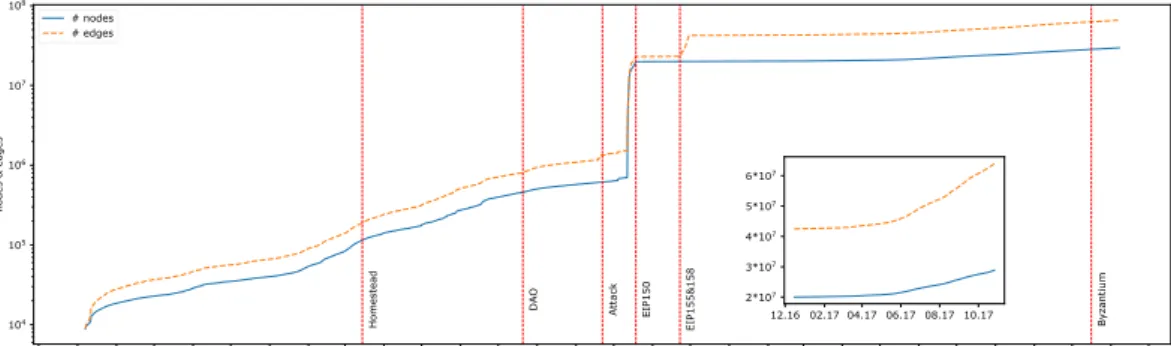
Ethereum has experienced a rapid growth since its inception. Moreover, Ethereum’s consensus rules have been revised (i.e., forked) many times. In Fig. 2.1, we can see the system growth in number of vertices (accounts and smart con-tracts) and edges (transactions). Each vertical dashed line in Fig. 2.1 shows a fork of the system due to the bloat attack [11], an attack that exploited Ethereum’s vulnerabilities (i.e., the attack exploited mispriced operations in the EVM). Dur-ing the attack period, the number of vertices and edges increased by one order of magnitude. Afterwards the system continued to grow quickly, although at a lower pace than prior to the attack. A solution to reduce the significant state growth after the attack was done, eliminating empty accounts. We chose not to show the reduced state after the solution was implemented in the figure.
07.15 08.15 09.15 10.15 11.15 12.15 01.16 02.16 03.16 04.16 05.16 06.16 07.16 08.16 09.16 10.16 11.16 12.16 01.17 02.17 03.17 04.17 05.17 06.17 07.17 08.17 09.17 10.17 11.17 12.17 date: Month.Year 104 105 106 107 108
nodes & edges
Homestead DAO Attack EIP150 EIP155&158 Byzantium
# nodes # edges 12.16 02.17 04.17 06.17 08.17 10.17 2*107 3*107 4*107 5*107 6*107
Figure 2.1. Ethereum graph evolution in number of vertices (accounts and smart contracts) and edges (transactions).
7 2.2 Ethereum’s blockchain graph
2.2
Ethereum’s blockchain graph
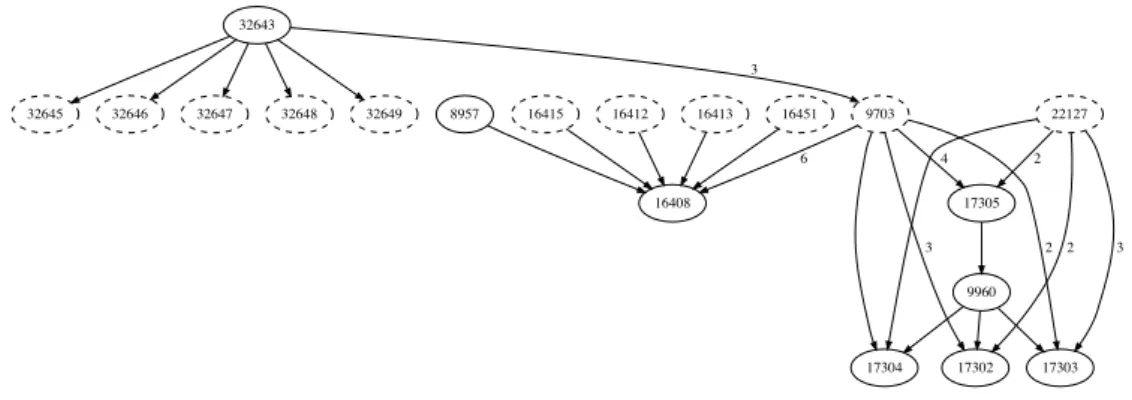
We build a directed graph based on the transactions in Ethereum from July 2015 to December 2017. In the graph, vertices represent accounts or contracts, and edges represent interactions involving accounts or contracts. All the following cases lead to an edge e from vertex v1 to vertex v2 in the graph: a user with account v1 submits a transaction that transfers some currency to account v2 or that activates contract v2; contract v1 transfers ether to account v2 or activates contract v2. 32643 32645 32646 32647 32648 32649 9703 3 16408 6 17302 3 17303 2 17304 17305 4 9960 22127 2 3 2 16451 8957 16415 16412 16413
Figure 2.2. Subgraph with accounts (full line nodes), contracts (dashed line nodes), and their dependencies (arrows).
Fig. 2.2 shows a subgraph of the Ethereum graph in September 2015. Full-line nodes represent accounts and dashed-Full-line nodes represent contracts. Edges originating in accounts are single transactions, edges originating in contracts can perform different calls in the same transaction, both to accounts and other contracts. The weight in each edge denotes the number of times edges were formed – when no weight is specified, the interaction happened once. For ex-ample, contract 9703 was called 16 times in the subgraph, 3 times with account 32643. As a result of these calls, the contract transferred ether to other accounts, for instance, it transferred ether to account 17305 four times. Notice that in the complete graph, there is no contract without at least one incoming edge, omitted in this graph for simplicity.
2.3
Partitioning methods
We formulate the problem of graph partitioning as follows: Given a graph G = (V, E) and a number of partitions k, a partition pi with 1≤ i ≤ k is a subset of V
such thatS pi = V and T pi = ;. That is, the graph is partitioned in k partitions and partitions are disjunct.
The problem of balanced graph partitioning is NP-Complete[34] and despite being studied for long (e.g., VLSI designs[46]), there are several ways to define what constitutes a good partitioning. Intuitively, a good partitioning is defined as one that minimizes the edges connecting two partitions (edge-cut) while main-taining each partition balanced.
More formally, let C(pi) be the set of edges that connect vertices in pi with vertices in V \ pi.
ed g e-cut= Pk
i=1|C(pi)|
|E| (2.1)
bal ance= ma x1≤i≤k(|C(pi)|) × k
|V | (2.2)
From Eq. 2.1 we get the edge-cut percentage and from Eq. 2.2, the relation between the most unbalanced partition and the others. For example, if k = 2 and ed g e-cut and bal ance are, respectively, 0.2 and 1.3, then 20% of the edges are across partitions and one partition has 30% more vertices than the average. Ideally, ed g e-cut is 0 and bal ance is 1.
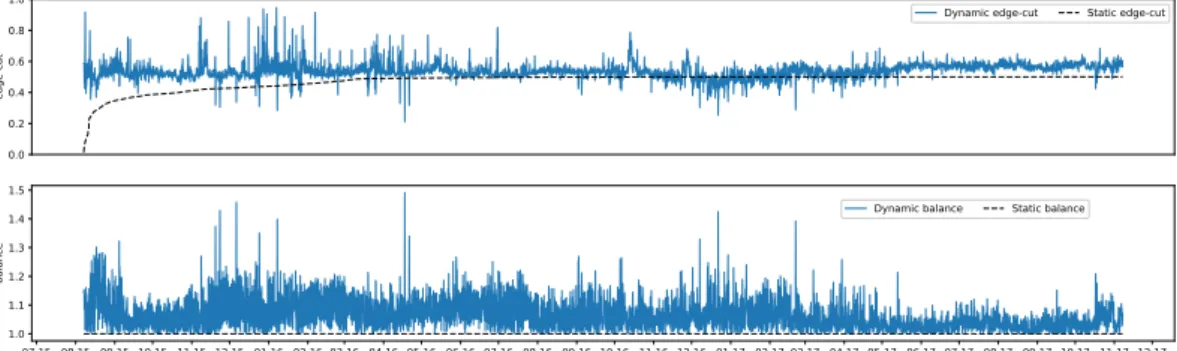
With Eqs. 2.1 and 2.2, only static aspects of the graph are taken into account. We can enrich the graph by assigning weights to vertices and edges to capture the frequency that accounts, contracts, and their interactions appear in the block-chain. By assigning weights to the edges, we can try to avoid cutting frequently used edges; by assigning weights to the vertices, we can better balance the load in the system. We refer to Eqs. 2.1 and 2.2 of a weighted graph as dynamic edge cut and dynamic balance, respectively. The dynamic edge cut and dynamic balance give us a more accurate view of the system’s executed cross-shard transactions and load.
In the following we describe the five partitioning methods we used to parti-tion Ethereum blockchain graph.
• Hashing. A straightforward way to partition the graph is to hash the vertex unique identifier and use the result (modulo the total number of shards k) to determine the shard the vertex belongs to. This is a common scheme to
9 2.3 Partitioning methods
shard data. Moreover, if the hash distribution is uniform, we can hope to obtain an optimum static balance among shards. The edge cut (number of multi-shard transactions), however, tends to increase with the number of shards. For instance, when k = 8 in our experiments, multi-shard trans-actions account for 88% of the total, despite the vertices being perfectly distributed.
• Kernighan-Lin algorithm [48]. In this method, we periodically partition the system based on the transactions executed at each period. The system starts in some partitioned state (e.g., computed using hashing). Each shard identifies vertices that if moved to other shards would minimize edge-cuts based on the transactions executed in each period. Each shard sends to an oracle the selected vertices and with the information from all shards the oracle computes a k× k probability matrix. The oracle calculates the probability that each shard should move its selected vertices to the other shards so that at the end shards remain balanced. The oracle then sends the matrix to all the shards, which exchange vertices with each other based on the probability matrix. Intuitively, the algorithm tries to reduce dynamic edge-cuts while keeping the shards dynamically balanced. This approach has been used to partition large graphs[59].
• METIS. In this method, we periodically partition the graph with METIS[47]. To do so, we input METIS with the current graph (i.e., up to the moment of partitioning) and shard vertices based on METIS output. We configured METIS to minimize edge-cuts while keeping shards balanced. We aim to reduce dynamic edge-cuts by assigning weights to the edges of the graph. When an account (or contract) appears for the first time (or is created), it has to be assigned to some shard. This is done by inspecting all the ac-counts involved in the transaction and picking the shard that minimizes edge-cuts; if more than one exists, we maximize the balance. There is a subtle problem with this approach, as every time the graph is partitioned METIS can move vertices back and forth between shards, since it is not part of METIS objectives to minimize the number or vertices that change shard between successive executions of the algorithm.
• R-METIS. While using the technique above with large graphs we realized that METIS sometimes does not produce good results due to the increas-ingly large size of the graph. We therefore revisit the previous technique by using as input for METIS a reduced graph. This graph contains all ac-counts, contracts, and their interactions within a fixed window of time (two
weeks), which starts at the last (re)partitioning.
• TR-METIS. This is essentially the method above where instead of triggering a repartition at constant time intervals, we set a threshold on the dynamic edge-cut and dynamic balance. When the threshold is reached, we run METIS to compute a new partitioning, which will hopefully reduce the number of transactions across shards. The motivation for the technique is to reduce unnecessary repartitioning.
2.4
Results
We assessed the five partitioning methods described in the previous section in configurations with 2, 4 and 8 shards. In each case, we computed the following metrics: static and dynamic edge-cut and balance and the number of vertices that change shard after the graph is repartitioned (i.e., number of moves).
0.0 0.2 0.4 0.6 0.8 1.0 edge-cut
Dynamic edge-cut Static edge-cut
07.15 08.15 09.15 10.15 11.15 12.15 01.16 02.16 03.16 04.16 05.16 06.16 07.16 08.16 09.16 10.16 11.16 12.16 01.17 02.17 03.17 04.17 05.17 06.17 07.17 08.17 09.17 10.17 11.17 12.17 date: Month.Year 1.0 1.1 1.2 1.3 1.4 1.5 balance
Dynamic balance Static balance
(a) Hashing 0.0 0.2 0.4 0.6 0.8 1.0 edge-cut
Dynamic edge-cut Static edge-cut
07.15 08.15 09.15 10.15 11.15 12.15 01.16 02.16 03.16 04.16 05.16 06.16 07.16 08.16 09.16 10.16 11.16 12.16 01.17 02.17 03.17 04.17 05.17 06.17 07.17 08.17 09.17 10.17 11.17 12.17 date: Month.Year 1.0 1.2 1.4 1.6 1.8 2.0 balance
Dynamic balance Static balance
(b) METIS
Figure 2.3. Dynamic edge cut and balance of (a) hashing and (b) METIS when Ethereum is partitioned in two shards.
11 2.4 Results
Figure 2.3 shows the results for hashing and METIS with two shards. Each data point corresponds to a four-hour window. Repartitioning takes place every two weeks in case of a periodic repartitioning, marked by vertical dashed lines in Figure 2.3(b). Hashing provides optimum static balance since each shard is assigned an equal number of vertices. This does not mean, however, that the load experienced by the shards is the same (see dynamic balance). With respect to static edge-cuts, with two shards hashing leads to about 50% of transactions across shards. METIS provides a much lower edge-cut, both static and dynamic, at the expense of dynamic imbalance among shards. Notice that dynamic balance is near two. This happens because vertices in one shard are much more “active” than vertices in the other shard, even though both shards contain similar number of vertices. The effect is particularly visible after the September 2016 attack, when a large number of dummy accounts were created.
0.0 0.2 0.4 0.6 0.8 1.0 edge-cut
Dynamic edge-cut Static edge-cut
07.15 08.15 09.15 10.15 11.15 12.15 01.16 02.16 03.16 04.16 05.16 06.16 07.16 08.16 09.16 10.16 11.16 12.16 01.17 02.17 03.17 04.17 05.17 06.17 07.17 08.17 09.17 10.17 11.17 12.17 date: Month.Year 1.0 1.2 1.4 1.6 1.8 2.0 balance
Dynamic balance Static balance
(a) R-METIS 0.0 0.2 0.4 0.6 0.8 1.0 edge-cut
Dynamic edge-cut Static edge-cut
07.15 08.15 09.15 10.15 11.15 12.15 01.16 02.16 03.16 04.16 05.16 06.16 07.16 08.16 09.16 10.16 11.16 12.16 01.17 02.17 03.17 04.17 05.17 06.17 07.17 08.17 09.17 10.17 11.17 12.17 date: Month.Year 1.0 1.2 1.4 1.6 1.8 2.0 balance
Dynamic balance Static balance
(b) TR-METIS
Figure 2.4. Dynamic edge cut and balance of (a) R-METIS and (b) TR-METIS when Ethereum is partitioned in two shards.
and TR-METIS partitioning schemes. R-METIS achieves a better result over time when compared to METIS since it considers only a portion of the total graph, making the problem easier for METIS and at the same time forgetting about un-used portions of the graph. We observe that periodic repartitionings do not alter the outcome of the sharding significatively. TR-METIS provides a comparable outcome to R-METIS but having less repartitioning and thus less objects moving across shards. 0.0 0.2 0.4 0.6 0.8 1.0 edge-cut
Dynamic edge-cut Static edge-cut
07.15 08.15 09.15 10.15 11.15 12.15 01.16 02.16 03.16 04.16 05.16 06.16 07.16 08.16 09.16 10.16 11.16 12.16 01.17 02.17 03.17 04.17 05.17 06.17 07.17 08.17 09.17 10.17 11.17 12.17 date: Month.Year 1.0 1.2 1.4 1.6 1.8 balance
Dynamic balance Static balance
Figure 2.5. The dynamic edge cut and balance of Kernighan-Lin when Ethereum is partitioned in two shards.
In Figure 2.5 we see how the Kernighan-Lin method for partitioning the Ethereum graph performs over time. Since vertices can only swap places with other vertices, the graph remains balanced throughout the experiment. Dif-ferently from the METIS algorithms, the Kernighan-Lin method could be done in a distributed setup and does not need a centralized component to function. Furthermore, observe that the same optimization heuristics done for TR-METIS could be done for this experiment.
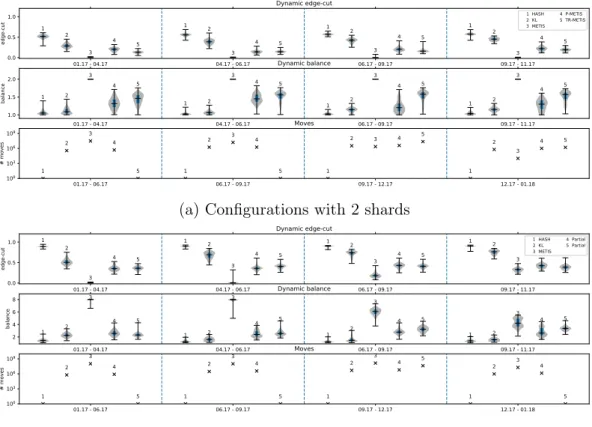
13 2.4 Results 01.17 - 04.17 04.17 - 06.17 06.17 - 09.17 09.17 - 11.17 0.0 0.5 1.0 edge-cut 1 2 3 4 5 1 2 3 4 5 1 2 3 4 5 1 2 3 4 5 Dynamic edge-cut 1 HASH 2 KL 3 METIS 4 P-METIS 5 TR-METIS 01.17 - 04.17 04.17 - 06.17 06.17 - 09.17 09.17 - 11.17 1.0 1.5 2.0 balance 1 2 3 4 5 1 2 3 4 5 1 2 3 4 5 1 2 3 4 5 Dynamic balance 01.17 - 06.17 06.17 - 09.17 09.17 - 12.17 12.17 - 01.18 100 103 106 109 # moves 1 2 3 4 5 1 2 3 4 5 1 2 3 4 5 1 2 3 4 5 Moves
(a) Configurations with 2 shards
01.17 - 04.17 04.17 - 06.17 06.17 - 09.17 09.17 - 11.17 0.0 0.5 1.0 edge-cut 1 2 3 4 5 1 2 3 4 5 1 2 3 4 5 1 2 3 4 5 Dynamic edge-cut 1 HASH 2 KL 3 METIS 4 Partial 5 Partial 01.17 - 04.17 04.17 - 06.17 06.17 - 09.17 09.17 - 11.17 2 4 6 8 balance 1 2 3 4 5 1 2 3 4 5 1 2 3 4 5 1 2 3 4 5 Dynamic balance 01.17 - 06.17 06.17 - 09.17 09.17 - 12.17 12.17 - 01.18 100 103 106 109 # moves 1 2 3 4 5 1 2 3 4 5 1 2 3 4 5 1 2 3 4 5 Moves
(b) Configurations with 8 shards
Figure 2.6. Box-and-whisker with violin plot (density plot) for five partitioning methods using Ethereum transactions in 2017 (whiskers show minimum and maximum values, bottom and top of the box show first and third quartiles, and the band inside the box shows the median).
Fig. 2.6 shows results for the five partition methods in configurations with 2 and 8 shards, using transactions executed in 2017, which represents the bulk of transactions in Ethereum. We show dynamic edge-cut, dynamic balance, and total number of moves in the period.
We draw the following conclusions from these results.
• There is a clear compromise between edge-cut and balance, and no tech-nique clearly stands out. This suggests that based on the workload at the time of writing, it is unlikely that Ethereum can be partitioned in such a way as to produce both low edge-cut and good balance among shards.
• Within a configuration (i.e., 2 or 8 shards), the behavior of the various partition methods does not change substantially over time, although it does
change from one configuration to the other. We take a closer look at this aspect at the end of this section.
• Hashing leads to a fair dynamic balance among shards, albeit at the cost of a large number of dynamic edge-cuts. Interestingly, hashing does not outperform KL with respect to dynamic balance, but performs consistently worse than all other techniques for dynamic edge-cuts. There are no moves since partitioning depends on vertex id only and once assigned to a shard a vertex remains in the assigned shard.
• KL reduces dynamic edge-cuts while maintaining shards balanced. The var-ious iterations of the technique lead to a large number of vertices changing shards. One pitfall of this method is that partitioning optimizes for a local minima.
• METIS trades balance for edge-cuts. However, as previously discussed, this is mostly an anomaly that resulted from the October 2016 attack, when a large number of dummy accounts were created and never used again. Although METIS statically balances the graph, one shard contains most meaningful accounts and transactions execute in a single shard.
• R-METIS considers just the subgraph formed after a repartitioning. This helps ignore vertices created and never used again. Vertices only used once create an artificial balance among shards. With this technique we managed to get a lower dynamic balance. This technique resulted in a more dynam-ically balanced system.
• TR-METIS improves on the previous technique by reducing the number of vertices moved across shards. This essentially happens because we trigger a repartitioning based on edge-cut and balance values. We adjust thresh-olds to trigger a repartitioning in such a way that the performance does not diverge much from the previous technique. The result is a dramatic decrease in the number of moved vertices, without compromising edge-cuts and balance, when compared to R-METIS.
Note that reducing the number of accounts and contracts that change shards after a repartitioning of the system is important for performance. If we were to move one vertex from one shard to another, we ought to move the entire state of the vertex. If the vertex is a contract, that would result in moving the entire contract storage to another shard.
15 2.5 Final remarks 0.00 0.25 0.50 0.75 1.00 Dynamic edge-cut 2 partitions 4 partitions 8 partitions 0.0 0.5 1.0 Dynamic balance
Hashing KL METIS P-METIS TR-METIS 107
109
Moves
Figure 2.7. Dynamic edge-cut, dynamic balance and total number of moves of various techniques with increasing number of shards.
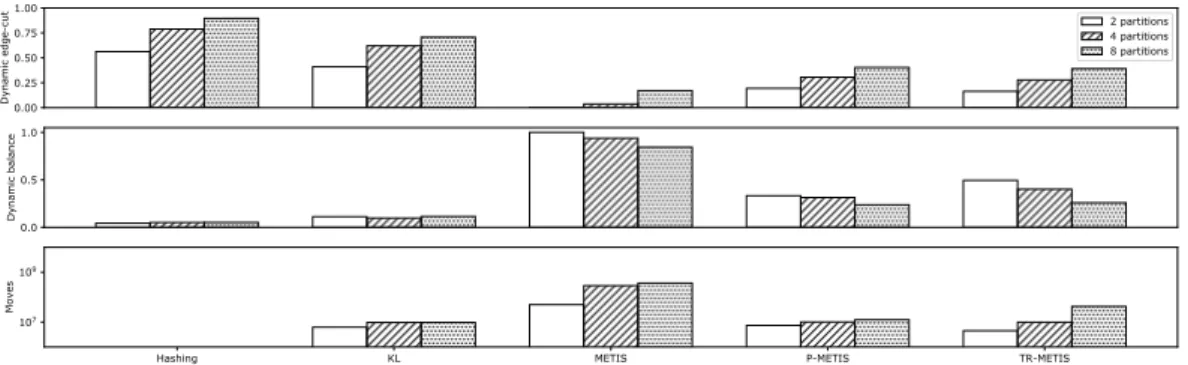
Fig 2.7 compares partitioning techniques with respect to dynamic edge-cut and balance and total number of moved vertices while varying the number of shards. In these executions we used data from the beginning of Ethereum up to the end of 2017. In order to show balance for different configurations in the same graph we normalized the results with the number of shards
(i.e., balance value− 1/number of shards − 1). As before, low values mean better balanced shards.
In all techniques, dynamic edge-cut becomes worse as the number of shards increases (top graph), although METIS-based techniques outperform hashing and KL. With respect to dynamic balance, Hashing and KL perform better than techniques based on METIS. Hashing and METIS, however, take extreme ends in the balance versus edge-cut tradeoff. The number of moves is large in the METIS algorithm, since the partitioner algorithm does not optimize for this as-pect. R-METIS and TR-METIS techniques perform substantially fewer moves be-cause they use a smaller graph.
2.5
Final remarks
This study sheds some light on what one could expect from sharding Ethereum. The results show that even with fairly sophisticated partitioning methods, there is a clear tradeoff between edge-cuts and balance. This is important since scalable performance requires low edge-cut and balanced partitioning.
The results come with some caveats. We assess Ethereum using the real work-load, which was not created for a sharded system. It is possible that if Ethereum is ever extended with the ability to handle sharding then applications will be de-signed in a different way. If sharding is made visible to developers, then
multi-shard operations could be sometimes avoided, at the expense of more complex applications.
When sharding a blockchain, multiple incentives have to be taken into ac-count. In case of a generic framework such as Ethereum, there are three main components that need to be addressed: computation, storage and bandwidth[20]. All of these components play an important role in partitioning. For instance, mov-ing state indiscriminately will have both an impact in the bandwidth and storage of the system. Designing the correct incentives is crucial to a good partitioning scheme.
In our analysis we considered accounts to be sharded, but a simple technique to split one’s account in different shards could help improve the number of cut edges. Alternatively, one could move all involved contracts of a transaction to a single shard and execute the transaction on that shard. A method for moving smart contracts is necessary for this operation to work. Furthermore, contracts can use the same operation to adapt to changes in the workload. We develop these concepts and ideas in the next chapter.
Chapter 3
A framework and protocol to scale
blockchain throughput
In this chapter, we propose a new method to scale blockchains by providing a primitive operation to enable sharded blockchains to communicate or communi-cation from different blockchains, often called Inter-Blockchain Communicommuni-cation (IBC). We provide a framework in which blockchains can communicate. We tar-get blockchains that hold state within smart contracts and provide a way to move a smart contract from one blockchain to another.
Our framework and protocol allow smart contracts to migrate to different blockchains or shards by using a move operation. In our framework, smart tract developers have a great deal of flexibility and can define policies for con-tract’s movements. Flexibility is achieved by reducing transparency – exposing information about other shards or blockchains. To exemplify how smart contracts could be developed using our framework, we modify two popular blockchain ap-plications in Ethereum and show how their throughout can scale.
In the following, we provide the background needed to understand the posed framework (Section 3.1), state the assumptions needed to support the pro-posed protocol (Section 3.2), introduce the general idea (Section 3.3), present the protocol operation in detail (Section 3.4), and discuss extensions to the basic protocol proposed in this chapter (Section 3.5).
3.1
Background
Blockchains can grow large in size and complexity. For instance, Ethereum has over three terabytes of log at the time of this writing and it can take several weeks to re-execute all appended transactions. Clients with low storage or
tional power can succinctly prove the validity of an arbitrary piece of the state [65] without re-executing the entire log, provided they maintain and verify all the block headers.
Blockchain systems typically rely on a Merkle-tree or similar data structure to provide data integrity checks. For example, Bitcoin uses a binary Merkle-tree [65], while Tendermint uses a modified AVL tree [44]. For the sake of sim-plicity, we call these structures “Merkle-trees”. Each block header includes the root of a Merkle-tree (i.e., Merkle-root). Data is encoded on the leaves of the Merkle-tree, and parent nodes are labeled with the cryptographic hash of child nodes grouped together, compacting the structure until a unique Merkle-root is reached. The objective of such data structure is to provide a computationally and spatially cheap way to prove the integrity of leaves of the state without necessar-ily having all the state.
Merkle-trees allow for a peer to hold only block headers and forego down-loading all the blockchain state. Peers can ask for a proved piece of partial state (Merkle-proof) at a specific block height from peers that have the state at the requested block height or happen to have the same Merkle-proof. The informa-tion provided by these peers can be checked with the Merkle-root stored in the trusted block header. We denote the unique path of a valid Merkle-proof from object v to Merkle-root m as {v} 7→ m. The leaf v and nodes h ∈ ({v} 7→ m) needed to reconstruct the proof must be given to verify the validity of the proof. The verification of Merkle-proofs can be done optimally in logarithmic time and space on the number of nodes of the tree[65].
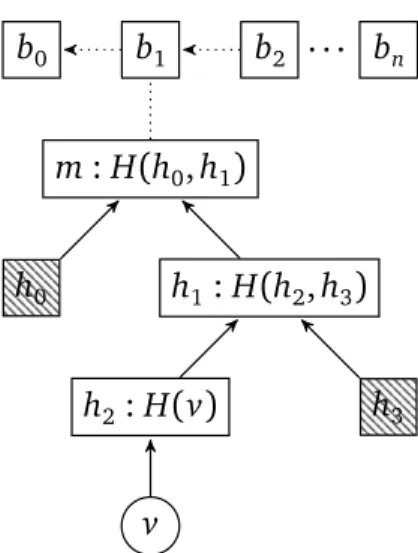
Figure 3.1 illustrates how Merkle-proofs can prune parts of the tree logarith-mically. Blocks from b0 to bn are shown linked together in the top. From block
b1 we see the Merkle-proof for {v} 7→ m. Given a hash function H, m is b1’s Merkle-root composed by h0 and h1 hashes. In the figure, we see the result of asking for the Merkle-proof of v. Anyone can compute the Merkle-root of this proof and accept it only if it is equal to the trusted Merkle-root m stored in b1. Observe that only v and hatched nodes h0 and h3 are needed to verify m.
3.2
Assumptions
We make the assumptions listed next in order for blockchains to support the move operation. Although these assumptions are not strictly necessary to move objects across blockchains, they simplify the Move protocol.
In particular, we assume that blockchains must: (a) support smart contracts (i.e., arbitrary computation);
19 3.3 Overview b0 b1 b2 . . . bn m: H(h0, h1) h1: H(h2, h3) h0 h3 h2 : H(v) v
Figure 3.1. Merkle-proof example,h0, h3 ∈ ({v} 7→ m).
(b) use the same execution environment (i.e., virtual machine); and
(c) provide a succinct way to prove state variables (e.g., using a Merkle-tree). Supporting smart contracts that can execute arbitrary computation allows us to investigate more complex and generic use cases for the protocol. When moved to the target blockchain, we assume that smart contracts can execute the same opcode instructions they executed in the source blockchain, i.e., they use the same execution environment. This simplifies how communicating blockchains are capable to understand each other.
Clients can have information about the Merkle-root of any other blockchain by downloading the correspondent block header. Clients can listen to headers from multiple blockchains all at once. Block headers have a constant size of usu-ally hundreds of bytes and are on average a small fraction of block bodies. For example, in Ethereum block headers are around 2% of the block’s body. More-over, blockchains willing to support the Move protocol must agree on certain configured parameters discussed in Section 3.7.1.
3.3
Overview
The state of a contract is presumably indivisible and must reside as a whole in a blockchain. Accounts and smart contracts are restrained to live in a single blockchain at a time. Therefore, we must ensure that if a contract moves from one blockchain (source) to another (target), it will no longer be “active” in the source
blockchain. When the contract becomes active in the target blockchain, its state must be identical to its state when it became inactive in the source blockchain. This implies that the move operation involving two blockchains must be atomic. One way to implement an atomic Move operation is to resort to the well-known two-phase commit (2PC) protocol[39], or one of its more resilient varia-tions (e.g.,[38]). We refrain from using a 2PC-like Move protocol since it would introduce expensive coordination between the involved blockchains (e.g., mem-bers of each blockchain would have to exchange votes in a reliable manner). In-stead, we use a two-step approach that divides the move operation into two trans-actions, Move1 and Move2. In Move1, the state of a smart contract is “locked” in the source blockchain, after which it is guaranteed not to be changed—although transactions can still read the contents of the locked smart contract. In Move2, the smart contract is reconstructed in the target blockchain, after which it can be safely used. To avoid simple attack vectors, the Move2 transaction is only suc-cessful at the target blockchain if it contains a proof that the Move1 transaction was successfully executed at the source blockchain.
This two-step approach reduces coordination between the source and the des-tination blockchains, but it complicates atomicity. For example, moving a con-tract can remain unfinished if the client fails after submitting the Move1 transac-tion and before it submits the corresponding Move2 transactransac-tion. To account for such cases, we allow any client to execute the Move2 transaction, and thereby complete a possibly unfinished Move operation. In the normal case, however, we expect the same client to execute both transactions.
3.4
The Move protocol in detail
Algorithm 1 details the move operation of contract c from blockchain Bi to Bj. We add a new field to a contract state, referred to as Lc. Lc specifies in which
blockchain the smart contract c currently resides. At low level, assigning a new value to Lc in Move1 is implemented with a new EVM opcode, OP_MOVE. The OP_MOVE opcode takes as argument the target blockchain identifier the smart contract is moving to (in this case Bj). When OP_MOVE is executed in c, it
changes Lc to Bj, and by consequence blocks the contract state at Bi. Any trans-actions that try to alter the state of blocked contract c in Bi will be aborted.
Move2 assumes the existence of two boolean functions, VS and VP. VS(B, m)
returns true if m is a valid Merkle-root in the blockchain B. VP(V 7→ m) returns
true if the state V of c is proved by V 7→ m. The smart contract code and other blockchain specific variables (e.g., the amount of currency held by the smart
21 3.4 The Move protocol in detail
contract) are omitted in the algorithm but still need to be proved by V 7→ m. Notice that before submitting a Move2 transaction for contract c, the client must acquire the proof V 7→ m at the source blockchain (discussed later).
The Move1 and Move2 transactions allow application developers to execute special routines when a contract is moved. We illustrate the use of this function-ality in the next section.
Algorithm 1 The operations.
1:
2: procedure MOVE1(c, Bj) . Move c in Bito Bj, executed at Bi
3: moveTo(·) . Execute custom function
4: Lc← Bj . Block contract c in Bi
5: procedure MOVE2(c, V 7→ m) . Complete move of c, execute at Bj
6: if Lc6= Bjthen . Is c being moved to the wrong blockchain?
7: return abort
8: if VS(Bi, m) = false then . Invalid Merkle-root
9: return abort
10: if VP(V 7→ m) = false then . Invalid proof
11: return abort
12: for all v∈ V do
13: Call SSTORE(v.key v.value) . Recreate storage in Bj
14: return moveF inish(·) . Execute custom function
3.4.1
A concrete implementation
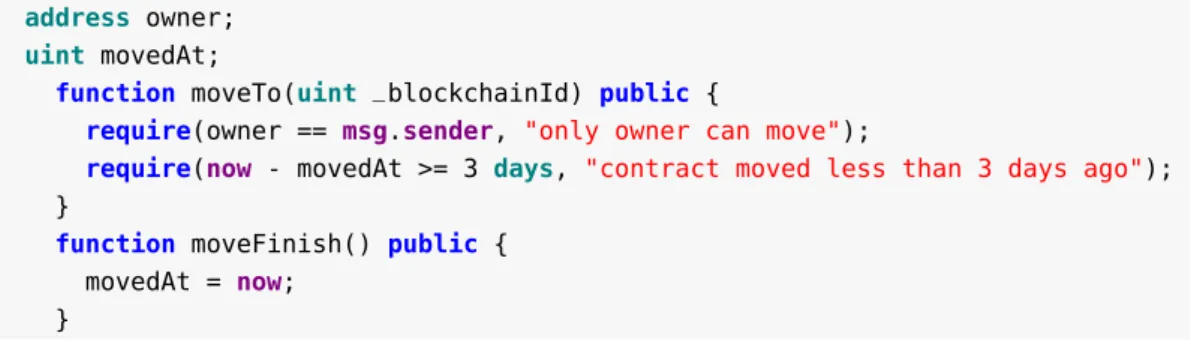
We have integrated the Move operation in the Solidity programming language[64]. In our prototype, smart contract developers must implement two functions to al-low contracts to move, moveTo(·) and moveF inish(·) (see Algorithm 1). This provides the application developer a great deal of flexibility. For example, in List-ing 3.2 we have an excerpt of Solidity code that in few lines ensures that only the contract’s owner is allowed to move the contract and the contract must remain at least three days in the target blockchain before being moved again.
address owner;
uint movedAt;
function moveTo(uint _blockchainId) public {
require(owner == msg.sender, "only owner can move");
require(now - movedAt >= 3 days, "contract moved less than 3 days ago"); }
function moveFinish() public {
movedAt = now;
}
Figure 3.2. Excerpt of a movable contract in Solidity.
3.4.2
Preventing replay attacks
If a client executes transaction Tmove1 at blockchain Bi to move contract c to Bj,
any client can craft a special transaction Tmove2 to be executed in blockchain Bj
that reconstructs the state of c in Bj. In Tmove2 the client appends the state of contract c encoded as V in the Merkle-proof V 7→ m. Target blockchain Bj is
responsible for verifying that m is accepted by the blockchain as a valid Merkle-root of Bi. Nodes in blockchain Bj verify the correctness of c’s state by verifying V 7→ m and Bi’s state root hash. If the proofs are valid, c’s state can be safely reconstructed in Bj.
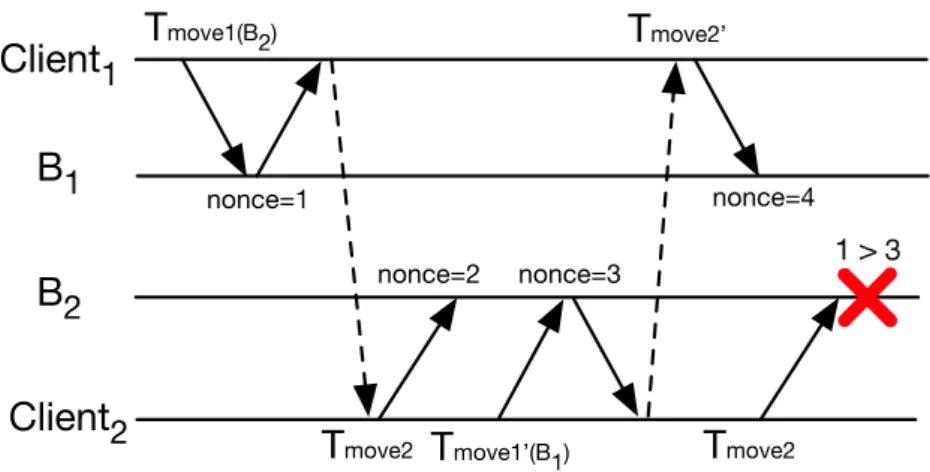
Additional measures should be taken to prevent replay attacks. The attack consists in a (malicious) client crafting a Tmove2transaction that uses an old state of contract c. The replayed transaction would lead to inconsistencies as transac-tions that followed the first (and thus legitimate) Move2 transaction would be lost. One remedy would be to have nodes store the contract’s nonce, a monoton-ically increasing number that is increased every time the contract is invoked. For instance, in Figure 3.3 a contract is moved from B1to B2 (transactions Tmove1and Tmove2, respectively) and afterwards back to B1 (transactions Tmove10 and Tmove20).
It starts with nonce equal to zero and as soon as Tmove2 is executed in B2 it in-crements the nonce by one. Afterwards Tmove10(B1) completes in B2and changes the nonce to three. When client2 tries to replay transaction Tmove2, the contract’s nonce is one which is less than what was previously seen by B2 and the transac-tion aborts.
23 3.5 Handling currencies
Client
1B
1B
2T
move1(B2)T
move2Client
2T
move1’(B1)T
move2’T
move2 nonce=1 nonce=2 nonce=3 nonce=4 1 > 3Figure 3.3. Preventing replay on stale data.
3.5
Handling currencies
Most cryptocurrencies rely on an internal currency for generating incentives to maintain the system (e.g., paying miners and transaction fees). In some cases, the currency is the main usage of the system (e.g., Bitcoin). It is important therefore to have a way of transferring this part of the system’s state from one blockchain to another. As it turns out, we can devise a simple mechanism that uses our protocol to accomplish the feat. It suffices for smart contracts to be allowed to hold currency in their state. We can then implement smart contract “relays” that can transfer currency from blockchains by creating a token in the target blockchain that is provably locked in the source blockchain, similar to Pegged Side Chains [7]. Currencies can be unlocked when contracts return to the original blockchain.
Assume for example that we would like to transfer e units of currency from cl ient1to cl ient2, from blockchain Bi to blockchain Bj. We assume the existence of contract c in Bi, that when called by client cl ient1 with input Bj, cl ient2 and value associated e creates a contract r that has e units of currency and lets cl ient2 withdraw e from its state (i.e., it executes Move1(Bj) on creation). The cl ient2 can call Tmove2on r effectively moving it to Bjwhere the funds would be available as a Bi’s token in Bj.
In Figure 3.4, we can see an example where a client successfully transfers a currency token from blockchain B1 to a token representation in blockchain B2. Contract c’s function c r eat e is called with e units of B1’s associated currency with
figure as “$”. Afterwards, the same function calls r’s moveTo(B2) changing r’s Lcto B2. The newly created contract has functions to generate tokens which are proved to be backed by e in B1. The cl ient2 waits for the transaction inclusion in B1 and sends transaction Tmove2 to B2, proving that r was moved to B2. After transaction Tmove2is included in B2, cl ient2calls transaction Tmintwhich executes
code in r creating tokens in B2 that represent the locked coins in B1.
Client
1
B
1
B
2
T
create(B2,e,C2) c $:e Lc:B2T
move2Client
2
$:e Lc:B2 proofT
mint r rFigure 3.4. Move operation example.
3.6
Additional details
Account identifiers. Although each blockchain maintains its own set of accounts, its identifier can be the same if the interacting blockchains use the same rule to derive such identifiers. Consequently, clients could use the same cryptographic keys to use accounts in different blockchains. It becomes essential to incorporate the blockchain’s identification to functions that compute contract addresses to ensure a unique system-wide contract identification to avoid collisions in con-tract identifiers.
Finding contracts. Lc can only have two logical states: either in the current blockchain or transferred (executed Move1), and if moveTo(·) and moveF inish(·) are implemented correctly, it can always go back to the first state with Move2.
25 3.7 Applications
A client who does not know where contract c is located can use Lc to track the contract’s location every time it moves.
Stale data. Every time a contract is moved it leaves behind a stale state on the original blockchain, which could be garbage collected, paying attention to guard against the attack previously described. Designing fee incentives to clean the state is left as future work.
3.7
Applications
The Move protocol can be used by blockchains to implement two important blockchain concepts: interoperability and sharding. Interoperability and shard-ing are related concepts that have increased in importance as blockchain tech-nology matures.
3.7.1
Interoperability
Blockchains coexist nowadays with different transaction designs, cryptographic features, and trust assumptions in a heterogeneous environment. Interoperabil-ity provides a way to offload transactions from one blockchain to another, un-leashing the potential to scale different applications and experiment with differ-ent combinations of blockchains.
Interoperability in permissionless systems is challenging mainly because forks can occur since block propagation time is unbounded [30], which invalidates transactions that build on the losing side of the fork. A way for systems propos-ing interoperability[7, 72, 51] to interact with permissionless blockchains is by introducing a parameter p that specifies the minimum number of blocks that a transaction’s block should be behind the blockchain’s head for it to be accepted by the other blockchain. The parameter can be configured according to each blockchain involved in the interoperability protocol.
Miners or validators of blockchains willing to interoperate should maintain a light client that validates Merkle-roots of other blockchains. Proposals for this scheme are discussed in Section 3.12.
3.7.2
Sharding
Sharding enables the blockchain state to be divided into shards responsible for holding a certain portion of the state. Sharding preserves some of the blockchain
assumptions, but there are clear trade-offs in security because the members them-selves have to be sharded. The way objects are assigned to each shard plays an important role when sharding a blockchain for scalability. For instance, if ob-jects are randomly partitioned into shards, most of the transactions will likely be cross-shard. The rate of cross-shard transactions also increases with the number of shards, and sharding the state while minimizing the number of cross-shard transactions keeping the various shards balanced is a hard problem as seen pre-viously in Chapter 2.
To cope with changes in load it becomes essential to incorporate a method to move state from shards, offloading one shard in detriment of another. As shards get congested and fees increase, users are tempted to move their contracts to underused shards.
3.8
Use cases
We implemented two applications for smart contracts and show how they scale with the number of blockchains:
• SCoin: A token smart contract based on a popular Ethereum token inter-face.
• ScalableKitties: A clone of CryptoKitties, a popular Ethereum application where virtual cats can migrate and reproduce in different shards.
3.8.1
SCoin
contract STokenI {function totalSupply() public view returns (uint);
function newAccount() public payable returns (AccountI, uint);
function newAccountFor(address forAddr) public payable returns (AccountI,
uint);
event CreatedAccount(address account, uint salt); }
contract AccountI {
function balance() public view returns (uint);
function allowance(address spender) public view returns (uint);
function transfer(AccountI to, uint tokens) public returns (bool);
function approve(address spender, uint tokens) public returns (bool);
function transferFrom(AccountI to, uint tokens) public returns (bool);
27 3.8 Use cases
function moveTo(uint shardId) public;
function moveFinish() public;
event Transfer(address to, uint tokens);
event Approval(address spender, uint tokens); }
Listing 3.1. Scalable Token interfaces extending ERC20.
ERC20 [33] is a standard interface widely used in Ethereum for token op-erations including token transfers. STokenI and AccountI, defined in Listing 3.1, are interfaces that support all ERC20 operations and allow for contracts to move from one blockchain to another. The main idea of the interface is to use one in-stance of AccountI per user account. Typical ERC20 implementations hold token balances in a map data structure, which multiple blockchains cannot share in our design since we do not allow for contracts to live in two or more blockchains at the same time.
Once created, accounts can freely move from within blockchains using the moveTo and moveFinish functions. It is left to the developer to restrict or even define a policy for moving accounts between blockchains.
To illustrate the STokenI interface, we implement SCoin, a scalable token con-tract that implements STokenI. SCoin creates instances of SAccount, which imple-ments AccountI. The implementation of SCoin and most functions of SAccount are straightforward and application-dependent. We focus next on how to do safe transfers between one SAccount to another. To execute a transaction that trans-fers e tokens from SAccount A to B, contract A has to decrease e from its state (called by transfer function) and B has to increase e. This is done by calling the debitfunction in B. If contracts A and B are in different blockchains, they have to be first moved to the same blockchain to be able to call each other. Once both contracts are in the same blockchain, how can A know that B is what it claims to be? For instance, one could design a contract B that, when debit is called, in-creases the contract’s tokens by an arbitrary amount. A could ask its parent if B was created by the same contract, but A’s parent contract might be in a different blockchain. The interface does not specify how contract A can be sure of contract B’s origin. It is up to the developer to devise safeguards to prevent incorrect us-age. The key idea for SCoin is holding a proof in B that it was created by the same contract that created A.
When we create an instance of SAccount in SCoin it uses a monotonically increasing salt, stored in the instance state. The salt is used to calculate the identifiers of both contracts using the create2 opcode[71]. With A’s salt, B can attest that A was created by the same contract that created B and vice-versa. To execute a transfer from SAccount A to B, contract A attests B’s origin, decrements
its own balance and calls the function d e bi t(·) in B. Contract B agrees to debit its own account only if A passes the same check, and A can safely add B’s fund to its own balance. The checks of origin are done with one inexpensive hash operation. In our implementation case, we take advantage of the way contract identifiers are generated in the EVM. A more generic method could be devised using Merkle proofs with the same proposed interfaces.
3.8.2
ScalableKitties
ScalableKittiesis a clone of CryptoKitties, a popular Ethereum smart contract that was created in November 23th 2017 and until the writing of this thesis had over four million related transactions. During the apex of its popularity, CryptoKitties congested the Ethereum network for several days, accounting for over fifteen percent of all Ethereum transactions [74]. In CryptoKitties, cats are collectibles that can be bred to generate more cats following a set of rules (e.g., sibling cats cannot mate). Cats were first generated by the contract’s owner. Both the initial and bred cats are sold in an auction smart contract. The game was the first mainstream application built on top of Ethereum, and some cats were sold for more than a hundred thousand dollars at the time. The contract is still actively used today.
We mapped the ScalableKitties functions one-to-one to the CryptoKitties smart contract but for simplicity we discuss only the functions that are related to the execution of cross-blockchain transactions. Cats are created in two ways: either by having the contract’s owner calling a function to generate “promotional” cats or by breeding two cats to generate a third. Breeding is the only operation that can generate cross-blockchain transactions because bred cats can be in different blockchains and need to be moved to the same one. Furthermore, if the owner of cat A wants to breed A with B, it either needs to own both cats or B’s owner has to permit B to be sired with A. In the experiments in Section 3.10.1 we replay transactions from the CryptoKitties contract on the ScalableKitties contract.
3.9
Deployment
We modify Hyperledger Burrow[43] and Ethereum [36] to implement the proto-col defined in Section 3.4. The resulting systems allow blockchains to communi-cate with each other (IBC) or implement sharding. To validate our approach, we conducted two types of experiments: we shard Burrow and analyze how applica-tions can scale performance, and make smart contracts migrate from Ethereum
29 3.10 Sharding experiments
to Burrow and vice-versa to assess the performance and monetary costs of IBC. Both Burrow and Ethereum implement the EVM model, where each opcode exe-cuted by the smart contracts has a cost modeled in gas (e.g., a sum between two integers costs 3 gas, while creating a new smart contract costs at least 32000 gas[71]).
Burrow uses Tendermint for consensus, which by design introduces the appli-cation’s Merkle-root from block n in block n+ 1, but in Burrow the state of block nis saved only in block n+ 1, therefore there is a need to wait for two blocks to prove the transaction inclusion required by Move2. For the experiments we set p(defined in Section 3.7.1) equal to two blocks in Burrow, since clients have no option other than waiting for two blocks to get the proof of inclusion of a Move1 transaction. For Ethereum we set p to six blocks.
Tendermint is configured to wait for five seconds between each consecutive block, the observed latency being slightly higher than this. Ethereum is config-ured to wait 15 seconds, which is similar to Ethereum’s main public network.
All experiments were conducted using a heterogeneous cluster in a local area network with simulated latencies between nodes based on the values published in [27], where the authors evaluate nodes in 14 regions in four continents on Amazon data centers. We emulate this environment in a cluster of servers and randomly allocate nodes to regions.
3.10
Sharding experiments
We evaluate the Move protocol using the two applications described in Sec-tion 3.8. The objective of this experiment is to show how the capacity to move smart contracts can significantly improve the performance of the applications. In all sharding experiments, one node hosts all clients and maintains one con-nection per shard to broadcast the client’s transactions. We decided to run one validator in each node and 10 validators per shard due to a limitation of our cluster size, comprised of 80 computers, each one with an eight-core Intel Xeon L5420 processor working at 2.5GHz, 8Gb of memory, SATA SSD disks, and 1Gbps ethernet card. With this configuration, we can run a maximum of 8 shards and we decided to run experiments with 1 (no sharding), 2, 4 and 8 shards. To de-cide which shard to send the contracts to when needed, we use hash partitioning where the contract’s shard is decided by the hash of the contract’s identifica-tion. Using hash partitioning ensures a good balance among shards but implies probably a higher cross-shard rate the more shards there are (see Chapter 2).