Publisher’s version / Version de l'éditeur:
Vous avez des questions? Nous pouvons vous aider. Pour communiquer directement avec un auteur, consultez la première page de la revue dans laquelle son article a été publié afin de trouver ses coordonnées. Si vous n’arrivez pas à les repérer, communiquez avec nous à [email protected].
Questions? Contact the NRC Publications Archive team at
[email protected]. If you wish to email the authors directly, please see the first page of the publication for their contact information.
https://publications-cnrc.canada.ca/fra/droits
L’accès à ce site Web et l’utilisation de son contenu sont assujettis aux conditions présentées dans le site
LISEZ CES CONDITIONS ATTENTIVEMENT AVANT D’UTILISER CE SITE WEB.
Canadian Building Digest, 1979-05-01
READ THESE TERMS AND CONDITIONS CAREFULLY BEFORE USING THIS WEBSITE.
https://nrc-publications.canada.ca/eng/copyright
NRC Publications Archive Record / Notice des Archives des publications du CNRC :
https://nrc-publications.canada.ca/eng/view/object/?id=cfa09663-806d-4050-b153-360e50449f58
https://publications-cnrc.canada.ca/fra/voir/objet/?id=cfa09663-806d-4050-b153-360e50449f58
NRC Publications Archive
Archives des publications du CNRC
For the publisher’s version, please access the DOI link below./ Pour consulter la version de l’éditeur, utilisez le lien DOI ci-dessous.
https://doi.org/10.4224/40000672
Access and use of this website and the material on it are subject to the Terms and Conditions set forth at
Calculating resistance to fire
Canadian Building Digest
Division of Building Research, National Research Council Canada
CBD-204
Calculating Resistance to Fire
Please note
This publication is a part of a discontinued series and is archived here as an historical reference. Readers should consult design and regulatory experts for guidance on the applicability of the information to current construction practice.
Originally published May 1979. T.T. Lie
The fire resistance of a structural member may be defined as its ability to withstand exposure to fire without loss of loadbearing function or ability to act as a barrier to spread of fire. This provides time to permit people to evacuate a building before it collapses and is essential in confining fire to the compartment in which it starts.
The fire resistance of various structural members, for example, beams, columns and walls, can be determined by testing or, in many cases, by calculation, which is far less expensive and time-consuming. Although experimental determination of fire resistance is still the most common method, progress in the field of theoretical prediction has been rapid in recent years. It is intended to present a state-of-the-art report and to describe some aspects of studies related to fire resistance now being carried forward at the Division of Building Research, National Research Council of Canada.
Calculation Procedure
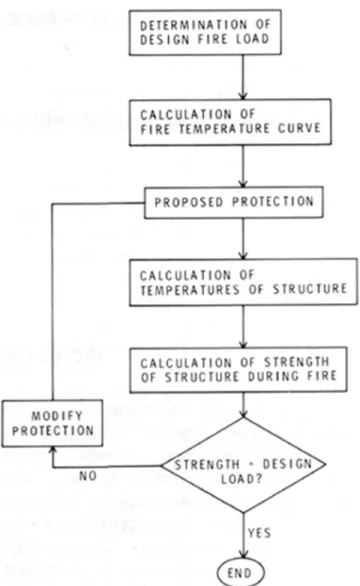
Prediction of the fire behaviour of structural members involves the calculation of fire temperatures and the temperature, deformation and strength of the members. Because all these quantities vary with time the calculation procedure is complex, although the use of high-speed computers has simplified it. The various steps in calculating the fire resistance of a member and determining appropriate protection are shown in Figure 1.
Figure 1. Calculation procedure for fire resistance design.
Fire Load. First is the determination of fire load, i.e., the combustible contents, on which the fire resistance design of the building should be based. Several surveys have been carried out recently for the purpose of obtaining information on fire loads in buildings.
Fire Temperature. Assuming that the design fire load is known, the fire temperature course can be determined from a heat balance for the compartment, taking into account the heat produced and the heat losses to the walls and openings. The most important factors are fire load and the dimensions of the openings through which air, necessary for combustion of the fire load, can enter. How fire load affects fire temperature is shown in Figure 2, the influence of openings in Figure 3. It may be seen that fire load determines the duration of the fire, whereas the openings influence both intensity and duration. From this it is possible to determine the fire temperature course for a given building.
Figure 2. Influence of fire load on fire temperature course.
Figure 3. Influence of opening factor on fire temperature course.
Temperature in Members. Methods exist for calculating the temperatures in fire-exposed structural members. In these, the dependence of material properties on temperature can be taken into account and a high accuracy obtained if the material properties are known. For example, the accuracy with which temperatures in protected steel can be predicted is better than 1 per cent if the material properties of the protection are known precisely (usually this is not the case and the accuracy is less). In practice, an accuracy of 15 to 20 per cent is
obtainable, and in the field of fire this may be regarded as fairly accurate.
Strength of Members. When temperature rises in fire-exposed members, their strength is reduced. If the fire load is sufficient and the duration of the fire long enough, a stage will be reached at which the strength of the member will no longer be adequate to support the structural load. The fire load that is just sufficient to reduce strength to this critical point is defined as the critical fire load.
The aim is to make the critical fire load for a member sufficiently high to allow it to withstand burn-out of the design fire load. In general, this can be achieved by selecting appropriate protecting materials of adequate thickness and appropriate dimensions of the member.
Design Fire Load Safety Factor
With increasing sophistication in methods of predicting fire resistance, the need increases for more refinement in determining how much fire resistance has to be provided. It is clear that if the requirement is inaccurate, the protection also will be inaccurate, irrespective of the
perfection of the analysis.
Studies to determine the appropriate fire resistance for buildings under various circumstances are now in progress. Mathematical models are used that enable calculation of the fire
resistance that will, on a probabilistic basis, provide adequate safety (acceptable target life loss expectation) at minimum cost (cost of measures plus loss expectation).
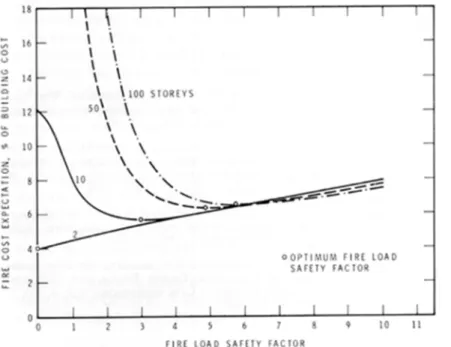
At present, studies are being carried out to determine the influence of the various factors considered important in determining fire loss expectation: these include building height, floor area, fire frequency, fire load, occupant load, value of building content, and indirect losses. In the following the influence of height and floor area, both of which are a measure of the number of people and value of property at risk, is shown as an example. How the building height affects optimum fire resistance is shown in Figure 4; the expected cost of fire is plotted as a function of fire load safety factor, i.e., ratio of fire load on which the fire resistance of the building should be designed to the statistically determined mean fire load for the building under
consideration. It may be seen that for two-storey buildings the cost expectation increases with the safety factor, indicating that provision of fire resistance in such buildings is not
economically justified. In practice, however, a minimum must be provided to allow people to escape. For higher buildings the provision of fire resistance is economically beneficial, with an optimum value of fire load safety factor for which the fire cost expectation is minimal.
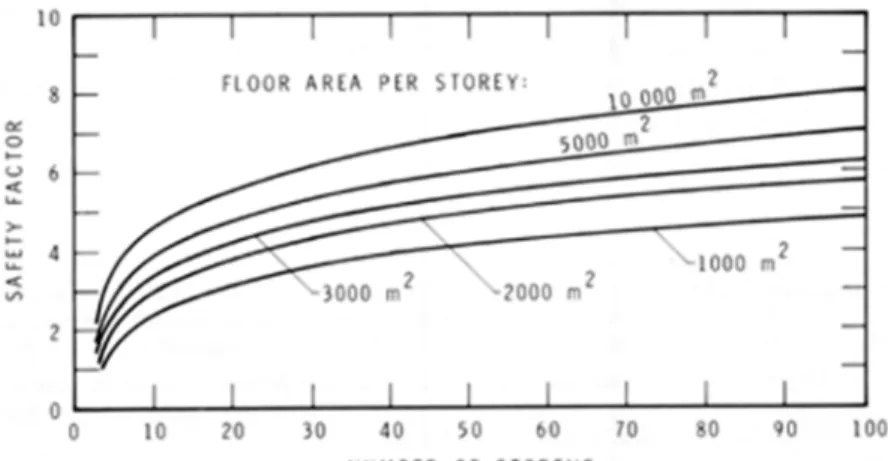
Figure 4. Fire cost expectation as a function of fire safety factor for various building heights. Figure 5 shows the influence of floor area on the optimum safety factor. Because, in practice, there is a wide range of floor area, the variation of the safety factor due to variation of floor area is substantial. According to the curves in Figure 5, a deviation from the selected standard floor area of 2000 m2per storey by a factor of two affects the optimum safety factor by roughly
20 per cent; and a deviation from the standard floor area by a factor of four affects the safety factor by roughly 40 per cent.
Figure 5. Optimum fire load safety factor as a function of building height for various storey floor areas.
Design Formulas
Although it is possible to use the method illustrated by Figure 1 for fire resistance design, the calculation procedure is elaborate and can at present be performed only by large computers. In addition, knowledge is required of the properties at elevated temperatures of fire-exposed materials, and this is still meagre. At this stage, therefore, its application for fire resistance design is still restricted.
A method more suitable for general application and incorporation in present codes is the use of design formulas in line with conventional design procedures in the structural field. In
developing such design formulas it is assumed that the member is exposed to a standard fire temperature course similar to that adopted in building codes and in common building practice. Several simple design formulas that can be processed by hand or desk calculators have been developed in recent years. They are based on equations used in the more exact and elaborate calculation procedure illustrated in Figure 1. In general, a mathematical model simulates the processes taking place during fire exposure of a member; for example, heat transfer,
deformations and strength changes. The validity of the model is then tested by comparing its results with those of experiments usually carried out in furnaces specially designed for the simulation of fire conditions. When the validity of the mathematical model has been established, all information is obtained by computer simulation, which can normally be performed with about 1 per cent of the time and cost involved in furnace simulations. In this way a great deal of information can be obtained in a relatively short time and can be
transformed into simple formulas that give the fire resistance of members as a ! ! function of the significant variables.
At present, fire resistance design for many steel members can be carried out by means of design formulas1. Formulas have been developed for concrete columns2and for composite
concrete floor and roof slabs3, and work is in progress on those for concrete walls and beams.
As well, design formulas have been developed recently for calculating the fire resistance of laminated beams and columns of various shapes and sizes4.
Concluding Remarks
Provision of appropriate fire resistance is one of the requirements in building today. Although not long ago fire resistance of members could only be determined by costly and
time-consuming tests, calculation methods are more and more replacing them. Many fire resistance design formulas derived from results of computer simulations and validated by furnace tests have been developed in recent years. They can be used for the purpose of satisfying building code requirements.
In most cases only individual members under a specified load have been considered. Restraint of thermal expansion of a member and interaction between members may significantly
influence their fire performance. Facilities are now under construction that will enable the study of these effects in future.
References
1. Lie, T. T., and W. Stanzak. Structural Steel and Fire -- More Realistic Analysis, Engineering Journal, AISC, Vol. 13, No. 2, 1976, p. 35-42.
2. Allen D. E., and T. T. Lie. Further Studies of the Fire Resistance of Reinforced Concrete Columns, National Research Council of Canada, Division of Building Research, NRCC 14047, 1974.
3. Lie, T. T. Calculation of the Fire Resistance of Composite Concrete Floor and Roof Slabs, Fire Technology, Vol. 14, No. 1, 1978, p. 28-45.
4. Lie, T. T. A Method for Assessing the Fire Resistance of Laminated Timber Beams and Columns, Canadian Journal of Civil Engineering, Vol. 4, No. 2, 1977, p. 161-169.