HAL Id: hal-02014173
https://hal.archives-ouvertes.fr/hal-02014173
Submitted on 15 Feb 2019
HAL is a multi-disciplinary open access
archive for the deposit and dissemination of
sci-entific research documents, whether they are
pub-lished or not. The documents may come from
teaching and research institutions in France or
abroad, or from public or private research centers.
L’archive ouverte pluridisciplinaire HAL, est
destinée au dépôt et à la diffusion de documents
scientifiques de niveau recherche, publiés ou non,
émanant des établissements d’enseignement et de
recherche français ou étrangers, des laboratoires
publics ou privés.
Copyright
Extreme and rare events in hydrodynamical and optical
systems
Giovanna Tissoni, Eric Simonnet
To cite this version:
Giovanna Tissoni, Eric Simonnet. Extreme and rare events in hydrodynamical and optical systems.
Université Côte d’Azur Complex Days, M. Argentina; S. Barland; P. Reynaud-Bouret; F. Cauneau;
K. Guillouzouic; U. Kuhl; T. Passot; F. Planchon, Jan 2018, Nice, France. pp.69-76. �hal-02014173�
Extreme and rare events in
hydrodynamical and optical
systems
Giovanna Tissoni and Eric SimonnetAbstract Rare and extreme events are ubiquitous in nature and society, spanning from magnetic storms or particularly violent earthquakes, to mar-ket crashes or oceanic rogue waves. Different viewpoints are therefore pos-sible: coming from two different communities, we will try here to bring to-gether our ways to look at these events. After a very brief review of some recent results in our respective scientific domains, that is, non-equilibrium/ statistical physics and nonlinear/dissipative optical systems, we draw some perspectives to develop a new approach using genetic algorithms to calcu-late extreme events in nonlinear dissipative optical systems.
1 Introduction
Nowadays, the modeling of complexity, in biology, geophysics or hydrody-namical turbulence for instance, involves systems with a huge number of degrees of freedom (d.o.f.) together with stochastic parametrisations. These parametrisations are needed, in general, to handle the physics at the micro-scopic/subgrid scale and to reduce the number of d.o.f. like in the Earth climate system, which involves multi-scale dynamics from a few meters to thousands of kilometers. Even more challenging, these systems are
gener-Giovanna Tissoni
Université Côte d’Azur, Institut de Physique de Nice (INPHYNI), 1361, route des Lucioles 06560 Valbonne, e-mail:[email protected]
Eric Simonnet
70 Giovanna Tissoni and Eric Simonnet
ally far from equilibrium. Therefore, deterministic tools such as dynamical systems and bifurcation theory are not sufficient to handle these aspects. Nonequilibrium statistical physics appears to be the natural framework to study these phenomena.
It is often the case that physical systems exhibit phase transitions related to the existence of metastable states. The typical scenario is a system at equi-librium that exhibits (random) small-amplitude fluctuations. From time to time, some of these fluctuations might not be small and "push" the known (local) dynamics into another regime. These noise-induced transitions gen-erally occur over a very short length of time. For many physical systems, it is particularly crucial to understand and predict these phase transitions, as they may have dramatic impacts to our societies.
The main aspect of this research is to use recent algorithmic tools for studying extreme and rare events in physics. These tools are not only able to compute the probability of these events but they also provide the physics associated to them. Even more importantly, they are able to overcome the so-called "curse of dimensionality" by handling systems with many d.o.f. These ideas were first proposed by J. Von Neumann (Manhattan project, un-published) and developed in [1]. The first mathematical developments were obtained much later [2–5] and many others. The first successful applications in complex systems are very recent [6,7].
Roughly speaking, the idea is to mimic the evolution of species by per-forming Darwinian selections on the system dynamics, in a controlled (un-biased) way. These types of algorithms essentially perform a large number of mutations and selections (branching) by cloning the system dynamics. This is the reason they have sometimes been called genetic algorithms although they bear several different names (multilevel splitting, go-with-the-winner, rare event - large-deviation algorithms, etc.). In summary, these approaches are able to sample the system tail probability very efficiently. It thus allows us to compute rare or/and extreme events (see [7] for computing extremes), no matter the dimension of the system.
2 Phase transitions for atmospheric jets
In the recent years, it has been conjectured that a global climate change has occurred on Jupiter in the past century, which can be traced back to the 30’s and the sudden disappearance of one of the atmospheric jets (similar to the North-Atlantic“jet stream" on Earth) [8]. In this work, we investigate phase transitions in a simple turbulent model of (barotropic) atmospheric jets. We are able to observe rare events corresponding to the absorption of a
west-0.2 0.4 0.6 0.8 1 1.2 α t 0 2 4 6 y -1 -0.5 0 0.5 1
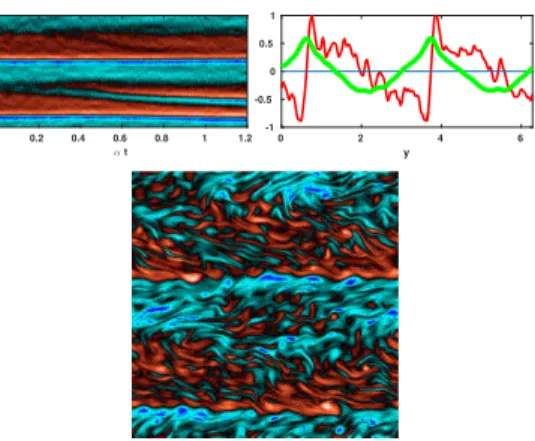
Fig. 1 Phase transition for an atmospheric jet (nucleation): Hovmöller diagram (space vs. time) of the vorticity (left panel), zonal velocity and vorticity (right panel, green and red curves resp.). The lower panel is a snapshot of the vorticity 2-D field. The probability to observe this phenomenon is of the order 10−7in this case.
q4 q3 q2
3 jets
2 jets
Fig. 2 Finite-noise instanton concentrated along the most probable transition path be-tween two-jet states and three-jet states.
ward jet into an eastward jet (coalescence) as well as the spontaneous cre-ation of new eastward jets (nuclecre-ation). The statistics and the corresponding physics of these rare events are computed using a genetic algorithm called adaptive-multilevel splitting. This algorithm is exponentially faster than tra-ditional tools (e.g., Monte-Carlo sampling) and allow for robust statistics of very low probability events. Figure1 illustrates the creation of a new east-ward jet. In addition, we can show that these transitions are controlled by an underlying instanton in the weak-noise limit (see Fig.2). Therefore, it
72 Giovanna Tissoni and Eric Simonnet
suggests that only specific fluctuations along the instanton can yield such transitions and that predictors can be defined.
Although it is too early to relate this theoretical work with [8] we expect in the near future to consider more realistic models exhibiting the observed phenomenology. This is joint work with Freddy Bouchet at the Physics lab. ENS Lyon (in preparation).
3 Rogue waves in a laser with saturable absorber
In the recent years, extreme events in optics have been attracting a lot of interest, originating from the seminal paper by Solli et al. [9], due to the well-known analogy between optics and hydrodynamics, where rogue wave formation and prediction is a priority field of investigations. A huge body of literature has been blooming on this subject, studying rogue waves for many different optical systems (for a review, see [10–12] and references therein).
Optical fibers and fiber lasers are systems of choice for the analysis of op-tical rogue waves due to their natural longitudinal extension both for the conservative and the dissipative case. Dissipative rogue waves in laser de-vices have been also studied, and semiconductor systems have emerged as experimentally convenient test beds for the analysis of extreme phenomena. For instance, low dimensional semiconductor systems in which the wave envelope is severely constrained by boundary conditions served to demon-strate that the emergence of rogue events can be associated to an external crisis in a chaotic regime [13], thus showing the deterministic character of these extreme events.
Very recently, extreme events were studied both experimentally and nu-merically [14] in the intensity emitted by a monolithic broad-area vertical cavity surface emitting laser (VCSEL) with a saturable absorber with a lin-ear pump (which reduces to one the transverse dimensions), and spatio-temporal chaos is claimed to be at the dynamical origin of extreme events.
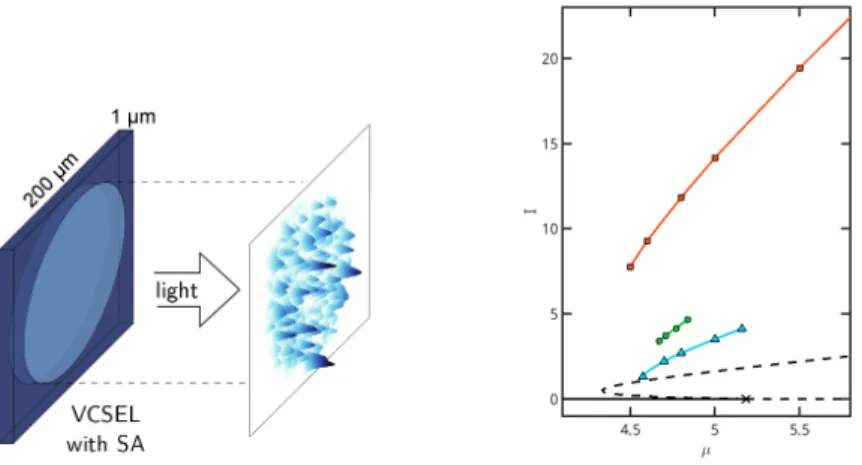
Here we show numerical results about extreme events occurring in the field intensity emitted by a monolithic broad-area VCSEL with an intra– cavity saturable absorber [15], as the one used in the experiments on cavity solitons [14]. The system is displayed in the left panel of Fig.3. The model we use is a set of 4 PDEs for the (complex) slowly varying envelope of the intra-cavity electric field, and the carrier populations in the active and in the passive material. The control parameters are the pump parameter µ in the active medium, and the ratio r between the nonradiative lifetimes in the ac-tive and passive materials (for the model and the parameters we refer the reader to [15]).
Fig. 3 Left panel: scheme of the the system in study. Right panel: branches of solutions displayed for r=1 as a function of the control parameter µ (injected current in the active medium, see text): homogenous stationary solution (dashed black line), stationary cavity solitons (blue line and triangles), time averaged maximum intensity of the turbulent state (orange line and squares) and of chaotic solitons (green line and circles). Note that the laser threshold is at µth=5.18 (subcritical bifurcation).
In the right panel of Fig. 3 we show that below the lasing threshold the system may present multiple solutions, such as stationary cavity soli-tons (also called localised structures), oscillating or chaotic solisoli-tons and a global "turbulent" solution where the light intensity oscillates aperiodically in space and time, together with the trivial non-lasing solution. The turbu-lent solution survives above threshold, where it is the only attractor of the system. This solution has been associated (for the 1D case and for a slightly different set of parameters) to spatio-temporal chaos [14].
When the system is emitting on the "turbulent" solution, we perform a statistical treatment on the full set of 3D data of field intensity as a func-tion of space and time. In contrast with previous literature about optical rogue waves in spatially extended systems [14,16], we developed a numeri-cal method for the individuation of the spatio-temporal maxima of the trans-verse field intensity in which each maximum appearing in the space profile is counted as an “event”only when its peak intensity reaches the maximum value also in time. This method allows a comparison, for example, with the hydrodynamical definition of “significant wave height”, corresponding to the mean value of the wave height (from trough to crest) of the highest third of the waves.
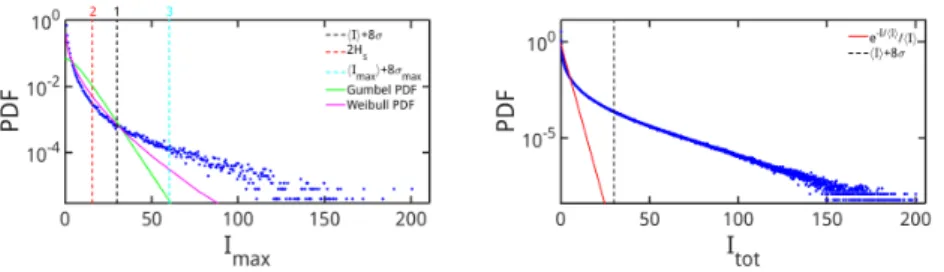
The results of the statistical analysis are shown in Fig.4, where the thresh-olds for RW are defined as follows:
74 Giovanna Tissoni and Eric Simonnet
Fig. 4 (a) PDF of the spatio-temporal maxima for a numerical simulation lasting 25 ns, for
µ=7 and r=2.5. The green and magenta lines are respectively the Gumbel and Weibull
distributions computed from the mean and standard deviation of the data. The three ver-tical dashed lines indicate three different definitions of rogue wave thresholds, defined in the text as thresholds 1,2 and 3 (see the legend, and the text). (b) PDF of all the values ex-plored by the intensity during the simulation in each point of the transverse plane. Black dashed vertical line: threshold for rogue waves (same as threshold 1 in (a)). Here µ=5 and r=2.4. The presence of very heavy tails is clearly visible, and RW exist according to all the threshold definitions.
Threshold 1: the mean intensity, averaged on every point of the transverse plane and every instant in time, plus 8 times the standard deviation. This is the definition most commonly used for studying optical rogue waves in spatially extended systems [16,17].
Threshold 2: two times the significant wave height Hs, defined as the
av-erage of the highest third of the spatio-temporal maxima values. This is the typical hydrodynamic definition, and permits one to get rid of a possible global increase of the average value, that would not correspond to a freak wave. The typical number of “events" detected during a simulation lasting 25ns is around 6×10⁵.
Threshold 3: average of spatio-temporal maxima values plus 8 times the standard deviation.
We performed a statistical analysis of all the data (spatio-temporal max-ima or total intensity) varying systematically the pump parameter µ and the carrier lifetimes ratio r, and we could conclude that rogue waves are most probable below the lasing threshold (in the multistability region, see Fig.3) towards the lowest values of µ (leftmost part of the turbulent branch) and for high values of r, meaning fast saturable absorbers.
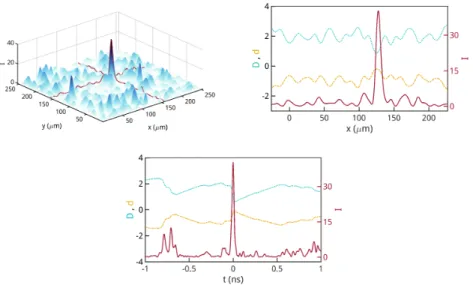
Finally, in Fig.5we show an example of how a rogue wave looks like in the transverse plane, together with its temporal profile.
Fig. 5 Example of a rogue wave in the transverse plane (upper left panel) and its spatial (upper right panel) and temporal (lower panel) profiles, shown for the variables I (solid red line), D (dotted blue line) and d (dash dotted yellow line). Parameters are µ=4.8, r=
2.2.
4 Conclusion
Based on our expertise, both in optical systems and the computation of rare and extreme events, we would like to analyze spatially extended optical cavities in various regimes. In particular, genetic algorithms similar to the one used for studying atmospheric jet phase transitions, could potentially give very large-ensemble statistics of optical rogue waves. One of the key points is to compare these results with known experiments taking place in our laboratory and in various places over the world (New Zealand, Scot-land, and France). This study will provide a rigorous formalism for optical rogue waves and will also give tools for predicting their appearance and in particular to detect instanton-driven regimes. This approach based on non-equilibrium statistical physics is completely new and could be extended to many area of physics due to its predictive character.
76 Giovanna Tissoni and Eric Simonnet
References
1. H.Kahn and T.Harris, Estimation of particle transmission by random sampling, Natl. Bur. Stand., Appl. Math. Ser.,12,27–30 (1951).
2. Pierre Del Moral, Feynman-Kac formulae, Genealogical and interacting particle sys-tems with applications, Probability and Applications, New York, Springer-Verlag, (2004).
3. F.Cérou and A.Guyader, Adaptive Multilevel Splitting for Rare Events Analy-sis,Stoch. Anal. and Appl.,25,417–443 (2007).
4. E.Simonnet, Combinatorial analysis of the adaptive last particle method, Stat.Comput., in press 2014, DOI 10.1007/s11222-014-9489-6 (access online). 5. J.Rolland and E.Simonnet, 2015. Statistical behavior of adaptive multilevel algorithm
in simple models, J.Comp.Phys, 283, 541–558.
6. J.Rolland, F.Bouchet, E.Simonnet, Computing transition rates for the 1-D stochastic Ginzburg–Landau–Allen–Cahn equation for finite-amplitude noise with a rare event algorithm, J.Stat.Phys, (2016), 162, 277–311.
7. F.Ragone, J.Wouters, and F.Bouchet, Computation of extreme heat waves in climate models using a large deviation algorithm , PNAS, 2017.
8. PS.Markus, Prediction of a global climate change on Jupiter. Nature, 22:428,828–31 (2004).
9. D.R. Solli, C. Ropers, P. Koonath, and B. Jalali, Optical rogue waves, Nature 450, pp 1054-1057, 2007.
10. M. Onorato, S. Residori, U. Bortolozzo, A. Montina, and F.T. Arecchi, Rogue waves and their generating mechanisms in different physical contexts, Physics Reports 528, pp 47–89 (2013).
11. J. M. Dudley, F. Dias, P. Koonath, M. Erkintalo, and G. Genty, Instabilities, breathers and rogue waves in optics, Nat. Photon. 8, pp 755–764, 2014.
12. N. Akhmediev, B. Kibler, F. Baronio, M. Beli´c, W.P. Zhong, Y. Zhang, W. Chang, J.M. Soto-Crespo, P. Vouzas, P. Grelu, etc., Roadmap on optical rogue waves and extreme events, Journal of Optics 18, 063001, 2016.
13. C. Bonatto, M. Feyereisen, S. Barland, M. Giudici, C. Masoller, J. R. Rios Leite, and J. R. Tredicce, Deterministic Optical Rogue Waves, Phys. Rev. Lett. 107, 053901, 2011. 14. F. Selmi, S. Coulibaly, Z. Loghmari, I. Sagnes, G. Beaudoin, M.G. Clerc, and S. Barbay,
Spatiotemporal chaos induces extreme events in an extended microcavity laser, Phys. Rev. Lett. 116, 013901–5, 2016.
15. C. Rimoldi, S. Barland, F. Prati, and G. Tissoni, Spatiotemporal extreme events in a laser with a saturable absorber, Phys. Rev. A 95, 023841–8, 2017.
16. C. Gibson, A. M. Yao, and G. L. Oppo, Optical Rogue Waves in Vortex Turbulence, Phys. Rev. Lett. 116, 043903–5, 2016
17. F.T. Arecchi, U. Bortolozzo, A. Montina, and S. Residori, Granularity and Inhomo-geneity Are the Joint Generators of Optical Rogue Waves, Phys. Rev. Lett. 106, 153901-4, 2011.