Publisher’s version / Version de l'éditeur:
Vous avez des questions? Nous pouvons vous aider. Pour communiquer directement avec un auteur, consultez la
première page de la revue dans laquelle son article a été publié afin de trouver ses coordonnées. Si vous n’arrivez pas à les repérer, communiquez avec nous à [email protected].
Questions? Contact the NRC Publications Archive team at
[email protected]. If you wish to email the authors directly, please see the first page of the publication for their contact information.
https://publications-cnrc.canada.ca/fra/droits
L’accès à ce site Web et l’utilisation de son contenu sont assujettis aux conditions présentées dans le site LISEZ CES CONDITIONS ATTENTIVEMENT AVANT D’UTILISER CE SITE WEB.
Electronic Imaging and the Visual Arts: EVA 2003 [Proceedings], 2003
READ THESE TERMS AND CONDITIONS CAREFULLY BEFORE USING THIS WEBSITE. https://nrc-publications.canada.ca/eng/copyright
NRC Publications Archive Record / Notice des Archives des publications du CNRC : https://nrc-publications.canada.ca/eng/view/object/?id=06c68458-68e0-409f-8a1f-bdaba07bdf22 https://publications-cnrc.canada.ca/fra/voir/objet/?id=06c68458-68e0-409f-8a1f-bdaba07bdf22
NRC Publications Archive
Archives des publications du CNRC
This publication could be one of several versions: author’s original, accepted manuscript or the publisher’s version. / La version de cette publication peut être l’une des suivantes : la version prépublication de l’auteur, la version acceptée du manuscrit ou la version de l’éditeur.
Access and use of this website and the material on it are subject to the Terms and Conditions set forth at
3D Acquisition of Donatello's Maddalena: Protocols, Good Practices
and Benchmarking
National Research Council Canada Institute for Information Technology Conseil national de recherches Canada Institut de technologie de l'information
3D Acquisition of Donatello's Maddalena: Protocols,
Good Practices and Benchmarking*
Guidi, G., Beraldin, J.-A, Ciofi, S., Cioci, A., and Atzeni, C.
March 2003
* published in Electronic Imaging and the Visual Arts: EVA 2003, Florence, Italy. March 24-28, 2003. pp. 174-178. NRC 45825.
Copyright 2003 by
National Research Council of Canada
Permission is granted to quote short excerpts and to reproduce figures and tables from this report, provided that the source of such material is fully acknowledged.
3D ACQUISITION OF DONATELLO’S MADDALENA:
PROTOCOLS, GOOD PRACTICES AND
BENCHMARKING
G. Guidi1, Jean-Angelo Beraldin2, Stefano Ciofi1, Andrea Cioci1, and Carlo Atzeni1 1Università degli Studi di Firenze, DET
Florence, Italy
2National Research Council Canada, IIT
Ottawa, Ont., Canada
Abstract – In this paper the acquisition process of the 3D digital model of the “Maddalena” by Donatello, is described. All the steps of the acquisition procedure, from the project planning to the solution of the various technical and logistical problems are reported. Since the scientific focus is centered on the 3D model dimensional accuracy, a methodology for its quality control is described. Detailed results are finally presented, demonstrating how the fusion of different sensors can allow first to check, and finally to improve the overall level of modeling accuracy.
INTRODUCTION
Three-dimensional (3D) acquisition and modeling, developed mainly for industrial purposes, exhibited in the last years a wide impact in the field of Cultural Heritage. Several international research works highlighted the paramount importance of non-contact 3D acquisition techniques for documentation, monitoring, fruition, study and reproduction of artworks. Since the topic is highly interdisciplinary, many researches have been carried out starting from definitely different points of view. Despite the common artistic and historical background, the subjects involved span from 3D sensors to photogrammetry, from vision to multimedia, engaging research interests of well established scientific communities, each supplying its specific contribution to the appropriate framing of the general problem.
The object of this study has been the “Maddalena”, a wooden statue made by Donatello in 1455 characterized by a number of difficulty factors. The first and most evident is represented by the extreme surface complexity. With triangulation based 3D sensors - as those used for this range of scales - such complexity involves range maps with large lacking portions due to the unavoidable shadows. Another drawback related to the same factor is that such kind of range maps, when aligned with adjacent ones, might include only small common surfaces due to positioning constrains, leading to possible alignment errors. Since a point kept in big consideration was the metric reliability of the final model, appropriate acquisition strategies were used, as well as complementary 3D measurement methods, such as photogrammetry, first for evaluating and afterwards for reducing possible metric errors. Finally, aspects related to nonuniform surfaces reflectivity have been taken into account. The material constituting the sculpture is gold coated wood subjected to several deterioration factors over the centuries, as the flood of Florence in 1966. Such factors deteriorated the sculpture taking away most of the golden layer. As a result the surface is mostly dark, with areas markedly non-Lambertian due some gold residuals. This fact tends to make worst the performances of 3D sensors in term of geometrical noise superimposed over the real surface behavior.
The need of facing all these problems required to develop a specific acquisition and modeling protocol together with some verification criteria, which are here described and proposed as possible standard approach for generating 3D models of Cultural Heritage.
MATERIALS AND METHODS
We looked for a range camera flexible enough to cover a wide variety of applications, from wide surfaces with few details, up to the small cracks in the wood, typical of some portion of the statue. A pattern projection system, whose opto-geometrical setup and the calibration were easily definable by the end user, was chosen. The system (manufactured by Optonet Srl, Brescia, Italy) is made with a C-mount video-camera and a liquid crystal pattern projector, fixed together on a metallic bar. Both the video-camera and the projector are controlled by a PC that activates a pattern and correspondingly acquires the resulting image from the video-camera through a frame grabber.
The range camera is usually oriented toward the object to be modeled in order to acquire in the best way all portions of its surface with different takes. The reference system of each range map is local to the camera. In order to transpose all the range maps into a global coordinate system, a software alignment technique known as Iterative Closest Point (ICP) was used. From the partially overlapping 3D images, ICP finds the mutual orientation by minimizing the RMS deviation of the overlapping areas, starting from an initial guess given by an operator. Once all 3D images have been properly re-positioned in the same coordinate system, they are merged to generate a single polygonal mesh. The mesh is then cleaned with an editing tool. In the project, all these stages were achieved through the commercial software package Polyworks modeller. Due to the large amount of data, the software has been run on a dual CPU PC, equipped with 2 GByte of RAM, in order to minimize the possible memory swapping during large data sets processing.
Photogrammetry has been then introduced with two different purposes. Due to its high intrinsic accuracy on large fields, it was initially exploited for a dimensional verification on the 3D model produced by the ICP based alignment. The stereoscopic pairs were generated with a 150 mm focal length metric camera employing a 130x180 mm format. Image registration and 3D coordinates estimation were obtained with a mechanical stereo collimator for cartography. For the following phase, involving the integration of 3D data coming from different sensors, a close-range digital photogrammetry system was employed, based on a 5.2 megapixel digital camera (Nikon Coolpix 5000) coupled with the ShapeCapture software (ShapeQuest, Ontario, Canada).
ACQUISITION AND MODELING
The first step was to define an acquisition volume suitable to digitize the 180 cm tall statue of Maddalena. The choice is a tradeoff between resolution, that should be as high as possible, and size of the data set produced by the digitization, that shouldn’t exceed the limits imposed by the hardware and the post processing software. Thanks to the advice given by the experts of the “Opera del Duomo” Museum, a lateral resolution of 0.5 mm was considered sufficient for the areas less rich of details, 0.25 mm for the zones richer of formal details (the hands, the face and the feet), and 0.1 mm for areas with special features as cracks and defects due to aging.
The first coarse acquisition was completed in about 20 hours, producing 170 range maps approximately aligned in parallel with the acquisition phase. A much longer time frame (30 hours) was taken by the fine-alignment stage during which a global ICP was carried out.
Once the first low-resolution model was completed, the missing areas, together with those richer of details, were re-acquired in a second session. For this purpose, the range camera set-up was changed in order to increase the lateral resolution (smaller framed area), and to decrease the baseline for reducing the shadowing effects in the deeper sculpted areas.
During the preliminary stage some critical points emerged, due in part to the intrinsic nature of the material and in part to the characteristics of the fringe projection system. The wood forming the “Maddalena” is a material optically non-cooperative since it absorbs a good part of the lighting energy incident over its surface. This involved an increase of the noise superimposed over the geometrical information. However, considering several acquisitions taken with the range camera fixed in the same location, the noise involved resulted white ergodic and with a Gaussian distribution. Thanks to this noise properties it was meaningful to operate an averaging of several shots taken with the camera in a fixed position. This was implemented with a specific piece of software we designed.
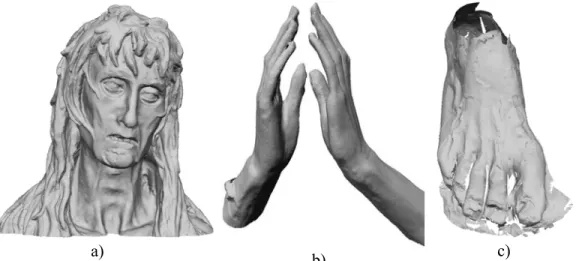
After the second high-resolution digitization for integrating the first rough model, a set of sub-models were completed, as shown in figure 1. The head (figure 1a) was the only model accurately edited in order to use it for multimedia presentations and demos, while the model of the face (figure 1b) and of the foot (figure 1c), were done at the maximum level of resolution and left unedited for avoiding fake data to be added. A high resolution model of the whole figure was then completed (figure 2b).
a) b) c)
Figure 1 – Partial models: a) head; b) hands; c) right foot. Both a and b acquired with horizontal resolution 0.25 mm, σz=70 µm; c with horizontal resolution of 0.1 mm and σz=21 µm
MODEL BENCHMARKING
A photogrammetry survey project was arranged for evaluating the correctness of the 3D model obtained after the integration stage (usually the final one in most 3D modeling projects). Stereo couples made with close range photogrammetry allowed to measure the relative distances between fully identifiable key points visible in stereoscopy, such as for example wood-worm holes. It was possible to compare them with the values measured on the model obtained with three-dimensional scanning.
From the detailed results of this comparison [1], it was evident that the distance between points belonging to the bust, as the distance between the right eye and the elbows, or the distance between arms, are in good agreement with both measurement techniques. Such agreement is due to a good alignment on the upper part of the statue, where point clouds have no significant gaps. Conversely, the typical discontinuous surface of the lower part of the statue, led to fragmented scans, whose alignment was more complex and involved wider errors, although the portion of overlapping surface between adjacent images was of the same order of the other scans. This was confirmed by the measurements from the right eye to the left foot, that emphasize a compression of the 3D model with respect to the photogrammetric survey.
SENSOR FUSION
The error detection on the first model stimulated the research of an improved alignment method, integrating the high density and high accuracy data coming out of the range camera for a little volume, with few selected points at high accuracy over the whole sculpture’s height. It was specially designed for delicate objects that cannot be touched as any ancient statue, differently by other techniques involving markers attached on the object surface. This was first developed in the lab with a mannequin [2], and afterwards applied to the Maddalena’s data with some integrating acquisitions.
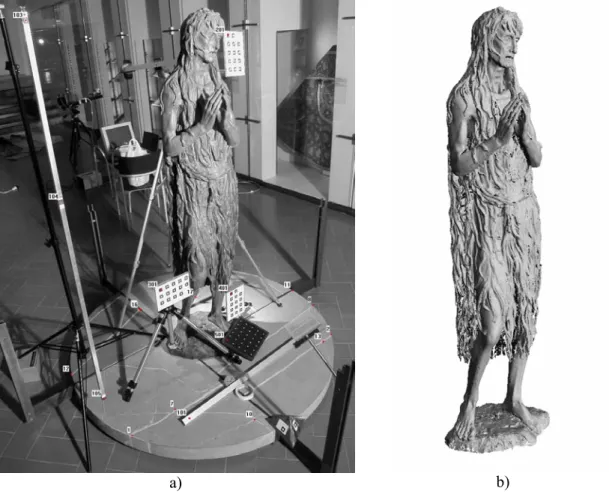
Four targeting plates were located around the statue with tripods. Big care was taken in order to avoid any contact between the plates and the sculpture. The plates positions were determined by choosing surface portions at the two far ends of the object (near the neck and at the bottom), in order to fix the final model height, and in a couple of central areas near the knees, where major errors reported in table 1 were found. The targeting plates were acquired with the range camera, framing in each image most of the plate together with an object surface portion large enough to be properly aligned with previously acquired range maps. From these acquisitions a redundant number of target centroids (i.e. more than 3) was obtained in the range camera coordinate system.
a) b)
Figure 2 – Maddalena 3D modeling: a) Image taken for photogrammetry; b) 3D model of the whole statue
Nine images analogous to fig. 2a were then taken with the digital camera, three of which were used for photogrammetry. These highly convergent images were then processed with the ShapeCapture program that allowed to locate the points corresponding to the different targets centroids, this time in a global coordinate system for the whole sculpture.
After the 3D scanning and photogrammetry sessions, a set of target centroids for each of the four range maps was available in two reference systems. Four rigid pose matrices (from the local to the global reference) were therefore calculated with high accuracy thanks to redundancy, through the Quaternion method [3].
Starting from these pre-aligned range maps, all the remaining 374 were then aligned through the Polyworks package, generating a second version of the model apparently equal to the first one but more accurate.
Finally some test measurements made on the Maddalena 3D model before and after the photogrammetry integration were compared with the first photogrammetry. Distances farer from the reference values reduced their discrepancy from some millimeters to tens of microns, as well as most distances already in good agreement, containing the maximum overall disagreement below 0.5 mm, and making evident an accuracy increase of about one order of magnitude.
CONCLUSIONS
In this paper, the acquisition of a high accuracy 3D digital model of a masterpiece of Donatello, Maddalena, kept in Florence, Italy, has been described. Modeling of Maddalena has represented a severe test for the performance of 3D digital acquisition technique. The statue exhibits extremely complex three-dimensional features that initially involved a lack of modeling accuracy by using conventional techniques. For overcoming such problems, a combination of range camera and photogrammetry was developed, in order to merge the good local accuracy and point density of the former, with the extraordinary overall accuracy of the latter. The methodology does not endanger the work of art (i.e. non invasive).
The subsequent steps of the acquisition procedure have been reported, describing the method required to refer all the photogrammetric and optical scanning data in a unique reference system. As a result, the overall dimension of the artwork, whose major size measures 1.80 meters, was modeled with a maximum vertical deviation of the order of few tenth of millimeter.
ACKNOWLEDGMENT
The authors wish to express their deep gratitude to dr. Anna Mitrano, president of the Opera del Duomo in Florence, whose precious support made possible the implementation of this work by permitting the access to the Donatello’s Maddalena in the Opera’s Museum. The stimulating collaboration of dr. Patrizio Osticresi, secretary of the Opera del Duomo, is also acknowledged.
The photogrammetric mesurements would have not been possible without the valuable support of Grazia Tucci, Daniele Ostuni and Fabrizio Costantino. Sabry El Hakim from NRC Canada gave also precious suggestions for carrying out the final digital photogrammetry.
Finally, the authors acknowledge the valuable collaboration of Valentina Damato during her stay at the University of Florence within her PhD fellowship.
REFERENCES
[1] Guidi G., Ostuni D., Costantino F., Pieraccini M., Tucci G., Beraldin J.-A.,
Photogrammetry and 3D scanning: assessment of metric accuracy for the digital model of Donatello's Maddalena, Italy-Canada Workshop on 3D Digital Imaging and
Modeling Applications of: Heritage, Industry, Medicine & Land, Padua, 3-4 April 2001.
[2] G. Guidi, J.-A. Beraldin, S. Ciofi, C. Atzeni, Fusion of range camera and
photogrammetry: a systematic procedure for improving 3D models metric accuracy,
accepted for publication on the IEEE Trans. on Systems, Man, and Cybernetics.
[3] B.K.P. Horn, Closed-form solution of absolute orientation using unit quaternions, J.