Publisher’s version / Version de l'éditeur:
Journal of Sound and Vibration, 16, 4, pp. 615-622, 1971-06
READ THESE TERMS AND CONDITIONS CAREFULLY BEFORE USING THIS WEBSITE. https://nrc-publications.canada.ca/eng/copyright
Vous avez des questions? Nous pouvons vous aider. Pour communiquer directement avec un auteur, consultez la première page de la revue dans laquelle son article a été publié afin de trouver ses coordonnées. Si vous n’arrivez pas à les repérer, communiquez avec nous à [email protected].
Questions? Contact the NRC Publications Archive team at
[email protected]. If you wish to email the authors directly, please see the first page of the publication for their contact information.
NRC Publications Archive
Archives des publications du CNRC
This publication could be one of several versions: author’s original, accepted manuscript or the publisher’s version. / La version de cette publication peut être l’une des suivantes : la version prépublication de l’auteur, la version acceptée du manuscrit ou la version de l’éditeur.
Access and use of this website and the material on it are subject to the Terms and Conditions set forth at
Dynamic ground compliance in multistorey buildings
Rainer, J. H.
https://publications-cnrc.canada.ca/fra/droits
L’accès à ce site Web et l’utilisation de son contenu sont assujettis aux conditions présentées dans le site LISEZ CES CONDITIONS ATTENTIVEMENT AVANT D’UTILISER CE SITE WEB.
NRC Publications Record / Notice d'Archives des publications de CNRC:
https://nrc-publications.canada.ca/eng/view/object/?id=82bbb9f6-3af9-4647-8f0a-2847281fd794 https://publications-cnrc.canada.ca/fra/voir/objet/?id=82bbb9f6-3af9-4647-8f0a-2847281fd794
Ser
TH1
N21r2
no.485
c.2
BLDG
A N A L Y ~ E D
NATIONAL RESEARCH COUNCIL OF CANADA CONSEIL NATIONAL DE RECHERCHE$ DU CANADA
DYNAMIC GROUND COMPLIANCE
IN
MULTISTOREY BUILDINGS
Reprinted from Journal of Sound and Vibration
Vol. 16, No. 4, June 1971 Pages 6 15-622 Research Paper N o . 485
of the
Division of Building Research
OTTAWA June 1971
'
BUILDING RESEARCH-
L I E R A R Y
-
f
JUL
26
1971
.NATIONAL RESEARCH C O U N C I L N R C C 11977 Price 25 centsACTION DYNAMIQUE RECIPROQUE ENTRE LE SOL ET LES
STRUCTURES DANS LE CAS DES BATIMENTS A MULTIPLES
ETAGES
L'article Ctudie les changements dans les caracteristiques du mode nature1 de vibration des bgtiments i multiples etages appuyCs sur des fondations flexibles. Le probleme est d'abord fornlulC comme un problbme standard de frequence propre applique au cas d'amortissement proportionnel. Ensuite, des expressions generales des changements dans les frequences naturelles et d e la forme des modes naturels sont dCrivCes pour la thCorie d e vibration lineaire. Au moyen d'un exemple, il est demontre, cependant, que seul le premier mode correspond i~ la prediction des changements de frequence et de la forme des modes pour Lln large eventail de rigidit6 de fondation. Les modes superieurs devient d e faqon importante du comportement lineaire. Cette ddviation est attribuee aux changements gComCtriques de la forme des modes naturels.
J. Sound Vib. (1971) 16 (4), 615-622
,$'I
y
d M n -
DYNAMIC GROUND COMPLIANCE IN MULTISTOREY
BUILDINGS
Division of Building Researcl~, National Research Council of Canada, Ottawa 7, Canada
(Received 24 October 1970)
A study is presented of the changes in the characteristics of the natural modes of vibration for multistorey structures which are founded on flexible foundations. First a standard eigenvalue problem is formulated for the proportionally damped case. Then general relationships of changes in natural frequencies and mode shapes are derived for the linear vibration theory. By means of an example problem it is demonstrated, however, that only the first mode obeys the predicted changes of frequencies and mode shapes over a wide range of foundation stiffness. The higher modes are shown to deviate substantially from the linear behaviour. This deviation is ascribed to geometric changes in mode shapes.
1. INTRODUCTION
An understanding of the interaction between a structure and its supporting ground is of importance in the design of safer structures and foundations subjected to earthquake motions, and also in the interpretation of full-scale measurements of dynamic properties of structures. The influence of flexible foundations also needs to be considered in satisfying critical performance requirements of structures such as radio telescopes, nuclear reactor vessels and tower structures under dynamic loads.
Two approaches have commonly been used in the study of dynamic effects of flexible foundations: (i) calculation of changes of forces and deformations in a structure when sub- jected to arbitrary disturbances, as, for example, in references [l, 21; (ii) determination of changes in natural modes of vibration with varying foundation stiffnesses, as in references [3, 4, 51. Although the former approach appears to offer the most direct solution to the problem, it has the disadvantage that certain interaction effects are likely to be obscured by the random nature of the disturbance chosen. As the resonance frequencies of a structure are modified with varying base flexibilities, the shifts in frequencies can result in large changes of response-either amplification or reduction-depending on the frequency content of the particular disturbance chosen. It is thus possible that effects arising from a flexible foundation are overshadowed by response changes that are due merely to shifts in the resonance fre- quencies ofthe structure. The natural modes of vibration, on the other hand, are characteristic of the structure and its support conditions alone. The modal approach therefore offers a greater likelihood of arriving at generalizations regarding the effects of a flexible foundation on the dynamic behaviour of the structure. With a knowledge of the mode shapes and frequencies, the response to given disturbances can then be estimated by various procedures of modal superposition [6].
This paper presents a method of modal analysis for multistorey structures with rocking flexibility in the foundations. First, a standard eigenvalue problem is formulated, from which mode shapes and natural frequencies can be calculated. Second, relationships are derived to predict the changes in the normal modes and frequencies of vibration of multistorey structures with various amounts of foundation rocking flexibility if the fixed-base mode shapes and
61 6 J. H. RAINER
frequencies are known. The range of applicability of the derived relationships is then investigated by means of an example problem.
A question that arises in connection with modal analysis is the influence of damping. For the exact applicability of conventional modal analysis, proportional damping is required, i.e., the damping matrix is to be a linear combination of the mass and stiffness matrix for the structure 171. With the inclusion of foundation flexibility and foundation damping, this assumption will generally not be satisfied. For the small levels of structural damping present in most buildings and foundations, however, the i d u e n c e of non-proportional damping on the mode shapes can be assumed to be small. Furthermore it is not yet possible to assign realistic values to foundation nor to structural damping.
In this analysis it has also been assumed that the foundation and structural properties are frequency independent. From results of previous theoretical studies for single-storey [8,9] as well as multistorey structures 121, this assumption is judged to be reasonable.
2. MATHEMATICAL MODEL FOR EIGENVALUE PROBLEM
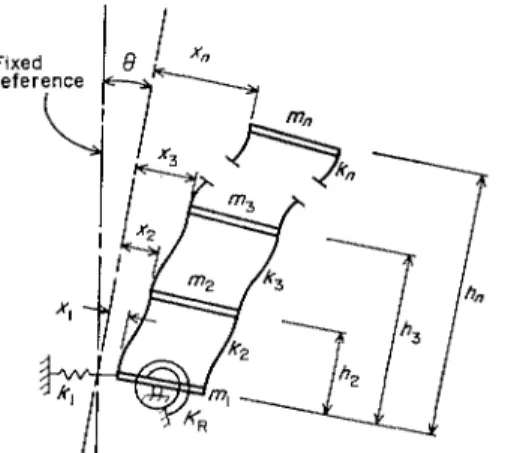
The type of structure under investigation is represented by the idealized model shown in Figure 1, which consists of n masses, m, to m,, and n interstorey springs with stiffnesses k, to k,. No restriction is placed on the nature of the interstorey stiffnesses: they may be of the
Figure 1. Multistorey structure with ground flexibility.
shear-type, flexural type, or a combination of both. This implies that all terms in the fixed- base stiffness matrix may be non-zero. The base mass nz, rests on a flexible foundation whose rotational capacity is characterized by the rotational stiffness KR, or conversely, the rotational flexibility f,. The condition where the base mass m , is restrained from horizontal movement can be treated simply by eliminating the equation of motion and the coordinate that pertains t o the base mass.
The equations of motion under arbitrary base disturbance are as follows. For relative horizontal displacements :
M x
+
CB+
Kx = -M(ii,+
he;). (1 For rotation about the base:dTx
+ J O +
cRe+
~ , e = - d , i i , ,@I
where bold capital letters denote square matrices, bold lower case letters denote colu~nn matrices, and the superscript T denotes the transpose of a matrix; ha = mass matrix of structure with horizontal flexibilities only, C = damping matrix, K = stiffness matrix, d =
GROUND COMPLIANCE I N BUILDINGS 617 {m, h, , m2h2,
.
.
.,
m,,h,,)T, x = {x,.
.
.
xnIT = interstorey displacement vector, h = {/I,. . .
hnIT =n n
storey heights above base, do =
2
mi hi, J = Jo+
2
m i ht, zlg = ground displacement, i= 1 i= 1Jo = sum of the mass moments of inertia of storey slabs about their own axis of rotation,
CR
= rotational damping coefficient,KR
= rotational spring stiffness, 8 = angular displace- ment coordinate and dots over a variable refer to differentiation with respect to time.To formulate a standard eigenvalue problem for the calculation of natural frequencies and mode shapes,
ii, is set to zero. Under the assumption of proportional damping, the mode
shapes are the same as for the undamped case; thus C andCR
can be omitted from the eigen- value problem. However, the mass and stiffness matrices are required to be symmetrical for the whole system, which consists of equations (1) and (2). If equations (1) and (2) are re- written asM'ji* +Kax" = 0 ,
where (3)
then for sinusoidal free vibration, equation (3) becomes
M*
-
K*] X* = 0, (4)where a * ' = diag(wT2, wZ2,
.
. .
w::,) are the natural modal frequencies for the structure with foundation flexibility. Equation (4) is now in the form of a standard eigenvalue problem, which can be solved for the eigenvalues and mode shapes by available computer routines.3. DETERMINATION OF MODE SHAPES FROM FIXED BASE PROPERTIES
As an alternative to the eigenvalue calculations given above, a method of analysis is presented to determine the mode shapes of multistorey buildings with foundation compliance, making use of fixed-base modal properties. The range of applicability of this method is outlined later in the example problem.
Under conditions of free vibration and with the assumption of proportional damping,
C and
CR
are omitted from the eigenvalue calculation, and ii, = 0. In order to facilitate the subsequent analysis, it is further assumed that moments of inertia, Jo, of the masses about their own axis of rotation are negligible as compared to the terms2
mih:, so that J = dTh. Equations (1) and (2) then becomePremultiplication of equation (5) by dTM-I gives
The first two terms in equations (6) and (7) are seen to be identical; therefore,
A change of coordinates of the left-hand side of equation (8) into the modal coordinates q of the fixed-base structure gives [2]
618 J. H. RAINER and
eT = dT@.
@ is the modal matrix for the fixed-base structure, whose columns consist of the mode shapes +i of the natural modes of vibration. For convenience the mode shapes + i are normalized so that the top-storey components T,,, = 1. Note that
= Q2 = diag (w:, w:.
.
.,cot); (13) thus, equation (8) becomeseTQ2q=KRB. For any mode i, equation (14) can be rewritten as
If one recalls that ei = dT+i, where +i is the mode shape of the fixed-base structure, then h,,eiwf can be interpreted as the fixed-base overturning moment of the ith mode. Conse- quently, equation (16) expresses the equality between the ratio of the modal coordinate qi to the displacement of the top storey A,, Bi due to rigid body rotation, and the ratio of rotational stiffness to the fixed-base overturning moment of the ith mode.
Equation (1 6) can also be written as
where hi = KR/h,,ei is the square of the rigid-body rocking frequency of the equivalent single- degree-of-freedom rocking system, and h,, ei = equivalent moment of inertia of the fixed-base mode i. If the fundamental mode shape is a straight line, then
and
which is the geometric transfer portion of the moment of inertia of the structure about the base.
4. CHANGES I N FREQUENCIES O F NATURAL MODES WITH BASE ROTATION
Equation (17) shows that the relation between the fixed-base frequency and the pure rocking frequency is exactly that derived by Balan et al. [l 11 for a single-storey structure with foundation rocking. I t is further shown in reference [l 11 that the ratio of fixed-base natural frequency w to the combined natural frequency w* is given by
where h is the rocking frequency. The same relationship was derived by Merritt and Housner [I]. Since equation (17) is derived for any mode i, equation (19) can also be generalized to any mode i. Thus
wi/wT = [I
+
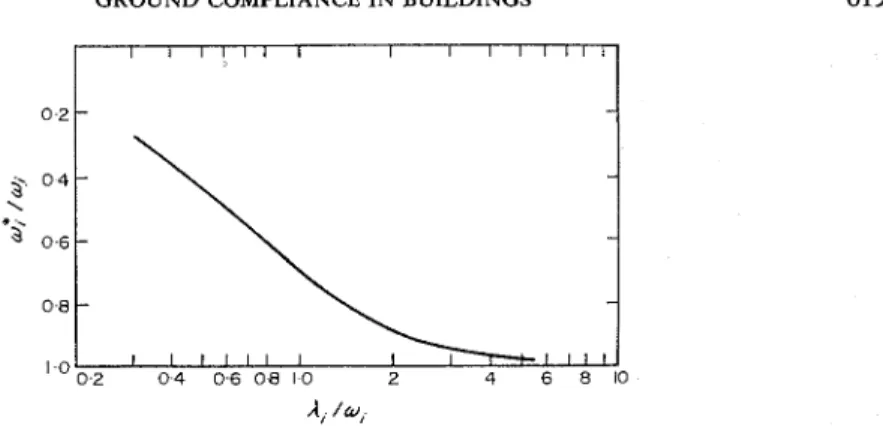
W ? / X ~ ] ' / ~ . (20) The curve for equation (20) is plotted in Figure 2. With the aid of Figure 2 or equation (20) it is thus possible within their range of applicability to find the combined natural frequencies of structures with rotational foundation flexibility.GROUND COMPLIANCE IN BUILDINGS
s
4 'u,
Figure 2. Frequency reduction for foundation rocking systems. Plot is given by w,/w: = (1
+
w:/X:)'/*.Implicit in the derivation of equation (16) and consequently of equation (20) is the assump- tion that the mode shape of relative displacements remain constant with the incorporation of rotational ground flexibility. For the higher modes this assumption is satisfied only for small rotational flexibilities. This will be demonstrated in the following numerical example.
5. EXAMPLE PROBLEM
The flexibility matrix for horizontal loads applied in the short direction of the Administra- tion Building of the Department of Agriculture, Ottawa, Canada, was used to investigate natural modes of vibration with various degrees of rotational foundation flexibility. The building is of flat slab construction with columns and shear walls, and has 13 full storeys and two penthouse floors. The flexibility matrix used is that of model 3b, Table 1 of reference [5],
+Angular +Relot~ve +Angular
+
Relative +Angular+
Relatlve dlsplocement d~splocement dlsplocement dlsplocement dlsplocement dlsplocementFigure 3. Mode shapes with foundation rocking flexibility. (a) Fundamental mode. 0-0, Fixed base, f~ = 0.01, f~ = 0.1;
-,
fR = 0.1; ----, fR = 0.01. (b) Second mode. 0-0, Fixed base; e---e, --,fR = 0.1; A - - - A , ----, fR = 0.01. (c) Third mode. 0-0, Fixed base; e---e, -, fR = 0.1; A - - - - A ,
---- , f ~ = 0.01. Note: all values of fR should be multiplied by 2.51 x 10-l2 rad/in Ib.
corresponding to a combined cantilever shear-frame system. Further structural details may be obtained from reference [5].
The mode shapes of the first three modes obtained from the eigenvalue problem of equation (4) are shown in Figure 3 for various values of foundation flexibility fR. The largest value of fR considered is one for which the rotational deformation at the top floor is comparable to
the relative displacement of the structure in the first mode.
From Figure 3(a) it may be observed that the relative displacements of the first mode remain essentially constant with increasing rotational flexibilities. Noticeable changes are
620 J. H. RAINER
evident, however, in the mode shapes of relative displacements for the second and third modes presented in Figure 3(b) and (c), respectively. This shows that the assumption of constant mode shape is satisfied for the first mode throughout the full range of foundation flexibilities considered, but is not satisfied for the larger values of flexibilities for the second and third modes.
The validity of the proportionality expressed by equation (16) can be established quantita- tively by evaluating equation (12) using the relevant quantities from the eigenvalue calcula- tion. If in equation (12) the actual mode shapes of relative displacement
+,
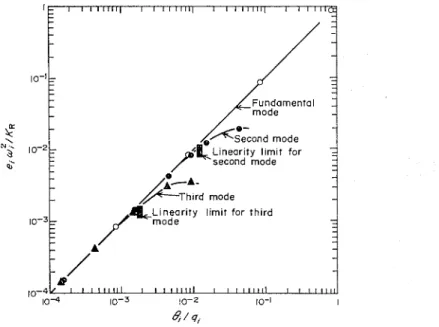
associated with a combined mode are used, instead of the original fixed-base mode shape +i, one obtains a measure of the deviation from the linearity expressed by equation (16). The values of Bi/qi vs. ei w:/K, obtained for the first three modes are plotted on a log-log scale in Figure 4.N< 10-2
ai-
10-3
Figure 4. Linearity test for example problem.
It may be observed that the first mode satisfies the proportionality of equation (16) through- out the range of values for f, considered, whereas for the higher modes the proportionality applies only to small values off,. Furthermore, the region of applicability of equation (16) decreases with increasing mode number. This deviation from the linearity of equation (16) is a direct result of the changes in mode shapes of relative displacements as the foundation flexibility increases. This can be seen from the results presented in Figure 3(b) and (c).
The deviation from linearity also affects the changes in modal resonant frequencies as given by equation (20). Table 1 shows a comparison between values of the frequency ratio oi/o: from the results of the eigenvalue calculation and those computed from equation (20). Here
Ji
is the total moment of inertia for mode i,For the first mode the two values agree well up to the largest value of f, considered, but substantial deviations are shown for the second mode after f, > 0.1 x and for the third mode after f, > 0.1 x With the aid of the comparisons of values in Table 1 and the curves of Figure 4, for practical purposes the limits of proportionality and consequently the limits of applicability of equations (16) and (20) can be assigned judiciously. Suggested limits are indicated in Figure 4 by the heavy lines. For the quantitative evaluation of the influence
Colnparison ofpredicted a11d colnputed natrtral frequencies
Total Square of
Fixed-based equivalent Rocking Computed fixed-based
natural inertia, J , flexibility, f, natural rocking
Mode frequency, w, (x 3.07 x 101° (x 2.51 x 10-l2 frequency, w r frequency, h: w,/w: from
622 J. H. RAINER
of rotational flexibility beyond these limits, the eigenvalue calculation of equation (4) or a Stodola iteration method can be used [5].
The results from the example problem are applicable to other multistorey buildings of similar construction. Jennings [12] has shown that the first three measured mode shapes of some eight multistorey buildings ranging from 9 to 44 storeys are very similar. The first mode can be approximated by a straight line and the inflection points of the second and third modes agree closely. For these buildings the behaviour of the fundamental mode of vibration with foundation rocking can therefore be predicted by the linear relationship of equation (16), whereas the applicability of equation (16) to the higher modes would be restricted to small foundation rocking flexibilities.
6. SUMMARY AND CONCLUSION
Two methods of analysis for the natural modes of multistorey buildings with rotational foundation flexibility are presented. The mode shapes and natural frequencies are computed by means of an eigenvalue formulation, and relationships are derived to predict the rotational component and changes in natural frequencies when the fixed-base mode shapes and fre- quencies are known. It is demonstrated that the latter method will predict the mode shapes and natural frequencies for the fundamental mode for a wide range of foundation flexibilities. Due to changes in mode shapes with increasing foundation flexibilities, however, higher modes show deviations from the linear relationships derived.
ACKNOWLEDGMENTS
The author is grateful to H. S. Ward, Research Officer, Division of Building Research, NRC, for making available the flexibility matrix for the example problem. This paper is a contribution of the Division of Building Research, National Research Council of Canada, and is published with the approval of the Director of the Division.
REFERENCES
1. R. G. MERRITT and G. W. HOUSNER 1954 Bull. seism. Soc. Am. 44, 551. Effect of foundation compliance on earthquake stresses in multistory buildings.
2. R. A. PARMELEE, D. S. PERELMAN and S. L. LEE 1969 Bull. seism. Soc. Am. 59, 1061. Seismic response of multiple-story structures on flexible foundations.
3. R. SHEPHERD and R. A. H. DONALD 1968 Proc. 5th Australia-New Zealarzd Conference on Soil Mechanics arzd Formclntior~ Erzgirzeering, p. 205-12. Foundation deformation effects in stri~ctural dynamic analysis.
4. D. J. PALMER 1969 N.Z. Er~gng 24,337. The effect of ground compliance on the free vibration of shear buildings.
5. H. S. WARD 1969 Proc. Irzstn ciu. Engrs43,553. Dynamiccharacteristics of a multi-storey concrete building.
6. R. W. CLOUGH 1926 Bull. seism. Soc. Am. 52, 647. Earthquake analysis by response spectrum superposition.
7. T. K. CAUGHEY 1960 J. nppl. Mech. 27,269. Classical normal modes in damped linear dynamic systems.
8. D. S. PERELMAN, R. A. PARMELEE and S. L. LEE 1968 J. strrtct. Diu. Am. Soc. ciu. Etzgrs 94,2597. Seismic response of single-story interaction systems.
9. J. H. RAINER (to be published) Structure-ground interaction in earthquakes.
10. W. C. HURTY and M. F. RUBINSTEIN 1964 Dynamics of Structures. New Jersey: Prentice Hall, Inc.
11. S. BALAN, M. IFRIM and C. PACOSTE 1966 Itzternational Symposium on the Efects of Repeated Loading of Materials and Structures, Mexico City, Sept. 1966 (RILEM). Dynamic equivalent of anti-seismic structures considering the deformability of the foundation ground.
12. P. C. JENNINGS 1969 Fourth World Conference ott Earthquake Engineering, Santiago, Chile, Session A-3. Spectrum techniques for tall buildings.
This publication is being distributed by the Division of Building Research of the National Research Council of Canada. It should not be reproduced in whole or in part without permission of the original publisher. The Division would be glad to be of assistance in obtaining such permission.
Publications of the Division may be obtained by mailing the appropriate remittance (a Bank, Express, or Post Office Money Order, or a cheque, made payable to the Receiver General of Canada, credit NRC) to the National Research Council of Canada, Ottawa.
KIA 0 R 6 .
A list of all publications of the Division is available and may be obtained from the Publications Section, Division of Building Research, National Research Council of Canada, Ottawa. K1A 0 R 6 .