HAL Id: hal-00303158
https://hal.archives-ouvertes.fr/hal-00303158
Submitted on 2 Nov 2007HAL is a multi-disciplinary open access
archive for the deposit and dissemination of sci-entific research documents, whether they are pub-lished or not. The documents may come from teaching and research institutions in France or abroad, or from public or private research centers.
L’archive ouverte pluridisciplinaire HAL, est destinée au dépôt et à la diffusion de documents scientifiques de niveau recherche, publiés ou non, émanant des établissements d’enseignement et de recherche français ou étrangers, des laboratoires publics ou privés.
Evaluation of model-simulated source contributions to
tropospheric ozone with aircraft observations in the
factor-projected space
C. Shim, Y. Wang, Y. Yoshida
To cite this version:
C. Shim, Y. Wang, Y. Yoshida. Evaluation of model-simulated source contributions to tropospheric ozone with aircraft observations in the factor-projected space. Atmospheric Chemistry and Physics Discussions, European Geosciences Union, 2007, 7 (6), pp.15495-15532. �hal-00303158�
ACPD
7, 15495–15532, 2007 Evaluation of simulated contributions to tropospheric O3 C. Shim et al. Title Page Abstract Introduction Conclusions References Tables Figures ◭ ◮ ◭ ◮ Back CloseFull Screen / Esc
Printer-friendly Version Interactive Discussion
Atmos. Chem. Phys. Discuss., 7, 15495–15532, 2007 www.atmos-chem-phys-discuss.net/7/15495/2007/ © Author(s) 2007. This work is licensed
under a Creative Commons License.
Atmospheric Chemistry and Physics Discussions
Evaluation of model-simulated source
contributions to tropospheric ozone with
aircraft observations in the
factor-projected space
C. Shim1,*, Y. Wang1, and Y. Yoshida2,3
1
Department of Earth and Atmospheric Sciences, Georgia Institute of Technology, 311 Ferst Drive, Atlanta, GA 30332, USA
2
Goddard Earth Science and Technology Center, University of Maryland, Baltimore County, Baltimore, MD 21228, USA
3
The Atmospheric Chemistry and Dynamics Branch, NASA Goddard Space Flight Center, Greenbelt, MD 20771, USA
*
now at: Jet Propulsion Laboratory, California Institute of Technology, 4800 Oak Grove Drive Pasadena, CA 91109, USA
Received: 4 October 2007 – Accepted: 18 October 2007 – Published: 2 November 2007 Correspondence to: C. Shim ([email protected])
ACPD
7, 15495–15532, 2007 Evaluation of simulated contributions to tropospheric O3 C. Shim et al. Title Page Abstract Introduction Conclusions References Tables Figures ◭ ◮ ◭ ◮ Back CloseFull Screen / Esc
Printer-friendly Version Interactive Discussion
Abstract
Trace gas measurements of TOPSE and TRACE-P experiments and corresponding global GEOS-CHEM model simulations are analyzed with the Positive Matrix Factor-ization (PMF) method for model evaluation purposes. Specially, we evaluate the model simulated contributions to O3 variability from stratospheric transport, intercontinental
5
transport, and production from urban/industry and biomass burning/biogenic sources. We select a suite of relatively long-lived tracers, including 7 chemicals (O3, NOy, PAN, CO, C3H8, CH3Cl, and
7
Be) and 1 dynamic tracer (potential temperature). The largest discrepancy is found in the stratospheric contribution to 7Be. The model underesti-mates this contribution by a factor of 2–3, corresponding well to a reduction of 7Be
10
source by the same magnitude in the default setup of the standard GEOS-CHEM model. In contrast, we find that the simulated O3 contributions from stratospheric
transport are in reasonable agreement with those derived from the measurements. However, the springtime increasing trend over North America derived from the mea-surements are largely underestimated in the model, indicating that the magnitude of
15
simulated stratospheric O3source is reasonable but the temporal distribution needs im-provement. The simulated O3 contributions from long-range transport and production
from urban/industry and biomass burning/biogenic emissions are also in reasonable agreement with those derived from the measurements, although significant discrepan-cies are found for some regions.
20
1 Introduction
Tropospheric O3 has important environmental consequences. Photolysis of O3 and the subsequent reaction of O(1D) with water vapor (H2O) in troposphere produces the
hydroxyl radical (OH), which is the most important oxidant in troposphere. This tro-pospheric oxidation by OH determines the lifetime of major greenhouse gases such
25
as methane (CH4). The sources of tropospheric O3 include photochemical
ACPD
7, 15495–15532, 2007 Evaluation of simulated contributions to tropospheric O3 C. Shim et al. Title Page Abstract Introduction Conclusions References Tables Figures ◭ ◮ ◭ ◮ Back CloseFull Screen / Esc
Printer-friendly Version Interactive Discussion
tion within the troposphere and transport from the stratosphere. Many studies have investigated the main sources to tropospheric O3. Springtime O3increase is attributed to photochemical production (e.g., Penkett and Brice, 1986 and Liu et al., 1987). A number of studies using 3-D chemical transport models have focused on the effect of intercontinental transport on tropospheric O3concentrations from Asia to North
Amer-5
ica (e.g., Berntsen et al., 1999; Jaffe et al., 1999; Jacob et al., 1999; Bey et al., 2001). The effect of trans-Pacific transport is particularly noticeable in the spring (e.g., Jacob et al., 1999; Mauzerall et al., 2000; Wild and Akimoto, 2001; Tanimoto et al., 2002; Wang et al., 1998, 2006). On the other hand, the studies based on the observed corre-lations between O3and
7
Be attributed this trend to transport of stratospheric O3(e.g.,
10
Oltmans and Levy, 1992; Dibb et al., 1994).
The observed relationships between tropospheric O3and CO provide additional
di-agnosis of O3 sources (e.g., Fishman and Seiler, 1983; Chameides et al., 1987;
Par-rish et al., 1993). Furthermore, those relationships between simulated CO and O3offer a reasonable way to evaluate model simulations of O3(e.g., Chin et al., 1994). Later
15
studies using the positive matrix factorization (PMF) method, an advanced multi-variant factor analysis, enabled better quantifications of source contributions to tropospheric O3 and diverse volatile organic compounds (Wang et al., 2003b; Shim et al., 2007).
PMF analysis of the measurements obtained during the Tropospheric Ozone Produc-tion about the Spring Equinox (TOPSE) experiment found that the increasing seasonal
20
trend of springtime O3 at northern mid and high latitudes is attributed more to
tropo-spheric O3production and transport, even though O3 transport from the stratosphere
is the largest contributor to O3variability (Wang et al., 2003b).
One drawback noted in the study by Wang et al. (2003b) is that the PMF results can-not be directly compared to 3-D model results. In this work, we apply the PMF method
25
to the simulation results of a global 3-D chemical transport model (GEOS-Chem). As such, we can compare the PMF results to model simulations and evaluate the perfor-mance of GEOS-Chem on the basis of aircraft measurements. A main issue is how model simulated factor contributions to O3 variability compare with those based on
ACPD
7, 15495–15532, 2007 Evaluation of simulated contributions to tropospheric O3 C. Shim et al. Title Page Abstract Introduction Conclusions References Tables Figures ◭ ◮ ◭ ◮ Back CloseFull Screen / Esc
Printer-friendly Version Interactive Discussion
the measurements. Unlike direct comparisons between observed and simulated trace gases, measurements and corresponding model results are first projected with PMF onto the factor space before model evaluation. In the factor space, a suite of chemi-cals can be evaluated simultaneously in a consistent and objective manner, which is difficult to achieve using direct comparisons between the measurements and model
re-5
sults. Aircraft measurements from two aircraft field campaigns, TOPSE and TRAnsport of Chemical Evolution over the Pacific (TRACE-P, March–April 2001) experiments are used. We describe data selections from TOPSE and TRACE-P and GEOS-CHEM sim-ulations in Sect. 2.1. The PMF method is explained in Sect. 2.2. Evaluation of model results in the projected factor space is discussed in Sect. 3. Conclusions are given in
10
Sect. 4.
2 Methodology
2.1 Measurements and GEOS-Chem simulations
Figure 1 shows the measurement regions during TOPSE and TRACE-P. The TOPSE experiment (February–May 2000) was conducted to investigate the photochemical
15
transition during spring at northern mid and high latitudes (Atlas et al., 2003). The TRACE-P experiment (March–April 2001) was conducted to investigate the Asian out-flow to the Pacific (Jacob et al., 2003). Both experiments took place during spring when significant transport of O3from the stratosphere is expected (e.g., Wang et al., 1998b and references therein)
20
In this study, we analyze relatively long-lived chemical tracers including O3, total
re-active nitrogen (NOy), peroxyacetylnitrate (PAN), CO, C3H8, CH3Cl, and Beryllium-7 (7Be) and one dynamic tracer (potential temperature). Those tracers other than O3
generally have specific primary source characteristics. NOy is a good tracer for air
masses influenced by tropospheric NOxemissions or transport from the stratosphere.
25
PAN is produced during oxidation of >C2hydrocarbons and its lifetime increases rapidly
ACPD
7, 15495–15532, 2007 Evaluation of simulated contributions to tropospheric O3 C. Shim et al. Title Page Abstract Introduction Conclusions References Tables Figures ◭ ◮ ◭ ◮ Back CloseFull Screen / Esc
Printer-friendly Version Interactive Discussion
with increasing altitude. Therefore, it is a good tracer for photochemically aged air masses in the free troposphere. CO is for combustion influence and C3H8is a good liq-uefied gas tracer. CH3Cl has its major sources from terrestrial biosphere and biomass
burning (Yoshida et al., 2004, 2006). 7Be is produced mainly by cosmic rays in the stratosphere and upper troposphere and is generally used as a tracer for stratospheric
5
air mass (Dibb et al., 2003). Potential temperature is a useful dynamic tracer since it is conserved in adiabatic processes. The analytical approach for the observed species is similar to the work by Wang et al. (2003b), but the number of chemicals used is smaller because only measured species that are also simulated by GEOS-Chem are selected. The resulting discrepancies with the previous work by Wang et al. (2003b)
10
will be discussed in Sect. 3.
Photochemical and dynamical environments vary dramatically with latitude. We sep-arate the analysis regions to low, mid, and high latitudes. The TOPSE measurement data set is over mid (40–60◦N, 87–104◦W) and high latitudes (60–85◦N, 61–94◦W). We consider only coincident measurements, which are mostly limited by availability of
15
7
Be measurements (144 coincident data points of all selected tracers for mid latitudes and 200 data points for high latitudes). We exclude missing data because including large amounts of missing data (by assigning a large uncertainty to these data) would lead to a large underweight of the7Be measurements and a loss of7Be and O3
correla-tion signal (Wang et al., 2003b). The7Be and O3correlation is critical for analyzing the
20
effect of stratospheric transport. The selected data have a bias towards high altitudes of 5–8 km (∼70% of the data); therefore the evaluation results are more relevant for the middle and upper troposphere. The TRACE-P measurements data set is over mid lati-tudes (30–45◦N, 125–240◦E, 65 data points) and low latitudes (15–30◦N, 120–205◦E, 78 data points). The selected data also have a bias towards 7–12 km (40–50% of the
25
data) due to the availability of7Be measurements.
GEOS-Chem is a global 3-D chemical transport model driven by assimilated me-teorological data from the Global Modeling Assimilation Office (GMAO) (Schubert et al., 1993). The 3-D meteorological fields are updated every six hours, and the
sur-ACPD
7, 15495–15532, 2007 Evaluation of simulated contributions to tropospheric O3 C. Shim et al. Title Page Abstract Introduction Conclusions References Tables Figures ◭ ◮ ◭ ◮ Back CloseFull Screen / Esc
Printer-friendly Version Interactive Discussion
face fields and mixing depths are updated every three hours. We use version 7.24 with a horizontal resolution of 2◦×2.5◦ and 30 vertical layers (GEOS-3 meteorological fields were used). GEOS-Chem includes a comprehensive tropospheric O3-NOx-VOC
chemical mechanism (Bey et al., 2001), which includes the oxidation mechanisms of 6 VOCs (ethane, propane, lumped >C3 alkanes, lumped >C2alkenes, isoprene, and
5
terpenes). Climatological monthly mean biomass burning emissions are from Duncan et al. (2003). The fossil fuel emissions are from the Global Emission Inventory Activ-ity (GEIA) for other chemical compounds (Benkovitz et al., 1996; Olivier et al., 2001). For standard simulations, the model was first spun up for one year. The GEOS-Chem simulations for the selected five tracers and one dynamic tracer (O3, NOy, PAN, CO,
10
C3H8, and potential temperature) are sampled at the same time and locations as the aircraft measurements. Simulated total reactive nitrogen (NOy) is estimated by the sum
of simulated NOx HNO3 (nitric acid), HNO4(pernitric acid), PAN, and N2O5(dinitrogen
pentoxide).
We follow Liu et al. (2001, 2004) in 7Be simulations. The 7Be source in
GEOS-15
Chem is taken from the study by Lal and Peters (1967) as a function of altitude and latitude and∼70% of7Be is emitted in the stratosphere. The seasonal and longitudinal dependence of 7Be productions is very small and not considered. The major sink of atmospheric 7Be is by wet deposition; the model considers scavenging in convective updrafts as well as first-order rainout and washout from both convective and large-scale
20
precipitation (Liu et al., 2001). Liu et al. (2004) reduced the stratospheric7Be source by a factor of 3. This simulation was first spun up for one year as well.
For model simulated CH3Cl, we used the GEOS-Chem results by Yoshida et al. (2004). Contributions from the six sources (pseudo-biogenic, oceanic, biomass burning, incineration/industrial, salt mash and wet land) are considered. The model
25
results are evaluated extensively with surface and aircraft measurements; the model simulations are usually in good agreement with measurements in the northern hemi-sphere.
In order to investigate the stratospheric O3contributions in the model, we conducted 15500
ACPD
7, 15495–15532, 2007 Evaluation of simulated contributions to tropospheric O3 C. Shim et al. Title Page Abstract Introduction Conclusions References Tables Figures ◭ ◮ ◭ ◮ Back CloseFull Screen / Esc
Printer-friendly Version Interactive Discussion
tagged O3 simulations to track the fractions of O3 transported from the stratosphere (Liu et al., 2002). Photochemistry is considered in the simulations by taking archived O3 production and loss rates from the GEOS-Chem standard simulations on a daily
basis. In this manner, when projecting simulated O3variability in the factor space using PMF, we can examine the fractional contribution from the stratosphere as compared to
5
tropospheric production (Sect. 3) in each factor.
2.2 PMF applications
The PMF method (Paatero and Tapper, 1994) explores factor categorization through the covariant structures of observed or simulated chemical and dynamical parameters (e.g., Paatero, 1997; Wang et al., 2003b; Liu et al., 2005). PMF generates only positive
10
factor contributions, which enables a better physical interpretation of the results. In contrast, conventional the principal component analysis method lumps positively and negatively correlated tracers together. The data matrix X of m measurements by n tracers are decomposed in PMF analysis for p factors as
X = GF + E (1) 15 Or xi j = p X k=1 gi kfkj+ ei j i =1, . . ., m; j=1, . . ., n; k=1, . . ., p. (2)
where the m by p matrix G is the mass contributions of kth factor to i th sample (factor score), the p by n matrix F is the gravimetric average contributions of kth factor to j th
20
chemical species (factor loadings), and the m by n matrix E is the error. In the PMF model, the solution is a weighted least squares fit, where the data uncertainties are used for determining the weights of the residuals in the error matrix. We also use the
ACPD
7, 15495–15532, 2007 Evaluation of simulated contributions to tropospheric O3 C. Shim et al. Title Page Abstract Introduction Conclusions References Tables Figures ◭ ◮ ◭ ◮ Back CloseFull Screen / Esc
Printer-friendly Version Interactive Discussion
explained variation (EV),
EVkj= m X i =1 |gi kfkj| " m X i =1 p X k=1 |gi kfkj| + |ei j| !# (3)
to define the relative contributions of each factor to chemical species since the mixing ratios of different compounds are directly comparable.
During PMF analysis, it is important to choose the number of factors that provide
5
physically meaningful results. In this analysis, the order factor is determined by sorting the center-of-mass locations of the G or F matrix in ascending order. By evaluating the error matrix E, we define the range of mathematically acceptable number of factors (Paatero et al., 2002). We then inspect the factor profiles to choose the number of factors that gives the best physically meaningful results. In general, we pick as small a
10
number of factors as possible to reduce the potential of overinterpreting of the dataset. Rotation is further used to improve factor separation (Paatero et al., 2002). However, the results presented in this work are insensitive to rotation.
As in the work by Wang et al. (2003b), the values of tracers are linearly scaled to a nondimensional range of 0–1 and assigned uniformly small uncertainty for the
15
dataset. The scaling is applied because the chemical and dynamical tracers have very different scales that affect the least square fitting in PMF. By scaling and assigning a uniform uncertainty, we assure that all tracers are weighted equally in the PMF analysis. In the analysis, we selected only coincident measurements of the selected tracers and corresponding model results. Missing measurement data are not used in order
20
to reduce the uncertainty in the analysis. Following the procedure described above, PMF resolved 5 factors for TOPSE and 4 factors for TRACE-P in both observed and simulated datasets.
PMF was often used for source apportionments of surface aerosols (e.g., Lee et al., 1999). For that purpose, it is often necessary to assume that the composition of the
25
air mass from a specific source does not change during transport. That assumption is unnecessary in this analysis since we evaluate how the simulated contributions to
ACPD
7, 15495–15532, 2007 Evaluation of simulated contributions to tropospheric O3 C. Shim et al. Title Page Abstract Introduction Conclusions References Tables Figures ◭ ◮ ◭ ◮ Back CloseFull Screen / Esc
Printer-friendly Version Interactive Discussion
tropospheric ozone from different processes compare to the contributions derived from observations. Obviously the chemical characteristics of air masses are affected by transport. Our previous analyses (Wang et al., 2003b; Shim et al., 2007) indicate that although some collocated sources are mixed during transport, clear air mass separa-tion based on the covariance of chemical and dynamical tracers can be obtained. We
5
did not find evidence that transport and mixing “create” chemically distinct air mass.
3 Results and discussion
3.1 TOPSE
As mentioned in Sect. 2.1, the TOPSE results are biased toward the middle and upper troposphere. In order to capture the correlation between the stratospheric O3and
7
Be
10
using PMF, we have included the data points that have O3 concentrations >100 ppbv
(5% of the data set), which are generally associated with the lower stratospheric air. When analyzing the PMF results, however, we only use data points with O3<100 ppbv
to minimize the effect of these lower stratospheric data (Wang et al., 2003b). The simulated O3 mixing ratios do not exceed 100 ppbv. We analyze the datasets for mid
15
(40–60◦) and high (60–85◦) latitudes separately. 3.1.1 TOPSE at mid latitudes
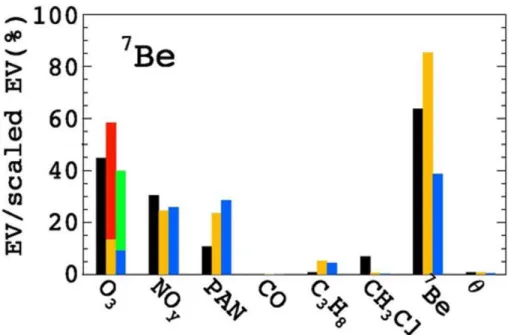
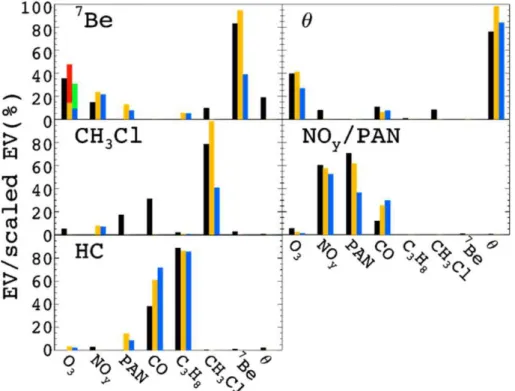
PMF derived EV profiles from the observed and simulated datasets for TOPSE mid latitudes are shown in Fig. 2. Each factor is named after the tracers that show the largest variability (7Be, θ, CH3Cl, NOy/PAN, and hydrocarbons). The figure shows
20
reasonably consistent factor profiles between observed and simulated datasets (black and yellow/red bars). Direct comparison of the EV profiles between the observed and simulated datasets can be misleading when the simulated variability differ significantly from the observations. For the simulated datasets, we therefore also show the scaled
ACPD
7, 15495–15532, 2007 Evaluation of simulated contributions to tropospheric O3 C. Shim et al. Title Page Abstract Introduction Conclusions References Tables Figures ◭ ◮ ◭ ◮ Back CloseFull Screen / Esc
Printer-friendly Version Interactive Discussion
EV profiles (blue/green bars in Fig. 2–6) by the following equation,
EVkj scaled= m X i =1 |gi kfkj| ! model " m X i =1 p X k=1 |gi kfkj| + |ei j| !# measurements (4)
The7Be factor in Fig. 2 shows the largest variability of 7Be for both observations and model (60% and 237 fCi/SCM for the observations, 85% and 188 fCi/SCM for the model), indicating the stratospheric origin of the air masses. The stratospheric O3
frac-5
tion from tagged O3 simulation in this factor show ∼75% of the stratospheric origin,
and a small fraction of the tropospheric7Be origin (∼25%), due likely to upper tropo-spheric7Be production, which is also evident in the small fractions of PAN in this factor. The7Be factor is associated with the largest O3 variability at mid latitudes (40% and
20 ppbv for the observations, 58% and 14 ppbv for the model). A notable
underestima-10
tion in the simulated7Be mean concentration is found (435 and 234 fCi/SCM for the observations and model, respectively). Figure 3 shows the7Be factor profiles when the measurements with [O3]>100 ppbv are included. The results are similar to Fig. 2. The
scaled EV of O3for the model (green bar) is lower because the observed O3variability is higher.
15
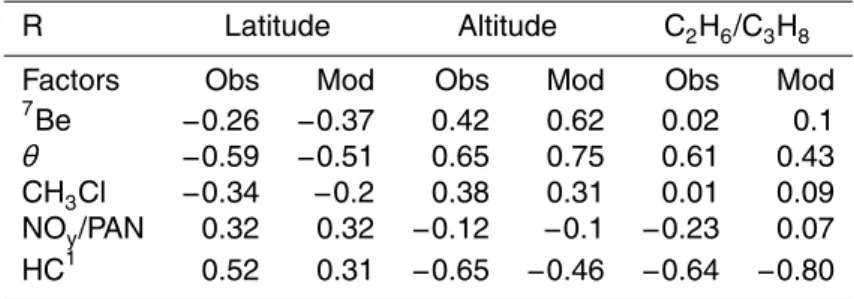
We examine the factor correlations with latitudes, altitude, and C2H6/C3H8 ratio in
order to further investigate the factor characteristics (Table 1). The higher C2H6/C3H8 ratio reflects photochemically aged air masses (Wang and Zeng, 2004). The positive correlations of the7Be factor with altitude (r=0.42 and 0.62 for the observed and sim-ulated datasets, respectively) are expected for a factor dominated by transport from
20
the stratosphere. The weak negative correlations with latitude (r=−0.26 and −0.37) indicate that stratosphere-troposphere exchange is likely more active at lower latitudes in 40–60◦N region.
The potential temperature (θ) factor has large variability of θ (77% and 36.4 K for the observations, 95% and 26.8 K for the model). It explains 14% of observed O3
vari-25
ability (3.6 ppbv) and 12.8% of simulated O3 variability (3.1 ppbv). The negative factor
correlations with latitude (r=−0.59 and −0.51 for the observed and simulated datasets, 15504
ACPD
7, 15495–15532, 2007 Evaluation of simulated contributions to tropospheric O3 C. Shim et al. Title Page Abstract Introduction Conclusions References Tables Figures ◭ ◮ ◭ ◮ Back CloseFull Screen / Esc
Printer-friendly Version Interactive Discussion
respectively) and CO (r=−0.64 and −0.52, respectively, not shown in the table), and positive correlations with altitudes (r=0.65 and 0.75, respectively) and C2H6/C3H8ratio
(r=0.61 and 0.43, respectively) imply that this factor is likely associated with intercon-tinental long-range transport of O3 from lower latitudes, which is consistent with the result by Wang et al. (2003b).
5
The CH3Cl factor is characterized by large signals of CH3Cl (78% and 41.2 pptv
for the observations, 95% and 25.1 pptv for the model), and no O3 variability is ex-plained by this factor. This factor contains significant CO variability, which can imply the biomass burning influence. However, the very small factor correlations with C2H6/C3H8
ratio (r=0.01 and 0.09), and negative correlation with latitude (r=−0.34 and −0.2) may
10
support the large biogenic CH3Cl emissions from the tropics (e.g., Yoshida et al., 2004, 2006) rather than biomass burning.
The NOy/PAN factor has large signals of NOy (44% and 120 pptv for the
tions, 74% and 160 pptv for the model) and PAN (68% and 96.3 pptv for the observa-tions, 45% and 63.4 pptv for the model). This factor is the second important factor for
15
tropospheric O3 variability at mid latitudes (25.6% and 6.6 ppbv for the observations,
18.4% and 4.4 ppbv for the model). It correlates positively with latitude (r=0.32 and 0.32 for the observed and simulated datasets, respectively). The correlations with al-titude (r=−0.12 and −0.1) and C2H6/C3H8ratio (r=−0.23 and 0.07) are much weaker
compared to the hydrocarbon factor discussed below, implying that the factor
repre-20
sents long-range transport of reactive nitrogen.
The hydrocarbon factor is characterized by large variability of CO (48% and 26.8 ppbv for the observations, 54% and 21.3 ppbv for the model) and C3H8(90% and 360 pptv for the observations, 90% and 272 pptv for the model). There is no contribu-tion to tropospheric O3variability. It positively correlates with latitude (r=0.52 and 0.31
25
for the observed and simulated datasets, respectively). Clear negative correlations with altitudes (r=−0.65 and −0.46, respectively) and C2H6/C3H8 ratio (r=−0.64 and
−0.8, respectively) reflect the influence of relatively fresh emissions from the surface at higher latitude in 40–60◦N region (Table 1).
ACPD
7, 15495–15532, 2007 Evaluation of simulated contributions to tropospheric O3 C. Shim et al. Title Page Abstract Introduction Conclusions References Tables Figures ◭ ◮ ◭ ◮ Back CloseFull Screen / Esc
Printer-friendly Version Interactive Discussion
3.1.2 TOPSE at high latitudes
Five factors are identified for high latitudes (7Be, θ, CH3Cl, NOy/PAN, and
hydrocar-bons; Fig. 4). As mid latitudes, there is also significant difference in 7Be variability between observations and simulation (415 fCi/SCM and 206 fCi/SCM, respectively) in the 7Be factor, reflecting serious underestimation of 7Be by GEOS-Chem. Liu et
5
al. (2001) artificially scaled down the stratospheric 7Be source by a factor of ∼3 in order to adjust for some surface measurements of 7Be. However, the simulated 7Be mean concentrations and the variability accounted for in the 7Be factor show consis-tent underestimations by about a factor of 2 in TOPSE and TRACE-P (to be shown) datasets. It implies that the factor of 3 reduction in the stratospheric7Be source in the
10
standard GEOS-Chem model is too large.
The7Be factor shows comparable O3variabilities between observations and
simula-tion (34% and 13.7 ppbv for the observasimula-tions, 45% and 12.4 ppbv for the model). The stratospheric O3 fraction from the tagged O3 simulation suggests that∼70% is of the
stratospheric origin (Fig. 4). The tropospheric fraction is∼30% in this factor. The
pos-15
itive correlations with altitude (r=0.48 and 0.4, respectively) and negative correlations with CO (r=−0.41 and −0.38, not shown in the table) support its stratospheric origin (Table 2).
The potential temperature (θ) factor shows large variabilities of θ (77% and 29 K for the observations, 98% and 32.6 K for the model). Its contributions to O3 levels are
20
as much as that of the7Be factor (39% and 15.4 ppbv for the observations, 41% and 10.7 ppbv for the model), which is different from mid latitudes. The positive correlation with altitude (r=0.51 and 0.55, respectively) and C2H6/C3H6 ratio (r=0.22 and 0.4,
respectively) indicates that this factor is likely associated with transport of reactive-nitrogen poor air masses from lower latitudes. Tagged O3 simulation shows that O3
25
variability accounted for in this factor is produced in the troposphere (orange bar). The CH3Cl factor is characterized by large signals of CH3Cl (78% and 38.6 pptv for
the observations, 98% and 20.3 pptv for the model), but its contribution to O3variability
ACPD
7, 15495–15532, 2007 Evaluation of simulated contributions to tropospheric O3 C. Shim et al. Title Page Abstract Introduction Conclusions References Tables Figures ◭ ◮ ◭ ◮ Back CloseFull Screen / Esc
Printer-friendly Version Interactive Discussion
is insignificant. This factor is positively correlated with altitude (r=0.38 and 0.46 for the observed and simulated datasets, respectively), which is consistent with long-range transport of high CH3Cl air masses since there are no significant sources of CH3Cl at
high latitudes.
The NOy/PAN factor has large signals of NOy (60% and 135 pptv for the
observa-5
tions, 57% and 119 pptv for the model) and PAN (72% and 132 pptv for the observa-tions, 62% and 67.5 pptv for the model). This factor also has clear chemical signals of CO but not7Be, implying that the air masses are influenced by industrial/fossil fuel emissions at high latitudes (Table 2). This factor, however, contributes to less than 5% of O3 variability, reflecting the largely inactive photochemical environment at high
10
latitudes in spring (Wang at al., 2003a).
The hydrocarbon factor is characterized by a large variability of CO (40% and 12.2 ppbv for the observations, 62% and 22.5 ppbv for the model) and C3H8(90% and
314 pptv for the observations, 88% and 297 pptv for the model). It does not contribute to tropospheric O3 variability. Just as mid latitudes, the negative correlations with
al-15
titude (r=−0.43 and −0.49, respectively) and C2H6/C3H8 ratio (r=−0.77 and −0.79,
respectively) reflect air masses affected by relatively fresh emissions (Table 2).
3.1.3 Springtime O3trends at northern mid and high latitudes
Understanding the contributions to the seasonal O3trend is another important purpose
of this study. As stated in Sect. 2.1, this study analyzed only eight tracers due to the
lim-20
ited availability of simulated tracers, while the previous study (Wang et al., 2003b, here-after referred to as the previous study) included fourteen tracers with seven factors. At mid latitudes, the seasonal increase of all factors of measurements is 6.48 ppbv/month (Table 3), consistent with the previous study (6.3 ppbv/month). The largest contributor to the O3 seasonal trend is the NOy/PAN factor (3.55 ppbv/month, Table 3) followed
25
by the7Be factor (2.66 ppbv/month). That is also consistent with the previous study (3.5 ppbv/month, and 2.5 ppbv/month, respectively). In contrast, the simulated overall
ACPD
7, 15495–15532, 2007 Evaluation of simulated contributions to tropospheric O3 C. Shim et al. Title Page Abstract Introduction Conclusions References Tables Figures ◭ ◮ ◭ ◮ Back CloseFull Screen / Esc
Printer-friendly Version Interactive Discussion
seasonal increase is only 3.01 ppbv/month, indicating a large underestimation. The in-crease from the NOy/PAN factor is underestimated (1.32 ppbv/month in the model), and
the7Be factor increase is also much smaller than that of observation (1.29 ppbv/month in the model).
At high latitudes, the overall springtime increase from the measurements is
5
4.29 ppbv/month (Table 3), comparable with the previous study (4.6 ppbv/month). In comparison, the simulated increase is only 1.3 ppbv/month, indicating a significant un-derestimation. The most contributions to the seasonal increases at high latitudes are from7Be, θ, and NOy/PAN factors (1.78, 1.16, and 1.10 ppbv/month, respectively) in
the measurement dataset. In comparison, the corresponding trends in the model are
10
much lower (0.76, 0.77, and 0.11 ppbv/month). The underestimation is particularly large for the NOy/PAN factor, implying that simulated O3production in reactive-nitrogen
rich air masses does not increase as much as in the observations. The negative O3 trend in the hydrocarbon factor in the simulation but not in the measurements is a likely reflection of the problematic simulations of its major components (C2H6 and C3H6) in
15
May by GEOS-Chem (Wang and Zeng, 2004).
The NOy/PAN factor trend is consistent with the previous study. However, the
contributions of 7Be and θ factors are different from those of the previous study (0.8 ppbv/month and 0.6 ppbv/month, respectively). The previous study had additional tracers resulting in the CH4-halocarbon factor. It accounts for transport from lower
20
latitudes, which contributes to the largest increase of O3at 1.7 ppbv/month at high
lati-tudes. In this study, that large increase trend is apportioned into the7Be and θ factors since we do not have CH4 and halocarbon (other than CH3Cl) simulations in
GEOS-Chem. Because the PMF factor projections are for the same number of tracers, model results can still be evaluated in this analysis. The CH4-halocarbon factor contribution
25
to O3variability is, however, <10% (3 ppbv) at high latitudes in the previous study; thus
the effect of the missing factor on factor apportioned O3 variability is fairly insignificant
in this study.
During TOPSE, the major contributions to the seasonal O3increase in springtime is
ACPD
7, 15495–15532, 2007 Evaluation of simulated contributions to tropospheric O3 C. Shim et al. Title Page Abstract Introduction Conclusions References Tables Figures ◭ ◮ ◭ ◮ Back CloseFull Screen / Esc
Printer-friendly Version Interactive Discussion
from intercontinental transport of polluted air masses, while the major contributions to O3 variability is from the stratospheric influences and long-range transport of O3 from lower latitudes. While the model generally captures the factor contributions to O3, factor
contributions to the springtime increasing trend of O3in the measurements are severely
underestimated. These model underestimations are also consistent with the results by
5
Wang et al. (2006). Improvements in the seasonal transitions of cross-tropopause and intercontinental transport are needed in the model.
3.2 TRACE-P
The TRACE-P experiment was conducted to investigate the effects of Asian outflow to the Pacific during spring (Jacob et al., 2003). As mentioned in Sect. 2.1, the
TRACE-10
P results are biased toward the middle and upper troposphere (more than 40% of the data is above 7 km). Compared to TOPSE analysis, there are fewer coincident measurements limited mostly by the availability of7Be measurements (65 and 79 for mid and low latitudes, respectively). We analyze the datasets for low (15–30◦) and mid (30–45◦) latitudes separately.
15
3.2.1 TRACE-P at mid latitudes
Four factors are identified for mid latitudes (7Be, θ, CH3Cl, and NOy/hydrocarbons,
Fig. 5). The7Be factor shows larger O3variability in the observations than model re-sults (68% and 20.8 ppbv for the observations, 48.5 % and 13.8 ppbv for the model). There is also a large underestimation in simulated 7Be variability (428 fCi/SCM and
20
211 fCi/SCM, respectively) for the reason discussed in Sect. 3.1.2. The tagged O3 simulation shows that∼80% of O3variability in this factor is of the stratospheric origin.
While this factor in the simulated dataset showed a positive correlation with altitude (r=0.63), it has a much weaker correlation (r=0.12) in the measurements (Table 4). One possible reason for the large difference is that transport from the stratosphere
oc-25
ACPD
7, 15495–15532, 2007 Evaluation of simulated contributions to tropospheric O3 C. Shim et al. Title Page Abstract Introduction Conclusions References Tables Figures ◭ ◮ ◭ ◮ Back CloseFull Screen / Esc
Printer-friendly Version Interactive Discussion
the stratosphere-troposphere exchange occurs in regions farther away, further down-ward transport or mixing with low-altitude polluted air would reduce the gradients in altitude.
The potential temperature (θ) factor shows large signals of θ (87% and 26.3 K for the observations, 93% and 23.4 K for the model). The factor correlations in Table 4
char-5
acterize this factor as long-range transport of air masses from the tropics (r=0.79 and 0.67 with altitude for the observed and simulated datasets, respectively; and r=0.86 and 0.82 with C2H6/C3H8 ratio, respectively). While this factor accounts for 25.6% of O3 variability in the simulated datasets, it has no contribution in the measurement
dataset.
10
The CH3Cl factor is characterized by the large signals of CH3Cl (76% and 37.4 pptv for the observations, 95% and 42.2 pptv for the model). The contributions of this fac-tor to O3 variability are small in measured and simulated datasets. The significant
contributions to CO (65% and 74.5 ppbv for the observations, 38% and 26.6 ppbv for the model), negative correlations with altitude (r=−0.25 and −0.77, respectively) and
15
C2H6/C3H8ratio (r=−0.33 and −0.6 for the observed and simulated datasets,
respec-tively), and the reactive nitrogen signals suggest a strong influence from biomass burn-ing. This factor contributes to NOy vaiability (168 pptv) only in the simulated dataset,
and PAN variability (164 pptv) only in the observed dataset. Since PAN is an impor-tant component of NOy, the signal in PAN will propagate to become a signal of NOy.
20
However, another large component of NOy is HNO3, which can be removed rapidly by
wet deposition in the atmosphere. It appears to suggest that the scavenging of HNO3
(a major component of NOy) during transport and the production of PAN from biomass burning NOxare underestimated by the model. The stronger negative correlation of the
factor with altitude suggests that the altitude of biomass burning transport is lower in
25
the model. This model bias also leads to a higher negative correlation with C2H6/C3H8 as is found here because mixing with locally emitted C2H6 and C3H8tends to destroy
the negative correlation.
In TRACE-P analysis, the NOy/PAN and hydrocarbon factors in TOPSE are com-15510
ACPD
7, 15495–15532, 2007 Evaluation of simulated contributions to tropospheric O3 C. Shim et al. Title Page Abstract Introduction Conclusions References Tables Figures ◭ ◮ ◭ ◮ Back CloseFull Screen / Esc
Printer-friendly Version Interactive Discussion
bined (now NOy/hydrocarbon factor) because the separation of those factors leads to incomparable factor profiles between the measurements and model results. The NOy/hydrocarbon factor is characterized by a large variability of NOy(51% and 509 pptv
for the observations, 67% and 523 pptv for the model), PAN (40% and 195 pptv for the observations, 72% and 234 pptv for the model), CO (25% and 27.8 ppbv for the
ob-5
servations, 53% and 54.6 ppbv for the model), and C3H8 (78% and 335 pptv for the
observations, 87% and 461 pptv for the model). This factor shows a contribution to tropospheric O3variability only in the simulation (14.5%). This factor has negative
cor-relations with altitudes (r=−0.77 and −0.31 for the observed and simulated datasets, respectively) and C2H6/C3H8ratio (r=−0.64 and −0.16, respectively), likely reflecting
10
relatively the influence of fresh industrial/fossil fuel emissions over Asia (Table 4). The stronger negative correlations with C2H6/C3H8ratio and altitude in the measurements
than the simulations imply that mixing is too fast at low altitudes in the model.
3.2.2 TRACE-P at low latitudes
Four factors also are identified for low latitudes (7Be, θ, CH3Cl, and NOy/hydrocarbons,
15
Fig. 6). The 7Be factor shows smaller O3 variability in the measurements than the
model simulation (17.4% and 7.1 ppbv for the observations, and 30.8% and 9.9 ppbv for the model). Large underestimation by a factor of 3 is found in simulated7Be variability (411 fCi/SCM and 139 fCi/SCM for the observed and simulated datasets, respectively). There are no data with O3above 100 ppbv in both observations and simulation results
20
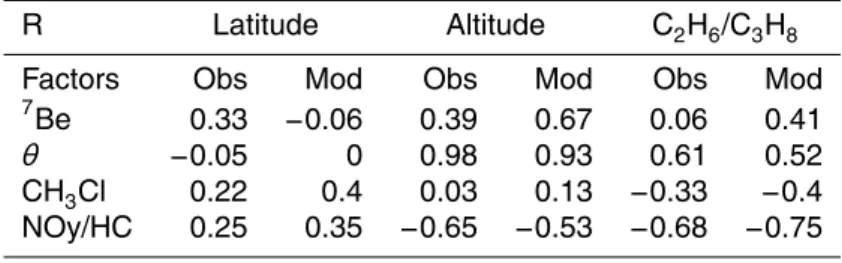
at low latitudes. The stratospheric O3 fraction from the tagged O3 simulation shows that∼50% is due to transport from the stratosphere, which is the smallest stratospheric influence among the datasets. The positive factor correlations with altitude (r=0.39 and 0.67, respectively) reflect in part the contribution from the stratosphere (Table 5). The weaker correlations with altitude and C2H6/C3H8 ratio in the observed than simulated
25
datasets likely reflect either a problem in the transport locations from the stratosphere or the mixing between stratospheric and tropospheric air masses in the model.
ACPD
7, 15495–15532, 2007 Evaluation of simulated contributions to tropospheric O3 C. Shim et al. Title Page Abstract Introduction Conclusions References Tables Figures ◭ ◮ ◭ ◮ Back CloseFull Screen / Esc
Printer-friendly Version Interactive Discussion
the observations, 77% and 23.2 K for the model). While the7Be factor is the largest contributor to simulated O3 variability at low latitudes, the θ factor is the largest
con-tributor to observed O3variability (27.4% and 11.1 ppbv for the observations, and 21% and 6.7 ppbv for the model). The model estimates a small stratospheric fraction of 15% in this factor. This factor contains small signals of simulated NOy, PAN, and CO,
5
which are absent in the observed dataset, indicating again that mixing of different air masses in the model is overestimated. The correlation coefficients are more consis-tent between observed and simulated datasets for this factor. The positive correlations with altitude (r=0.98 and 0.93 for the observed and simulated datasets, respectively) and C2H6/C3H8ratio (r=0.61 and 0.52, respectively) and negative correlations with CO
10
(r=−0.66 and −0.49, not shown in the table) suggest the dominance of photochemi-cally aged upper tropospheric air in this factor.
The CH3Cl factor is characterized by large signals of CH3Cl (81% and 39.7 pptv for the observations, 67% and 42 pptv for the model) and a significant contribution to O3 variability is found in this factor (24.6% and 9.9 ppbv for the observations, 15.7%
15
and 5 ppbv for the model). This factor contributes more to O3 in the observations than the model. The larger contribution in the observations is associated with CO (50% and 40.7 ppbv), NOy (53.7 pptv), and PAN (52 pptv). In comparison, this factor
in the simulated dataset has a smaller contribution from CO (22% and 17.4 ppbv) and negligible contributions from NOyand PAN. The observed profile is consistent with the
20
characteristics of biomass burning.
It appears that the contributions to PAN, NOy, and CO from biomass burning are attributed to the NOy/hydrocarbon factor in the model. Comparing the profiles between
CH3Cl and NOy/hydrocarbon factors, a major separation factor between these factors
is the correlation between C3H8 and CH3Cl. In both datasets, almost all the C3H8
25
signals are in the NOy/hydrocarbon factor. There is no correlation between C3H8and
CH3Cl in the observed dataset. Consequently there is no CH3Cl signal in the observed
NOy/hydrocarbon factor. The opposite is true in the simulated dataset, leading to a significant contribution to the CH3Cl variability (29% and 17 pptv). The inadequate
ACPD
7, 15495–15532, 2007 Evaluation of simulated contributions to tropospheric O3 C. Shim et al. Title Page Abstract Introduction Conclusions References Tables Figures ◭ ◮ ◭ ◮ Back CloseFull Screen / Esc
Printer-friendly Version Interactive Discussion
separation of C3H8 and CH3Cl in the model may result from two sources. The first is that mixing is overestimated in the model, which results in excessive mixing of biomass burning and industrial/urban air masses. The second is that the locations of biomass burning or industrial/urban sources are misplaced in the model, which also leads to unrealistic mixing.
5
The NOy/hydrocarbon factor is characterized by large variabilities of NOy (33% and
185 pptv for the observations, 60% and 376 pptv for the model), PAN (30% and 56.5 pptv for the observations, 55% and 94.3 pptv for the model), CO (40% and 34.2 ppbv for the observations, 57% and 49.6 ppbv for the model), and C3H8(85% and 172 pptv
for the observations, 75% and 234 pptv for the model). The factor contributions to
10
these trace gases are lower in the observations than the model results because some of the enhancements in the model are due in part to biomass burning emissions. In-terestingly, the factor contributions to tropospheric O3 variability are comparable in the
observations (16% and 6.5 ppbv) and model results (18.5% and 6 ppbv) even though the enhancements in NOy, PAN, and CO are higher in the model results. The two
15
datasets have comparable positive factor correlations with latitude (r=0.25 and 0.35 respectively), and large negative correlations with altitude (r=−0.65 and −0.53, re-spectively) and C2H6/C3H8 ratio (r=−0.68 and −0.75, respectively) indicating fresh
pollution plumes from East Asia.
4 Discussion and conclusions
20
Trace gas measurements of TOPSE and TRACE-P experiments are analyzed with the PMF method in order to evaluate the model performance in simulating source contri-butions to tropospheric O3variability and its springtime increase (during TOPSE). We select a suite of relatively long-lived variables, which are available both in observations and GEOS-Chem model: seven chemicals (O3, NOy, PAN, CO, C3H8, CH3Cl, and
7
Be)
25
and one dynamic tracer (potential temperature). The evaluation has a bias towards a high altitude of 5–8 km (∼70% of the data) for TOPSE and 7–12 km (∼50% of the data)
ACPD
7, 15495–15532, 2007 Evaluation of simulated contributions to tropospheric O3 C. Shim et al. Title Page Abstract Introduction Conclusions References Tables Figures ◭ ◮ ◭ ◮ Back CloseFull Screen / Esc
Printer-friendly Version Interactive Discussion
for TRACE-P, due to the availability of7Be measurements.
In general, the factor loadings between the observations and simulations are in better agreement during the TOPSE experiment than TRACE-P. The former experiment took place in remote regions. Therefore, the model results are not as sensitive to source locations as for the latter experiment. There are also slightly more data points
(deter-5
mined largely by the availability of7Be measurements) in the former experiment. We summarize the factor contributions to O3variability in Figs. 7 and 8.
The7Be factor is found in all regions. Among all the factors, the largest discrepancy is found in the variability of7Be, which is controlled largely by its source in the strato-sphere. The simulated results are a factor of 2–3 lower than those observed. The large
10
underestimation is due to the default reduction of the stratospheric7Be source by a factor of ∼3 in the model. Inadvertently, the default reduction provides a test for the PMF analysis.
Tagged O3 simulations in the model indicate that the O3 signal in the 7
Be factor is controlled largely (70–80%) by transport from the stratosphere at mid and high
lati-15
tudes. Only over the lower latitude does the stratospheric contribution drop to∼50%. The 7Be factor explains 34–40% of O3 variability in the measurement dataset
dur-ing TOPSE, in agreement with the simulated dataset. Durdur-ing TRACE-P, this factor contributes 68% and 17% at mid and low latitudes, respectively in the measurement dataset. In comparison, the contributions in the simulated datasets are also higher
20
at mid latitudes (49%) and lower at low latitudes (31%). In general, we find that the decrease of stratospheric O3 contributions (and the increase of tropospheric O3 con-tributions) from mid to low latitudes during TRACE-P are much larger in the measured than simulated datasets. One potential reason is that mixing is overestimated between mid and low latitudes in the model, reducing the gradients between the two latitude
25
bands.
Another common factor is the θ factor. There are consistent positive correlations of this factor with altitude and C2H6/C3H8 ratio, indicating long-range transport in the upper troposphere. The contribution of this factor to reactive nitrogen is small,
ACPD
7, 15495–15532, 2007 Evaluation of simulated contributions to tropospheric O3 C. Shim et al. Title Page Abstract Introduction Conclusions References Tables Figures ◭ ◮ ◭ ◮ Back CloseFull Screen / Esc
Printer-friendly Version Interactive Discussion
flecting likely chemical aging during transport. The large contribution to O3 variability at high latitudes during TOPSE (∼40%) in the measurement dataset is in agreement with the simulated dataset. In comparison, its contributions to mid latitudes during TOPSE are much lower in both datasets. During TRACE-P, there is no contribution from this factor to O3variability in the measurement dataset at mid latitudes. However,
5
26% contribution is found in the simulated dataset. A similar situation is found for the NOy/hydrocarbon factor. Excessive mixing between mid and low latitudes could explain some of the discrepancy. Further, the unresolved portion of O3 variability is ∼30% in
this case, much higher than the range of 11–19% in the other cases. Some of the unresolved portion is due to O3production in the troposphere.
10
A third common factor found is the CH3Cl factor. The contributions of this factor to O3are usually small. The exception is at low latitudes during TRACE-P, when biomass
burning contributes to both CH3Cl and O3. Some of the biomass burning contribution
in the simulated datasets is attributed to the NOy/hydrocarbon factor since simulated C3H8is correlated with CH3Cl. The latter correlation was not found in the measurement
15
dataset. Thus, we combine the CH3Cl and NOy/hydrocarbon factor contributions to O3
variability; it is somewhat higher in the measurement dataset (41%) than the simulated dataset (34%). As discussed previously, the difference can be reduced if mixing is reduced between mid and low latitudes in the model.
During TOPSE, the NOy/PAN factor is resolved separately from the hydrocarbon
fac-20
tor. The latter made no contribution to O3variability. The NOy/PAN factor contributions
are much higher at mid latitudes (18–26%) than high laitutdes (<5%) in measured and simulated datasets, reflecting more active photochemistry at mid latitudes in spring.
Since the TOPSE experiment last longer than TRACE-P, we compare the factor con-tributions to the seasonal trend of O3 in the observed and simulated datasets.
De-25
spite of reasonably good agreements in the averaged contributions, the trends of factor contributions are quite different. The observed springtime O3 increase is higher than
simulated by a factor 2 at mid latitudes (6.5 vs. 3 ppbv/month) and a factor of 3 at high latitudes (4.3 vs. 1.3 ppbv/month). The increasing trend from the stratospheric
contri-ACPD
7, 15495–15532, 2007 Evaluation of simulated contributions to tropospheric O3 C. Shim et al. Title Page Abstract Introduction Conclusions References Tables Figures ◭ ◮ ◭ ◮ Back CloseFull Screen / Esc
Printer-friendly Version Interactive Discussion
bution (the7Be factor) is underestimated by a factor of 2. The increasing trend from the tropospheric contribution is simulated well for the θ factor. However, the increasing trend from O3 production by reactive nitrogen (the NOy/PAN factor) is underestimated by a factor of >3 (3.5 ppbv/month vs. 1.3 ppbv/month at mid latitudes and 1 ppbv/month vs. 0.1 ppbv/month at high latitudes). These results suggest that more attention needs
5
to be placed on improving the simulations of the temporal trends of trace gases in chemical transport models.
Acknowledgements. This work was supported by the National Science Foundation Atmo-spheric Chemistry Program. The GEOS-CHEM model is managed at Harvard University with support from the NASA Atmospheric Chemistry Modeling and Analysis Program.
10
References
Atlas, E. L., Ridley, B. A., and Cantrell, C.: Tropospheric Ozone Production about the Spring Equinox (TOPSE) Experiment: Introduction, J. Geophys. Res., 108(D4), 8353, doi:10.1029/2002JD003172, 2003.
Benkovitz, C. M., Schwartz, C. E., Jensen, M. P., et al.: Global gridded inventories of
an-15
thropogenic emissions for sulfur and nitrogen, J. Geophys. Res., 101(D22), 29 239–29 253, 1996.
Berntsen, T. K., Karlsdo’ttir, S., and Jaffe, D. A.: Influence of Asian emissions on the compo-sition of air reaching the northwestern United States, Geophys. Res. Lett., 26, 2171–2174, 1999.
20
Bey, I., Jacob, D. J., Yantosca, R. M., et al.: Global modeling of troposheric chemistry with assimilated meteorology: Model description and evaluation, J. Geophys. Res., 106, 23 073– 23 096, 2001.
Chameides, W. L., Davis, D. D., Rodgers, M. O., et al.: Net ozone photochemical production over the eastern and central north Pacific as inferred from CTE/CITE 1 observations during
25
fall 1983, J. Geophys. Res., 92, 2131–2152, 1987.
Chen, P.: Isentropic cross-tropopause mass exchange in the extratropics, J. Geophys. Res., 100, 16 661–16 673, 1995.
ACPD
7, 15495–15532, 2007 Evaluation of simulated contributions to tropospheric O3 C. Shim et al. Title Page Abstract Introduction Conclusions References Tables Figures ◭ ◮ ◭ ◮ Back CloseFull Screen / Esc
Printer-friendly Version Interactive Discussion
Chin, M., Jacob, D. J., Munger, J. W., et al.: Relationship of ozone and carbon monoxide over North America, J. Geophys. Res., 99, 14 565–14 573, 1994.
Dibb, J. E., Meeker, L. D., Finkel, R. C., et al.: Estimation of stratospheric input to the Arctic troposphere: 7Be and 10Be in aerosols at Alert, Canada, J. Geophys. Res, 99, 12 855– 12 864, 1994.
5
Dibb, J. E., Talbot, R. W., Scheuer, E., et al.: Stratospheric influence on the northern North American free troposphere during TOPSE:7Be as a stratospheric tracer, J. Geophys. Res., 108(D4), 8363, doi:10.1029/2001JD001347, 2003.
Duncan, B. N., Martin, R. V., Staudt, A. C., et al.: Interannual and seasonal variability of biomass burning emissions constrained by satellite observations, J. Geophys. Res., 108(D2),
10
4100, doi:10.1029/2002JD002378, 2003.
Fishman, J. and Seiler W.: Correlative nature of ozone and carbon monoxide in the tropo-sphere: Implications for the tropospheric ozone budget, J. Geophys. Res., 88, 3662–3670, 1983.
Holton, J. R., Haynes P. H., McInyre E. M., et al.: Stratosphere-troposphere exchange, Rev.
15
Geophys, 33, 403–439, 1995.
Jacob, D. J., Logan, J. A., and Murti, P. P.: Effect of rising Asian emissions on surface ozone in the United States, Geophys. Res. Lett., 26, 2175–2178, 1999.
Jacob, D. J., Crawford, J. H., Kleb, M. M., et al.: Transport and Chemical Evolution over the Pacific (TRACE-P) aircraft mission: Design, execution, and first results, J. Geophys. Res.,
20
108(D20), 1–19, 2003.
Jaffe, D., Anderson, T., Covert, D., et al.: Transport of Asian air pollution to North America, Geophys, Res. Lett., 26, 711–714, 1999.
Lee, E., Chan, C. K., and Paatero, P.: Application of positive matrix factorization in source ap-portionment of particulate pollutants in Hong Kong, Atmos. Environ., 33, 3201–3212, 1999.
25
Liu, H., Jacob, D. J., Bey, I., and Yantosca, R. M.: Constraints from210Pb and 7Be on wet deposition and transport in a global three-dimensional chemical tracer model driven by as-similated meteorological fields, J. Geophys. Res., 106, 12 109–12 128, 2001.
Liu, H., Jacob, D. J., Chan, L. Y., et al.: Sources of tropospheric ozone along the Asian Pa-cific Rim: An analysis of ozonesonde observations, J. Geophys. Res., 107(D21), 4573,
30
doi:10.1029/2001JD002005, 2002.
Liu, H., Jacob, D. J., Dibb, J. E., Fiore, A. M., et al.: Constraints on the sources of tropospheric ozone from 210Pb-7Be-O3 correlations, J. Geophys. Res., 109, D07306,
ACPD
7, 15495–15532, 2007 Evaluation of simulated contributions to tropospheric O3 C. Shim et al. Title Page Abstract Introduction Conclusions References Tables Figures ◭ ◮ ◭ ◮ Back CloseFull Screen / Esc
Printer-friendly Version Interactive Discussion
doi:10.1029/2003JD003988, 2004.
Liu, S. C., Trainer, M., Fehsenfeld, F. C., et al.: Ozone production in the rural troposphere and the implications for regional and global ozone distributions, J. Geophys. Res., 92, 4191– 4207, 1987.
Liu, W., Wang, Y., Russell, A., et al.: Atmospheric aerosols over two urban-rural pairs in
south-5
eastern United States: Chemical composition and sources, Atmos. Environ., 39, 4453–4470, 2005.
Logan, J. A.: Tropospheric ozone: Seasonal behavior, trends, and anthropogenic influence, J. Geophys. Res., 90, 10 463–10 482, 1985.
Mauzerall, D. L., Narita, D., Akimoto, H., et al.: Seasonal characteristics of tropospheric ozone
10
production and mixing ratios over East Asia: A global three dimensional chemical transport model analysis, J. Geophys. Res., 105, 17 895–17 910, 2000.
Olivier, J. G. J. and Berdowski, J. J. M.: Global emissions sources and sinks, in: The Climate System, edited by: Berdowski, J., Guicherit, R., and Heij, B. J., A. A. Balkema Publish-ers/Swets and Zeitlinger Publishers, Lisse, The Netherlands, ISBN 90-5809-255-0, 33–78,
15
2001.
Oltmans, S. J. and Levy II., H.: Seasonal cycle of surface ozone over the western North Atlantic, Nature, 358, 392–394, 1992.
Paatero, P. and Tapper, U.: Positive Matrix Factorization: a non-negative factor model with optimal utilization of error estimates of data values, Environmetrics, 5, 111–126, 1994.
20
Paatero, P.: Least squares formulation of robust non-negative factor analysis, Chemomet. Intell. Lab. Sys., 37, 23–35, 1997.
Paatero, P., Hopke, P. K., Song, X.-H., et al.: Understanding and controlling rotations in factor analytic models, Chemomet. Intell. Lab. Sys., 60, 253–264, 2002.
Parrish, D. D., Holloway, J. S., Trainer, M., et al.: Export of North American ozone pollutions to
25
the North Atlantic Ocean, Science, 259, 1436–1439, 1993.
Penkett, S. A. and Brice, K. A.: The spring maximum in photo-oxidants in the Northern Hemi-sphere tropoHemi-sphere, Nature, 319, 655–657, 1986.
Shim, C., Wang, Y., Singh, H. B., et al.: Source characteristics of oxygenated volatile organic compounds and hydrogen cyanide, J. Geophys. Res., 112, D10305,
30
doi:10.1029.2006JD007543, 2007.
Tanimoto, H., Wild, O., Kato, S., et al.: Seasonal cycles of ozone and oxidized nitrogen species in northeast Asia: 2. A model analysis of the roles of chemistry and transport, J. Geophys.
ACPD
7, 15495–15532, 2007 Evaluation of simulated contributions to tropospheric O3 C. Shim et al. Title Page Abstract Introduction Conclusions References Tables Figures ◭ ◮ ◭ ◮ Back CloseFull Screen / Esc
Printer-friendly Version Interactive Discussion
Res., 107(D23), 4706, doi:10.1029/2001JD001497, 2002.
Wang, Y., Jacob, D. J., and Logan, J. A.: Global simulation of tropospheric O3-NOX -hydrocarbon chemistry, 3. origin of troposheric ozone and effects of non-methane hydro-carbons, J. Geophys. Res., 103, 10 757–10 767, 1998b.
Wang, Y., Liu, S. C., Wine, P. H., et al.: Factors Controlling Tropospheric O3, OH, NOx, and
5
SO2over the Tropical Pacific during PEM-Tropics B, J. Geophys. Res., 106, 32 733–32 748, 2001.
Wang, Y., Ridley, B., Fried, A., et al.: Springtime photochemistry at northern mid and high latitudes, J. Geophys. Res., 108(D4), 8358, doi:10.1029/2002JD002227, 2003a.
Wang, Y., Shim, C., Blake, N., et al.: Intercontinental transport of pollution manifested in the
10
variability and seasonal trend of springtime O3 at northern middle and high latitudes, J. Geophys. Res., 108(D21), 4683, doi:10.1029/2003JD003592, 2003b.
Wang, Y. and Zeng, T.: On tracer correlations in the troposphere: The case of ethane and propane, J. Geophys. Res., 109, D24306, doi:10.1029/2004JD005023, 2004.
Wang, Y., Choi, Y. S., Zeng, T., et al.: Late-spring increase of trans-Pacific pollution transport
15
in the upper troposphere, Geosphys. Res. Lett., 33, L01811, doi:10.1029/2005GL024975, 2006.
Wild, O. and Akimoto, H.: Intercontinental transport of ozone and its precursors in a three-dimensional global CTM, J. Geophys. Res., 106, 27 729–27 744, 2001.
Yoshida, Y., Wang, Y. H., Zeng, T., et al.: A three-dimensional global model study of
20
atmospheric methyl chloride budget and distributions, J. Geophys. Res., 109, D24309, doi:24310.21029/2004JD004951, 2004.
ACPD
7, 15495–15532, 2007 Evaluation of simulated contributions to tropospheric O3 C. Shim et al. Title Page Abstract Introduction Conclusions References Tables Figures ◭ ◮ ◭ ◮ Back CloseFull Screen / Esc
Printer-friendly Version Interactive Discussion Table 1. The factor scores correlations (r) with latitude, altitude, and C2H6/C3H8 for TOPSE
mid latitudes.
R Latitude Altitude C2H6/C3H8 Factors Obs Mod Obs Mod Obs Mod
7 Be −0.26 −0.37 0.42 0.62 0.02 0.1 θ −0.59 −0.51 0.65 0.75 0.61 0.43 CH3Cl −0.34 −0.2 0.38 0.31 0.01 0.09 NOy/PAN 0.32 0.32 −0.12 −0.1 −0.23 0.07 HC1 0.52 0.31 −0.65 −0.46 −0.64 −0.80
Extreme factor scores (outside 2σ range) and the measurements that have O3 greater than 100 ppbv are excluded.1HC denotes the hydrocarbon factor.
ACPD
7, 15495–15532, 2007 Evaluation of simulated contributions to tropospheric O3 C. Shim et al. Title Page Abstract Introduction Conclusions References Tables Figures ◭ ◮ ◭ ◮ Back CloseFull Screen / Esc
Printer-friendly Version Interactive Discussion Table 2. Same as Table 1, but for TOPSE high latitudes.
R Latitude Altitude C2H6/C3H8 Factors Obs Mod Obs Mod Obs Mod
7 Be −0.08 −0.08 0.48 0.4 0.25 0.11 θ −0.1 −0.2 0.51 0.55 0.22 0.4 CH3Cl −0.07 −0.2 0.38 0.46 0.18 −0.18 NOy/PAN 0.16 0.07 0.02 −0.34 0.25 −0.14 HC1 −0.08 0.04 −0.43 −0.49 −0.77 −0.79
ACPD
7, 15495–15532, 2007 Evaluation of simulated contributions to tropospheric O3 C. Shim et al. Title Page Abstract Introduction Conclusions References Tables Figures ◭ ◮ ◭ ◮ Back CloseFull Screen / Esc
Printer-friendly Version Interactive Discussion Table 3. Factor contributions to O3seasonal increase (ppbv/month) for TOPSE.
Mid latitudes High latitudes Obs Mod Obs Mod
7 Be 2.7 1.3 1.8 0.8 θ 0.3 0.4 1.2 0.8 CH3Cl 0 0 0.3 0 NOy/PAN 3.5 1.3 1.1 0.1 HC 0 0 0 −0.4 Total 6.5 3.0 4.3 1.3 Only the measurements O3<100 ppbv are analyzed.
ACPD
7, 15495–15532, 2007 Evaluation of simulated contributions to tropospheric O3 C. Shim et al. Title Page Abstract Introduction Conclusions References Tables Figures ◭ ◮ ◭ ◮ Back CloseFull Screen / Esc
Printer-friendly Version Interactive Discussion Table 4. Same as Table 1, but for TRACE-P mid latitudes.
R Latitude Altitude C2H6/C3H8 Factors Obs Mod Obs Mod Obs Mod
7
Be −0.37 0.05 0.12 0.63 0.32 0.28 θ −0.33 −0.67 0.79 0.67 0.86 0.82 CH3Cl −0.02 0.11 −0.25 −0.77 −0.33 −0.6 NOy/HC 0.18 −0.42 −0.77 −0.31 −0.64 −0.16
ACPD
7, 15495–15532, 2007 Evaluation of simulated contributions to tropospheric O3 C. Shim et al. Title Page Abstract Introduction Conclusions References Tables Figures ◭ ◮ ◭ ◮ Back CloseFull Screen / Esc
Printer-friendly Version Interactive Discussion Table 5. Same as Table 1, but for TRACE-P low latitudes.
R Latitude Altitude C2H6/C3H8 Factors Obs Mod Obs Mod Obs Mod
7 Be 0.33 −0.06 0.39 0.67 0.06 0.41 θ −0.05 0 0.98 0.93 0.61 0.52 CH3Cl 0.22 0.4 0.03 0.13 −0.33 −0.4 NOy/HC 0.25 0.35 −0.65 −0.53 −0.68 −0.75 15524
ACPD
7, 15495–15532, 2007 Evaluation of simulated contributions to tropospheric O3 C. Shim et al. Title Page Abstract Introduction Conclusions References Tables Figures ◭ ◮ ◭ ◮ Back CloseFull Screen / Esc
Printer-friendly Version Interactive Discussion Fig. 1. Locations of aircraft measurements.
ACPD
7, 15495–15532, 2007 Evaluation of simulated contributions to tropospheric O3 C. Shim et al. Title Page Abstract Introduction Conclusions References Tables Figures ◭ ◮ ◭ ◮ Back CloseFull Screen / Esc
Printer-friendly Version Interactive Discussion Fig. 2. Explained variation (%, defined in Sect. 2.2) profiles of the observed (shown in black)
and simulated datasets (shown in yellow and red) at mid latitudes (40–60◦N) during TOPSE. Also shown is the scaled EV profiles (in blue and green) for the simulated datasets for di-rect comparison with the measurements (Eq. (4), see text for details). The two-color bars for O3 show the model simulated stratospheric (upper bar, red or green) and tropospheric (lower bar, yellow or blue) fractions. The results are for measurement data with O3 concentrations <100 ppbv (and the corresponding model dataset).
ACPD
7, 15495–15532, 2007 Evaluation of simulated contributions to tropospheric O3 C. Shim et al. Title Page Abstract Introduction Conclusions References Tables Figures ◭ ◮ ◭ ◮ Back CloseFull Screen / Esc
Printer-friendly Version Interactive Discussion Fig. 3. Same as Fig. 2 for the 7Be factor, but the results are for all the measurement data
ACPD
7, 15495–15532, 2007 Evaluation of simulated contributions to tropospheric O3 C. Shim et al. Title Page Abstract Introduction Conclusions References Tables Figures ◭ ◮ ◭ ◮ Back CloseFull Screen / Esc
Printer-friendly Version Interactive Discussion Fig. 4. Same as Fig. 2, but for TOPSE high latitudes (60–85◦N).
ACPD
7, 15495–15532, 2007 Evaluation of simulated contributions to tropospheric O3 C. Shim et al. Title Page Abstract Introduction Conclusions References Tables Figures ◭ ◮ ◭ ◮ Back CloseFull Screen / Esc
Printer-friendly Version Interactive Discussion Fig. 5. Same as Fig. 2, but for TRACE-P mid latitudes (30–45◦N).
ACPD
7, 15495–15532, 2007 Evaluation of simulated contributions to tropospheric O3 C. Shim et al. Title Page Abstract Introduction Conclusions References Tables Figures ◭ ◮ ◭ ◮ Back CloseFull Screen / Esc
Printer-friendly Version Interactive Discussion Fig. 6. Same as Fig. 2, but for TRACE-P low latitudes (15–30◦N).