ConTaCT: Deciding to Communicate during Time-Critical
Collaborative Tasks in Unknown, Deterministic Domains
The MIT Faculty has made this article openly available.
Please share
how this access benefits you. Your story matters.
Citation
Unhelkar, Vaibhav V., and Julie A. Shah. "ConTaCT: Deciding to
Communicate during Time-Critical Collaborative Tasks in Unknown,
Deterministic Domains." Thirtieth AAAI Conference on Artificial
Intelligence (AAAI-2016) (February 2016).
As Published
http://www.aaai.org/Conferences/AAAI/2016/aaai16accepted-papers.pdf
Publisher
Association for the Advancement of Artificial Intelligence
Version
Author's final manuscript
Citable link
http://hdl.handle.net/1721.1/101433
Terms of Use
Creative Commons Attribution-Noncommercial-Share Alike
ConTaCT : Deciding to Communicate during Time-Critical
Collaborative Tasks in Unknown, Deterministic Domains
Vaibhav V. Unhelkar and Julie A. Shah
Computer Science and Artificial Intelligence Laboratory Massachusetts Institute of Technology
Cambridge, Massachusetts 02139
{unhelkar, julie a shah}@csail.mit.edu Abstract
Communication between agents has the potential to im-prove team performance of collaborative tasks. However, communication is not free in most domains, requiring agents to reason about the costs and benefits of shar-ing information. In this work, we develop an online, decentralized communication policy, ConTaCT, that en-ables agents to decide whether or not to communicate during time-critical collaborative tasks in unknown, de-terministic environments. Our approach is motivated by real-world applications, including the coordination of disaster response and search and rescue teams. These set-tings motivate a model structure that explicitly represents the world model as initially unknown but deterministic in nature, and that de-emphasizes uncertainty about ac-tion outcomes. Simulated experiments are conducted in which ConTaCT is compared to other multi-agent com-munication policies, and results indicate that ConTaCT achieves comparable task performance while substan-tially reducing communication overhead.
Introduction
Communication between agents has the potential to improve team performance during collaborative tasks, but often has associated costs. These costs may arise due to the power re-quirements necessary to transmit data, computational require-ments associated with processing new data, or the limitations of human information processing resources (if the team in question includes human agents). The benefit gleaned from using newly communicated information may not necessarily outweigh the associated costs, and excessive communication can hamper collaborative task performance.
A number of works (Xuan, Lesser, and Zilberstein 2004; Spaan, Gordon, and Vlassis 2006; Williamson, Gerding, and Jennings 2009) have aimed to design communication strate-gies that support agents in communicating only when nec-essary, reducing communication overhead and potentially improving collaborative task performance. Prior decision-theoretic approaches for generating online communication (Roth, Simmons, and Veloso 2005; Wu, Zilberstein, and Chen 2011) have largely focused on tasks modeled us-ing extensions of DEC-POMDP (Bernstein et al. 2002)
Copyright c� 2016, Association for the Advancement of Artificial Intelligence (www.aaai.org). All rights reserved.
that include communications (Pynadath and Tambe 2002; Goldman and Zilberstein 2003) and assume complete knowl-edge of action and sensing uncertainty present in the model. These approaches are particularly suited for multi-agent set-tings that include uncertain outcomes from agents’ actions and partially observable local states, and circumstances where the associated uncertainty - namely, transition and observa-tion probabilities - can be quantified a priori.
The focus of our work, in contrast, is a subclass of decen-tralized, multi-robot problems wherein the world model is initially unknown but deterministic in nature. In the DEC-POMDP model, this corresponds to a setting with a deter-ministic but initially unknown transition function. We are motivated by real-world applications, including the coordi-nation of disaster response teams, where agents can often achieve the desired outcome from a chosen action in a ro-bust fashion (e.g., through the use of dynamic controllers), thereby de-emphasizing uncertainty about the outcomes of actions. However, the world model is unknown at the out-set, potentially precluding a priori generation of optimal or even feasible plans. In addition, these domains are typically time-critical, meaning that there are hard temporal deadlines under which tasks must be completed. Finally, agents are assumed to have prior knowledge of the planning behavior, initial states and goal states of their collaborators.
The key contribution of this paper is an online, decentral-ized communication strategy, ConTaCT, that allows an agent to reason about whether to communicate to team members during execution of a time-critical collaborative task within an unknown, deterministic domain. By maintaining an esti-mate of what other team members know about the domain, the algorithm allows the agent to compare the expected bene-fit of its decision against the cost of communication.
We begin with a formal definition of the subclass of the multi-agent problems of interest, and highlight how it differs from problems considered in prior art. Next, we describe the ConTaCT algorithm and evaluate its performance of a simu-lated task motivated by rescue operations in disaster response. We compare ConTaCT with online communication policies generated using an existing approach for multi-agent commu-nication (Roth, Simmons, and Veloso 2005) applied to our task model, and show that ConTaCT achieves comparable task performance while substantially reducing communica-tion overhead.
Preprint accepted at the
Thirtieth AAAI Conference on
Artificial Intelligence (AAAI-2016),
Phoenix, Arizona, 2016.
Problem Definition
In this section, we define the decentralized, multi-agent com-munication problem in the context of time-critical collabora-tive tasks within unknown, deterministic domains. We specify the model structure, objective function and solution repre-sentation. In the following section, we highlight the need to study the chosen subclass of communication problems and call attention to its key differences from those assessed in prior research.
Model Structure
Our model builds upon the factored, DEC-MDP framework (Becker et al. 2004), which is transition and observation in-dependent, locally fully observable and has null state space corresponding to external features (Becker et al. 2004). We incorporate additional model features to represent commu-nication between agents and characteristics of time-critical tasks. The model, which we call the “time-critical determin-istic factored, DEC-MDP with communication” (TCD-DEC-MDP-COM) model, is defined as follows:
• I is a finite set of agents i indexed 1, . . . , n. • T ∈ Z+denotes the time horizon of the problem. • Si is a finite set of states, si, available to agent i. �S =
×i∈ISiis the set of joint states, where �s = �s1, . . . , sn� denotes a joint state.
• ai ∈ Aiis a finite set of operation actions, ai, available to agent i. �A =×i∈IAiis the set of joint actions, where �a =�a1, . . . , an� denotes a joint action.
• Piis a Markovian state transition function (Pi: Si× Ai× Si→ {0, 1}), corresponding to agent i, which depends on local states and actions. The joint state transition function is given as P =�i∈IPi, as we assume transition indepen-dence. Note that Pimaps only to the discrete set {0, 1}, denoting deterministic transitions.
• Ci ∈ {0, 1} is the set of communication decisions avail-able to the agent i. �C =×i∈ICiis the set of joint commu-nication decisions. The commucommu-nication decision 0 repre-sents no communication, while communication decision 1 indicates transmission of information to all agents. In order to model the communication delays observed in practice, we assume that communication is not instantaneous and that information takes up to one time step to reach other agents. At a given time step an agent may carry out an operation action and communication simultaneously. • Riais the agent action reward function (Ria: Si× Ai→
�), corresponding to agent i. It denotes the reward received by agent i while initializing from state si(t)and taking action ai(t).
• Ric is the agent communication reward function (Ric : Si× Ci → �), corresponding to agent i. It denotes the reward received by agent i for making communication decision ci(t), while in state si(t).
• Rig is the agent goal reward function (Rig : Si → �) corresponding to agent i. It denotes the reward received by agent i based on its terminal state si(T ). The agent goal reward function is used to model the time-critical nature of the task, and can serve to quantify the penalty for not completing the subtask by the specified time.
• Ξiis the cumulative agent reward corresponding to agent i, and is given as Ξi= Rig(si(T )) + T � t=0 Ria(si(t), ai(t)) + Ric(ci(t)) • Ξ is the final team reward assigned at the end of the task,
and is given as Ξ = mini∈IΞi.This definition of team reward is chosen to reflect that the overall task is complete if and only if all agent subtasks are complete.
Task Characteristics
Our model also incorporates following task characteristics1, • The agents begin the task with incomplete information about the domain. The true deterministic, Markovian state transition function P is not accurately known to the agents at the start of the problem, but an initial estimate of the state transition function ˆPis common knowledge. • On visiting a state s, an agent observes its own state as
well as some components of the transition function based on a domain-dependent function ObserveDomain. The ObserveDomain function depends on the previous estimate of transition function ˆPi(t− 1) and the local state of the agent si(t), and provides an updated estimate ˆPi(t). • The initial state �s(0) and desired goal state �sg(T )for all
agents are pre-specified and common knowledge. The time horizon, action and communication space, reward func-tions and ObserveDomain function are also known to the agents.
• The algorithm to generate action plans (i.e., the planning technique) for each agent is specified and common knowl-edge, and is denoted as ActionPlanner. This planner com-pletely specifies the policy πi : Si → Ai of an agent i given the initial state si(0), goal state sg,i(T )and transi-tion functransi-tion ˆPiused to generate the plan.
• Lastly, a communication message from an agent i includes the agent’s local estimate of transition function ˆPi, an indicator function Δi corresponding with the observed components of P that it knows accurately, the joint state ˆ
�siand its action policy π i.
Objective Function The objective of the agents is to com-plete the task with maximum reward, represented as follows:
max Ξ = max min i∈I Ξi.
Solution Representation
Given the model structure, task characteristics and objective function, our objective is to design a decentralized algorithm that determines at each time step whether an agent should re-plan for itself using newly observed information about the environment and/or communicate this information to others, in order to maximize team reward.
1Notation: ˆ· denotes an estimate. A superscript denotes the agent
maintaining the estimate. Two superscripts are equivalent to nested superscripts. For instance, ˆPji = ( ˆPj)i and denotes estimate
maintained by agent i regarding the estimate of P maintained by agent j.
Background and Prior Art
We review prior art related to multi-agent communication, including task models and communication algorithms, and discuss the distinguishing features of our approach.
Task Models The first decision-theoretic frameworks to de-scribe multi-agent tasks with communication include COM-MTDP (Pynadath and Tambe 2002) and DEC-POMDP-COM (Goldman and Zilberstein 2003). These approaches extended the DEC-POMDP (Bernstein et al. 2002) model to include communication actions and their associated costs.
These models have since been augmented in a number of ways. For example, the work of Spaan, Gordon, and Vlassis modeled the noise within the communication channel. The DEC-POMDP-Valued-COM framework (Williamson, Gerd-ing, and Jennings 2008) augmented the model to include communication rewards corresponding to information gain, and used a heuristic to determine the contribution of that com-munication to the total team reward. RS-DEC-POMDP im-proved upon this by adopting a more principled approach to merge communication and action rewards (Williamson, Gerd-ing, and Jennings 2009). Most recently, Amato, Konidaris, and Kaelbling developed a framework incorporating macro actions for DEC-POMDPs capable of generating both actions and communication (Amato et al. 2014).
TCD-DEC-MDP-COM, the task model proposed in this paper, addresses a sub-class of multi-agent communication problems by building upon the factored DEC-MDP model (Becker et al. 2004) and incorporating communication actions and costs similar to DEC-POMDP-COM. Our model is dis-tinguished by additional features that represent time-critical tasks and unknown but deterministic settings. By consider-ing deterministic, factored DEC-MDP tasks, our model does not include sensing or action uncertainties, thereby improv-ing computational tractability. However, from the agent’s perspective, we treat the transition function as an unknown. Our model includes an additional terminal reward function to model the associated time constraints; an alternate but potentially computationally prohibitive approach would be to include time-dependent reward functions by incorporat-ing time as part of the state. Also, our model assumes non-instantaneous, one-way communication to better capture the impact of communication delays observed in practice. Communication Algorithms Several prior approaches have used sequential decision theory to determine when agents should communicate in multi-agent settings. These methods have ranged from offline, centralized approaches that generate communication policies prior to task initiation (Nair, Roth, and Yokoo 2004; Mostafa and Lesser 2009) to decentralized algorithms that determine each agent’s commu-nications during task execution (Xuan, Lesser, and Zilberstein 2004). Here, we review the online, decentralized approaches, due to our focus on finite-horizon, time-critical tasks for which agents must generate plans and make decisions about communication during execution.
Roth, Simmons, and Veloso developed the DEC-COMM algorithm, one of the first approaches to consider communi-cation decisions during execution time. The DEC-COMM algorithm requires agents to generate a centralized, offline
policy prior to execution. The agents maintain a joint belief over the state of every agent and execute actions based on the offline policy. Upon making observations about the en-vironment, the agents weigh the expected benefit of sharing this information against the cost of communication to decide whether or not to communicate. Communication messages include the agent’s observation history, and are assumed to be transmitted instantaneously. This may result in multiple communications at each time step. Once the information is shared, agents re-compute the joint policy and follow it until the next communication action. By using a pre-computed joint policy and by not using local information until it is communicated, agents maintain perfect predictability and coordination. (Roth, Simmons, and Veloso 2005) also pre-sented a variant DEC-COMM-PF that uses a particle filter for maintaining estimates of possible joint beliefs to improve computational tractability.
Wu, Zilberstein, and Chen designed MAOP-COMM, an online communication algorithm that offers improved compu-tational tractability and performance. The algorithm requires that agents use only jointly known information when generat-ing plans; however, agents are able to use local information for task execution. The proposed communication policy re-quires agents to communicate when their observations of the environment are inconsistent with their pre-existing beliefs. The MAOP-COMM algorithm is robust to communication delays; however, it assumes that communication occurs ac-cording to the synced communication model (Xuan, Lesser, and Zilberstein 2004). Recently, an alternate approach to communication has been developed by posing it as a sin-gle agent in a team decision (SATD) problem (Amir, Grosz, and Stern 2014). The authors proposed MDP-PRT, a novel logical-decision theoretic approach that combines MDPs and probabilistic recipe trees (Kamar, Gal, and Grosz 2009).
The decision-theoretic approaches to communication dis-cussed above assume knowledge of the underlying transition and observation probabilities, which is often not available in real-world settings. Our problem definition assumes deter-ministic transitions and perfect sensing on the part of each agent, and instead requires agents to generate communica-tion decisions in the absence of complete knowledge of the deterministic transition function.
Communication for Time-Critical
Collaborative Tasks : ConTaCT
In this section, we describe the proposed algorithm, ConTaCT, for the multi-agent problem of interest - namely, TCD-DEC-MDP-COM with unknown transition function. The algorithm operates in a decentralized fashion and allows each agent on a team to make communication and re-planning decisions during task execution, with the aim of maximizing the team reward. The proposed algorithm includes the following three components:
• the model representation maintained by each agent; • algorithms to update the model with and without
commu-nication (model ‘propagate’ and ‘update’ rules); and • an algorithm to generate communication and trigger
Essentially, the ConTaCT algorithm computes, at each time step, the anticipated reward for communicating and re-planning by maintaining an estimation of the knowledge of the other agents. The output of the algorithm is the decision whether or not to communicate and/or re-plan at each time step. Below, we describe each of these three components.
Agent Model Representation
In order to carry out the multi-agent collaborative task, each agent i must maintain its local action policy πi - also re-ferred to as the agent’s plan. In addition to this, the ConTaCT algorithm requires the agent i to maintain estimates of the following:
• �sˆi, the joint state, and ˆPi, the transition function; • ˆπi
j, the action policy of other agents (j ∈ I \ i);
• ˆPji, the transition function as estimated by other agents j; • Δi, an indicator function (Δi : S× A × S → {0, 1}) defined over the same space as P , which maps to 1 if the corresponding component of transition function is known to i accurately and 0 otherwise; and
• Δi
jindicator function of other agents (j ∈ I \ i). We denote the agent model as Mi : �ˆ�si, ˆPi, ˆPji, πi, ˆ
πi
j, Δi, Δij�, where j denotes other agents; i.e., (j ∈ I \ i). The estimates of joint state�sˆi and the transition functions
ˆ
Pi and ˆPji are initialized using the initial joint state and an a priori estimate of the transition function, respectively, both of which are common knowledge. All components of the indicator functions Δi, Δijare initialized to 0. The local action policy, ˆπi, and estimates of the policies of other agents, ˆ
πi
j, are initialized using the known ActionPlanner, the initial estimate of the transition function, and the known goal states.
Model Propagate and Update Rules
Borrowing terminology from estimation theory, the agent carries out ‘propagate’ and ‘update’ procedures at each time step to maintain reliable model estimates. During execution, agent i propagates its model estimates at each time step in the absence of any communications. Upon receiving new information through incoming communication, the agent uses this information to update its model.
Propagation comprises of two steps - ModelSelfPropagate and ModelOtherPropagate (see Algorithms 1-2). In Model-SelfPropagate, the agent updates knowledge about its local state based on local observations, and updates � ˆPi, Δi� ac-cording to the available information based on the domain-dependent function ObserveDomain. For all the (s, a, s�) tu-ples observed via ObserveDomain, the indicator function Δi is set to 1. Thus, Δi quantifies the amount of knowledge gathered regarding the unknown, deterministic domain. Ad-ditionally, ModelSelfPropagate provides a binary output, bo, which quantifies whether or not the agent received any new information about the environment; bois set to ‘true’ if the estimate ˆPichanges from its past value.
Propagation of estimates corresponding to another agent j -i.e., (ˆsi
j, ˆPji, ˆπji) - is carried out using ModelOtherPropagate. This function additionally requires as input information about
Algorithm 1 ModelSelfPropagate
1: function MODELSELFPROPAGATE(Mi)
2: bo= f alse
3: si← obtained from local observations ;
4: � ˆPi, Δ
i� ← updated based on ObserveDomain;
5: if change in the estimate ˆPithen 6: bo= true;
7: end if 8: return Mi, bo
9: end function
Algorithm 2 ModelOtherPropagate
1: function MODELOTHERPROPAGATE(Mi, j, Cj)
2: if Cj= 0then 3: ψˆi j← ActionPlanner( ˆsij, ˆPji) 4: if EPˆji[Ξj(ˆπji)] < EPˆji[Ξj( ˆψij)]then 5: ˆπij← ˆψij 6: end if 7: end if 8: ˆai j← ˆπij(ˆsij); ˆsij← arg max sj ˆ Pi j(·|ˆsij, ˆaij) 9: Pˆji ← SimulateObserveDomain( ˆPji, ˆsi j, ˆPi) 10: return Mi 11: end function
whether or not agent j communicated during the previous time step. In the event that agent j did not communicate, then agent i first propagates the estimate of j’s policy, ˆπi
j. This is done by comparing the expected local reward of ˆπi
jdenoted2 as EPˆji[Ξj(ˆπji)], with that of a policy ψijafter re-planning, and choosing the latter if it results in a greater reward. Policies of the agents that communicated during the previous time step are known based on their communication, and do not need to be recomputed during the propagation step. The policy estimate is used to compute the previous action based on the previous estimate of the agent state, which is then used to estimate the current state. Lastly, agent i updates its estimate of the transition function maintained by agent j, ˆPji, by using the SimulateObserveDomain function to simulate the transition function update of agent j. This function simulates ObserveDomain assuming the true transition function as ˆPi.
Similarly, the update step includes two substeps: ModelSel-fUpdate and ModelOtherUpdate (see Algorithms 4-5). Both these functions use MergeTransition, which merges the avail-able information about the domain received from a sender ( ˆPs, Δ
s) into the receiver’s model ( ˆPr, Δr). MergeTransi-tion, described as Algorithm 3, updates a component of the transition function if and only if the corresponding compo-nent of the sender’s indicator function is 1. This ensures that only observed information is used in the update. Further, in the event of a conflict between the two models for which Δs(�s�|�s,�a) = 0, the receiver retains its previous estimate. Note that because we model one-way communication, only the receiver’s estimate ˆPrand indicator function are updated. Using the MergeTransition function, the ModelSelfUpdate and ModelOtherUpdate incorporate the received information in the agent’s model.
2The subscript of the expected value denotes the transition function
Algorithm 3 MergeTransition
1: function MERGETRANSITION( ˆPr, Δ
r, ˆPs, Δs)
2: for (�s,�a, �s�∈ S × A × S) do
3: if Δs(�s�|�s,�a) = 1 then
4: Pˆr(�s�|�s,�a) ← ˆPs(�s�|�s,�a) ; Δr(�s�|�s,�a) ← 1
5: end if 6: end for 7: return ˆPr, Δ r 8: end function Algorithm 4 ModelSelfUpdate
1: function MODELSELFUPDATE(Mi, j, ˆPj, sj, πj, Δj)
2: � ˆPi, Δi� ← MergeTransition( ˆPi, Δi, ˆPj, Δj) 3: � ˆPji, ˆsi j, ˆπij� ← � ˆPj, sj, πj� 4: return Mi 5: end function Algorithm 5 ModelOtherUpdate
1: function MODELOTHERUPDATE(Mi, j, ˆPj,Δj)
2: for (k ∈ I \ i) do 3: � ˆPi k, Δik� ← MergeTransition( ˆPki, Δik, ˆPj, Δj) 4: end for 5: return Mi 6: end function
Making Replanning and Communication Decisions
The model of the agent obtained after the ‘update’ and ‘prop-agate’ steps is used to make the re-planning and communi-cation decisions. If an agent receives novel observations, as indicated by bo, it has to decide whether to use this infor-mation for re-planning, communicating, both or neither. Re-planning its own actions without communicating may lead to a loss of coordination, while communicating each time prior to using the information may result in high communication costs. Lastly, although not using observed information does not lead to loss of coordination or any communication cost, it may result in poor task performance due to use of a stale model and plan. Thus, either option available to the agent can potentially be the best decision, depending on the domain and the problem state. To determine which decision is opti-mal, the communicating agent must use its current model to assess the impact of utilizing information unavailable to other agents. To compare the benefits of the available choices, we define the following three quantities of interest that must be estimated after gathering new observations about the world: • α, the team reward estimated to result from the previously chosen policy if it is executed within the updated world model. This may not be identical to the true reward, but is the best estimate that the agent can calculate with the available information. Given that the agent does not modify its policy, coordination if present before is maintained. • β, the team reward estimated to result from modifying the
policy locally but not communicating this modification to other agents. This may result in better performance from the agent; however, by not communicating the information, the agent is at risk of poor coordination within the team. The agent must calculate the potential gain in reward from using the local information, and the potential reduction in reward due to the possible poor coordination. However, no communication costs must be factored in.
Algorithm 6 The ConTaCT algorithm
1: function CONTACT(Mi(t− 1), Cj(t− 1) ∀j ∈ I and
� ˆPj, s
j, πj, Δj�∀j ∈ {I such that Cj(t− 1) = 1})
2: Calculate total number of communications within the team since the previous time step: Nc=�j∈ICj
3: ∀j ∈ {I \i such that Cj= 1}: Mi← ModelSelfUpdate (Mi, j, ˆPj, sj, πj, Δj) 4: �Mi, bo� ← ModelSelfPropagate (Mi) 5: ∀j ∈ {I \i}: Mi← ModelOtherPropagate(Mi, j, Cj) 6: ∀j ∈ {I such that Cj= 1}: Mi← ModelOtherUpdate(Mi, j, ˆPj, Δj) 7: if Nc= 1then
8: ∀j ∈{I \(i, Cj= 1)}: ˆπji←ActionPlanner(ˆsij, ˆPji)
9: else if Nc> 1then 10: ∀j ∈ {I \i} : ˆπi j← ActionPlanner( ˆsij, ˆPji) 11: end if 12: if bo= truethen 13: Calculate α, β, γ.
14: Select the maximum among α, β, γ. In case of ties, prefer α over β over γ.
15: If maximum is β or γ : πi← ActionPlanner(si, ˆPi)
16: If maximum is γ : Ci← 1
17: end if
18: return Mi(t), Ci(t)
19: end function
• γ, the team reward estimated to result from a globally modified policy, wherein an agent communicates an ob-servation, and all agents then work with a modified policy. This includes the reward resulting from use of novel in-formation and the communication cost; however, no costs due to poor coordination must be factored in.
After receiving new observations, the agent calculates the above three quantities and selects the option which results in maximum expected reward among the three. To avoid redun-dant communication, the agent performs this computation if and only if its local observations contain novel information re-garding the domain. In case of ties between α, β and γ, prefer-ence in choosing the maximum is given in the order (α, β, γ). This order is chosen to reduce the amount of re-planning and communication in the team. The agent communicates if γ is the maximum. The agent re-plans its actions if the maximum is either β or γ. Upon receiving a new communication the agent updates its model and re-plans its actions.
Algorithm 6 presents ConTaCT, which is called by each agent at each time step. The algorithm includes the model propagate and update steps, and the logic for deciding whether to communicate and/or re-plan. The algorithm takes as input agent i’s current model as of the previous timestep Mi(t− 1) and the incoming communications since the pre-vious timestep, Cj(t− 1) ∀j ∈ I and � ˆPj, sj, πj, Δj�∀j ∈ {I such that Cj(t− 1)=1}. The algorithm outputs agent i’s updated model Mi(t)and its communication decision Ci(t). In line 2, the agent i first computes the number of communi-cations within the team since the previous time step, Nc. In line 3-4, the agent uses the received communications (from agents with Cj = 1) and local observations to improve its model Mi. In line 4, the agent also computes bo, which
indi-cates whether new information regarding the environment is observed. Next, the agent propagates its estimate of the transi-tion and indicator functransi-tions maintained by other agents (line 5), and incorporates the effect of communication on them via ModelOtherUpdate (line 6). The agent then recomputes plan estimates ˆπi
jusing the updated model (lines 7-11). In case of only one sender (Nc = 1), agent i recomputes its plan estimates for other agents except for the sender (who does not receive any new communication). When there are multiple senders (Nc> 1), agent i recomputes plan estimates for all the other agents, since all receive new information and ini-tiate replanning. Lastly, in lines 12-17, if the agent receives any novel information (bo = 1) it makes replanning and communication decisions based on the parameters (α, β, γ).
Results
We empirically evaluate the efficacy of ConTaCT through simulations of a multi-agent task motivated by rescue op-erations during disaster response scenarios. In this section, we briefly describe the simulated domain, the computational policies against which we benchmark our algorithm and the results of our simulation experiments.
Task Description We consider a hypothetical disaster re-sponse scenario in which a team of first-responders answers a rescue call. At the outset, the responders are distributed at known starting locations, and the location of the person to be rescued is known. We model the environment as a grid world with obstacles. Decision making is fully decentralized and the action planners used by each agent are known and identical. For this scenario, action planning corresponds to path planning and ActionPlanner is chosen as a single agent path planner (Likhachev, Gordon, and Thrun 2003). A map of the environment is available; however, it does not reflect any changes to the environment resulting from the disaster. This requires the responders to operate within a potentially unknown environment. During execution the agents can ob-serve their own state but not that of any other agent. Further, the ObserveDomain function of our task model corresponds to the agents being able to obtain true information regarding the adjacent grids of the map during execution.
During the rescue operation, the responders have an op-tion to communicate with one another. Each communica-tion consists of an agent sharing their current, labeled map of the environment (which may differ from the initial map due to novel observations) with labels indicating whether or not they know a part of the map accurately, their location and trajectory, and their belief about location of each agent. The communication takes up to one time step to reach other agents. Further, there is a pre-specified cost associated with a communication (−Ric). The objective of the responders is to reach and rescue the person before a pre-specified deadline while maximizing the team reward. The task is successfully completed if and only if all the responders reach the rescue location before the deadline.
Experiment Details The task is modeled as a TCD-DEC-MDP-COM with unknown transitions. Agents incur an action reward, Ria, of −1 in all states but for the goal state, and
terminal reward, Rig, of −106 if they do not reach their goal by the deadline (time horizon). The chosen simulated scenario is analogous to the benchmark problem Meeting in a Grid (Bernstein et al. 2002); however, in our evaluation action and sensing uncertainty is absent, and agents have the additional challenge of reasoning with imperfect knowledge of the transition function (map). We use a larger map and team size in comparison to the prior work.
We evaluate the performance of ConTaCT on randomly generated grid worlds with varying communication reward, Ric. One fifth of the grids, on average, are labeled as ob-stacles for the ground truth map of the environment. Each agent’s initial knowledge of the map is imperfect; 30% of grids, on average, are mislabeled either obstacle or free space for the agents. The initial and goal states are common knowl-edge and are sampled from a uniform distribution over the obstacle-free grid squares.
The performance of ConTaCT is benchmarked against two policies, no communication (NC) and re-plan only on com-munication (RooC). The RooC baseline is implemented by eliminating the β alternative from ConTaCT, and modify-ing the propagate rule to reflect no communication implies no re-planning. The RooC baseline is motivated by the al-gorithm DEC-COMM (Roth, Simmons, and Veloso 2005) designed for DEC-POMDPs with known transition functions. In DEC-COMM agents do not use local information without communicating it, and communicate only if the expected reward of the new joint action post communication is higher than that of the current joint action.
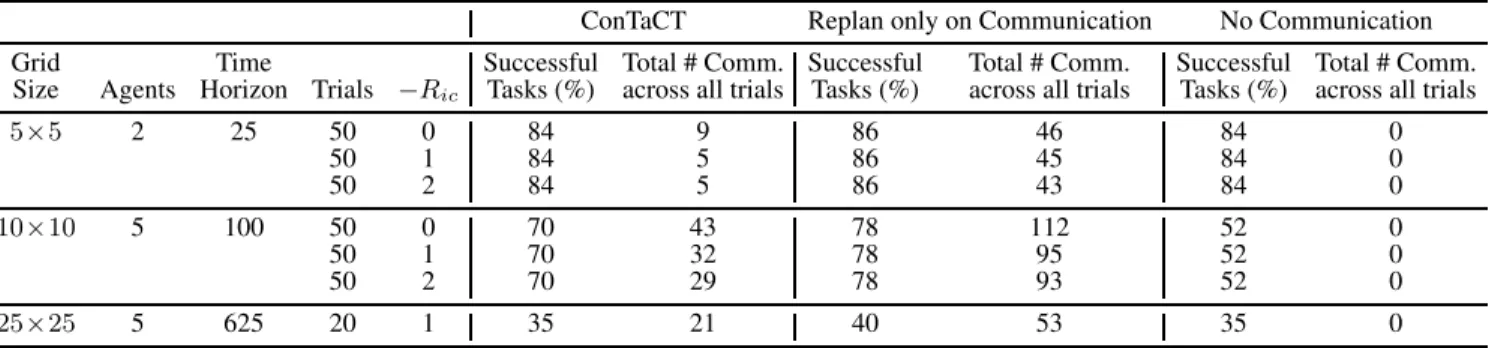
Discussion Table 1 summarizes the experimental results. While average team reward is comparable for the tasks in which all algorithms resulted in sucessful completion, teams completed tasks successfully marginally more often with RooC than with ConTaCT or NC. For instance, for the fifty trials on a 10 × 10 grid with five agents and Ric = −1, teams using RooC succeeded in 39 tasks as opposed to the 35 and 26 tasks completed by teams using ConTaCT and NC, respectively.
However, this marginal improvement in success rate of RooC as compared to ConTaCT comes at the cost of signifi-cantly higher numbers of communication messages. Agents using RooC always communicate prior to using new informa-tion, resulting in a marginally higher success rate but many redundant communications. Teams communicated only 43 times using ConTaCT, as compared to 112 for RooC, a more than two-fold difference. Similar trends are observed across problems with different grid sizes, number of agents and com-munication cost. Teams using ConTaCT achieve comparable performance with more than a 60% reduction in the number of communications.
ConTaCT’s comparable performance despite the small number of communications is possible since each agent is able to use information locally without necessarily communi-cating the same. This is advantageous when the information benefits only the local agent but not necessarily other mem-bers of the team. Thus, the agent communicates if and only if the information benefits the team and thereby maintains sim-ilar task performance with less number of communications.
Table 1: Summary of Simulated Results.
ConTaCT Replan only on Communication No Communication Grid Time Successful Total # Comm. Successful Total # Comm. Successful Total # Comm. Size Agents Horizon Trials −Ric Tasks (%) across all trials Tasks (%) across all trials Tasks (%) across all trials
5×5 2 25 50 0 84 9 86 46 84 0 50 1 84 5 86 45 84 0 50 2 84 5 86 43 84 0 10×10 5 100 50 0 70 43 78 112 52 0 50 1 70 32 78 95 52 0 50 2 70 29 78 93 52 0 25×25 5 625 20 1 35 21 40 53 35 0
This behavior is especially desired in human-robot teams, where excessive communication from an agent may hinder the human’s task performance.
Since, the ConTaCT algorithm requires the agent to com-municate and maintain estimates of its transition function, as opposed to the observation history, the memory requirements of the algorithm are fixed. For implementation in real sys-tems, protocols may be designed that require the agents to communicate only the difference between the current transi-tion functransi-tion and previous common knowledge to efficiently use the available communication bandwidth. Lastly, we note that the ConTaCT algorithm provides a general approach to making communication decisions through the consideration of parameters (α, β, γ) and can work with definitions of team reward other than the one specified by our task model.
Conclusion
In this paper, we present a novel model, TCD-DEC-MDP-COM, for representing time-critical collaborative tasks in deterministic domains. This is motivated by applications, in-cluding disaster response and search and rescue, where the outcome of agents’ actions can be modeled as certain but the environment is often initially unknown. We develop an algorithm, ConTaCT, that generates re-planning and commu-nication decisions for tasks modeled as a TCD-DEC-MDP-COM with unknown transitions. Simulated experiments are conducted for hypothetical rescue tasks. Results suggest that ConTaCT has the potential to substantially reduce communi-cation among agents without substantially sacrificing perfor-mance in the task.
Acknowledgments
We thank Chongjie Zhang for useful discussions.
References
Amato, C.; Konidaris, G.; How, J. P.; and Kaelbling, L. P. 2014. Decentralized Decision-Making Under Uncertainty for Multi-Robot Teams. In the Workshop on Future of Multiple Multi-Robot Research and its Multiple Identitie at IROS. IEEE.
Amato, C.; Konidaris, G. D.; and Kaelbling, L. P. 2014. Plan-ning with macro-actions in decentralized POMDPs. In AAMAS. Amir, O.; Grosz, B. J.; and Stern, R. 2014. To share or not to share? the single agent in a team decision problem. In AAAI.
Becker, R.; Zilberstein, S.; Lesser, V.; and Goldman, C. V. 2004. Solving transition independent decentralized Markov decision processes. JAIR 423–455.
Bernstein, D. S.; Givan, R.; Immerman, N.; and Zilberstein, S. 2002. The complexity of decentralized control of Markov decision processes. Mathematics of Operations Research 27(4):819–840.
Goldman, C. V., and Zilberstein, S. 2003. Optimizing informa-tion exchange in cooperative multi-agent systems. In AAMAS. Kamar, E.; Gal, Y.; and Grosz, B. J. 2009. Incorporating helpful behavior into collaborative planning. In AAMAS.
Likhachev, M.; Gordon, G. J.; and Thrun, S. 2003. ARA*: Any-time A* with provable bounds on sub-optimality. In advances in NIPS.
Mostafa, H., and Lesser, V. 2009. Offline planning for commu-nication by exploiting structured interactions in decentralized MDPs. In International Conference on Intelligent Agent Tech-nology, volume 2, 193–200.
Nair, R.; Roth, M.; and Yokoo, M. 2004. Communication for improving policy computation in distributed POMDPs. In AA-MAS, 1098–1105.
Pynadath, D. V., and Tambe, M. 2002. Multiagent teamwork: Analyzing the optimality and complexity of key theories and models. In AAMAS, 873–880.
Roth, M.; Simmons, R.; and Veloso, M. 2005. Reasoning about joint beliefs for execution-time communication decisions. In AAMAS.
Spaan, M. T.; Gordon, G. J.; and Vlassis, N. 2006. Decentral-ized planning under uncertainty for teams of communicating agents. In AAMAS, 249–256.
Williamson, S.; Gerding, E.; and Jennings, N. 2008. A prin-cipled information valuation for communications during multi-agent coordination. In Workshop on Multi-Agent Sequential De-cision Making in Uncertain Domains at AAMAS.
Williamson, S. A.; Gerding, E. H.; and Jennings, N. R. 2009. Reward Shaping for Valuing Communications During Multi-Agent Coordination. In AAMAS, 641–648.
Wu, F.; Zilberstein, S.; and Chen, X. 2011. Online planning for multi-agent systems with bounded communication. Artificial Intelligence 175(2):487–511.
Xuan, P.; Lesser, V.; and Zilberstein, S. 2004. Modeling Coop-erative Multiagent Problem Solving as Decentralized Decision Processes. In AAMAS.