F
UTHE CERENKOV EFFECT IN COSMIC RAY AIR SHOWERS
by
FRANCIS J. LOMBARD, JR.
SUBMITTED IN PARTIAL FULFILLMENT OF THE REQUIREMENTS FOR THE DEGREE OF
BATCHELOR OF SCIENCE
at the
MASSACHUSETTS INSTITUTE OF TECHNOLOGY (1956)
Signature of Authpr
Certified by ... e
ACKNOWLEDGMENT
I would like to express my thanks to
the M. I. T. Cosmic Ray Group for their cooperation and especially to Prof. George W. Clark for his assistance in making this work possible.
TABLE OF CONTENTS
Abstract ... * 1
I Introduction... 2
II Description of the Experiment ... 7
III Experimental Results ... 12
IV Conclusion .. 21
ABSTRACT
Pulses of Cerenkov radiation produced in
cosmic ray air showers have been detected by exposing
a photomultiplier tube and a parabolic mirror as a light collector to the night sky. The pulses were recorded in conjunction with an array of four
scintillation counters with which the arrival direction of the shower could be determined by fast timing
measurements. The number of Cerenkov pulses are plotted as a function of their relative heights for 0, 1, 2, 3 and 4 fold coincidence. The arrival direction of 15 showers with the relative intensity of the associated Cerenkov pulse is given.
The time duration of 97% of the pulses was found to
be less than 30 m. sec. The possibility of using
Cerenkov radiation to determine the arrival direction of cosmic ray air showers is discussed.
I - INTRODUCTION
Cerenkov radiation was originally discovered by P. A. Cerenkovl in 1934 while conducting experiments on the passage of beta particles through water. It wasn't until
1937 that the effect was explained theoretically by
Frank and Tamm2. Most of the work on Cerenkov radiation
before 1948 was done with charged particles passing through
solid and liquid media. In 1948 Blackett3 pointed out that
the effect should exist in gases. He suggested that there would be a contribution to the light intensity of the night
sky by Cerenkov radiation produced by cosmic ray particles traversing the atmosphere.
Jelley and Gailbraith4',5- (1953) found experimentally
that short bursts of Cerenkov light did accompany large cosmic ray air showers. In further work 6,7, they studied the light in more detail by examining its directional properties, its polarization and its frequency spectra. To date Cerenkov radiation has not been tested as a means of determining the arrival directions of cosmic ray air showers.
1. P. A. Cerenkov, C.R. Acad.Sci.U.S.S.R. 2, 451, (1934)
2. , I. Frank and Ig. Tamm C.R.Acad Sci U.S..R. 14 109, (1937)
3. P.M.S. Blackett, Phys.Soc.Gassiot Committee Report 34 (1948) 4. J.V.Jelley and W. Galbraith, Phil.Mag. 44, 619, (1952")
5. W.Galbraith and J.V.Jelley, Nature 171, 349, (1953)
6. W.Galbraith and J.V.Jelley, J.Atmos*Terres.Phy.8, 250, (1954) 7. J.V.Jelley and W.Galbraith, J.AtmosTerres.Phy.. 304, (1955)
The possibility of using Cerenkov radiation to determine the arrival direction of a shower is the purpose of this
experiment.
a. Cerenkov Effect
It is a well known fact that a charged particle traveling at constant velocity does not emit electromagnetic radiation. It is not so well known however, that there are exceptions to this rule. That is, when the charged particle traverses a medium with a velocity greater than the phase velocity of light in that medium, electromagnetic radiation will be emitted at a certain angle with the trajectory.
This effect,is the optical analog of the shook wave
experienced in supersonic flight.
The essential features 8 of the radiation are as follows:
1. It is produced by a particle traveling faster than the phase velocity of light,
where 9 and n. is the index of refraction.
-.4-2. It is emitted at an angle
&
with theL16HTr PA P 4LLL
trajectory given by C- r.
3. The number of quanta emitted per unit length is given approximately by
ct L
This indicates that the spectrum is continuous and depends on frequency only insofar as the index of refraction
depends on freauency.
For the case we are interested in i.e. electrons
in air at sea level, the threshold energy at whichQ1 .OL Mev. The maximum angle of emission is ,= -3ono matter how
fast the electron moves i.e,
as -*' + '/1
and
-The number of pkotons emitted per unit length OM 0.3 at (N.T.P.) between 3500 AO and 5500 AO.
- 5
-The spectrum cute off at the short wave side of the x-ray
region because tn becomes less than one and the condition
CQ. 6
=
/ ,,. cannot be satisfied. Presence of atomicand molecular absorption bands are responsible for long wave cut-off by self absorption.
The above figures suggest the possibility of measurable Cerenkov radiation in cosmic ray electrons in air. However heavier cosmic ray particles do not contribute appreciably because of the small intensity of particles above the threshold energy.
E
=
4.4 Bev(.q
mesons)E
=
39 Bev(protons)Since a typical cosmic-ray shower at sea level contains on the order of 106 particles (95% electrons) most of the
energy greater than the threshold E= 21 Mev, it is feasible
to detect by ordinary photometric methods, the pulse of light which accompanies such a shower.
b. Air Showers
Primary cosmic ray particles (protons, alpha particles, heavy nuclei) colliding with nuclei in the
upper atmosphere initiate a series of nuclear interactions in which a cascade of secondary particles are created. In the initial interaction charged and neutral 7T mesons are
produced. Neutral 77 mesons decay almost instantaneously
into photons which in turn generate an electron-pboton cascade.
- 6
-This cascade is a process by which the photons undergo materialization and produce electrons; the electrons in
turn produce more photons by the Bremastrahlung process. This continues until the shower reaches sea level or
until all the energy is dissipated by ionization losses of the electrons.
Initially the shower spreads out like a fir tree, symmetrical about the continued trajectory of the primary particle (called the shower core). This spreading out does not persist however. After a few radiation lengths
most of the shower contains electrons of energy
E.
= 86 Mev.At this value (called the critical energy) the electrons dissipate their energy rapidly by colliding with air molecules. The shower then ceases to spread out and
actually begins to contract like a funnel, because of the increasing density of the air.
Finally, near sea level, the shower is
approximately a plane wave of particles, mostly electrons, distributed symmetrically about the core, and moving in the same direction as the extrapolated trajectory of the primary high energy cosmic ray particle.
We can then expect a shower of photons in the visible region to accompany the electron shower. The
small angle between the electrons and the Cerenkov photons
O~w,=
Isuggests the possibility of using a Cerenkov light receiver to determine the arrival directions of cosmic ray air showers.- 7
-II - DESCRIPTION OF THE EXPERIMENT
The experimental equipment consists of a Cerenkov detector and four scintillation counterswhose outputs are amplified, displayed on an oscilloscope and recorded photographically. The arrival direction of the
shower can be determined by measuring the delay in the
arrival times of the scintillation pulses. At the same time the burst of Cerenkov light assiciated with the
shower may be studied. A minimum of three scintillation
pulses is necessary to determine the arrival direction of the shower.
Apparatus
The Cerenkov detector consists of a parabolic mirror of 36" diameter and 14-5/16" focal length with a photo-multiplier tube (RCA 6655) mounted near the focus. The angular aperture of the device is 3.9± 0.20 and it was operated with its axis vertical. A light shield 4' in
height completely surrounds the mirror (see Fig.l). This
apparatus was operated in conjunction with an array of four
scintillation counters, each with a sensitive area of .13 m2,
arranged at the corners of a 36 meter square as shown in Fig. 2.
-a-)K*
ts
CERENKov
a
SCINTI LATION
F
1..
I
DETECTOR
C
O
UNT ER
S
t~
SCtMIN4ATIoN OovNT EA -r --- i
TE i
ARR AN6 M NTF|G. CENIV SoV OrTECTO.2P
I I A LUN v LI' um9-um
n- 10
-Figure 3 is a block diagram of the entire experiment including all electronic apparatus. The distributed line -amplifiers have a rise time of about 1 mi sec. The sweep speed of the scope is 0.1914*'/. as measured by a 25 Mc oscillator. Delays were calibrated by placing the counters on top of each other and allowing cosmic ray. mesons to produce nearly simultaneous
scintillations. Small corrections were made for the time of flight of the mesons between the counters.
The entire apparatus was located on the roof of a building at sea level (Bld. #6 M.I.T.). The
electronic equipment was situated inside a shelter on the roof, with coaxial cables running outside to the detectors. Data was taken during the moonless, cloudless nights of April 17, May 3, and May 12,,1956.
.TCMTI&AT1 LAYvr7
BLOCK
DIAGRAM~
Fcie. 3
m
m
v
oscit. a 4C. 0 E
12
-III - EXPERIMENTAL RESULTS
a. Procedure
All data was obtained by triggering the
oscilloscope sweep on pulses from the Cerenkov detector. The photographs of the resulting oscilloscope traces
showed the Cerenkov pulse and any coincident pulses from the scintillation counters. In the event of a three or four fold scintillation counter coincidence the direction of the shower could be determined from measurements of the differences in the arrival times of the scintillation pulses. For a discussion of how this is done and a sample of the calculations involved see the Appendix.
Because of stray light from surrounding buildings there is a continuous current in the phototube and hence a high level of noise. With the high voltage on the photo-tube held constant (H.V. = 900 volts) the discrimination was set for a counting rate of 1 count per minute. Using
these values, about 80% of the traces showed a Cerenkov pulse, 10% contained no signal at all, 10% had a large
amount of noise fluctuations. Only traces with a Cerenkov signal have been included in the data.
b. Cerenkov Pulse Height Distribution
The histogram plots shown in Fig. 5 gives the size distributions of the Cerenkov pulses obtained during
a total operating time of 9-1/2 hours over three different nights. A separate plot is shown for each multiplicity of coincident pulses from the scintillation counters. Figure 6 shows the relative frequencies of the various multiplicities of coincidence for all pulse heights.
The pulse heights are relative. The
smallest Cerenkov pulse was arbitrarily set equal to
one unit, and all other pulses were measured as multiples of the unit pulse. As can be seen there were very few three and four fold coincidences (15) as compared to the others. With only these 15 Cerenkov pulses can we determine the arrival direction of the associated
-'4-Nat S E 0 FOLD 2A Me. CAd. 10 iATtoW
6-
-.- 0 C e AS/ov P(,t4S / Na t*T so AY ARoW
osao scoe Tt? eas
Fla.
+
PC
C-oe. FO L(
OS
5 V Z 0/4,
iP , .,£
d8I0& ~1 S -~ 4e
I ~I ~ I -O7Q~j' 0 1WORP,4 .0 e'12
of 0 io O0s 01 0A 001 'Ta~oov OVmm-rn-,,-- .6 -Ng,~~5a o~4: ~q~1VTS 4 3 4 . 6 /0 1 ( , '33 S4 4 ~ s ' 7'
7
(o 20 104'
Oa..
+3
46
&
0fonCAAN MIOV
Fi..
SU
b
10 0 0 3 IF41 -0MIQMBAUt op a
MAO
.4 ;L40 4t5~ t"00 704*
3.
a.
to20
3
Fi
a.
ro
- 18
-c. Arrival Direction of the Showers Associated with Cerenkov Light Pulses
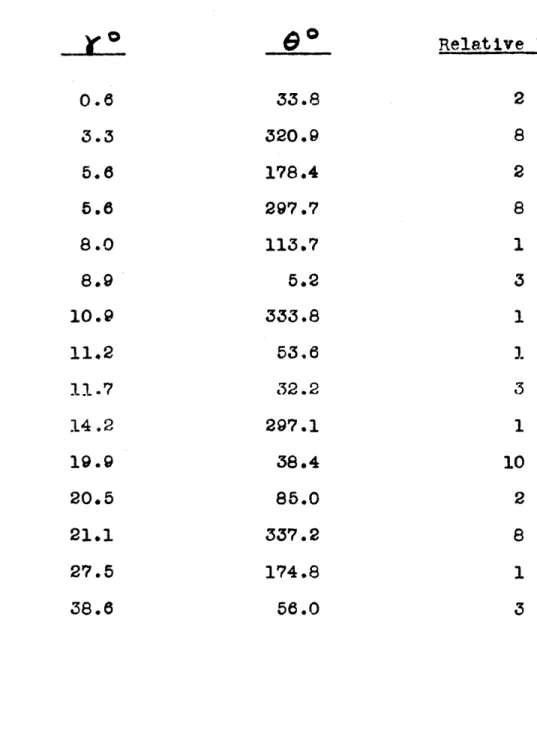
Figure 7 is a plot of the arrival directions of the showers. The direction of arrival is indicated by the position of the point and the size of the Cerenkov pulse is indicated by the number adjacent to the point.
The concentric circles are curves of constant Y (the
angle from the zenith). Light incident at an angle
greater than Y,
=
400 would be prevented from reachingthe mirror by the 4' light shield. 9 is the azimuthal
angle measured with respect to the counter array (see Fig.2).
The dotted lines indicate the North - South direction.
The error'of a measurement of the arrival direction arises from the following:
1. The shower is not a perfect plane of particles,
but actually has a finite thickness (about 4m due to
multiple scattering9 .
2. The shower front has finite curvature9 .
3. The precision of a measurement of the arrival
of a pulse is about
±
2.3 m- secl0 . These sources of errorlead to an uncertainty of about ± 50 in the determination of
an arrival direction1O. This error estimate
aplds
only whenthere are four scintillation pulses to be measured.
9. P.Bassi, G.Clark, B.Rossi, Phys.Rev. 92, 441, (1953) 10. G. W. Clark - Private communication.
*cot
QUC'*olg
*of
.0o
20
-The fourth pulse is used to check the three others. With a three fold event there is additional uncertainty intro-duced because of the lack of a self consistancy check.
d. Time Duration of Cerenkov Light
The time duration of the Cerenkov light pulse was found by measuring the maximum width of the pulse i.e. at the base line. The result was that 97% of these widths lay between 25 moy sec and 30 m-1 sec (the exact
number of each was not measured). The remaining 3% had
maximum widths of 35 mj-1 sec to 40 m- sec but in all cases this was because of their large height.
We can conclude that in 97% of the showers detected the spread in arrival times of the photons was less than 30 m sec.
21
-IV - CONCLUSIONS
The arrival direction plot (Fig,8 ) shows
that most of the showers arrive from a direction outside the acceptance cone of the light receiver. There are
three explanations for this:
1. the lack of self consistancy check for the three fold events; (Actually twelve of the fifteen showers shown were three fold events while only three showers were
produced by four fold events.)
2. the possibility that large bursts of Cerenkov light might diffuse into the photolube from large angles;
3. the direction of the Cerenkov light differs from the direction of the shower. The suitability of using Cerenkov radiation to study the directional properties of cosmic ray showers cannot be concluded from our results but must be left for future experiments to decide.
The fact that no shower occurs at an angle greater than
=
400 suggests that a longer light shield would improve the angular resolution of the light receiver. A better angular resolution in future experiments of this type, would enable one to tell whether the arrival direction of the showeractually is the same, or nearly the same, as the arrival
direction of the Cerenkov light. Another suggestion is that only the four fold events which check consistently be
-22-The fact that 97% of the showers were accompanied by Cerenkov pulses with widths less than 30 m i sec.
indicates that the thickness of the moving front of Cerenkov photons is not greater than 9 meters.
APPENDIX I
Bremsstrahlung and Recombination Radiation
Cerenkov radiation is not the only process which contributes to visible light in cosmic ray air showers. The angle of emission of the continuous spectrum of
Bremsstrahlung6 light (OrI,0O0) is comparable to that of Cerenkov radiation (O".±) at N. T. P. However, the
intensity is much smaller. For Bremsstrahlung the number
of photons emitted per cm. of length, between 4,000 - 6,000 AO,
is only 8 x 10⁻⁶ compared to 0.5 photons per cm for Cerenkov
radiation at N. T. P.
Estimates of the intensity of recombination
radiation are very difficult to make. The recombination
process differs from the other two in that it emits a discrete spectrum of unpolarized light in all directions. Since Cerenkov light is polarized and has a continuous
spectrum, these two processes may be separated experimentally.
J. V. Jelley6 has studied the polarization and spectra of the
light pulses associated with air showers and has concluded that at least some of the light is due to the Cerenkov effect.
- 24
-APPENDIX II
Sample Calculation of a Cosmic Ray Shower Arrival Direction
The four scintillation counters are arranged at the corners of a square, with sides of length d = 36 m. The origin of the coordinate system shown above is located at the center of the square.
By assuming
1. the shower front is approximately a plane of
particles;
2. the plane of the particles is perpendicular to the direction of motion of the particles;
3. that they all move wilth the veloc'ity *of 'light c; we can calculate the arrival direction by measuring the
differences in the arrival times, of this plane of particles, at each counter.
- 25
-The equation of a plane, moving in the direction of its normal, with the velocity c is:
lx + my
+
V = - atThe initial conditions are such that the plane intersects the origin at t
=
o. The direction cosines of the normalare lm,n respectively. At t a ti suppose the plane
arrives at the location of counter 1 whose coordinates are
( 0). The equation of the plane becomes
1
+
m 4 - cti.If counters 2, 3, and 4 are struck by the moving plane at
t2 ) t 3 and t4 respectively, we have in addition
1f - m - t2 -1 4m - at 3,
2 2 -ct 4.
Solution of the above equations yields:
1 -(t2_- t,)c
d m c(ty - tI)
d
t4 4 tl = t2 * t 3 '
The Pythagoreon Theorem is used to find n.
n =4 -1 m
Since we can measure t2 - 1, tt 3 - t1, and d, the direction
cosines of the air shower can be calculated. If all four counters were struck by particles, we can check our results by the requirement that t 4 + t1 a t2 + t3 *
- 28
-APPENDIX III
Table of Arrival Directions of the 15 ShowersShownin Figure 7 Relative Height 0.8 3.3 5.8 5.8 8.0 8.9 10.9 11.2 11.7 14.2 19.9 20*5 21.1 27.5 38. 8 2 8 2 8 1 3 10 2
090
33.8 320.9 178.4 297.7 113.7 5.2 333.8 53.6 32.2 297.1 38*4 85.0 337.2 174.8 56.0 8 1- 27
-APPENDIX IV
Estimate of the Intensity of Cerenkov Light
Let Po (Eo E) represent the total distance
travelled by all the electrons of energy greater than E
in a shower initiated by an electron of energy Eo.
Using for E the threshold energy for electrons (21 Mev), we get
PoVO (EoE) = h Eo
where h w 1.5 x 10 g cm" ev1 according to Rossill.
The number of photons emitted per om. (Page 4) is 0.3 photons/cm at N. T. P.
If we consider that the entire shower occurs at sea level, where the density of air is 10~3 gm/cm3 and that the initial
energy Eo - 10 14 ev, we find that the number of photons
produced is
N
=
h Eo xL x dN
=
1.5 x 10-7 x 1014 x1 x 0.3 10-3or N '0' 1/2 x 1010 photons
- 28
-Using 100 meters as the characteristic spread
of the electron shower and an additional 130 m around this
for the spread of Cerenkov light6, we can estimate the area
covered by all the Cerenkov light.
A ITR2
R
=00
+130 a 180 m.A TT' (180 x 102)2 - 109 cm2
Assuming a uniform distribution, we get 5 photons/ cm2 A