HAL Id: hal-00298630
https://hal.archives-ouvertes.fr/hal-00298630
Submitted on 2 Mar 2005HAL is a multi-disciplinary open access
archive for the deposit and dissemination of sci-entific research documents, whether they are pub-lished or not. The documents may come from teaching and research institutions in France or abroad, or from public or private research centers.
L’archive ouverte pluridisciplinaire HAL, est destinée au dépôt et à la diffusion de documents scientifiques de niveau recherche, publiés ou non, émanant des établissements d’enseignement et de recherche français ou étrangers, des laboratoires publics ou privés.
Soil moisture-runoff relation at the catchment scale as
observed with coarse resolution microwave remote
sensing
K. Scipal, C. Scheffler, W. Wagner
To cite this version:
K. Scipal, C. Scheffler, W. Wagner. Soil moisture-runoff relation at the catchment scale as observed with coarse resolution microwave remote sensing. Hydrology and Earth System Sciences Discussions, European Geosciences Union, 2005, 2 (2), pp.417-448. �hal-00298630�
HESSD
2, 417–448, 2005 Soil moisture-runoff relation at the catchment scale K. Scipal et al. Title Page Abstract Introduction Conclusions References Tables Figures J I J I Back CloseFull Screen / Esc
Print Version Interactive Discussion
EGU Hydrol. Earth Syst. Sci. Discuss., 2, 417–448, 2005
www.copernicus.org/EGU/hess/hessd/2/417/ SRef-ID: 1812-2116/hessd/2005-2-417 European Geosciences Union
Hydrology and Earth System Sciences Discussions
Soil moisture-runo
ff relation at the
catchment scale as observed with coarse
resolution microwave remote sensing
K. Scipal1, C. Scheffler2, and W. Wagner1,3
1
Vienna University of Technology Institute of Photogrammetry and Remote Sensing, Vienna, Austria
2
University of Jena, Institute of Geography, Jena, Germany
3
Christian Doppler Laboratory “Spatial Data from Laser Scanning and Remote Sensing”, Vienna, Austria
Received: 26 January 2005 – Accepted: 28 February 2005 – Published: 2 March 2005 Correspondence to: K. Scipal ([email protected])
HESSD
2, 417–448, 2005 Soil moisture-runoff relation at the catchment scale K. Scipal et al. Title Page Abstract Introduction Conclusions References Tables Figures J I J I Back CloseFull Screen / Esc
Print Version Interactive Discussion
EGU
Abstract
Microwave remote sensing offers emerging capabilities to monitor global hydrological processes. Instruments like the two dedicated soil moisture missions SMOS and HY-DROS or the Advanced Scatterometer (ASCAT) onboard METOP will provide a flow of coarse resolution microwave data, suited for macro-scale applications. Only recently, 5
the ERS scatterometer, which is the precursor instrument of ASCAT, has been used successfully to derive soil moisture information at global scale with a spatial resolution of 50 km. Concepts of how to integrate macro-scale soil moisture data in hydrologic models are however still vague. In fact, the coarse resolution of the data provided by microwave radiometers and scatterometers is often considered to impede hydro-10
logical applications. Nevertheless, even if most hydrologic models are run at much finer scales, radiometers and scatterometer allow monitoring of atmosphere-induced changes in regional soil moisture patterns. This may prove to be valuable informa-tion for modelling hydrological processes in large river basins (>10 000 km2). In this paper, ERS scatterometer derived soil moisture products are compared to measured 15
runoff of the Zambezi River in south-eastern Africa for several years (1992–2000). This comparison serves as one of the first demonstrations that there is hydrologic relevant information in coarse resolution satellite data. The observed high correlations between basin-averaged soil moisture and runoff time series (R2>0.85) clearly demonstrate that
the seasonal change from low runoff during the dry season to high runoff during the wet 20
season is well captured by the ERS scatterometer. Additionally, differences in runoff from year to year could be to some extend, explained by soil moisture anomalies.
1. Introduction
Soil moisture is widely recognised as a key parameter in environmental processes, including meteorology, hydrology, agriculture and climate change. From a hydrologic 25
HESSD
2, 417–448, 2005 Soil moisture-runoff relation at the catchment scale K. Scipal et al. Title Page Abstract Introduction Conclusions References Tables Figures J I J I Back CloseFull Screen / Esc
Print Version Interactive Discussion
EGU therefore has an important effect on the runoff behaviour of catchments (Aubert et al.,
2003). Being basic to hydrologic processes an accurate assessment of the spatial and temporal variation of soil moisture may therefore not only be useful for improving the predictive capability of runoff models, it may also be of high value for improving and val-idating hydrologic process representation at the catchment scale. Unfortunately, in-situ 5
observations are rarely available as area representative measurements are expensive and tedious to collect (Hollinger and Isard, 1994; Rombach and Mauser, 1997). The difficulty of measuring soil moisture on the ground has motivated considerable research in the field of remote sensing to retrieve soil moisture of use for hydrological models (Engman and Chauhan, 1995). Specifically, microwave remote sensing offers the pos-10
sibility to retrieve soil moisture at various scales due to the sensitivity of microwaves to changes in the dielectric properties of the soil.
Much emphasize has been put on Synthetic Aperture Radars (SAR), the only sys-tem which can provide information on smaller scales (<50 m), with some success being achieved using change detection approaches (see e.g. Moran, 2000). However, cur-15
rently available SAR systems neither provide the data necessary for routine application of these methods nor are they truly optimised for soil moisture retrieval. That is why SAR studies are in general still experimental and progress has been slower than ex-pected. At the same time, significant progress has been made using coarse-resolution microwave radiometers and scatterometers. The advantage of these systems com-20
pared to SAR is that they offer multi-dimensional, multi-temporal observation capabili-ties (multiple frequencies and polarisations in the case of microwave radiometers and multiple-viewing capabilities in the case of scatterometers). These capabilities allow to better account for the confounding effects of vegetation and surface roughness, which are inherent in both active and passive microwave observations. The progress made, 25
has consequently led to the approval of two experimental satellite missions designed to measure soil moisture, ESA’s second Earth Explorer Opportunity Mission SMOS and NASA’s Earth System Science Pathfinder mission HYDROS. As low microwave frequencies are beneficial for soil moisture retrieval (longer wavelengths better
pene-HESSD
2, 417–448, 2005 Soil moisture-runoff relation at the catchment scale K. Scipal et al. Title Page Abstract Introduction Conclusions References Tables Figures J I J I Back CloseFull Screen / Esc
Print Version Interactive Discussion
EGU trate vegetation) both missions will be operated in L-band. SMOS will use a radiometer
to make measurements at a spatial resolution of about 40 km (Kerr et al., 2001). HY-DROS will combine a radiometer (40 km) and a scatterometer (3 and 10 km). Foreseen launch dates are 2007 and 2010, respectively. These two missions will perform first-of-a-kind exploratory measurements and aim to measure soil moisture with an accuracy 5
of 0.04 m3m−3.
Beside these two dedicated soil moisture missions, an operational scatterometer has also been found capable of soil moisture retrieval. Recently, the first global, remotely sensed soil moisture dataset has been derived from ERS-1/2 scatterometer data (Sci-pal et al., 2002; Sci(Sci-pal, 2002). The data set has a spatial resolution of 50 km and 10
was found to be of comparable quality with state-of-the-art, global soil moisture models (Wagner et al., 2003). The accuracy of the scatterometer based soil moisture product was assessed using over 45 000 measurements worldwide and is around 0.054 m3m−3 for the 0–1 m layer for temperate and tropical climatic regions (a red-noise filtering ap-proach was used to estimate the water content in the soil profile from the remotely 15
sensed surface soil moisture series). The retrieval algorithm developed for use with the ERS scatterometer will be directly applicable to its successor, the Advanced Scat-terometer (ASCAT). This instrument will have a spatial resolution of 25 km and will be flown on a series of METOP satellites, providing data continuity over an initial period of at least 14 years, starting in 2005.
20
The coarse resolution of the afore mentioned sensors is however often assumed to be insufficient for hydrologic applications, therefore they have so far not been consid-ered by the hydrologic community. Given the impending launch of a series of coarse resolution microwave sensors capable of accurately retrieving soil moisture in the next few years and the unavailability of other data sources, the logic dictates, that it is now 25
necessary to investigate the potential of these techniques to support hydrologic ap-plications. Clearly, substantial research efforts will be needed to develop methods for ingesting such kind of data into hydrologic models. The questions of spatial resolu-tion, irregular sampling intervals, and low penetration depth into the soil surface need
HESSD
2, 417–448, 2005 Soil moisture-runoff relation at the catchment scale K. Scipal et al. Title Page Abstract Introduction Conclusions References Tables Figures J I J I Back CloseFull Screen / Esc
Print Version Interactive Discussion
EGU to be addressed. Fortunately, the technique of data assimilation has recently gained
significant attention and will provide important impetus in the future (e.g. Walker et al., 2001).
Before complex hydrological assimilation schemes are developed to ingest a partic-ular remotely sensed soil moisture product, it is nevertheless advisable to firstly test 5
the quality of the remotely sensed products by means of simple methods to gain a better understanding of the available information. This is the aim of this paper, which compares ERS scatterometer soil moisture with runoff time series from the Zambezi River. The Zambezi River has been chosen for this investigation because of its large catchment area and its pronounced intra- and inter-annual variability in runoff. Before 10
the results of this comparison are presented in Sect. 7, Sect. 2 reviews a number of studies, which investigated the possibility of using soil moisture observations for im-proving runoff prediction. Soil moisture scaling issues are addressed in Sect. 3 to lay the foundation for assessing the information contained in coarse resolution data. The soil moisture retrieval technique based on ERS scatterometer data is explained in 15
Sect. 4, including a more detailed discussion on the accuracy of the derived soil mois-ture products in Sect. 5. The available hydrometric data are described in Sect. 6. The discussion of the results aims particularly at identifying the information inherent in the macro-scale soil moisture products.
2. State of the art
20
In recent years there have been a few studies geared towards combining hydrologic models and space borne data to improve the predictive capability of runoff models, or just to use the data to improve and validate hydrologic process representation at catchment scale.
Classically, soil moisture observations are not used directly to address hydrologic 25
problems such as runoff prediction, drought monitoring or flood forecasting, but are used in assimilation schemes of land surface hydrologic models or to constrain soil
HESSD
2, 417–448, 2005 Soil moisture-runoff relation at the catchment scale K. Scipal et al. Title Page Abstract Introduction Conclusions References Tables Figures J I J I Back CloseFull Screen / Esc
Print Version Interactive Discussion
EGU vegetation atmosphere transfer models (Aubert et al., 2003; for examples see Houser
et al., 1998; Li and Islam, 199; Walker et al., 2001; Walker and Houser, 2001; Reichle et al., 2001). Most of these studies focused on the assimilation technique itself and its influence on the soil water content, but did not examine the effect of the soil mois-ture assimilation on other modelled fluxes such as discharge and evapotranspiration 5
(Pauwels et al., 2001). This was also noted by Aubert (2003) who states that coupling soil moisture observations with the routing function of hydrological models, in order to improve stream flow simulations and forecasts, has not extensively been studied. However, first experimental studies confirm that assimilation of remotely sensed soil moisture can significantly improve simulation results especially under extreme condi-10
tions.
Pauwels (2001) examined the effect of ERS SAR derived soil moisture assimila-tion on modelled discharge, concluding that the data assimilaassimila-tion could improve model based discharge estimates. In the study, a lumped hydrologic model was used in combination with two assimilation methods of remotely sensed soil moisture. One as-15
similation method used the spatial patterns, the other only the statistics (spatial mean and variance) of observed soil moisture. Already the assimilation of the spatial mean and variance significantly improved hydrological model based discharge predictions. These results suggest that the mean value captured by coarse resolution soil moisture is a statistically meaningful descriptor, which may help to improve simulation results 20
regardless of scale differences between model and data.
Francois et al. (2003) and Bach and Mauser (2003) showed that spaceborne ob-servations of soil moisture are especially useful to improve simulation results under extreme flood conditions. Francois et al. (2003) used an extended Kalman filter with a lumped rainfall runoff model, Bach and Mauser (2003) a four dimensional data assim-25
ilation method with a flood forecasting model. Similar results were obtained by Aubert et al. (2003) showing that observed soil moisture can be used to improve runoff predic-tion over a sub-catchment of the Seine River in France. Although not using remotely sensed data, the study elaborates on the use of remotely sensed soil moisture
ob-HESSD
2, 417–448, 2005 Soil moisture-runoff relation at the catchment scale K. Scipal et al. Title Page Abstract Introduction Conclusions References Tables Figures J I J I Back CloseFull Screen / Esc
Print Version Interactive Discussion
EGU servations and indicates its potential if provided frequently enough (1–3 days). This
high temporal sampling requirements can currently only be fulfilled by coarse resolu-tion sensors. Although none of these studies directly used coarse resoluresolu-tion data, they indicate the potential of coarse resolution data and point to possible ways forward in the use of macro scale soil moisture products.
5
3. Soil moisture scales
To make best use of a certain data set it is essential to define the processes captured by the data set, to understand the processes influencing the observed quantity, the scale at which the variability acts and finally the relation between the process and the observation scale. According to Grayson et al. (2002), scale is one of the key issues 10
in hydrologic applications. It is not only a question how to observe relevant features but also to observe and use them at the appropriate scale. In the ideal case process scale, model scale and the measurement scale are compatible (Bl ¨oschl, 1996). The process scale characterizes the typical time and length scales on which a particular natural process predominantly takes place, while the measurement scale refers to the 15
spatial resolution and temporal sampling interval of the measurement device.
Based primarily on in-situ soil moisture data, from both experimental and opera-tional observaopera-tional networks, scaling properties of the soil moisture field in the spatial and temporal domain have been investigated. It has been found that soil moisture is spatially and temporally highly variable. Several authors showed that the variability is 20
driven by vegetation, soil type and topography and suggested that the spatial scale of soil moisture is on the order of tens of meters (Nielsen et al., 1973; Vieira et al., 1981; Vachaud et al., 1985). The perception was that beyond this distance there is too much variability of soil, vegetation and topographic properties to maintain a correlation of soil moisture. Concurrently it was argued by Kontorschikov (1979), Meshcherskaya 25
et al. (1982) and more recently by Cayan and Georgakakos (1995) that a second factor influences soil moisture variability on a scale of hundreds of kilometres and attributed
HESSD
2, 417–448, 2005 Soil moisture-runoff relation at the catchment scale K. Scipal et al. Title Page Abstract Introduction Conclusions References Tables Figures J I J I Back CloseFull Screen / Esc
Print Version Interactive Discussion
EGU it to atmospheric forcing effects. Recent studies by Vinnikov et al. (1996) and Entin et
al. (2000) support the two scale concept with a small scale component influenced by vegetation, soil type and topography acting on the range of centimetres to hundreds of meters and a large scale component influenced by climatic conditions and atmo-spheric events such as precipitation and radiation acting on scales of kilometres and 5
larger. Vinnikov et al. (1999) argued that small scale variability does not effect soil moisture above 1 km, and that above this scale the variability in soil moisture for the scale of typical coarse resolution sensors (ranging from 1 km to 100 km resolution) is relatively constant.
Evidence of a two scale concept to describe the soil moisture process can also be 10
found in Ceballos et al. (2003) and Mart´ınez-Fern´andez and Ceballos (2003). The authors studied characteristics of soil moisture in a semiarid environment based on data from the REMEDHUS network located in the North West of the Iberian Penin-sula. The network consists of twenty soil moisture measurement stations spread over a 1200 km2 large area, characterised by different soil and land use types. The sta-15
tions are within the same climatological context but are hydrological independent. The analysis of multi-year soil moisture time series indicated clear spatial patterns of per-sistence. Some stations were noted to be consistently wetter than the average while some were consistently drier, independent of the point in time. Still, observations from all stations followed the same temporal trend and a high correlation in the time series 20
build of data from the twenty different stations could be observed. Differences in abso-lute soil moisture were explained by differences in soil type, texture and topography.
This leads to the conclusion that observations made with coarse resolution sensors such as scatterometers, which effectively average over the small-scale structure of the observed region, contain information about the large-scale component which refers to 25
meteorological and climatic events such as precipitation and evapotranspiration pat-terns.
HESSD
2, 417–448, 2005 Soil moisture-runoff relation at the catchment scale K. Scipal et al. Title Page Abstract Introduction Conclusions References Tables Figures J I J I Back CloseFull Screen / Esc
Print Version Interactive Discussion
EGU
4. Soil moisture from scatterometer data
Soil moisture data used in this study is taken from the Global Soil Moisture Archive 1992–2000 located at http://www.ipf.tuwien.ac.at/radar/ers-scat/home.htm (Scipal et al., 2002). The archive is based on ERS Scatterometer data and comprises global surface soil moisture data and indicators of root zone soil moisture sampled at ten-day 5
intervals.
Scatterometers are active microwave sensors characterised by a coarse spatial but a high temporal resolution. To retrieve soil moisture information, scatterometers on-board of the European Remote Sensing Satellites ERS-1 and ERS-2, operated by the European Space Agency were used. The ERS scatterometer operates at 5.3 GHz (C-10
band) vertical polarization, collecting backscatter measurements over an incidence an-gle range from 18◦to 57◦using three sideways looking antennae. The sensor achieves global coverage within 3 to 4 days where each beam provides measurements of radar backscatter from the sea and land surface for overlapping 50 km resolution cells with a 25 km grid spacing at approximately 10:30 a.m. and 10:30 p.m. for ascending and 15
descending tracks, respectively.
Scatterometry offers capabilities to infer soil moisture due to the strong variation of the dielectric constant of soil with volumetric water content. However, scattering from land surfaces also depends on other factors. Potential retrieval techniques must ac-count for the confounding effects of surface roughness, vegetation, topography and 20
soil texture. Since the 1970’s several methods have been developed to retrieve soil moisture from microwave remote sensing data. Possibly the largest potential is held by change detection approaches. Change detection has successfully been used to re-trieve soil moisture for active (Wagner et al., 1999; Moran et al., 2000) and passive data (deRidder, 2000). Unlike more complex theoretical or semi empirical approaches often 25
preferred for retrieval purposes, change detection is attractive for global applications because comprehensive pre-knowledge of surface characteristics is not required.
HESSD
2, 417–448, 2005 Soil moisture-runoff relation at the catchment scale K. Scipal et al. Title Page Abstract Introduction Conclusions References Tables Figures J I J I Back CloseFull Screen / Esc
Print Version Interactive Discussion
EGU change detection method developed by Wagner et al. (1999). The method allows the
retrieval of surface soil moisture information equivalent to the degree of saturation in relative units (ranging between 0 and 100%). To infer root zone soil moisture a red-noise filtering approach was used, which is controlled by the ratio of the layer depth and the pseudo diffusivity that depends on the soil properties (Wagner et al., 1999; 5
Ceballos et al., 2004). As soil properties are not known quantitatively on a global scale, this parameter was determined empirically and set constant (Wagner et al., 1999). The resulting index is the Soil Water Index SWI, a percentile measure of soil moisture between the soil moisture extremesΘmin (dry) andΘmax(wet) which have been shown to correlate well with the wilting level and point midway the field-capacity and total water 10
capacity (Wagner et al., 1999).
5. Soil moisture quality
To assess the quality of scatterometer derived soil moisture, data from “The Global Soil Moisture Archive 1992–2000” has been compared extensively with soil moisture information from various sources.
15
Wagner et al. (2003) compared scatterometer derived monthly soil moisture esti-mates with global gridded precipitation data and global modelled soil moisture of the 0–50 cm layer. The study showed that there is reasonable agreement between the different datasets especially under tropical and temperate climates. Only in extreme climates such as deserts and the arctic, spurious effects have been observed. Given, 20
that the accuracy of the gridded precipitation and the modelled soil moisture is not known it is not possible to draw any quantitative conclusions. Considering that the datasets are independent it is however reasonable to assume that a high agreement indicate regions of good data quality and that in such a case upper limits of the accu-racy of the scatterometer derived soil moisture can be inferred. This upper limit has 25
been determined to be in the range of 0.03–0.07 m3m−3.
HESSD
2, 417–448, 2005 Soil moisture-runoff relation at the catchment scale K. Scipal et al. Title Page Abstract Introduction Conclusions References Tables Figures J I J I Back CloseFull Screen / Esc
Print Version Interactive Discussion
EGU out by Scipal (2002) using over 45 000 soil moisture measurements from 372 stations
worldwide. Samples were taken at agro-meteorological large-scale measurement net-works located in Russia, Ukraine, China, Mongolia and the US, covering a wide range of soil types and climatic regions. For Ukraine, Russia and Illinois soil moisture sam-ples from a depth of 1 m were compared. In India and China, soil moisture samsam-ples 5
from a depth of 50 and 60 cm, respectively were used, as samples of deeper layers were not available. Statistical analysis indicated an accuracy of scatterometer derived soil moisture for the 1 m layer between 0.049 m3m−3 and 0.084 m3m−3 depending on the measurement network. The average accuracy was determined to be 0.054 m3m−3. Even better values have been determined for soil moisture anomalies with an average 10
accuracy of 0.032 m3m−3.
A more detailed study, was carried out by Ceballos et al. (2003) who compared scat-terometer derived soil moisture to field observations from the REMEDHUS network. All stations of the REMEDHUS network are within one scatterometer pixel therefore allow-ing a more detailed assessment of soil moisture conditions of the covered region. For 15
the comparison, data from twenty stations were averaged. The resulting time series compared well with scatterometer derived soil moisture. The coefficient of estimation
R2 for the average soil moisture profile (0–100 cm) reached a value of 0.74 and the mean square error (RMS error) was 0.022 m3m−3.
6. Hydrometric data
20
Hydrometric data is available for the Zambezi River. The basin of the Zambezi River is one of the largest of the African continent covering approximately 1.35 million km2 or 5 % of the continent. The Zambezi River runs through six countries: Zambia, An-gola, Zimbabwe, Namibia, Botswana and Mozambique, from the centre of Africa to the Indian Ocean. The source of the Zambezi River is situated at Kalenehills in the north-25
western part of Zambia. At the frontier to Zimbabwe, the Zambezi reaches a largest width of 1,7 km before it reaches the Victoria falls. The entire river amounts 3000 km
HESSD
2, 417–448, 2005 Soil moisture-runoff relation at the catchment scale K. Scipal et al. Title Page Abstract Introduction Conclusions References Tables Figures J I J I Back CloseFull Screen / Esc
Print Version Interactive Discussion
EGU from source to estuary (Zambezi River Authority, 2002). Along the Zambezi River two
major dams (Lake Kariba and Cabora Bassa) have been built that are mainly used for generation of energy.
The climate of the Zambezi catchment generally underlies the movement of the In-tertropical Convergence zone ITC, resulting in distinct dry and wet seasons during the 5
year in the southern part of the catchment. Consequently, the flow of the Zambezi River is seasonal in nature with the lowest flows occurring during the dry months, from June to November and the higher flows occurring during the wetter parts of the year, December to May. The study period, ranging from 1992–2000, was characterized by a wet period from 1992 to 1994, followed by a rather dry period from 1995 to September 10
1997. The end of the study period was characterized by extreme wet conditions with disastrous floods in the years 1997 and 2000.
The Zambezi River Authority in Zambia provided hydrometric parameters from a network of eleven stations where water levels are monitored daily (Fig. 1). Data of the station Kasambamezi has not been provided. At seven of these stations, additional 15
flow measurements are carried out which allows calculation of runoff. The observations cover the years 1992 to 2000. Only stations above Lake Kariba have been used, which are Chavuma, Watopa, Lukulu, Kalabo, Matongo, Senanga, Sesheke, Nana’s Farm and Victoria Falls (Table 1). Records of the stations Gwayi and Sanyati are incomplete and have therefore not been used in this study. For the station Sesheke unrealistic 20
low water level values have been recorded for the period March 1997 to October 1998 which clearly do not fit with the other measurements. Therefore these records have been removed prior to the analysis.
7. Results
Studying the relationship between soil moisture and hydrometric parameters is not a 25
straightforward task. Principally it can be expected that both parameters are related. When soils are close to saturation runoff will be much higher compared to the
situa-HESSD
2, 417–448, 2005 Soil moisture-runoff relation at the catchment scale K. Scipal et al. Title Page Abstract Introduction Conclusions References Tables Figures J I J I Back CloseFull Screen / Esc
Print Version Interactive Discussion
EGU tion when soils are dry. However given the different nature of the parameters it can
be expected that no linear relationship exists but that a more complex interaction be-tween the processes has to be considered. Soil moisture will, for example, show higher sensitivity to changes under dry conditions compared to runoff. Under prolonged wet conditions soil moisture will saturate and will be insensitive to additional rainfall. Runoff, 5
conversely, is theoretically not bound to an upper limit and will be highest under such conditions. Additionally, it has to be considered that runoff is a point measure integrat-ing information on the hydrologic status of an entire catchment. To get a representative indicator, SWI data has therefore been integrated over all grid points of the respective sub basins according to Eq. (1) to derive a “Basin Water Index” BWI:
10 BWI= N P i=1 SWIi N . (1)
In this simplistic approach the position of each sample point with respect to the hydro-metric gauging station is not accounted for. Principally it can be expected that each point shows a distinct relation to the hydrometric gauging station characterised by the response time which should be longer for points farther away from the gauging station. 15
This will specifically be the case for large catchments. Equation (1) also assumes that all points in the catchment are equally relevant for the generation of runoff. For the sake of simplicity of this explanatory analysis more realistic schemes were set aside. To re-trieve temporal matching data sets daily hydrometric parameters have been averaged over ten day periods.
20
To compare samples from hydrometric gauging stations with scatterometer derived soil moisture, time series have been visually analysed for all stations in a first step. It was examined whether similar temporal trends can be observed and if the climatic con-ditions observed throughout the study period are reflected in both datasets. Figure 2 shows discharge and BWI time series for the station Victoria Falls for the years 1994, 25
HESSD
2, 417–448, 2005 Soil moisture-runoff relation at the catchment scale K. Scipal et al. Title Page Abstract Introduction Conclusions References Tables Figures J I J I Back CloseFull Screen / Esc
Print Version Interactive Discussion
EGU dry conditions whereas the year 2000 was an extreme wet year with disastrous floods.
These climatic differences are well reflected in both time series. However, the extreme conditions of the year 2000 are better visible in the discharge time series than in the
BWI time series. Generally, it can be observed that the BWI shows less variability
between the sampled years than the hydrometric data. However, annual variations in 5
the BWI are clearly evident for all stations.
In Fig. 2 it can also be observed that the highest discharge lags some time behind the highest of the BWI. For the station Victoria Falls the highest runoff is recorded between April and May, whereas the BWI maximum is already observed between February and March. The time difference in the observed maxima is most likely explained with the 10
delay time of the discharge system. It can be expected that runoff measured at a gaug-ing station shows a much slower response to precipitation events than soil moisture which will immediately respond. This is also in agreement with the observation that the magnitude of the delay time increases with the basin size. Despite of this difference in the two data sets, differences in the annual cycle observed during the observation 15
period are clearly visible and correlate well between both data sets.
Principally, these temporal patterns can be observed in time series from all stations, which closely follow the climatic conditions experience during the study period. Only for the station Kalabo situated at the Luanginga River a different behaviour is observed (Fig. 3). At Kalabo, hydrometric data indicates only little runoff during the entire obser-20
vation period. Elevated runoff measurements, which significantly exceeded samples taken at previous years were reported only in the year 2002. This extreme pattern is not evident in the BWI.
Based on the time series analysis, the relation between the hydrometric parameters and the BWI has been assessed quantitatively in a second step. For this purpose 25
hydrometric samples have been plotted against the BWI for all stations. As the extreme temporal pattern observed at the Kalabo station made a quantitative analysis difficult, data for the station Kalabo was not further considered.
HESSD
2, 417–448, 2005 Soil moisture-runoff relation at the catchment scale K. Scipal et al. Title Page Abstract Introduction Conclusions References Tables Figures J I J I Back CloseFull Screen / Esc
Print Version Interactive Discussion
EGU To account for the difference in the response time observed in the time series,
hydro-metric data was shifted back such that the observed maxima corresponded. Figures 4 and 5 show the plots between the BWI and the shifted runoff and water level data, respectively. The best fit and hence the magnitude of the applied shift was determined using a simple regression model. The models used to determine the relation between 5
the BWI and the hydrometric parameters (runoff and water level) has been set up em-pirically based on a visual analysis of the scatterplots. The regression models are given in Eqs. (2) and (3) were the first is used for discharge measurements and the second is used for water level measurements. Although both models are mathemati-cally identical they have been defined separately to allow a correct interpretation of the 10
fitted parameters. In Eq. (2) the discharge Q at time t is determined by the “baseflow”
Q0, the highest observed Basin Water Index BWImax, a hydrometric scaling factor χQ and the delay time of the system∆t:
Q (t)= Q0+ χQln BWImax
BWImax− BWI (t −∆t). (2)
Similarly, in Eq. (3) the water level h at time t is determined by the lowest water level 15
h0, by the highest observed Basin Water Index BWImax, a hydrometric scaling factor χh and the delay time of the system∆t:
h (t)= h0+ χhln BWImax
BWImax− BWI (t −∆t). (3)
The models were designed in such a way that its parameters can be related to physical quantities. The baseflow Q0and the lowest water level h0relate to the waterflow when 20
soils are completely dry. The highest observed BWI relates to the threshold where the soils are close to saturation and any additional water available on a certain area will directly result in runoff. The hydrometric scaling factor is necessary to determine the shape of the logarithmic model, such influencing the soil moisture runoff/water level behaviour. The delay time∆t determines the difference observed in the temporal 25
HESSD
2, 417–448, 2005 Soil moisture-runoff relation at the catchment scale K. Scipal et al. Title Page Abstract Introduction Conclusions References Tables Figures J I J I Back CloseFull Screen / Esc
Print Version Interactive Discussion
EGU The fit of the regression model expressed in Eqs. (2) and (3) is excellent as can be
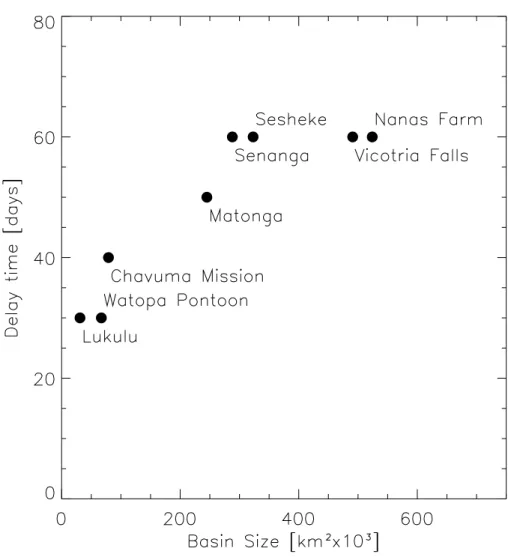
observed in Figs. 4 and 5. The estimated correlations are well above R2=0.8 for all stations (Tables 2 and 3). Evidentially, the parameters Q0, h0and BWImaxgive realistic numbers. It is also interesting to note that the delay time ∆t shows a dependency on the catchment size. For upstream gauging stations a delay time of 30 days is 5
estimated, for downstream stations this value increases to 60 days (Fig. 6). Also the hydrometric scaling factor increases with basin size, but more knowledge would be needed to appropriately interpret these observations.
Although the results are favourable they need to be considered carefully. It can be expected that the pronounced inter-annual cycle observed in the discharge behaviour 10
of the Zambezi with a very dry period and a wet period predetermines the high cor-relations observed. To check if the BWI is not only sensitive to annual variations, anomalies have been compared. Anomalies were calculated by subtracting the mean annual cycle from the samples (both from the BWI and the hydrometric series). If measurement series were incomplete, care was taken that the calculation of the mean 15
hydrometric parameter and scatterometer soil moisture were based on the same data range. Mean values were only calculated if at least two measurements per sample interval were available, otherwise the respective sample was removed from the data set. Figures 7 and 8 show scatterplots of the anomalies. To ease interpretation both quantities have been scaled between −1 and+1. The trend observed in all plots is 20
positive which indicates that differences in runoff/waterlevel from year to year can to some extent be explained by soil moisture anomalies. However under dry conditions the BWI anomalies show much more variability than the hydrometric anomalies. This is not surprising as especially under dry conditions variations caused by different pre-cipitation/evapotranspiration rates will only be experienced by the soils. But given the 25
lack of appropriate ground truth information about these quantities distinct conclusions are speculative and should be clarified in further studies.
HESSD
2, 417–448, 2005 Soil moisture-runoff relation at the catchment scale K. Scipal et al. Title Page Abstract Introduction Conclusions References Tables Figures J I J I Back CloseFull Screen / Esc
Print Version Interactive Discussion
EGU
8. Conclusions
In this paper a novel data set “The Global Soil Moisture Archive 1992–2000” has been presented. Although being not optimum for hydrologic applications due to the coarse resolution it was shown that the soil moisture products contain valuable information about large scale atmospheric induced variations of the soil moisture field. Contrary 5
to the availability of this soil moisture data, a review of state of the art research led to the impression that concepts of how to make best use of this data and how to inte-grate coarse resolution products in current hydrological modelling are still vague. The quality of the soil moisture data set, and first result of soil moisture assimilation studies however gave rise to the argumentation that coarse resolution soil moisture can suc-10
cessfully be used in hydrologic applications if scaling issues are considered carefully. To assess the usefulness of coarse resolution soil moisture data for catchment scale modelling, scatterometer derived soil moisture data was compared to hydrometric mea-surements (runoff and water level) taken at eight gauging stations of the Zambezi River in Africa. For this purpose the “Basin Water Index” BWI has been introduced which in-15
tegrates scatterometer derived soil moisture over the respective sub-basins. Visual analysis showed a reasonable agreement between the BWI and the hydrometric time series. Aside a shift between the observed maxima of the two datasets climatic con-ditions and multi-annual variations are clearly visible. The observed shift could be ex-plained with differences in the response time to precipitation events. For a quantitative 20
comparison between the BWI with hydrometric measurements a simple logarithmic regression model has further been developed. Using this model considerable agree-ment has been found between the absolute measures of the datasets with coefficients of correlation well above R2=0.8. Also for anomalies a positive trend was observed which led to the feeling that differences in runoff/waterlevel from year to year can to 25
some extent be explained by soil moisture anomalies.
These observations are especially encouraging given the approaching launch of a number of coarse resolution microwave sensors which will provide a flow of operational,
HESSD
2, 417–448, 2005 Soil moisture-runoff relation at the catchment scale K. Scipal et al. Title Page Abstract Introduction Conclusions References Tables Figures J I J I Back CloseFull Screen / Esc
Print Version Interactive Discussion
EGU global, high quality soil moisture data. Especially in ungauged basins these datasets
might turn out as invaluable source of information to improve the predictive capability of runoff models, or just to use the data to improve and validate hydrologic process representation at catchment scale.
Acknowledgements. We would like to thank the Zambezi River Authority in Zambia for making
5
hydrometric data available. The study has been funded by the Austrian Science Fund (FWF) though the SHARCKS project (P14002-TEC).
References
Aubert, D., Loumagne, C., and Oudin, L.: Sequential assimilation of soil moisture and stream-flow data in a conceptual rainfall-runoff model, J. Hydrol., 280, 145–161, 2003.
10
Bach, H. and Mauser, W.: Methods and Examples for Remote Sensing Data Assimilation in Land Surface Process Modelling, IEEE Geosci., 41, 1629–1637, 2003.
Bl ¨oschl, G. and Sivapalan, M.: Scale issues in hydrological modelling: A Review, Hydrol. Proc., 9, 251–290, 1995.
Bl ¨oschl, G.: Scale and scaling in hydrology, Wiener Mitteilungen, Wasser Abwasser Gew ¨asser,
15
Band 132, Insitut f ¨ur Hydraulik, Gew ¨asserkunde und Wasserwirtschaft, Technische Univer-sit ¨at Wien, 1996.
Cayan, D. R. and Georgakakos, K. P.: Hydroclimatology of continental watersheds: II spatial analyses, Water Res. R., 31, 677–697, 1995.
Ceballos, A., Martin ´ez-Fern ´andez, J., Santos, F., and Alonso, P.: Soil Water Behaviour of sandy
20
soils under semi-arid conditions in the Duero Basin (Spain), J. Arid Env., 51, 501–519, 2002. Ceballos, A., Scipal, K., Wagner, W., and Mart´ınez-Fern´andez, J.: Validation of ERS Scatterometer-Derived Soil Moisture Data in the Central Part of the Duero Basin, Spain, Hydrol. Proc., in press, 2004.
Crow, W. T. and Wood, E. F.: The assimilation of remotely sensed soil brightness temperature
25
into a land surface model using Ensemble Kalman filtering: A case study based on ESTAR measurements during SGP97, Adv. Water R., 26, 137–149, 2002.
De Ridder, K.: Quantitative estimate of skin soil moisture with the Special Sensor Mi-crowave/Imager, Bound-Lay. M., 96, 421–432, 2000.
HESSD
2, 417–448, 2005 Soil moisture-runoff relation at the catchment scale K. Scipal et al. Title Page Abstract Introduction Conclusions References Tables Figures J I J I Back CloseFull Screen / Esc
Print Version Interactive Discussion
EGU
Engman, E. T. and Chauhan, N.: Status of microwave soil moisture measurements with remote sensing, Remot. Sen. E., 51, 189–198, 1995.
Entekhabi, D., Asrar, G. R., Betts, A. K., Beven, K. J., Bras, R. L., Duffy, C. J., Dunne, T., Koster, R. D., Lettenmaier, D. P., McLaughlin, D. B., Shuttleworth, W. J., van Genuchten, M. T., Wei, M., and Wood E. F.: An Agenda for Land- Surface Hydrology Research and a call for the
5
Second International Hydrological Decade, B. Am. Meteor., 80, 2043–2058, 1999.
Entin, J. K., Robock, A., Vinnikov, K. Y., Hollinger, S. E., Liu, S., and Namkhai A.: Temporal and spatial scales of observed soil moisture variations in the extratropics, J. Geo. Res-A., 105, 11 865–11 877, 2000.
Francois, C., Quesney, A., and Ottle C.: Sequential assimilation of ERS–1 SAR data into a
10
coupled land surface hydrological model using an extended Kalman filter, J. Hydromete., 4, 473–487, 2003.
Grayson, R. B., Bl ¨oschl, G., Western, A., and McMahon, T. A.: Advances in the use of observed spatial patterns of catchment hydrological response, Adv. Water R., 25, 1313–1334, 2002. Hollinger, S. E. and Isard, S. A.: A Soil Moisture Climatology of Illinois, J. Climate, 7, 822–833,
15
1994.
Houser, P. R., Shuttleworth, W. J., Famiglietti, J. S., Gupta, H. V., Syed, K. R., Goodrich, D. C.: Integration of soil moisture remote sensing and hydrologic modelling using data assimilation, Water Res. R., 34, 3405–3420, 1998.
Kerr, Y. H., Waldteufel, P., Wigneron, J.-P., Martuzzi, J.-M., Font, J., and Berger, M.: Soil
20
moisture retrieval from space: The Soil Moisture and Ocean Salinity (SMOS) mission, IEEE Geosci, 39, 1729–1735, 2001.
Kontorschikov, V. I.: Statistical structure of the soil moisture in Ukraine, (in Russian), 1979. Koster, R. D., Houser, P. R., Engman E. T., Kustas W. P.: Remote Sensing May Provide
Un-precedented Hydrological Data,http://www.agu.org/eos elec/97035e.html, 1999.
25
Li, J. and Islam, S.: On the estimation of soil moisture profile and surface fluxes partitioning from sequential assimilation of surface layer soil moisture, J. Hydrol., 220, 86–103, 1999. Martin ´ez-Fern ´andez, J. and Ceballos A.: Temporal stability of Soil Moisture in a Large-Field
Experiment in Spain, Soil Sci. So., 67 1647–1656, 2003.
Meshcherskaya, A. V., Boldyreva, N. A., and Shapaeva N. D.: District Average Plant available
30
soil water storage and the depth of snow cover, statistical analysis and its usage (some examples), Gidrometeoizdat, Leningrad, USSR, 243, (in Russian), 1982.
Multi-HESSD
2, 417–448, 2005 Soil moisture-runoff relation at the catchment scale K. Scipal et al. Title Page Abstract Introduction Conclusions References Tables Figures J I J I Back CloseFull Screen / Esc
Print Version Interactive Discussion
EGU
Temporal Synthetic Aperture Radar (SAR) in Semiarid Rangeland, Agr. For. Met., 105, 69– 80, 2000.
Pauwels, V. R. N., Hoeben, R., Verhoest, N. E. C., and DeTroch, F. P.: The importance of the spatial patterns of remotely sensed soil moisture in the improvement of discharge predictions for small scale basins through data assimilation, J. Hydrol., 251, 88–102, 2001.
5
Reichle, R. H., Mc Laughlin, D. B., and Entekhabi, D.: Variational data assimilation of mi-crowave radiobrightness observations for land surface hydrology applications, IEEE Geosci, 39, 1708–1718, 2001.
Robock, A., Vinnikov, K. Y., Srinivasan, G., Entin, J. K., Hollinger, S. E., Speranskaya, N. A., Liu, S., and Namkhai, A.: The Global Soil Moisture Data Bank, B. Am. Meteor., 81, 1281–1299,
10
2000.
Rombach, M. and Mauser, W.: Multi-annual analysis of ERS surface soil moisture measure-ments of different land uses, 3rd ERS Symposium on Space at the service of our Environ-ment, Florence, Italy, 14–21 March, European Space Agency, SP-414, 27–34, 1997. Scipal, K.: Global Soil Moisture Monitoring using ERS Scatterometer Data, Dissertation an der
15
Technisch Naturwissenschaftlichen Fakult ¨at, Technische Universit ¨at Wien, Juni, 2002. Scipal, K., Wagner, W., Trommler, M., and Naumann, K.: The Global Soil Moisture Archive
1992–2000 from ERS Scatterometer Data: First Results, in Proc. IGARRS’2002, Toronto, Canada, 24–28 June, 2002.
Vachaud, G., Passerat de Silans, A., Balabanis, P., and Vauclin M.: Temporal stability of
spa-20
tially soil water probability density functions, Soil Sci. So., 45, 1040–1048, 1985.
Vieria, S. R., Nielsen, D. R., and Biggar J. W.: Spatial variability of field meassured infiltration rate, Soil Sci. So., 67, 1647–1656, 1981.
Vinnikov, K. Y., Robock, A., Qiu, S., Entin, J. K., Owe, M., Choudhsury, B. J., Hollinger, S. E., and Njoku, E. G.: Satellite remote sensing of soil moisture in Illinois, USA, J. Geo. Res-A.,
25
105, 4145–4168, 1999.
Wagner, W., Lemoine, G., and Rott, H.: A Method for Estimating Soil Moisture from ERS Scatterometer and Soil Data, Remot. Sen. E., 70, 191–207, 1999.
Wagner W., Scipal, K., Pathe, C., Gerten, D., Lucht, W., and Rudolf B.: Evaluation of the agree-ment between the first global remotely sensed soil moisture data with model and precipitation
30
data, J. Geo. Res-A., 108, 4611–4626, 2003.
Walker, J. P. and Houser, P. R.: A methodology for initializing soil moisture in a global climate model: assimilation of near-surface soil moisture observations, J. Geo. Res-A., 106, 11 761–
HESSD
2, 417–448, 2005 Soil moisture-runoff relation at the catchment scale K. Scipal et al. Title Page Abstract Introduction Conclusions References Tables Figures J I J I Back CloseFull Screen / Esc
Print Version Interactive Discussion
EGU
11 774, 2001.
Walker, J. P., Willgoose, G. R., and Kalma, J. D.: One-dimensional soil moisture profile re-trieval by assimilation of near-surface observations: A comparison of rere-trieval algorithms, Adv. Water R., 24, 631–650, 2001.
Zambezi River Authority:http://www.zaraho.org.zm, 2002.
HESSD
2, 417–448, 2005 Soil moisture-runoff relation at the catchment scale K. Scipal et al. Title Page Abstract Introduction Conclusions References Tables Figures J I J I Back CloseFull Screen / Esc
Print Version Interactive Discussion
EGU
Table 1. Gauging stations on the Zambezi River used in this study.
Gauging station River Location Catchment size Measurement
Kalabo Luanginga 14◦580S–22◦410E 28 500 km2 Discharge
Watopa Pontoon Kabompo 14◦020S–23◦3703000E 66 750 km2 Discharge
Chavuma mission Zambezi 13◦050S–22◦410E 76 000 km2 Discharge
Victoria Falls Zambezi 17◦550S–25◦500E 507 200 km2 Discharge
Nanas Farm Zambezi 17◦500S–25◦390E 524 000 km2 Discharge
Lukulu Zambezi 14◦230S–23◦140E 212 450 km2 Water level
Matongo Zambezi 15◦160S–23◦0303000E 245 000 km2 Water level
Senanga Zambezi 16◦070S–23◦2301500E 290 572 km2 Water level
HESSD
2, 417–448, 2005 Soil moisture-runoff relation at the catchment scale K. Scipal et al. Title Page Abstract Introduction Conclusions References Tables Figures J I J I Back CloseFull Screen / Esc
Print Version Interactive Discussion
EGU
Table 2. Parameters of the logarithmic model given in Eq. (2) after optimising the fit between
the model and the parameters for all stations, and coefficient of correlation R.
Gauging station Q0 χQ BWImax ∆t R
Watopa Pontoon 32.78 93.08 82.4 30 0.94
Chavuma Mission 8.55 151.28 75.1 40 0.96
Victoria Falls 19.87 711.637 74.7 60 0.95
HESSD
2, 417–448, 2005 Soil moisture-runoff relation at the catchment scale K. Scipal et al. Title Page Abstract Introduction Conclusions References Tables Figures J I J I Back CloseFull Screen / Esc
Print Version Interactive Discussion
EGU
Table 3. Parameters of the logarithmic model given in Eq. (3) after optimising the fit between
the model and the parameters for all stations, and coefficient of correlation R.
Gauging station h0 χh BWImax ∆t R
Lukulu 1.52 0.88 82.6 30 0.92
Matongo 1.48 1.93 84.1 50 0.96
Senanga 0.15 1.671 83.6 60 0.96
HESSD
2, 417–448, 2005 Soil moisture-runoff relation at the catchment scale K. Scipal et al. Title Page Abstract Introduction Conclusions References Tables Figures J I J I Back CloseFull Screen / Esc
Print Version Interactive Discussion
EGU
Fig. 1. The catchment of the Zambezi River with the location of the twelve gauging stations
HESSD
2, 417–448, 2005 Soil moisture-runoff relation at the catchment scale K. Scipal et al. Title Page Abstract Introduction Conclusions References Tables Figures J I J I Back CloseFull Screen / Esc
Print Version Interactive Discussion
EGU
Fig. 2. Runoff and Basin Water Index series for the station Victoria Falls situated on the
HESSD
2, 417–448, 2005 Soil moisture-runoff relation at the catchment scale K. Scipal et al. Title Page Abstract Introduction Conclusions References Tables Figures J I J I Back CloseFull Screen / Esc
Print Version Interactive Discussion
EGU
Fig. 3. Runoff and Basin Water Index series for the station Kalabo situated at the Luanginga
HESSD
2, 417–448, 2005 Soil moisture-runoff relation at the catchment scale K. Scipal et al. Title Page Abstract Introduction Conclusions References Tables Figures J I J I Back CloseFull Screen / Esc
Print Version Interactive Discussion
EGU
Fig. 4. Scatterplot of Basin Water Index and runoff at four gauging stations of the Zambezi
River. Runoff data has been shifted back such that the observed maxima corresponded. The fitted model of Eq. (2) is also shown.
HESSD
2, 417–448, 2005 Soil moisture-runoff relation at the catchment scale K. Scipal et al. Title Page Abstract Introduction Conclusions References Tables Figures J I J I Back CloseFull Screen / Esc
Print Version Interactive Discussion
EGU
Fig. 5. Scatterplot of Basin Water Index and water level at four gauging stations of the Zambezi
River. Water level data has been shifted back such that the observed maxima corresponded. The fitted model of Eq. (3) is also shown.
HESSD
2, 417–448, 2005 Soil moisture-runoff relation at the catchment scale K. Scipal et al. Title Page Abstract Introduction Conclusions References Tables Figures J I J I Back CloseFull Screen / Esc
Print Version Interactive Discussion
EGU
HESSD
2, 417–448, 2005 Soil moisture-runoff relation at the catchment scale K. Scipal et al. Title Page Abstract Introduction Conclusions References Tables Figures J I J I Back CloseFull Screen / Esc
Print Version Interactive Discussion
EGU
Fig. 7. Scatterplot of Basin Water Index and discharge anomalies at four gauging stations of
HESSD
2, 417–448, 2005 Soil moisture-runoff relation at the catchment scale K. Scipal et al. Title Page Abstract Introduction Conclusions References Tables Figures J I J I Back CloseFull Screen / Esc
Print Version Interactive Discussion
EGU
Fig. 8. Scatterplot of Basin Water Index and water level anomalies at four gauging stations of