www.newphytologist.org 705
Forum
Blackwell Publishing, Ltd.Commentary
Functional–structural plant
modelling
In the last decade, many research teams throughout the world initiated a new approach in plant science by developing computer models of plant functioning and growth. The intention of this approach was to understand the complex interactions between plant architecture and the physical and biological processes that drive the plant development at several spatial and temporal scales, using so-called functional–structural plant models (FSPMs). Explicitly taking into account the spatial distribution of plant organs has multiple consequences: (i) FSPMs are usually associated with 3D plant models where plant architecture is represented as a collection of interconnected plant components, which are distributed in the 3D below- and above-ground space; (ii) FSPMs usually deal with the spatial distribution of both environmental and biological processes; (iii) FSPMs are usually based on scaling up, mostly from the organ to the plant, but also from tissue to organ or from plant to stand; and (iv) to deal with the system complexity owing to the high number of plant constituents, and to deal with the potentially high numbers of interacting processes, FSPMs must develop adequate computational methods.
To discuss these questions, in 1996 the FSPM series of workshops (http://amap.cirad.fr/workshop/FSPM04/index.html) was established to assemble regularly from all over the world scientists who integrate 3D representations of plants, physi-ological models, environmental models, computer science and mathematics into their approach. The general aim of this community is to understand better, through the use of 3D representations, the importance of taking into account the spatialisation of processes in plant functioning and morpho-genesis. The FSPM community contributes to unravelling these integrated plant functioning mechanisms and in this issue of New Phytologist we feature a set of papers that address the different aspects and questions raised (Godin et al., 2005), so highlighting the current advances and future directions required.
‘Plant spatial representations can be made at various levels
of detail, ranging from accurate descriptions of each organ
to coarse descriptions of branching systems at plant level.’
Nature of plant spatial representation
This question is central to the design of FSPMs. Plant spatial representations can be made at various levels of detail, ranging from accurate descriptions of each organ (leaf, metamer, etc.) to coarse descriptions of branching systems at plant level. Plant organs may be represented as constituents simply distributed in space. This geometric representation can be augmented by a description of the physical connections between organs, corresponding to the plant topological structure. Geometric structures are useful to model interactions of the plant with its environment. Topological structures are useful to model the circulation of substances or physical quantities within the plant (water, sugars, strains, etc.).
Different methods have been designed to digitise plants of various sizes in 3D or to map their topological structures (Sinoquet & Rivet, 1997) (Godin et al., 1999) (Hanan & Wang, 2004). Using these methods, researchers can build up plant architecture databases that are used for further analysis or modelling. To analyse these complex databases, dedicated tools are necessary. Durand et al. (pp. 813–825, this issue) give a very innovative illustration of such analysis tools. They introduce a new Markovian-based stochastic model designed to identify homogeneous zones in tree structures and transitions between these zones. This approach contributes to creating a new generation of tools for automating complex tree architecture analysis in the context of understanding the botan-ical organisation of plants or building and assessing models.
Plant structure as an interface
The surfaces of plant organs are the location of energy, mass and information exchanges with the environment. From the plant viewpoint, this includes phylloclimate (Chelle, pp. 781– 790, this issue), which is the microclimate and the environmental signals sensed by plants at the organ scale, and includes mass and energy fluxes gained or lost by the plant. From the environment point of view, plants act as modifiers of both soil and microclimate variables, as the result of plant presence (e.g. light interception, wind attenuation, disease propagation) and also due to tree functioning (e.g. air humidity due to transpiration, soil drying). Most of the interactions between the plant and the environment only depend on plant geometry, namely the 3D distribution of plant organs (e.g. light interception). In particular, the plant ability for resource capture mainly depends on spatial display by foraging organs. However, plant topology also influences the interactions between the plant and the environment. By using a FSPM, Pearcy et al. (pp. 791–800, this issue) show how light-capture
Commentary
New Phytologist (2005) 166: 705–708 www.newphytologist.org © New Phytologist (2005)
Forum 706
strategies are influenced by topological constraints, namely hydraulics and biomechanics, and how plants regulate biomass investment in order to achieve multiple purpose optimisa-tion. This illustrates the usefulness of FSPMs to understand interactions between multiple processes better.
Plant as a network
The plant structure provides the support for different forms of fluxes (water, sugars) and signals (mechanical constraints, hormones) that control the plant functioning and growth. Models of water transport have been developed in the past decade and rely on the application of Darcy’s law to express the relationship between fluxes and water potential in porous media, (e.g. Früh & Kurth, 1999). More recently, the simulation of mechanical stress and strains in plants has been considered by several teams ( Jirasek et al., 2000; Alméras et al., 2002; Fourcaud & Lac, 2003) and is now considered to be a tractable issue. The problem of carbon transport and allocation is more complex because the underlying physiological processes are difficult to observe and are not yet well under-stood. Current modelling approaches use different variants of the concept of source and sink strength, reviewed in this issue by Minchin & Lacointe (pp. 771– 779, this issue). The authors suggest that a ‘minimal Münch model’ can provide a sound and general theoretical framework to model carbon transport, where allocation priorities are an emergent property of the model. Allen et al. (pp. 869–880, this issue) illustrate this approach by describing a transport-resistance model based on the integration of similar assumptions for carbohydrate flow and allocation and -systems for studying the growth of peach trees.
Plant as a developing organism
The growth of the plant continuously modifies the network of components and space occupation, which in turn changes the general balance between organ demand and production. This dynamic feedback between structure and function is probably one key issue in the understanding of plant development which necessitates further theoretical and applied developments. Current work in this area consists of developing mechanistic models that integrate models of physiological processes and descriptive information where knowledge of the underlying mechanisms is lacking. Knowledge is usually expressed at the metamer or growth unit level, and the growth of the entire organism is considered as an emerging property of the locally defined interactions between plant components or between plant components and environmental factors.
Two approaches in this issue were designed to study the effect of environmental factors (here, light) on plant growth. Evers et al. ( pp. 801–812, this issue) adopted a detailed descriptive approach to model the growth of wheat. The variation of arch-itectural variables throughout time (e.g. leaf dimensions, inter-node length, phyllochrone and leaf number) was estimated
according to field measurements or bibliographic data. Sterck et al. (pp. 827 – 843, this issue) designed a model where each metamer can produce a flush of growth. Flushes are controlled by the product of probabilities, depending on their metamer topological and environmental context. This growth principle is then integrated with computation of light capture, photo-synthesis and carbon allocation at each cycle of growth to study the effect of different light environment on tree growth.
Models of plant development can also be used to study the ability of locally specified hypotheses to generate a range of emerging behaviours through complex interaction at plant level. Fournier et al. (pp. 881– 894, this issue) describes a model of grass leaf that was designed to analyse the likeli-hood of event synchronisation during plant growth, such as leaf emergence and triggering of leaf elongation. Allen et al. developed a model able to integrate various sources of physi-ological knowledge. Here, emphasis is put on the handling of complex dynamical systems. First, efficient algorithms are described to compute carbohydrate flows within the dynami-cally changing tree structure. Second, correct qualitative behaviour of the model is shown to emerge from simple quantitative local rules expressing carbon allocation and storage, water supply, light availability and fruit growth.
Finally, the approach of Buck-Sorlin et al. (pp. 859– 867, this issue) shows the possibility of using growth models to test the integration of new levels of knowledge in a com-plex system. Their model combines morphogenetic rules of the development of Barley and a description of metabolic regulatory network simulating the biosynthesis of gibberel-lic acids that control the elongation of internodes.
Challenges and future directions of research
Functional–structural approaches are intended to face several aspects of plant architecture complexity: (i) complexity of the biological system, in particular due to the high variability and plasticity of plant growth, and to the multitude of interwoven scales at which physical, ecophysiological and morphogenetic phenomena occur; (ii) complexity of integrating various sources of knowledge, possibly at different time scales, into one consistent modelling framework; and (iii) computer simulation complexity, which necessitates management of numerous dynamically changing and interacting parts. These questions are currently being discussed within the FSPM research community (Godin et al., 2004), where the following new approaches are emerging.
Integration. To tackle the lack of a modelling framework for
developing integration of structure and function, new modelling paradigms are being developed and tested. This is illustrated for instance by the intermediate-level approach (not completely mechanistic and not completely descriptive), based on a sys-tematic flux-based representation of the various phenomena at different scales (Renton et al., pp. 845 – 857, this issue).
Commentary
© New Phytologist (2005) www.newphytologist.org New Phytologist (2005) 166: 705–708
Forum 707
Link between models and the real world. Because virtual
plants and FSPMs are firstly tools developed to address biological questions, they must show properties and behaviours similar to those of real plants. FSPMs allow scientists to make virtual experiments and measurements, impossible to set in the real world due to time, cost or feasibility constraints. Light partitioning between fruiting units in tree canopies, for example, cannot be measured from light sensors distributed in the canopy, whereas virtual plants allow accurate estimations of light sharing at intra-canopy scales (Allen et al.). In order for there to be confidence in the results from the virtual experiments, quality requirements are needed. This should be carefully checked from quantitative assessment. This applies for both plant structure and function. As a result, virtual experiments should presently be used in applications where FSPMs results have been validated from comparison with field or lab measurements, while more interaction between modellers and experimenters should develop in order to ensure close relationships between FSPMs and real plants.
Understanding the effect of genes in the development of plant
form. The large number of recent results obtained in both
molecular and cellular biology makes it possible to consider a new approach of developmental biology based on modelling at a cellular scale. Today, several teams are building models of meristem development, organ growth and hormone signals, to grasp the role of different parameters in the control of phenomena like phyllotaxy, meristem maintenance and response to environment (for a review, see Prusinkiewicz, 2004). A first step in this direction is illustrated by Buck-Sorlin et al.
Design of new languages and formalisms. Several attempts
are being made in order to generalise the -system approach. Classical -systems only manipulate strings or tree structures. However, at the scale of tissues for instance, structures correspond to complex 2D or 3D objects and cannot be simply represented by strings or trees. In an attempt to generalise -systems to model the development of discretised surfaces, Prusinkiewicz and colleagues introduced a language, called VV, for rewriting meshes of triangles (representing tissues). They applied this generic system to the problem of modelling the growth of apical meristem and the emergence of phyllotactic patterns (Smith & Prusinkiewicz, 2004). In a similar perspective, Buck-Sorlin et al. introduce another extension of -systems, RGG, that can represent genetic, metabolic and morphological aspects of plant development within the same framework.
Conclusion
The FSPM community is young and multidisciplinary in nature. Its size is increasing at each FSPM conference since 1996 and around 200 participants attended FSPM04 in
Montpellier, June 2004. As illustrated by the selection of papers in this special feature of New Phytologist, major trends are readily observable: (i) -systems, for instance, are adopted by a majority of teams as a paradigm to model plant development; (ii) there is a real need for modellers to exchange ideas, formalisms and experience independently of the type of plant ( grass, bush or tree) they work on; and (iii) there is a new and growing interest in the FSPM community in modelling the interaction between genes and form. These trends will probably be the basis of major topics of the next FSPM conference, which will be held in New Zealand in November 2007.
Christophe Godin1 and Hervé Sinoquet2*
1INRIA, UMR AMAP, TA40/PSII, Boulevard de la Lironde, 34398 Montpellier Cedex 5, France; 2UMR PIAF, INRA-Université Blaise Pascal, Site de Crouelle, 234, avenue du Brezet, 63100 Clermont-Ferrand, France (*Author for correspondence: tel +33 4 73 62 43 61; fax +33 4 73 62 44 54; email [email protected])
References
Allen MT, Prusinkiewicz P, DeJong TM. 2005. Using -systems for modeling source–sink interactions, architecture and physiology of growing trees, the L-PEACH model. New Phytologist166: 869– 880.
Alméras T, Gril J, Costes E. 2002. Bending of apricot-tree branches under the weight of axillary productions: confrontation of a mechanical model to experimental data. Trees – Structure and Function16: 5–15.
Buck-Sorlin GH, Kniemeyer O, Kurth W. 2005. Barley morphology, genetics and hormonal regulation of internode elongation modelled by a relational growth grammar. New Phytologist166: 859– 867. Chelle M. 2005. Phylloclimate or the climate perceived by individual
plant organs, What is it? How to model it? What for?New Phytologist166: 781–790.
Durand J-B, Guédon Y, Caraglio Y, Costes E. 2005. Analysis of the plant architecture via tree-structured statistical models, the hidden Markov tree models. New Phytologist166: 813 – 825.
Evers JB, Vos J, Fournier C, Andrieu B, Chelle M, Struik PC. 2005. Towards a generic architectural model of tillering in Gramineae, as exemplified by spring wheat (Tricitum aestivum). New Phytologist
166: 801–812.
Fourcaud T, Lac P. 2003. Numerical modelling of shape regulation and growth stresses in trees I. An incremental static finite element formulation. Trees – Structure and Function17: 23–30.
Fournier C, Durand JL, Ljutovac S, Schäufele R, Gastal F, Andrieu B. 2005. A functional–structural model of elongation of the grass leaf and its relationships with the phyllochron. New Phytologist166: 881– 894.
Früh T, Kurth W. 1999. The hydraulic system of trees: theoretical framework and numerical simulation. Journal of Theoretical Biology
201: 251–270.
Godin C, Costes E, Sinoquet H. 1999. A method for describing plant architecture which integrates topology and geometry. Annals of Botany84: 343–357.
Godin C, Costes E, Sinoquet H. 2005. Plant architecture modelling – virtual plants and complex systems. In: Turnbull C, ed. Plant Architecture
Commentary
New Phytologist (2005) 166: 705–708 www.newphytologist.org © New Phytologist (2005)
Forum 708
and its Manipulation. Annual Plant Reviews, Vol. 17. Oxford, UK: Blackwell Publishing, 237–286.
Godin C, Hanan J, Kurth W, Lacointe A, Takenaka A,
Prusinkiewicz P, DeJong TM, Beveridge C, Andrieu B, eds.2004.
Proceedings of the 4th International Workshop on Functional-Structural Plant Models.Montpellier, France: UMR AMAP.
Hanan J, Wang Y. 2004. Floradig: a configurable program for capturing plant architecture. In: Godin, C, Hanan, J, Kurth, W, Lacointe, A, Takenaka, A, Prusinkiewicz, P, DeJong, T M, Beveridge, C, Andrieu, B, eds. Proceedings of the 4th International
Workshop on Functional-Structural Plant Models. Montpellier, France: UMR AMAP, 407– 411.
Jirasek C, Prusinkiewicz PW, Moulia B. 2000. Integrating biomechanics into developmental models expressed in 1-systems.
Plant Biomechanics. Freiburg, Germany: Badenweiler, 615 – 624. Minchin PEH, Lacointe A. 2005. New understanding on phloem
physiology and possible consequences for modelling long-distance carbon transport. New Phytologist 166: 771–779.
Pearcy RW, Muraoka H, Valladares F. 2005. Crown architecture in sun and shade environments, assessing function and trade-offs with a three-dimensional simulation model. New Phytologist 166: 791–800.
Prusinkiewicz P. 2004. Modeling plant growth and development.
Current Opinion in Plant Biology 7: 79 – 83.
Renton M, Hanan J, Burrage K. 2005. Using the canonical modelling approach to simplify the simulation of function in functional–structural plant models. New Phytologist 166: 845– 857.
Sinoquet H, Rivet P. 1997. Measurement and visualisation of the architecture of an adult tree based on a three-dimensional digitising device. Trees – Structure and Function 11: 265 –270.
Smith C, Prusinkiewicz P. 2004. Simulation modeling of growing tissues. In: Godin, C, Hanan, J, Kurth, W, Lacointe, A, Takenaka, A, Prusinkiewicz, P, DeJong, T M, Beveridge, C, Andrieu, B, eds.
Proceedings of the 4th International Workshop on Functional-Structural Plant Models. Montpellier, France: UMR AMAP, 365 –370. Sterck FJ, Schieving F, Lemmens A, Pons TL. 2005. Performance
of trees in forest canopies, explorations with a bottom-up functional–structural plant growth model. New Phytologist 166: 827– 843.
Key words: complexity, computer models, FSPM, integration, plant architecture, virtual experiments, virtual plants.
166 Commentary Commentary
Fructans and freezing
tolerance
Fructans are linear or branched polymers of fructose that occur in about 15% of flowering plant species, including many which are cultivated commercially – they are synthesized from sucrose in the vacuole, where they are stored as reserve nonstructural carbohydrates. However, their role is wider than just storage. For example, fructan metabolism may impact on the tolerance of plants to drought and frost, and may aid in the defense against infection by fructan-producing pathogens. In this issue (pp. 917– 932), Van den Ende et al. report exciting new findings pertaining to the
phy-siological role(s) of fructan. These authors employed a diverse experimental approach that led to the cloning and biochemical characterization of two 6-kestose exohydrolase (6-KEH) isozymes from cold-hardened wheat crown tissue. The 6-KEHs are novel among enzymes of fructan meta-bolism because of their high specificity for a single substrate, 6-kestose, and their localization in the apoplastic fluid of fructan-containing sink tissues. The thorough examination of fructan metabolism by Van den Ende et al. provides perhaps the best evidence to date that fructan degradation in the apoplast functions to stabilize cell membranes exposed to freezing temperature.
‘6-kestose exohydrolase degradation of apoplastic
6-kestose to sucrose and fructose may be a mechanism
to protect membranes from freezing’
Synthesis and degradation
Determining the metabolic pathway(s) of fructan synthesis / degradation proved to be a painstaking endeavor owing to the unusual kinetic properties of the enzymes. Nearly 30 years elapsed before the conceptual model for fructan synthesis proposed by Edelman & Jefford (1968) was shown to be correct (reviewed in Vijn & Smeekens, 1999). The enzymes sucrose:sucrose 1-fructosyl transferase (1-SST) and fructan: fructan 1-fructosyl transferase (1-FFT) synthesize inulin, the most basic fructan. Both 1-SST and 1-FFT are nonspecific with regard to substrate utilization, and the activity is essentially nonsaturable and dependent on both enzyme and substrate concentration (Koops & Jonker, 1996). Subsequently, the enzymes that catalyze the formation of more complex fructans have been isolated and have been shown to have similar properties to 1-SST and 1-FFT.
Compared with fructan synthesis, relatively little is known about the degradation and subsequent mobilization of fructans from the vacuole (Vijn & Smeekens, 1999). Fructan exohydolase (FEH) enzymes have been localized in vacuoles and catalyze the removal of terminal fructose residues. In addition to degrading fructans before mobilization out of the vacuole, vacuolar FEHs are thought to function as trimming enzymes during fructan synthesis (Van den Ende et al.).
Beyond storage
Vijn & Smeekens (1999) discussed the long-held suspicions of researchers that fructans have physiological roles
Commentary
© New Phytologist (2005) www.newphytologist.org New Phytologist (2005) 166: 705–708
Forum 709
not directly associated with the role as a storage form of carbohydrate. As predicted by Vijn & Smeekens (1999), the advent of molecular genetics has been a great benefit to researchers concerned with fructan metabolism. Some surprising results have opened avenues of research not previ-ously considered. Livingston & Henson (1998) reported the presence of fructans and FEH activity in the apoplastic fluid of second-phase cold-hardened crown tissue of oat, leading to the suggestion that fructan metabolism may contribute to the mechanism of freezing tolerance. Van den Ende et al. confirm and greatly extend this research. The two 6-kestose exohydrolase enzymes cloned from a cDNA library prepared from cold-hardened wheat crown tissue were rigorously characterized at the molecular and biochemical levels. The absolute specificity of 6-KEH for 6-kestose provides unequivocal evidence that the enzymes are indeed 6-KEHs, enzymes never before detected in plants. The activity of the 6-KEHs was predominantly found in the apoplastic fluid of the crown tissue, consistent with the array of fructan substrates found in the apoplasic fluid. Furthermore, both 6-KEHs have N-terminal sequences consistent with secretion from the cell. Although the evidence for localization of the 6-KEHs in the apoplastic fluid is not totally definitive, when considered with the novel properties of 6-KEH (especially the extreme specificity for a single substrate) and the expression of 6-KEH in sink tissues that must tolerate freezing temperature, it is logical to conclude that 6-KEH functions to degrade apoplastic 6-kestose to sucrose and fructose as a mechanism to protect membranes from freezing. Alternatively, the authors note that 6-KEH may function to inhibit infection by fructan-producing pathogens, a role that has been proposed for FEH enzymes that occur in plants such as sugar beet that do not synthesize fructans (Van den Ende et al., 2003, 2004).
Transport to the apoplast
Although only briefly discussed by Van den Ende et al., there remains a relevant unresolved question pertaining to fructan metabolism. Specifically, how are fructans, which are syn-thesized and stored in the vacuole, transported to the apoplast? The authors speculate that fructan transport may occur by a vesicle-mediated mechanism (exocytosis) as described by Echeverria (2000). New results of E. Etxeberria (aka E. Echeverria, pers. comm.) indicate that a similar mechanism exists for import of solutes from the apoplast to cellular compartments (endocytosis). Such a mechanism of transport is attractive because multiple solutes of varying sizes could be transported with no requirement for specific membrane carriers. It seems essential that the mechanism(s) of fructan transport from the vacuole be resolved in order obtain a complete picture of the physiological roles of fructan in plants.
Perspectives
In a more general sense, the experimental approach of Van den Ende et al. provides new information at several levels, from the gene to the intact tissue. Indeed, at least two reports could have been derived from the wealth of data reported in this paper, leading to a more impressive resumé but a much less satisfying story for the scientific community. It can be expected that breakthroughs, such as the discovery of 6-KEH reported in this issue, will soon be forthcoming, leading to new avenues of research. Advances in understanding fructan metabolism may provide new strategies to bioengineer stress tolerance in commercially cultivated plant species and may also impact exploitation of the commercial utility of fructans that has been hampered by the difficulties in obtaining homogeneous complex fructans.
Steven J. Crafts-Brandner
United States Department of Agriculture, Agricultural Research Service, Western Cotton Research Laboratory, 4135 East Broadway Road, Phoenix, AZ 85040, USA (tel +1 602 437 0121; fax +1 602 437 1274; email [email protected])
References
Echeverria E. 2000. Vesicle-mediated solute transport between the vacuole and the plasma membrane. Plant Physiology 123: 1217–1226. Edelman J, Jefford TG. 1968. The mechanism of fructosan
metabolism in plants as exemplified in Helianthus tuberosis.
New Phytologist 67: 517–531.
Koops AJ, Jonker HH. 1996. Purification and characterization of the enzymes of fructan biosynthesis in tubers of Helianthus tuberosus Colombia. II. Purification of sucrose:sucrose 1-fructosyltransferase and reconstitution of fructan synthesis in vitro with purified sucrose:sucrose 1-fructosyltransferase and fructan:fructan 1-fructosyltransferase. Plant Physiology 110: 1167 –1175. Livingston DP, Henson CA. 1998. Apoplastic sugars, fructans,
fructan exohydrolase, and invertase in winter oat, responses to second-phase cold hardening. Plant Physiology 116: 403 – 408. Van den Ende W, De Coninck B, Clerens S, Vergauwen R,
Van Laere A. 2003. Unexpected presence of fructan 6-exohydrolases (6-FEHs) in non-fructan plants. Characterization, cloning, mass mapping and functional analysis of a novel ‘cell-wall
invertase-like’ specific 6-FEH from sugar beet (Beta vulgaris L.).
Plant Journal 36: 697 –710.
Van den Ende W, De Coninck B, Van Laere A. 2004. Plant fructan exohydrolases: a role in signaling and defense? Trends in Plant Science 9: 523–528.
Van den Ende W, Yoshida M, Clerens S, Vergauwen R, Kawakami A. 2005. Cloning, characterization and functional analysis of novel 6-kestose exohyrolases (6-KEHs) from wheat (Triticum aestivum L.).
New Phytologist 166: 917– 932.
Vijn I, Smeekens S. 1999. Fructan: More than a reserve carbohydrate?
Plant Physiology 120: 351 – 335.
Key words: apoplast, freezing tolerance, fructan, 6-ketose exohydrolase, solute transport, vacuole.
Letters
New Phytologist (2005) 166: 705–708 www.newphytologist.org © New Phytologist (2005)
Forum 710
Letters
Leaf-level light
compensation points in
shade-tolerant woody
seedlings
Photosynthetic traits such as respiration rate and light compensation point (LCP) likely play an important role in determining a plant’s tolerance to low light levels, which can dictate long-term partitioning of the light supply among species and successional patterns (Givnish, 1988; Pacala et al., 1994). Walters & Reich (1999) reviewed patterns of leaf-level LCPs and associated leaf parameters in seedlings of tree species. They reported differences in mass-based dark respiration rates (Rd,mass) and specific leaf area (SLA), but no differences in area-based dark respiration rates (Rd,area), quantum yield (QY) or LCP among species that are considered shade-tolerant, shade-intolerant or intermediate in their tolerance of shade. Although other aspects of plant ecophysiology are certainly important for shade tolerance, is it true that leaf LCPs are unimportant?
Shade tolerance: questions
There are, in fact, several reasons to question the truth of this assertion. First, for a given plant, shade leaves are considered to have lower LCPs than sun leaves (Ellsworth & Reich, 1993). If phenotypic and genotypic plasticity operate in the same direction, then shade-tolerant plants would have lower LCPs compared with shade-intolerant species. Second, shade-tolerant species are thought to intercept a higher fraction of the incident light, i.e. species that are tolerant of shade cast deeper shade (Horn, 1971; Canham et al., 1994). For this pattern to exist, the leaves of shade-tolerant plants at the bottom of the canopy would have to have lower LCPs than leaves of shade-intolerant species because mature leaves likely need to be energetically self-sufficient (Lacointe et al., 2004; Sprugel et al., 1991). Third, individual studies that compare shade-intolerant and shade-tolerant species under similar growth conditions often show that shade-tolerant species have lower LCPs than shade-intolerant species (e.g. Lusk, 2002). Finally, data for Rd,area and LCPs were log-normally distributed, and should have been log-transformed to meet the requirements of (Sokal & Rohlf, 1994).
Patterns of photosynthetic traits
In order to investigate this, we started with data on Rd,area, QY and LCP from appendix 1 of Walters & Reich (1999), which included the leaves of 67 species of broadleaf evergreen trees and 27 species of temperate deciduous trees that were grown under low light (< 4% full sun) and/or slightly higher light levels (4 –12% full sun). Using the same criteria as Walters & Reich, we obtained data on photosynthetic character-istics of seedlings of woody species published since 1998 (see Appendix). These included 22 new species from six publica-tions (Einig et al., 1999; Valladares et al., 2000; Hattenschwiler, 2001; Lusk & Del Pozo, 2002; Lusk, 2002; Muraoka et al., 2003) for a total data set of 115 species. Following Walters & Reich, no needleleaf evergreens were included.
Species means were recalculated for each of the two light levels (< 4% and 4 –12% full sun). Also following Walters & Reich, species were categorized with respect to shade tolerance based on published survival data in shade by original authors and/or previously published observations of toler-ance. Species with ambiguous classification (e.g. Acer pseudo-platanus of Hattenschwiler, 2001) were not included in this analysis. Data from Einig et al. (1999) were taken from leaves positioned at intermediate height on the seedlings. Hattenschwiler (2001) data were averages of means at 1.3 and 3.4% full sun for ambient CO2. Only shade plants were used from Lusk (2002), because it was uncertain whether the high-light category exceeded 12% full sun. For Muraoka et al. (2003), we averaged data for seedlings in deciduous– coniferous and deciduous forests. We removed one strong outlier from the analysis. Fraxinus americana, an intermedi-ate shade-tolerance species that was reported to have an LCP of 1.1 µmol m−2 s−1 (Bazzaz & Carlson, 1982), but a calcu-lated LCP (Rd,area/QY) of 11.3. All analyses were performed in 5.0.1 (SAS, Cary, NC).
When examining the relationships among photosynthetic characteristics, species with lower area-based dark respiration rates and/or higher QY had lower LCPs. Both Rd,area and QY were significant predictors of LCP (log LCP = 1.73 + 0.84 log Rd,area – 11.25 QY; r2 = 0.61, P < 0.001 for each coefficient) with significant bivariate relationships using a Model II regression (Fig. 1).
Differences in Rd,area, QY and LCP among categorical factors that include species classification (broadleaf evergreen and deciduous), light levels and shade-tolerance were tested using two separate full-factorial s. Because the light levels, shade-tolerance categories and leaf habit contrasts represent
Letters
© New Phytologist (2005) www.newphytologist.org New Phytologist (2005) 166: 705–708
Forum 711
post hoc categories, nonsignificant predictors (P > 0.05) were removed serially.
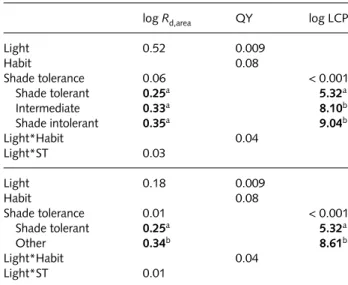
LCPs were lower for tolerant species than shade-intolerant species and species intermediate in their tolerance for shade (P < 0.001, Table 1). Shade-tolerant species have positive carbon balance at light levels approximately 3 µmol m−2 s−1 less than intermediate or intolerant species (least squares means LSMs = 5.3 vs 8.1, 9.0 µmol m−2 s−1, respec-tively). Combining the intolerant and intermediate species into a single category strengthens the significance of differ-ence between tolerant and other species for Rd,area and LCP (Table 1). The lower LCPs of shade-tolerant species compared with intermediate and intolerant species was associated with lower Rd,area (P = 0.06 for three categories, P = 0.01 with two), but no difference in quantum yield (Table 1).
Relevance of lower LCPs
There are three major consequences to shade-tolerant species having lower values of Rd,area and LCP. First, net carbon balance in low light should be greater for tolerant than for less-tolerant species, and hence contribute (along with whole-plant char-acteristics) to the success of tolerant species in shade. Light levels in the understory of forests can be near the LCPs of seedlings for the greater part of the day. Ellsworth & Reich (1992) measured 10-min means of photosynthetic photon flux density over the course of a growing season in the under-story of an Acer saccharum forest. Over 90% of the time light levels were below 20 µmol m−2 s−1. The low LCP and Rd,area of shade-tolerant species should allow them both to
conserve carbon better than less tolerant species and to gain carbon better, having net photosynthesis at lower light levels.
Second, the trade-off between low respiration rates and high maximum photosynthetic rates among species was Fig. 1 Bivariate relationships among Rd,area,
QY and LCP. Lines represent Model II regression best fit. LCP and Rd,area were log-transformed before regressions.
Table 1 Backwards elimination results for species-averaged
Rd,area, QY and LCP
log Rd,area QY log LCP
Light 0.52 0.009 Habit 0.08 Shade tolerance 0.06 < 0.001 Shade tolerant 0.25a 5.32a Intermediate 0.33a 8.10b Shade intolerant 0.35a 9.04b Light*Habit 0.04 Light*ST 0.03 Light 0.18 0.009 Habit 0.08 Shade tolerance 0.01 < 0.001 Shade tolerant 0.25a 5.32a Other 0.34b 8.61b Light*Habit 0.04 Light*ST 0.01
Note that the table also includes P-values for categorical contrasts (light level and evergreen vs deciduous leaf habit) and least squares means (LSM) for shade-tolerance categories. Superscript letters refer to Tukey’s HSD comparisons (P = 0.05) among LSMs (bold text) of shade-tolerance categories for a given factor. Units for
Rd,area and LCP are µmol m−2 s−1. Neither the interaction between
leaf habit and shade tolerance nor the three-way interactions was significant in either model.
Letters
New Phytologist (2005) 166: 705–708 www.newphytologist.org © New Phytologist (2005)
Forum 712
thought to reflect differential selection for conservation of carbon in shaded habitats vs the ability to photosynthesize at high rates in high-light environments (e.g. Givnish, 1988). With shade-tolerant species having lower LCPs, this trade-off should be extended such that plants can either have leaves that photosynthesize at low light levels or photosyn-thesize at high rates at high light levels. Hence, there is an additional dimension to the evolutionary trade-off between success in shade and sun habitats. Third, shade-tolerant trees should be able to reduce light levels to lower levels than shade-intolerant species by building canopies with a greater leaf area index that intercept a greater fraction of total incoming radiation. Combined with differences in carbon balance at low light, this could serve as a mechanism by which shade-tolerant species can prevent the establishment of seedlings of shade-intolerant species.
Joseph M. Craine1* and Peter B. Reich2
1Environmental Studies, Dartmouth College, Hanover, NH 03755, USA; 2Department of Forest Resources, University of Minnesota, Saint Paul, MN 55108, USA (*Author for correspondence: tel +1 603 646 2721; fax +1 603 646 1682; email [email protected])
References
Bazzaz FA, Carlson RW. 1982. Photosynthetic acclimation to variability in the light environment of early and late successional plants. Oecologia 54: 313 –316.
Canham CD, Finzi AC, Pacala SW, Burbank DH. 1994. Causes and consequences of resource heterogeneity in forests: Interspecific variation in light transmission by canopy trees. Canadian Journal of Forest Research 24: 337–349.
Einig W, Mertz A, Hampp R. 1999. Growth rate, photosynthetic activity, and leaf development of Brazil pine seedlings (Araucaria angustifolia Bert. O. Ktze.). Plant Ecology 143: 23 –28.
Ellsworth DS, Reich PB. 1992. Leaf mass per area, nitrogen-content and
photosynthetic carbon gain in Acer-Saccharum seedlings in contrasting forest light environments. Functional Ecology 6: 423 – 435.
Ellsworth DS, Reich PB. 1993. Canopy structure and vertical patterns of photosynthesis and related leaf traits in a deciduous forest. Oecologia 96: 169 –178.
Givnish TJ. 1988. Adaptation to sun and shade: a whole plant perspective.
Australian Journal of Plant Physiology 15: 63 –92.
Hattenschwiler S. 2001. Tree seedling growth in natural deep shade: functional traits related to interspecific variation in response to elevated CO2. Oecologia 129: 31– 42.
Horn HS. 1971. The Adaptive Geometry of Trees. Princeton, NJ, USA: Princeton University Press.
Lacointe A, Deleens E, Ameglio T, Saint-Joanis B, Lelarge C, Vandame M, Song GC, Daudet FA. 2004. Testing the branch autonomy theory: a C-13/C-14 double-labelling experiment on differentially shaded branches. Plant, Cell & Environment 27: 1159 –1168.
Lusk CH. 2002. Leaf area accumulation helps juvenile evergreen trees tolerate shade in a temperate rainforest. Oecologia 132: 188 –196. Lusk CH, Del Pozo A. 2002. Survival and growth of seedlings of 12
Chilean rainforest trees in two light environments: Gas exchange and biomass distribution correlates. Austral Ecology 27: 173–182. Muraoka H, Koizumi H, Pearcy RW. 2003. Leaf display and
photosynthesis of tree seedlings in a cool-temperate deciduous broadleaf forest understorey. Oecologia 135: 500 –509.
Pacala SW, Canham CD, Silander JA, Kobe RK. 1994. Sapling growth as a function of resources in a north temperate forest. Canadian Journal of
Forest Research 24: 2172–2183.
Sokal R, Rohlf J. 1994. Biometry: the Principles and Practice of Statistics in
Biological Research. New York, USA: W H Freeman.
Sprugel DG, Hinckley TM, Schaap W. 1991. The theory and practice of branch autonomy. Annual Review of Ecology and Systematics 22: 309–334.
Valladares F, Martinez-Ferri E, Balaguer L, Perez-Corona E, Manrique E. 2000. Low leaf-level response to light and nutrients in Mediterranean evergreen oaks: a conservative resource-use strategy? New Phytologist 148: 79 –91.
Walters MB, Reich PB. 1999. Low-light carbon balance and shade tolerance in the seedlings of woody plants: Do winter deciduous and broad-leaved evergreen species differ? New Phytologist 143: 143 –154.
Key words: light compensation point, low light, photosynthetic traits, respiration rate, shade tolerance.
Meetings
© New Phytologist (2005) www.newphytologist.org New Phytologist (2005) 166: 705–708
Forum 713
Appendix
Presented below are data published on photosynthetic characteristics since Walters & Reich (1999). Categorical data include leaf habit (deciduous or evergreen), the shade tolerance of the species and the light levels under which the seedlings were grown (low (< 4% full sun) or medium (4 –12% full sun). All species were from temperate habitats. Reported data include
Rd,area (µmol m−2 s−1), QY (unitless) and LCP (µmol m−2 s−1).
Meeting report
Advances in forest tree
genomics
Forest Trees Workshop, Plant and Animal Genome XIII Conference, San Diego, CA, USA, January 2005
What’s up in forest tree genomics?
Genomics can be defined as the development and applica-tion of genome-wide experimental approaches to assess gene
structure and function, which include DNA sequencing, gene mapping and gene expression profiling. Forestry entered the genomic era in the early 1990s, with the introduction of forward (genetic mapping for quantitative trait loci (QTL) detection, reviewed by Cervera et al., 2000; Sewel & Neale, 2000) and reverse (knockout and overexpression; MacKay
et al., 2004) genetics approaches. In the late 1990s, the
establishment of functional genomics tools in many forest tree research laboratories has enabled the simultaneous analysis of thousands of transcripts or proteins, providing an opportunity to understand protein function, gene regulation and eventually how these long-lived organisms are assembled.
Leaf habit Shade tolerance Light Genus Species Rd,area QY LCP Study
Deciduous Tolerant Medium Acer distylum 0.19 0.0685 2.5 Muraoka et al. (2003)
Deciduous Intolerant Medium Acer rufinerve 0.22 0.064 2.5 Muraoka et al. (2003)
Evergreen Tolerant Low Aextoxicon punctatum 0.19 3.7 Lusk (2002)
Evergreen Tolerant Medium Aextoxicon punctatum 0.24 7 Lusk and Del Pozo (2002)
Evergreen Tolerant Medium Amomyrtus luma 0.45 8 Lusk and Del Pozo (2002)
Evergreen Intermediate Low Aristotelia chilensis 0.44 6.7 Lusk (2002)
Evergreen Intolerant Medium Aristotelia chilensis 0.73 9 Lusk and Del Pozo (2002)
Evergreen Intolerant Medium Auracaria angustifolia 1.52 38 Einig et al. (1999)
Evergreen Intolerant Medium Caldcluvia paniculata 0.61 9 Lusk and Del Pozo (2002)
Evergreen Tolerant Medium Dasyphyllum diacanthoides 0.55 8 Lusk and Del Pozo (2002)
Evergreen Intermediate Medium Drimys winteri 0.64 9 Lusk and Del Pozo (2002)
Evergreen Intolerant Low Embothrium coccineum 0.57 6.9 Lusk (2002)
Evergreen Intolerant Low Eucryphia cordifolia 0.42 6.3 Lusk (2002)
Evergreen Intolerant Medium Eucryphia cordifolia 0.68 11 Lusk and Del Pozo (2002)
Evergreen Tolerant Low Gevuina avellana 0.49 6.3 Lusk (2002)
Evergreen Tolerant Low Laurelia philippiana 0.37 3.8 Lusk (2002)
Evergreen Tolerant Medium Laurelia philippiana 0.56 7 Lusk and Del Pozo (2002)
Evergreen Tolerant Low Luma apiculata 0.38 5.3 Lusk (2002)
Evergreen Tolerant Low Myrceugenia planipes 0.4 3.5 Lusk (2002)
Evergreen Tolerant Medium Myrceugenia planipes 0.57 6 Lusk and Del Pozo (2002)
Evergreen Intolerant Medium Nothofagus dombeyi 0.95 15 Lusk and Del Pozo (2002)
Evergreen Intolerant Medium Nothofagus nitida 0.96 12 Lusk and Del Pozo (2002)
Evergreen Intolerant Low Quercus coccifera 0.55 0.01 39 Valladares et al. (2000)
Deciduous Tolerant Medium Quercus crispula 0.31 0.0745 2.5 Muraoka et al. (2003)
Evergreen Intolerant Low Quercus ilex 0.67 0.02 31 Valladares et al. (2000)
Deciduous Intermediate Low Quercus robur 0.28 4.7 Hattenschwiler (2001)
Evergreen Intolerant Medium Weinmannia trichosperma 0.63 10 Lusk and Del Pozo (2002)
Meetings
New Phytologist (2005) 166: 705–708 www.newphytologist.org © New Phytologist (2005)
Forum 714
In 2004, this discipline reached an unprecedented level with the public release of the complete genome sequence of Populus trichocarpa (http://genome.jgi-psf.org/Poptr1/Poptr1.home. html; Tuskan et al., 2004). The Forest Trees Workshop, begun in 1993 and organized within the Plant and Animal Genome meeting, has been an excellent forum for reviewing the current state of knowledge and discussing new directions of research in this community. In January 2002, this workshop also became the annual meeting of the Forest Genomics working party of the International Union of Forestry Research Organizations (IUFRO; http://www.iufro.org/science/ divisions/division-2/) and is complemented by the biannual Tree Biotech meeting (http://www.iufro.up.ac.za/) which focuses on the molecular biology, genetics and biotechnology of trees as well as more basic aspects of growth, development and environmental and biological forest tree interactions. Here we focus on the 2005 Forest Trees workshop, where many advances were reported and discussed, covering aspects of tree genomes, environment–genome interactions, genomics of wood formation, molecular ecology and leveraging model systems.
‘The need for improved EST resources is also argued
by the evidently large number (approximately 75%)
of genes predicted from the poplar genome sequence
that are not supported by EST sequence information’
Which genes really matter for forest trees adaptation?
Growth, development and survivorship of long-lived organisms such as forest trees are continuously challenged by biotic and abiotic stresses. Accelerated climatic changes and the biotic environmental challenges resulting (e.g. the rapid colonization of previously hostile niches by pests and pathogens) suggest that if these long-lived, late-reproducing, immobile organisms are to survive in their current physical distributions, they will need to respond via both phenotypic plasticity and selection-driven changes on allele frequencies. An immediate question, now partly testable, is whether the present structures and levels of genetic diversity in existing forest tree species/populations is sufficient to allow adaptation to these future conditions. Addressing this question will help underpin actions to preserve adaptability and possibly avoid major losses, especially in managed forests. Quantitative transcriptomics and proteomics allow remarkable variation in gene/protein expression to be discovered in many forest
tree species, thus making available ‘expressional candidate genes’ for many traits of ecological interest (e.g. cold and drought tolerance, disease resistance and phenology). Gene activation tagging and reverse genetics approaches also allow exploration of gene expression–phenotype correlation (but stop well short of demonstrating causation). The second question, concerning whether observed expressional/physiolo-gical variation matters (i.e. whether it affects the function and fitness of organisms in natural populations), is the next frontier. Here we report on advances in forest tree genomics and especially on how functional genomics combined with association genetics promises major new insights into forest tree adaptation.
Functional genomics in forest trees
Systematic and genome-wide approaches are now being applied for gene discovery and analyses of gene function by using complementary methods. Work in hardwood trees (angiosperms) including Populus and Eucalyptus is now poised to benefit directly from the entirely sequenced, assembled and annotated Populus genome sequence. On the other hand, work on the very distantly related commercial softwoods (gymnosperms) must rely much more heavily on expressed sequence tag (EST) sequence information and comparative genomic approaches, because the whole genome sequence is not expected to be available in the foreseeable future.
From EST sequencing to gene expression profiling
The large-scale sequencing and analysis of ESTs remains a fundamental part of genomics research in most forest tree species. Results were presented for loblolly pine ( J. Dean, University of Georgia at Athens, USA), maritime pine ( J. Paiva, IBET/INRA, France) and white spruce ( J. MacKay, Laval University, Canada). Whereas many EST sequencing projects carried out in forest trees focus on wood formation and secondary xylem, more and more projects have involved a broader diversity of tissues and a growing interest in the response to abiotic stresses (including drought stress and frost tolerance). In the loblolly pine ADEPT project ( J. Dean; http://dendrome.ucdavis.edu/adept/), cDNA libraries were made from seedlings during drought stress and the recovery from drought. For each condition, separate libraries were made from three different genotypes and the comparative analysis of their ESTs identified several putative drought-responsive genes. Furthermore, the transcript profiles of one of the genotypes strongly suggested that it responded more strongly to the stress. If further analysis shows that this genotype displays a greater tolerance to drought, its differ-entially expressed genes may represent expressional candidate genes for drought response or tolerance. Gene discovery
Meetings
© New Phytologist (2005) www.newphytologist.org New Phytologist (2005) 166: 705–708
Forum 715
projects are also sequencing cDNAs from both 5′ and 3′ ends as means to augment the sequence information and improve the annotation of genes, while providing sequences that offer highly robust assemblies. The need for more complete information has been highlighted by the recent analyses of pine genes, which show that the majority of contigged sequ-ences which have no sequence similarity to other genomes are indeed very short and that a large majority of sequences above 1 kb in length give strong matches to Arabidopsis in particular (Kirst et al., 2003; Pavy et al., 2005). The need for improved EST resources is also argued by the evidently large number (approximately 75%) of genes predicted from the poplar genome sequence that are not supported by EST sequence information (S. DiFazio, Oak Ridge National Laboratory, USA).
Gene sequences identified through large-scale EST sequencing, using targeted cDNA discovery methods such as suppressive subtractive hybridization (SSH), or based upon the poplar genome sequence, are now being used in several laboratories to characterize gene families and develop microarrays for comprehensive gene expression profiling. Several groups are focusing on transcription factors, which are thought to play regulatory roles in primary and second-ary xylem formation in conifers, poplar and Arabidopsis. Systematic prospecting of pine xylem ESTs has identified several sequences from diverse families of well-characterized plant transcription factors, including AP2, MYBs, HDzip, KNOX, LIM-domain, MADS and others (S. Rui, North Carolina State University, USA). Analysis of their transcript abundance by quantitative polymerase chain reaction (PCR) indicated that many of the sequences are somewhat ubiqui-tous and a minority are preferentially expressed in second-ary xylem tissues. A detailed analysis of the KNOX-1 family in conifers revealed that gene evolution and the resulting family structure is clearly distinct from that of angiosperms (Guillet-Claude et al., 2004). Conifers KNOX-1 genes form a single rapidly evolving cluster and are found in only one of the three large clades observed in Angiosperms. The report suggests that extrapolation of the biological role of genes in this family based upon sequence similarities alone may be inadequate, and it argues in favor of reverse genetic studies using gain-of-function and loss-of-function approaches. Unfortunately, there have been few reverse genetic experi-ments owing to the lack of simple transformation and regen-eration methods. During the meeting it was reported that several transgenic spruce lines misexpressing conifer tran-scription factors are now being analyzed to help to delineate more clearly the function and biological role of genes belonging to multimember families ( J. MacKay).
The discovery of a large number of micro-RNAs from poplar xylem was also reported, and the potential implica-tions of this important class of regulatory molecules in trees were discussed (V. Chiang, North Carolina State University, USA). Although many studies in Arabidopsis have linked
micro-RNAs to the regulation of plant development through their action on transcripts of homeotic transcription factor, it was reported that the putative targets of nearly 50% of the poplar micro-RNAs isolated in this study are structural proteins and enzymes. Transcripts encoding cellulose synthase, mananne biosynthesis enzymes, and enzymes implicated in cell wall phenylpropanoid and flavonoid biosynthesis are thought to represent novel targets for micro-RNAs. This intriguing finding may suggest a specialization of micro-RNAs in secondary xylem of trees.
Wood formation in forest trees is characterized by its remarkable phenotypic plasticity, especially in conifers where the morphology and properties of xylem cells change signifi-cantly across the growth season, with the age of the cambial meristem, and in response to environmental cues. Macro-array analyses were used in maritime pine to uncover differ-ential gene expression related to the shift between early wood and late wood (formed within a single growing season), juvenile and mature wood (formed at different developmen-tal stages), and in compression wood (formed in leaning or bent trees; J. Paiva). Microarrays developed with cDNAs isolated from subtractive libraries are being used to investigate the acquisition of frost tolerance in scots pine (Pinus sylvestris) and European beech (Fagus sylvatica; P. Balk, ATO, the Netherlands). Frost tolerance and cold resistance are phenomena that vary widely across plant species. This study has identified several gene transcripts related to osmotic stress in particular, which appear to show similar responses in the angiosperm and gymnosperm trees during the acqui-sition of frost tolerance. Gene sequences (including dehydrins, ABA responsive genes and PR proteins) were up-regulated, whereas tubulin, certain membrane-intrinsic proteins and expansins (among others) were down-regulated. Finally, a major outcome of the poplar genome sequence is the devel-opment of oligonucleotide arrays (Y. Sun, North Carolina State University, USA). The high level of specificity of oligo arrays is being used to delineate systematically between mem-bers of multigenic families of transcription factors and cell wall associated proteins, in order to determine which family members are specifically expressed in secondary vascular tissues.
Proteomics
Proteomics methods have yet to gain widespread application to forest trees. Protein profiling using one- and two-dimensional gel electrophoresis has been applied in several studies in the last decade (e.g. Plomion et al., 2000). However, few studies have reported advances based upon recent technological developments enabling the identification of proteins at higher throughputs, using much smaller quantities of protein and at much lower cost. D. Lippert (University of British Columbia, Canada) presented a study in which protein profiles of somatic embryos of white spruce were analyzed over a developmental sequence using two-dimensional gel
Meetings
New Phytologist (2005) 166: 705–708 www.newphytologist.org © New Phytologist (2005)
Forum 716
electrophoresis and proteins identification by liquid chroma-tography - mass spectrometry (LC-MS) analyses (Lippert et al., 2005). Similar methods are now being applied to char-acterize protein profiles in response to herbivory by insects and are helping to differentiate between the wounding response and the response to weevil infestation in spruce. The rate of identification of proteins in both studies was 60–70%. It was shown that the identification of a majority of proteins was made possible with information derived from EST sequence data. Identical results were recently reported in pine (Gion et al., 2005). These findings argue in favor of developing proteomic studies in conjunction with EST sequencing and transcript profiling research.
Bioinformatics
The growing need to process, analyze and integrate data in functional genomics is leading to the development of more and more advanced and accessible bioinformatic tools. The flow of data and information between different genomic technologies is at the very heart of several experiments. For example, processed EST sequences must be analyzed to identify and annotate unigene sets, used to design and manufacture microarrays, and for the discovery of single nucleotide polymorphisms (SNPs) (Le Dantec et al., 2004). The database package (L. Pratt, University of Georgia at Athens, USA) was designed to accommodate this central need for integration. It is a portable package that was designed for use by biologists with minimal informatic expertise (http:// www.fungen.org/Laboratory/Bioinformatics.htm). The database is currently used in conjunction with EST sequencing and microarray manufacture in loblolly pine ( J. Dean); it also supports microarray databasing.
Beyond candidate genes
By bringing together ecologists, molecular biologists and population geneticists, a new research area is being developed in the forestry community to identify the genes responsible of forest tree adaptation. The approach seeks to identify functionally important genes from the study of nucleotide diversity patterns and to test these nucleotide polymorphisms for associations with the phenotypic variation in adaptive traits (Neale & Savolainen, 2004). Once a set of candidate (structural or regulatory) genes is determined, mutations of adaptive significance (i.e. that natural selection has favored) can then be identified, based on the within and between species nucleotide diversity pattern analysis (Kreitman, 2000). To determine whether or not observed variation has adaptive significance, scientists are describing the following. • The number (SNPs and insertion/deletion events (INDELs)), nature (silent vs nonsynonymous) and genomic location (coding vs noncoding) of nucleotide polymorphisms (Brown et al., 2004; Pot et al., 2005).
• The level and the structure of diversity (at the nucleotide and haplotype level). Diversity is one of the key elements to preserve the adaptive potential and the capacity of organisms to adapt to new environmental conditions. It is therefore of main importance to quantify the level of diversity in genes putatively involved in forest tree adaptation. The structure of diversity (i.e. how the genetic diversity is distrib-uted within and among populations) is also an important feature to be considered.
• The extent of linkage disequilibrium (LD), i.e. the tendency of alleles to be inherited together, is also an important parameter, both for understanding the genealogical history of populations, and for predicting the efficiency of association studies in natural populations (Goldstein & Weale, 2001). • The extent to which nuclear diversity patterns are the result of selection. There are a number of methods used to search for ‘molecular signatures’ of natural selection (Ford, 2002). They generally use neutrality as the null hypothesis, and they are based on site/allele frequency distributions or ratios of synonymous vs nonsynonymous polymorphisms within and between species.
The validation of putatively important SNPs (or haplo-types) is carried out in a third step, wherein nucleotide polymorphisms are tested for association with the phenotypic variation of adaptive traits in natural populations (Cardon & Bell, 2001). Given the low LD window frequently observed in these largely outbred and highly polymorphic species (in poplar: Ingvarsson, 2005; in pine: Brown et al., 2004; in spruce: presented by E. De Paoli, University of Udine, Italy), it is suggested that this association strategy should lead to the identification of functional variation to a scale that could not be reached by classical QTL mapping experiments.
Christophe Plomion1*, Tom Richardson2
and John MacKay3
1UMR BioGeco, INRA Equipe de Génétique, 69 Route d’Arcachon, 33612 Cestas Cédex, France; 2New Zealand Forest Research, Private Bag 3020, Rotorua, New Zealand; 3Centre de Recherche en Biologie Forestière, Université Laval, Québec, Canada G1K 7P4 (*Author for correspondence: tel +33 5 57 12 28 38; fax +33 5 57 12 28 81; email [email protected])
References
Brown GR, Gill GP, Kuntz RJ, Langley CH, Neale DB. 2004. Nucleotide diversity and linkage disequilibrium in loblolly pine.
Proceedings of the National Academy of Sciences, USA 101: 15255– 15260.
Cardon LR, Bell JI. 2001. Association study designs for complex diseases. Nature Reviews Genetics 2: 91–99.
Cervera MT, Plomion C, Malpica C. 2000. Molecular markers and genome mapping in woody plants. In: Jain, SM, Minocha, SC, eds.
Meetings
© New Phytologist (2005) www.newphytologist.org New Phytologist (2005) 166: 705–708
Forum 717
Molecular Biology of Woody Plants, Vol. 1. Dordrecht, the Netherlands: Kluwer Academic Publishers, 375–394.
Ford MJ. 2002. Applications of selective neutrality tests to molecular ecology. Molecular Ecology 11: 1245–1262.
Gion J-M, Lalanne C, Le Provost G, Ferry-Dumazet H, Paiva J, Frigerio JM, Chaumeil P, Barré A, de Daruvar A, Brach J, Claverol S, Bonneu M, Plomion C. 2005. The proteome of maritime pine wood forming tissue. Proteomics. (In press.) Goldstein DB, Weale ME. 2001. Population genomics: Linkage
disequilibrium holds the key. Current Biology 11: 576–579. Guillet-Claude C, Isabel N, Pelgas B, Bousquet J. 2004. The
evolutionary implications of knox-I gene duplications in conifers: correlated evidence from phylogeny, gene mapping, and analysis of functional divergence. Molecular Biology and Evolution 21: 2232– 2245.
Ingvarsson PK. 2005. Nucleotide polymorphism and linkage disequilibrium within and among natural populations of European aspen (Populus tremula L., Salicaceae). Genetics 169: 945–953.
Kirst M, Johnson AF, Baucom C, Ulrich E, Hubbard K, Staggs R, Paule C, Retzel E, Whetten R, Sederoff R. 2003. Apparent homology of expressed genes from wood-forming tissues of loblolly pine (Pinus taeda L.) with Arabidopsis thaliana. Proceedings of the
National Academy of Sciences, USA 100: 7383–7388.
Kreitman M. 2000. Methods to detect selection in natural populations with applications to the human. Annual Review of Genomics and
Human Genetics 1: 539–559.
Le Dantec L, Chagné D, Pot D, Cantin O, Garnier-Géré P, Bedon F, Frigerio J-M, Chaumeil P, Léger P, Garcia V, Laigret F, de Daruvar A, Plomion C. 2004. Automated SNP detection in expressed sequence tags: statistical considerations and application in maritime pine. Plant Molecular Biology 54: 461–470.
Lippert D, Zhuang J, Ralph S, Ellis DE, Gilbert M, Olafson R, Ritland K, Ellis B, Douglas CJ, Bohlmann J. 2005. Proteome analysis of early somatic embryogenesis in Picea glauca. Proteomics 5: 461–473.
MacKay J, Bérubé H, Regan S, Séguin A. 2004. Functional genomics in forest trees: application to the investigation of defense
mechanismsand wood formation. In: Walter C, Carson M, eds.
Plantation Forest Biotechnology for the 21st Century. Kerala, India: Research Singpost, 163–180.
Neale DB, Savolainen O. 2004. Association genetics of complex traits in conifers. Trends in Plant Sciences 9: 325–330.
Pavy N, Laroche J, Bousquet J, Mackay J. 2005. Large-scale statistical analysis of pine xylem ESTs lead to the discovery of regulatory genes expressed in root xylem. Plant Molecular Biology. (In press.)
Plomion C, Pionneau C, Brach J, Costa P, Bailleres H. 2000. Compression wood-responsive proteins in developing xylem of maritime pine (Pinus pinaster Ait.). Plant Physiology 123: 959– 969.
Pot D, MacMillan L, Echt C, le Provost G, Garbnier-Géré P, Cato S, Plomion C. 2005. Nucleotide diversity of genes involved in wood formation in Pinus pinaster and Pinus radiata. New Phytologist doi:10.1111/j.1469-8137.2005.01417.x
Sewel MM, Neale DB. 2000. Mapping quantitative traits in forest trees. In: Jain, SM, Minocha, SC, eds. Molecular Biology of Woody
Plants, Vol. 1. Dordrecht, the Netherlands: Kluwer Academic Publishers, 407–424.
Tuskan G, Difazio SP, Teichmann T. 2004. Poplar genomics is getting popular: The impact of the poplar genome project on tree research. Plant Biology 6: 2 –4.
Key words: adaptation, candidate genes, forest trees, functional genomics
166 Meetings Meeting report
Cell walls: the boundaries of
plant development
The role of the extracellular matrix in the control of plant development: the 13th New
Phytologist Symposium, London, UK, January 2005
The extracellular matrix, or cell wall, plays a diversity of important roles in higher plants. Besides providing skeletal support to the plant as a whole and providing a mechanical counterbalance to turgor pressure in plant cells, the wall is also key to many aspects of growth regulation and cell-to-cell interactions and signalling. From this point of view, it is not surprising that the extracellular matrix is also of consequence to many areas of plant development, and this formed the topic of the 13th New Phytologist Symposium. The Symposium brought together biochemists, physiologists, cell biologists and geneticists working on different experi-mental systems to focus on this topical issue – highlights from which are discussed in this report. The benefits of bringing different disciplines together was no more evident than at this meeting, with many stimulating discussions and debate taking place, from which we can look forward to exciting developments.
‘The cell wall is in essence a composite material built
on a framework of cellulose microfibrils which have a
greater tensile strength than steel’
Growth and expansion
Growth and expansion can be considered as distinct concepts in cell biological terms. Cell growth can be defined as the process by which the machinery of the cell is replicated, and this is intimately tied to the cell cycle or the process of endoreduplication. In the normal cell cycle, chromosomes are replicated before cell division, whilst endoreduplication involves chromosomal replication in the absence of division, resulting in polyploid cells; this process is common in plants. Both events lead to a doubling of nuclear material providing the potential increased production of ribosomal and other cell components, the difference being that in the normal cell cycle this material is partitioned into a new cell. In Arabidopsis, ploidy levels vary from 2C in meristematic and stomatal guard cells, for example, up to 24C in trichome cells. Plant cells can expand massively