HAL Id: cea-02340823
https://hal-cea.archives-ouvertes.fr/cea-02340823
Submitted on 31 Oct 2019
HAL is a multi-disciplinary open access
archive for the deposit and dissemination of
sci-entific research documents, whether they are
pub-lished or not. The documents may come from
teaching and research institutions in France or
abroad, or from public or private research centers.
L’archive ouverte pluridisciplinaire HAL, est
destinée au dépôt et à la diffusion de documents
scientifiques de niveau recherche, publiés ou non,
émanant des établissements d’enseignement et de
recherche français ou étrangers, des laboratoires
publics ou privés.
Functionalized carbon nanotubes as sensitive layers for
BTEX and TIC sensing
Adeline Trouvé, G. Deniau, D. Porterat, Jocelyne Leroy, Serge Palacin, M
Mayne-L'hermite
To cite this version:
Adeline Trouvé, G. Deniau, D. Porterat, Jocelyne Leroy, Serge Palacin, et al.. Functionalized carbon
nanotubes as sensitive layers for BTEX and TIC sensing. CESEP 2017, Oct 2017, Lyon, France.
�cea-02340823�
OB3
Functionalized carbon nanotubes as sensitive layers for BTEX
and TIC sensing
Adeline TROUVE, Guy DENIAU, Dominique PORTERAT, Jocelyne LEROY, Serge PALACIN, Martine MAYNE-L’HERMITE
NIMBE, CEA, CNRS, Université Paris-Saclay, CEA Saclay 91191 Gif-sur-Yvette France email address: [email protected]
The control of air quality is a huge preoccupation to keep a safe environment. The BTEX (benzene, toluene, ethylbenzene and xylene) volatile organic compounds constitute an important class of indoor air pollutants. Human exposure to these compounds can cause serious damages on human health due to their carcinogenic nature. In addition, toxic industrial chemicals (TIC) such as chlorine, ammonia, …, are potential pollution sources. Therefore, there is a strong interest to detect and quantify such pollutants either in indoor or outdoor environments.
Carbon nanotubes (CNTs) have received considerable interest over the last decade as new sensing materials due to their high specific surface area and their electronic properties1,2,3. In this context, the
objective of our work is to develop chemical sensors based on carbon nanotubes to detect BTEX or TIC compounds and especially either benzene and toluene or chlorine and ammonia.
Multi-walled carbon nanotubes (MWNT, outer diameter: 40 nm) used for sensing device preparation are synthesized using catalytic chemical vapour deposition (CCVD) process4. The raw MWCNTs are
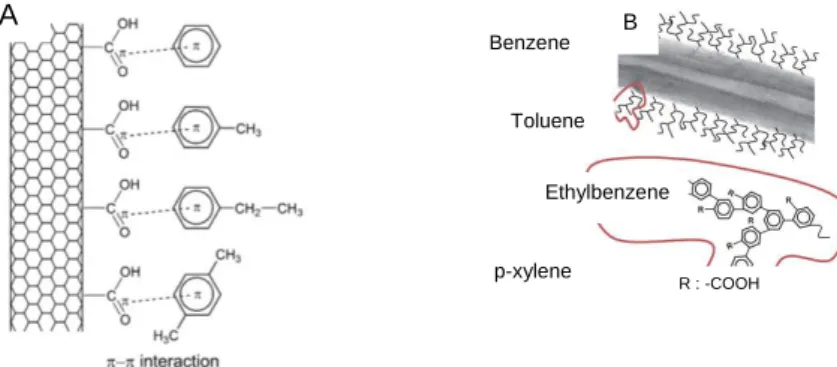
annealed at 2000°C under Ar atmosphere and, eventually, functionalized to increase sensing selectivity. Carboxylic groups5 and poly(phenylene) coatings6 bearing carboxylic groups were investigated for BTEX
detection (figure 1). The functionalisation process with poly(phenylene) coatings is derived from the diazonium salt chemistry. Detection tests performed at room temperature demonstrate that simply annealed CNT–based sensors are able to detect benzene diluted in nitrogen at concentrations in the tenth of ppb range which is appropriate for indoor air qualification.
Figure 1: (A) π-π stacking interactions between carboxylic groups and BTEX5, (B) Poly(phenylene)
derivative grafted onto CNTs.
Regarding the detection of TIC (Cl2, NH3), the sensor sensitivity and selectivity are adjusted by tuning
MWCNT network morphology and electronic properties, as well as surface chemistry through different functionalisations (poly(phenylene)-like or vinyl polymer groups). The devices are operating at room temperature, for the detection of pollutants such as Cl2, HCl, NH3. Such sensors are able to detect down to
30 ppb chlorine and selective detection of NH3 and HCl and at low concentration is possible down to 300
ppb and 1 ppm respectively.
References
[1] D.R. Kauffman, A. Star, Angew. Chem. 2008, 47, 6550.
[2] A. Gohier, J. Chancolon, P. Chenevier, D. Porterat, M. Mayne-L’Hermite, C. Reynaud, Nanotechnology 2011, 22, 105501. [3] I. lopes, A. Gohier, D. Porterat, P. Chenevier, G. Deniau, S. Palacin, M. Mayne-L’Hermite, C. Reynaud, KEM 2012, 495, 298. [4] M. Pinault, V. Pichot, H. Khodja, P. Launois, C. Reynaud, M. Mayne-L’Hermite, Nano Lett. 2005, 5, 2394.
[5] C. Lu, F. Su, S. Hu, Appl. Surf. Sci. 2008, 254, 7035.
[6] A. Gohier, F. Nekelson, M. Helezen, P. Jegou, G. Deniau, S. Palacin, M. Mayne-L’Hermite, J. Mater. Chem.2011, 21, 4615.
A B R : -COOH p-xylene Toluene Ethylbenzene Benzene