HAL Id: tel-01684994
https://hal.archives-ouvertes.fr/tel-01684994v2
Submitted on 8 Mar 2018HAL is a multi-disciplinary open access archive for the deposit and dissemination of sci-entific research documents, whether they are pub-lished or not. The documents may come from teaching and research institutions in France or abroad, or from public or private research centers.
L’archive ouverte pluridisciplinaire HAL, est destinée au dépôt et à la diffusion de documents scientifiques de niveau recherche, publiés ou non, émanant des établissements d’enseignement et de recherche français ou étrangers, des laboratoires publics ou privés.
Copyright
Egocentric Representations for Autonomous Navigation
of Humanoid Robots
Hendry Ferreira Chame
To cite this version:
Hendry Ferreira Chame. Egocentric Representations for Autonomous Navigation of Humanoid Robots. Automatic. Ecole Centrale de Nantes (ECN); Université de Nantes Angers Le Mans, 2016. English. �tel-01684994v2�
Thèse de Doctorat
Hendry F
ERREIRA
C
HAME
Mémoire présenté en vue de l’obtention dugrade de Docteur de l’École centrale de Nantes sous le label de l’Université de Nantes Angers Le Mans
École doctorale : Sciences et technologies de l’information, et mathématiques Discipline : Automatique, productique et robotique
Unité de recherche : Institut de Recherche en Communications et Cybernétique de Nantes (IRCCyN) Soutenue le 11 Janvier 2016
Représentations Ego-centrées pour la
Navigation Autonome d’un Robot Humanoïde
JURY
Président : M. Philippe MARTINET, Professeur des universités, École Centrale de Nantes, IRCCyN Rapporteurs : M. François CHARPILLET, Directeur de recherche, INRIA Villers-lès-Nancy
M. David FILLIAT, Docteur HDR, ENSTA ParisTech
Examinateurs : M. Yannick AOUSTIN, Professeur des universités, École Centrale de Nantes, IRCCyN
M. Philippe LUCIDARME, Maître de conférences, Université d’Angers, LARIS
M. Alexandre PITTI, Maître de conférences, Université de Cergy-Pontoise, Cergy-Pontoise
Dedication
Acknowledgments
There is no way this work would be finished without the important contributions from individuals, institutions, and places that I am pleased to acknowledge:
I start by expressing my gratitude to my beloved family for inspiring me, providing the basis, and supporting me in this journey.
I thank the Ecole Centale de Nantes (ECN) in the person of the headmaster, Mr Arnaud Poitou, for having me at such a prestigious institution.
I thank the Institut de Recherche en Cybernétique de Nantes (IRCCyN) of the CNRS, in the person of the director, Mr Michel Malabre, for receiving me.
I would like to express my gratitude to my supervisor, Mme Christine Chevallereau, whose expertise, cordiality, and patience, added considerably to my personal and profes-sional growth.
I thank the members of the jury, Mr François Charpillet, Mr David Filliat, Mr Alexandre Pitti, Mr Yannick Aoustin, Mr Philippe Lucidarme, and Mr Philippe Martinet; for kindly accepting the invitation.
I express my gratitude to Mr Wisama Kalil from the ECN for the good advices. I also thank Mr Gaëtan Garcia for inviting me to lecture the ARPRO module for the master EMARO+/ARIA.
I thank the funding institutions. The Ecole Centrale de Nantes (ECN) and EQUIPEX ROBOTEX, of France; and the CAPES Foundation, Ministry of Education of Brazil, Brasília - DF 700040-020, Brazil.
I thank my research colleagues for the interesting discussions at lunch time, the trips, and the fun. I also express my gratitude to my dear friends from Nantes and abroad, for the good vibes, the support, and the positive influence.
I thank our mother earth. The countries of France, Venezuela, and Brazil for provid-ing me wonderful experiences and opportunities. And life for givprovid-ing me the energy and the passion to fulfill this dream. Cheers!
Résumé étendu
La recherche sur l’automatisation du comportement a mis en évidence divers défis technologiques pour parvenir aux performances d’un système biologique. Il devient de plus en plus clair que les caractéristiques des organes sensoriels et moteurs humains sont essentiels pour atteindre certains objectifs. Malgré l’intérêt croissant en matière de so-lutions robotiques pour des applications de service et d’assistance, une machine qui soit polyvalente et qui imite de façon réaliste le corps anthropomorphe de l’être humain n’est pas encore disponible. Actuellement, le domaine de l’intelligence artificielle (IA) passe par des reformulations importantes. L’approche cognitiviste de l’IA n’a pas abouti à des modèles et des stratégies de représentation adaptés pour fournir un système de résolu-tion de problème universel. Pendant les dernières décennies, la recherche en cognirésolu-tion incarnée (Embodied Cognition (EC)), où la représentation de la connaissance est fondée sur l’interaction physique avec l’environnement s’est développée offrant une alternative pour l’étude du comportement naturel. Toutefois, l’adoption de la méthodologie EC pose également des défis importants pour les roboticiens. Notamment, lorsqu’elle vise à satis-faire les exigences imposées par l’hypothèse du fondement physique (physical grounding hypothesis). Ainsi, son utilisation dans les applications de robotique de service n’est pas encore très développée.
Cette étude a pris un point de vue intermédiaire entre la méthodologie cognitiviste et l’EC. Ce travail porte sur l’aspect architectural du comportement et se concentre sur l’exploration des sources locales d’information pour obtenir des solutions flexibles et ro-bustes vis-à-vis des applications en robotique de service. Lors de ce travail une com-pétence fondamentale a été considérée comme cas d’étude : il s’agit de l’utilisation de l’ego-localisation pour se rapprocher et se positionner par rapport à des cibles visuelles. Pour cela, d’une part, on adopte l’hypothèse cognitiviste selon laquelle le robot peut se servir des représentations indépendantes-de-l’action (sous la forme de schémas percep-tifs) pour faire la reconnaissance visuelle de la cible. Alors que, d’autre part, une fois que le robot s’engage dans une tâche sensorimotrice il aura recours à des représenta-tions locales sous la forme de sensareprésenta-tions corporelles afin d’anticiper les conséquences de l’action, de discriminer les objets, de réagir à des circonstances imprévues, d’apprendre à partir d’expériences passées, et d’évaluer le progrès et le succès de la mission. Ainsi, à partir d’une approche multidisciplinaire, ce travail porte sur différents aspects : les architectures de comportements, l’attention visuelle ascendante et descendante, la vision par ordinateur, la localisation égocentrique embarquée, la sélection d’action, l’intégration multisensorielle, et l’apprentissage par renforcement.
Contents
1 Introduction 1
1.1 Humanoid assistants . . . 1
1.2 A shift in artificial intelligence research . . . 3
1.3 The research problem . . . 4
1.4 Overview of Chapters . . . 4 1.5 Contributions . . . 5 1.6 Notation . . . 6 2 Humanoid navigation 9 2.1 Introduction . . . 9 2.2 Humanoid robots . . . 10 2.2.1 Some milestones . . . 10 2.2.2 Worldwide research . . . 11 2.2.3 French projects . . . 15
2.2.4 The humanoid Nao . . . 15
2.3 Challenges in humanoid research . . . 18
2.3.1 Bipedal locomotion . . . 18
2.3.2 Perception . . . 19
2.3.3 Human-robot interaction . . . 20
2.3.4 Dexterous manipulation . . . 20
2.3.5 Learning and adaptive behavior . . . 21
2.4 Autonomous navigation . . . 22
2.4.1 Robot localization . . . 23
2.4.2 Spatial cognition in the brain . . . 24
2.5 The action selection problem . . . 26
2.5.1 Deliberative models . . . 27 2.5.2 Reactive models . . . 28 2.5.3 Hybrid models . . . 29 2.5.4 Behavior-based models . . . 30 2.6 Conclusions . . . 31 3 Visual attention 33 3.1 Introduction . . . 33 3.2 Theories of attention . . . 34
3.2.1 The filter theory . . . 34
3.2.2 The spotlight theory . . . 36
3.2.3 The FIT and GS theories . . . 37
3.2.4 Inspiring robotics solutions . . . 37
3.3.1 The camera sensor . . . 39
3.3.2 The human eye . . . 40
3.3.3 Perspective projection . . . 41
3.3.4 Visual feature extraction . . . 42
3.4 Case studies . . . 48
3.4.1 Materials and resources . . . 48
3.4.2 CS-I: Semi-automatic color-based segmentation . . . 48
3.4.3 CS-II: Top-down color-based segmentation . . . 50
3.4.4 CS-III: Bottom-up segmentation based on optical flow . . . 55
3.5 Conclusions . . . 62
4 Visually-guided locomotion 65 4.1 Introduction . . . 65
4.2 Related work . . . 66
4.3 Visual servoing . . . 67
4.3.1 The interaction matrix . . . 68
4.3.2 Controlling the robot effectors in joint space . . . 69
4.4 Task definitions . . . 70
4.4.1 The Walk task . . . 70
4.4.2 The Look-at task . . . 71
4.5 Egocentric localization . . . 72 4.5.1 Sensory ego-cylinder . . . 72 4.5.2 Vision-based localization . . . 73 4.5.3 Object models . . . 74 4.6 Case studies . . . 76 4.6.1 Materials . . . 76
4.6.2 CS-I: Simulation of the approach to a salient object . . . 77
4.6.3 CS-II: Placement for the spatial reference system . . . 79
4.6.4 CS-III: Approaching a real object . . . 89
4.7 Conclusions . . . 91
5 Embodied perception 93 5.1 Introduction . . . 93
5.2 Grounding vision-based locomotion . . . 94
5.3 EC-based task analysis . . . 95
5.3.1 Mimicking human walking style . . . 95
5.3.2 Resources available . . . 97
5.3.3 Modeling a behavior scheme . . . 98
5.4 Behavior autonomy . . . 102
5.4.1 Embodied features . . . 103
5.4.2 Bayesian network for information fusion . . . 105
5.5 Case studies . . . 107
5.5.1 Materials and resources . . . 107
5.5.2 Behavior scheme implementation . . . 108
5.5.3 Hybrid architecture implementation . . . 109
5.5.4 CS-I: Model parameters estimation . . . 110
5.5.5 CS-II: Simulation of object redundancy . . . 113
5.5.6 CS-III: Approaching a real can . . . 117
5.6 Designing reliable approach tasks in six-steps . . . 121
6 Reactive walking 125
6.1 Introduction . . . 125
6.2 Related work . . . 126
6.3 The framework iB2C . . . 128
6.3.1 Model components . . . 128
6.3.2 Behavior coordination . . . 130
6.3.3 The sequence node extension . . . 131
6.4 Reinforcement Learning . . . 132
6.5 Case studies . . . 134
6.5.1 Materials and resources . . . 135
6.5.2 Behavior-based models implementation . . . 135
6.5.3 CS-I: Action-oriented approach . . . 136
6.5.4 CS-II: Object approach and obstacle avoidance . . . 144
6.5.5 CS-III: Learning-based approach . . . 152
6.6 Conclusions . . . 161 7 Conclusions 163 7.1 Research perspectives . . . 165 List of publications 167 References 169 Appendixes 183
List of Tables
2.1 Characteristic of functional humanoids . . . 17
2.2 Characteristics of the Nao humanoid . . . 17
2.3 Sensors available in Nao . . . 17
2.4 Localization problems taxonomy . . . 24
3.1 Scene interpretation workflow . . . 45
3.2 Survey on bottom-up tracking methods . . . 48
4.1 The studied placements for the reference frame. . . 79
4.2 Modified Denavit & Hartenberg parameters for Nao . . . 80
4.3 Dependent variables under study . . . 83
4.4 Comparison on alternatives versions of the Walk task . . . 87
5.1 Resources available to solve the task. . . 98
5.2 Embodied features . . . 103
5.3 Filtering features . . . 104
5.4 Motion profile evaluation . . . 111
5.5 Feature signals vs. delay . . . 112
5.6 Embodied filtering . . . 112
5.7 Comparison on the Bayesian network policies . . . 116
5.8 CS-III experimental cases results . . . 118
6.1 Behavior inputs and outputs . . . 129
6.2 Components of a RL problem . . . 133
6.3 CS-I task parameters . . . 142
6.4 CS-II task parameters . . . 150
6.5 State arbitration profiles . . . 155
6.6 Arbitration events . . . 155
6.7 MDP state descriptions . . . 157
6.8 CS-III task parameters . . . 158
List of Figures
1.1 Speedy’s dilema . . . 2
1.2 World population aged 60 or over . . . 3
2.1 Honda humanoids . . . 11
2.2 The MIT Cog project . . . 11
2.3 Final round of the DARPA Challenge . . . 14
2.4 Aldebaran humanoids . . . 15
2.5 The robot Nao . . . 16
2.6 Nao’s pelvis design . . . 16
2.7 Kinematics of Nao . . . 18
2.8 Passive dynamics research . . . 19
2.9 Sociable robots . . . 20
2.10 Robot hands . . . 21
2.11 Spatial representations . . . 25
2.12 Human planes of motion . . . 26
2.13 Architectures for mobile robot control . . . 27
2.14 Deliberative models . . . 28
2.15 Reactive model . . . 28
2.16 Deliberative vs. reactive models . . . 28
2.17 Hybrid model . . . 29
3.1 The filter theory of attention . . . 35
3.2 The spotlight attention model . . . 36
3.3 Bottom-up architecture for saliency detection . . . 38
3.4 Photosite charge wells and incident photons . . . 39
3.5 Simplified cross section of the human eye . . . 41
3.6 High dynamic range in photography . . . 42
3.7 Central perspective geometry . . . 43
3.8 Blob centroid illustration . . . 44
3.9 Contour central moment . . . 44
3.10 Scene interpretation workflow . . . 45
3.11 The aperture problem . . . 47
3.12 K-means segmentation from color and topology . . . 51
3.13 K-means vs. top-down segmentation . . . 52
3.14 First-order neighborhood system . . . 52
3.15 Segmentation of a natural scene . . . 55
3.16 Segmentation of colored objects . . . 55
3.17 Segmentation under camera motions . . . 56
3.18 Algorithm for displacement estimation . . . 59
3.20 Optical flow segmentation . . . 61
4.1 Definition of the reference frames . . . 70
4.2 Top view of the localization parameters . . . 71
4.3 Top view of the localization prediction . . . 71
4.4 Illustration of the Look-at task . . . 72
4.5 Representation of the ego-cylinder localization . . . 73
4.6 Cylindrical object model . . . 74
4.7 Estimation of the object’s depth . . . 75
4.8 The approach task modeled in Webots . . . 78
4.9 Egocentric visualization of the localization . . . 78
4.10 Evolution of the localization error . . . 79
4.11 Evaluated placements for the base frame B . . . 80
4.12 Geometrical model of the robot Nao . . . 81
4.13 Definition of the ground frame . . . 82
4.14 Frame placement initial conditions . . . 83
4.15 Box plots results of frame placement . . . 85
4.16 Body posture comparison between Eg and G . . . 85
4.17 Top view of egocentric localization . . . 86
4.18 Top view of object positions for Tg and Eg . . . 86
4.19 Comparison on the evolution of the neck yaw . . . 87
4.20 Box plot results for the noise experimental condition . . . 88
4.21 Evolution of the localization error under noise for frame G . . . 88
4.22 Yellow card approach experiment . . . 90
4.23 On-board view of the yellow card . . . 90
4.24 Multicolor saliency . . . 91
5.1 HMW non-holonoic angular motion . . . 97
5.2 First-order description of the walk . . . 98
5.3 Behavior scheme for the approach task . . . 99
5.4 Embodied filtering illustration . . . 101
5.5 Hybrid task architecture . . . 103
5.6 Embody features illustration . . . 104
5.7 Bayesian network for contextual information fusion. . . 105
5.8 Dynamic policies for the Bayesian network . . . 107
5.9 Deliberation state automate . . . 110
5.10 Localization discrepancy vs delay . . . 112
5.11 Evolution of the embodied features . . . 113
5.12 Simulation of the task with object redundancy . . . 114
5.13 Comparison between the network policies . . . 115
5.14 Task demonstration . . . 119
5.15 Visual saliency degradation . . . 119
5.16 Experimental evaluation with object redundancy . . . 120
5.17 On-board views of the approach sequence . . . 121
6.1 Behavior module . . . 128
6.2 Group behavior . . . 130
6.3 Conditional behavior stimulator module . . . 131
6.4 Graphical representation of MDPs . . . 134
6.6 CS-I behavior scheme model . . . 138
6.7 Arbitration for walk control . . . 140
6.8 CS-I sparse flow task model . . . 142
6.9 Reactive object approach . . . 142
6.10 CS-I evaluation of the bilateral symmetry condition . . . 143
6.11 On-board view of the bilateral symmetry condition . . . 143
6.12 On-board view of the sparse flow evaluation . . . 143
6.13 CS-II task model . . . 145
6.14 Reactive obstacle avoidance . . . 148
6.15 Non-reactive vs. reactive approach . . . 150
6.16 Model performance . . . 151
6.17 Evaluation of motion consistency . . . 151
6.18 Bottom-up segmentation . . . 153
6.19 Visual encoding . . . 154
6.20 State automate for motion arbitration . . . 155
6.21 Top view of the action primitives . . . 156
6.22 MDP task model . . . 156
6.23 Visual encoding neighborhood . . . 157
6.24 kinesthetic demonstrations for scene encoding . . . 158
6.25 Encoding transition matrix . . . 159
6.26 Panoramic flow detection . . . 159
6.27 CS-II vs CS-III implementation . . . 160
6.28 Evaluation of the condition of multiple objects and obstacles . . . 160
6.29 RL policy learning . . . 161
1
Introduction
Humanoid assistants
According to the historical review by Ichbiah [88] the word robot was popularized in 1920 in the science fiction Czech play R.U.R. by Karel Čapek. In the play artificial people are manufactured to help and free humanity from the slavery of manual labor, but they turn against their creators. These creatures would be made from synthetic organic matter so they could be easily mistaken for humans. Thus, perhaps under the effects of the severe consequences of the First World War, the literature of the 20-30s pictured a distopic view of robots as a menace and a replacement for mankind.
This negative connotation started to change through the work of Issac Assimov. The American Russian-born biologist contributed to a positive view of robots as our allies, servants and assistants; simply because we can choose it to be so. The famous introduc-tion of the three laws of robotics in the short story Runaround (Assimov [13]), became an influential step towards ethics in robotics, accordingly:
1. A robot may not injure a human being or, through inaction, allow a human being to come to harm.
2. A robot must obey the orders given to it by human beings, except where such orders would conflict with the First Law.
3. A robot must protect its own existence as long as such protection does not conflict with the First or Second Laws.
The story takes place in a mining station on the planet Mercury. The photo-cell banks that would provide life support to the base station was short on selenium. Given that the robot SPD-13 (also called Speedy) could withstand Mercury’s high temperatures, the crew asked it to get some selenium from the nearest pool. Speedy got confused about its mission, suffering from what is described as the "robotic equivalent of drunkenness”. The situation is illustrated in Fig. 1.1. The robot walked uninterruptedly a huge circle
1.1. Humanoid assistants Chapter 1. Introduction around the selenium pool when it was found by the crew. After failing to recover Speedy by a voice command, the astronaut Powell eventually realized that the selenium source contained unforeseen danger to the robot, so the second rule (to obey an order given by a human) and the third rule (to preserve itself) were in conflict. Thus, the momentary equilibrium in Speedy’s behavior is finally broken when Powell decides to put himself in danger by going out in the heat, hoping that the first law would force the robot to overcome the cognitive dissonance and saving his life, what indeed happened.
Figure 1.1 – Illustration of Speedy’s confusion, as described in the short story Runaround by Assimov [13]. Speedy cannot decide whether to execute the mission order or to protect himself from danger. The robot then oscillates between the two behavioral modes of approaching and avoiding the selenium pool.
Leaving aside for the moment the fascination with fiction, one might ask if there are legitimate reasons that justify the interest in the research of humanoid applications. This issue is tackled by Behnke [17], when he argues that the increasing popularity of humanoids research is motivated by the vision of creating a tool that cooperates with humans to solve problems in their same environment. That is, since our everyday tasks are human-centered designed, humanoids are believed to be more suited to move (e.g. climbing stairs) or to dexterously manipulate tools. In addition, a robot that is able to synthesize speech, to move the eyes, or to gesticulate; would favor a more intuitive and fluid communication with human beings, so increasing its adaptation and acceptance to the home or the office environment. The anthropomorphic body is also advantageous to facilitate programming by demonstration and automatic learning from imitation, since the actions would be more or less equivalents.
The development of service robotics has indeed been viewed as a promising way to provide assistance to elderly people, given the fact that the world population is aging. According to the UN [180], over the first half of the current century the global population 60 or over is projected to expand by more than three times, to reach nearly 2 billion in 2050 (see Fig. 1.2). Moreover, conforming to the projections of the International Monetary Fund and the World Bank (see Carone & Costello [33]), the aging of population would threaten the prospects for economic growth by exerting severe pressure on public expenditure. Therefore, humanoid robots could provide assistance and health care for elderly people so increasing their quality of life and autonomy.
However, despite the growing interest in robotics solutions to service and assistance applications, which is evidenced by ambitious funding to humanoid research projects in some developed countries; a general-purpose machine that realistically mimics the
Chapter 1. Introduction 1.2. A shift in artificial intelligence research
Figure 1.2 – Population aged 60 or over (UN [180]).
anthropomorphic body of human beings - until the point of being mistaken by humans as in the sci-fi literature - is still on the way. The research on behavior automation has pointed out to the technological challenge to reach the performance of the biological system, and to how the characteristics of human sensory and motor organs are crucial for the accomplishment of certain behaviors. In fact, by drawing attention to such differences, the research on humanoids (and robotics in general) has revealed itself as a useful means to understand human cognitive processes, and has also contributed to advances in the field of artificial intelligence.
A shift in artificial intelligence research
The field of artificial intelligence (AI) is going through important reformulations. The traditional view of AI (also known by cognitivist AI), under the influence of Cartesian dualism, has tended to look at physical and mental processes as belonging to different realms. Efforts in this direction have not come to a satisfactory end, notably, when propos-ing models and representation strategies to endorse a general-purpose problem solver with knowledge to deliberate on the task. A criticism has been formulated from what is known as the Moravec’s paradox (Russell & Cohn [158]), that is, the discovery by AI and robotics researchers that, contrary to traditional assumptions, high-level reasoning requires very little computation, but low-level sensory-motor skills require enormous computational re-sources. Therefore, the humanoid robot has not been able to leave the environment of the lab, under strict control of extraneous variables.
In the last decades, a different perspective has been adopted to study natural be-havior from the research on embodied cognition (EC), where knowledge representation is thought to be grounded in the physical interaction with the environment. Unlike the cognitivist approach, behavior is considered to emerge from multiple concurrent pro-cesses, so behavior would not be globally representable nor planed. The analysis of the sensory-motor coupling in natural tasks, from a dynamic system perspective, is becoming a promising research direction that can provide more efficient, robust, and autonomous solutions. However, adopting the EC methodology also poses important challenges to
1.3. The research problem Chapter 1. Introduction robotists, in particular, when fulfilling the requirements underlying the physical
ground-ing hypothesis (Brooks [29]). Firstly, the autonomous development of the behavior, as it
happens in natural beings, would ideally occur under a phylogenetic architecture that can modify itself; which is hard to obtain for an artificial body. Secondly, the ontology of the system must be flexible enough to ensure knowledge acquisition for diverse purposes, by fusing information from different sensory modalities. Lastly, the development of cognitive skills is conditioned to sensory-motor coupling and interaction with the environment, thus knowledge acquisition is a slow process analogous to natural learning.
In view of the advantages and the challenges encountered in the aforementioned research approaches, this work has opted for an intermediate perspective for behavior automation, by acknowledging the importance of obtaining an adequate balance between generality and autonomy in applications of service robotics. In this sense, it takes into account the aspects of deliberation and reaction in the context of the action selection problem. For example, getting back to Speedy’s dilemma (see Fig. 1.1), the deliberative aspect of the mission would be to accomplish the general plan of bringing some selenium to the crew, whereas the reactive aspect would be to handle the unexpected situations encountered, such that the emergence of danger. Both aspects are important for the mission, and the robot should ideally be able to detect the contradictory effects of these behavioral modes, and eventually to stop and to ask for guidance.
The research problem
This research focuses on the architectural aspect of the behavior of a humanoid robot, and concentrates on the exploration of local sources of information for obtaining more flexible and robust solutions to service applications. It has taken as a case study the fundamental skill of approaching and positioning in relation to visual stimuli. Thus, the problems of top-down and bottom-up visual attention, knowledge representation, and action selection, are investigated. For this, the work adopts the cognitivist assumption that action-independent knowledge (in the form of perceptive schemes) can be employed for recognizing stimuli. But, as an embodied being, when the robot engages in sensory-motor activities, it can efficiently resort to local representations in the form of bodily sensations, in order to anticipate the consequences of action, to discriminate the object, to react to unexpected circumstances, and to assess the progress and success on the mission.
Overview of Chapters
From the multidisciplinary approach adopted in this work, this manuscript reports on different topics of interest. Thus, Chapter 2 starts by presenting an overview on humanoid robotics research and the main challenges encountered. Then, it focuses on the problem of humanoid navigation and localization, and the problem of deliberation and reactivity (i.e. the action selection problem). Different aspects of the top-down (i.e. deliberation) and bottom-up (i.e. reaction) processing are discussed, including the advantages and disadvantages of pure deliberative or reactive schemes.
Chapter 3 deals with the topic of visual attention. It starts by reviewing some
Chapter 1. Introduction 1.5. Contributions the efficient management of the visual information available. The more commonly used sensor technologies are reviewed, and contrasted to the human eye, in order to illustrate potential challenges for artificial solutions. A review on the literature of machine vision is also presented, where the whole scene segmentation and the feature tracking approaches are described. Three case studies are developed in order to evaluate potential top-down and bottom-up approaches.
In Chapter 4 the problem of egocentric on-board localization for autonomous walk is investigated. The visually-guided approach task is defined and modeled. For this, a distributed solution relying on visual servoing and motion primitives is studied. A cylindrical ego-sensory structure is defined for processing the localization, and different placements for this structure are compared. Several case studies in simulation and a real experiment are conducted in other to assess the autonomous execution of the task, under a restricted scenario to a single salient object.
Chapter 5focuses on the aspect of attention selection. A more realistic solution to
the approach task is proposed by defining a behavior scheme according to the EC research methodology. Thus, from a first-person perspective analysis of the sources of information available, the agent is given a non-holonomic walking style that mimics human motion. In order to ensure robustness and reliability in the task, the behavior scheme is integrated to a hybrid architecture in charge of monitoring the execution. This functionality is ob-tained from the design of a Bayesian network in charge of information fusion for attention selection. The chapter finishes by presenting the proposal of a six-steps methodology to develop robust visually-guided approach tasks.
The central topic of concern in Chapter 6 is reactive walking. For this, it includes the study of embodiment, knowledge representation, and learning; under different action selection scenarios. By keeping the first-person perspective adopted throughout the work, and the proposal of distributed models for the task; a behavior-based framework is se-lected to study concurrency in the access of available resources, so emergent behavior is produced. Local action-oriented representations of the task are studied, thus the agent can approach the object while avoiding obstacles. Visual encoding is proposed as an embodied description of the task, so more efficient solutions can be learned.
Contributions
From a personal perspective on the various topics studied, the technical and concep-tual proposals presented next are original.
Chapter 3. The improvement of the MRF color-based segmentation technique
de-scribed in Sec. 3.4.3 for a use of top-down saliency detection, in the context of real-time processing of visual inflow.
Chapter 4. The behavior scheme in Sec. 4.4 based on ego-cylindrical localization,
combining the IBVS and PBVS modeling techniques, relying on a low-frequency acquisi-tion rate, from robust color-based MRF segmentaacquisi-tion. The embodied evaluaacquisi-tion of the sensory ego-space for stimuli persistence in Sec. 4.6.3, so the hybrid control policy based on body- and eye-centered references is proposed to obtain a computationally more effi-cient solution, by heuristically exploiting the posture adopted by the robot while moving on a plane.
1.6. Notation Chapter 1. Introduction that mimics human motion style, when positioning in relation to the frontal face of an ob-ject of interest, by moving on a plane surface. The distributed scheme for visual selection in Sec. 5.3.3, that combines ideas from the information processing models in cognitive science, and the EC methodology. The embodied and filtering features set detailed in Sec. 5.4.1, that register diverse information about the stimulus of interest and the body context. The hybrid model for action selection in Sec. 5.5.3 based on motion primitives, so remote resources can be safely used in the task, from the probabilistic evaluation of the degree of confidence and the discriminative power of the attention selection process. The Bayesian network model for information fusion in Sec. 5.4.2, under static and dynamic estimation of the features certainty. The six-steps methodology for designing reliable approach tasks in Sec. 5.6.
Chapter 6. The behavior model in Sec. 6.5.3 that exploits embodiment and local
heuristics, so a solution for the task is obtained by relying on high-frequency dense optic flow processing, and distributed action-oriented representations of the stimulus of inter-est. The behavior scheme in Sec. 6.5.4 for obstacle avoidance and object approaching, combining top-down and bottom up attention selection, relying on the processing of dense optic flow and whole scene segmentation, from on-board acquisitions in a humanoid robot. The visual encoding proposed as an embodied description of the task, so the arbitration of behavioral modes is produced, and actions in the form of walk primitives can be learned.
Notation
• Lowercase letters in boldface "u" denote vectors which are always column vectors. • Uppercase letters in boldface "M" are used for matrices.
• The ith element of a vector is denoted by "u
i". In case a particular element is
referenced in a matrix, a double index notation "Mij" is used (i.e., the element at
the ith row and the jth column). A single index can be used for matrices denoting
the ith row "M
i" of the matrix.
• The transpose of a real matrix or vector is denoted "Mt".
• The inverse of a matrix is "M−1"
• The pseudo-inverse of a matrix is "M+".
• Vectors and matrices columns are delimited by brackets (e.g. u = [u1 u2 ... uk]t).
• The inner product operator for vectors is "·", so r = u·v. The cross product operator of vectors is "×", so i = u × v.
• The euclidean norm of a vector is obtained from the inner product, such that kuk=√ut· u (1.1)
• The absolute norm of a vector is obtained such that |u|=X
i
|ui| (1.2)
• The observation of a variable o is "ˆo".
• The estimation or prediction of a variable s is "˜s".
Chapter 1. Introduction 1.6. Notation
• Points in the 3D Cartesian space are uppercase so "B = (X, Y, Z)", the coordinates components are also uppercase. The fact that a point B is expressed in a given reference frame G is denoted by GB.
• Image projections of points are represented by "B0 = (x, y)", with pixel coordinates
in lowercase.
2
Humanoid navigation
Contents
2.1 Introduction . . . . 9 2.2 Humanoid robots . . . . 10 2.2.1 Some milestones . . . 10 2.2.2 Worldwide research . . . 11 2.2.3 French projects . . . 15 2.2.4 The humanoid Nao . . . 15 2.3 Challenges in humanoid research . . . . 18 2.3.1 Bipedal locomotion . . . 18 2.3.2 Perception . . . 19 2.3.3 Human-robot interaction . . . 20 2.3.4 Dexterous manipulation . . . 20 2.3.5 Learning and adaptive behavior . . . 21 2.4 Autonomous navigation . . . . 22 2.4.1 Robot localization . . . 23 2.4.2 Spatial cognition in the brain . . . 24 2.5 The action selection problem . . . . 26 2.5.1 Deliberative models . . . 27 2.5.2 Reactive models . . . 28 2.5.3 Hybrid models . . . 29 2.5.4 Behavior-based models . . . 30 2.6 Conclusions . . . . 31Introduction
The research is humanoid robotics has been intensifying over the last decades, includ-ing international collaboration in the form of annual meetinclud-ings, conferences, and robotic
2.2. Humanoid robots Chapter 2. Humanoid navigation challenges. Thus, an interesting question to be asked is: how far are these robots from reaching the performance of human beings? To answer this question the first part of the chapter presents an overview on the field, including important milestones and challenges encountered in different topics, such that: locomotion, perception, human-machine inter-action, dexterous manipulation, learning and adaptation. The problem of autonomous navigation is reviewed in more detail, since it is on the core of the research interests. For this, the distinction between allocentric and egocentric spatial representations is estab-lished. In view of the stochastic nature of the studied task, the problem of action selection (i.e. deciding what to do next given the task constraints) is reviewed, and existent ap-proaches are classified into deliberative, reactive, hybrid and behavior-based. The relative advantages of these models are analyzed in the context of autonomous walk.
Humanoid robots
In a broader sense, a robot is a goal-oriented machine with capabilities of sensing, planning and acting on the environment (Corke [51]). According to the goal, diverse body configurations have been proposed to automate different industrial mass production processes. A humanoid is a robot with an anthropomorphic body plan and human-like senses (Behnke [17]). Although the concept of human-like automata is relatively old in the literature and arts, the appearance of the humanoid robot had to wait until late 20th century for the advances in digital computing.
Some milestones
The key initial contributions were produced both in Japan and the USA, although the projects had very different focus and background. In 1986 the Japanese company Honda started the confidential Humanoid Project with the goal of developing a robot that would coexist and cooperate with human beings. The evolution of the prototypes is illustrated in Fig. 2.1 (see Hirose & Ogawa [82]). The first versions corresponded to the E-Series, which focused exclusively on the automation of biped locomotion. Full-body humanoids appeared in the P-Series. The project was made public with the announcement of the P2 prototype in 1996. The release of the model P3 in 1997 was undoubtedly an important milestone. Like its predecessor, the robot was able to walk on flat floors and climb stairs, but it could also kneel, stand up, keep balance when disturbed, and move gracefully at the human speed. Since 2001 the latest series is called Asimo1.
By 1993 in the MIT (USA) Rodney Brooks and his team started to construct the upper-body Cog (see Fig. 2.2). The project differed significantly from the standard assumptions of artificial intelligence, that viewed human as a general purpose individuals in possession of full monolithic control and internal models. Instead, the project adopted a multidisciplinary approach to robotics, with strong influence of cognitive science, systems theory, philosophy, and linguistics; under the hypothesis that: "human-level intelligence requires gaining experience from interacting with humans, like human infants do" (Brooks et al. [28]). Thus, the control for Cog is implemented as a heterogeneous network of different processors types operating at distinct levels in the control hierarchy, ranging from small micro-controllers for joint-level control, to digital signal processor (DSP) networks for audio and visual preprocessing. The Cog project was active until 2003, though it was
Chapter 2. Humanoid navigation 2.2. Humanoid robots
Figure 2.1 – Historic evolution of Honda’s humanoid achievements [82].
very influential to other humanoid projects. This is the case of the robot iCub developed by the Italian Institute of Technology (IIT), as part of the EU RobotCub project (see Metta et al. [119]). The development counted on the collaboration of former participants of the Cog project.
Figure 2.2 – The MIT Cog project. On the left, the upper-torso humanoid robot. Cog has twenty-one degrees of freedom. It is equipped with visual, vestibular, auditory, and tactile senses. In the center the robot’s head. On the right, Rodney Brooks is interacting with Cog.
The upper-body Hadaly-2 was relatively contemporary with Cog. Hadaly-2 was developed in 1997 by the University of Waseda (Japan). The robot was given skills to interact with the environment, such that visual processing, conversation (e.g. voice recognition and synthesis), and gesticulation (Hashimoto et al. [79]). The project focused on the human morphology beyond the simple imitation of the anthropomorphic shape (e.g. the mobility of the eyes, neck and hands). However, the approach taken for behavior automation was not as innovative as in the Cog project and followed the standard AI assumptions. In this sense, the behaviors were explicitly modeled by the engineers and counted on extensive knowledge data-bases, including the 3D model of the scene.
Worldwide research
Japan has undoubtedly excelled in full-body humanoid innovation. After being left behind in the personal computer industry run, both the Japanese private and the public sector have striven for getting ahead on humanoids research. This has been in fact the case when Sony released the ludic 60 centimeters tall robot Qrio, that was at the forefront of
2.2. Humanoid robots Chapter 2. Humanoid navigation Asimo. The robot is able to dance, recognizing faces, detecting obstacles, climbing stairs, and running, among other skills. Some other important projects in the private sector are: the Toshiba series Partners, Fijitsu’s HOAP-1 and HOAP-2, Kawada Industries’ Isamu, and Kitano Symbiotic Systems’ Pino, Sig2, Morph and Morph3. At the public sector in 1998 the Ministry of Economy, Trade and Industry of Japan launched the famous Humanoid Robotics Project (HRP). An important release was the prototype HRP-2, which can walk at two third human speed (2.5 km/h), move on narrow paths, cope with uneven surfaces, lie down, and get up by itself (Kaneko et al. [93]).
According to Ward [185], the USA has been left behind in the run for humanoids. Few investments have been done at the industrial level, due to non immediate profit return from the commercial point of view. A study in 2006 by the Technology Evaluation Center (see Ambrose et al. [5]) has compared the USA research activity with the rest of the world. It concluded that:
[...] The U.S. currently leads in such areas as robot navigation in outdoor en-vironments, robot architectures (the integration of control, structure and com-putation), and in applications to space, defense, underwater systems and some aspects of service and personal robots. Japan and Korea lead in technology for robot mobility, humanoid robots, and some aspects of service and personal robots (including entertainment). Europe leads in mobility for structured envi-ronments, including urban transportation. Europe also has significant programs in eldercare and home service robotics. Australia leads in commercial applica-tions of field robotics, particularly in such areas as cargo handling and mining, as well as in the theory and application of localization and navigation. In contrast with the U.S., Korea and Japan have national strategic initiatives in robotics; the European Community has EC-wide programs. [...] The U.S. lost its preeminence in industrial robotics at the end of the 1980s, so that nearly all robots for welding, painting and assembly are imported from Japan or Europe. The U.S. is in danger of losing its leading position in other aspects of robotics as well.
Nevertheless, more recently some initiatives have been conducted in academia, space research, an defense. The country’s first full-sized humanoid robot called CHARLI was developed by the Virginia Polytechnic Institute and State University (popularly known as Virginia Tech) in the Robotics and Mechanisms Laboratory (RoMeLa)2. The NASA has
financed the Robonaut project3 in collaboration with General Motors and Oceaneering.
The current release is the highly dexterous model R2, build from multiple component tech-nologies and systems (e.g. image recognition systems, sensor integrations, tendon hands, among others). The Defense Advanced Research Projects Agency (DARPA) has funded projects such that the robot Atlas developed by Boston Dynamics, and the Robotics Challenge DRC.
In relation to the research in China, the Beijing Institute of Technology (BIT) has been developing the BHR series, and the Zhejiang University (ZHU) has been working on the table-tennis-playing humanoid twins Kong and Wu; among other projects. In Korea there is the prestigious research team KAIST, who won the DARPA Robotics Challenge 2015. The team developed the robot DRC-Hubo, which is a semi-autonomous humanoid that presents a hybrid structure, it is capable of both biped and wheeled locomotion. In Thailand the King Mongkut’s University of Technology Thonburi (KMUTT) has
de-2. http://www.romela.org/main/Robotics_and_Mechanisms_Laboratory 3. http://robonaut.jsc.nasa.gov/
Chapter 2. Humanoid navigation 2.2. Humanoid robots veloped the robot Ka-Nok for playing football. In the Singapore Polytechnic (SP), the Advanced Robotics and Intelligent Control Centre (ARICC) research group has released the Robo-Erectur series. Australia has developed the robot GuRoo in the Mobile Robotics Laboratory of the University of Queensland.
European projects are diverse with Germany probably leading the way. The Technis-che Universität MünTechnis-chen (TUM) in Munich has developed Johnnie. In the same city the University of Bundeswehr has worked on the robot HERMES. The Karlsruhe Institute of Technology (KIT) has developed the ARMAR series for collaborative tasks. The NimbRo team4 from the University of Bonn was the best ranked from Europe (coming at the fourth
overall place) in the DARPA Robotics Challenge, with the robot Momaro (a four-legged humanoid torso). Other developments of the team are: the NimbRo-OP Humanoid Open Platform, Copedo, Dynaped and Bodo. In the Netherlands the Delft University of Tech-nology is doing research on the concept of passive dynamics for energy storage in biped walking, and many robots have been released (e.g. Flames and Fides). In the context of the UK, the Imperial College of London developed an upper torso LUDWIG. In Sweden the Chalmers University has been developing several robots (e.g. Priscilla, Elvina, HR 2), also the University of Uppsala has released Murphy. In Russia the company New Era in cooperation with the St. Petersburg State Polytechnical University, have developed the robots ARNE and ARNEA. In Italy the Polytechnic University of Turin has released the Issac Robot. The humanoid iCub was also developed at the Italian Institute of Technol-ogy (IIT), as part of the EU project RobotCub and subsequently adopted by more than 20 laboratories worldwide5. The project is an open source initiative for the research in
human cognition and artificial intelligence. The motivation behind the humanoid design is strongly based on the embodied cognition research, so the dimensions of the iCub are similar to those of a 2.5 year-old child.
Challenges and competitions
There are important international events around the humanoid community that have encouraged progress in the field. Indeed, many challenges and competitions have become application domains for these robots, since their commercialization to the wide public has not excelled yet. There are several participation modalities, the teams can either build their own robots or use available commercial kits. Some relatively famous events are for instance the soccer competitions RoboCup6 and FIRA7. The goal is to develop
fully autonomous robot teams that play together. The RobotChallenge8 in the Humanoid
Sprint modality requires the robots to complete a course walking or running as fast as possible. Other popular competition is Robo-One in Japan9, where teleoperated robots
engage in martial arts. In the competition RoboCup@home10the goal is to develop service
and assistive technologies, with the emphasis on household and personal applications. As already mentioned, DARPA has financed the Robotics Challenge (DRC)11. The
teams that reached the final round are shown in Fig. 2.3. The objective of the
compe-4. http://www.nimbro.net/Humanoid/robots.html 5. http://www.icub.org/ 6. http://www.robocup.org/robocup-soccer/ 7. http://www.fira.net/main/ 8. http://www.robotchallenge.org/competition/ 9. http://www.robo-one.com/ 10. http://www.robocupathome.org/ 11. http://www.theroboticschallenge.org
2.2. Humanoid robots Chapter 2. Humanoid navigation
Figure 2.3 – Darpa Robotics Challenge finals 2015 [1]. The KAIST team from the Republic of Korea won the competition.
tition is to promote the development of semi-autonomous ground robots (most of them are anthropomorphic but it is not a requirement), for accomplishing complex tasks in dangerous, degraded, human-engineered environments. Examples of tasks are driving a vehicle, opening doors, clearing obstacles on the way, maneuvering a valve, and so on.
Chapter 2. Humanoid navigation 2.2. Humanoid robots For this, the robot has to operate in environments it has not encountered previously, or to flexibly using human tools without requiring extensive reprogramming. The autonomy must be enough to ensure operation under degraded communications with the mission operator.
French projects
In France initial efforts started in 2000 with the project INRIA BIB. The objective was to research on various aspects related to the control of complex robotic systems, in-cluding walking machines. Due to shortages in the budget these efforts ceased in 2002 and were latter incorporated to the BIBOP project, which is currently active12. In 2001
the Centre National de la Recherche Scientifique (CNRS) founded the project Robea (Robotique et Entités Artificielles), which produced the RABBIT testbed platform (see Chevallereau et al. [45]). The project13 was a joint effort between several French labs
(including the IRCCyN), and some international contributions. The main goal was to build a prototype for studying dynamic motion control for high speed walking and run-ning. The CNRS has also signed an agreement with the Japanese Humanoid Robotics Projects, so the robot HRP-2 is available at the Laboratoire d’Analyse et d’Architecture des Systèmes (LAAS) since 2006. The interactive robotics team of the Laboratoire des Systèmes Intégrés de Versailles (LISV), has been working since 2006 on HYDROïD14, a
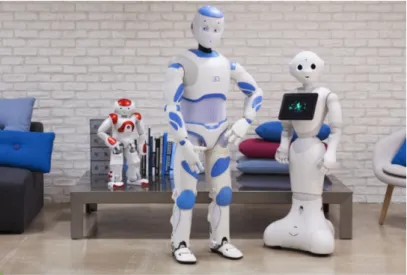
humanoid robot for medical applications. In the private sector, Aldebaran Robotics has been successful worldwide with the launch of the robot Nao in 2004, which substituted since 2007 Sony’s Aibo in the RoboCup Standard Platform League (SPL)15. The latest
developments of the company are the robot Romeo and Pepper (see Fig. 2.4).
Figure 2.4 – Aldebaran humanoids. From left to right the robots Nao, Romeo and Pepper.
The humanoid Nao
The humanoid robot Nao by Aldebaran Robotics is the platform considered in this work (see Fig 2.5), so it is presented in detail. As described in Gouaillier et al. [75], Nao
12. http://www.inria.fr/equipes/bipop/%28section%29/activity 13. http://www.gipsa-lab.grenoble-inp.fr/projet/Rabbit/English/
14. http://www.uvsq.fr/hydroid-8201-un-robot-humanoide-au-service-de-la-sante-173507.kjsp 15. http://www.robocup.org/robocup-soccer/standard-platform/
2.2. Humanoid robots Chapter 2. Humanoid navigation is an innovative lightweight and compact robot, that is 0.57 meters tall and weights about 4.5 kg. The body mass index (BMI) is about 13.5 kg/m2, which means that it is very
light compared to other robots of the same height. Moreover, the walk speed is similar to the speed of a child of the same size, that is about 0.6 km/h.
Figure 2.5 – The robot Nao by Aldebaran Robotics (Gouaillier et al. [75])
Distinctive aspects of Nao are its pelvis kinematics design (see Fig. 2.6), its pro-prietary actuation system based on brush DC motors, its electronic, computer, and dis-tributed software architecture. Nao is also affordable when compared to other platforms. As shown in Tab. 2.1, these robots are somewhat expensive, making the price for Nao (by 2008) a plausible alternative for research teams with moderate budget. The platform is also extensible and easy-to-handle, where the user can change the embedded software or add some applications to make the robot adopt specific behaviors. The robot’s head and forearms are modular and can be changed to promote further evolution. The comprehen-sive and functional design is one of the reasons so Nao substituted the AIBO quadruped in the RoboCup standard league.
Figure 2.6 – Nao’s pelvis design. On the left the classical set of three rotary joints, one horizontal axis at the waist and two vertical axis for the legs. On the right the coupled inclined axis rotary joints (at 45◦ towards the body) for the Nao pelvis (Gouaillier et al. [75]).
Table 2.2 summarizes the characteristics of Nao. It has a total of 25 degrees of freedom (DOF), 11 DOF for the lower part that includes the legs and pelvis, and 14 DOF for the upper part that includes the trunk, arms and head. Each leg has 2 DOF at the ankle, 1 DOF at the knee and 2 DOF at the hip. Figure 2.7 gives the kinematics details. Tab. 2.3 shows the sensory modalities included in the platform.
Chapter 2. Humanoid navigation 2.2. Humanoid robots
Height (m) Weight (kg) BMI (kg/m2) Price
KHR-2HV 0.34 1.3 10.9 1K US $ HOAP 0.50 7.0 28.0 50K US $ Nao 0.57 4.5 13.5 10K euros QRIO 0.58 6.5 19.0 NA ASIMO 1.30 54.0 32.0 NA REEM-A 1.40 40.0 20.4 400K US $ HRP-2 1.54 58.0 24.5 (5 year lease) Human 1.5-2 50-100 18-25 NA
Table 2.1 – Characteristic of functional humanoids (Gouaillier et al. [75]). BMI: body mass index = w/h2, NA: not available.
Body Height (m) 0.57 Weight (kg) 4.5 Battery Type Lithium-ion Capacity 55 Wh
Degrees of freedom (DOF): 25
Head 2 DOF Arms 5 DOF X 2 Pelvis 1 DOF Leg 5 DOF X 2 Hands 1 DOF X 2 Masses (g) Chest 1217.1 Head 401 Upper Arm 163 Lower Arm 87 Thigh 533 Tibia 423 Foot 158 Total 4346.1
Table 2.2 – Characteristics of the Nao humanoid (Gouaillier et al. [75]).
Type Number
30 FPS CMOS videocamera 1
Gyrometer 2
Accelerometer 3
Magnetic rotary encoder (MRE) 34
FSR 8
Infrared sensor (emitter/receiver) 2
Ultrasonic sensor 2
Loudspeaker 2
Microphone 4
Table 2.3 – Sensors available in Nao (Gouaillier et al. [75]).
The Aldebaran Robotics software framework is the architecture NaoQi, which is a modular and distributed environment that can deal with a variable number of executable binaries, depending on the user’s architectural choices. The advantages of a distributed environment are diverse. It allows the user to run behaviors locally or remotely. Robot functionalities such that motion, vision, among others, can be run standalone or inter-acting with other modules on other computers. The development of applications is easier in a distributed environment, since the same code can be compiled on different platforms and cross-compiled for embedded execution. A distributed environment also allows the user to look at variables and running methods on any real or simulated robot from the programming interfaces.
2.3. Challenges in humanoid research Chapter 2. Humanoid navigation
Figure 2.7 – Kinematics of Nao. The wrist joint is not represented (Gouaillier et al. [75]).
Challenges in humanoid research
Although it may look like the most important challenges for the conception and control of humanoids have been solved, the current capabilities of these robots are rather limited when compared to humans beings. Below some of these limitations are discussed.
Bipedal locomotion
One of the distinctive features of full-body humanoids is bipedal locomotion. Human beings can walk and run with apparently ease, though these skills have been proven hard to obtain in humanoids. According to Behnke [17] there are two opposing approaches to bipedal walking. One is based on the concept of zero-moment-point theory (ZMP), that is defined as the point on the horizontal plane about which the sum of the moments of all the active forces equals zero (Vukobratović & Borovac [183]). Dynamic stability can be evaluated such that, if the ZMP is within the convex hull (i.e. the support polygon) of all contact points between the feet and the ground, the system is stable. This was a major advance over the center-of-mass projection criterion describing static stability. Many robots (e.g, Asimo, Nao, HRP, etc) employ ZMP-based control, however they are not energy-efficient since they do not recycle energy stored in elastic elements in the way humans do.
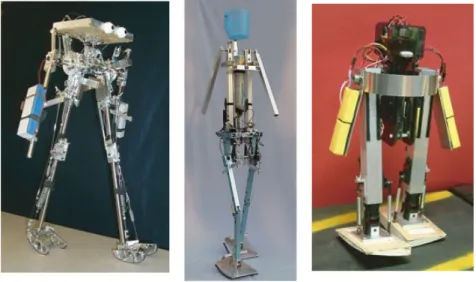
The other approach for bipedal locomotion is to use the robot dynamics. A work by McGeer [118] has shown that for planar walking it is possible to down a slope without control or actuation. The idea of passive dynamic walking has inspired the study of walk
Chapter 2. Humanoid navigation 2.3. Challenges in humanoid research on level ground (see Colins et al. [48]). As shown Fig 2.8, these robots are very efficient and easy to control since their actuators only support the inherent machine dynamics. However, there are problems to be solved such that the autonomous starting and stopping of the walk, and the change of speed or direction. Furthermore, since round feet are employed, these machines cannot stand still. Perhaps a promising research direction is to combine ZMP theory with passive dynamics, though many aspects are still to be investigated (e.g. walking over uneven terrain and multi contact with the environment, among others).
Figure 2.8 – Passive dynamics research. Three level-ground powered walking robots based on the ramp-walking designs (Collins et al. [48]). On the left the Cornell biped, in the center the Delft biped, on the right the MIT learning biped.
Perception
Humanoid robots are equipped with sensory devices for perceiving their own state and the environment. Usually joint encoders, force sensors, or potentiometers, are available for proprioceptive feedback. Contact with the ground is detected through Force Sensitive Resistors (FSR) placed at the feet, which register resistance changes according to the pressure applied. More recently, some robots have been covered with force-sensitive skin (e.g. Stiehl & Breazeal [171], and Elkmann et al. [62]). Capacitive sensors are also used for detecting contact with the environment, they are usually placed at the hands, head and fore-arms. Super-human senses, such as laser range-finders or ultrasonic distance sensors may be available for exteroceptive feedback. Vision and audition are perhaps the most important modalities. Frequently robots are equipped with two movable cameras, the architecture may also include on-board computers for image interpretation. Though, the interpretation of real-world images is still an unsolved problem since the cameras employed are mostly general-purpose, differing significantly from the characteristics of the human visual system, which is much more efficient handling noise. Thereby, many vision-based tasks work well only under controlled conditions. Frequently, key objects are color-coded to ease their perception (e.g. in Moughlbay et al. [127]). Similar difficulties arise when interpreting the audio signals captured by on-board microphones (e.g. Allen et al. [4]). One major problem is the separation of the sound source of interest (e.g. a human communication partner) from other sound sources and noise. So far there is probably no audio recognition system that is infallible.
2.3. Challenges in humanoid research Chapter 2. Humanoid navigation
Human-robot interaction
Several research projects have focused on human-robot interaction. The general idea is to provide humanoids with capabilities normally present in natural face-to-face communications. This includes multiple sensory modalities such that speech, eye gaze, facial expressions, gestures with arms and hands, body language, and so on. According to Breazea [25], sociable robots are designed to communicate and interact with human, to understand and to relate to human or other robots in a personal way, by sharing social terms. Figure 2.9 shows some examples of these robots. They are equipped with expressive animated heads.
Figure 2.9 – Sociable robots. On the left, the robot Kismet developed in the MIT. On the right, the therapeutic baby harp seal Paro by AIST.
Perhaps the most extreme form of sociable robots are androids and gynoids, which exhibit a photo-realistic resemblance to humans. Their faces are covered with silicone skin, they have human-like hair, and are dressed as humans. Some of these robots are modeled after living persons, such that Repliee Q2 developed in Osaka (see Matsui et al. [117]). However, these robots may produce the uncanny valley effect (Mori [124]). Accordingly, as the appearance of a robot approaches the human, some observers’ emotional response to the robot will become increasingly positive and empathic, until a point where there is a sudden drop in attractiveness close to perfect human-likeness. In Behnke’s opinion [17], in these robots the synthesis-part of multi-modal interaction works reasonably well, but the insufficient performance in perception and action, and the lack of true meaning in the dialogue systems, prevent them so far from engaging in truly intuitive multimodal interactions with humans.
Dexterous manipulation
Another key human capability is dexterous manipulation. The human hand has about thirty degrees of freedom. It is not easy to reproduce its strength, flexibility, and sensitivity. As shown in Fig. 2.10, among the most advanced robotic hands is Shadow (Reichel [154]), which has 25 DOF and is capable of performing much of the motion of the human hand, including the curling of the palm. The actuation includes a flexible pneumatic system, acting as "air muscles". Other designs consider motorized biomimetic prosthetic hands based on tendon driven mechanisms (e.g. the iCub’s hand, see Stellin et al. [170]). As pointed out by Amlie et al. [94], the study of human hand morphology reveals that developing an artificial hand with the dextereous capabilities of human hand
Chapter 2. Humanoid navigation 2.3. Challenges in humanoid research is an extremely challenging task. Furthermore, hand dexterous manipulation also requires hand-arm and visual coordination. In practice, most of the studies have considered tasks with known objects.
Figure 2.10 – Robot hands. On the left the hand developed Shadow Robot Company Ltd. On the right the iCub hand developed in the IIT.
Learning and adaptive behavior
Humanoids must ideally be flexible in their adaptation to the environment. Thus, it is desirable that they can autonomously acquire knowledge, extend current skills to solve related tasks, and cope with unexpected changes. An efficient way of learning is by imi-tation. According to Schaal [161], the study of imitation learning offers a promising route to gain new insights into mechanisms of perceptual motor control, that could ultimately lead to autonomous humanoid robotics solutions. The field focuses on three important as-pects: motor learning, the connection between action and perception, and modular motor control in the form of motion primitives. There are several problems to be solved. One is obtaining a precise perception of the teacher. Other is the reliable mapping between the human body and the robot’s body. That is, some human motions may not be possible for the robot given the body differences (e.g. in Munirathinam et al. [130]). The robot might have degrees of freedom that are not constrained by the captured motion, thus a useful technique to simplify imitation is kinesthetic teaching (e.g. in Kormushev [102]), where the teacher directly moves the limbs of the robot.
Programming by demonstration can also benefit the adaptability of the robot to the environment. According to Cypher [53] the motivation behind this methodology can be announced as follows: "if a user knows how to perform a task on the computer, that should be sufficient to create a program to perform the task". When extended to robotic agents, this method can be useful to teach procedural knowledge in the form of a task algorithm. Reinforcement learning (RL) has also been used to optimize the behavior of humanoid robots. A mode detailed discussion about RL is presented in Sec 6.4. In a nutshell, RL can be viewed as the mapping from situations to actions that maximizes a reward signal (Kaelbling et al. [92]). The learner is not told which actions to take, instead, it must discover those that yield the most reward by trying them. As pointed out by Russell & Norvig [159], an important challenge encountered in RL is the trade-off between exploration and exploitation. Specially because it cannot be assumed that the environment would generate a reward structure that is sufficient for the learning of complex tasks. Thus, the agent must try a variety of actions and progressively favor those policies that appear to be best.
2.4. Autonomous navigation Chapter 2. Humanoid navigation A distinct perspective is adopted in the research of enaction (see Vernon [182]). The agent is given autonomy and an active role in learning through sensory motor coupling. Thus, knowledge is constructed from the interactions with the environment. Here, em-bodiment and stimuli affordances are fundamental for the robot’s understanding of the world. That is, the physical properties of stimuli and the agent’s body would provide the opportunity for learning actions. For example, the operations allowed by a knob are twisting and pushing, whereas a cord would afford pulling. By following these ideas au-tonomous sensory-motor coordination has been learned (e.g. eye-hand coordination in Fanello et al. [66]), and stimuli categorization (e.g. visual recognition in Morse et al. [125]), among other skills.
The aspects of learning and adaptation is of great interest for this research. Through-out chapters 4-6 different topics related to embodiment and emergent behavior are studied, where supervised demonstrations are fundamental to teach the agent the desired state of the task. The use of RL is also explored to increase the effectiveness in the task by se-lecting successful actions from previous experiences. The analysis of the sensory-motor coupling is a central topic, so the agent can rely on egocentric representations that it is able to obtain on-board in an autonomous manner (e.g. without relying on a ubiquitous representation of the scene). In this work the achievement of the task goals require the efficient control of the robot locomotion based on visual and proprioceptive information. The research on robot navigation and the action selection problem are relevant to this study, so they are discussed in more details in the next sections.
Autonomous navigation
The appearance of mobile robots in the late 1960s initiated the research domain of autonomous navigation. According to the historical review by Siciliano & Khatib [167], early navigation systems were based on fruitful ideas that influenced latter development of motion planning algorithms. Some examples are grid-based environment exploration (Nilsson [135]), and search-trees for the optimal path to a goal (Thompson [177]). Latter, studies in robot manipulation popularized the notion of the configuration space of a mechanical system (Lozano-Pérez [112]). Thus, motion planning was reduced to finding a path for a point in the configuration space.
Other important contribution came from the problem of car parking, which moti-vated the interest for non-holonomic motion planning (see Li & Canny [109]). According to Laumond [105], non-holonomic systems are characterized by constraint equations in-volving the time derivatives of the system configuration variables. These equations are non integrable and typically model the case where the system has less controls than con-figuration variables. For instance, a car-like robot has two controls (i.e. the linear and angular velocities) though it moves in a 3D configuration space. Consequently, a path in the configuration space does not necessarily correspond to a feasible path for the system. This is basically why the purely geometric techniques developed for holonomic motion planning do not apply directly to non-holonomic systems.
More recently, the focus of the research in the field has turned to the problem of autonomous outdoor navigation. That is, under inaccurate localization conditions, such that, uncertain and incomplete models of the world (e.g. navigation maps), and unex-pected disturbance (e.g. moving obstacles). These topics definitely present a challenge to the cognitivist approach in AI, by emphasizing the gap between planning a path and
![Figure 2.3 – Darpa Robotics Challenge finals 2015 [1]. The KAIST team from the Republic of Korea won the competition.](https://thumb-eu.123doks.com/thumbv2/123doknet/7773387.257305/33.892.221.676.108.983/figure-darpa-robotics-challenge-finals-kaist-republic-competition.webp)
![Table 2.1 – Characteristic of functional humanoids (Gouaillier et al. [75]). BMI: body mass index = w/h 2 , NA: not available.](https://thumb-eu.123doks.com/thumbv2/123doknet/7773387.257305/36.892.160.729.107.295/table-characteristic-functional-humanoids-gouaillier-bmi-index-available.webp)
![Figure 2.7 – Kinematics of Nao. The wrist joint is not represented (Gouaillier et al. [75]).](https://thumb-eu.123doks.com/thumbv2/123doknet/7773387.257305/37.892.269.614.111.577/figure-kinematics-nao-wrist-joint-represented-gouaillier-et.webp)
![Figure 3.3 – Implementation of the Koch & Ullman architecture by Itti et al. [89]](https://thumb-eu.123doks.com/thumbv2/123doknet/7773387.257305/57.892.211.680.115.511/figure-implementation-koch-amp-ullman-architecture-itti-et.webp)