Publisher’s version / Version de l'éditeur:
Polymer Degradation and Stability, 41, 2, pp. 205-210, 1993
READ THESE TERMS AND CONDITIONS CAREFULLY BEFORE USING THIS WEBSITE. https://nrc-publications.canada.ca/eng/copyright
Vous avez des questions? Nous pouvons vous aider. Pour communiquer directement avec un auteur, consultez la première page de la revue dans laquelle son article a été publié afin de trouver ses coordonnées. Si vous n’arrivez pas à les repérer, communiquez avec nous à [email protected].
Questions? Contact the NRC Publications Archive team at
[email protected]. If you wish to email the authors directly, please see the first page of the publication for their contact information.
NRC Publications Archive
Archives des publications du CNRC
This publication could be one of several versions: author’s original, accepted manuscript or the publisher’s version. / La version de cette publication peut être l’une des suivantes : la version prépublication de l’auteur, la version acceptée du manuscrit ou la version de l’éditeur.
For the publisher’s version, please access the DOI link below./ Pour consulter la version de l’éditeur, utilisez le lien DOI ci-dessous.
https://doi.org/10.1016/0141-3910(93)90045-K
Access and use of this website and the material on it are subject to the Terms and Conditions set forth at
Reactions of dimethyl sulfide with oxidized polypropylene
Falicki, S.; Carlsson, D. J.; Gosciniak, D. J.; Cooke, J. M.
https://publications-cnrc.canada.ca/fra/droits
L’accès à ce site Web et l’utilisation de son contenu sont assujettis aux conditions présentées dans le site LISEZ CES CONDITIONS ATTENTIVEMENT AVANT D’UTILISER CE SITE WEB.
NRC Publications Record / Notice d'Archives des publications de CNRC: https://nrc-publications.canada.ca/eng/view/object/?id=82c95c98-28ae-4275-9bf5-0266fc28fb44 https://publications-cnrc.canada.ca/fra/voir/objet/?id=82c95c98-28ae-4275-9bf5-0266fc28fb44
Polymer Degradation and Stability 41 (1993) 205-210
Reactions of dimethyl sulfide with oxidized
polypropylene*
S. Falicki, D. J. Carisson
Institute for Environmental Chemistry, National Research Council of Canada, Ottawa, Canada K1A OR9
&
D. J. Gosciniak & J. M. Cooke
ICI Specialty Chemicals, Wilmington, DE 19897, USA (Received 11 May 1992; accepted 24 September 1992)
The reaction of dimethyl sulfide (DMS) vapour with solid films of y- and photo-oxidized polypropylene and high density polyethylene is found to involve the extensive decomposition of sec. and tert. hydroperoxide groups rather than the destruction of peracids alone as reported previously. Film of oxidized PP were extremely stable to further oxidation at 60°C after DMS exposure and also lost their ability to generate nitroxide from secondary amines. Both sec. and tert. hydroperoxide groups reacted with DMS by dual kinetics. The fast-reacting hydroperoxide groups may result from catalysis of the DMS attack by other oxidation products such as carboxylic acids.
Polyolefin oxidations are widely believed to result from free radical reactions involving peroxyl radicals. 1-3 Hydroperoxides are the first molecular products, but are photo- and thermally labile. Their decomposition initiates further oxidation. In recent years, several authors have suggested that peracids or their esters can also be formed during ocidation. 4-8 Peracids are well known to be extremely reactive. Their presence has been used to explain the formation of nitroxide intermediates from polyolefins stabi- lized with secondary hindered amine stabilizers (usually known as HALS, hindered amine light stabilizers). This reaction (la) is very fast as compared to the amine-hydroperoxide reaction (lb).7
\
C(~---O)OOH + NH f"~', NO- (la~
I
C - - O O H + \ N H ~,ow NO. (lb)
I /
* Issued as NRCC No. 00000.
In contrast to the previous, circumstantial evidence supporting peracid involvement in polyolefin oxidation, Zahradnickova et al. have recently proposed that dimethyl sulfide (DMS) can be used as a reagent to quantify peracids in the presence of hydroperoxides. 7 They have applied this approach to the analysis of the products from the photo-oxidation of solid polypropylene (PP) films. DMS is proposed to react very rapidly with peracids and only slowly with unactivated hydroperoxide (reaction (2)).
C H 3 - - S - - - C H 3 + - C ( ~ O ) - - O O H fast9" C H 3 - - S ( = O ) - - - C H 3 + ~ C ( = O ) - - - O H
(2a)
I C H 3 - - S - - - C H 3 + ~ C - - O O H I 205 I slow CH3--S(=O)CH3 + - C - - O H (2b) Because of our previous failure to detect peracids in oxidized polyethylene and polypropylene by reaction with diazomethane at206 S. Falicki et al. low temperature, 9 we have repeated the DMS
work of Zahradnickova et al. In addition we have extended their study to both photo- and y-oxidized films of PP and high density polyethylene (HDPE) by the use of potentially more reliable and informative analytical methods for hydroperoxides and alcohols.
EXPERIMENTAL
Commercial isotactic polypropylene film (Himont Profax, -30/~m thickness) was acetone extracted (48 h, Soxhlet) to remove additives (a phenolic, antioxidant, calcium stearate antiacid and an antistatic compound). The extracted film was oxidized by y-irradiation in air (Atomic Energy of Canada Gammacell 220, 0-6Mrad/h dose rate) or ultra-violet (UV) exposure (Atlas xenon arc WeatherOmeter, 6000 W, borosilicate inner and outer filters). Films were oxidized to levels at which products could be reliably analyzed, but without the film becoming too brittle to handle.
Oxidation products were identified and quan- tified by transmission infrared (IR) spectroscopy (Perkin-Elmer 1 5 0 0 Fourier Transform IR spectrometer) and by iodometric analysis. Iodo- metric analysis involved refluxing - 5 mg film samples in acetic acid/propan-2-ol with sodium iodide and measuring the 13 liberated by spectrophotometry at 360 mm.10 All hydroperox- ides, peracids and peresters are summed by this method; dialkyl peroxides do not react. The reflux time was chosen to allow close to complete reaction. This was shown by a <5% increase in detected peroxidic species when the film sample was exposed to a second reflux in fresh reagents. Direct IR gives an indication of overall - O H species at - 3 4 0 0 c m -1 (alcohol and hydropero- xide) and all carbonyl species at 1700-1800 cm -1. Hydroperoxides were specifically quantified by NO exposure of the oxidized film (70h at -20°C). 11 Sec. and tert. hydroperoxides are then separately quantified by their sec. and tert. nitrate absorptions at 1276 and 1292cm -1 respectively. Alcohols form nitrites with NO under these conditions and can be quantified by their
-760 cm -I absorption.
To investigate the reaction of DMS with oxidized films, film samples were suspended in a 40 ml stoppered tube which was N2 purged for 15 min. Then 0-1 ml of DMS was introduced and the tube capped. Film samples were removed at
intervals after this exposure to DMS vapor at 21.0 + 0.5°C. The films were then purged with N2 for 15 min to remove residual DMS. These DMS treated films were analyzed for total peroxidic species (by iodometry), individual hydroperox- ides and alcohols (after NO exposure) and sulfoxide formation (IR absorptions at 1050 and 1030
cm-1).
Quantification of the expected sulfoxide product was complicated by the very low solubility of dimethyl sulfoxide in solvents such as hexane. This prevented the direct measure- ment of the sulfoxide IR extinction coefficients for the > ~ O absorption (1050 and 1030 cm -1) in the polyolefin-like environment. Instead di-n-butyl sulfoxide, which is hexane soluble, was used to give an approximate estimation of the dimethyl sulfoxide extinction coefficient.
In nitroxide generation experiments, oxidized films were exposed to DMS vapour for various times and then immersed in a 2,2,6,6-tetra- methylpiperidine solution in benzene. The nitroxide formed was estimated by electron spin resonance (ESR) spectroscopy (Varian E4 x-band spectrometer). The presence of a residual peroxyl radical signal in y-oxidized PP films prevented nitroxide quantification by double integration because of partial overlap of the nitroxide and peroxyl signals. Instead the nitroxide was quantified by measuring the height of the high field branch of the nitroxide triplet which is clear of the peroxyl signal. This height was compared with a calibration curve con- structed from ESR spectra of 2,2,6,6-tetra- methylpideridyl-N-oxyl in benzene.
RESULTS
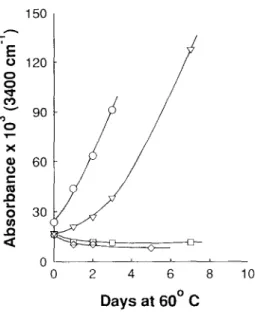
Oxidized PP films are quite unstable and reactive. They undergo a rapid autocatalytic oxidation at 60°C in air. l: In addition they generate nitroxide when exposed to secondary amines such as tetramethylpiperidine at room temperature. 7'13 Exposure of y-preoxidized film to DMS vapor dramatically prevented both of these reactions (Figs 1 and 2). Oxidative stability at 60°C in air was monitored by the increase in the 3400cm -~ absorption which results from total, hydrogen bonded hydroperoxide with a minor contribution from alcohol groups.
From the work of Zahradnickova et al., Figs 1 and 2 can be explained by DMS exposure
Reactions of dimethyl sulfide with oxidized polypropylene 207 150
o E
1208
90 x 8 6o o 30 . Q 0 0 ¢33 O E v e-- .£ f- o t- o 0 ~ ~__--<>- 2 4 6 8 10 Days at 60 ° CFig. 1. Effect of DMS exposure on PP oxidative stability. All films pre-oxidized by a 2-2 Mrad ),-dose in air before DMS vapour exposure for: 24 h ( ~ ) , 3 h ([3), 30 rain (V) and zero min (O). Initial total peroxide level 0.075 mole/kg.
All data normalized to a film thickness of 50/~m.
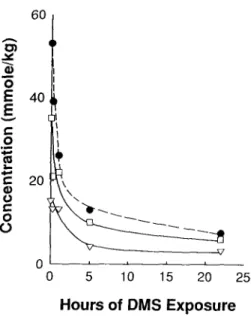
preferentially destroying peracids, leaving the bulk of the less reactive hydroperoxide groups unchanged. 7 To explore this possibility, the loss of total peroxides and of each hydroperoxide during DMS exposure was measured for PP films with two different degrees of initial oxidation (Fig. 3). Total peroxidic species were destroyed initially rapidly, then much more slowly as reported previously for both DMS and thermally
1.5 "~ 1.2 E E ~- 0.9 .£ 0.6 ,r'- 0 0 0.3 6 Z ~ o o ~ o - - o - - / \ o o 0 1 2 3 4 5 Hours at 21 ° C
Fig. 2. Nitroxide generation by pre-oxidized PP. Films ( - 5 mg) pre-oxidized by a 2.2 Mrad 7-dose in air before immersion in 0-35 ml of a 1-0t x 10 2 mole/liter solution of 2,2,6,6-tetramethyipiperidine in benzene which contained 7 × 10 5 mole/kg of the nitroxide as an impurity. Initial total hydroperoxide concentration 0.075 mole/kg (O, control (not DMS treated); Q, 5h DMS vapour treatment before
immersion). 80 60 40 20 it ~ ~ 0 5 10 15 20 Hours of DMS Exposure
Fig. 3. Detailed peroxide analysis of y-preoxidized, DMS-treated PP films. Initial total peroxide 0-075 mole/kg:
total peroxidic species by iodometry (O); t e r t .
hydroperoxide groups from NO method ([q); s e c .
hydroperoxide groups from NO method (V); sulfoxide yield ( O ) . Dashed line generated by computer from eqn (5); all other points simply connected for clarity. Initial total
peroxide 0.016mole/kg: t e r t . hydroperoxide groups from NO method (11); s e c . hydroperoxide groups from NO
method (V).
induced decomposition. 6,7,~3,14 However when
sec. and tert. hydroperoxide groups were quantified (as their corresponding nitrates after NO exposure) both hydroperoxides were dest- royed by DMS. The sum of sec. and tert.
hydroperoxide concentration was in good agree- ment with total peroxide level. Furthermore hydroperoxide loss followed a distinctly two stage process for both the secondary and tertiary groups. Sulfoxide was detected by FTIR consistent with reaction (2b). Sulfoxide yields are plotted in Fig. 3. The yield is approximately stoichiometric up to about 1 h of DMS exposure, but then decays, possibly because of volatiliza- tion from the films. Stoichiometric yields of alcohols are expected from reaction (2b). Alcohol formation upon DMS treatment was clearly indicated by the formation of strong nitrite absorption at - 7 6 0 c m - 1 after NO treatment. 1~ In adding the general - - O H IR absorption at - 3 4 0 0 cm -1 did not really decrease upon prolonged DMS exposure (despite exten- s i v e - - 0 O H loss) but was simply displaced to -3300 cm -1. Precise quantification of alcohol groups from the DMS reaction was complicated by broadening of the nitrite absorptions so that extinction coefficients for model compounds were
208 S. F a l i c k i et al. 60 o~
g
f,
40 20 0 0 0 0 5 10 15 20 25 Hours of DMS ExposureFig. 4. Detailed peroxide analysis of UV pre-oxidized, DMS-treated PP film. Films exposed for 75 h at 0.04 W/cm 2 in the xenon arc WeatherOmeter. Total peroxide species by iodometry (0); tert. hydroperoxide groups by NO method ([2); sec. hydroperoxide groups by NO method (V). Dashed line generated by computer fit to eqn (5); all other points
simply connected for clarity.
inapplicable. Approximate nitrite quantification based on peak areas indicated appreciable yields of alcohol for short DMS exposure times but only about 25% based on hydroperoxide loss at ---5 h of DMS treatment.
The oxidized PP films used in our experiments (Fig. 3) were produced by 7-irradiation. For mechanistic studies this type of oxidation is most
25 - - 20 O E E c - O 15 ° ~ .m e- ID o 10 C o 5 L 0 5 10 15 20 Hours of DMS Exposure
peroxide analysis of y-pro-oxidized,
F i g . 5 . Detailed
DMS-treated HDPE film. Film pre-oxidized by 5-0 Mrad y-exposure. Total peroxide species (0); sec. hydroperoxide groups by NO method (V). Dashed line generated by computer fit to eqn (5); all other points simply connected for
clarity.
easily controlled and reproducible without the complication of impurity-driven processes found in thermal and photo-oxidation. However for a direct comparison with the data of Zahradnick- ova et al., a photo-oxidized sample was also analyzed in detail after DMS exposure (Fig. 4). Total peroxide again showed a two stage decay, but was completely accounted for by loss of the
sec. and tert. hydroperoxides.
HDPE oxidizes to only secondary hydroperoxide. 15 DMS exposure of y-preoxidized HDPE film showed a two stage hydroperoxide decay (Fig. 5).
D I S C U S S I O N
The reported DMS method depends on the difference in reactivity between peracids and hydroperoxides with DMS (reactions (2a) and (2b)). In the liquid phase, perlauric acid reacts with DMS at a rate of more than two orders of magnitude faster than tert. butyl hydroperoxide at room temperature. 7 However the assumption that this difference will occur in the solid, oxidized polyolefin will be complicated by the diffusion limited rate of DMS penetration into the films and by their nonuniform oxidation.
Our data (Figs 3-5) clearly show that the hydroperoxides are destroyed by DMS and that the total hydroperoxide is in reasonable agree- ment with the concentration of total peroxidic species (from iodometry). Zahradnickova e t a l .
concluded that up to 20% of the total peroxidic species was peracid in their photo-oxidized samples, 7 although a value of 5% was quoted in their more recent paper. 8 In separate experi- ments we have quantified acids in oxidized PP films and found that total acid (carboxylic plus peracids) is present at -<10% of the concentra- tion of total peroxidic species. 16 We have previously shown that peracid was not detected in oxidized polypropylene or polyethylene by the diazomethane method which should form methyl perester groups (reaction (3)). 9 Low temperature was essential to avoid any peracids forming the methyl ester, which also comes from carboxylic acid sites.
- - 7 8 ° C
~ C ( - ~ O ) - - O O H + CH2N2 )
-C(--~O)--OOCH3 + N2 (3) Zahradnickova et al. have also used a
Reactions o f dimethyl sulfide with oxidized polypropylene 209
diazomethane reaction with oxidized poly- propylene, but worked at 0°C. 8 After diazo- methane treatment, the films were much less reactive in nitroxide generation from HALS. However as well as reaction with peracids and carboxylic acids, diazomethane reacts extensively with ---OOH to form the much less active methyl peroxide groups, so that the HALS reaction data is ambiguous. In contrast to our failure to detect perester (at - 1 7 8 4 c m -1) from a diazomethane reaction at -78°C with oxidized polypropylene, 9 Zahradnickova et al. assigned a very weak, broad absorption at 1 7 7 0 - 1 7 9 0 c m -1 from thick (250/am) oxidized samples to the formation of methyl perester. 8
In contrast to the iodometric method that we have used to measure total peroxidic species, Zahradnickova et al. used the colorimetric reaction of methanolic ferrous thiocyanate with oxidized samples which had been partly swollen in benzene for 24 h. 7'8 We have previously shown
that this latter method when used exactly as described in their papers 7"8 is unreliable for solid oxidized polymer, reaction only occurring with - 1 0 % of the total peroxidic species as measured by iodometry or the N O - - method. 1° This underestimation of hydroperoxide concentration is also indicated by estimates based on their reported IR spectra of - - O H species at 3400cm-~, 7"8 which can be assumed to have an extinction coefficient of 90 ( m o l e / l i t e r ) - l c m -1 and to be predominantly from - - 4 ) O H species. Furthermore their stoichiometry of nitroxide generation is reported to be much greater than unity which could again point to an underestima- tion o f - - O O H .
Zahradnickova et al. have attempted to use the NO treatment method to monitor hydroperoxide. 7 However their published IR spectra clearly show that they had selected conditions under which only <-10% of the - - O H species reacted because only a small decrease in the 3400cm -1 peak (from t o t a l - - O H absor- bance) was visible in their IR spectra, again leading to a large underestimation of hydropero- xides. The small changes in the carbonyl envelope that they observed after DMS treat- ment can be reasonably explained by the IR shifts resulting from changes in hydrogen bonding. 9
Hydroperoxide decomposition via dual kinetic paths has been previously reported from studies of the thermal stability of pre-oxidized pp.6A3A4
The rapidly decaying component was attributed by Chien and Jabloner to the decomposition of sequences of adjacent, 1, 3, 5 , . . . , etc., tert.
hydroperoxide groups. 14 The slower decomposing hydroperoxide was suggested to be isolated - - O O H groups. However our data in Figs 3-5 show that sec. hydroperoxide groups also decay by dual kinetics paths, even in oxidized H D P E which is believed to oxidize intermolecularly to give random - - O O H sites. 14
The faster decomposing sec. and tert.
hydroperoxide sites in PP and H D P E may possibly be activated by their proximity to other oxidation products. Carboxylic acids ( H - - X ) are known to be particularly effective catalysts of the sulfide reaction with hydroperoxide (reaction (4)). 17 R'SR' + R OOH H:-x~ R t \ /;-~--H / R" , R;SO + R"OH + HX (4) Although we have relatively few data points in Figs 3-5, the curves were assumed to come from two simultaneous, pseudo-first order decay processes as suggested previously for the thermal decomposition of PP hydroperoxide. 6,14 Data were then computer fitted to the expression:
[--OOH], = a e -~ft + b e -~t (5) Here a and b are the initial concentrations of the fast and slow decaying - - O O H sites, kf and ks the pseudo-first order rate constants for their decays and t the time of reaction. The dashed lines in Figs 3 and 4 are the computer generated fits. The tentative initial concentrations and pseudo-rate constant values from this curve fitting exercise are collected in Table 1. The rate constant for the slowly decomposing hydroperox- ides is surprisingly constant, being independent of the nature of the polymer or of the initiation mode (UV or y). The fast decay rate constant is similar for y-oxidized PP and HDPE, but somewhat higher for photo-oxidized PP.
Gijsman has reported that the fast component of the thermal decay of PP peroxides is only observed in highly oxidized samples whereas Chien and Jabloner found the converse. 6"~4 From Fig 3, fast and slow reacting hydroperoxides were
210 S. Falicki et al.
Table 1. Kinetic parameters from curve fitting of the hydroperoxide decay data in
the presence of D M S vapour ~
Polymer Initiation Total initial Hydroperoxide kf (s-l) ks (s- 1) mode hydroperoxide concentration
concentration ratio (mole/kg) (fast/slow) PP UV 0"052 2"2 PP y 0"073 1"3 PP )' 0"016 5"0 HDPE )' 0"022 0"6 3-2 x 10 -3 1.1 x 10 -5 1-0×10 -3 1-1x10 -5 ND b ND b 0-93 x 1 0 - 3 0"8 × 10 -5 a Total hydroperoxide concentration data in Figs 3-5 fitted to eqn (5).
b Not determined.
f o u n d e v e n at v e r y low total p e r o x i d e concentra- tions for d e c o m p o s i t i o n by D M S . T h e c o n c e n t r a - tion ratio for fast decaying to slow decaying h y d r o p e r o x i d e s in ),-oxidized P P is - 5 for the low initial p e r o x i d e level (0.016 m o l e / k g ) b u t - 1 . 3 for the higher initial p e r o x i d e level (0-073 m o l e / k g ) .
C O N C L U S I O N S
D M S v a p o r reacts with p r e o x i d i z e d P P and H D P E films by the rapid d e s t r u c t i o n of sec. and
tert. h y d r o p e r o x i d e groups. B o t h sec. and tert.
h y d r o p e r o x i d e g r o u p s r e a c t e d with D M S b y t w o mechanisms, the fast d e c a y c o m p o n e n t possibly resulting from carboxylic acid catalysis o f the h y d r o p e r o x i d e - s u l f i d e reaction. A f t e r D M S e x p o s u r e , which d e s t r o y s the m o r e reactive h y d r o p e r o x i d i c species, the oxidized P P films no longer g e n e r a t e nitroxide f r o m a s e c o n d a r y amine despite the p r e s e n c e o f - 4 0 % o f the initial (but slow in reaction with D M S ) sec. and tert.
h y d r o p e r o x i d e groups. This implies that the h y d r o p e r o x i d e sites which are m o r e reactive towards D M S are also those that attack H A L S . A l t h o u g h the p r e s e n c e o f low level peracids cannot be d i s c o u n t e d , the results o f Z a h r a d n i c k - ova et al. 7 can b e largely explained in terms of D M S reaction with h y d r o p e r o x i d e .
R E F E R E N C E S
1. Fischer, H., Hellwege, K. H. & Neudorfl, P., J. Polym. Sci. Part A, 1 (1963) 2109.
2. Decker, C. & Mayo, F. R., J. Polymer. Sci., Polym. Chem. Ed., 11 (1973) 2847.
3. Carlsson, D. J., Dobbin, C. J. B. & Wiles, D. M.,
Macromolecules, 18 (1985) 2092.
4. Felder, B. N., Am. Chem. Soc. Symp. Series, 280
(1985) 69.
5. Klemchuk, P. P., Gande, M. E. & Cardola, E., J.
Polym. Deg. Stab., 27 (1990) 65.
6. Gijsman, P., Hennekens, J. & Vincent, J., Proceedings, 11th International Conference on Advances in the Stabilization and Controlled Degradation of Polymers,
Luzerne, Switzerland, (1989), p. 33.
7. Zahradnickova, A., Sedlar, J. & Dastych, D., J. Polym. Deg. Stab., 32 (1991) 155.
8. Zahradnickova, A., Dastych, D. & Sedlar, J., J. Polym. Deg. Stab., 37 (1992) 189.
9. Carlsson, D. J., Brousseau, R., Zhang, C. & Wiles, D.
M., Am. Chem. Soc. Symp. Ser., 364 (1988) 376. 10. Carlsson, D. J. & Lacoste, J., J. Polym. Deg. Stab., 32
(1991) 377.
11. Carlsson, D. J., Brousseau, R., Zhang, C. & Wiles, D.
M., J. Polym. Deg. Stab., 17 (1987) 303.
12. Carlsson, D. J., Dobbin, C. J. B., Jensen, J. P. T. & Wiles, D. M., Am. Chem. Soc. Symp. Ser., 280 (1985) 359.
13. Carlsson, D. J., Chan, K. H., Durmis, J. & Wiles, D.
M., J. Polym. Sci. Polym. Chem. Ed., 20 (1982) 575. 14. Chien, J. C. W. & Jabloner, H., J. Polym. Sci. A 1, 6
(1968) 393.
15. Carlsson, D. J., Bazan, G., Chmela, S. & Wiles, D. M.,
J. Polym. Deg. Stab., 19 (1987) 195.
16. Lacoste, J. & Carlsson, D. J., submitted for publication.
17. Block, E., Oxidation and reduction of sulphides. In The Chemistry of Functional Groups: Supplement E, Chap. 13, ed. S. Patai. John Wiley, Chichester, 1980.