Publisher’s version / Version de l'éditeur:
Heating, Piping, Air Conditioning, 3, pp. 149-155, 1956-03
READ THESE TERMS AND CONDITIONS CAREFULLY BEFORE USING THIS WEBSITE. https://nrc-publications.canada.ca/eng/copyright
Vous avez des questions? Nous pouvons vous aider. Pour communiquer directement avec un auteur, consultez la
première page de la revue dans laquelle son article a été publié afin de trouver ses coordonnées. Si vous n’arrivez pas à les repérer, communiquez avec nous à [email protected].
Questions? Contact the NRC Publications Archive team at
[email protected]. If you wish to email the authors directly, please see the first page of the publication for their contact information.
NRC Publications Archive
Archives des publications du CNRC
This publication could be one of several versions: author’s original, accepted manuscript or the publisher’s version. / La version de cette publication peut être l’une des suivantes : la version prépublication de l’auteur, la version acceptée du manuscrit ou la version de l’éditeur.
Access and use of this website and the material on it are subject to the Terms and Conditions set forth at
Dependence of water vapor permeability on temperature and humidity
Chang, S. C.; Hutcheon, N. B.
https://publications-cnrc.canada.ca/fra/droits
L’accès à ce site Web et l’utilisation de son contenu sont assujettis aux conditions présentées dans le site
LISEZ CES CONDITIONS ATTENTIVEMENT AVANT D’UTILISER CE SITE WEB.
NRC Publications Record / Notice d'Archives des publications de CNRC:
https://nrc-publications.canada.ca/eng/view/object/?id=9aca41af-554a-4e2d-b8a2-a1b8e4cdffea https://publications-cnrc.canada.ca/fra/voir/objet/?id=9aca41af-554a-4e2d-b8a2-a1b8e4cdffea
N A T I O N A L R E S E A R C H C O U N C I L
BLDG iC A N A D A
D B V I S I O N O F B U I L D I N G R E S E A R C H
DEPENDENCE
OF
WATER VAPOR PERMEABILITY
ON
TEMPERATURE AND HUMIDITY
I
S. C. CHANG and N. B. HUTCHEON
REPRINTED FROM
NAL SECTION, HEATING, PIPING & AIR CONDITIONING, MARCH 1 9 5 6
RESEARCH PAPER NO.
21
OF THE
DIVISION OF BUILDING RESEARCH
C
I
NRC No. 39O t t a w a
Dependence of Water Vapor Permeability
on Temperature and Humidity
By S. C. Chang*, Saskatoon, Sask., and
N.
B. Hutcheon"*, Ottawa, Ont., CanadaN MANY situations a knowledge of
I
the movement of moisture through unsaturated materials is of interest or of importance. These may occur in the design of walls and roofs to avoid condensation, in the design of wetting or drying processes, in the estimation of humidifying and de- humidifying loads, in the selection of packaging to control moisture con- tent, and in the prediction of the moisture content in any material ex- posed to changing conditions. Many of these cases are of direct concern to the air-conditioning engineer. The need for more and better data is growing rapidly. It is of interest to re-examine the basis on which data are presently obtained and to take stock of the present position.The movement of moisture through unsaturated material is broadly con-
--
'Research Assistant, Department of Mechanical n tneering Un~verstty of Saskatchewan.
B'Assistabt Dzrector, Division of Building Re- search. National Research Council of Canada. Mcrnber of ASHAE.
For presentatton at the Semi-Annual Meeting of the AMERICAN S O U E ~ Y OF HEATING AND AIR- CONDIT~ONING ENGINEERS, Washington. D.C.. June 1956.
SUMMARY-The present ap- proach to the calculation and prediction of vapor flow through materials uses a simple flow equation with vapor pressure as the potential. The corresponding coefficient of permeability is, for many materials, a function of temperature and humidity. Ways of correlating dry-cup and wet- cup permeance data to provide the necessary permeability co- efficients for the isothermal case
the. material or materials in the vapor: form. The transmission of water va- por under these conditions is regar
are presented and d data obtained for papers over a rang tures and humidi
sented. The effect of a n vapor. It is with ture gradient, in the f the type normally re-.
of vapor flow, is not
lished, and may int this paper is concerned. complication, requiring an equa-
tion which recognizes surface-
film and capillary migration Vapor Flow Equation under a moisture content gradi-
ent combined with vapor diffu- Engineering calculation of vapor sion occurring under the vapor flow has to date been based o n a
pressure gradient. simple flow equation, analogous to that used in heat transfer. The basic form is:
sidered as a vapor flow so long as
the water crosses the boundaries of w = - p ( d p / d x )
...
(1)to = weight of vapor transmitted t h ~ o u g h a unit area in unit time.
p = vapor pressule.
x = distance along flow path.
and hence:
d p / d x = vapor plessure gradient.
and
p = coefficient of permeability, or simply, permeability.
This equation is of the same form1 as the diffusion equation describing Fick's Law which is frequently ap- plied to diffusion processes. The weight of vapor transmitted is pro- portional to the vapor pressure gradi- ent, provided p is a true coefficient as implied, and is independent of p
and x .
The Permeability Coefficient
It would be convenient if the per- meability were constant for any par- ticular material. Unfortunately this is not always the case and it be- comes necessary to determine if pos- sible the factors which cause it to change and their relation, quantita- tively, to it.
Barrer-rom experimental evi- dence states that membranes which sorb little water behave at low rela- tive humidity as iiidicated by Fick's Law, that the more hygroscopic the substance the lower is the humidity above which this relationship breaks down and that the increase in per- meabiiity fnllo~vs roughly the increase in water sorbed.
Joy et a13 have presented exten- sive data on sugar pine wood in- dicating a marked increase ixi per- meability with relative humidity be- ginning at about 50 percent. They acknowledge the probability that the sorption of water in these materials, in amounts which increase with rel- ative humidity, may be responsible for the increased vapor flow. Bab- bitt4 has presented similar data for 11lywood and two types of building paper.
Babbitt1! 4 3 5 assumes that sorption
contributes to flow by making pos-
-
'Exponent numerals refer to References
sible movement of tne water mole- cules as adsorbed layers on internal surfaces, and believes that the de- parture of the diffusion from Fick's
Law is due to this. Following the method used by Muskat he has an- alyzed three of the currei~tly held adsorp~ion theories and has concluded [hat the corresponding value of per- meability ought to increase with relalive humidi~y at an increasing rate for hygroscopic materials.
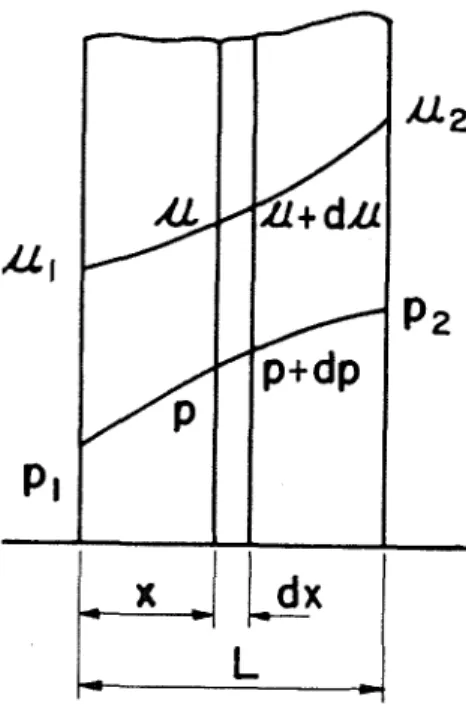
Fig. 1-Variation of vapor pressure and permeability throughout a homogeneous sample
At high relative humidities sorbed films become thick enough to merge in small capillaries, filling them. A liquid-type flow then becomes pos- sible. JohanssonG considered moisture transfer as a combination of capillary movement and gaseous diffusion. The value of permeability which he de- termined was a function of many factors, ixicluding the diffusion con- stant of air, the size of capillaries, and the viscosity and density of water vapor. He concluded that in general permcability ought to increase with relative humidity although the re- verse could be true if the capillaries were specially sized.
Temperature may also have an effect on permeability, leading to
different values of permeability at different temperatures for the same relative humidity. Barrer2 states that changes i n temperature have a marked effect on the permeability constants of the least permeable mem- branes but that the constants of porous membranes are independent, or slightly dependent upon, tempera- ture. Doty et a17 found a wide range in the temperature dependence of the permeability of several polymer films of the type used in packaging.
It may be possible to describe the effects of temperature for qertain a- terials on the basis of a&$
J
on energy. This is a concept de eloped from kinetic theory40,
' >
e d i n the effect of temperature upon rate of chemical reactions.,It i s based upon the premise that only the molecules having kinetic energies above a cer- tairrle<el can enter into a reaction. Its application to certain types of diffusion processes2 leads to an equa- tion of the form:p. = permeability for T = a.
R = gas constant.
E = activation energy. T = absolute temperature.
Application of this equation LO
vapor transmission may be limited to materials such as rubbers, resins, and polymers in which the water mole- cules enter and move through the molecular structures by a process known as activated diffusion. A posi- tive value of
E
indicating an in- crease i n coefficient of permeability with temperature has been found for a variety of such materials217. This equation may also serve, however, as a basis for an approximate tem- perature correction in other cases.Equation 2 is readily applied to data in a .graphical solution when transformed to :
...
log p log p, - ( E / R T ) ( 3 )
A straight line of slope
-E/R
is obtained in a plot of log p against1/T. The intercept with the Y-axis Heating, Piping & Air Conditioning, March 19%
i s log p,,. Any two values of p for different. temperatures but at the same relative humidity may be used to establish the slope of the line, and, therefore, the value of
E,
from which the coefficientg for other tem- peratures may be established.The Average Permeability
When moisture is tranemitted through a material the temperature and humidity may vary along the path of transmission.
h
the diacue- sion of the previous section indicated, the permeability, p, is likely to be, in practice, a function of relative hu- midity and temperature and to have different values from point to point. Some simplification may be intro- duced if the possibility of a tempera- ture gradient is disregarded, and only isothermal cases considered. The permeability p can then be regarded ae a function only of vapor pressure (or relative humidity) at any par- ticular temperature.The conditions for uni-directional, steady-state flow through a slab of material of thickness,
L,
can be rep-reaented as in Fig. 1, and Equation
1 applied.
Equation 1 may be written:
Integrating Equation
4
from x0 to x =
L,
and from pl to p2 and dividing both sides by the thicknees:transposing
let
spp11~a"
-
-
=p...
(a)
Pi
-PzThen Equation 6, rearranged, be- comes :
-
1" = f i ( p 2
--
p , ) / L...
( 9 )Equation 9 is in the form most commonly used in calculations of
p i p 2
WATER VAPOR PRESSURE, P
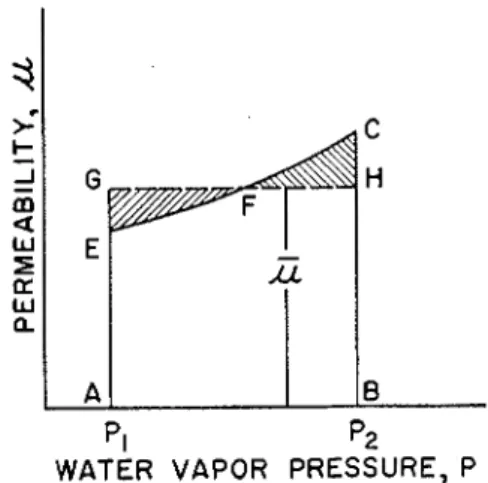
Fig. 1-Variation of permeability with vapor pressure, a t constant temperature
vapor flow. The coefficient T;is usual- ly found by the application of this equation to the results of dry-cup, or wet-cup tests carried out on sheets or plates of material at one particular temperature. T h e results are frequent-
r
-
ul ul w CURVE OF SPOT z Y PERMEABILITY ,U 0 I I- X e m z DRY CUP- LIMITS L 0 5 0 100 R E L A T I V E HUMIDITY - %Fig. 3-Relationship between dry- and wet-cup teats and the spot permeability for a material such as wood
, : I
...
ly expressed as a permeance,
j3i/L,
which applies to the thickness of ma- terial stated or implied, rather than to unit thickness. The values obtained may, however, be unique to the con- ditions of test since T; is the average coefficient of permeability over the range of vapor pressure in the par- ticular test.
The
relationship betweerr ,I mrtlj;
can be more readily seen by reference to Fig. 2 where the permeability p
is plotted against vapor pressure for the conditions represented in Fig. 1.
The coefficient
;T
is nun~erically equal to the area ABCE divided by AB, as given b y the vertical ordinate to the mean lineGH.
It may be noted that area GFE in Fig. 2 equals the area FCH and that generally the average permeability7
does not equal thespot or differential permeability p at mean vapor pressure ( p ,
f
p2)/2.A further representation of the average permeabilities obtained from dry-cup and wet-cup tests carried out at the same temperature but at rela- tive humidities of 0 percent to 50 percent and 50 percent to 100 per- cent respectively is given in Fig. 3.
In this case the plot is against rela- tive humidity, since at constant tem- perature vapor pressure and relative humidity are for practical purposes proportional. For a curve of perme- ability varying with relative humidity as shown, the average permeabilities obtained will be
TI,
f o r the dry-cup test and7i2,
for the wet-cup test. These frequently differ by a factor of 3 or more for wood and wood products, the wet-cup test providing the higher values.T l i e P e r m e a b i l i t y C u r v e
The permeability p cannot be meas- ured directly. I t is ~ossible, how- ever, from a series of values of aver- age permeabilities for a particular -
material at a given ternpezstare ob- tained from suitable tests, to construct a permeability curve such as that shown in Figs. 2 and 3. If in Fig. 3
the average permeabilities for the dry-cup and wet-cup tests were plotted as show11 it would be possible to con- struct a rough permeability curve on a trial and error basis.
The trial curve must satisfy the condition in the case of each of the tests that the area under the curve so constructed between the limits of relative humidity for the test should equal the area under the average permeability line as found from the tests, between the same limits. Con- sideration shows that four dry-cup tests run at humidities outside the Heating, Piping & Air Conditioning, March 1956
cup increasing in increments of 20 percent ~voulcl permit a reasonably accurate curve to be drawn, up to tlie high humidity range.
Once the permeability curve is ob- tained it is possible to determine by a reverse procedure the average per- meability /*, for any desired limits of humidity (or vapor pressure) for isothermal conditions at thc tempera-
l:
1
A V E R A G E PERMEABILIT I E S FROM DRY CUP DATA4 0
I
SPOT PERMEABlLl T IES
P A P E R A
a
R E L A T I V E HUMIDITY, h , %
Fig. 4-Permeabilities obtained from dry- cup tests of a 15 Ib asphalt-saturated sheathing felt, 0.037-in. thick
ture for which the test data were obtained.
A more straightforlvarcl method snggested by a colleague involves plotting the vslues of the integral
.fp,pZ p i p calculated from the dry-
cup test data rather than
which is
7
Babbitt' used the devicc of plotting permeabilities, or permeances where appropriate, against the mean relative humidity for the test conditions, ancl of drawing a curve through the points obtained from a series of tests. This curve can provide data for other mean relative humidities, and is in effect, an approximate permeability curve. The nature of the approxima-
tion is evident from Fig. 3, i.e: the true average permeability is not the permeability at the mean humidity. This method may, however, be suf-
ficiently accurate for many purposes. Further curves of permeability ap- plying to other temperatures can be constructed froin test data, for such other temperatures. Some reduction in the amount of testing required to cover a range of temperatures may be obtained by using Equation 2 to extend the data obtainecl for any two temperatures to other temperatures.
data have not yet been obtained for these papers, but similar results might be expected since both are essentially ~voocl products. These results are in- teresting in view of the relatio~lship which has been proposed between hy- groscopicity and increase i n perme- ability with relative humidity, ancl suggest that another factor must be
Paper Test Data
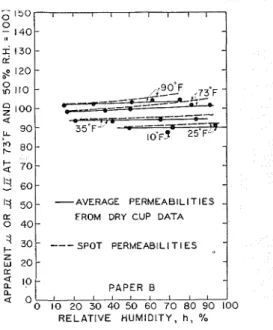
The variation of permeance with temperature and humidity was de- termined for three building papers by an extended series of dry-cup tests. The results obtained for two of these, an asphalt saturated feIt, A, and a smooth, lightly saturated and waxed kraft building paper,
B,
are given in Figs. 4 and 5, respectively. They are expressed as relative per- meabilities, a s percentages of the test ~ e r m e a b i l i t ~ found at the standardTesting
as so cia ti or^
of Pulp and Pa- per Industry test conditions of 73F
aild 50 percent relative humidity. The solid curves are the average perme- abilities found from the tests, plotted against the relative humidity outside the cup ( 0 percent on the inside). These data were reduced to apparent permeabilities, by the method out- lined in this paper, which are rep- resented by the dotted curves.
The very marked influence of tem- perature and humidity on permeabil- ity for paper A of Fig. 4 may be noted. Of interest is the reduction in slope of the permcability curve at tlie higher relative humidities as the temperature is reduced. The error introduced by applying data irom the standard dry-cup test conditions to higher humidities without correction and the increasing effects of tem- perature at higher humidities are ap- parent. The third paper, an asphalt- saturated building paper showed simi- lar results. Paper B of Fig. 5 gave markedly different results, showing only small increases in permeability with incrcase in temperature and rel- ative humidity. Hygroscopic moisture
AVERAGE PERMEABILITIES
40 FROM DRY CUP DATA
1
SPOT PERMEABILI T I E S
;;
, ,
,,
,
,
j
2
lo a P A P E R B a '0 I0 20 30 40 50 60 70 80 90 100 RELATIVE H U M I D I T Y , h , %Fig. 5-Permeabilities obtained from dry- cup tests of a lightly saturated and
waxed k r a f t building paper, 0.008-In.
thick
-
.----
taken into account. Paper
B
has a relatively low expansion with illcrease in moisture content.Permeability of a Combination of Homogenleotis Materials
The average permeability of a com- bination of homogeneous materials can be determined if the appropriate permeability data are available ior each material. This is a procedure of much interest in practice, particularly in calculations of vapor transmission through walls and roofs. The resist- ance method of calculating an overall coefficient which is e~nployed in the case of heat transmission, by adding the resistances of the various ele- ments, can be used. I t must be noted, however, that the individual resist- ances and, therefore, the overall co- Heating, Piping & Air Conditioning, March 1956
efficient, in the case of vapor flow, may vary with humidity in the iso- tllermal case, with both temperature and humidity, and perhaps even with moisture content gradient, when there is a temperature gradient. The hu- midity limits for each element must be assumed before a permeance value can be selected for it, thus leading to a trial and error procedure.
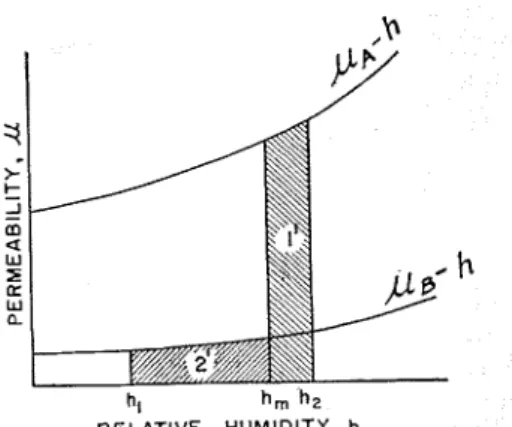
Another method based on perme- ability curves can be used for the isothermal case. Fig. G illustrates a combination of two materials A and B of thickness L1 and L,, respectively. Material A is assumed to be highly
of permeance, or p/L, might be used, Effect of Thickness
in which case the corresponding areas 1 and 2 would be equal, for equal flow rates. Once the appropriate interfacial humidity is knowu, the average permeability and the average permeance of the combination can be calculated.
A reversal of the humidity con- ditions with A exposed to humidity
I L ~ ,
andB
exposed to humidity h,,will normally change the value of h,,,
and the overall average permeability as shown in Fig. 8. The change in jjT
resulting will depend on the relative thickness of the two materials and on the shape of their respective p-h
curves. This effect is common in the
hl hm " 2
R E L A T I V E HUMIDITY, h
Fig. 7-Permeabilities and relative hu- midities for a simple combination of materials
Fig. 6-Simple case of a combination of materials
permeable and
B
less permeable, with their corresponding p-h curves shown in Fig. 7. The ambient humidities areI L ~
and h, and the interfacial hu- midity is h , . The problem is essential- ly one of finding the interfacial hu- midity h, for which the rate of flow will be the same through each of the two-materials. I t follows from Equa- tions 8 and 9 that the area under the permeability curve between appropri- ate limits of relative humidity gives the flow rate through unit area for unit thickness of material. The flow rate for thickness, L, is therefore given by the area divided by L. The inter- facial humidity, h,,,, must therefore be selected so that area 1 of Fig. 7is to area 2 as L, is to L,. Curves
dry-cup testing of coated papers where different results are obtained with different orientation of the test specimen.
The method outlined may be ex- tended to combinations of more than two materials. It does not, however, avoid the need for trial and error in determining the interfacial hu- midity. As in the case of the con- struction of the permeability curve, this operation can be facilitated by employing plots of the integrals of the permeability curves so that the new curves give the areas under the original permeability curves at suc-
The method presented for deter- mination and use of permeability curves is predicated upon an assump- tion not yet stated explicitly, that the permeability coefficient is independ- ent of vapor pressure gradient. Stated in other words the permeabil- ity is assumed to be independent of
he thickness. Babbitt1v"las presented
RELATIVE HUMIDITY, h
Fig. 8-Permeabilities and relative hu- midities for a simple, combination of materais as in Fig. 7, but for the mate- rials in reverse order
experimental evidence in support of this as have Joy et a13.
There is some evidence2 indicating that in certain cases thickness may be a factor.
If
so, this introduces still another complication in the case of homogeneous materials which may be - tested and used in a range of thick- nesses, since a simple correction for thickness callilot then be made. It may well be that such effects are to be found at high humidities, partic,- ularly for thin films o r membranes. Materials which a r e non-homoge- neous as to moisture properties ought always to be dealt with on the basis of permeance, rather than on a unit thickness basis, and should be tested in the thicknesses used. Results may, however, be expressed as average permeabilities so long as it is recog- nized that these apply to certain spe- cific thicknesses or arrangements. cessively higher humidities directly.Effect of a Temperature
The need for repeated measurement
of areas for comparison is thus Gradient
avoided since these can be determined Experimental determination of va- for particular relative humidity limits por flow through a material under from differences in vertical ordinates the combined effects of both vapor to the integral curve. pressure and temperature gradients Heating, Piping & Air Conditioning, March 1956
is exacting and time-consuming. Few such tests have been conducted, and are not particularly revealing as to the influence of a temperature gradi- ent. I n the combined gradient case, the relative humidity is no longer proportional to vapor pressure. It is possible, depending on the tempera- ture gradient, to have the relative humidity increasing, decreasing, or increasing and then decreasing along the flow path through the material.
If permeability is a function only of relative humidity and temperature, the methods presented for the iso- thermal case can be elaborated to deal with the non-isothermal cases. Babbitt, however, attributes the in- crease in permeability with humidity to the increased sorption and to the migration in sorbed layers under a gradient in sorbed moisture. In the isothermal cases the vapor pressure, relative humidity and sorbed mois- ture concentration all decrease in the direction of flow. However, with certain temperature gradient conditions, the relative humidity and,
heref fore, the sorbed moisture con- centration can be made to in- crease in the direction of decreas- ing vapor pressure8. It is thus pos- sible that a vapor diffusion may take place in the direction of decreasing vapor pressure, and be opposed by a film, or by a combined film and capillary migration occurring in the opposite direction.
Edenholm%as proposed that mois- ture migration be expressed in terms of two mechanisms, one a diffusion depending only on vapor pressure, and the other a capillary movement depending on a moisture content gra- dient. He uses separate coefficients for each mechanism, but combines them in one equation. He has further proposed a method by which the co- cfficients may be obtained and com- bined for use in a graphical plot. While liis method contains many ap- ' proximations, it is interesting for it attempts to deal with combined vapor pressure and temperature gradients.
Further experimental investigation of such cases is greatly needed.
Calculation of Flow under Combined Gradients
Calculation of vapor flow under combined temperature and humidity gradients can presently be carried out, using the resistance method, based on the simple flow equation. This is a rational method, so long as the permeabilities are reasonably independent of both temperature and humidity. Briefly, this means that it will best apply to the low-to-moderate range of relative 'humidities for po- rous, non-hygroscopic materials.
There are at present very limited data from which a selection of per- meabilities for design may be made. These are mainly from dry-cup and wet-cup tests and therefore are strict- ly applicable only to isothermal flow cases. Judgment must be used in selecting design values. It may well be that the simple flow equation based only on vapor pressure as the poten- tial causing flow may have to be re- placed by one based on a more in- volved concept of the mechanism o r mechanisms of migration. Until then, it would seem to be best to rely on the simple flow equation, and to use permeability data related as well as possible to the relative humidities in use. The complications of film or capillary migration which may op- pose the main vapor flow must be lelt for further investigation.
Conclusion
Complications in the determination of permeabilities or perrnenrlces wliich have been discussed arise from the use of a simple flow equation. Much of the complexity of the actual func- tional relationship between flow rate, material properties, and specimen en- vironment, is thus thrown into the coefficient. Whether it is possible to develop a new flow equation with constant coefficients to describe the material properties re- mains to be seen. The simple flow equation can in the meantime be used, although with difficulty, if the permeability coefficients can be eval- uated. It will be a forward step if the nature of these coefficients can be generally recognized, as an aid
in stimulating investigation, and pro- moting rational procedures.
The adequacy of a single test of a material at one set of conditions ought not to be taken for granted. Tests ought to be carried out at two different humidity conditions and at two different temperatures to indicate the degree of dependence of perme- ability upon these factors. Whenever possible a series of tests over a range of conditions should be carried out for each material. This is the only way at present by which the perme- ability of a material can be properly evaluated.
Dry-cup tests are relatively simple, although time-consuming. Data from them can be used, by the methods outlined, to establish a permeability curve applicable to the isothermal case. Permeability data over a range ,.
of temperature and humidity are a~7ailable for only a few materials.
A
very great deal of work will be re- quired to cover even the more com- mon materials. Variations i n proper- ties from one sample to another are frequently great and lead to an in- crease in the number of samples to be tested.Research must be carried out to establish more definitely he nature of the dependence of permeability upon temperature, relative humidity, and thickness. It may then be pos- sible to find ways of reducing the amount of testing required for eval- uation of a particular material.
The discussions presented have clealt largely with Row under iso- thermal conditions. There is great need for some method of dealing with the general case of a tempera- ture gradient together with a vapor pressure gradient. This will provide more complications than the isother- mal case, since under a temperature gradient relative humidity and vapor pressure a r e no longer directly pro- portional, and their relationship is different for each new set of tempera- ture conditions. The gradient of con- centration of sorbed moisture which Heating, Piping & Air Conditioning, March 1956 154
sented were obtained from a post- 4. T h e Physics of Condensation in Build-
graduate research project carried out ings, by No. 2, 1952. Nalional Research Council, J. D. Babbitt. (A'. R . C. Bulletin by the senior author. The authors o t t a w a ) .
is largely dependent upon relative humidity may differ in relation to vapor pressure and to the vapor pres- sure gradient from one case to thc next. As a result, the migration of sorbed moisture may for certain con- ditions oppose the vapor flow, where- as in the isothermal case these are more simply related and are always additive.
Acknowledgments
This paper is a contribution from the program of cold weather wall research being carried out co-opera- tively between the University of Sas- katchewan and the Division of Builcl- ing Research, National Research Council. The paper test data pre-
are indebted to
G.
0.
Handegord, officer-ill-charge of the Prairie Re- gional Station of the Division, for his interest and assistance, and to Dr.T.
D. I\lorthwood of the Building Physics Section of the Division, at Ottawa, for the suggcstiorl to usc the integrated permeability curve.References
1. Observations on the Permeability of I-Iygroscopic hlaterials to Water Vapor, by J. D. Babbitt (Canadian .lournal of Re-
search, A, 18, 1940, pp. 105-121).
2. Diflusion I n and T?~roug?r Solids, by R. &f. Barrer ( C a ~ n l ~ r i d g e : Tlie University Press, London, 1951).
3. Water Vapor Transfer through Build- ing Materials, by F. A. Joy, E. R. Queer, and R. E. Schreiner (Bulletin 61, Errgi-
neering E x p e ~ r n e r l l Slnlion, Pennsylvania
State College).
5. T h e Diffusion of Wnter Vapor through Various Building Materials, by J. D. Babbitt. (Canadian Journal of Research, A, 17, 1939, pp. 15-32).
6. Theoretical Investigation of the Effect of Capillary Suction on Transmission of nloisture in Hygroscopic Materials, by C. H. Johansson (Transactions of the Royal
I ~ u t i t u t e o f Technology, M , 20, Stockholm, 1948).
7. Temperature Dependence of Water Vapor Permeability by P. M. Doty, W. H. Aiken a n d H. Mark. (Industrial and Engi-
neering Chemistry 38, No. 8, 1946, pp. 788- 791 )
.
8. Moisture Migration in a Closed Guarded Hot Plate by N. B. Hutcheon and J. A. Pnxton (ASHVE TRANSACTIONS, Vo1. S8, 1952, pp. 301-320).
9. Moisture Movement and hloisture Distribution in the Walls of Buildings. 13. Edenholm. (Meddelanden fran Statens Forsknirrgskornmittee for L a n t n ~ a n n a b ~ g - gnader, No. 5: 53-76, 1945. Also available as Technical Translation TT-361, Nation-
al Repearcl~ Courrcil o f Canada, 1952).
T
HIS publication is being distributed by the Division of Building Research of the Na-
tional Research Council as a contribution towards better building in Canada. It should
"not be reproduced in whole or in part, without permission of the original publisher. The
Division would be glad to be of assistance in obtaining such permission.
Publications of the Division of Building Research may be obtained by mailing the ap-
propriate remittance, (a Bank, Express, or Post Office Money Order or a cheque made
payable at par in Ottawa, to the Receiver General of Canada, credit National Research
Council) to the National Research Council, Ottawa. Stamps are not acceptable.
A
coupon system has been introduced to make paynlents for publications relative1
simple. Coupons are available in denominations of
5, 25,and
50cents, and may
be
o
tained by making a remittance as indicated above. These coupons may be used for the
purchase of all National Research Council publications including specifications of the Ca-
nadian Government Specifications Board.
A list of publications issued by the Division of Building Research can be obtained on application to the Publications Section, Division of Building Research, National Research Council, Ottawa, Canada.
Printed in U.S.A.