Oxidative stress in sperm competition games:
Experimental tests of the soma vs. germline allocation
trade-off in wild House Sparrows Passer domesticus
Thesis dissertation for the title of Ph.D. in Biology
by
Luis Alfonso Rojas Mora
Supervised by
Prof. Dr. Fabrice Helfenstein
External jury Prof. Dr. David Hosken
Dr. Gabrielle Sorci Faculty member Prof. Dr. Jacob Koella
Laboratory of Evolutionary Ecophysiology Institute of Biology
Faculty of Sciences University of Neuchatel Neuchatel, Switzerland
Faculté des sciences Secrétariat-décanat de Faculté Rue Emile-Argand 11 2000 Neuchâtel - Suisse Tél: + 41 (0)32 718 2100 E-mail: [email protected]
Imprimatur pour thèse de doctorat www.unine.ch/sciences
IMPRIMATUR POUR THESE DE DOCTORAT
La Faculté des sciences de l'Université de Neuchâtel autorise l'impression de la présente thèse soutenue parMonsieur Luis Alfonso Rojas Mora
Titre:
“Oxidative stress in sperm competition games:
experimental tests of the soma vs. germline
allocation trade-off in wild house sparrows
Passer domesticus”
sur le rapport des membres du jury composé comme suit:
- Prof. ass. Fabrice Helfenstein, directeur de thèse, Université de Neuchâtel, Suisse
- Prof. Jacob Koella, Université de Neuchâtel, Suisse - Prof. David Hosken, University of Exeter, Royaume-Uni - Dr. Gabriele Sorci, CNRS, Université de Bourgogne, France
Rectorat Fbg du Lac 5a 2000 Neuchâtel Tel +41 32 718 10 20 [email protected]
Pledge of Honour*
I hereby declare that I have read and understood the material explaining plagiarism and the prevention thereof provided by the University of Neuchâtel and that I understand the procedures of accurate citation and bibliographical practice.
I confirm that my paper is the result of my personal research and is solely my own work.
I affirm that any formulation, idea, research, reasoning or analysis borrowed from a third party is correctly and accurately indicated as such, clearly and transparently, and in such a way that the original source is immediately recognisable, in respect of citation techniques and the author’s rights. I am aware that not documenting source material or not citing clearly, correctly and completely constitutes plagiarism.
I am aware that plagiarism is considered a serious offence within the University and that any case of plagiarism can entail administrative sanctions and disciplinary consequences (including expulsion). I have understood that in the case of plagiarism, the file will automatically be transferred to the Rector’s office.
In light of the above, I declare that I have not plagiarised, nor committed any other kind of fraud.
Last name: First name:
Course of study: Faculty:
Place and date: Signature:
**************************************
This form is to be filled in by each student writing a significant paper (especially a Bachelor’s or Master’s thesis) or a Doctoral thesis. It must be included with each paper submitted.
*The text of this form has largely been inspired by the Rector’s office’s directive 0.3 bis Directive de la direction 0.3 bis, entitled Formulaire Code de déontologie en matière d’emprunts, de citations et d’exploitation de sources diverses, of the University of Lausanne, April 23rd 2007, and adapted for the requirements of the University of Neuchâtel.
CONTENTS
SUMMARY 9
GENERAL INTRODUCTION 10
CHAPTER 1:ROLE OF SOCIAL STATUS IN PATTERNS OF ANTIOXIDANT
ALLOCATION INTO SPERM QUALITY 17
CHAPTER 2:RELATION BETWEEN SPERM MORPHOLOGICAL DESIGN AND
FUNCTION 27
CHAPTER 3: ROLE OF SOCIAL STATUS IN PATTERNS OF WITHIN-EJACULATE
VARIATION OF SPERM MORPHOLOGICAL DESIGN 36
CHAPTER 4:TEST FOR THE OXIDATION-BASED PHENOTYPE-LINKED
FERTILITY HYPOTHESIS 45
CHAPTER 5:EFFECTS OF INCREASED OXIDATIVE STRESS IN PATTERNS OF
ANTIOXIDANT ALLOCATION INTO SPERM ACROSS SOCIAL RANKS 55
GENERAL DISCUSSION 67
ACKNOWLEDGEMENTS 71
MATERIALS AND METHODS APPENDIX 72
Summary
Female promiscuity leads to the situation where ejaculates of two or more males compete for the fertilization of the ova. Therefore, the reproductive success of a male largely depends on its ejaculate quality, and thus sperm competition exerts strong selection into traits that maximize the fertilizing ability of an ejaculate. Theory predicts that males should progressively increase resource investment into the production of high quality ejaculates as they incur in higher costs to obtain a mate. Yet, the resources being strategically allocated between somatic vs. germline functions remained to be uncovered. Sperm cells are highly vulnerable to oxidative stress (OS), which is known to impair male fertility. Thus, males being able to better protect their ejaculates from oxidative damage should produce higher quality ejaculates. In species where social dominance determines access to fertile females, the oxidation-based soma vs. germline trade-off predicts that subordinate males would strategically allocate more antioxidant resources into their germline, and thus far best in ejaculate quality. In contrast, dominant males should prioritize the protection of their soma over their germline, and thus produce more oxidized and lower quality ejaculates. I tested these predictions using wild House Sparrows Passer domesticus, a passerine species where male reproductive behaviors are associated to their social dominance. To approach the oxidation-based soma vs. germline predictions I experimentally (1) manipulated males’ social status, (2) increased the amount of oxidative stress, and (3) induced an immune response. For those experiments, I explored how male phenotype (e.g. badge and/or dominance) would correlate to germline traits (e.g. sperm morphology, swimming ability) and to patterns of antioxidant allocation into sperm. I found evidence that males that better protect their ejaculates from oxidative damage produced better quality ejaculates, and thus dominant males produced more oxidized and less motile ejaculates (Chapter 1). For instance, when males face higher levels of oxidative stress, they produce ejaculates that are more oxidized and swim at lower speeds (Chapter 5). Differences in ejaculate quality were not explained by differences in sperm morphology, yet the correlations between sperm morphological design and function across social ranks suggest that ejaculate quality depends on the energetics of the sperm cell (Chapter 2). Further, dominant males also produced ejaculates that have larger morphological variation, suggesting that they invest fewer resources into controlling their ejaculate production (Chapter 3). Remarkably, I showed that males can adjust their ejaculate quality and sperm morphological variation to rapid changes of their social environment (Chapters 1 and 3), and that changes in ejaculate quality are paralleled by changes in antioxidant allocation into the ejaculate (Chapter 3). Further, we did not find evidence that male secondary traits would reflect male fertility, yet it seems to signal the oxidative balance of sperm (Chapter 4). Finally, we observed that males at the lower end of the hierarchy could produce ejaculates similar to those of the dominant males, namely their ejaculates had high levels of morphological variation, high oxidative stress, and low motility (Chapters 1 and 3). We suggest that males at the bottom of the hierarchy cannot invest as much resources as predicted into ejaculate quality without compromising their somatic condition. Thus, when they gain positions within a social hierarchy they proportionally increase ejaculate investment (Chapter 1), and they their ejaculates are the most damaged when males face an oxidative challenge (Chapter 5). Altogether, I suggest that under sperm competition oxidative stress and antioxidant allocation are the physiological mechanism modulating male reproductive tactics.
Keywords: Sperm competition, soma vs. germline, oxidative stress, House sparrow,
General introduction
Organisms maintain a stable physiological balance (e.g. fluids and energy) that is optimized to the biotic and abiotic conditions, and such homeostatic system depends largely on various physiological and behavioural responses that act in concert to face environmental variation. Stress is any perturbation to homeostasis that will require an individual to expend energy into restoring the original homeostatic state, thus maximizing survival (e.g. fight or flight response) (Nelson 2011). While stress in the literature has become a fuzzy term, an alternative model for homeostasis is allostasis – the process on maintaining stability through both behavioural and physiological responses –. The cumulative costs of allostasis are known as allostatic load, which under optimal circumstances the allostatic load does not exceed the energy available in the environment (McEwen and Wingfield 2003). However, when the energetic costs of allostasis either are maintained over time or exceed the energy available in the environment, the individual will shut down non-essential processes in order to maximize survival (e.g. reproduction, growth) (Wingfield et al. 1998, Nelson 2011).
Box 1. Sperm competition
When females copulate with two or more males, sexual selection continues inside the female reproductive tract (Parker 1998, Birkhead and Pizzari 2002). Strong selection is exerted in traits that enhance the fertilizing ability of an ejaculate (e.g. sperm numbers, sperm velocity, sperm longevity, etc.), and the male with the better ejaculate quality will fertilize the ova (Snook 2005, Fitzpatrick and Lüpold 2014). Various mechanisms for sperm competition have been proposed (reviewed by Parker 1998, Parker and Pizzari 2010), however here I will briefly explain two basic mechanisms that can occur in birds: Fair raffle (Parker et al. , Parker 1990)
The fair raffle is the simplest of all mechanisms, where all ejaculates are assumed to have the same fertilizing capacity. Therefore, males gain an advantage by varying the amount of sperm being expended in an ejaculate, and thus sperm
Figure B1. A passive loss raffle where two males
copulate with a female and inseminate the same amount of sperm. At the time of ovulation, the sperm of male 1 has been largely lost, and male 2 has higher sperm number in the female tract. Therefore, male 2 is more likely to fertilize the ova. Adapted from Birkhead and Pizzari (2002)
competes like in a lottery (e.g. the more tickets one gets, the more likely one is to win). In a two males contest, the probability of male-2 to fertilize the eggs is P2 = s2 / (s1 + s2), where s2 is the number of sperm inseminated by male 2. In support of this mechanism, Martin et al. (1974) found that when the ejaculates of genotypes of domestic fowls Gallus domesticus were pooled in different proportions and artificially inseminated, paternities were proportional to the proportion of sperm from each phenotype.
Loaded raffle (Parker et al. , Parker 1990)
The loaded raffle is an extension of the fair raffle. The fertilizing capacity of an ejaculate is not assumed to be equal between males, and thus sperm of one male is more likely to fertilize the ova. Therefore, one male will gain a direct advantage expressed as a loading factor (r), which is added to the fair raffle. Thus, if ejaculates from two males are competing, the probability of male-2 to fertilize the ova is P2 = s2 / (rs2 + s2). A special case for the loaded raffle is the passive loss raffle (Lessells and Birkhead 1990), where sperm is assumed to perish at a constant mortality rate (k) through time (t). Therefore, the loading factor is r=exp(k*t), which reflects a passive loss of sperm through time (Fig. B1). Previous studies in birds had reported that the last male copulating with the female would gain an advantage (Compton et al. 1978, Sims et al. 1987, Birkhead et al. 1989), suggesting that sperm of the last mating male gets stored closer to the ova (e.g. stratification; Lessells and Birkhead 1990). However, such results could be better explained by passive loss of sperm (Birkhead et al. 1995b).
This later scenario is known as the emergency life history state, and it has been argued to be an adaptative response to challenging environments (Wingfield et al. 1998).
An unavoidable departure from homeostasis is oxidative stress. Reactive oxygen species (ROS) are metabolic by-products that cause random cellular damage, which leads to cell death, ageing, degenerative diseases, or impaired cellular pathways (reviewed in Finkel and Holbrook 2000). Although ROS are needed to control and promote physiological processes (e.g. ATP production, immune response, etc.; Finkel and Holbrook 2000), in many instances antioxidants cannot quench all the ROS and further ROS-induced damage is known as oxidative stress (OS) (Jones 2006). Importantly, regular metabolic processes (Finkel and Holbrook 2000, Zitzmann et al. 2003, Hulbert et al. 2007), immune response (Bedard and Krause 2007, Sorci and Faivre 2009), and pollutants (Banerjee et al. 2001, Li et al. 2003) are unavoidable factors that are responsible for OS generation. Given that all organisms are subject to attacks by ROS, oxidative stress is hypothesized to be a main constraint to life history evolution (Dowling and Simmons 2009, Monaghan et al. 2009, Metcalfe and Alonso-Alvarez 2010).
Reproduction is costly and physiologically demanding (Reznick 1985, Speakman 2008), and as a consequence the costs of reproduction are usually traded-off with other life history traits. For example, increased investment in immediate reproduction is traded-off against survival and thus future reproduction (Stearns 1989). Increasing
Box 1. Sperm competition (continued) This doctoral thesis was developed under a recent mathematical model that assumes the situation where males have a resource budget R that can be allocated to either finding mates (c) or producing sperm (s). Thus, a male playing a strategy s is expected to have a number of mates n(s) = R / (s + c), and the fitness of such individual will depend on its reproductive success 𝑣(𝑠, ŝ) per mating. A main assumption of this model is that 𝑣(𝑠, ŝ) follows a fair raffle, and therefore the reproductive success of a male mated with a female that copulate with other k males playing a strategy ŝ is proportional to the amount of resources s that are invested into producing
Figure B2. Evolutionary stable strategies of resource
allocation into sperm s(c) (solid line) and expected number of mates n(c) (dashed line) for males paying different costs c to obtain a mate. Taken and modified from Tazzyman et al. (2009).
sperm, 𝑠 / 𝑠 + 𝑘𝑠̂. Further, the probability that the female copulates with other k males (pk) is
assumed to follow a Poisson distribution, 𝑛!!𝑒!!!/ 𝑘!. Therefore, the reproductive success of a male
playing a strategy s will be
𝑣(𝑠, ŝ) = ! 𝑝!
𝑠 (𝑠 + 𝑘𝑠̂)
!
!!!
Finally, in a population where males have a 𝑛! expected number of mates and a 𝑠̂ ejaculate investment, the fitness (W) of a male having a resource budge R, mating costs c, and a ejaculate investment invest 𝑠(𝑅, 𝑐) will be:
𝑊(𝑅, 𝑠, 𝑐|𝑠̂, 𝑛!) = 𝑅 (𝑠 + 𝑐)! 𝑝! 𝑠 (𝑠 + 𝑘𝑠̂) ! !!!
If the model is iterated for resources, allocation into sperm production remains unchanged (Tazzyman et al. 2009). However, if the costs 𝑐 to obtain a mate continuously vary, males are predicted to invest more resources into sperm production as the costs 𝑐 increase (Fig. B2). Such predictions are similar to those of a more recent model (Parker et al. 2013). In species where continuous phenotypic variation is correlated to reproductive success (e.g. dominance), these models could be used to predict the potential physiological mechanisms involved in the trade-off between somatic and reproductive investment (further discussed in Parker and Pizzari 2010).
number of studies show that oxidative stress might be an important cost of reproduction. For example, egg production in fruit flies Drosophila melanogaster was stimulated by supplementing females with extra nutrients (Wang et al. 2001), hormones (Salmon et al. 2001), or mate availability (Rush et al. 2007), and such females producing more eggs were more prone to OS compared to control females. Further evidence that oxidative stress is a resulting cost of reproduction comes from studies in zebra finches Taenopygia guttata (Alonso-Alvarez et al. 2004, Alonso-Alvarez et al. 2006, Bertrand et al. 2006). For instance, Alonso-Alvarez et al. (2004) experimentally increased brood size to manipulate reproductive effort, and they found that males in charge of large broods had reduced body mass and higher vulnerability to oxidative damage. Further, in zebra finches the number of breeding events (Alonso-Alvarez et al. 2006) and number of laid eggs (Bertrand et al. 2006) is negatively correlated to the antioxidant capacity of the breeding pairs, and such correlation disappear when breeding pairs are supplemented with antioxidants (Bertrand et al. 2006). Thus, OS might represent a major constrain when sexual selection occurs, and thus male reproductive strategies might be modulated in part by the OS costs in which they incur in.
One important way through which OS constrain male reproductive strategies is the deleterious effects of OS on male fertility. Sperm cells contain a large amount of polyunsaturated fatty acids (PUFA) on their membrane, and the presence of PUFA has been shown to enhance ejaculate traits (reviewed by Wathes et al. 2007). For example, in boars it has been shown that dietary PUFA supplementation results in a higher amount of such fatty acids in sperm, which in turns enhance sperm mobility and velocity (Mitre et al. 2004). However, PUFA can be easily oxidized by ROS (reviewed by Hulbert et al. 2007), and lipid peroxidation largely affects the integrity of sperm membranes (Aitken 1999, Aitken and Baker 2004). Oxidative damage on sperm membranes can cause impaired cell-egg interactions, reduced motility, or cell death (Aitken 1999, Aitken and Baker 2006, Tremellen 2008). Additionally, ROS can also attack DNA causing changes in chromosome arrangements, histones modifications, deletions, base modifications, or changing methylation patterns (Lloyd et al. 1997, Kemal Duru et al. 2000, Wellejus et al. 2000, Aitken and Krausz 2001, Zitzmann et al. 2003), and sperm DNA is easily attacked by ROS leading to male infertility (Aitken 1999). For example, oxidative damage on sperm DNA can cause deleterious mutations that can affect embryo development or reduce offspring fitness (i.e. 8-oxo guanine is ROS-caused based modification that leads to infertility in sons of smokers, Zitzmann et al. 2003). Hence, oxidative damage has been proposed as one important cause of infertility (Aitken 1999, Tremellen 2008), and might be a major constraint to male fitness.
In species where females copulate with several males, sperm of two or more male compete for the fertilization of the ova (Box 1 for some of the mechanisms involved in sperm competition). Under sperm competition, variation in both male’s ability to monopolize females and the fertilizing ability of their ejaculate determines their reproductive success (Birkhead and Pizzari 2002), and strong selection acts upon traits that maximize ejaculate quality (Snook 2005, Simmons and Fitzpatrick 2012, Fitzpatrick and Lüpold 2014). Both sperm speed and viability have been shown to give a fertilizing advantage under sperm competition in different taxa (for reviews see Snook 2005, Fitzpatrick and Lüpold 2014). In the Atlantic Salmon (Salmo salar) it has been found that faster swimming sperm gets a larger share of the paternities when competing with a slower ejaculate (Gage et al. 2004), while in insects male variation in sperm viability explains variation in paternity share under sperm competition (Garcı́a-González and Simmons 2005). Interestingly, those traits that confer a higher fertilizing
ability to an ejaculate are also traits that can be affected by oxidative stress and/or antioxidant availability (in the rainbow trout Ciereszko and Dabrowski 1995, e.g. in rats Chitra et al. 2003, in birds Helfenstein et al. 2010a). For example, Helfenstein et al. (2010a) observed on male great tits (Parus major) that ejaculates with lower initial speeds were more oxidized. Also, they reported that individuals who underwent through reproductive stress and received carotenoids supplementation had an enhanced proportion of motile sperm in their ejaculate. However, on a following study Losdat et al. (2011) did not find any effect of carotenoid supplementation on sperm quality, though they argue that carotenoids could have been used to increase the antioxidant potential in the soma. Therefore oxidative stress can be hypothesized as a strong constraint on sperm competition games. Further, females might gain both direct and indirect benefits from avoiding males that might have oxidatively damaged sperm (Blount et al. 2001, Velando et al. 2008). For the above-mentioned reasons, I hypothesized that males being able to better protect their ejaculates from oxidative stress will enjoy of better ejaculate quality, and thus be more likely to outcompete other males in sperm competition.
In species where social dominance determines the access to fertile females, theory predicts a negative correlation between male’s ability to monopolize resources and ejaculate quality (Parker 1998, Parker and Pizzari 2010). Indeed, the predictions of those models have been previously observed in various taxa (Preston et al. 2001, Rudolfsen et al. 2006, Cornwallis and Birkhead 2007, Thomas and Simmons 2009, Evans 2010, Lemaître et al. 2012). For example, in the Arctic charr (Salvelinus alpinus) dominant males produce slower swimming sperm that subordinate males (Rudolfsen et al. 2006), and in feral fowls subordinate males have ejaculates with higher viability (Froman et al. 2002). However and importantly, the physiological proximate mechanisms modulating ejaculate quality are yet to be uncovered. Two recent theoretical models proposed that as the costs to get a mate increase, males are expected to continuously invest more resources in their ejaculate (Box 1) (Tazzyman et al. 2009, Parker et al. 2013). Thus, if continuous male phenotypic variation correlates to variation in access to fertile females, males with the lowest access to females – the typical case of a subordinate male - are expected to increase resource investment into their germline at the expense of their soma (e.g. soma vs. germline trade-off). If males being able to better protect their ejaculates from oxidative stress will enjoy better ejaculate quality, then one could predict that males could vary how much antioxidant resources they would invest into somatic vs. germline functioning (e.g. oxidation-based soma vs. germline trade-off). Therefore, dominant males would be expected to disproportionally invest their antioxidant resources to the somatic rather than the germ-line functioning, and thus maintain their body condition and social status. In contrast, subordinate males should invest more antioxidant resources to the germ-line to increase the competitiveness of their ejaculate.
In this doctoral thesis I tested the predictions of the oxidation-based soma vs. germline trade-off in House Sparrows (Passer domesticus), a socially monogamous bird species where females mate with a single male in a reproductive season. In house sparrows around one quarter of the unhatched eggs are due to infertility (Birkhead et al. 1995a). Theory predicts that in socially monogamous species females that engage into extra-pair copulations would benefit form higher fertility rates – even if they know the fertility of their partner – (Hasson and Stone 2009), and for instance promiscuity in this species leads to extra-pair paternity rates ranging from 12-14% (Møller 1987a, Wetton and Parkin 1991, Møller and Birkhead 1994, Wetton et al. 1995). House sparrow males and females have a hierarchical social system (Anderson 2006), where male dominance
correlates to variation in copulation rates (Møller 1988, 1990, 1992, Riters et al. 2004), mate guarding rates (Møller 1990, Anderson 2006), and - for some populations - extra-pair paternity (Václav et al. 2002). Female house sparrows get involved in both forced and non-forced extra-pair copulations (Møller 1987a), but females mated to more dominant males are less likely to be forced into an extra-pair copulation (Møller 1987a, Møller 1992). Thus, while dominant males are able to better avoid sperm competition in their social mate, subordinates are likely facing a higher risk of sperm competition due to their inability to keep other males from copulating with their social partner. For the above-mentioned reasons, house sparrows provide a great animal model to test the predictions from the oxidation-based soma vs. germline hypothesis, and thus I conducted three field experiments with wild-caught House Sparrows housed in outdoor aviaries.
First, I manipulated the social status to test the role of the social environment on sperm quality and antioxidant allocation. Phenotypic plasticity allows individuals to modify traits in other to maximize fitness under different environmental circumstances (Via et al. 1995). Therefore, if ejaculate quality determines the reproductive success of a male under sperm competition (as reviewed above), then it would be expected that males would flexibly respond to changes in their risk of sperm competition by adapting their ejaculate quality. For example, previous studies in birds have shown that males adjust their sperm morphology and ejaculate quality to match changes in the social environment (Cornwallis and Birkhead 2007, Immler et al. 2010), and thus I explored how changes in antioxidant allocation could modulate plastic responses of sperm quality to a changing social environment. In a second experiment, I experimentally manipulated the oxidative balance of males by giving them a potent pro-oxidant. For instance, it has been observed that both the quality and the oxidative balance of an ejaculate are affected by exposure to pro-oxidants (Chitra et al. 2003, Lacoume et al. 2009, Wang et al. 2009, Abarikwu et al. 2010), and thus I explored how induced pro-oxidant production could change patterns of antipro-oxidant allocation into the germ-line functions given the social status of an individual. In a third experiment, I experimentally challenged the immune system by causing a controlled parasite infection (results not included in this document). The immune response is known for causing oxidative stress insults (Bedard and Krause 2007, Costantini and Møller 2009, Sorci and Faivre 2009), giving a perfect natural frame to test whether males would adjust antioxidant allocation into germ-line functions given their social ranks and the oxidative-related costs of the immune response. Finally, ejaculate quality can involve a multidimensional set of traits, including both functional (e.g. motility and swimming speed) and morphological features of sperm (Snook 2005, Fitzpatrick and Lüpold 2014). Therefore, for all of the above-mentioned experiments I explored both traits of ejaculate and morphology, and correlated them to either the social status of an individual or its oxidative balance. Further, the oxidative balance integrates several types of antioxidant defenses and oxidative damage to several molecules (Box 2) (Cohen and McGraw 2009, Monaghan et al. 2009). So, for my doctoral thesis I used markers that would represent both changes in the antioxidant capacity of an individual as well as the oxidative damaged caused to cell membranes in both somatic and germ-line tissues (further details in Box 2). Here in I present evidence that when males face different levels of sperm risks, their reproductive strategies are likely mediated by strategic antioxidant into germline functioning.
Box 2. How to measure oxidative stress
Figure B3. Scenarios for different levels of both antioxidants and proxidants that can lead to low levels of oxidative damage (gray), high levels of oxidative damage (black), or no oxidative damage (white). For further information refer to the text. Taken and adapted from Costantini and Verhulst (2009).
Oxidative stress is the result of an unbalance between antioxidants and prooxidants, in favor of the latest (Jones 2006). However, the oxidative balance is characterised by a multidimensional system integrating several lines of antioxidant defences and oxidative damage to various biomolecules (Cohen and McGraw 2009, Monaghan et al. 2009). Therefore, when evolutionary ecologists use oxidative stress to understand the physiological trade-off of life history traits, it is challenging to distinguish between shifts in antioxidant capacity and oxidative damage (Costantini and Verhulst 2009, Hõrak and Cohen 2010). For instance, Costantini and Verhulst (2009) illustrated several scenarios where the oxidative balance can change leading to different outcomes of oxidative damage and antioxidant capacity (Fig. B3), which I will briefly summarize bellow (for further details and examples refer to Costantini and Verhulst (2009)).
If two individuals A and B do not differ in their production of pro-oxidants, one could conclude that they should bear the same levels of oxidative damage. However, if they differ in their antioxidant capacities, the individual with the lowest antioxidant capacity will suffer the most oxidative damage (Fig. B3 A). However, individuals can overexpress antioxidants in response to an elevated production of pro-oxidants, and yet have lower levels of oxidative damage compare to individuals that produce less pro-oxidants (Fig. B3 B). Thus, individuals can adjust their antioxidant expression in order to match the pro-levels, and differences in either antioxidant capacity or production of pro-oxidants are not necessarily reflected in oxidative damage (Fig. B3 C). However, individuals can suffer higher oxidative damage because the antioxidant response is not sufficient to maintain a low level of oxidative damage (Fig. B3 D). Now, if A and B have the same antioxidant capacity, they might suffer different levels of oxidative damage if their pro-oxidant levels differ (Fig. B3 E). Finally, B can have lower oxidative damage, and yet have higher antioxidant capacity than A (Fig. B3 F).
As evidenced above, it is important to select a battery of biomarkers that represent can provide a general overview of the changes in oxidative balance of an individual. Yet, further methodological problems have been identified with the assessment of oxidative stress markers (for reviews, see Dalle-Donne et al. 2006, Hermans et al. 2007, Knasmüller et al. 2008), and any results coming from unreliable methodologies are difficult to interpret. Therefore, a rigorous set of criteria should be considered when choosing the biomarkers of oxidative stress (Dalle-Donne et al. 2006, Hermans et al. 2007, Hõrak and Cohen 2010):
1. The assay for the biomarker should represent the in vivo function of the target molecule: Several assays recreate oxidative environments to measure the peroxidability of a substrate, however they do not represent the same oxidative environments found in vivo. Thus, results from such assays are hard to interpret, because the substrate might have different susceptibilities to various potential pro-oxidants (Halliwell and Gutteridge 2007). Among such assays, the most popular one is the total antioxidant capacity assay (TAC), which measures in vitro the ability of a tissue to quench a set of pro-oxidants in a solution.
Box 2. How to measure oxidative stress (continued)
2. The biomarker should be stable: Several biomarkers of the oxidative balance are prone to collection and assay conditions (e.g. glutathione oxidation during sample preparation, Rossi et al. 2006). However, this can be easily controlled with if sample repeatability is estimated. Further, some assays can result in an artefactual formation of the target molecule, thus making the results of such assays unreliable. For example, the thiobarbituric acid-reacting (TBARS) assay estimates the levels of MDA by its derivatization with thiobarbituric acid (TBA). However, TBA is also known to react with other compounds like amino acids and sugars (Meagher and Fitzgerald 2000, Abuja and Albertini 2001), thus making any result derived from the TBARS assays unreliable.
3. Validation of the method: When validating an assay, it is important to consider its repeatability, sensitivity, and specificity. If any known confounding factors might affect the assay, they should be considered during the laboratory analyses and/or sample collection. Therefore, samples should be ideally done in duplicate to estimate either repeatability or coefficients of variance. However, if sample volumes are not sufficient, a previous validation of the method using aliquots of samples is essential.
4. Sample collection should not interfere with the normal life of the individuals: The samples taken from animals should adhere to a well practice of animal welfare, which in some cases it means that the biological sample volumes will result small for the implementation of popular laboratory kits for biomarker determination. For example, when repeated sampling on an individual is required, changes in the oxidative balance could be result from either physiological stress (Costantini et al. 2011) or inflammatory responses (Costantini and Møller 2009) coming from any harm caused during the previous sampling session.
5. Not confounded by diet: Several biomarkers of oxidative stress could be ingested and absorbed, thus the diet of the individual could bias any measurement of oxidative stress. For example, aldehydes and lipid hydroperoxides can be absorbed from diet, and thus measurements of MDA could be confounded (Draper et al. 2000, Wilson et al. 2002). However, in experiments where individuals are fed a standardized diet, this is a minor confounding factor (Dalle-Donne et al. 2006, Hõrak and Cohen 2010).
For the above mentioned reasons, in this doctoral thesis I chose to describe the oxidative balance of different either somatic or reproductive tissues through (1) MDA as a marker of oxidative damage, i.e. the levels of end-products of lipid peroxidation, (2) a marker of cellular oxidative stress, i.e. the ratio of oxidized over reduced glutathione, and (3) the activity of the antioxidant enzyme SOD, i.e. an endogenous antioxidant that catalyzes the dismutation of superoxide anions into molecular oxygen or hydrogen peroxide.
Chapter 1
Role of social status in patterns of antioxidant
allocation into sperm quality
Antioxidant allocation modulates ejaculate quality
across changing social environments
Alfonso Rojas Mora1*,Magali Meniri1, Sabrina Ciprietti1, Ophélie Gning1, Gaëtan Glauser2, Armelle Vallat2 & Fabrice Helfenstein1†
1Laboratory of Evolutionary Ecophysiology, Institute of Biology, Faculty of Sciences, University of Neuchâtel, Neuchâtel, Switzerland
2Neuchatel Platform of Analytical Chemistry, Institute of Chemistry, Faculty of Sciences, University of Neuchâtel, Neuchâtel, Switzerland
Abstract
In promiscuous species the sperm of several males compete for fertilization, and the fertilizing ability of an ejaculate, i.e. ejaculate quality, determines males’ reproductive success. Theory predicts males to progressively increase resource investment into ejaculate quality as they have lesser access to females. Sperm cells are highly vulnerable to oxidative stress (OS), which impairs male fertility. Since social dominance is a major determinant of mating opportunity, we predict that subordinate males should be faring best by investing more antioxidants in their ejaculates. We tested this hypothesis in House Sparrows and found that ejaculate quality correlates with OS level in sperm, while dominant males produce more oxidized and lower quality ejaculates. After experimentally manipulating the social environment, males matched their ejaculate quality to their new rank, while increases in antioxidant investment into ejaculates paralleled increases in ejaculate quality. Our results highlight OS and strategic antioxidant allocation as the proximate physiological mechanism underlying ejaculate quality and male reproductive tactics.
Keywords: Sperm competition, social dominance, oxidative stress, antioxidant
allocation, soma vs. germ-line, ejaculate plasticity
Introduction
Under sperm competition risk, ejaculate quality determines the fertilizing ability and the reproductive success of a male (Birkhead and Pizzari 2002, Parker and Pizzari 2010). Thus, selection acts upon various ejaculate traits (e.g. velocity, proportion of motile sperm, ATP production, etc.) to maximize the fertilizing ability of the ejaculate, generally referred to as ejaculate quality (Snook 2005, Simmons and Fitzpatrick 2012, Fitzpatrick and Lüpold 2014). Several theoretical models have explored how much males in different social roles are selected to invest into post-copulatory traits, i.e. ejaculate quality and competitiveness (Parker 1998, Parker and Pizzari 2010). The predictions of those models have been tested in several taxa (Preston et al. 2001, Rudolfsen et al. 2006, Cornwallis and Birkhead 2007, Thomas and Simmons 2009, Evans 2010, Lemaître et al. 2012), though only discrete social roles have been tested (e.g. favoured vs. disfavoured). A recent model predicts that continuously increasing costs to obtain a mate should select for progressive increases of resource investment in the ejaculate (Tazzyman et al. 2009), resulting in a continuous trade-off between
*
Correspondence to ARM e-mail: [email protected].
†
somatic vs. germ-line functioning. Some evidence exists in support to this model, such as Engqvist’s (2011) finding of a negative genetic co-variation between attractiveness and mating investment in the scorpionfly (Panorpa cognata). Remarkably, although several studies have investigated the potential outcomes of a soma vs. germ-line allocation trade-off, the actual resources to be strategically allocated to the germ-line are yet to be identified.
Oxidative stress (OS) is the unbalance between pro-oxidants and antioxidants (Finkel and Holbrook 2000), and has been hypothesized to be a major cost of reproduction (Wang et al. 2001, Alonso-Alvarez et al. 2004). Sperm cells are especially prone to OS (Aitken 1999), and OS has been shown to be deleterious to sperm (Jones et al. 1978, Kemal Duru et al. 2000, Chitra et al. 2003, Tremellen 2008, Ribou and Reinhardt 2012). Various studies have shown that ejaculate quality correlates with the level of oxidative stress in the ejaculate (Chitra et al. 2003, Helfenstein et al. 2010a, Losdat et al. 2011), while antioxidant supplementation seems to improve ejaculate quality (Ciereszko and Dabrowski 1995, El-Demerdash et al. 2004, Ateşşahin et al. 2006, Almbro et al. 2011). Consequently, OS has been identified as an important cause of male infertility (Aitken 1999, Aitken and Baker 2004, Tremellen 2008), and may thus act as a selective pressure in shaping various sperm traits. For example, a comparative analysis has shown that across mammals the amount of polyunsaturated fatty acids, which make sperm membranes prone to OS (Hulbert et al. 2007), negatively correlates with the species level of sperm competition (delBarco-Trillo and Roldan 2014). Here, we propose that antioxidants are the resource being traded-off between somatic vs. germ-line functions, and hence strategic antioxidant allocation in the ejaculate should modulate ejaculate quality.
In species where dominance determines access to fertile females we predict that sperm quality positively correlates with antioxidant allocation in the ejaculate, while OS should be negatively correlated with sperm quality. We further predict that males occupying lower social ranks should invest more antioxidant resources to the production of higher quality ejaculates. In contrast, more dominant males should invest less antioxidant resources, and thus produce more oxidatively stressed and lower quality ejaculates. We tested the above predictions in wild House Sparrows (Passer domesticus), a socially monogamous passerine bird that forms social hierarchies, where more dominant males have greater access to fertile females (Anderson 2006). We tested our predictions by maintaining 15 groups of four males and four females for four weeks in outdoor aviaries. In order to test whether patterns of antioxidant allocation to the ejaculate were causally related to a males’ social dominance, we then experimentally changed the social rank of males by shuffling them across groups and aviaries to test whether changes in antioxidant allocation would match adjustments of ejaculate quality.
Materials and Methods
The experiment
We trapped a total of 60 male and 60 female House Sparrows using mist-nets in western Switzerland in April 2014. After trapping, we measured body mass and tarsus length prior to transferring birds into 15 mixed outdoor aviaries at the Ethological Station Hasli, University of Bern, Switzerland. In House Sparrows, courtship displays, solicitations by females, and copulation rates vary among males in different social ranks (Møller 1988, 1990, 1992, Riters et al. 2004), and thus any differences in ejaculate quality may result from sperm depletion (Preston et al. 2001) or fresh sperm effects ((Siva-Jothy 2000, Pizzari et al. 2008a), but see (Firman et al. 2015)). Hence, after four
weeks of acclimatization we transferred all females into a separate aviary during four days. On the day when females were removed, we took a blood and a sperm sample from each male, followed by a second sperm sample the day after and a third sperm sample after four days of being sexually rested. This procedure allowed us to ensure that any difference in ejaculate quality is the result of intrinsic male characteristics. Then, males were shuffled across groups and aviaries according to their current status, in a way that optimized the expected number of males moving up and down the hierarchy, and females were re-introduced in their initial aviaries. After an 18-day period allowing males to settle down into a new hierarchy and cover at least one full spermatogenesis cycle (Jones and Lin 1993), females were released into their localities of origin. On the day females were released, blood and sperm samples were taken from males, and further sperm samples were taken on the second and the fourth day after female release. Then, all males were also released in their localities of origin.
To establish the hierarchy of the males in each aviary, we recorded a total of 13 hours of observations before the manipulation and 10 hours after the manipulation in each aviary. We removed the feeders for 1.5 hours, and then recorded all the antagonistic interactions at the feeders for one hour after reintroducing the feeders into the aviaries. Within each aviary, we computed each male's David's score as a proxy for their social rank (Gammell et al. 2003).
Ejaculate quality
We obtained ejaculates by massaging male’s cloaca, and we immediately video recorded sperm using a camera mounted on a microscope at 100X magnification. A subsample of the ejaculate was diluted in PBS and stored at -80º C for laboratory analyses. From the videos we estimated standard ejaculate quality traits using a Computer Assisted Sperm Analyser plug-in (Wilson-Leedy and Ingermann 2007) for ImageJ (Schneider et al. 2012). We modelled the rate at which initial speed decreases through time (from now on endurance) as well as the rate at which initial proportion of swimming sperm decreases through time (from now on longevity) using mixed linear models with time as a fixed effect and individual identity as a random factor. For further details, refer to the Materials and Methods Appendix.
Oxidative stress and antioxidant defences
We assessed the amount of lipid peroxidation by determining the levels of malondialdehyde (MDA) in plasma, red blood cells (RBCs), and sperm. MDA levels were determined by derivatisation with thiobarbituric acid and further separation by ultra-high pressure liquid chromatography (UHPLC) with fluorescent detection (Agarwal and Chase 2002, Moselhy et al. 2013). We also measured superoxide dismutase (SOD) activity per ml of tissue in sperm and RBCs applying minor modifications to a commercial kit (Cayman Chemical, USA). Finally, we determined the levels of glutathione, an intracellular antioxidant in both its reduced (GSH) and oxidized (GSSG) forms both in sperm and RBCs using UHPLC-MS/MS (Bouligand et al. 2006). More details are available in the Materials and Methods Appendix.
Statistical analyses
For the above-mentioned reasons, the data used for all the analyses corresponds to the last sampling, where males were sexually rested and previously sperm depleted. We used linear mixed models to test our hypotheses. We first predicted that ejaculate quality and antioxidant allocation would vary according to social ranks. In a first set of statistical models we investigated ejaculate quality and OS markers as a function of the initial social rank, including body weight and tarsus length as covariates. The dependent
variables describing sperm quality were the proportion of motile sperm, initial swimming speed, sperm longevity and sperm swimming endurance. The dependent variables describing antioxidant allocation and oxidative stress were the ratio of oxidized glutathione [GSSG/(GSSG+GSH), used as a measure of the oxidative stress endured by the cells in sperm and RBCs], SOD activity in sperm and RBCs, the proportion of SOD activity in the sperm relative to the total SOD activity in sperm and RBCs [SODsperm /(SODsperm + RBC)], used as a measure of relative SOD investment into spermatic vs. somatic functions, MDA levels in the sperm and plasma, and the proportion of MDA in the sperm relative to the total level of MDA in sperm and plasma [MDAsperm/(MDAsperm + plasma)], used as a measure of relative oxidative stress in the sperm vs. soma.
Second, we predicted that males would adjust sperm quality and antioxidant allocation in accordance to an experimental change in their social status. To test such hypothesis, we ran a set of models that used the same set of dependent variables as mentioned above, but measured after the experimental manipulation of the social ranks. The tested factors were the initial social rank, the final social rank and their interaction, as well as final body mass and tarsus length as covariates.
Proportions were either logit- or arcsin-transformed when necessary, while other dependent variables were log-transformed to match normality. All the models included the aviary and the batch of males as random factors, using the restricted maximum likelihood method for parameter estimation, and Kenward-Roger approximation for the computation of fixed effects degrees of freedom. To avoid inflating the type I error (Whittingham et al. 2006), we did not apply model selection, and therefore always report results for full models. The analyses were performed using SAS v. 9.3.
Results
Ejaculate quality
Before experimentally manipulating the hierarchy
We could not collect any ejaculate from one male having a very small cloacal protuberance, thus we obtained a total of 59 ejaculates. We found that ejaculates
0.149 0.218 0.286 0.352 0.417 0.479 Social Rank
Proportion of Motile Sperm ( )
Subordinate 3 Subordinate 2 Subordinate 1 Dominant
0.644 0.703 0.758 0.807 0.852 0.891 GSSG / GSH + GSSG in Sperm ( )
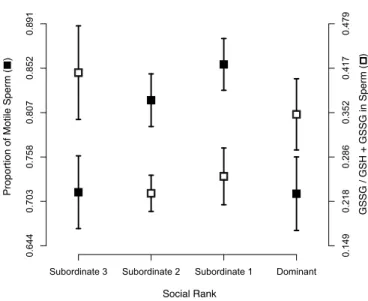
Figure 1. Mean proportion of motile sperm ± SE ( ) and proportion of oxidized over total glutathione
(GSSG / GSH + GSSG) in sperm ± SE ( ) of males with different social status. Ejaculates with higher motility have lower proportions of GSSG, while the greater the proportion of GSSG (e.g. the more oxidatively stressed the sperm cells) the less motile the ejaculate is. The axes for proportion of motile sperm and GSSG / GSH + GSSG in sperm are arcsine scaled.
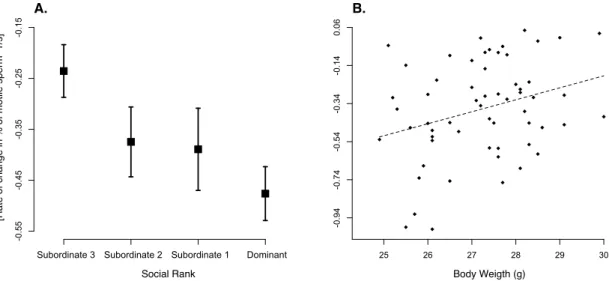
produced by males with different social ranks differed in their initial proportion of motile sperm (Fig. 1; F3,40.5 = 4.44, p = 0.009), with subordinate males 1 and 2 producing ejaculates with a greater proportion of motile sperm than dominant and subordinate 3 males (pairwise difference between groups: D vs. S1: t40.4 = 2.99, p = 0.005; D vs. S2: t41.8 = 2.32, p = 0.025; D vs. S3: t40.6 = 0.28, p = 0.78; S1 vs. S2: t40.6 = 0.58, p = 0.57; S1 vs. S3: t40.2 = 2.81, p = 0.008; S2 vs. S3: t39.7 = 2.23, p = 0.032). Additionally, we found that sperm longevity also covaried with social rank (Fig. 2A; F3,41 = 2.98, p = 0.042), while heavier males produced longer-living sperm (Fig. 2B; F1,49.4 = 7.30, p = 0.009, slope = 0.074 ± 0.026). More specifically, we found that subordinate 3 males had longer living sperm compared to that of dominant males (pairwise difference between groups: D vs. S1: t22.7 = 0.90, p = 0.38; D vs. S2: t26.3 = 1.17, p = 0.25; D vs. S3: t28.0 = 3.26, p = 0.003; S1 vs. S2: t26.0 = 0.14, p = 0.89; S1 vs. S3: t22.4 = 1.60, p = 0.12; S2 vs. S3: t26.0 = 1.62, p = 0.12). Finally, we did not find any differences in initial sperm swimming speed (all factors and covariates F ≤ 2.91, p ≥ 0.094) and endurance (all factors and covariates F ≤ 0.85, p ≥ 0.36) across males with different social ranks.
After experimentally manipulating the hierarchy
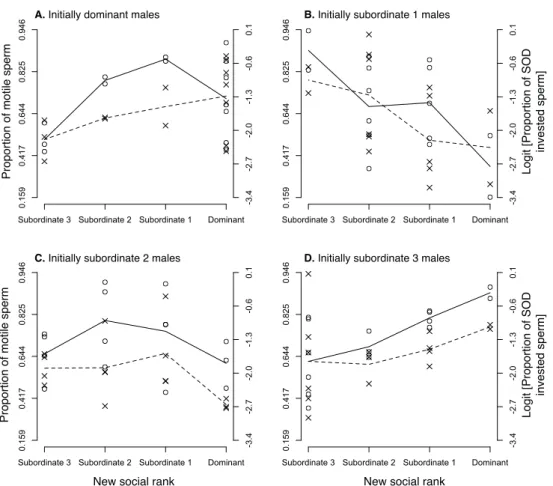
After having experimentally changed the social rank of males, we could only obtain ejaculates from 59 males. We found that the proportion of motile sperm differed among males in their new social ranks, and this depended on their initial social rank (Fig. 3A-D; F9,41 = 2.59, p = 0.018). More specifically, we found the same bell-shaped patterns for dominant and subordinate-2 males (Fig. 3A, and C), while subordinate-1 males increased or decreased the proportion of motile sperm fully matching Tazzyman’s et al. (Tazzyman et al. 2009) predictions (Fig. 3B). Finally, males at the bottom of the hierarchy seemed to consistently increase ejaculate quality as they gained social ranks (Fig. 3D). Initial swimming speed, sperm longevity and sperm swimming endurance were neither affected by the final rank nor the interaction between the initial and final rank (swimming speed: all factors and covariates F ≤ 2.23, p ≥ 0.10; sperm longevity all factors and covariates F ≤ 3.70, p ≥ 0.063; sperm swimming endurance: all factors and covariates F ≤ 1.50, p ≥ 0.23).
Social Rank
Ejaculate Longevity
[Rate of change in % of motile sperm 1/s]
Subordinate 3 Subordinate 2 Subordinate 1 Dominant
-0.55 -0.45 -0.35 -0.25 -0.15 Body Weigth (g) 25 26 27 28 29 30 -0.94 -0.74 -0.54 -0.34 -0.14 0.06 A. B.
Figure 2. Sperm longevity expressed as the rate of decay in motile sperm (A) differs between males at
different social status (mean ± SE), (B) while heavier males have longer living sperm (F1,49.4 = 7.30, p = 0.009, slope = 0.074 ± 0.026). The dotted line represents a linear regression.
Oxidative stress and antioxidant allocation
Before experimentally manipulating the hierarchy
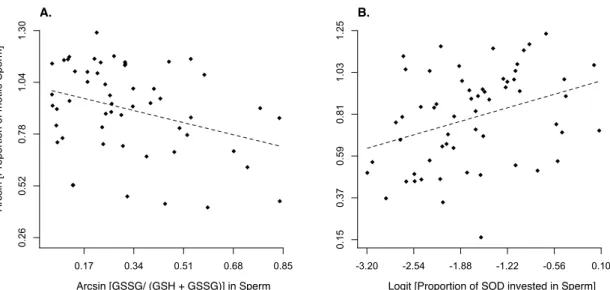
We found that the ratio of oxidized over total concentration of glutathione in the ejaculate varied according to social rank (Fig. 1; F3,48 = 3.85, p = 0.015), with dominant and subordinate 3 males having more oxidatively stressed sperm cells (pairwise difference between groups: D vs. S1: t25.4 = 1.36, p = 0.18; D vs. S2: t20.6 = 1.98, p = 0.061; D vs. S3: t23.2 = -0.71, p = 0.48; S1 vs. S2: t20.4 = 0.50, p = 0.62; S1 vs. S3: t19.8 = -1.89, p = 0.073; S2 vs. S3: t15.5 = -2.40, p = 0.029). Moreover, we found that the higher the ratio of oxidized over total concentration of glutathione in the sperm (the more oxidized the sperm cells) the lower the proportion of motile sperm in the ejaculate (Fig. 4A; F1,42.1 = 5.08, p = 0.03, slope = -0.35 ± 0.16). The ratio between oxidized over total glutathione in the RBCs did not differ across social ranks (F3,54 = 0.74, p = 0.53). Absolute concentrations of SOD activity and GSH in either sperm or RBC did not differ across social ranks (all F ≤ 3.25, p ≥ 0.078). Nor did the proportion of SOD in sperm relative to the SODsperm + RBCs or the proportion of reduced glutathione GSH in sperm relative to GSHsperm + RBCs (all F ≤ 1.60, p ≥ 0.21). The levels of damage to lipids did not differ across males with different social ranks in any of the sampled tissues (all factors and covariates: F ≤ 0.54, p ≥ 0.46). The proportion of MDA in sperm relative to plasma or RBC did also not differ across social ranks (all factors and covariates F ≤ 1.23, p ≥ 0.27), which indicates that variation in sperm quality is achieved through differential
-3.4 -2.7 -2.0 -1.3 -0.6 0.1 -3.4 -2.7 -2.0 -1.3 -0.6 0.1 -3.4 -2.7 -2.0 -1.3 -0.6 0.1 -3.4 -2.7 -2.0 -1.3 -0.6 0.1
Subordinate 3 Subordinate 2 Subordinate 1 Dominant
0.159
0.417
0.644
0.825
0.946
Subordinate 3 Subordinate 2 Subordinate 1 Dominant
0.159
0.417
0.644
0.825
0.946
Subordinate 3 Subordinate 2 Subordinate 1 Dominant
0.159
0.417
0.644
0.825
0.946
Subordinate 3 Subordinate 2 Subordinate 1 Dominant
0.159
0.417
0.644
0.825
0.946
Proportion of motile sperm
Logit [Proportion of SOD
invested sperm]
Logit [Proportion of SOD
invested sperm]
New social rank New social rank
A. Initially dominant males B. Initially subordinate 1 males
C. Initially subordinate 2 males D. Initially subordinate 3 males
Proportion of motile sperm
Figure 3. Proportion of motile sperm ( ) and proportion of SOD activity in sperm relative to the total SODsperm + RBCs ( ) after shuffling males across aviaries. This relative sperm SOD activity, used as a proxy for the relative investment of antioxidant resources in soma vs. germ-line functions. Initial male social status: (A) dominant, (B) subordinate-1, (C) subordinate-2, and (D) subordinate-3 males. The lines connect the mean average of each group, and are only illustrative. The axis for the proportion of motile sperm is arcsine scaled.
allocation of antioxidant resources, but at constant levels of oxidative damage both in the soma and the germ-line. Samples sizes and degrees of freedom vary across measures due to technical problems with the different assays.
After experimentally manipulating the hierarchy
Our manipulation of the social status did not affect the levels of SOD activity in the soma (F9,35.1 = 0.99, p = 0.47). However, we found that both the levels of SOD activity in sperm (F9,39.3 = 2.29, p = 0.036) and the proportion of SOD invested in sperm relative to the amount of SOD activity in the soma (Fig. 3A-D; F9,39.4 = 2.40, p = 0.028) depended on the final social rank in function of the initial rank. Moreover, both sperm SOD activity (F1,56.9 = 11.34, p = 0.0014; slope = 0.55 ± 0.16) and the proportion of SOD invested in sperm (Fig. 4B; F1,56.9 = 7.78, p = 0.007; slope = 0.43 ± 0.15) positively correlated with the proportion of motile sperm. No other marker of oxidative stress or antioxidant allocation (absolute or relative levels of MDA or GSH in sperm or blood) responded to our manipulation (all F ≤ 3.62, p ≥ 0.06).
Discussion
In the present study, we found a negative correlation between social dominance and the proportion of motile sperm (Fig. 1) and sperm longevity (Fig. 2A). These results match the prediction of previous theoretical models (Parker 1998, Tazzyman et al. 2009, Parker and Pizzari 2010), though not completely. More specifically, subordinate1 and -2 males produced the highest quality sperm in terms of proportion of motile sperm compared to dominant males (Fig. 1). However and interestingly, subordinate-3 males produced ejaculates with a low proportion of motile sperm, similar to ejaculates of dominant males. While this latter result contradicts the predictions we derived from Tazzyman et al.’s (2009) model, it strongly suggests that subordinate-3 males might be constrained by their reduced access to resources. Alternatively, theory predicts that the pay-offs of investing into ejaculate quality decrease when males face a large number of competitors (Parker et al. 1996, Parker et al. 2013), thus males at the bottom of the hierarchy would benefit in lowering their investment into ejaculate quality. However, those models explore how males should strategically expend their sperm according to the number of competitors during a given copulation event, rather than how much
Arcsin [GSSG/ (GSH + GSSG)] in Sperm
Arcsin [Proportion of motile Sperm]
0.17 0.34 0.51 0.68 0.85 0.26 0.52 0.78 1.04 1.30
Logit [Proportion of SOD invested in Sperm]
-3.20 -2.54 -1.88 -1.22 -0.56 0.10 0.15 0.37 0.59 0.81 1.03 1.25 A. B.
Figure 4. Relationship between the proportion of motile sperm with (A) the ratio of oxidized (GSSG) to
reduced (GSH) glutathione (F1,42.1 = 5.08, p = 0.03, slope = -0.35 ± 0.16) before manipulating the social status and (B) the proportion of SOD invested in the ejaculate (F1,56.9 = 7.78, p = 0.007; slope = 0.43 ± 0.15) after manipulating the social status. The dotted line represents a linear regression.
resources they should invest in the production of high quality ejaculates. Moreover, in our study males were not given the chance to adjust their ejaculate expenditure because the experimenter stimulated the ejaculation. Nevertheless, whether our results would be reproduced if males were given the opportunity to copulate with a female under varying levels of risk vs. intensity of sperm competition remains to be tested.
In several species, females store sperm before ovulation (Birkhead and Møller 1993), and sperm have to survive longer to be able to fertilize the ova. For example, Pizzari et al. (Pizzari et al. 2008b) experimentally showed in domestic fowls that spermatozoa stored in the female tract become progressively less numerous with time. Further, when females were inseminated with sperm from two different males, the sperm inseminated in larger numbers had a greater chance to fertilize the eggs than higher-quality sperm when ovulation occurs close to insemination (Pizzari et al. 2008b). Yet, once stored in the female storage tubules, higher quality sperm prevails in the long run, and it is able to fertilize more eggs than low-quality sperm (Pizzari et al. 2008b). Thus, longer-living sperm might increase the likelihood that sperm of subordinate-3 males would be present around the oocyte when the female ovulates, and longer-living sperm could confer a large fertilizing advantage to subordinate-3 males.
We predicted that subordinate males should be better at defending their ejaculate from OS, and thus should produce higher quality ejaculates. In agreement with our prediction, we found that the ratio of oxidized over total amount of glutathione, i.e. an indication of the risk of oxidative stress experienced by the cells, was negatively related to the proportion of motile sperm (Fig. 4A). More importantly, we found that this ratio varied across social ranks in a way that matched the variation in sperm quality (Fig.1). Further, ejaculates from subordinate-3 males were as oxidized as those produced by dominant males (Fig. 1), which again supports the hypothesis that subordinate-3 males might be constrained by resource access.
After changing the social environment for all males, we found that males adjusted both their sperm quality and antioxidant allocation to match their new social status (Fig. 3). Indeed, we found that males that were initially dominant, 1 or subordinate-2 adjusted the proportion of motile sperm according to our predictions (Fig. 3 A-C). Plasticity in sperm traits given rapid changes in social environments has been reported in previous studies (e.g. Rudolfsen et al. 2006, Cornwallis and Birkhead 2007, Immler et al. 2010), though the physiological proximate mechanism underlying such plasticity remained to be identified. Here, we found that the proportion of motile sperm positively correlated not only with the absolute amount of the endogenous enzymatic antioxidant superoxide dismutase (SOD) activity in the ejaculate, but also with the proportion of SOD activity in their sperm relative to the SOD activity in their blood (Fig. 4B). Such results support our hypothesis that antioxidants are the resource being strategically allocated in the soma vs. germ-line trade-off. Although we did not measure any somatic cost other than oxidative stress, in house sparrows dominant males have been previously shown to have higher mate guarding rates (Møller 1990, Anderson 2006), higher copulation rates (Møller 1990, Anderson 2006), and larger badges (Nakagawa et al. 2007), thus showing a greater investment into pre-copulatory/somatic functions. Finally, subordinate-3 males produced ejaculates with a higher proportion of motile sperm and invested a greater proportion of SOD activity in their ejaculates as they moved up in the hierarchy (Fig. 3D), again supporting the idea that access to resources constrains subordinate-3 males in the development of their reproductive tactic. As they acquire a higher social status, such constraints may be lifted, and they increase their investment into ejaculate quality.
There are a variety of factors causing oxidative stress, e.g. immune response, metabolic processes, pollutants (Finkel and Holbrook 2000). The glucocorticoid stress response has been argued to cause oxidative stress insults (Haussmann and Marchetto 2010, Costantini et al. 2011). Social status has been shown to be linked to stress, and higher glucocorticoid levels are expressed when either dominant or subordinate individuals exhibit larger allostatic loads (Goymann and Wingfield 2004). However, in House Sparrows there is no clear link between dominance and glucocorticoid levels. For example, Gonzalez et al. (Gonzalez et al. 2002) found no relation between social status and glucocorticoid levels, while Buchanan et al. (Buchanan et al. 2010) found subordinate males to have higher glucocorticoid levels during the breeding season. In another study, Lindström et al. (Lindström et al. 2005) found that bigger males incurred higher stress costs when subordinates, while smaller males incurred higher stress costs when dominant. Hence, further studies would be needed to understand how the glucocorticoid stress response and oxidative stress interact in modulating male reproductive strategies.
Oxidative stress is an unavoidable physiological cost (Hulbert et al. 2007), and may thus be a major cost of reproduction (Wang et al. 2001, Alonso-Alvarez et al. 2004) as well as a universal constraint to life history evolution (Monaghan et al. 2009, Metcalfe and Alonso-Alvarez 2010). To our knowledge, we show for the first time in a socially monogamous bird species that males develop their reproductive tactics along a continuum of dominance, and remarkably that oxidative stress is one likely proximate physiological mechanism. Oxidative stress is known to have deleterious effects in sperm of various taxa (e.g. Chitra et al. 2003, Aitken and Baker 2004, Helfenstein et al. 2010a), and thus we predict strategic antioxidant allocation to be a general physiological mechanism to enhance ejaculate quality under sperm competition. Finally, we suggest that future theoretical models should include a minimal cost of bodily functions maintenance that guarantee male condition and survival, which could potentially limit resource allocation to germline functioning as evidenced here with males at the lower end of the hierarchy.
Ethics
This study was conducted under the licenses n° BE41/12 and WTH/g-525/14 for animal experimentation by the Veterinary Office of the Canton Bern, Switzerland.
Acknowledgments
We are very grateful to the Laboratory of Behavioural Ecology at the university of Bern for providing us with all the facilities to run the experiment, as well as all the members of the lab who supported us during the field season. We thank both Redouan Bshary and Leif Engqvist for their comments on earlier versions of the manuscript. Finally, we are also grateful to all the farmers that allowed us to catch birds in their properties. This study was supported by a grant from the Swiss National Science Foundation n° PP00P3_139011/1 to FH.
Authors’ contributions
F.H. & A.R.M. designed the study. A.R.M., M.M. & S.C. conducted the experiment, and collected the data. A.R.M. Performed all the laboratory analyses and analysed the sperm videos A.R.M & F.H. performed statistical analyses and wrote the manuscript. G.G& A.V. provided analytical methods to quantify MDA and GSH/GSSG. O.G. contributed reagents, materials, and analysis tools. All authors read and approved the manuscript.
Chapter 2
Relation between sperm morphological design and
function
Sperm design and function across social hierarchies in
common passerine bird
Alfonso Rojas Mora1*, Sabrina Ciprietti1, Magali Meniri1 & Fabrice Helfenstein1†
1Laboratory of Evolutionary Ecophysiology, Institute of Biology, Faculty of Sciences, University of Neuchâtel, Neuchâtel, Switzerland
Abstract
Sexual selection continues after copulation by either sperm competition or female cryptic choice. Hence, selection acts upon sperm traits that maximize the fertilizing ability of an ejaculate. Both sperm swimming velocity and longevity are important determinants of the outcome in sperm competition. Sperm design can influence sperm velocity at least in three different non-exclusive ways: (i) longer sperm to generate more propelling thrust, (ii) bigger midpieces to produce more energy, and/or (iii) larger flagella or midpieces that compensate the drag forces around the head. Theory predicts larger expenditure in ejaculate quality as males face higher sperm competition risks, a situation usually faced by males occupying low ranks in social hierarchies. Here, we investigated how sperm design varied across dominance groups in wild House Sparrows, and we tested the causality of the observed patterns by experimentally changing the social environment. Additionally, we explored whether sperm design functionally correlates to sperm performance. We did not find any differences in sperm design across social ranks. Interestingly, we found that sperm design correlated to ejaculate longevity, and such relation varied across social ranks. After manipulating the social rank, there was a tendency between sperm design and ejaculate longevity as initially observed. Our results suggest that sperm performance might be achieved by strategic allocation of resources, e.g. ATP or antioxidants, that could exploit the functional design of spermatozoa.
Keywords: Sperm competition, social dominance, sperm design, sperm function,
resource allocation
Introduction
When females copulate with more than one male, strong selection acts upon traits that maximize the fertilizing ability of sperm (Parker 1998, Birkhead and Pizzari 2002, Parker and Pizzari 2010). Postcopulatory sexual selection can be the result of either female cryptic choice or competition between sperm of different males, known as sperm competition, and it is known to affect sperm morphology (Birkhead and Pizzari 2002, Snook 2005, Fitzpatrick and Lüpold 2014). For instance, in many species sperm is stored in the female reproductive tract, and it has been shown that sperm size coevolves with the female reproductive tract in various taxa (Dybas and Dybas 1981, Presgraves et al. 1999, Miller and Pitnick 2002, Higginson et al. 2012). Moreover, across taxa it has also been observed that sperm morphology correlates to the intensity of sperm competition (Gomendio and Roldan 1991, Gage 1994, Morrow and Gage 2000, Balshine et al. 2001, Anderson and Dixson 2002, Anderson et al. 2005, Immler and
*
Correspondence to ARM e-mail: [email protected].
†