HAL Id: cea-02328963
https://hal-cea.archives-ouvertes.fr/cea-02328963
Submitted on 25 Feb 2020HAL is a multi-disciplinary open access archive for the deposit and dissemination of sci-entific research documents, whether they are pub-lished or not. The documents may come from teaching and research institutions in France or abroad, or from public or private research centers.
L’archive ouverte pluridisciplinaire HAL, est destinée au dépôt et à la diffusion de documents scientifiques de niveau recherche, publiés ou non, émanant des établissements d’enseignement et de recherche français ou étrangers, des laboratoires publics ou privés.
Cr-coated cladding development at Framatome
J. Bischoff, C. Delafoy, N. Chaari, C. Vauglin, K. Buchanan, P. Barberis, F.
Schuster, J.-C. Brachet, K. Nimishakavi
To cite this version:
J. Bischoff, C. Delafoy, N. Chaari, C. Vauglin, K. Buchanan, et al.. Cr-coated cladding development at Framatome. Topfuel 2018 - Light Water Reactor (LWR) Fuel Performance Meeting 2018, Sep 2018, Prague, Czech Republic. �cea-02328963�
CR-COATED CLADDING
DEVELOPMENT AT
FRAMATOME
J. BISCHOFF, C. DELAFOY, N. CHAARI, C. VAUGLIN, K. BUCHANAN
Framatome, Fuel Design, 10 rue Juliette Récamier 69456 Lyon, France
P. BARBERIS
Framatome, Component Research Center, Avenue Paul Girod, 73403, Ugine, France
F. SCHUSTER, J-C BRACHET
CEA, DP and DEN/SRMA, 91191, Gif-sur-Yvette, France
K. NIMISHAKAVI
Framatome Inc., Fuel Design, 3315 Old Forest Rd., Lynchburg, VA, 24501, USA
ABSTRACT
Framatome is actively developing an evolutionary enhanced Accident Tolerant Fuel (E-ATF) design showing enhanced performance in both nominal and accidental conditions: Cr-coated M5 cladding combined with Cr2O3-doped UO2 fuel. The Cr-coated M5
cladding consists of a thin, dense and extremely adherent chromium layer deposited on the external surface of the M5 cladding.
The main advantage of this solution is that it significantly reduces the high temperature steam oxidation, and thus limits the heat and hydrogen production usually observed in the oxidation reaction of steam with zirconium. Furthermore, recent out-of-pile results have shown improved behavior of the Cr-coated cladding with respect to debris fretting, which suggests that this solution will enhance the reliability of fuel.
Additionally, Framatome has developed a large scale Cr-coating deposition to demonstrate the feasibility of PVD deposition on full length tubes and to use this facility to produce the Cr-coated cladding tubes for Lead Fuel Rod (LFR) irradiations such as the one planned for insertion in 2019.
1. Introduction
The Fukushima-Daiichi accident triggered a worldwide research and development effort in the nuclear fuel industry to increase fuel margins in severe accidents leading to the development of Enhanced Accident Tolerant Fuels (E-ATF). In this context Framatome is actively developing several concepts ranging from short-term evolutionary (Cr-coated zirconium alloy cladding and Cr2O3-doped UO2 fuel) to long term revolutionary (SiC/SiC composite cladding) solutions, relying
on its worldwide teams and partnerships, with programs and irradiations planned both in Europe and the United States. The short-term solution is defined as evolutionary since it very similar to the current Zr-based cladding/UO2 pellet fuel rods, and thus corresponds to an improvement or
evolution from that basis. SiC/SiC composite cladding on the other hand corresponds to a significant shift since we would move from a metallic to a ceramic cladding and all the current regulations may have to change. Concerning the evolutionary solution, the advantage of combining the Cr-coated cladding with the Cr2O3-doped UO2 fuel is that both solutions provide
complementary benefits, such as for example reduced fission gas release from the Cr2O3-doped
combined to the reduced ballooning of the Cr-coated cladding provides significant improvements in maintaining the coolable geometry of the fuel rod in accident conditions. The benefits of this short-term evolutionary solution are described in more detail in another paper [1].
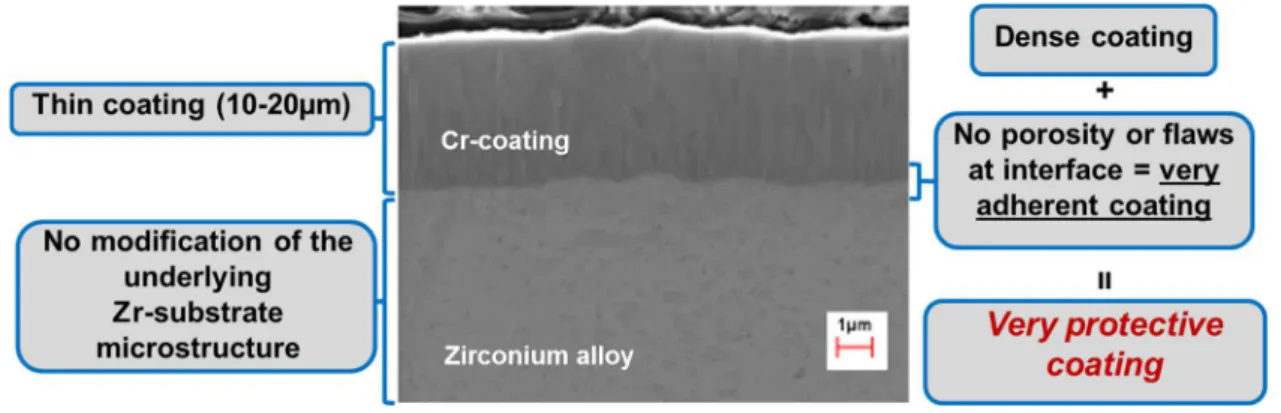
This article focuses on the developments of the Cr-coated M5 cladding, which is the most mature cladding solution developed by Framatome. It consists of a relatively thin Cr-coating (10-20µm) deposited on the surface of the M5 cladding using a Physical Vapor Deposition (PVD) technique. The coating thus deposited is very dense and adherent therefore making it very protective. Additionally, the PVD technique does not modify the underlying substrate microstructure since no heat treatment is applied on the tubes during deposition and the increase in temperature due to the incident Cr atoms is relatively small. Figure 1 shows an example of the cross-section of the Cr-coated cladding. This cladding solution has been developed in partnership with the CEA and EDF as part of the French Joint Nuclear Research program [2-7]. The developments on-going in Europe support and feed the developments and implementation of the solution in the USA as part of the DOE project.
Fig 1. Description of the Cr-coated M5 cladding
2. Motivation: improved accident and normal operation behavior
2.1 High temperature steam oxidation resistance
The main goal of enhanced accident tolerant fuel cladding is to improve the behavior of the fuel in accidental conditions, which has always been an important part of fuel development, with in this case a particular focus on reducing the high temperature (HT) steam oxidation of the current zirconium alloy cladding. This focus significantly increased since the Fukushima accident where the rapid zirconium alloy oxidation led to the production of H2 which then resulted in the reactor
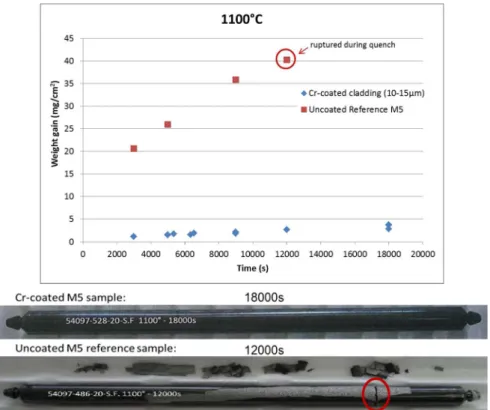
building explosion. The Cr-coated cladding was developed as a solution to reduce the high temperature steam oxidation of the cladding and shows significant benefits in HT steam oxidation resistance as demonstrated by current results obtained for long exposure times at the Framatome Research Center in Paimboeuf. Figure 2 shows the compared oxidation kinetics at 1100°C of Cr-coated and unCr-coated cladding up to 18000s and the visual aspect of the samples after quench.
Fig 2. Comparison of the HT steam oxidation kinetics at 1100°C of Cr-coated and uncoated M5 cladding samples and the visual aspect after quench
In this figure the uncoated sample fails after quench after exposure to 1100°C steam for 12000s while the Cr-coated sample maintains very low oxidation kinetic (reduced by at least 15x compared to uncoated samples) up to at least 18000s with no failure after quench. The main reason for the difference in behavior is that the Cr-coating protects the cladding from oxidation and from the diffusion of oxygen within the underlying zirconium substrate which leads to cladding embrittlement and therefore rupture after quench. By reducing the HT steam oxidation significantly, the Cr-coated cladding also maintains post-quench ductility for longer times thus providing significant benefits in accidental conditions. This test confirms previous results obtained at the CEA at other temperatures and times [4, 5, 8].
2.2 Debris wear resistance in normal operation
Although the Cr-coated cladding was developed initially to improve performance in accident conditions, it also brings significant benefits in normal operating conditions [7]. For example, since Cr is harder than Zr, it will protect the cladding for debris wear. To demonstrate this a parametric test was developed at the Framatome Technical Center of Le Creusot to simulate an extremely harsh debris wear in order to compare the behavior of Cr-coated and uncoated cladding. The debris used was a stainless steel wire that was fixed and a sliding displacement of +/-200µm was imposed on the cladding with a contact force on the wire of 1.5N. The set-up was placed in an autoclave at 300°C with a loop controlling the water chemistry to be representative of PWR chemistry ([B]=1000ppm and [Li]=2.2ppm). The goal of this test was not to be fully representative of conditions in reactor but was meant to be extremely harsh so as to highlight the difference in behavior of the two types of cladding. Similar tests to simulate more precisely grid-to-rod fretting had already been performed and are presented other articles [1, 7].
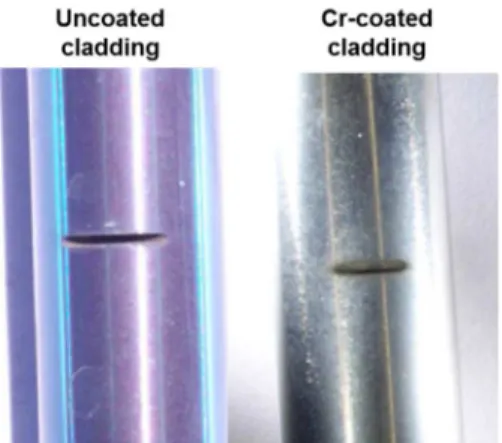
For the uncoated sample, the test had to be stopped after only 23h due to significant wear while the Cr-coated sample was tested for 100h. After 23h, the maximum wear depth on cladding was measured around 500µm corresponding to almost the entire cladding thickness, while for the Cr-coated sample after 100h the maximum wear depth was around 280µm so almost half of the uncoated sample. Figure 3 shows a schematic of the test set-up and the visual aspect of the Cr-coated and unCr-coated tubes after the tests. In the visual aspects after the tests it can be clearly seen that the notch on the Cr-coated sample is reduced in size and depth compared to the uncoated sample. It is also interesting to notice that even though the coating has been penetrated fully the wear rate is still low, which may be explained by the fact that the steel wire still has
contact with the Cr-coating on the edges of the worn area.
The main cause of fuel rod failures in reactors is fretting wear, whether it be debris or grid-to-rod fretting wear. This result combined with previous results on grid-to-rod fretting wear resistance [6] demonstrates that the Cr-coated can reduce cladding wear significantly and therefore its implementation will most likely reduce the number of failed fuel rods. This is an important benefit for the utilities since a Cr-coated fuel rod will improve the reliability of the fuel.
Fig 3. Schematic of the debris wear set-up and visual aspect of Cr-coated and uncoated cladding after the test.
3. Manufacturing developments
All the out-of-pile characterizations were performed using samples fabricated in a PVD machine that limited the size of the samples to 50cm in length. Foreseeing the need of insertion of LFRs in a very short time frame to obtain in-pile results as soon as possible, Framatome launched the fabrication of a full length prototype in 2016. The fabrication of the prototype to coat full-length (4m long) tubes was performed with two specific goals in mind:
- Demonstrate the feasibility of full length Cr-coated cladding using PVD
- Support the insertion of full-length Cr-coated lead fuel rods (LFRs) in commercial PWRs. The prototype machine was finished being built in summer of 2017 with the first Cr-coating tubes produced in the fall 2017. Several months were spent testing the machine after start-up and performing an optimization of the parameters to obtain the same quality of coatings as on the smaller length, and to make sure the coating was uniform in thickness and quality over the full length. Figure 4 shows an example of full-length Cr-coated tubes fabricated using the prototype.
Fig 4. Example of Cr-coated full length tubes fabricated using the prototype showing uniformity of the visual aspect over the full length.
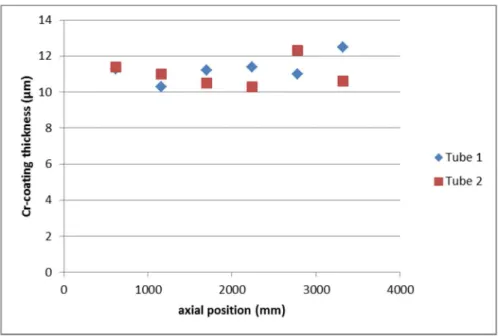
The tubes have a uniform visual aspect along the full length suggesting a coating with a homogeneous quality over the full length. This visual uniformity is also confirmed through coating thickness measurements using the calotest method (often used for coatings) during trial tests given in Figure 5, which show similar thicknesses within the uncertainty of the measurement (+/-
1.5µm) over the whole length of the tube. The calotest method corresponds to the grinding of the coating surface up to the substrate with a ball of known diameter, and the radius of the various “circles” obtained by the grinding, corresponding to the edges of the coating, allow the operator to calculate back the thickness of the coating.
Additionally, HT air oxidation tests at 1100°C for 850s were performed on segments of the tubes at various axial positions to make sure the behavior of the coating was the same along the length. Figure 6 shows the visual aspect of the samples oxidized in these conditions and immediately quenched in room temperature water. Both samples have a similar visual appearance and the weight gains were close with 4.97 and 4.52 mg/cm2 for extremity and center positions,
respectively. The oxidation was performed on open tube samples, therefore double-sided oxidation, with the Cr-coating only on the external surface, so the majority of the weight gain measured comes from the oxidation of the unprotected internal zirconium alloy surface. These weight gains are also similar to ones obtained for Cr-coated samples obtained previously using a smaller PVD chamber, thus confirming the reproducibility on the full length scale of the coating quality previously obtained on small length. Furthermore, the immediate quench in room temperature water is very harsh for the samples and highlights the excellent adherence of the coating and the similarity in behavior along the length.
Consequently, the fabrication of Cr-coated cladding on full length is feasible and shows similar properties as for samples coated previously in a smaller PVD chamber, thus confirming Framatome’s ability to reproduce the same coating quality with the change of scale. Framatome is therefore currently preparing for the qualification of the full length Cr-coated tubes before the fabrication of the Cr-coated tubes that will be used for the LFRs in 2019.
Fig 5. Cr-coating thicknesses along the length of tubes showing thickness uniformity.
Fig 6. Appearance of Cr-coated tube samples after double-sided HT oxidation in air at 1100°C for 850s followed by a quench at room temperature (4.97 (extremity) and 4.52 (center) mg/cm2 in
4. Obtaining in-pile data for future licensing
With the goal of accelerating the implementation of Cr-coated cladding in commercial reactors, Framatome has started irradiations of this solution early-on to obtain the necessary in-pile data to support future licensing needs. Framatome was therefore the first to irradiate E-ATF solutions in a commercial reactor with the insertion of Material Test Rods in the Gösgen reactor in 2016 as part of the IMAGO irradiation (Irradiation of Materials for Accident tolerant fuels in GOesgen). After 1 cycle the samples were inspected visually and showed good behavior with no delamination or deterioration of the Cr-coating, as presented more in detail in another article [9]. Some samples were extracted after 1 cycle to be analyzed in hot cells but most of the samples were reinserted to continue the irradiation.
Additional irradiations of Cr-coated cladding have started or are planned in research reactors to evaluate the behavior of a fuel rod and the interaction of fuel pellets with the Cr-coated cladding: - As part of the French Joint Research program with CEA and EDF, the irradiation of UO2
-Cr-coated cladding rodlets (containing both Zy4 and M5 substrates) in the HALDEN reactor started in summer 2017. Several pellet diameters are tested to investigate the impact of pellet-cladding interaction on the Cr-coated cladding behavior.
- As part of phase 2 of the DOE ATF program, an irradiation of Framatome’s short term E-ATF concept (Cr2O3-doped UO2 fuel with Cr-coated M5 cladding) is planned to start in
2018 in the Advanced Test Reactor (ATR) at Idaho National Laboratory in the US as part of the ATF-2 irradiation. This will be the first irradiation of the Framatome’s complete E-ATF fuel rod concept with chromia doped fuel and Cr-coated cladding.
These irradiations will provide complementary information to the IMAGO irradiation for the justification of future LFR irradiations with data more representative of the fuel rod by investigating the overall pellet-cladding interaction. Furthermore, since Framatome had launched several irradiations in various reactors, and especially commercial reactors, the closure of HALDEN will not impact significantly the Framatome Cr-coating irradiation program and the results that would have been obtained in HALDEN can be obtained through other irradiations. Thus the closure of HALDEN will have minimal impact of Framatome’s irradiation feedback and will not delay the implementation of its evolutionary solution. The rodlets irradiated in HALDEN will nonetheless be investigated and will be useful to obtain irradiated data on Cr-coated cladding at an intermediate dose.
5. Conclusion
Framatome is strongly engaged in the E-ATF developments relying on its worldwide teams with programs both in Europe and the USA. Its objective is to accelerate the implementation of its near-term solution consisting of Cr2O3-doped UO2 fuel combined with Cr-coated M5 cladding,
which provides significant benefits in both normal and accidental conditions. The main focus of the current developments is on the Cr-coated cladding since the doped fuel has already been industrialized. For example, the Cr-coating increases the wear resistance of the cladding suggesting improved reliability of the fuel in normal operation, as well as reduced steam oxidation resistance at high temperature increasing safety margins in design basis accidents or providing additional coping time in severe accidents.
Due to the good behavior of the Cr-coated cladding in out-of-pile tests, Framatome has fabricated a PVD prototype machine in partnership with the CEA to be able to coat full length cladding tubes. The goal was on one hand to demonstrate the feasibility of PVD coatings on the full length and to develop a facility to be able to fabricate full length Cr-coated tubes. The construction was finalized in summer 2017 and Framatome has since been performing tests and optimization of the prototype to obtain the same quality of coatings as previously observed on short length with good axial uniformity over the full length. Framatome is now gearing up to qualify and fabricate the full length Cr-coated cladding tubes that will serve for the LFRs planned in 2019 in the USA. Additionally irradiations were started or are going to be launched in commercial and material test
reactors to obtain the necessary in-pile data to support future licensing of the fuel rod. Framatome was for example the first to irradiate E-ATF concepts in a commercial reactor with the irradiation of test samples in the Gösgen reactor (IMAGO). These data will be essential to implement Framatome’s near-term solution in the upcoming years.
Acknowledgements
The authors would especially like to thank Eric Monsifrot for all his help and expertise on the fabrication of coatings and also Kernkraftwerk Gösgen-Däniken AG for their collaboration and financial contribution in the irradiation of E-ATF samples in the Gösgen reactor, and their support for the licensing of Material Test Rods and future examination of the samples.
Some of the data presented in this article is based upon work supported by the U.S. Department of Energy under Award Number DE-NE0008220 with Framatome Inc.
M5 is a trademark or a registered trademark of Framatome or its affiliates in the USA or other countries.
References
[1] C. Delafoy, J. Bischoff, J. Larocque, P. Attal, L. Gerken, K. Nimishakavi, “Benefits of Framatome’s E-ATF evolutionary solution: Cr-coated cladding with Cr2O3-doped UO2
fuel”, Proceedings of TopFuel 2018, Prague, Czech Republic, September 2018.
[2] I. Idarraga-trujillo, M. Le Flem, J-C Brachet, M. Le Saux, D. Hamon, S. Muller, V. Vandenberghe, M. Tupin, E. Papin, A. Billard, E. Monsifrot, F. Schuster, “Assessment at CEA of Coated Nuclear Fuel Cladding for LWRs with Increased Margins in LOCA and beyond LOCA Conditions”, Proceedings of 2013 LWR Fuel Performance Meeting/TopFuel, Charlotte, NC, USA, Sept. 15-19, (2013).
[3] J. Bischoff, K. McCoy, J. Strumpell, J-C. Brachet, C. Lorrette, "Development of Fuels with Enhanced Accident Tolerance", Proceedings of TopFuel Conference 2015, Zurich, Switzerland, September 2015
[4] J-C. Brachet, M. Le Saux, M. Le Flem, S. Urvoy, E. Rouesne, T.Guilbert, C. Cobac, F. Lahogue, J. Rousselot, M. Tupin, P. Billaud, C. Hossepied, F. Schuster, F. Lomello, A. Billard, G. Velisa, E. Monsifrot, J. Bischoff, A. Ambard, "On-going Studies ar CEA on Chromium Coated Zirconium Based Nuclear Fuel Claddings for Enhanced Accident Tolerant LWR Fuel", Proceedings ofTopFuel Conference 2015, Zurich, Switzerland, September 2015
[5] J-C. Brachet, M. Le Saux, V. Lezaud-Chaillioux, M. Dumerval, Q. Houmaire, F. Lomello, F. Schuster, E. Monsifrot, J. Bischoff, E. Pouillier, "Behavior under LOCA Conditions of Enhanced Accident Tolerant Chromium Coated Zircaloy-4 Claddings", Proceedings of TopFuel 2016 Conference, Boise, ID, USA, September 2016
[6] J. Bischoff, C. Delafoy, P. Barberis, D. Perche, B. Buerin, J-C Brachet, "Development of Cr-coated Zirconium Cladding for Enhanced Accident Tolerance", Proceedings of TopFuel Conference 2016, Boise, ID, USA, September 2016
[7] J.Bischoff, C. Delafoy, C. Vauglin, P. Barberis, C. Roubeyrie, D. Perche, D. Duthoo, F. Schuster, J-C. Brachet, E.W. Schweitzer, K. Nimishakavi, "AREVA NP's Enhanced Accident Tolerant Fuel Developments: Focus on Cr-coated M5 Cladding", Proceedings of WRFPM 2017 Conference, JeJu, Republic of South-Korea, September 2017
[8] J.C. Brachet, M. Dumerval, V. Lezaud-Chaillioux, M. Le Saux, E. Rouesne, D. Hamon, S. Urvoy, T. Guilbert, Q. Houmaire, C. Cobac, G. Nony, J. Rousselot, F. Lomello, F. Schuster, H. Palancher, J. Bischoff, E. Pouillier, "Behavior of Chromium Coated M5 Claddings under LOCA Conditions" Proceedings of WRFPM Conference, Jeju, Republic of South Korea, September 2017
[9] G. Girardin, R. Meier, F. Jatuff, J. Bischoff, C. Delafoy, E. Schweitzer, “Inspection Capabilities and In-pile Experience with Innovative and Enhanced Accident Tolerant Fuel Materials at KKG”, Proceedings of TopFuel 2018, Prague, Czech Republic, September 2018.