HAL Id: hal-00957660
https://hal.archives-ouvertes.fr/hal-00957660
Submitted on 10 Mar 2014
HAL is a multi-disciplinary open access
archive for the deposit and dissemination of
sci-entific research documents, whether they are
pub-lished or not. The documents may come from
teaching and research institutions in France or
abroad, or from public or private research centers.
L’archive ouverte pluridisciplinaire HAL, est
destinée au dépôt et à la diffusion de documents
scientifiques de niveau recherche, publiés ou non,
émanant des établissements d’enseignement et de
recherche français ou étrangers, des laboratoires
publics ou privés.
A Multi-agent Min-Cost Flow problem with
Controllable Capacities: Complexity of Finding a
Maximum-Flow Nash Equilibrium
Nadia Chaabane, Cyril Briand, Marie-José Huguet
To cite this version:
Nadia Chaabane, Cyril Briand, Marie-José Huguet. A Multi-agent Min-Cost Flow problem with
Controllable Capacities: Complexity of Finding a Maximum-Flow Nash Equilibrium. International
Conference on Operations Research and Enterprise Systems (ICORES), Mar 2014, Angers, France.
8p. �hal-00957660�
A Multi-agent Min-Cost Flow problem with Controllable Capacities:
Complexity of Finding a Maximum-Flow Nash Equilibrium
Nadia Chaabane Fakhfakh
1,2, Cyril Briand
1,3and Marie-Jos´e Huguet
1,2 1CNRS, LAAS, 7 avenue du colonel Roche, F-31400 Toulouse, France2Universit´e de Toulouse, INSA, LAAS, F-F-31400 Toulouse, France 3Universit´e de Toulouse, UPS, LAAS, F-31400 Toulouse, France
{nadia.chaabane, briand, huguet}@laas.fr
Keywords: Multi-agent, Network Flow, Nash Equilibrium, Complexity, Min-Cost Flow.
Abstract: A Multi-Agent Minimum-Cost Flow problem is addressed in this paper. It can be seen as a basic multi-agent transportation problem where every agent can control the capacities of a set of elementary routes (modeled as arcs inside a network), each agent incurring a cost proportional to the chosen capacity. We assume that a customer is interesting in transshipping a product flow from a source to a sink node through the transportation network. It offers a reward that is proportional to the flow that the agents manage to provide. The reward is shared among the agents according to a pre-established policy. This problem can be seen as a non-cooperative game where every agent aims at maximizing its individual profit. We take interest in finding stable strategies (i.e., Nash Equilibrium) such that no agent has any incentive to modify its behavior. We show how such equilibrium can be characterized by means of augmenting or decreasing path in a reduced network. We also focus on the problem of finding a Nash equilibrium that maximizes the flow value and prove its NP-hardness.
1
INTRODUCTION
Multi-agent network games have become a promising interdisciplinary research area with important links to many application fields such as transportation, project scheduling, computer network, etc. In these applicative areas, decision processes often involve several actors, each one having its own autonomy, its own objectives and its own constraints. These actors, often referred to as agents, aim at maximizing their own profits, provided a global objective should be fulfilled. This kind of problem, called multi-agent optimization, can be met in many real-life problems such as transportation networks, supply chain man-agement, web services, production, etc. The nature and complexity of network optimization problems change significantly when the multi-agent context is considered. Besides optimizing a global objective, a solution should also satisfy additional criteria related to multi-agent games. In fact, on the one hand, a solution should optimize the agent’s objective and, on the other hand, should also be stable in the sense of Nash (i.e.; no agent is able to improve its profit, to the detriment of the others). Those additional features are connected with multi-objective optimization and Game Theory, respectively. This work sits at the
crossroads between two disciplines, namely multi-agent systems and social networks. The former ties in with distributed resolution of multi-agent problems, while the latter is connected to game theory, which formalizes the multi-agent optimization problem with strategic game between different agents.
Recently, some researchers have paid attention to a particular multi-agent network problem: the Multi-Agent Project Scheduling (MAPS) problem. In the seminal work of (Evaristo and Fenema, 1999), the authors proposed a special framework for distributed projects, with costs and rewards shared among agents. In an earliest work (De et al., 1997), the authors consider a MAPS problem where each agent can control the duration of its activities at a given cost. The project activities and precedence constraints are classically modeled by an activity-on-arc graph. A reward is offered to agents when they manage to finish the project earlier than expected, as proposed in (Fernandez, 2012). It was demonstrated in (Agnetis et al., 2013) and (Briand et al., 2012a) that finding a Nash equilibrium minimizing the project makespan is NP-hard in the strong sense . Moreover, based on the concepts of increasing and decreasing cuts, as defined in (Kamburowski, 1994), and, on duality between maximum flow and minimum cut problems,
Briand et al. (2012b) proposed an efficient integer linear program formulation for this problem (Briand et al., 2012b).
Another important application to the network opti-mization is the well-known Network Flow theory (Ford and Fulkerson, 1958). Several algorithms have been developed in order to find a maximum flow in a network. Ford and Fulkerson (1956) were the first to develop a clever algorithm based on the duality between minimum cut and maximum flow (Ford and Fulkerson, 1956). Later on, efficiency improvements were proposed see eg; (Edmunds and Karp, 1972), (Goldberg and Tarjan, 1986), etc. The minimum cost maximum flow problem, which is equivalent to the minimum cost circulation problem, is solvable in polynomial time (Tardos, 1985).
As regards to social networks, the prediction of agents’ behavior is of interest. Several papers focus on games associated with various forms of networks, see (Tardos and Wexler, 2007) for an overview. In a recent work, Apt and Markakis (2011) studied the complexity of finding a Nash Equilibrium for the multi-agent social networks with multiple products, in which the agents, influenced by their neighbors, can choose one out of several alternatives (Apt and Markakis, 2011).
Specifically, this work considers a transportation network that involve a set of agents, each one being in charge of a part of the network. It is assumed that each agent is able to control the transportation capacities of its arcs. A lot of features of this work are inspired by the multi-agent project scheduling problems, as presented in (Briand et al., 2012a), especially concerning the reward sharing policy. In fact, the outcome of an agent depends on its own strategy and on the satisfaction of a customer, which depends on the network flow. As proposed by Fernandez (2012) (Fernandez, 2012), we assume that the customer gives a reward proportional to the maximum-flow that can circulate inside the network. This reward is shared among agents according to some ratios predefined in the network design phase (Cachon and Lariviere, 2005).
To the best of our knowledge, the research presented here is an original way of presenting a transportation problem using multi-agent network flow with con-trollable arcs capacities. One important application to the problem proposed in this paper is the distributed control of transportation networks, like traffic, water, where the road of the network are distributed among several agents which can control the amount of product or water to circulate on the network.
This paper mainly discusses the complexity of finding
a Nash Equilibrium that maximizes the flow in the network.
The paper is organized as follows: Section 2 defines formally the Multi-Agent Minimum-Cost Flow prob-lem and introduces some important notations. There-after, Section 3 introduces the duality between effi-ciency and stability of a strategy and presents some important definitions and properties. In Section 4 and 5, we illustrate some basic notions for the single agent and the multi-agent cases, respectively. In Section 6, an example is provided to illustrate the notions intro-duced in previous sections. Section 7 deals with the complexity of the problem of finding a Nash equilib-rium with bounded flow. Finally, conclusions and fu-ture directions are drawn in Section 8.
2
PROBLEM STATEMENT AND
NOTATIONS
We focus on a Minimum-Cost Flow problem under a Multi-Agent context. This problem will be further referred to as MA-MCF. Considering a transportation network with limited arc capacities, this problem con-sists in sending a maximum amount of products from a source node to a sink node, at minimum cost. In this work, a major assumption is that arc capacities are controlled by agents, each arc being assigned to a specific agent.
2.1
Problem Definition
The MA-MCF problem can be described as a tuple < G,
A
, Q, Q,C, π,W >, where:• G = (V, E) is a flow network. V is the set of nodes,
s,t ∈ V being the source and the sink nodes of the flow network G, respectively. E is the set of arcs, each one having its capacity and receiving a flow. An arc e from node i to node j is denoted by e= (i, j).
•
A
is a set of m agents:A
= {A1, . . . , Au, . . . , Am}.Arcs are distributed among agents. An agent Au
owns a set of muarcs, denoted
E
u. Each arc(i, j)belongs to exactly one agent (i.e.,
E
u∩E
v= /0 foreach agent’s pair(Au, Av) ∈
A
2such that u6= v).• qi, jis the capacity of arc(i, j) which takes value in
an interval[qi, j, qi, j]. qi, j(resp. qi, j) is the normal
(resp. maximum) arc capacity. Q= (qi, j)(i, j)∈E
and Q= (qi, j)(i, j)∈E referred to as the vectors of
For any circulating flow fi, j, it classically holds
fi, j≤ qi, jwith qi, j∈ [qi, j, qi, j].
• C = {ci, j} is the vector of costs where ci, jis the
unitary cost incurred by agent Au, such that(i, j) ∈
E
u, for increasing qi, jby one unit.The vector Cudenotes the cost vector incurred by
augmenting the capacity of arcs by the agent Au.
• π referred to as a reward given by a final client. This reward is proportional to the maximum flow that can circulate from s to t.
• W = {wu} defines the sharing policy of rewards
among the agents. The Aureward for a gain of
one unit of maximum flow equals wuπ.
We denote by Qu, u = 1, . . . , m the vector of
capacities chosen by the agent Au for the arcs
belonging to him. Q≤ Qu ≤ Q represents the
individual strategy of the agent Au. We further
refer to S= (Q1, . . . , Qm) as the vector of individual
strategies of all agents. A strategy S−u denote the
strategies of the(m − 1) players, but agent Au, such
that S−u= (Q1, Q2, .., Qu−1, Qu+1, .., Qm).
Given a strategy S, F(S) denotes the maximum flow that can circulate on the network flow given the current values of capacities. It is equal to the sum of flow circulating in the forward arcs of source node (i.e., F= ∑(s, j)∈E fs, j). F corresponds to the
maxi-mum flow when capacities qi, jare set to qi, j, in other
words, the largest possible flow at zero cost. F is the maximum flow that can circulate when capacities are set to their maximum values (qi, j= qi, j). Therefore,
for any strategy S, it holds that F≤ F(S) ≤ F. It is assumed, in this paper, that the share of reward among agents wu did not depend on the arcs used
by agents. It is nevertheless possible to extend this work to the case in which the reward depends on how much the resource owned by each agent is used at optimum.
The cost incurred by agent Au for a strategy Qu
equals:
Cu(Qu− Qu) =
∑
(i, j)∈Eu
ci, j(qi, j− qi, j)
With respect to the above payment scheme, the total reward given for a circulating flow F(S) under strat-egy S isπ (F(S) − F).
The profit Zu(S) of agent Auunder strategy S is equal
to:
Zu(S) = wuπ (F(S) − F) −
∑
(i, j)∈Eu
ci, j(qi, j− qi, j)
(1)
We denote by Z(S) = (Z1(S), . . . , Zm(S)) the overall
profit vector.
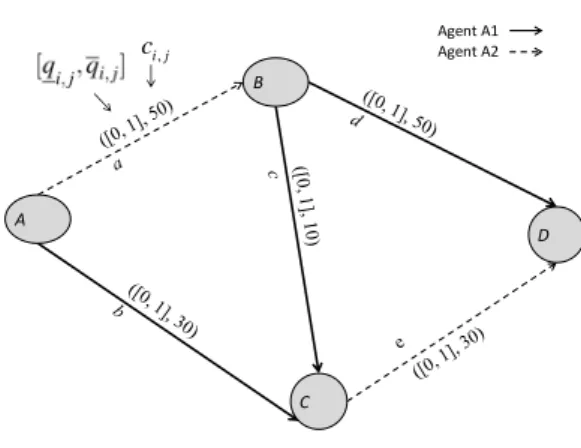
Example of a MA-MCF Network
The network flow G(V, E) displayed in Fig. 1 is com-posed of five arcs E = {a, b, c, d, e} distributed be-tween two agents A1and A2such that
E
1= {b, c, d}and
E
2= {a, e} (their assigned arcs are representedwith plain and dotted arcs, respectively). The set of vertex is V = {A, B,C, D} where the source node is
A and sink node is D. Each arc in the graph 1 is denoted by the interval of normal and maximum ca-pacities, and by the cost of increasing arc capacities ([qi, j, qi, j], ci, j). Costs and capacities are such that
CAB= CBD= 50, CAC = CCD= 30, CBC= 10 and
qAB, qBD, qAC, qCD, qBC∈ [0, 1]. When increasing arc
capacities which leads to one additional unit of flow circulating, a final client gives rewardπ = 120 which will be shared between agents following the sharing policy w1= w2=12. B C Agent A1 Agent A2 , i j c A D
Figure 1: Problem description of example 1
2.2
Mathematical Formulation
Each agent should choose the capacities of its arcs, having the objective of maximizing its own profit. The problem can be formalized as the following multi-objective mathematical program:
Max (Z1(S), Z2(S), . . . , Zm(S))
s.c.
(i) fi, j≤ qi, j, ∀(i, j) ∈ E
(ii) ∑(i, j)∈Efi, j− ∑( j,i)∈Efj,i=
0∀i 6= s,t F, i = s −F , i = t (iii) q i, j≤ qi, j≤ qi, j, ∀(i, j) ∈ E fi, j≥ 0, ∀(i, j) ∈ E
Where Zu(S), u = 1, . . . , m is the profit of agent Au
given by the equation (1) for each strategy S. Constraints (i) represent the capacity constraints. Constraints(ii) impose the conservation of the flow. The aim of this problem is to find an overall strategy
Sthat maximizes agents’ profit. Each agent Auhas to
decide the arc capacity qi, j, ∀(i, j) ∈
E
u in order tomaximize its profit.
3
EFFICIENCY VS. STABILITY
A strategy is said efficient if it corresponds to a Pareto-optimal solution with respect to the above multi-objective program. The notion of Pareto opti-mality is concerned with social efficiency (Ehrgott, 2005). A Pareto strategy is preferred to any other strategy dominated by it.
Definition 1. Pareto optimality: A strategy S is Pareto-optimal if it is not dominated by any other strategy S′. In other words, it does not exist any strat-egy S′such that Zu(S′) ≥ Zu(S) for all Au, with at least
one inequality being strict.
The set of Pareto optimal strategies is denoted by SP.
On the other hand, a strategy is stable if there is no in-centive for any agent to modify its decision in order to improve its profit. The stability of a strategy ensures that agents can trust each other. It is connected to the notion of Nash equilibrium in non-cooperative game. Definition 2. Nash Equilibrium: given a sharing
re-ward policy wu, a strategy S= (Q1, . . . , Qm) is a Nash
Equilibrium if for any agent Auwith strategy Q′u, the
following equation holds:
Zu(Qu, S−u) ≥ Zu(Q′u, S−u), ∀Q′u6= Qu (2)
We refer to SNas the set of Nash equilibria.
Let us also define the concept of a poor strategy. This concept will be useful for characterizing prop-erly Nash equilibria.
Definition 3. Poor strategy: A strategy S = (Q1, . . . , Qm) with flow F(S) is a poor strategy if and
only if it exists an agent Auand an alternative strategy
Q′usuch that Zu(S) < Zu(S′) and F(S′) = F(S), where
S′= (S−u, Q′u).
In other words, S is a poor strategy if and only if one agent is able to increase its profit by changing unilaterally its strategy (modifying the capacity of some of its arcs), without modifying the overall flow in the network, nor the profits of other agents. It is obvious that for any poor strategy S, S6∈ SNSSP.
The set of non-poor strategies will be denoted by ˆS. Ideally, agents should choose a strategy which sat-isfy both Pareto optimality and Nash stability (i.e.,
S ∈ SNTSP). Nevertheless, since SNTSP can be
empty, such a strategy is not always attainable. In this case, we are looking for a Nash equilibrium that is as efficient as possible with respect to the customer viewpoint. A Nash equilibrium that maximizes the flow circulating is indeed suitable both for maximiz-ing the total reward and the customer satisfaction. The aim of this study is to find an optimal strategy profile S∗such that the solution is a Nash Equilibrium that maximizes the flow circulating, the share of re-ward among agents wubeing fixed.
Assumptions: For sake of simplicity, it is assumed throughout this paper, that q
i, j= 0. Therefore, the
initial minimum circulating flow at zero cost is equal to F = 0. This assumption does not modify the fun-damental results of this work.
4
THE SINGLE-AGENT CASE
This section presents some basic properties related to classical network flow theory. In the single agent case (all the arcs belong to a single agent), a non-poor strat-egy S for a given flow F(s) is a strategy that mini-mizes the overall cost. Such minimization problem is well-identified in the literature as the minimum-cost flow problem (Busacker and Gowen, 1961).
Let us recall in the following section how the total flow can be either increased or decreased, at minimum cost, using increasing or decreasing paths. These no-tions will be used in section 5.
4.1
Increasing the Max-Flow
Given a flow F(S) for strategy S, we are interested in increasing the flow value at minimum cost. For this purpose, we recall the well-known notion of an
aug-menting pathbased on the concept of residual graph
Gf(S), which is defined below.
Definition 4. Residual graph: Given a network G= (V, E) and a flow F(S), the corresponding residual
graph Gf(S) = (V, Er) is defined as follows: each arc
(i, j) ∈ E, having a maximum capacity q(i, j) and a
flow fi, jin G, is replaced by two arcs(i, j) and ( j, i).
The arc(i, j) has cost ci, jand residual capacity ri, j=
qi, j− fi, j and the arc( j, i) has cost cj,i= −ci, j and
residual capacity rj,i= fi, j.
Definition 5. Augmenting path: An augmenting path
is a path P in Gf(S) from s to t, where e1= s and
ek= t.
We refer to
P
as the set of augmenting paths.The greatest flow augmentation that can be achieved using P is rp= min{ri j:(i, j) ∈ P}.
An augmenting path in Gf(S) is made of forward arcs
(having the same direction in G) and backward arcs (having the opposite direction than the ones in G). The set of forward and backward arcs are denoted P+ and P−, respectively.
The cost of augmenting the flow by one unit using the augmenting path P∈
P
is denoted cost(P). It isexpressed as follows: cost(P) =
∑
(i, j)∈P+ ci, j−∑
(i, j)∈P− ci, j (3)4.2
Decreasing the Max-Flow
When considering the problem of decreasing the flow at minimum cost in the network, we introduce the new concept of decreasing path.
Definition 6. Decreasing path: a decreasing path P
is a path in Gf(S) from node t to node s through which
the flow can be decreased.
We refer to
P
as the set of decreasing paths.Similarly, a decreasing path in Gf(S) is made of
for-ward arcs (having the opposite direction than the one in Gf(S)) and backward arcs (having the same
direc-tion in Gf(S)). The set of forward and backward arcs
are denoted P+and P−, respectively.
pro f it(P) =
∑
(i, j)∈P+
ci, j−
∑
(i, j)∈P−ci, j (4)
5
THE MULTI-AGENT CASE
In the multi-agent context, one agent can decrease (or increase) unilaterally its arc capacities to improve its profit. In this context, we introduce the concept of profitability of an augmenting or a decreasing path and provide a characterization of Nash equilibrium.
5.1
Increasing the Max-Flow
Let us introduce the notion of profitable augmenting path. In a similar way, in the multi-agent context, an augmenting path is composed by a set of forward and backward arcs P= {P+, P−} such that if q
i, j is
in-creased by one unit∀(i, j) ∈ P+and decreased by one
unit∀(i, j) ∈ P−, it is possible to increase the overall flow by one unit.
The cost of an augmenting path for agent Au,
costu(P), is defined as the net change in cost flow for
one unit of flow augmentation throughout this path. It is expressed as follows: costu(P) =
∑
(i, j)∈P+∩Eu ci, j−∑
(i, j)∈P−∩Eu ci, j (5)Definition 7. Profitable augmenting path. An
aug-menting path P∈
P
is said profitable path for all agents if, for every agent Au, costu(P) < wu× π.This means that through a profitable augmenting path, increasing the flow by one unit, is profitable for all the agents owning the arcs of the path.
5.2
Decreasing the Max-Flow
Now, the notion of profitable decreasing path is intro-duced. In the multi-agent context, a decreasing path
P= {P+, P−} is composed of forward and backward arcs. If qi, jis decreased by one unit,∀(i, j) ∈ P+, and
increased by one unit,∀(i, j) ∈ P−, the overall flow is decreased by one unit.
The profit pro f itu(P) generated by decreasing
capac-ity through a decreasing path, for an agent Au, is
de-fined as follows: pro f itu(P) =
∑
(i, j)∈P+∩Eu ci, j−∑
(i, j)∈P−∩Eu ci, j (6)Definition 8. Profitable decreasing path. A
decreas-ing path P∈
P
is profitable if there is one agent Ausuch that pro f itu(P) > wu× π.
In other words, through a profitable decreasing path, decreasing the flow by one unit is profitable for one agent, to the detriments of the others.
In the multi-agent context, it is important to charac-terize strategies in which an agent can decrease or increase the overall flow. Therefore, it is important to find profitable augmenting paths in order to in-crease flow without generating decreasing paths that are profitable for some agent, hence preserving stabil-ity.
Proposition 5.1. Nash Equilibrium.
For a given non-poor strategy profile S, S is a Nash Equilibrium if and only if:
• ∀Au∈
A
,∀P ∈P
such that(i, j) ∈E
ucostu(P) > wu× π (7)
• ∀Au∈
A
,∀P ∈P
pro f itu(P) < wu× π (8)
Proof. Consider a strategy S and an agent Au. If S
is non poor, Aucan improve its situation only by
in-creasing or dein-creasing the flow. In the former case, for an additional unit of flow, Aureceives wu× π. Since,
such increase is profitable to Auif and only if there is
an augmenting path P such that costu(P) < wu× π. In
the latter case, viceversa, it is profitable for an agent
Auto decrease the flow by one unit if and only if there
is a decreasing path P such that pro f itu(P) > wu× π.
Therefore, if and only if for no agent any of those con-ditions holds, no agent Aucan individually improve its
profit, and S is a Nash equilibrium.
6
ILLUSTRATIVE EXAMPLE
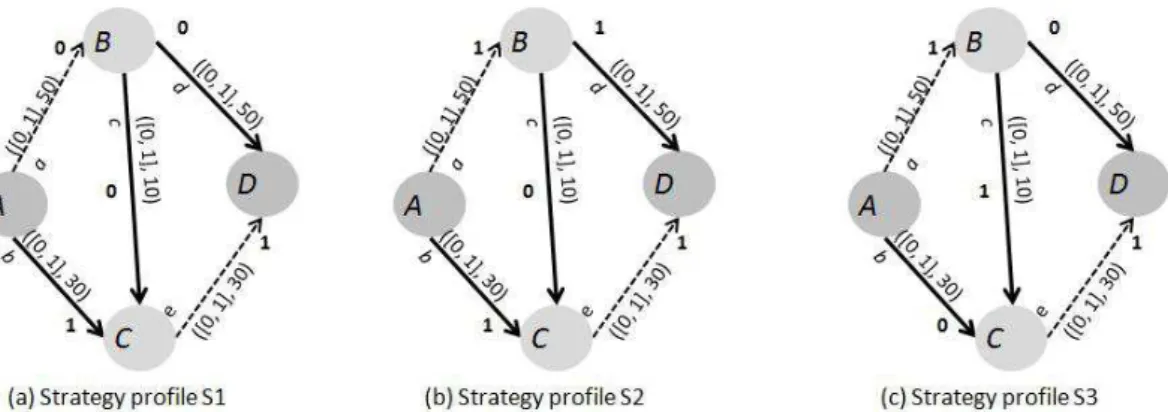
Let us come back to the previous example (section 2.1) to illustrate the optimality-stability duality of a strategy. The initial flow on the network is equal to its minimum value F= 0. It is possible to increase it along the profitable augmenting path (A-C-D), which leads to the strategy S1= (0, 1, 0, 0, 1) (see Figure
2(a)) with F(S1) = 1 and Z1(S1) = Z2(S1) = 30. From
this strategy, it is still possible to increase the flow along the profitable augmenting path (A-B-D), which leads to the strategy profile S2= (1, 1, 0, 1, 1) (see
Fig-ure 2(b)) with F(S2) = 2 and Z1(S2) = Z2(S2) = 40.
From this strategy, we observe that there exists a prof-itable decreasing path(D − B −C − A) from sink node
Dto source node A which is profitable for agent A1.
In fact, A1can improve its own profit, by decreasing
back the flow on b and d by one unit and increasing the flow on arc c by one unit. This leads to the strategy
S3= (1, 0, 1, 0, 1) (see Figure 2(c)) with F(S3) = 1
and profits Z1(S3) = 50 and Z2(S3) = −20, which is
obviously bad for A2. Therefore, although the
strat-egy S2corresponds to a Pareto Optimum, which leads
to a maximization of agent’s profits, it is not a stable strategy. Strategy S1 is a Nash Equilibrium but not
Pareto Optimum. Therefore, in our example there is no a strategy which is both in SN and SP. The mo-tivation of this paper is to search for a Nash-stable solution which is as efficient as possible, i.e., which maximizes F(S).
7
PROBLEM COMPLEXITY
In this section, we discuss the complexity of finding a Nash equilibrium that maximizes the flow in the net-work. This problem can be described by the following mathematical model.
P
MA−MCFMax F s.c.
(i) fi, j≤ qi, j, ∀(i, j) ∈ E
(ii) ∑j∈P+(i)fi, j− ∑j∈P−(i)fj,i=
0∀i 6= s,t F , i = s −F , i = t (iii) q i, j≤ qi, j≤ qi, j, ∀(i, j) ∈ E (iv) pro f itu(P) < wu× π, ∀P ∈ Gf(S) fi, j≥ 0, ∀(i, j) ∈ E
Constraints(i), (ii) and (iii) are the same as the one of the multi-objective mathematical formulation pre-sented above 2. They represent the constraints of arcs capacities and flow conservation, respectively. Con-straints (iv) impose that no decreasing path P exists in solution S with profit pro f itu(P) greater or equal to
wu× π. In other words, it represent the constraints for
a solution to being Nash stable. Even if the constraint (iv) is linear, we notice that the number of possible paths in the residual graph can grow exponentially. Moreover, a non-linearity can be recognized since the residual graph Gf(S) depends on the strategy chosen
by each agent.
Constraints(iv) impose that no decreasing path P ex-ists in solution S with pro f itu(P) greater or equal to
wu× π (See Proposition 5.1). Increasing paths do not
need to be bounded since since the network flow is maximized.
7.1
Finding a Nash Equilibrium with
Bounded Flow
We consider the decision problem to find a strategy which is a Nash equilibrium, with a flow greater than a given value. This problem can be defined as follows.
Nash-Equilibrium Bounded Flow:
Instance: a tuple< G,
A
, Q, Q,C, π,W > as defined insection 2 and an integerΦ Problem: Is there a Nash Equilibrium
stra-tegy profile S such that F(S) > Φ?
Proposition 7.1. Problem NE-Bounded Flow is
Figure 2: A multi-agent network flow with two agents and five arcs
Proof. The NP-completeness of this problem can be proved using a reduction from the well-known 3-partition problem, which is known to be NP-complete in the strong sense (Garey and Johnson, 1979).
3-partition:
Instance: a setζ = {a0, . . . , aK−1} of K = 3k positive
integers, such that ∑Kl=0−1al= k × B and
al∈]B/4, B/2]
Problem: Deciding whetherζ can be partitioned into
ksubsets so that the sum of integers in each subset is equal to B?
An instance of the MA-MCF problem with control-lable capacities can be generated from an arbitrary in-stance of the 3-partition problem as follows.
From the 3-partition problem instance, we build up a network G with k× K arcs and K + 1 nodes where the first one is source node V0= s and the last one is the
sink node VK= t. An agent Au∈
A
= {A1, . . . , Ak}owns K arcs.
The tail of an arc ei is Vidiv K, its head is V(i div K)+1.
Between nodes Vidiv K and Vidiv K+1, there are k
par-allel arcs, indexed from i to i+ K step k, each of them belonging to a specific agent: arc eibelongs to
Aidiv K. The cost of arc ei is cei = aimodK. In other
words, to every positive integer al∈ ζ is associated k
parallel arcs with, same head and tail, maximum ca-pacity qei = 1 and cost al. The total reward is set to
π = (B+ε)k, ε being an arbitrary small positive value. The sharing policy is defined by wu= 1/k. Therefore,
agent’s unit reward is wuπ = B + ε, identical for all
agents. The objective is to determine whether it exists a Nash strategy such that F(S) > Φ?
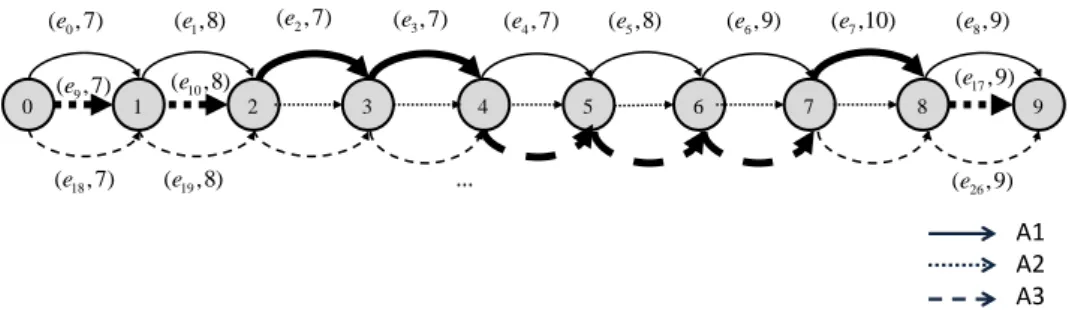
For instance, Figure 3 illustrates the resulting flow network obtained from the 3-partition instance de-fined by k= 3, ζ = {7, 8, 7, 7, 7, 8, 9, 10, 9} and B =
24. We have k= 3 agents and K ∗ k = 27 arcs. Be-tween nodes i and i+ 1, we find k = 3 arcs with cost
ai+1. The problem is to find, whether it exists, a Nash
strategy such that the flow is strictly greater than 0. In that case, using the path with bold arcs allows to ob-tain a one-unit total flow, which is a Nash equilibrium since every agent does not pay more than its part of reward (wuπ = B + ε = 24 + ε). Any equivalent stable
path is also a solution to the original 3-Partition prob-lem.
Let us prove this last property in a general way. Con-sider the strategy S where all arcs have normal capac-ity, qi, j= 0. The resulting flow obviously equals to
F(S) = 0. With respect to S, we observe that an agent can increase the flow by the amountδ ∈]0, 1], increas-ing the capacities of all its arcs by the same amount δ. However, doing so, the agent pays kBδ and only gains (B + ε)δ. Hence, the new strategy is not prof-itable and cannot be a Nash equilibrium. In order to obtain a Nash equilibrium, the total cost incurred by each agent for increasing its arc capacities must not exceed B, otherwise at least one agent will be inter-ested in decreasing back its capacities.
Due to the topology of the network, in order to in-crease the flow, exactly K= 3k arcs must be involved in an augmenting path. In any Nash equilibrium strat-egy with flow strictly greater than 0, the augmenting path having to be profitable for every agent, it must be made of exactly three arcs per agent. The total com-pression cost for every agent equals exactly B.
8
CONCLUSIONS
This paper presents a new game theory framework for a multi-agent flow network problem with controllable capacities. We consider that a final customer gives a reward, shared among agent, for any additional unit of flow circulating in the network. Each agent has
0 1 2 3 4 5 6 7 8 9 A1 A2 A3 0 ( , 7)e ( ,8)e1 ( , 7)e2 ( , 7)e3 ( , 7)e4 ( ,8)e5 ( ,9)e6 ( ,10)e7 ( ,9)e8 9 ( , 7)e 18 (e , 7) 10 (e ,8) 19 (e ,8) 17 (e ,9) 26 (e ,9) …
Figure 3: Reduction from 3-PARTITION problem with k= 3
the possibility to modify the capacities of its arcs at a given cost. We particularly point out the notions of efficiency and stability of a strategy. We also prove that finding a Nash Equilibrium with maximum flow is NP-hard in the strong sense. Further works are on-going to linearize the mathematical model of finding a Nash Equilibrium as a Mixed Integer linear program-ming. Distributed heuristics able to find a Nash equi-librium are also under study.
9
ACKNOWLEDGMENTS
This work was supported by the ANR project no. ANR-13-BS02-0006-01 named Athena.
REFERENCES
Agnetis, A., Briand, C., Billaut, J.-C., and Sucha, P. (2013). Nash equilibria for the multi-agent project scheduling problem with controllable processing times. Technical report, LAAS-CNRS.
Apt, R. K. and Markakis, E. (2011). Diffusion in social networks with competing products. In Proceedings of the 4th international conference on Algorithmic game theory, SAGT’11, pages 212–223. Springer-Verlag. Briand, C., Agnetis, A., and Billaut, J. (2012a). The
multia-gent project scheduling problem : complexity of find-ing an optimal nash equilibrium. In Proceedfind-ings of the 13th International Conference on Project Manage-ment and Scheduling, Leuven, Belgium, pages 106– 109.
Briand, C., Sucha, P., and Ngueveu, S. (2012b). Min-imisation de la dur´ee totale d’un projet multi-agent : recherche du meilleur ´equilibre de nash. In Proceed-ings of the 13th edition of ROADEF, pages 111–112. Busacker, R. and Gowen, P. (1961). A Procedure for
Deter-mining a Family of Minimal-Cost Network Flow Pat-terns. Defense Technical Information Center, Johns Hopkins University, 15 edition.
Cachon, G. and Lariviere, M. (2005). Supply chain coordi-nation with revenue-sharing contracts: Strengths and
limitations. International journal of Management Sci-ence, 51(1):30 – 44.
De, P., Dunne, E., Ghosh, J., and Wells, C. (1997). Com-plexity of the discrete time-cost tradeoff problem for project networks. European journal of Operations Re-search, 45(2):302–306.
Edmunds, J. and Karp, R. (1972). Theoretical improve-ments in algorithmic efficiency for netowrk flow prob-lems. Journal of the Association for Computing Ma-chinery, 19:248–264.
Ehrgott, M. (2005). Multicriteria Optimization. Springer, Berlin, second edition edition.
Evaristo, R. and Fenema, P. V. (1999). A typology of project management: emergence and evolution of new forms. International Journal of Project Management, 17(5):275–281.
Fernandez, M. E. (2012). A game theoretical approach to sharing penalties and rewards in projects. European Journal of Operational Research, 216(3):647–657. Ford, L. and Fulkerson, D. (1956). Maximum flow through
a network. Canadian Journal of Mathematics, 8:399– 404.
Ford, L. and Fulkerson, D. (1958). Flows in networks. Princeton University Press, New Jersey.
Garey, M. and Johnson, D. (1979). Computers and Intractability: A Guide to the Theory of NP-Completeness. W.H. Freeman & Co, New York, USA. Goldberg, A. and Tarjan, R. (1986). A new approach to the maximum flow problem. In Proceedings of the eigh-teenth annual ACM symposium on Theory of Comput-ing (STOC’86), pages 136–146. New york.
Kamburowski, J. (1994). On the minimum cost project schedule. International Journal of Management Sci-ence (Omega), 22(4):401– 407.
Tardos, E. (1985). A strongly polynomial minimum cost circulation algorithm. International journal Combi-natorica, 5(3):247–255.
Tardos, E. and Wexler, T. (2007). Network formation games and the potential function method. Algorithmic Game Theory, Cambridge University Press.