Publisher’s version / Version de l'éditeur:
Vous avez des questions? Nous pouvons vous aider. Pour communiquer directement avec un auteur, consultez la première page de la revue dans laquelle son article a été publié afin de trouver ses coordonnées. Si vous n’arrivez pas à les repérer, communiquez avec nous à [email protected].
Questions? Contact the NRC Publications Archive team at
[email protected]. If you wish to email the authors directly, please see the first page of the publication for their contact information.
https://publications-cnrc.canada.ca/fra/droits
L’accès à ce site Web et l’utilisation de son contenu sont assujettis aux conditions présentées dans le site LISEZ CES CONDITIONS ATTENTIVEMENT AVANT D’UTILISER CE SITE WEB.
Building Research Note, 1984-05
READ THESE TERMS AND CONDITIONS CAREFULLY BEFORE USING THIS WEBSITE. https://nrc-publications.canada.ca/eng/copyright
NRC Publications Archive Record / Notice des Archives des publications du CNRC : https://nrc-publications.canada.ca/eng/view/object/?id=182699da-9d5d-4aec-85b2-f83acffae349 https://publications-cnrc.canada.ca/fra/voir/objet/?id=182699da-9d5d-4aec-85b2-f83acffae349
NRC Publications Archive
Archives des publications du CNRC
This publication could be one of several versions: author’s original, accepted manuscript or the publisher’s version. / La version de cette publication peut être l’une des suivantes : la version prépublication de l’auteur, la version acceptée du manuscrit ou la version de l’éditeur.
For the publisher’s version, please access the DOI link below./ Pour consulter la version de l’éditeur, utilisez le lien DOI ci-dessous.
https://doi.org/10.4224/40000503
Access and use of this website and the material on it are subject to the Terms and Conditions set forth at
NRCC passive solar test facility performance of a mass-wall unit
Barakat, S. A.
Sex
m
NATIONAL RESEARCH
COUNCIL CANADADIVISION
OF B U I L D I N GRESEARCH
NRCC PASSIVE
SOLAR TEST FACILITY
PERPORMANCE O F A MASS-WALLUNIT
S
.A, RarakatOZ tawa May 1984
NRCC
PASSIVE SOLAR TEST FACILITYPERFORMANCE OF A M A S H J A L L UNIT
by
S.A. Barakat
Experimental data f o r t h e mass--wall u n i t of t h e passive solar t e s t f a c i l i t y af t h e D i v i s i o n of B u i l d i n g Research are p r e s e n t e d f o r
two
heatingseasons. The e f f e c t s of solar g a i n and b u i l d i n g thermal load on t h e
performance of the m a s s w a l l system as a passive s o l a r h e a t i n g d e v i c e are examined.
A comparison was made between the performance o f the mass-wall system
and an equivalent: d i r e c t - g a i n system. Although t h e r n a s ~ w a l l system u t i l i z e d less sotar e n e r g y than a d i r e c t - g a i n system, it resulted in a
marginally l o w e r space heating requirement, d u e to the h i g h e r thermal
resistance values of the mass-wall system. Analysis indicated that a
d i r e c t - g a l n system w i t h a t r i p l e g l a z e d window
would
r e s u l t in a lower1. INTRODUCTION
The NRC
passive solar t e s t facility consists of seven direct-gain unitsand a m a s s w a l l unit. Construction d e t a i l s of all u n i t s are g i v e n i n
Reference 1. Reference 1 a l s o describes the data acquisition system,
p r e s e n t s the method
used
to analyze the d a t a to o b t a i n various performancefactors, and discusses t h e uncertainties assocfated wfth these factors.
The "mass-wall" unit of the passive s o l a r t e s t f a c i l i t y c o n s i s t s of a
s o u t h and a north room.
It
h a s the s a m e l i g h t i n t e r l o r f i n i s h as thelight-mass direct-gain U n i t
1,
but has in a d d i t i o n a masswall
locatedinside the south w i n d o w . The wall, of solid concrete b r i c k s , i s 305 mm
thick and has rwo 406 x 76 mm vent h o l e s at both t o p and bottom. Before t h e
1981J32 heating season, additional insulation was added to t h e w a l l s and c e i l i n g , t o demonstrate t h e effect of reducing the h e a t loss on t h e mass
w a l l performance.
In
a d d i t i o n , a n i g h t i n s u l a t i n g curtain w a s used in the90 m gap between the window and t h e mass wall for part of t h e 1981/82
s e a s o n . The unit can b e operated in t w o modes. In Mode
1,
the u n i t is monitored as two separate rooms,while
in Mode 2 the connectingdoor
fs opened and a i r i s c i r c u l a t e d between t h e t w o rooms by a small fan above thed o o r .
Data gathered f o r the mass-wall unit between October
1 and
April 30 f o r t h e heating seasons1980/81 and
1981182
were a n a l y z e d t o determine eheseasonal performance factors (1).
Performance data for t h i s unit in Modes 1 and 2 are given in Table 1.
S i n c e t h e i n s u l a t i n g c u r t a i n caused a reduction in the room h e a t loss
coefficient (UA) of only 4 2 , data far t h e 1981/82 season for t h e u n i t
with
and w i t h o u t t h e curtain were combined and are p r e s e n t e d
for
t h e whole season. I n t h i s r e p o r t t h e effects of the inter-room a i r circulation andchanges in t h e r a t i o of h e a t i n g load to s o l a r gatn are examined, and t h e performance of the mass-wall system is compared to that of a direct-gain system.
2. P E R P O W C E FACTORS
1
The following are the main factors used to d e s c r l b e the performance o f
the units. Derails on these and other parameter calculations are g i v e n in
Reference
I.
( I )
Useful solar gainThis i s t h e p a r t i o n of t h e solar g a i n t h a t contributes to the
reduction in the purchased h e a t i n g requirement. I t i n c l u d e s t h e s o l a r gain used t o offset heat l o s s e s , p l u s t h e p o r t i o n s t o r e d in
the thermal mass and used to offset lasses a s a l a t e r time.
It
does n o t i n c l u d e the excess gain that must be vented to prevent
room temperature from exceedfng a preset maximum, nor any g a i n
u t i l i z e d to o f f s e t a d d f t i o n a l losses caused by a rise
In
roomtemperature above the thermostat s e t t i n g .
(2) Reference heat loss
( 3 )
Gain-load r a t i o ,GtR
This
is
the r a t i o of solar g a i n t o the n e t h e a t i n g loadcalculated at thermostat s e t t i n g (reference heat loss). ( 4 ) Mass-gain r a t i o ,
MGR
T h i s is the r a t i o of the thermal c a p a c i t y of the unit t o the
average hourly s o l a r gain.
It
r e f l e c t s the thermal storagecharacteristics of the unit.
(5) Solar utilization factor,
us
This
is the f r a c t i o n of t h e total s o l a r g a i n that contributes t o a reduction o f the h e a t i n g requirement. It is, therefore, the r a t i o of t h e useful solar gain to the total solar gakn.( 6 ) Purchased heating fraction, F h
This is t h e f r a c t i o n of the n e t heating load of the b u i l d i n g that is supplied by t h e h e a t i n g system,
( 7 ) N e t effective gain,
QNE
This is
defined
a s the difference between t h e u s e f u l s o l a r g a i nand the reference heat loss of t h e mass-wall system. The net
effective gain is a measure of t h e n e t c o n t r i b u t i o n of t h e passive system t o the space heating requirement.
'En comparing t h e performance of various passive systems, it is m o s t r e a l i s t i c to compare t h e i r n e t effective gain, s i n c e i t is referenced as a f i x e d base (an adiabatic wall).
3. RESULTS
3.1 Effect of Interzone Circulation
The
effect of air circulation can be d e t e r m i n e d from the 1980/81 datain
Table 1f o r
t h e unit o p e r a t i n g in Mode1
and in Mode 2. The unit'sperformance i s almost the same f a r both modes
CGLR
0.4 and rl = 0.54). The mass mall inhibited overheating of the south room in Mode8 ;
the a i rIt~mperature in t h e south r o o m d i d not exceed 23.6D6. Thus,
little
excess heat was available for use in the north room. Therefore, operating b o t hr o a m in thermal combination (Mode
2)
did n o t r e s u l t in any enhancement ofthe thermal performance ather than a slight reduction in maximum
temperature. The u s e f u l solar gain, In this case, is c o n t r o l l e d by the
characteristics of t h e mass wall itself and does n o t depend on the heating load or the thermal s t o r a g e of the b u i l d i n g .
This conclusion is not apparent from the 1981/82 results; t h e solar
utilization was l o w e r f o r Mode 2
(GLR
= 0.57, qs =0.43)
than for Mode 1(GLR
=0.6,
rl, = 0.51). This could b e a result of an increase in heat lossfrom t h e outer
wall surface
to ambtent due to lower outdoor temperature.The average outdoor temperature was - 3 . 0 ° C for Mode 2 and - 1 . 4 " C f o r
3.2 Effect
of
Building LoadS i n c e additional insulation w a s added t o the e n v e l o p e of
all
u n i t sin
1981182, t h e e f f e c t of r e d u c i n g the building load ( h i g h e r
GLR)
on the mass walk performance can be studied by comparfng t h e performance in one mode forthe two h e a t i n g seasons. A reduction in building load d o e s not have a significant effect on the u s e f u l gain, p r o v i d e d t h a t dumping of excess h e a t
is not n e c e s s a r y . For example, comparing t h e d a t a in Table 1 f o r the s o u t h
room in t h e two heating seasons shows t h a t the o n l y effect of l o a d reduction
is an increase in t h e maximum temperature of t h e south room
m ode
1) from 2 3 . 6 O C to 2 5 . 6 ' ~ (both less than t h e temperature s e t t i n g f o r dumping). The s o l a r utilization is v i r t u a l l y the same for b o t h seasons 30.49 in1980/81
and 0.45 f o r
1981182).
However, the u s e f u l solargain
represeats a largerfraction of the heating requiremenr as i n d i c a t e d by a r e d u c t i o n in purchased
heaLing f r a c t i o n from
0.66
in 1980$81 (GLR =0.7)
to 0.53 in 1981182(GLR = 1 . 0 4 ) .
3 . 3 Mass Wall Effectiveness
The n e t effective gain of t h e mass wall, d e f i n e d as t h e d i f f e r e n c e
between the u s e f u l solar g a i n and t h e reference losses throwh the m a s s w a l l
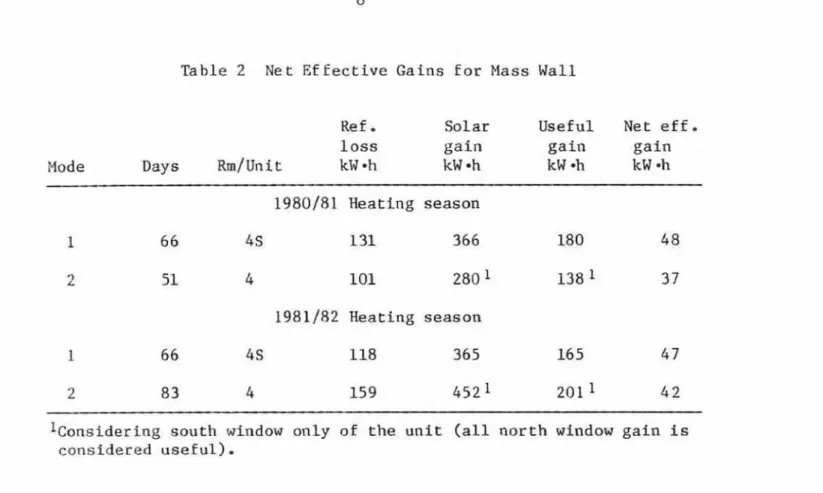
system, is given in Table 2 f a r both heating seasons. To c a l c u l a t e the r e f e r e n c ~ loss of the mass wall, the Loss coefficient of t h e wall system i s obtained by subtracting t h e calculated less coefficient of a l l other
e n v e l o p e components
from
the UA for the room. The HA value of t h e mass-wallsystem was calculated as 3.5 W/K compared t o 8 . 9
WIK
f o r t h e window by i t s e l f ( b o t h v a l u e s include framing).
Under the operating conditions described, the mass wall has a n e t e f f e c t i v e g a i n i n all cases. In o t h e r words, i t perform b e t t e r than a
p e r f e c t l y i n s u l a t e d
wall.
This
is due to the solar gain and the reduced heat loss resulting from t h e added i n s u l a t i o n value of t h e brick wall and a i r space.3 . 4 Performance Comparison Between
Mass-Wall
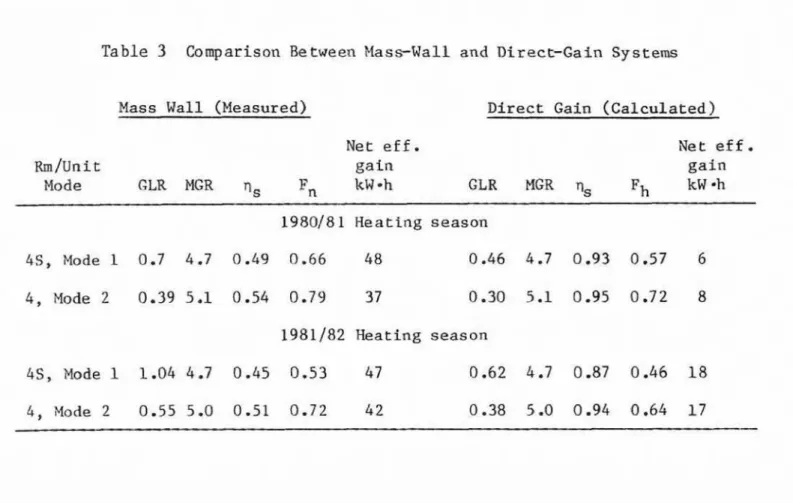
and Direct-Gain Systems A comparfsofi can be made between t h e performance of t h e mass wall and r h a t nE a direct-gain system having the same window area and thermal mass (same MGR) the mass being distributed w i t h i n the room. The performance ofthe mass w a l l measured i n 1980181 and 1981182 is compared to t h e p r e d i c t e d
performance of an equivalent: direct-gafn unit. The d i r e c t s a i n performance
is estimated using the u t i l i z a t i o n f a c t o r curves g i v e n in Reference 2 f o r
t h e same mode and h e a t i n g season as for t h e mass-wall system.
Table 3 gives v a l u e s of the s o l a r utilization factor and t h e n e t effective gain for the mass wall unit and t h e e q u i v a l e n t direct-ga-ln unit. As might
be
expected, Lhe d i r e c t - g a i n u n i t utilizes a significantly largerp o r t i o n of the solar g a i n . Under t h e c o n d i t i o n s specified, b o t h the d i r e c t -
gain and the mass-wall systems make
a
p o s i t i v e contribution to the h e a t i n g requirement. For t h e direct-gain unft, this means t h a t a sufficient amountof additional s o l a r energy was utilized to offset the a d d i t i o n a l window
losses.
In all
of the cases i n T a b l e 3, t h e n e t effective g a i n of the mass wall i s higher than that of the window, whfch means a lower energyconsumption. The difference is small, however, a rnaximrrn of 42 kW*h f o r t h e
gain has a
large
associated u n c e r t a i n t y (in the order of 5 0 % f o r t h eexample gf ven in Reference
1).
This s h o u l d be considered when attempting t odraw conclusions.
The
d i r e c t - g a i n system would overheat, while t h e masswall s y s t e m wouldnot. This overheating
should b e L i m i t e d , however, j u d g i n g by the small number of overheating hours ( a maximum of 3 3 % of the time) f o r d i r e c t - g a i n U n i t s 2 and 3 , with v a l u e s o f MGR encompassing that o f the u n i t underconsideration (MGB = 4.7 to 5.1) as g i v e n in Reference 3 .
I n general, under the conditions in t h e t e s t f a c i l i t y , t h e mass wall
performed s l i g h t l y better than a d a u b l e g l a z e d window because of t h e e x t r a insulation of the mass-wall assembly and a l s o because, in the direct-gain
unir, t h e window area was n o t optimrn. The results should d i f f e r f o r e t h e r conditions ar o t h e r glazings. F o r example, f o r a d i r e c t - g a i n unit in Mode 1 ( s o u t h room only) with t r i p l e g l a z e d south w i n d o w (II =
1.8
~ / m k
andSC = 0.81) and the same amount of thermal mass as t h e masswall u n i t
(GLR = 0.49
and MGR =
5.0 f a r1980J81
conditions) t h e n e t effective g a i n iscalculated to be 91 kW*h, which is higher than t h a t o f t h e mass wall. A direct-gain system with a window of b e t t e r thermal p r o p e r t i e s than d o u b l e g l a z i n g ( t r i p l e g l a z i n g or '"super windowm' ) would, therefore, result i n a lower purchased heating requirement t h a n t h e mass-wall system. A mass
w a l l may be considered as complementary t o a d i r e s e g a i n system.
It
maybe
used instead of a d d i t i o n a l windows when an increased s o l a r contrPbatiwn is
requtted. The m a s s w a l l component would t e n d t o reduce t h e p o t e n t i a l f o r overheating and d e l f v e r s o l a r h e a t in the e a r l y e v e n i n g , thereby s a t i s f y i n g
a g r e a t e r p o r t i o n of
t h e
load. Thethermal
b e n e f i t s of mass w a l l s must, however, be weighed against other f a c t o r s such as economics and loss ofd a y l i g h t and view. They should perhaps be regarded as a t y p e o f s o l a r
collector wall and compared w i t h
walls
rather than windows.4 .
CONCLUSIONS
The
p r e s e n t experimental and a n a l y t i c a l r e s u l t s indicate that, forthese c o n d i t i o n s , t h e following conclusions can be drawn:
(1) A mass-wall system produces a n e t effective gafn to the apace. That means that the u s e f u l solar galn exceeds rhe system l o s s e s or that t h e
mass-wall system performs better than a perfectly i n s u l a t e d wall.
(2) A mass-wall system without night i n s u l a t i o n (or
wirh
poor night:i n s u l a t i o n ) has a much lower utilization of solar gain than a d i r e c e g a i n system of the same MGR. However, due to its higher i n s u l a t i o n
value compared to a d o u b l e g l a z e d window, i t : could r e s u l t in a higher net eEfective gaPn.
( 3 ) A direct-gain system with triple-glazed windows r e s u l t s in a higher net e f f e c t i v e gain or lower purchased h e a t i n g requirement than a m a s - w a l l sys tern.
REFERENCES
1, Barakat, S.A.
NRGC Passive Solar
T e s t Facility, Jkscription and DataReduction, B u i l d i n g Research N o t e 214, D i v i s i o n of Building Research,
National Research
Council
Canada, Ottawa, 1984.2. Barakat, S . A . , and R.M. Sander. Utilization of Solar Gains Rrough
Windows f u r H e a t i n g Houses, Building Research N o t e 184, Division of
B u i l d i n g Research, National Research Council Canada, Ottawa, 1982.
3. Barakat, S.A. NRCC Passive Solar T e s t Facility, Performance of Direct Gain U n i t s , B u i l d i n g Research Note 215, D i v i s l o n of Building Research,
maim r n ? Q
d o d
s P.4e
&E >
2
'
cd 4w
C * bOL - 5
(U LId ;
-
+ 5 tcl a + ar to O B P m s !4 d64
4 4 6 m2Ii w es
+
as
v-
m w d U S r d W ' u m 3 0 0 3 H 4 U 0 CI - 0-
X O . rd a?5
5
U U u 0 0 - 0-
> =
-VE+
0 a U m h~
a u r( c 3u3q9
a4 m 4
I N N N N NTable
2
Net Effective Gains f o r Mass WallRef, S o l a r Useful N e t e f f
.
loss gain gain gain
Node Days ~ m / ~ n i t
kW
-hkW
a hkW
*hkW
*h -- -1980/#l
Heating season I 6 6 4 s 131 366 18 0 48 251
4 101 280 138 3 7 1981/82 Heating season 1 66 4 S 118 345 16 5 4 7 2 83 4 159 4 5 2 2101 4 2k o n s i d e r i n g south window o n l y o f t h e unit Gall n o r t h window g a i n is considered u s e f u l ) .
Table 3
Comparison Be tween MassWall and U-Prect-Gain SystemsMass Wall (Measured) Direct Gaia (Calculated)
Net: eff. N e t c f f . ~ o l J ~ n i t g a i n g a i n Mode