OR Spektrum (1998) 20:109-122
@ Springer-Verlag 1998
QOBJ modeling
A n e w a p p r o a c h i n d i s c r e t e e v e n t s i m u l a t i o n A. Stagno I , P. Ch6nais 2, Th. M. Liebling 1
1 Department of Mathematics, Swiss Federal Institute of Technology (EPFL), CH-1015 Lausanne, Switzerland 2 Schindler Elevator Ltd, Research and Development, CH-6030 Ebikon, Switzerland
Received: 19 September 1996 / Accepted: 2 July 1997
Abstract. This paper deals with a new discrete event simu- lation modeling concept, called
qobj,
which comes from two well-known paradigms:objects
andqueuing networks'.
The first provides important conceptual tools for model organi- zation, while the second one allows for nice visualization of models' internal state and processes. Thanks to the in- tegration of these two paradigms, theqobj
concept allows the suppression of several dichotomies characterizing current simulation modeling approaches. For instance,qobj
allows the description of system elements which are both mobile and able to do processing, and allows the dynamic instanti- ation of static and mobile elements during simulation. The design of lift group models for an industrial project illus- trates the main features of theqobj
concept.Zusammenfassung. Vorliegende Arbeit pr~isentiert
qobj,
ein neues Modellkonzept zur Diskreten Ereignis-Simulation, das die Vereinigung yon zwei bekannten Simulations-Paradig- men: den Objekten und den Warteschlangen-Netzwerken darstellt. Dabei bringt das erstgenannte wichtige Hilfsmittel zur Modell-Organisation und das zweite seine angenehme Art die Veranschaulichung innerer Zustfinde und Prozesse. Diese Vereinheitlichung gestattet die Aufhebung verschiede- ner Dichotomien herk6mmlicher Simulationskonzepte. So erm6glichtqobj
z.B. das Bestehen beweglicher Prozessoren, sowie die Kreation statischer und beweglicher Elemente w~ihrend des Simulationsablaufs. Die wichtigsten Eigen- schaften desqobj
Konzepts werden an Hand des Aufbaus eines in der Praxis eingesetzten Aufzugsgruppen-Simulators illustriert.Key words:
Qobj
modeling, discrete event simulation, graphical simulator, lift group modelingSchliisselwiirter:
Qobj
Modellierung, Diskrete Ereignis- Si- mulation, graphischer Simulator, Aufzugsgruppen-Simula- tionCorrespondence to:
Th. M. Liebling1 Introduction
This paper presents a class-representative case of an indus- trial lift group modeling process, where existing discrete event simulation concepts do not apply well, and for which a new simulation paradigm and its related simulator have been developed.
Existing simulation paradigms sometimes fail to catch reality because of the modeling dichotomies they introduce between
active
(able to process information) andpassive
modeling elements, between
mobile
(able to move from one active element to another) andstatic
modeling elements, and between the elements that can be created during the simula- tion and those that cannot. Obviously, all these dichotomies provide a structured framework which helps the user at mod- eling, as long as the model is simple. But, with growing model complexity, these guidelines become rigid obstacles surmounted only with pain and detours.A new modeling concept, called
qobj,
has been devel- oped for the design and the development of complex models. This concept, coming from two well-known paradigms:ob-
jects
andqueuing networks,
allows the suppression of the dichotomies described above. In particular, it can be instan- tiated during the simulation, it can represent both mobile and static elements, and both active and passive elements, it is thus possible to represent the models exclusively withqobj
as building blocks. Moreover, it allows a good organization of the models, and provides the mechanisms necessary to visualize state and process of the models. This polyvalency offers extended modeling and simulation control capabili- ties, but as a counterpart demands an increased abstraction effort from the user.
The design of a general industrial lift group model, de- scribed in Sect. 2, and the comparison of some representa- tive simulation paradigms, presented in Sect. 3, will show the drawbacks of the modeling dichotomies introduced by the existing discrete event simulation approaches. Section 4 presents the
qobj
concept developed with the aim to suppress these dichotomies. Section 5 presents the general QOBJ- CEOS simulator, using theqobj
lift group model as an ex- ample of implementation. Finally, Sect. 6 shows how the lift groupqobj
simulation model is used in order to evaluate and validate a new general basic assignment algorithm.2 L i f t g r o u p c o n c e p t u a l m o d e l
Arguments in favor of a new simulation modeling concept are presented using the design of a general lift group sim- ulation model. This model, representative of a class of sys- tems defined below, has been developed for the performance evaluation of new assignment algorithms designed to be able to control any lift group configuration. In view of this re- quirement, the model must allow the representation of any possible lift group configuration.
The development of lift group models includes the identi- fication of the information needed to represent any lift group configuration as well as that required by the assignment al- gorithm. Cabin motion modeling will help understand this process. Figure 1 represents schematically the trajectory of a cabin in a speed/position state space. The horizontal axis represents floor position, and the vertical axis cabin speed. Not all points of this continuous trajectory are important for the assignment algorithm, but only those represented by cir- cles. These points carry the following types of information:
ETAGE 1
O PO:NTS IMpORT~TS SELECTEURS 9 OBaECT: FS
~:rAn}: 2 ~:'rAC~: 3
Fig. 1. Cabin trajectory in the speed/position state space
i . / "
sl,2LI ~ S 2 , 1 L I
h 3 L ]
Fig. 2. Conceptual model of the cabin position in the speed/position state space
- Cabin destination floors are the floors the cabin is al- lowed to reach. Sometimes, there are blind zones, which correspond to management floors, secret laboratories ... where not all cabins, but only those with restricted access can stop.
- Selectors are the points in the speed/position state space beyond which a cabin cannot stop at the next floor, even if the assignment algorithm has sent an according order.
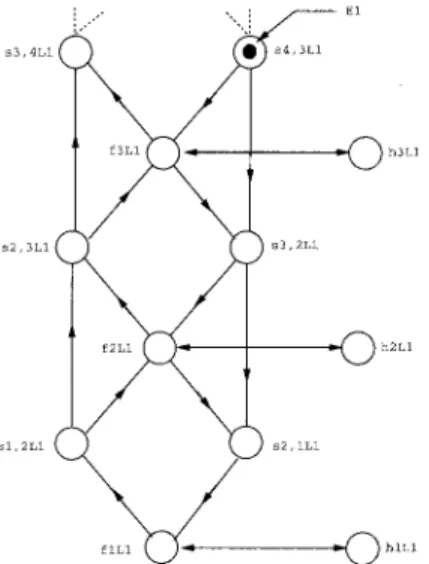
- The discrimination points are system configuration de- pendent. They are set by the user, to follow, for instance, the cabin trajectory inside a long blind zone, thus pre- venting the assignment algorithm from losing it in this zone. This type of information is not always necessary. Figure 2 represents one conceptual model of a possible cabin trajectory built using this restricted information.
This model is a graph, where vertices are called places, and links between places are called arcs. No discrimination points have been used in this example, but the following additional places have been introduced in order to represent two lift group states that are relevant for the assignment algorithm:
- Places h (home). When an elevator token enters these places, it means that it is parked. This happens when a lift has neither passengers nor orders to serve.
- Places c (cabin). When an elevator token enters these places, it means that the operation is transferred to the cabin, which is responsible to open doors and exit pas- sengers.
In this model, in order to point out at each moment the current cabin position, a state marker, called token, is moved from place to place. Its trajectory in the graph reproduces the cabin trajectory in the speed/position state space. Each time the token El moves from one place to another, the assignment algorithm is informed and can update its internal information. Token motions from place to place take time. Durations depend on the real system features (cabin speed, acceleration, height between consecutive floors, etc.).
There is a graph for each particular real lift group. Even if each graph has its own number of vertices, durations and relationships between vertices, depending on the real system features, all such graphs contain exclusively the information types (place types) described above. This uniformity allows the development of a general assignment algorithm able to control any lift group.
The translation of the conceptual model into a computer program is related to the question: "who" controls E l ' s mo- tions. There are at least two alternatives. In one approach, each visited place controls the token under normal operat- ing conditions, but a higher level place, called agent, takes over control of the token in emergency situations. In a sec- ond approach, the agent always controls the token El. In this paper, the second approach has been chosen. Figure 3 sketches the behavior of the agent, called LIFT, that controls the places of Fig. 2. The symbol # represents the level of a floor and @ the identification number of a lift. This function is associated to the LIFT agent, and is called enter function. The agent LIFT, is called the pilot of the places of the graph of Fig. 2. Section 5 describes how pilot places are set.
Figure 4 shows the complete conceptual model, built only with relevant information for the assignment algorithm. In this model, there are three types of agents: FLOOR, CABIN and LIFT. FLOOR is responsible to serve passengers at floors. It puts them in queues, where they wait for cabins. CABIN is responsible to manage cabin doors and passengers inside the cabin. Finally, LIFT is responsible to move cabins from floor to floor according to the ASSIGNMENT ALGORITHM orders and the cabin passenger destinations. The model uses
A. Stagno et al.: QOBJ modeling 111
A l g o r i t h m 1 LIFT entry function. /*
- the symbol # is the level of a floor and @ the identification number of a lift.
- dest_floor is the destination floor position of the elevator token. - curr_floor is the current floor position of the elevator token. - curr_class is the class of the current place of the token. - dest_class is the class of the destination place of the token.
- MOVE is the function that moves tokens from place to place. Its parameters are: the token to move, its destination place and the transition duration. */
case curt_class f#L@:
if dest_floor > curr_floor then
MOVE( El, s#,#+lL@, duration_f_to_s); else if dest_floor < curt_floor then
MOVE( El, s#,#-lL@, duration_f_to_s ); else
if dest_class = h then
MOVE( El, h#L@, duration_f_to_h ); else
MOVE( El, c#C@, duration_f_to_c ); s#,#+lL@:
if dest_floor > curr_floor then
MOVE( El, s#+l,#+2L@, duration_s_to_s ); else
MOVE( El, f#+lL@, duration_s_to_f ); s#,#-lL@:
if dest_floor < curr_floor then
MOVE( El, s#-l,#-2L@, duration_s_to_s ); else
MOVE( El, f#-lL@, duration_s_to_f ); end
Fig. 3. Part of LIFT entry function
three types of tokens: PASSENGER, ELEVATOR ( E l belongs to the ELEVATOR type) and ACTIVATOR. PASSENGER are sent by the trq[fic g e n e r a t o r I (not represented) to places t F @ (Travel request). Arrival of an ELEVATOR token on the place p F @ (Passenger) marks the end of the cabin door opening phase, whereupon PASSENGERS move from place t F @ to cabin q C @ (Queue). The ACTIVATOR token synchronizes the doors opening and the passenger entry operations. An- other case of synchronization between two agents is repre- sented by the transition of token ELEVATOR between places f 3 L 1 and c 3 C 1 . When the cabin stops at a floor, the token E1 arrives in p l a c e f 3 L 1 . Control of this token is transferred from the LIFT to the CABIN, then cabin doors are opened and the ELEVATOR token is sent to the FLOOR through the tran- sition c 3 C ! to p F 3 . Passengers can exit the cabin (transition from q C 1 to x F 3 ) or enter the cabin as mentioned above. In this scenario, the token E1 is transferred successively under the control of three agents and is used to synchronize their control activities.
3 E x i s t i n g s i m u l a t i o n p a r a d i g m s
The translation of the conceptual lift group model into a dy- namic operating computer simulation program requires well- adapted simulation language features. The main modeling el- I The traffic generator is the module that creates passengers in a lift group simulation model.
ements of the lift group conceptual model to be represented in the computer program are the following:
- ELEVATOR tokens must be mobile and able to process information.
- PASSENGER tokens must be instantiable, mobile and able to process information.
- PASSENGER and ELEVATOR tokens must stay in places as long as necessary.
- Places and agents must be static and able to process information.
- Communication of active elements (elements that pro- cess information) must be visible.
- Operating control can be dynamically changed during simulation.
In short, the simulation language must provide at least a modeling element able to represent at the same time, mobile, active and instantiable elements, that allows the user to visu- alize communication of active element and that allows also a dynamic modification of operating control during simula- tion. Five representative existing simulation paradigms have been evaluated using the following modeling criteria:
- a c t i v e ~ p a s s i v e says whether an element is able to do pro- cessing or not,
- m o b i l e ~ s t a t i c says whether an element is able to move from queue to queue or not,
- i n s t a n t i a b l e says whether elements may be instantiated during simulation or only at start,
- a m o r p h o u s ~ r e a c t i v e says whether a queue allows a token to stay in it without processing or not,
- c o m m u n i c a t i o n v i s u a l i z a t i o n says whether communica- tion between active elements is visible.
Table 1 summarizes the results of this comparison.
SIMAN V [7] models are sequences of b l o c k s that repre- sent the processing to be applied to mobile elements, called p a r t s . Blocs are static, not instantiable and active elements (they can act on mobile and on static elements), while parts are mobile, instantiable and passive elements. Once a part enters a queue, its processing is started as soon as the down- stream resource (reserved using the SEIZE block) is free, thus making queues reactive.
QNAP2 [9] models are built using s t a t i o n s and c u s - t o m e r s . A station is composed of a queue and one or more servers. Stations are static, not instantiable, reactive and ac- tive, while customers are mobile, instantiable and passive. Customer services are described inside stations, using a pow- erful P a s c a L - l i k e language. Such a language allows the def- inition of a service that can be as complicated as necessary. Like SIMAN V and QNAP2, P e t r i n e t s , considered here as a simulation paradigm, are also composed of static, not in- stantiable and active elements, called p l a c e s , and of mobile, instantiable and passive elements, called t o k e n s .
SIMULA-67 [3] provides a different modeling approach. This language provides, through the s i m s e t package, the con- cepts of q u e u e s and c o r o u t i n e s necessary to build simulation programs. As SIMULA-67 is an object oriented language, all the modeling elements can be instantiated. Moreover, and on the contrary to the SIMAN V, QNAP2 and P e t r i n e t s ap- proaches, SIMULA-67 queues are static, amorphous and pas- sive, while coroutines are mobile and active.
1 PASSENGER . . . CABIN_ ELEVATOR - - 3CI ACTIVATOR qCl / ... ~[ ... . . . : :'::" / g3Cl LIFT
... /
iiiii
xF39
/
Fig. 4. Final lift group conceptual model
- - •
h3Ll S3,2LI - O h~L~s2, ILl
: 9 h~L~
Table 1. Main features of existing simulation paradigms
A C T I V E P A S S I V E S T A T I C M O B I L E I N S T A N . Q U E U E C O M M .
SIMAN V queue part queue part part reactive visible
QNAP2 station c u s t o m e r station customer customer reactive visible
PETRI NETS place token place token token reactive visible SIMULA-67 coroutine queue queue coroutine q u e u e amorphous non visible
coroutine
This comparison shows that none of these simulation languages provides a modeling element having the features presented at the beginning of this section, i.e. with an amor- phous queue, that can be instantiated during simulation, that allows the representation of both mobile and static and both active and passive elements, and that allows the visualization o f communication between active elements. Rather, QNAP2-
like approaches do not allow instantiation of mobile and active elements, while SlMULA-67-1ike approaches do not allow visualization of active elements communication. The next section will describe the most important features of the
qobj paradigm developed on the basis of these observations.
4 Qobj
modeling concept
There are two ideas at the origin of the qobj concept devel- opment. Firstly, even if the existing simulation paradigms make differences between mobile/static and active/passive elements, actually these elements can be included in a more general concept, which is mobile, active and instantiable. In- deed, static elements can be considered as mobile elements that do not move, passive elements as active elements that do not operate and non instantiable elements as simply instan- tiable elements that are not instantiated. This is in agreement with the French dictum saying qui peut le plus peut le moins!
Secondly, as queuing networks allow visualization o f ac- tive elements communication and object oriented approaches permit element instantiation, good model organization and element reutilization, the new concept must integrate these paradigms in some way.
Thanks to these observations and the integration of the best features of both queuing networks" and object ap- proaches, it has been possible to build a unique concept that suppresses all above dichotomies, allows for a good orga- nization o f the models and for a nice visualization of the communication o f the active elements.
It should be noted that the qobj paradigm is not just another object oriented simulation approach, comparable to languages like Simplex II (Eschenbacher [4]). Indeed, even though they bring interesting model organizing features, they do not suppress the limiting dichotomies discussed previ- ously, which can be a drawback when constructing complex and realistic models.
4.1 Main qobj attributes
A qobj is an object with the following elements: a unique
identifier, a class, a set o f attributes, a queue which can receive qobj, a parent (which is a qobj), a pilot (which is
a qobj too), an entry function, an exit function, a starting function, an ending function, a set of entering arcs and a set
of exiting arcs.
Class. Each qobj belongs to a class. The class defines the be- havior and the attributes the qobj acquires when it is instan- tiated. There is a default class, called Q_QOBJ, from which users can derive new classes simply by defining or redefining the following parameters: the class name, the enter, the exit,
the starting, the ending and attributes functions (described below).
A t t r i b u t e s . There are system and user attributes. Attributes allow the association of information to qobj. They also pro- vide a means of communication between qobj
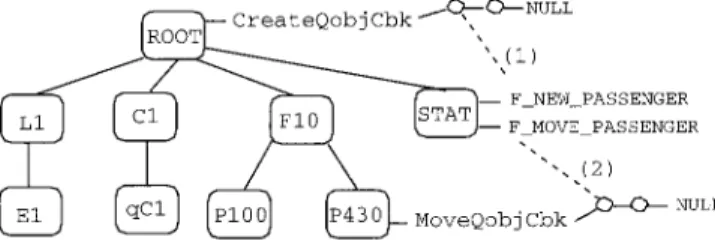
through the use o f callbacks. Indeed, each attribute has a list o f callback routines that are executed each time the value o f the attribute is modified. Figure 5 shows how two sys- tem callbacks MoveQobjCbk and CreateQobjCbk are used in order to follow the motion of PASSENGER type qobj. Each time a qobj is created, the user routines linked to the call- back CreateQobjCbk are executed. To be informed of the creation of a new passenger, the qobj STAT must record its
A. Stagno et al.: QOBJ modeling
Creat eQobj
Cbk/IO~-O---NULL
C77
rsTA l--
PASSENGER
C
Fig. 5. Example of the use of the system callbacks MoveQobjCbk and CreateQobjCbk
113
(1) (2)
d e l a y
. . . ) ' " :: serv
Fig. 6. Qobj pilot entry and exit function activation after a MOVE
function F_NEW_PASSENGER in this list. Afterwards, in or- der to be informed of the motion of the created PASSENGER type
qobj,
it must record its function F_MOVE_PASSENGER in the callbackMoveQobjCbk
of the created passenger. Dur- ing simulation, newqobj
can record themselves into a call- back, whereas others may become unrecorded.Queue.
Qobj
can communicate through execution o f call- back routines, but their main feature is to be able to com- municate through the exchange o fqobj
which circulate into their queues. This allows the visualization of the communi- cation between active elements.Qobj
exchange allows mod- eling asynchronous (time delayed) communications. Aqobj
can send any
qobj
of the model to any other unless theqobj
to be moved is already moving. The transition o f a
qobj
from one queue to another takes simulated time, even when the modeled duration of the transition is null.Qobj
queues do not have a priority rule of typefifo
orlifo;
they are only places where tokens (token stands for "movingqobj")
wait to be served. Ordering ofqobj
in a queue is the responsibility of the user. W h e n a token enters a queue, it is served by a service function (theenter
function of thepilot
(described below) of the queue). A t the end of the service, the token is either destroyed or moved to another queue or left in the queue. The latter possibility is allowed by the fact thatqobj
queues are amorphous.As
qobj
can remain passively in a queue, their reacti- vation and synchronization with otherqobj
must be man- aged by the user. This is not the case in other queuing net- work discrete event simulators, Q N A P 2 o r SIMAN V, where synchronization and reactivation of entities is automatically managed by the simulator. The explicit management o f syn- chronization and reactivation can be annoying in some cases. However, it allows more flexibility when the control of the operation of the model is complicated, for example when the model represents a complex system.Parent. W h e n a
qobj
is created it is not necessarily inserted into a queue. It can "float" anywhere in the model, withouta parent.
The first time it is moved into a queue, it acquires a parent. The parent of aqobj
is simply the owner o f the queue to which it is attached at a given moment. The parent of aqobj
changes when theqobj
moves from one queue to another. During transitions, a token carries with it allqobj
whose father it is.
Pilot, entry function and exit function. Consider Fig. 6. W h e n token D moves from
qobj 13
toqobj C,
several op- erations are realized. First, theexit function 'fexit"
of pilotP(B)
of the originqobj B
of the token is executed. There- after, theentry function 'renter"
o f pilotP(B)
of the desti-nation place C (place stands for
"qobj
receiving tokens") of the token is executed. Token processing is done inside these functions(entry function
andexit function). Entry functions
control token routing, while
exit functions
update internal data of their associatedpilot.
Theexit function
is necessary to keep internal integrity of pilots, because anyqobj
can move any otherqobj.
Indeed, if aqobj
different from the pilot o f a queue moves a token out of that queue, the pilot must be informed in order to update his internal data. This information is given b y theexit function.
Such type of func- tion is unnecessary whenqobj
are moved only by the pilots of the queues.The pilot of a
qobj
can be either theqobj
itself or anotherqobj
of the model. This type of control allows centralizing or distribuing services inside the model according to the operating conditions. We can imagine two extreme configu- rations: in the first, all the queues o f the model are m a n a g e d by only oneqobj
and in the second, eachqobj
manages its own queue. In the first case, the system is totallycentralized:
there is only one pilot for all the qobj, while in the second case, the system is completely
distributed:
eachqobj
being its own pilot.The pilot of a
qobj
can be changed during the simu- lation, thus making it possible to delegate control of the system to the lowest levelqobj
when the system operates normally and to centralize it in case o f an emergency (fire, breakdown, etc.). The pilot mechanism introduces a new form of organization into the models based on the central- ization/distribution of the control.Starting function and ending function. At the beginning o f simulation
qobj
may need to initialize their internal data. For that purpose, astarting function
is associated to eachqobj.
Likewisean ending function
is associated to eachqobj
to update its internal data at the end o f a simulation run.
Starting functions
o f eachqobj
are executed before the first token is moved. Similarly, the simulator executes theending functions
at the end o f each simulation run. Asqobj
are not ordered in queues, it is impossible to know their starting or ending order. If a precise order is needed, it must be coded in the model. In this case, an initializing token is created by one o f the
qobj
o f the model and is m o v e d fromqobj
toqobj
in the desired order.A r e s . Arcs are elements introduced to ease construction o f simulation models and to serve as information support, as in Fig. 4.
Arcs
belong to classes, have attributes, but do not have functions, indeed, processing is only accomplished in- sideqobj
service functions. Attributes are values or functions which, for instance, return a transition duration, or informa-tion on tokens that can do the transition. For a
qobj,
the set of its entering and exiting arcs represents information that can be used in itsenter
andexit
functions.4.2 Main qobj concept features
The particular structure and behavior of the
qobj
concept confer several interesting features to it. Some are inherited from theobject
andqueuing network
paradigms, while others are completely original.Qobj
concept polyvalency. Inqobj
simulation models there is no difference between dynamic and static elements. There are onlyqobj,
that can be both mobile or static depending on their use. This feature is called theqobj
concept polyva- lency. Theqobj
modeling approach goes further, as it is op- posed to one of the current trends, supported by the graphic simulators, which recommend the development of special- ized modeling concepts such as machines, trucks, pallets, conveyors, etc. It is easy to use these elements with corre- sponding systems, but as they are specialized, they can only be used for these systems and not for others. On the con- trary,qobj
is a general modeling concept, that can be used for a large number of systems.Organization forms in the
qobj
models. Inqobj
mod- els there are three types of organization:hierarchies',
by parent links;networks,
byqobj
motions; andcentraliza-
tion~decentralization
of control, by the pilot and the service functions mechanism.Hierarchical organization.
Theqobj
concept polyvalency al- lows the design of hierarchical models with many different levels. Indeed, since there is only one type of element in the model (theqobj)
and since eachqobj
has a queue, anyqobj
can be the son of any otherqobj.
With alternative sim- ulation~ approaches, that have only one hierarchical level: queues that control tokens, it is harder to model hierarchical systems.Queuing network organization. Qobj
moving between queues can describe flow of both information and materials. Mod- els can be considered as networks whose nodes are theqobj
and whose links are the transitions from one
qobj
to an- other. Theqobj
of a given class generally visit a subset ofqobj
of the model. Linking together two consecutiveqobj
on such a path results in a network representing aprocess.
This form of organization comes from discrete event simulation queuing network.Centralization~distribution organization.
This form of orga- nization comes fromqobj
mechanism based on the pilot and the service functions(entry
andexit
function). This mecha- nism allows the separation of the representation of the sys- tem from its control. Inside the models, it is possible to modify the distribution of the control simply by modifying the pilot and the service functions of theqobj
during the simulation. This form of organization does not exist in other queuing networks approaches. Indeed, in queuing networks, token motions depend on implicit rules of the network el- ements (servers, resources, semaphores, etc.), which block or release tokens according to their intrinsic simulation be- havior. The user gathers these elements and verifies that theresulting model produces the correct behavior. The control of the tokens is completely (in S~MAN V) or partially (in QNAP2) contained in the network, as well as in Petri nets where token transitions depend only on the state of the net- work and on its structure. The implicit motion of the tokens, as well as the dichotomies introduced between mobile/static and active/passive elements, are a help to the user, but only until the model becomes too complex, at which time this aspect turns into an obstacle hard to surmount.
Types of communication in
qobj
models. There are two types of communication inqobj
models: one is based on the exchanges ofqobj
and the other on the execution of callback routines.Communication based on qobj exchange.
This type of communication, which comes from the queuing network ap- proach, has the nice property to be visible.Qobj
motion is particularly well adapted for asynchronous communication description.Communication by callbacks.
This type of communica- tion allows the description of synchronous exchanges of in- formation. Compared to theqobj
exchanges, this type of communication is less expensive in execution time, because it consists only of direct routine calls without using the scheduler which controls the simulated time.Integration of paradigms. The
qobj
concept does not ex- clude other types of paradigms as for instance Petri nets or neural nets, rather it integrates them. Indeed, these ap- proaches can be used for the implementation of theqobj
service functions. This property, coming from the object ori- gin, allows the use of the most appropriate formalism there where it is needed.
4.3 Qobj modeling rules
Basically, the
qobj
modeling process consists in identifying the elements of the system to be represented byqobj.
Theqobj
modeling rules come directly from the features of theqobj.
As aqobj
can be either static or mobile and either active or passive, it can represent: aprocessing element
of the system, amobile element, a state element, a state marker,
or a
communication element.
A processing element
is an element that transforms other elements, computes, optimizes, etc. All these operations can be realized byentry
andexit
functions of eachqobj.
In a lift group, examples of processing elements are assignment al- gorithms, logical modules that generate passengers, statistics modules, etc.A state element
represents either a particular state of the system (out of order, working, waiting for furniture, ...), or an event that provokes the start of an activity (arrival of a cabin at a floor .... ), or finally an activity of a more com- plex process (painting, machine operating a part .... ). In the model, wherestate elements
are represented byqobj,
state and process models can be nicely visualized. A token (an- otherqobj),
which moves from onestate-qobj
to another, is sufficient to mark the current state of the model and its route is sufficient to allow process visualization. Such a token is calledstate marker.
Section 2 will provide an example of a state marker used in lift group models.A. Stagno et al.: QOBJ m o d e l i n g 115
A communication element
is a message exchanged be- tween two processing elements, it can serve to send infor- mation, or to synchronize their activity. Acommunication
element
can be also astate marker,
in which case it gives the state o f the model at each moment.It should be noted that the role o f a
qobj
is not fixed, but it can vary during the simulation. For instance, at some given moment it can be a processing element and at another, a message. A passenger can be thought of as a communica- tion element between thefloor
and thecabin,
but also as a processing element when it receives orders from the system that indicate him which cabin to enter. We can also notice that aqobj
can be a processing element at a given m o m e n t and a state marker at others. For instance, as described in Sect. 2, aselector
is a lift engine state represented by aqobj,
but it is also a processing element which moves the
elevator
tokens.
5 QOBJIGEOS s i m u l a t o r
This section describes how the conceptual lift group sim- ulation model, described in Sect. 2, has been translated in a computer program using the general purpose QOBJ-GEOS simulator which is based on the
qobj
paradigm. The first QOBJ-GEOS modeling step consists in defining aqobj
class library covering the domain of interest. Then, in any order, the following operations must be realized: build a particular instance o f the model, define the statistics and describe the experiments to run.5.1 Domain-specific qobj library
As the QOBJ-GEOS is a general purpose simulator, the first modeling stage consists in the definition o f a domain-specific lift group
qobj
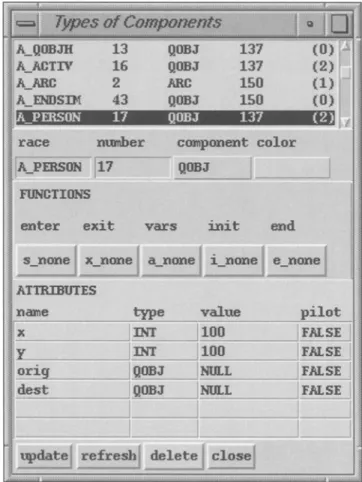
library. Newqobj
classes are built using the w i n d o w o f Fig. 7. For that, the user must provide the class name, the type o f the new class(qobj
orarc'),
the color, the class parameters and theqobj
class service functions. These functions are written in a c + +-like programming language developed specifically for the QOBJ-GEOS simulator. All theqobj
o f a same class have the same parameters, but can have different parameter values. Parameter values are set during the model building stage (Sect. 5.3).5.2 Statistics definition
QOBJ-GEOS allows the definition o f three types o f statis- tics. These statistics are defined in terms o f
qobj
and their parameters:- SOJTIME: measures the time spent by a type of
qobj
ina qobj
of another subset. For instance, it is possible to measure passenger waiting time in a lift group by mea- suring the sojourn time o f all theqobj
o f type PERSON in anyqobj
o f type A_PLACEQ (placeqC@).
- TRAVTIME: measures the time necessary for a given
qobj
(belonging to a user-defined subset) to move from a
qobj
(of a second subset) to another
qobj
(of a third subset). For instance, this type o f statistic can be used to measureFig. 7. Class definition w i n d o w
the time required for a
qobj
of type ELEVATOR to go from aqobj
A_PLACEP to aqobj
A_PLACEP (placepF#),
i.e. from floor to floor.
- USERDATA: measures the successive value changes o f
qobj
andarc
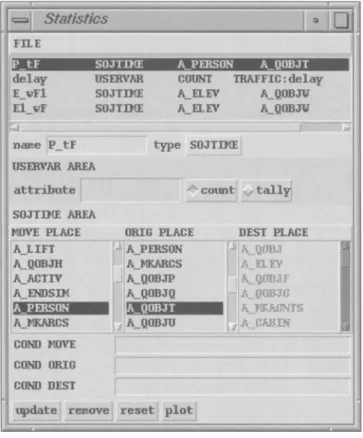
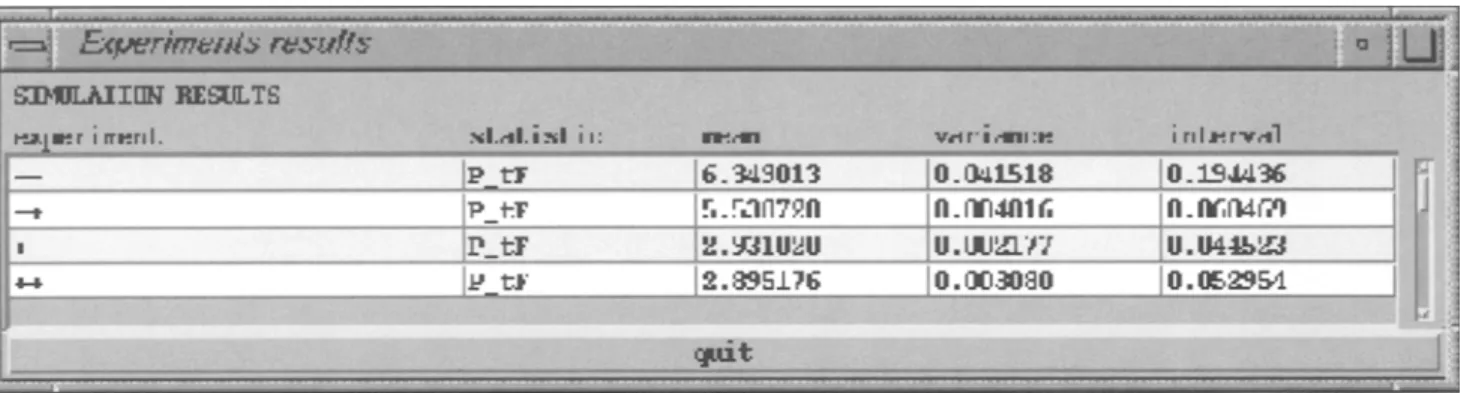
parameters. F o r instance, this type o f staffs- tic can be used tc~ measure queue levels over time. It is possible to measure value changes only, or value changes over time (integrals).Figure 8 shows the statistics definition window. This ex- ample refers to a SOJTIME type statistics definition, used to measure waiting time o f passengers at a floor. It is possi- ble to display several curves in the same w i n d o w and plot discrete observations and mean continuous curves. Figure 9 contains two curves: mean passenger waiting time and their mean inter-arrival time. This window also contains the indi- vidual observations o f each statistic. For each statistic, the mean value, the confidence interval at 95% and the number o f observation can be obtained (Fig. 10). It is also possible to get the cumulative empirical distribution and the transient curve for each statistic.
5.3 Qobj model building
Model building consists in picking up necessary elements from the class library and parameterizing them (setting at- tributes values) according to model features. These oper- ations can be done either manually using a mouse, or by program when models are too large. For lift group models,
Fig. 10. Passenger waiting time (P_tF) statistics summary
Fig. 11. Initialization of main level
qobj
Fig. 8. Statistic definition window.
Fig. 9. Passenger waiting time and inter-arrival time (observations and mean curves)
Fig. 12. GROUP parameters window
both m e t h o d s have b e e n used. First, m a i n level
qobj
have b e e n m a n u a l l y created (Fig. 11), then service functions of theseqobj
have created their subnets.T h e GROUP s u b n e t is built in four steps. First of all, its
initfunction
m a k e s instances of FLOOR, LIFT a n d CABINqobj
according tofloors
a n dlifts'
variables of theqobj
GROUP and puts them in its queue.Floors
a n dlifts'
variable values are interactively set b y the user through the GROUP p a r a m e t e r w i n d o w (Fig. 12).T h e n the GROUP sends a A_MKQOBJ
qobj
to the first LIFT. W h e n a LIFT receives such aqobj,
it creates its o w n subnet (Fig. 14), then theqobj
A_MKQOBJ is m o v e d to the next lift, then to each CABIN and finally to each FLOOR, until all theqobj
have built their o w n subnet. T h e last operation consists in s e n d i n g aqobj
A MKARCS, following the same circuit, w h i c h indicates to the LIFT, CABIN a n d FLOOR to create the links b e t w e e n theqobj
in their queue.A. Stagno et al.: QOBJ modeling 117
Fig. 13. GROUP initialization subnet
Fig. 15. Specific lift graphic interface
Fig. 14. Part of the model hierarchy
5.4 Animation
The QOBJ-GEOS simulator allows visualizing of
qobj
motion from queue to queue. This form o f visualization corresponds to theqobj
motion from window to window, as a window can always be associated to aqobj
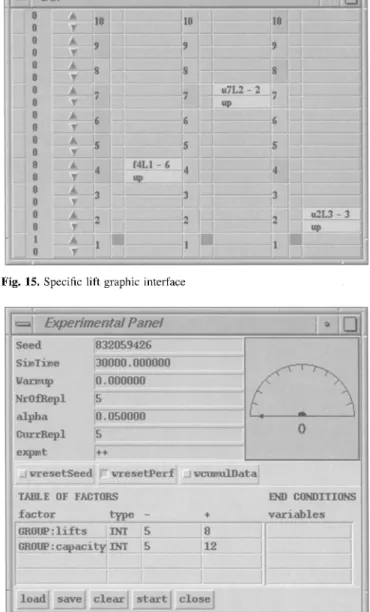
queue contents. More- over, the user is also allowed to include an external graphics interface written in C++ (Stroustrup [11]) and O S F Motif. Figure 15 shows such an interface developed for the lift group models. In this figure the interface has been instanti- ated for a lift group composed of 10 floors and 3 lifts. The third column represents floor buttons state (pushed or re- leased). The fourth, the seventh and the tenth columns show the first, the second and the third cabin buttons state (pas- senger destinations) respectively. The fifth, the eight and the eleventh columns show the assignment orders of these cab- ins. The sixth, the ninth and the twelfth columns show the position of these cabins.5.5 Experiment design
Two types of experiments (Jain [5]) can be defined in QOBJ- GEOS. The first, called 1 k for
simple design,
consists in ex- ecuting several runs, each one differing from the initial run only by one model parameter value. The second type of experiments, called 2 k, consists in running factorial exper- iments. In this type of experiments, the user gives severalFig.
16. 2 k experimental planparameters and defines for each parameter a m i n i m u m and a m a x i m u m value. A t the beginning of the simulation, the sim- ulator computes the 2 k (where k represents the number of parameters) experiments and runs them. Figure 16 contains a 2 ~ experiment definition, where two parameters of the
qobj
GROUP have been selected:
lifts
andcapacity.
Results of the four corresponding runs are illustrated in Fig. 17. These re- sults may be used in a regression meta-model computation that can be used for optimization (Kelton & Law [6]).6 Assignment algorithm
This section shows how the
meta-model
o f Fig. 4 is used by theassignment algorithm
in order to compute its assign- ments. It is also shown how the graphical user interface of the QOBJ-GEOS simulator has been helpful for the assign- ment algorithm validation. The algorithm presented in this section, being mainly developed to validate the simulation model of lift groups, it has the advantage to be very simple.Fig. 17. Results related to 2 k experiments defined in Fig. 16
6.1 Communication between the algorithm and the model
During simulation, the assignment algorithm and the lift group model exchange the following types of information:
- The model sends to the algorithm important trigger events that take place in the model.
- The algorithm reads the model state information for com- puting assignments.
- The algorithm sends orders to the cabins at the end of computations.
These types of information can be expressed within a for- mal communication language based on the state elements represented in the model of Fig. 4.
S t a r t i n g events. The assignment algorithm is informed by its callback routines associated either to the system callback
moveQObjCbk of each token elevator, or to the user callback
pushButtonCbk of each place tF. These routines are executed by the simulator each time a token elevator has m o v e d and each time a floor button state has changed. Information on token elevator position is useful to detect the instants when the cabin has no more destinations to serve, i.e. when the associated elevator token enters one of the places wF or hL
o f the model. Each time the algorithm is called, it computes again all cabin destinations. In some lift groups, it is not only necessary to follow cabin motions but passenger motions too. Some example o f starting events are given below:
<date> E1 pF3 Elevator E1 is in pF3: waiting for passen- gers boarding.
<date> E2 wF5 Elevator E2 is in wF5: cabin C2 parked un- der floor F5 control.
<date> E3 h9L3 Elevator E3 is in h9L3: cabin C2 parked under algorithm control.
<date> P1 tF1 Passenger P1 is in tFl: waiting at floor FI. <date> P3 qC4 Passenger P3 is in qC4: waiting in cabin C4. <date> P9 xF8 Passenger P9 is in xFg: exiting the system. Information on floors button state changes are generated by user pushButtonCbk callback
- when a token elevator leaves a place pF (end of passen- ger boarding).
- or when a new passenger arrives at a floor and pushes a button. The button in a given direction can be pushed only by the first passenger.
In the first case, the algorithm checks whether the leaving cabin has served a floor call, whereas in the second case the
algorithm is informed o f a new floor call to serve. Some examples, valid for a floor with two buttons: one to go up and another to go down, are given below:
<date> tFl 0P There are no waiting passengers at floor FI.
<date> tF3 *P {up} There are waiting passengers to go up, at floor F3.
<date> tF5 *P (up} {down} There are waiting passengers to go up and down, at floor F5. State information. When the algorithm computes the as- signments, it needs some additional information concerning, for instance, the motion direction of the cabins, their serving direction, their position, the number of passengers they con- tain, etc. The assignment algorithm reads this information directly in the model, by examining attributes associated to the qobj and by reading their queues. S o m e example are given below:
! <date> qC1 0P : Cabin C1 is empty.
! <date> qC2 4P {xF4} {xF9} : Four passengers in cabin C2; floors F4 and F9 are selected. In a real system, with two buttons at each floor, the number of passengers is approximately only obtained with a balance in each cabin. In a simulation model, this information can be obtained accurately, simply by reading the qobj contained in the cabin queues.
O r d e r s . The assignment algorithm sends the cabins their new destinations by the means of orders. An order is com- posed o f an elevator identifier and one or many destinations. A destination is one of the places of the model represented in Fig. 4 and sometimes a serving direction. There are three types o f orders: clear orders, service orders and park or- ders. Clear orders allow cancelling of previous orders sent to a cabin. Service orders tell the cabins to serve a particular floor call. Finally, park orders tell the cabins to get parked. Some examples o f orders are given in the array below:
!! <date> E1 Clear previous orders for cabin C1.
!! <date> E1 pF3 (down} Cabin C1 must serve serving di- rection down of place pF3. !! <date> E1 wF1 Cabin CI must park under con-
trol of floor FI.
!! <date> E1 h2L1 Cabin C1 must park under con- trol of the assignment algorithm at floor F2.
A. Stagno et al.: QOBJ modeling 119
6.2 Assignment policy
Assignments of floor calls to cabins are computed using heuristic rules, initially based on common sense and further validated by (simulation) experiments in order to improve their efficiency. The following terms are necessary to under- stand the assignment algorithm.
- A cabin serving direction indicates the floor buttons (uP o r D O W N ) it serves.
- A cabin is parked if its associated
elevator
token is in placewF
or in placehL.
- A cabin is not empty if it contains at least one passenger. - A cabin is served if it is p a r k e d and it receives a new
destination, or if it is not empty.
- Assume that the floors of a building are numbered in an increasing way from the bottom to the top. This number is called floor position.
- A cabin is above (resp. below) a floor, if the cabin goes up and the floor position is g r e a t e r (resp. smaller) than the cabin position, or if the cabin goes down and the floor position is smaller (resp. greater) than the cabin position.
The assignment algorithm (algorithm 2) is composed of three main rules, chosen and organized in order to assign all the current floor calls to the maximum number of cabins.
Algorithm 2 Assignment algorithm.
lif there are floor calls to serve then
2 Assign floor calls to parked cabins, according to their serving direction. 3 Assign floor calls to non empty cabins with the same serving direction. 4 Assign remaining floor calls to not yet served cabins, according to their
serving direction.
5end
Fig. 18. Assignment algorithm
The objective of the step 2 of algorithm 2, detailed in the algorithm 3, is to distribute the floor calls among a maximum number of cabins, by serving parked cabins first. As parked cabins do not have destinations, it is possible to assign them floor calls in any serving direction. Meanwhile, in order to minimize the cabins travel, floor calls assigned to a parked cabin all have the same serving direction and are all above the cabin or all below it. After this step, cabins with at least one destination are considered as served and are ignored in the next two steps of algorithm 2. In the same way, when a floor call has been attributed to a cabin, it is marked and it cannot be reassigned in the second part of the algorithm (see Fig. 19).
The objective of the step 3 of algorithm 2, detailed in algorithm 4, is to serve non empty cabins just after parked cabins. As their serving direction is fixed by the serving direction of the passengers they contain, the assignment al- gorithm gives them only floor calls above with the same direction as their serving direction. The aim of this policy is to fill cabins that still contain passengers. But, as this policy does not take into account the capacity of the cabins, it can happen that during their travel they become full and can- not serve floor calls assigned to them by the algorithm. At the end of this step, all cabins that already contain passen- gers are considered as served, even if they have not received
Algorithm 3 Floor calls assignment to parked cabins.
for each cabin do if parked then
Mark as served the current cabin.
servdir = serving direction of the cabin.
if servdir = NONE then servdir = UP.
Assign to the cabin all the floor calls above, with the same serving direction than servdir.
if the number of assignments = 0 then
Assign to the cabin all the floor calls above with the opposite serving direction than servdir.
if the number of assignments = 0 then
if servdir = UP then servdir = DOWN else servdir = UP. Assign to the cabin all the floor calls below with a same serving direction than servdir.
if the number of assignments = 0 then
Assign to the cabin all the floor calls below with an opposite serving direction than servdir.
end end
Send orders to the cabin.
end
Fig. 19. Floor calls assignment to parked cabins
new destinations. These cabins are ignored in the following phase.
Algorithm 4 Floor calls assignment to non empty cabins.
for each cabin do if not empty then
Mark the current cabin, as being served.
Assign it all above floor calls with the same direction than its serving direction.
end end
Fig. 20. Floor calls assignment to non empty cabins
The objective of the step 4 of algorithm 2 is to assign floor calls to the cabins that are not yet served. This step ends only when all cabins become served, i.e. when they have received at least one new destination. Assignment of floor calls to each non served cabin (algorithm 5) consists in searching a serving direction for which there is at least one possible destination for the cabin. If such a serving direction is found, then all destinations with this serving direction are assigned to the cabin. This process is repeated until all cabins are served. After each iteration, all floor calls are unmarked and can be reassigned to cabins that have no destinations yet (see Fig. 21).
6.3 Traffic in lift groups
In lift simulation models, the general passenger traffic model is defined using four parameters: traffic intensity, given in number of passengers per second, and the percentages of
up-
peak, down-peak
andinter-floor
passengers, which represent respectively the proportion of passengers that go from the main floor (generally the first floor), to the other floors in the building, the proportion of passengers that go from all the floors in the building, except the main floor, to the main floor, and finally, the proportion of passengers that go from any floor, except the main floor, to any other floor, except the main floor. The percentagesup-peak, down-peak
andinter-
floor are
linked by the formulas given in the left columnA l g o r i t h m 5 Floor calls assignment to remaining cabins.
f o r each cabin d o i f not served then
servdir = serving direction of the cabin.
i f servdir = NONE then servdir = UP.
Assign to the cabin all the floor calls with the same direction as servdir.
if the number of assignment equal 0 then Assign to the cabin all the floor calls with the opposite direction of servdir.
if the number of assignment equal 0 then
i f servdir = UP then servdir = DOWN else servdir = UP. Assign the cabin all the floor calls
with the same direction as servdir.
i f the number of assignment equal 0 then Assign to the cabin all the floor calls with the opposite direction of servdir.
end end
Send orders to the cabin.
Mark the current cabin as being served. end
Unmark all the floor calls, even if they have been assigned.
e n d
Fig. 21. Floor call assignment to remaining cabins
50 f$ v O] 03 m t~ ! i f \ i / '%
i
. - - - r ; 2 y "
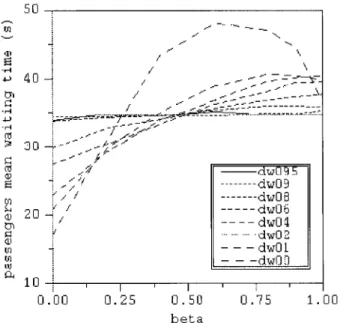
3 0 --[- - " - /" ~ "' j ,.,fS ''~/" d w 0 9 5 ,. . . . . d w 0 9 / / / . . . dw08 2 0 ~ / .4 1 0 0.00 0.25 . . . duO 6 . . . . dwO ~1 ... d w 0 2 - - - d w O 1 - - - d w O :3 0 . 5 0 0 . 7 5 1.00 b e t aFig. 22. Passengers mean waiting time as a function of/3 and down-peak
below, which are equivalent to those expressed only with two variables: /3 and
down-peak,
in the right column. The latter traffic formulation is used in point 6.4.0<_3_<1 0 < up-peak < 1 0 < down-peak <_ 1
0 _< down-peak <_ up-peak up-peak = ( I -/3)(1 - down-peak) inter[toor = 1 up-peak-down- inter[toor =/3(1 - down-peak)
peak
6.4 Assignment algorithm performance analysis
Several operating conditions have been tried in order to eval- uate the performances of the assignment algorithm 2. Ex- periments have consisted in varying the parameters /3 and
down-peak
and in measuring the influence of these param- eters on the mean passenger waiting time. They have been realized using a building with l0 floors and 3 cabins with a capacity of 10 passengers each, no passengers in the build- ing at the beginning of the simulation. Traffic intensity was always equal to 1 passenger each 6.66 seconds. Each con- figuration has been simulated 5 times (5 replications) over 50000 units of time (seconds). Results are represented in Fig. 22. Each point is a mean of five measures.For
down-peak
equal 0, mean passenger waiting time is at its minimum when/3 is equal to 0. Then it grows until/3 is equal to 0.6 and decreases until/3 is equal to 1.0. Fordown-
peak
taken in the interval [0.1...0.6], the mean passengerwaiting time grows in a monotonic way in function of/3. Finally, for
down-peak
bigger than 0.6, the mean passenger waiting time is more or less constant, independently of the value of/3.Traffic 0%
down-peak.
Consider the case wheredown-peak
is equal to O. W h e n / 3 is equal to O, i.e. when traffic is 100%
up-peak,
cabins start to load passengers at the first floor and go up the building. During their travel they unload passen- gers and when the last passenger has exited they return tothe main floor where the cycle starts again. It can be consid- ered that, when the system is stable, i.e. when queues do not explode, this traffic results in the smallest mean passenger waiting time, as shown in Fig. 22.
When /3 grows, the part of the
interfloor
traffic grows too. In this case, cabins cannot come back to the main floor as quickly as when /3 is equal to 0, because they have to serveinter-floor
passengers. Moreover, the larger theinter-
floor
traffic becomes, the less frequently cabins come backto the main floor, with the consequence that the passengers' mean waiting time becomes larger and larger, because a ma- jority of passengers have to wait for a minority to be served. It is for/3 about equal to 0.6 (for the experienced system) that
inter-floor
passengers most disturb the assignment algo- rithm performance. W h e n / 3 is greater than this value, mean passenger waiting time decreases again, and for/3 equal to 1.0, it reaches the same value as that obtained with a 100%down-peak
traffic.Such a performance has been first imputed to the
inter-
floor
passengers perturbation. However, after analyzing thebehavior of the cabins with the graphical simulator, the influ- ence of parasite cycling phenomena affecting empty cabins was identified as having a major influence. This cycling phe- nomenon was caused by the assignment algorithm decision rules based on the
serving direction.
Figure 23 explains with an example cycling problems discussed above. In part (1) of the figure, the cabin waits at one floor. In part (2), it receives a new order to serve theup
floor call at floor 1. Then, it mod- ifies its serving direction, which becomes{up},
and starts to move to floor 1. Before arriving at its destination floor, a new floor call arrives from above (part (3)). Then, the al- gorithm again computes the assignments and according to its rules, gives the cabin an order to serve the new floor call. The consequence is that the cabin changes its serving direction, which becomes{down},
and inverts its moving direction which becomes{up}
(part (4)). If alternately floor calls above and below an empty cabin arrive, the cabin canA. Stagno et al.: QOBJ modeling 121 n u m b e r of passengers in the cabin
\
serving direction \ cabin floor callD
floor call assigned to the cabin
moving direction
I A opl
2'
/
m
V
,ik
D
IJoPI
/x
7q
Fig. 23. Cycling problems with the algo-rithm 2
begin to cycle, with the consequence that passengers have to wait at floors to be served and the mean passenger waiting time becomes larger and larger.
This problem only concerns empty cabins and that only when the percentage of
inter-floor
traffic is sufficiently high. In this case, each new floor call can invalidate previous as- signments. This type of degeneracy does not affect the mean passenger waiting time when traffic is 100%inter-floor,
for two reasons: firstly, because there are no passengers wait- ing at the first floor, so there are no passengers that can be ignored, and secondly because the passengers mean inter- arrival time (parametermean)
is sufficiently high that the cabin cannot cycle too much. Indeed, when there are enough floor calls, the cabin is in some way obliged to serve at least one of them, and once it is no longer empty, it can no longer cycle.Down-peak
t r a f f i c c o m p r i s e d b e t w e e n 0 . 1 a n d 0 . 6 . The degeneracy observed fordown-peak
equal to 0, tends to dis- appear as the percentage of thedown-peak
traffic increases. Indeed, when this percentage becomes different from 0, the probability that a cabin loads adown-peak
passenger be- comes non zero. When such a passenger is in a cabin, the cabin must go to the first floor and waiting passengers there are served. In this case, the risk of degeneracy decreases when thedown-peak
percentage increases. This analysis is confirmed by results illustrated in Fig. 22.Down-peak
t r a f f i c a b o v e 0.6. When the percentagedown-peak
of traffic rises beyond a certain value (here 0.6), the mass of these passengers is large enough to influence the mean passenger waiting time. This is the reason why this measure does not depend on the/3 parameter. To sum- marize, it can be said that the assignment algorithm 2 works correctly as long as there is a small percentage ofdown-
peak
traffic in the system. Otherwise, its performance tend to degenerate.6.5 Corrected assignment algorithm
In order to correct the problems of assignment algorithm 2, algorithms 3 and 5 have been modified in such a way that decisions are no longer based on the
moving direction
but on theserving direction
of the cabins (algorithm 6). Thus, the new algorithm is simply obtained by replacing the serving directionservdir
by the moving directionmovedir
every- where in the rules 3 and 5.50 4--) O~ .,,I -e4 o l @ r n o~ 43 36 29 22 ~ / / 15 0 . 0 " - - ' ; /
... d~59
, _ ~, i/ ... d ~ 3 8 / / ; / - . . . . d ~ 3 6 , / / - - - d ~ r s / ... d ~ 3 2 - - - d ~ 3 i - - - d ~ O O I ' I ' I ' i 0 . 2 0 . 4 0 . 6 0 . 8 }>~ta 1 . 0Fig. 24. Passengers mean waiting time as a function of/3 and down-peak
A l g o r i t h m 6 Corrected assignment algorithm. l i f there are floor calls to serve t h e n
2 Assign floor calls to the parked cabins, with respect to their m o v i n g d i r e c t i o n .
3 Assign floor calls to not empty cabins with the same s e r v i n g d i r e c t i o n .
4 Assign floor calls to remaining cabins, with respect to their m o v i n g d i r e c t i o n .
5 e n d
in order to verify the positive effects of the previous modifications, the experiments, described at the point 6.4 have been rerun using the corrected algorithm. The results (Fig. 24) show that the errors have been corrected.
When the percentage of