Computing Point-of-View:
Modeling
and
Simulating Judgments of Taste
Xinyu Hugo
Liu
Sc.B, Massachusetts Institute of Technology (2001)
M.Eng., Massachusetts Institute of Technology (2002)
Submitted to the Program
in
Media Arts and Sciences,
School of Architecture and Planning,
in
partial fulfillment of the requirements for the degree of
Doctor of Philosophy
in
Media Arts and Sciences
at
theMASSACHUSETTS INSTITUTE OF TECHNOLOGY
June 2006
O Massachusetts Institute of Technology 2006. All rights reserved.
Author
P / X-
y-
4gram
in Media Arts and Sciences
.
I5
May 2006
Certified by
-. C -'Pattie Maes
Associate Professor
Program in Media Arts and Sciences
Thesis Supervisor
AAccepted by
1
Andrew
B.
Lippman
I
LIBRARIES
I
Chair, Department Committee on Graduate Students
Program
in
Media
Arts
and Sciences
Computing Point-of-View: Modeling and
Simulating Judgments
of
Taste
by
Xinyu Hugo Liu
Submitted to the Program in Media Arts and Sciences, School of Architecture and Planning,
on 1 May 2006, in partial fulfillment of the requirements for the degree of
Doctor of Philosophy in Media Arts and Sciences
Abstract
People have rich pointsof-view that afford them the ability to judge the aesthetics of people, things, and everyday happenstance; yet viewpoint has an ineffable quality that is hard to articulate in words, let alone capture in computer models. Inspired by cultural theories of taste and identity, this thesis explores end-to-end computational modeling of people's tastes
-
from model acquisition, to generalization, to application-
under various realms.Five aesthetical realms are considered-cultural taste, attitudes, ways of perceiving, taste for food, and sense-of-humor. A person's model is acquired by reading her personal texts, such as a weblog diary, a social network profile, or emails. To generalize a person model, methods such as spreading activation, analogy, and imprimer supplementation are applied to semantic resources and search spaces mined from cultural corpora. Once a generalized model is achieved, a person's tastes are brought to life through perspective-based applications, which afford the exploration of someone else's perspective through interactivity and play.
The thesis describes model acquisition systems implemented for each of the five aesthetical realms. The techniques of 'reading for affective themes' (RATE), and 'culture mining' are described, along with their enabling technologies, which are commonsense reasoning and textual affect analysis. Finally, six perspective-based applications were implemented to illuminate a range of real-world beneficiaries to person modeling-virtual mentoring, self-reflection, and deep customization.
Thesis Supervisor: Pattie Maes
Computing Point-of-View: Modeling and
Simulating Judgments of Taste
Xinyu Hugo Liu
Thesis Committee:
Advisor
2rofessor Pattie Maes
Associate Professor of Media Arts
and
Sciences
Massachusetts Institute of Technology
Thesis Reader
-
-
--
Professor
whiam
J. Mitchell
Alexander W. Dreyfoos, Jr. (1954) Professor
Professor of Architecture
and Media Arts
and
Sciences
Director, Design Laboratory
Massachusetts Institute of Technology
Thesis Reader
Lr. I
I "
Professor Warren Sack
Assistant Professor of Film
&
Digital Media
University of California, Santa Cruz
Acknowledgements
If a point-of-view is interesting, it could only be due to the rich soil whence it grows. Most dearly, thank you Henry, Pattie, Ted, and Push (in memoy) for believing in me through the years, for
entrusting me with space to create and play in the deep end of the pool, and for giving me the important chances.
Thanks
Warren, Bill,Pattie, Henry, Walter, and Ted for critiquing versions of this document. Judith and Erik-thanks for generals and for lending me your encyclopedic insight on too many occasions.
To those who've inspired or supported my scholarship
-
Glorianna, Marvin, Jef, Bill, John, Roz, and Prof. Singer-thanks for your generosity. Grazie mille to- in presentia, Rada, Ian, Carson, Josiah, and Greg, and in absentia, Friedrich, Gilles, Erlend, Soren, Henri, Milan, Joseph, Marcus, Jean-Francois, Jacques, Jacques, Erich and Ludwig-
for having advanced my point-of-view.
To my professors, group mates, friends, detractors, and water-cooler mates at the Media Laboratory -you're wonderful.Thank you my N., my nothing-to-do-with-work super friends M., A., T., A., C. and A., J., L., and E. Mom and Dad
-
this is for you most.Contents
Abstract Aperitif
1 Introduction
1.1 Thesis summary
1.2 Roadmap and contributions 2 Approach
2.1 Related work in user modeling 2.2 Person modeling from everyday texts 2.3 Model acquisition
2.4 Model generalization 2.5 Model application 3 Techniques & Technologies
3.1 Reading for affective themes 3.2 Culture mining
3.5 Commonsense reasoning 3.6 Textual affect analysis
4 Acquisition systems: implementations & evaluations 4.1 Cultural taste realm: 'taste fabric'
4.2 Food realm: 'synesthetic cookbook' 4.3 Perception realm: 'escada'
4.4 Attitudes realm: 'what would they think?' 4.5 Humor realm: 'catharses'
5 Perspective-based applications 5.1 Art that's always tasteful 5.2 Facilitating social introductions 5.3 An identity mirror
5.4 Virtual mentors, and pundits too 5.5 Foraging for food with the family 5.6 A jocular companion
6 Philosophical underpinnings
6.1 Bourdieu's framework from taste 6.1 Post-structural aesthetics
6.2 The aesthetic consistency hypothesis 6.3 The stability of viewpoint
6.4 Dialogics 7 Conclusion References
List
of
Figures
Figure 1-1. Triptych summarizing the thesis's approach tomodeling persons in aesthetical realms. 18
Figure 1-2. A walkthrough for cultural taste modeling 20 Figure 1-3. Topological features in the learned taste fabric
-
identity hubs (left) and taste cliques (right) 22
Figure 1-4. A walkthrough for generalizing attitudes 25 Figure 1-5. The space of possible ways of perceiving 27
Figure 1-6. Summary of built applications
Figure 2-1. A semantic sheet representation Figure 2-2. A semantic diversity matrix
Figure 4-1. Mining algorithm for cultural taste space Figure 4-2. Taste Fabric's instance types and ontology sources
Figure 4-3. Evaluation of the generalized cultural taste model, and the effect of identity hubs and taste cliques, in a complete recommendation task
Figure 4-4. Results of ten-fold cross validation showing blog- level classification accuracies
Figure 4-5. Learned feature weightings for single-scale classification. .
Figure 4-6. How reflexive memories get recorded from weblog excerpts
Figure 4-7. Political viewpoints of major newspapers Figure 4-8. Evaluating model-based predictions of persons' reactions to news stories.
Figure 5-1. A semiotic model of aesthetic transaction
Figure 5-2. The effects of perspective on artistic rendition
-
the words "sunset" (top-row) and "war" (bottom-row) are rendered with a Thinking-Seeing bias (left-column) versus with an Intuiting-Feeling bias (right-column)Figure 5-3. Aesthetiscope's aesthetic impressions of the four season keywords (columns) rendered through the monadic optics of each Reader taken alone (rows)
Figure 5-4, a-d. Reflections in the Identity Mirror
-
(clockwise from upper-left) as performer approaches the Identity Mirror, his reflection gains descriptive granularity, passing from subcultures (a), into genres and artists (b), into films and albums (c), into foodstuffs, activities, and songs (d) Figure 5-5. A panel of virtual A1 mentors react affectively to a passage of text that the user is readingFigure 5-6. Clicking on virtual Roz Picard triggers an explanation dialog
Figure 5-7. Evaluation of WWTT in a person-learning task Figure 5-8. Interactions with the Synesthetic Cookbook
List of
Tables
Table 4.1. Excerpt from Synesthetic Cookbook's lists ofingredients and descriptive keywords 95 Table 4.2. Political culture: attitudes of the Democratic and
Republican parties 105
Table 5.1. Signalling efficacy of Aesthetiscope's five dimensions
Aperitif
Wither the future battles of humankind? I believe they will increasingly be fought in the aesthetic plane. Media systems and commerce begin to unravel the use function of aesthetics, leading to more systematic productions of poetics. The willful construction of perspective, authenticity, and image up the ante in the worlds of ideology and marketing. Today's artificial intelligence personalizes search and recommends books, but tomorrow's will likely design our life-styles and proustian recommenders will select wines and spirits to release particular memories and desires submerged within each of us.
While the explicit topic of this dissertation is point-of-view, its underlying thematic is certainly aesthetics. A point-of-view, after all, may be recognized as a coherent and comprehensive system of aesthetics, efflorescing from the limitless ecology of aesthetics that is life. What renders point-of-view such a challenging study is precisely its complex etiology -just as each snowflake is constituted idiosyncratically by an unknown mixture of passing clouds, so too are our perspectives shaped by psychological predispositions, past experiences, and culture embeddedness.
Point-of-view and its aesthetics have long been studied poetically and rhetorically. Here, I embark upon yet another such philosophical investigation of the topic, this time informed by a computational perspective. Over the past four years, I have implemented a cadre of experimental computational systems, which automatically model and simulate particular persons' judgments of taste in various aesthetical realms. At some point in this process, the versatility of the approach that was being applied across these realms became aware of itself, and informed by semiotics and cognitive science, a methodology began to crystallize. So, these systems and their results are presented in this thesis-now unified under a common theoretical discourse and computational framework.
Introduction
Our capacity for aesthetics and affectedness is one of the most celebrated bastions of humanity. Underlying our explicit knowledge and rationality is a faculty for judgment-the impulsion to prefer, to view the world through our individual lenses of taste. An interesting intellectual question is: can a computer model a person's tastes, attitudes, and aesthetics richly enough to predict their judgments? This thesis explores one answer to the question.
Our investigation flies under the banner of point-of-view for two reasons. Firstly, the term reflects an understanding that individual tastes are seated in, and articulated against a social and cultural fabric. Secondly, ' point-of-view' is developed to mean not isolated taste judgments, but rather, a coherent and systematic apparatus that engenders such judgments.
1.1
Thesis summary
Each person has their own tastes, attitudes, and ways of perceiving the world. I believe that these aesthetic dimensions of our selves are revealed in our everyday writings-weblog diaries, comrnentary- rich papers, social network profiles, instant messenger
conversations, personal emails, and so on. I focus on the genre of everyday texts, which offers first-person and self-expressive accounts of everyday happenstance, and I point out that in this Information Age, these texts are par excellence portraits of who we
are. Unlike esoteric 'user models' of persons acting within the context of particular computer applications, everyday texts portray persons in the most general sense possible-their domain of discourse is social, pragmatic, everyday life. In
this
thesis, I show that it is possible to build models of persons' tastes, attitudes, and ways of perceiving the world by reading their everyday texts. The accuracy of these models and their applications will also be addressed. The rest ofthis
thesis summary 1) discusses related work; 2) introduces the approach taken; summarizes the premise, methods, and results of person modeling in the three primary realms of 3) cultural taste, 4) attitudes, and 5) ways of perceiving; and finally, 6) reviews six implemented applications for the produced models. Subsequent chapters will address all of these topics in detail.Before describing the approach taken by this thesis, I will frame the modeling portion of
this
work within related work in user modeling, natural language processing, and semiotics.'In user modeling and its related literatures of user-adaptive systems and recommender systems, we find a great deal of prior work on predictive models of people. Two important paradigms are category-based models and behavior-based models. Category-based models-such as Elaine Rich's (1979) groundbreaking book recommender system, GRUNDY
-
models users by first collecting a profile of attributes describing the user, and second generalizing the user model from these attributes, based on a priori stereotypes. For example, women 26-35 years old could stereotypically prefer "romance novels." Whereas each attribute activates a different set of stereotypes with varying numerical strengths' the final recommendation is entailed by the strongest stereotype overall. The categorical approach is a sound one, but models built from a prioristereotypes tend to be overly generic descriptions of individuals. The other paradigm of behavior-based models is a posteriori and predominantly data-driven. Software sensors collect users' behavioral traces through an application and then generalize each user's traces via statistical inference. Key examples of the behavior- based approach include collaborative filtering (Shardanand & Maes 1995), and Bayesian goal inference models ( H o ~ t z et al. 1998). This
1 The literature review in the thesis summary is merely indicative. A more complete survey of related work is achieved in later chapters
-
for user modeling (Section 2.1)' interactive user interfaces (Section 2.5),computational reading (Section 3.1), text mining and social network analysis (Section 3.2), commonsense reasoning (Section 3.3), and textual affect analysis (Section 3.4).
approach has seen a great deal of success, and has been applied to a great variety of recommender systems and intelligent tutoring systems. A caveat related to this approach is that behavioral traces are often specific to an application domain, and may not well describe a person in general. These two paradigms are complementary though, and some systems including Selker's (1994) COACH system and Orwant's (1995) DOPPELGANGER system demonstrates aspects of both. While many of the behavior-based systems are more statistical (e.g. collaborative filtering recommenders), systems such as the COACH intelligent tutoring system are also knowledge-based. DOPPELGANGER also exhibited aspects of both paradigms. The current behavior of users (e.g. 'hacking', 'writing', 'idle') was predicted with Markov models, thus adopting a behavior-based approach. Dynamic categorical models generated for communities that the user was a member of served to supplement each user's profile of interests;
thus
harkening to the category-based approach.In the computational linguistics literature, we find related work on methods for computing the subjective and affective dimensions of text. Wiebe, Wilson, Cardie and others have taken a corpus- annotation approach to tracking subjectivity in third-person narratives (Wiebe 1994) and to characterizing the degree of subjectivity
in
textual passages (Cardie et al. 2003; Wiebe et al. 2004). A drawback of the corpus-annotation approach is that it is supervised. Another approach to computing textual affect is by exploiting dictionaries annotated with semantic orientation, or, prior polarity, of words and concepts (Tumey & Litbnan 2003). Withthis
method, numeric priors on words become building block for statistical estimation of larger pieces of text, and some research has nuanced the application of polarity dictionaries by considering negations and intensifiers (Grefenstette et al. 2004a; Polanyi & Zaenen 2004, Wilson, Wiebe & Hoffman 2005). Liu et al. (2003) suggested a complementary method for appraising text's event structure using common sense knowledge, in order to also account for event-level connotations, e.g. "be(person, fired)."In the semiotics literature, we find helpful frameworks for structuring readings of text. Greimas's (1966) isotopy model of reading describes the reading process convergently, as
rnonosemization. The meanings of words in a textual passage mutually disambiguate one another, converging upon a system of stable themes which represent the overall understanding had from the text. Paralleling Greimas's bottom-up movement from words to themes, Zholkovsky (1970b) describes a top-down movement from larger theme to specific expression dezices which manifest bits of the theme. Finally, in literary stylistics, cf. Todorov's (1968) introduction, it is thought that the most important evidence for a writer's style and tastes can be found in the emotive dimensions of a text's themes -its
affective themes, so to speak. Sack's (1994; 2001) SpinDoctor exemplifies how natural language processing techniques can be employed to operationalize semiotic frameworks. SpinDoctor was
able to detect the ideology implied by a news story by reading for ideologically motivated actor-role bindings (Greimas 1987)-e.g. "Oliver North is an actor who may be bound to various roles, such as "criminal" or "patriot," by authors with different ideologies.
My approach to modeling a person's tastes, attitudes, and ways of perceiving from their everyday texts relates and contributes to each of these three bodies of literature. Existing textual affect analysis techniques (via dictionaries of word affects and via commonsense- based sensing) are leveraged as a building block technology to advance the greater goal of reading for stable affective themes emergent from a person's everyday texts-it is hoped that these affective themes will accurately depict a writer's tastes, attitudes, and ways of perceiving. However, it is recognized that what directly results from such readings will be sparse and disconnected. To generalize a more comprehensive model of a person from fragmentary textual evidence, the person's evidence is situated in cultural patterns of tastes and attitudes that underlie our society. To acquire these cultural patterns, we engage in comparative readings of hundreds of thousands of people's everyday texts, finally arriving at a 'map' of culture's topological space. Each person's textual evidence is located on the map, and can be generalized by activating the neighborhood that surrounds the person's location. The idea of locating persons in the cultural space inherits from both the behavior-based paradigm and the category-based paradigm. The topology of the cultural space is acquired by statistical inference, but in essence, the knowledge embodied by the topology is still a stereotype, albeit a data-driven one.
This thesis considers models of persons within five aesthetical realms. The three primary realms which are narrated in this thesis summary have already been enounced
-
attitudes, cultural tastes, and ways of perceiving. Two other realms discussed only in later thesis chapters are taste for food, and sense of humor. These five aesthetical realms are not claimed to be canonical, nor are they claimed to be independent in scope. Rather, realms were chosen opportunistically based on available everyday texts, and my own sense of interesting directions to explore.A brief description of each realm is now given. An attitude is defined as an affect about some topic, so the realm of attitudes considers a person's feelings toward every topic under the sun. In the realm of cultural tastes, a person is seen as a pattern of consumption, over a field of consumer interests and identities (e.g. books, music, films, foods). In the realm of perception, a person's psychological dispositions are modeled as a coordinate location in a four- dimensional Jungian space whose axes are think, feel, sense, and intuit-proposed by Jung (1921) as four basic psychological functions. A perception model addresses the question-is the
'a-
\--
CQII*IIQI-\
,'
Figure 1-1. Triptych summarizing the thesis's approach to modeling persons in aesthetical realms.
person a realist who senses and thinks or is she a romantic who intuits and feels? In the realm of food, a person's taste is modeled as a pattern of liking and disliking over a densely connected semantic fabric of foodstuffs (e.g. flavors, sensations, ingredients, dishes). The realm of humor is motivated by Freud's (1905) theory of tendentious jokes as outlets for psychic tensions. Thus, a person's humor model resembles an attitude model-it considers the person's psychic tension levels toward every topic under the sun.
The person modeling process which is applicable to each of the five realms can be summarized as three steps (Figure I-1)-acquire, generalize, and apply. Each of the five realms has a topological space, and some of these spaces need to be modeled by employing culture mining to analyze cultural corpora-for example, the connectedness of nodes in the semantic fabric of cultural interests is acquired by analyzing pairwise affinities between interests, across 100,000 social network profiles. A person's everyday texts are read for stable affective themes, and this textual evidence is regarded as location in the topological space. In a second phase, a generalized model of a person is produced. Her location is expanded into a more general surrounding neighborhood, which is implied by the topology of a particular realm. Spreading activation and analogy are two methods used to perform this generalization. In the third phase, the generalized model is employed by a range of applications to simulate the taste, attitude, or perceptual perspective of a person on arbitrary input.
To illustrate and concretize the described approach, the next three subsections narrate the person modeling process for the three realms of cultural taste, attitudes, and ways of perceiving.
To model a person's cultural tastes, social network profiles were focused upon as an everyday text most suitable for acquiring person models. Today tens of millions of internet users are members of
social networking sites
-
such as Myspace2, Friendster3, Orkut?, and Facebooks- on which they maintain a text profile of their cultural interests (e.g. favorite books, music, films). In modeling cultural tastes, we assume that tastes are not arbitrary-that there is an unconscious gestalt that unifies each person's selections of cultural interests. This coherence assumption is consistent with recent consumerist theory stating that peoplef s consumptive choices tend to form gestalts -McCracken (1988) termed these "Diderot unities" and Solomon & Assael(1987) called them "consumption constellations." Proceeding from this premise, cultural taste modeling aims to analyze a corpus of 100,000 social network profiles, and extract from them a topology of cultural tastes, which can be used to generalize a single person's profile.An algorithm for 'culture mining' from 100,000 social network profiles is now described. Each social networking website, although having a somewhat different design, does observe certain conventions in how it elicits and displays users' profiles. The convention is that a user's interests are broken down into organizing categories, the most common being 'books', 'music', and 'movies'. Within each category, interests are typically given as a token- delimited list. There is typically also an overarching category, called variously 'passions' and 'general interests'
-
to emphasize their importance, our present modeling maps these descriptions into an ontology of identity descriptors (e.g. 'fashionista', 'book lover'). Figure 1-2a shows a typical social network profile, taken from the Orkut social networking site-
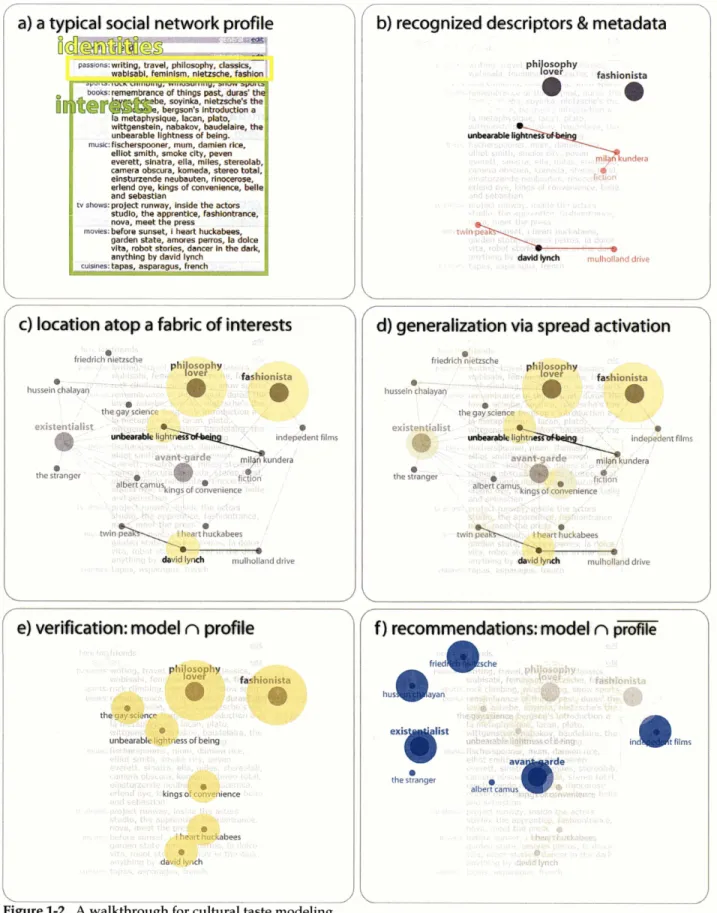
identity and interest categories are depicted. A first step of processing is to normalize as many of these natural language fragments as possible, using ontologies of interests and identities assembled from folksonomies such as DMOZ6 and Wikipedia'. Figure 1-2b supposes that some subset (the four nodes shown in black) of the profile's descriptions have been mapped into recognized identity and interest descriptors. In actual processing of the 100,000 profiles, the rate of recognition was 68% of natural language fragments, including 8% false positives. Also shown in Figure 1-2b are red edges and red nodes-these are metadata associated with the black nodes. They are added to each user's profile to improve the robustness of the profile, but at a discounted strength of 0.5 per link-hop traversed away from a black node./
a) 8
typical
social
network
profile
'
b)
recognized
descriptors
& mctacktci
. , -.. -. '8 -. , ' ,. Z!' . ' l t , l i , - - . - ncb
crlsnd oye, kings nf ro::v~:tic.i~ce, bcile and tiehastian
i $ rrw?., piojec\ I'tithwa}, losir!;. ti: ~cLc,!';
<t.~~rl;it p i 1 9 d[ip~~:rtlir~>, i?<:ifq?r>t!*~2#.+.,
an,,tikint; by
r
. .
-ls;...t:!~;:s, ,;s;,,ra,?u,. .El?
~ U I ~ . M ~ M c ~ u c a-musk: R s c h ~mum, , d a m h ila.
eflid a l t h , smoke dty, pwen
ever& slnatts ella miles smwtia8 cumera'- k~n'eda, sjsleo w
elnsavrsnda neubaukn, rlnocenm,
erlend om, ldnps of mvenlPnce, balk
and I.bsstrsn
M
-garden state, amores ~enos, b ddce
e)
verification:
model
n
profile
F:& l i ~ c . toc>,fricn&
books- I
4
itctiz-" , ,... .J,
.tgec ow. Iraurlek~~t?, tile
-..WL., .-ofMnpt&l
eiliat sm~tli, snloke c-11 y. [,even
eitldmQ,de rlcuip wlcnd oyc, ktkings and stzttnstl.,rl
tors;
birdlo, ttie appl ?nharko. inC,~l' . before sunset bee"
t r r ~ i p n slatefd
E=....,
la dun.-vita, roucsl 51 cer IVI tIh.2 dn&;.,
anylhrng by &,
c 11 II - t-,,prls, fiqpnrdg~~
a111.l ~~~tl:?5l.;:.l~l i*! ::!;-:..- . ~!cl.],?rC runway, inside rrdo!s
stliiiio. 111~' ~p~:eiiti~,~~&-tiu~~~.iii::r.e,
novil. !:wet t l l ~ p ~ . & 1,
$11 .:I, -, t~efcti. -;url.;et, j **$ze+
rg,rrrit>ii
, , I & - :;SPY. amges &no;
::-
r ! : > : i ~ . .,<=: robot slia% il&,cr;r r. '-& dari..aoictl;;r,p tty &&&ti&
5 I;):,:,, . t:+;;>\, il?l;ara!lLj<, f1(*r;-11
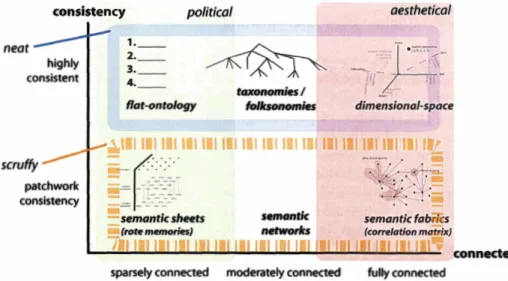
Next is a machine learning step which operationalizes the aforementioned assumption that each profile has taste coherence. The goal is to learn the numerical strength of affinity between every pairwise combination of interest and identity descriptors. In a parsed profile, each possible pairwise combination of descriptors is recorded as a co-occurrence. Using the pointwise mutual information (PMI) (Church & Hanks 1990) measure of semantic similarity, the aggregate co-occurrence data for the 100,000 profiles is analyzed, and a PMI score representing affinity is calculated for each pair of descriptors. After pruning, what results is a 12,000 by 12,000 correlation matrix of learned affinities-I will call this a semantic fabric of cultural taste (or taste fabric for short) to emphasize the
graph's density and to re-introduce the spatial metaphor.
Using this taste fabric which has captured cultural patterns of taste, a person's profile can be generalized. An algorithm for producing a generalized model of a person's cultural tastes is now described. Suppose the profile shown in Figure 1-2a is inputted to the model generalizer. First the profile is segmented into natural language fragments, those fragments are normalized via ontology recognition (Figure 1-2b) and metadata is added at a discount, and the normal and metadata nodes are located into the just-acquired taste fabric (Figure 1-2c). Via spreading activation outward from these nodes along the fabric's edges (e.g. discount = 0.5), a generalized model of the person's taste is produced (Figure 1-2d). It is well described as an activation cloud, or, to emphasize that it has captured the general interests of the person, we can call this a taste etlws formation. It is useful to illuminate two interpretations of this generalized model. Taking the set intersection between this model and the original profile (assuming that its contents were fully norrnalizable), Figure 1-2e shows that in addition to the recognized descriptors, the generalized model has rediscovered other descriptors that were present in the profile, but failed to be recognized; a soon to be described evaluation treats these rediscovered nodes as verification that the algorithm has worked properly. Finally, Figure 1-2f shows the complementary set of nodes which are not in the profile
-
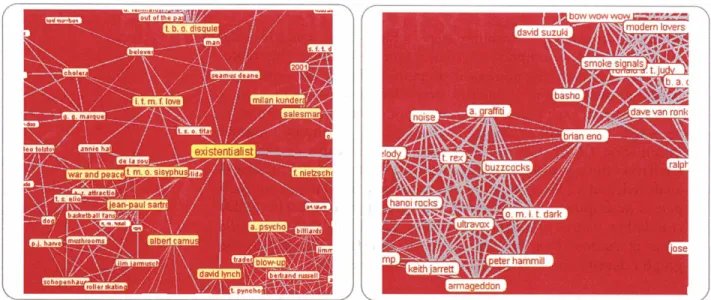
we can interpret these as the identities and interests that are suitable to offer up as recommendations.Some interesting results from taste fabric production are its emergent topological features such as cliques (i.e. a cluster of nodes with strong mutual connectedness) and hubs (i.e. nodes with strong connections to an unusually high number of other nodes, sometimes called 'stars'). Figure 1-3 depicts two topological features
-
theidentity hub 'existentialist' in the left pane, and two taste cliques
straddled by 'brim eno' in the right pane. To produce the unexpectedly sparse semantic network shown in this visualization, most of the graph edges in the original 12,000 x 12,000 correlation matrix were thresholded away, until only thousands of the strongest edges remained; edge strength is not shown in the visualization. Identity hubs and taste cliques are interesting because they are disproportionately influential features in the spreading activation
Figure 1-3. Topological features in the learned taste fabric-identity hubs (left) and taste cliques (right)
process. A telling statistic is that after profiles are normalized into ontology, each identity descriptor in the ontology occurred in the corpus of 100,000 profiles on average 18 times more frequently than the typical interest descriptor. We hypothesize that in the graph, identities behave as indexicals, serving as hubs around which interests organize
-
as shown in Figure 1-3's left pane, 'existentialist' is an identity hub which can be seen to a variety of interests matching intuition, such as 'albert camus', 'friedrich nietzsche', 'death of a salesman', etc. Likewise, taste-cliques shown in the right pane may behave like identity hubs in spreading activation, because as the size of the clique increases, so does its influence-
measured asthe number nodes leaving the clique. We may think of taste cliques
as unnamed indexicals. That taste cliques and identity hubs seemingly organize the taste fabric is consistent with consumer theorists' observations that taste is shaped under 'Diderot unities' (McCracken 1988) and 'consumption constellations' (Solomon &
Assael1987).
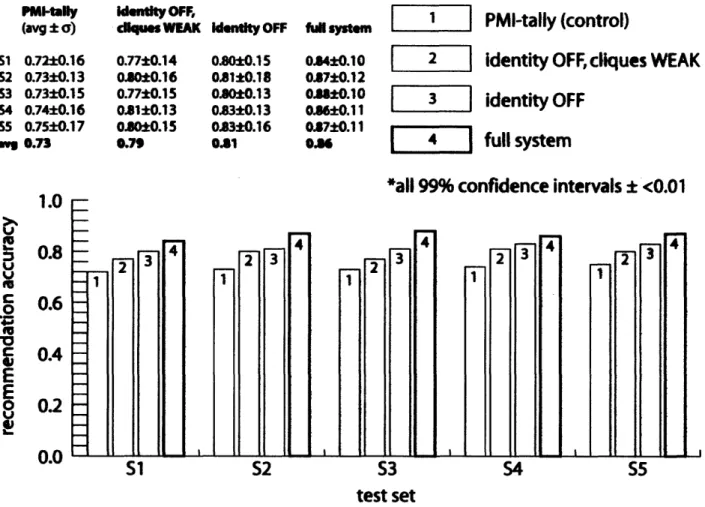
The accuracy of the generalized model of cultural taste was evaluated against three control systems in a five-fold validation experiment over the corpus of 100,000 profiles. Given the task of producing a complete recommendation
-
total rank-ordering of interest and identity descriptors, a control system approximating item-item collaborative filtering (Sarwar et al. 2001) yielded an accuracy of 0.74, which was exceeded by our system's accuracy of 0.86. It was also found that identity nodes improved recommendation accuracy by 0.05, and taste cliques were also beneficial, though less so.These
results provide one measure of validation of the described method for generalizing a model of persons' cultural tastes from their social network profile.
We now shift gears to consider modeling a person's attitudes from their everyday texts. We begin with a working definition for attitude- an attitude is a discourse topic, imbued with some affective tint; that is to say, attitude is how you feel about some thing, some one, some event. This definition is consistent with Ortony, Clore & Collins's (1988) position on emotion-that they always result from cognitive appraisal about some thing, some one, some event. How is the affective tint quantified? We chose Mehrabian's (1995b) PAD model of affect- which considers affect in a three dimensional Cartesian space whose axes are pleasure-displeasure, arousal- nonarousal, dominance-submissiveness. To model a personf s attitudes, we regarded attitudes as affective themes to emerge from readings of weblog diaries and commentary rich papers. By strategically choosing everyday texts, which are defined as first- person and self-expressive, we hoped to avoid the difficult problem reported by Wiebe (1994) of tracking character viewpoints in third- person texts. With everyday texts, it is a reasonable assumption to attribute affective themes to the writer's attitudes.
The algorithm used for Reading for Affective Themes (RATE) is now described. The algorithm is consistent with Greimas's (1966) isotopy model of reading, which stipulates that in reading, meaning is convergent, and the end product of reading is an isotopy
-
a system of stable themes (Greimas called these classemes). In the beginning is personal everyday text, for example, a weblog diary. The diary is segmented, tokenized, and a surface syntactic parse of the text is made with the MontyLingua natural language processor (Liu 2002). The diary's original space of words are now reduced to keywords, key phrases, and parsed event structures, where event equals verb(subject, object, indirect objects*). Each of these textual entities are polysemous and taken alone, they have numerous mutually incompatible connotations. However, by intersecting all the entities' connotations, certain threads of consistent meaning emerge, and these include discourse topics. Accompanying each textual entity is also an affective characterization scored in the PAD model-for example, (P:+0.9,A:-0.2,D:+0.5) might correspond with the affect 'smugf. Just as textual entities are summed up into emergent topics, so each textual entity's PAD affect can be statistically averaged into the emergent topic's stable affect. The association of topic plus its PAD affect is called the stabilized attitude. Proceeding along these lines, a system of attitudes emerges from the weblog diary.Reading for affective themes in this simple associative way was accomplished with lightweight natural language processing tools, embodying a knowledge-based approach. Natural language parsing tasks were all performed by MontyLingua (Liu 2002). Topic identification was performed using the guess-topic ( ) function in the ConceptNet (Liu & Singh 2004) commonsense reasoning toolkit, augmented with topic hierarchies mined from DMOZ. Eagle et al. (2003) had made similar use of ConceptNet for topic spotting in spoken conversations. Affective analysis of text in terms of the PAD
model was achieved by hybridizing a superficial sensing approach with a deep sensing approach. Superficial sensing utilized lexical affect dictionaries which state prior polarities for words
-
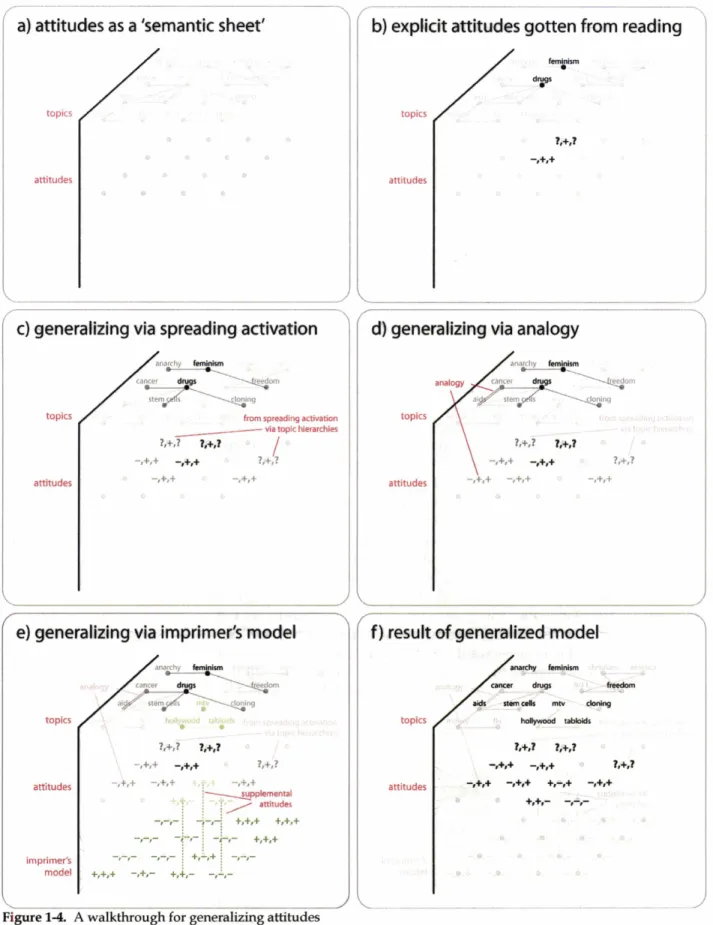
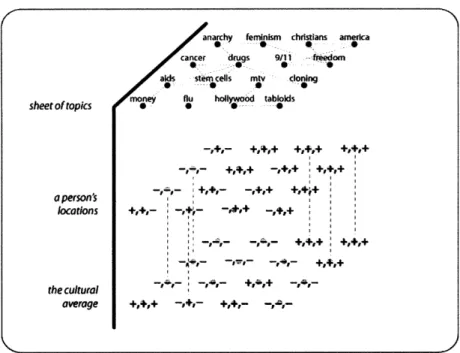
one such dictionary employed was ANEW (Bradley & Lang 1999) and another custom-built dictionary was created out of sentiment headword classes in Roget's (1911) English Thesaurus. For deeper textual analysis via common sense inferences about event structures in the text, Emotus Ponens (Liu, Lieberman & Selker 2003) was used. The explicit descriptors extracted from a social network profile were an incomplete model; likewise, the explicit system of attitudes read out of a weblog diary are also incomplete, and require generalization. An algorithm for producing a generalized model of a person's attitudes is now described. One way to visually represent a person's location in the space of possible attitudes is via semantic sheets. As shown in Figure 1-4a, the upper sheet is a grid enumerating all possible topics. A person's attitudes are captured in the lower sheet, as a grid of PAD affects associated with each possible topic. Walking through generalization, the process begins with the results of RATE being plotted onto these semantic sheets. Figure 1-4b supposes that two stable attitudes resulted from such a reading-
general arousal (P:?, A:+, D:?) about 'feminism' and anger (P:-,A:+,D:+) about 'drugs'. A first generalization technique is to propagate these attitudes to topics closely related to 'feminism' and 'drugs'. Spreading activation along topic hierarchy lines (gotten from DMOZ and ConceptNet) achieves this (Figure 1-4c). Note that certainty of the spread attitudes is discounted. A second technique is structure-mapping analogy (Gentner 1983). Figure 1-4d shows that an attitude about 'aids' is inferred by analogy with 'cancer', based on the topics' shared attributes. ConceptNet is used to perform analogy. Certain cases of analogy tend to produce wrong inferences, such as inferring that attitudes about 'dog' will translate to the taxonomically and functionally similar 'cat'. These exceptions are discussed in Chapter 2. Next, Figure 1-4e depicts the idea that your attitudes can be supplemented by introjecting the attitudes of your imprimers - who Minsky (forthcoming) describes as those whose goals and values you mimic, such as mentors and parents. Currently, the identification of imprimers requires supervision. An algorithm identifies imprimer candidates by reading for the co- occurrence of self-conscious emotions (e.g. embarrassment, pride) with mention of persons, but as yet, a corpus of texts cannot be automatically assembled for imprimers. Figure 1-4e shows that animprimer's explicit attitudes can align with and supplement the model of the one who is imprimed (these also occur at a discounted certainty). Finally, we can see that the result of generalization (Figure 1 4 ) has spread the original explicit attitudes into its surrounding semantic neighborhood.
I 3 -r 1 ---I.? b- - '4, . .(- I r' I I - L e e (C attitudes 0
/
b)
explcit
ntltudcr
gotten
kom
reading
I
topicsTo evaluate the acquired model of attitudes, two experiments were conducted -their results are summarized below. A first experiment was conducted for political culture. Two political corpora were assembled from Democratic Party and Republican Party political speech transcripts and these were used to generate a "Virtual Democratf' and a "Virtual Republican." Examination of their most positive and most negative attitudes were consistent with intuition, though some attitudes were seemingly incorrect. For example, Virtual Democrat held very negative attitudes about 'god' and 'elderly', and Virtual Republican held a very positive attitude about 'poor'. These illustrate one drawback of the associative approach to reading for affective themes
-
Democrats were actually negative about the invocation of 'god' in civil affairs, but that nuanced attitude was incorrectly generalized to 'god'. Using Virtual Democrat and Virtual Republican to define the poles of a political spectrum, the political bias of six major U.S. newspapers were calculated as a function of their degree of alignment with either pole's attitudes. With some scale normalization, the results of this experiment were found consistent with a previous study which specified the media bias of these same newspapers (Groseclose & Milyo 2004). The only major discrepancy was that "Wall Street Journal" was found to be conservative leaning using the thesis system while the prior study found it to be liberal. With some investigation into political theory, the discrepancy was explainable-
the thesis system looked at the editorial texts of 'Wall Street Journal', while Groseclose & Milyo looked at news articles.A second experiment evaluated the accuracy of attitude prediction using the generalized model against human raters. Measuring the deviation of the model's PAD reaction to news articles against the actual PAD reaction of the corresponding human raters, it was found that Arousal (A in PAD) prediction was most accurate, with an average deviation of 0.22 (out of 2.0 max). The prediction of Pleasure and Dominance was promising, but variance was large, and their 95% confidence intervals overlapped with one of two baselines. One interpretation of these results is the Arousal is easier to predict than Pleasure or Dominance because it is more amenable to additive calculation. More details of the studies are presented in Chapter 4.
We describe person modeling experiments for a third realm-the realm of perception. Consider that persons are disposed to perceive and engage the world in different ways. For example, realists and romantics seemingly interpret the world in antithetical ways. But what sort of theoretical framework can betray the differences between realists and romantics? With a salutary spirit, Carl Jung's (1921) theory of psychological type was adapted as the framework to be experimented with. Jung proposed four basic psychological functions
-
sense, intuit, feel, think -and suggested that each person is disposed to engage these functions to various degrees. A mostWllW
image of colorful sky - a realist's location image of sun
I
~l.a~a.1)feels 60'F
think space from Jung (1 921)
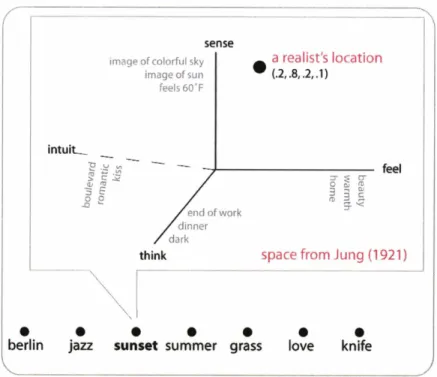
Figure 1-5. The space of possible ways of perceiving
simple model then, would be to take each function as an axis in a four-dimensional Cartesian space. Assuming each axis ranges from 0.0 (not engaged) to 1.0 (fully engaged), a four-tuple coordinate would indicate a person's location in perception space. As Figure 1-5 shows, the 4-d model of perception simulates a person's interpretive process by acting as a 'prism' that refracts meaning. For example, as shown the prism is passing over the topic of 'sunset'. Along each axis gather keywords forming one interpretation of sunset. For example, 'feel' interprets 'sunset' as 'beauty', 'warmth', 'home'. The system predicts that a realist, located at (0.2, 0.8, 0.2, 0.1), would roughly adopt 20% of keywords from 'feel', 80% of keywords from 'sense', and so on. A person's way of perceiving is
thus taken to be a mixture of the Jungian interpretations.
How can such a model be acquired by reading a person's everyday
texts? A first-pass experiment was completed, to see if affective
patterns of communication in a weblog could implicate a rough
location of the person in the Jungian space. In this proposed
reading, the affective themes being read for differ slightly from the reading scheme proposed for attitude modeling. The following affective themes resulted from the proposed reading:
O EGGPAD (writer's average PAD-level) *:
* ALTEEPAD (other persons and things' PAD-level) *:
* INCOMING-PAD (PAD flowing from alters into ego) O OUTGOING-PAD (PAD flowing out from ego into alters)
+3 MENTAL-ACTMTY (frequency with which mental
<* INTROVERSION-EXTRAVERSION-RATIO (ratio of passive acts e.g. 'resent' to active acts e.g. 'murder')
These themes are further explained in Chapter 4. A blog corpus for 3800 bloggers with known MBTIs was analyzed for the above statistics. MBTI is the Myers-Briggs Type Indicator (Briggs & Myers 1976), a popular psychological inventory of personality, and is based on Jung's theory of psychological types. MBTI performs binary classification of persons on four scales
-
Extravert-Introvert (E-I), Sense-Intuit (S-N), Feel-Think (F-T), Judge-Perceive (J-P). For our purposes, only S-N and F-T classification are relevant. A machine learning algorithm called BoosTexter (Schapire & Singer 2000) was fed the affective theme features and from the 3800 blogs, learned binary classifiers for S N and F-T. Evaluating this classification with ten-fold cross validation, average classification accuracies were 0.58 for S N , and 0.62 for F-T. These exceeded a 0.5 lower bound corresponding with guessing, but were well short of upper bounds of 0.85 for S N and 0.73 for F-T, estimated from MBTI's five-week test-retest reliability statistics (Myers & McCaulley 1985), which represent a fundamental limitation on the stability of the MBTI scales. Looking at a decomposition of the classifier's learned features, for S N classification, affective exchange (incoming and outgoing PAD) was more important than ego and alter's affects; for T-F classification, ego's affect was more important than alter's affect or exchanged affect. This result was nicely consistent with intuition about these Jungian dimensions. The overall result is promising, but this computational reading approach is still a ways away from being viable for real-world application.Up to now we have explored how models of a person's tastes, attitudes, and ways of perceiving can be acquired and generalized. The results of evaluation proved the general promise of the approach, but also illuminated some weaknesses, which suggest an agenda for further work. Another more tantalizing 'result' is a slew of implemented applications driven by these person models (Figure I-6)-these concretize and motivate the thus described modeling. What is a person model in the aesthetical realms good for? They enable new tools for self-reflection, person learning, and deep custornization. The six implemented applications are now introduced. Subsequently, I distill some interaction design principles gotten from reflecting on building these artifacts.
W h a t Would Tlzey Tlzink? (WWIT) (Liu & Maes 2004) is a panel of virtual mentors who reside on the computer desktop, and offer users just-in-time affective feedback. Figure 1-6a shows WW'IT configured to display a panel of mentors from Artificial Intelligence
-
(from left to right) Rodney Brooks, Seymour Papert, Rosalind Picard, Marvin Minsky, Douglas Lenat. WWIT is envisaged as a novel way to learn about a mentor's points-of-view.As the user browses web pages, and types emails and papers, the virtual mentors continuously observe the user's read-write textual activity. The user's present textual context becomes input for these virtual mentors, and according to each mentor's generalized model of attitudes, a simulated reaction is produced to the input. Reactions, in the form of a PAD value, are graphically rendered according to this visual metaphor -green for pleasure, red for displeasure; brightness for arousal; blurry if submissive, and sharp if dominant. To learn more about the justification for a reaction, reacting mentors can be double-clicked- bringing about an offering of quotes from that mentor's personal texts that best justify their reaction. WWTT's suitability as a tool for person-learning was evaluated in a 36-person user study. The task was to answer a multiple choice test about strangers' personalities, explicit attitudes whose evidence was located in their weblog diaries, and implicit attitudes whose evidence is not stated in their diaries, but whose correctness was verified by each diary author. Study participants formed three groups
-
one browsed strangers' weblogs, another used a text-search version of WWTT, and a third used the full WWTT system. Results of the study showed with statistical significance (95% confidence) that WWIT users outperformed text- search WWTT users on personality questions; WWIT users outperformed both text-search WWTT and weblog users on questions about explicit attitudes. All three groups have equally poor performance on implicit attitude questions, which tested knowledge of attitudes not stated in the weblog diary. These results are strong evidence for the utility of models of personal attitudes presented in the WW?T interface.The Identity Mirror (Liu & Davenport 2005) shows you your cultural identity as a swarm-of-keywords (Figure 1-6b). Monitoring your social network profile and generalizing your taste ethos from that profile produces a visualization of the person's cultural identity in the form of an abstract mirror. Basic image recognition and image tracking was implemented to allow a viewer to interact with his reflection. Walking to and fro, the viewer traverses granularities of identity, from broad descriptions (e.g
.
identity descriptors, music genre, book genre) of a far-away viewer, to specific descriptions (e.g. song titles, book titles, film titles) when the viewer is up-close. Finally, a viewer's reflection is time-variant-
representing the understanding that as culturef s priorities and desires change, so does cultural identity, which is always articulated against cultural priorities. An advantage of the taste ethos representation is that it is can be biased by activating contextual nodes in the taste fabric to represent the present concerns of culture. A topic parser monitors live news feeds and automatically biases the taste fabric. For example, during Oscars season, nodes relating to film and entertainment are activated in the taste fabric, and as a result, the mirror's reflection reveals a more glamorous entertainment-oriented facet of your taste ethos.The Aestlzetiscope (Liu & Maes 2005b; Liu & Maes 2006) is a perspective-driven abstract art bot (Figure 1-6c). In the spirit of Ellsworth Kelly and early twentieth century abstract expressionist artwork that took the form of a semantic color grid, the Aesthetiscope renders inspirational texts (e.g. a word, a poem, song lyrics) into abstract color grid artwork. A model of the viewer's preferred ways of perceiving and interpreting the inspirational text controls the chosen combination of colors. The viewer's model is given as four 0.0-1.0 numbers corresponding to the viewer's disposition for the four scales -think, feel, intuit, and sense. Just as wine may be chosen to pair with foods, the Aesthetiscope generates perspective-specific artwork that pairs with a user's music playlist and choice of poems. A user study of the Aesthetiscope's generated artwork validates the claim that artwork that is specific to an inspirational text has greater aesthetic efficacy than artwork with mismatched text. An interesting implication of the Aesthetiscope beyond its deep customization is the ability for viewers to communicate their differing perspectives to each other, and to explore the intersection of their perspectives.
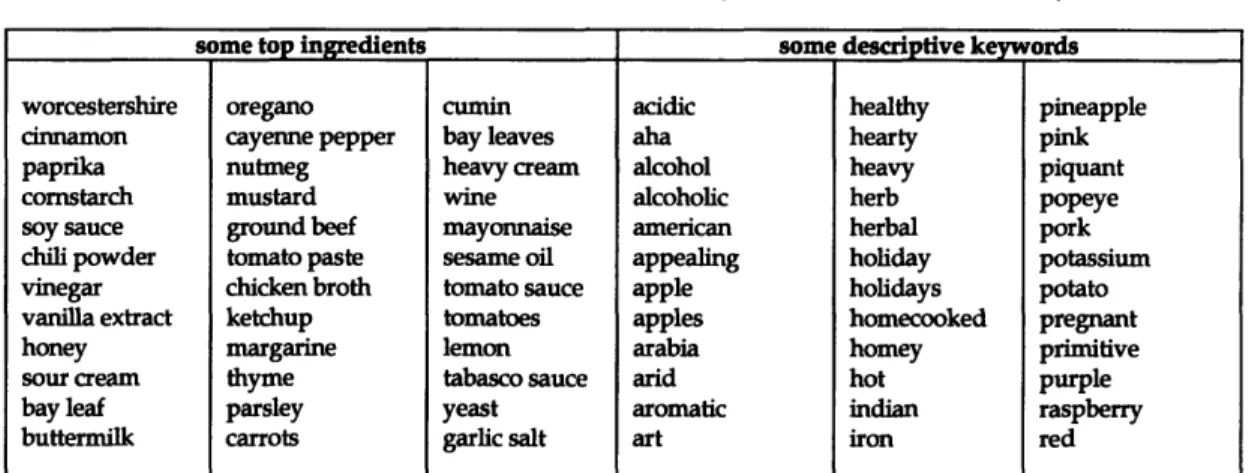
Tlze Synestlzetic Cookbook (Liu, Hockenberry & Selker 2005) is an interactive recipe browsing interface backed by a mined semantic fabric of food consisting of 60,000 recipes, 5000 ingredient keywords, 1000 sensorial keywords, 400 cooking procedures, 400 nutritional terms. In the cookbook, virtual tastebuds (Figure 1-6d) simulate persons' reactions to recipe selections. A tastebud in food space is akin to cultural taste etlzos in cultural taste space. A virtual tastebud is represented as an activation cloud, and is generated by spreading activation across the food fabric, from a starting profile of a user's likes and dislikes. To account for the importance of disliking in taste for food, the food fabric implements negative activations, or inhibitions, in addition to the more standard positive activation. Ambient Semantics is a wearable information system that offers wearers of its tag-reading wristband form-factor just-in-time feedback on books that the wearer picks up, and on people that the wearer meets. Each wearer is backed by their social network profile and a model of their attitudes generated from their corpus of everyday texts. Figure 1-6e is a screenshot of the system's social introduction faculty. When two strangers meet, the system tells them what they have in common. More than intersecting their keywords, the system explains shared identities, and cultural interests that are in the shared context of their intersecting taste ethoi. By illuminating shared context rather than explicit keywords, there are more opportunities to seed ice-breaking conversations and make social bridges.
- - . . . - - - foddw:: eiper knows how you feed
I
I
/'--
-
-- e) cuStwrd tam social mit-h
B a r e d Interests
nugo. please meet Dave M ~ ~ I I I Conmlo~l Dave and you both love some of
the same soom. such as snowtmrdlna. . . Friellds
Both OrYoU know n a m m Eagle. E l l s a l i
1/
Sylvan, Cory Kldd. Cameron Maflow, Joanle Moms DlMlccolHugo, you mlghl also be Inleresled Mat
Dave Menlll llkes cryptonomlcon. neal Stephenson. leamlng. sumna, surllna. water wlo. stevle mv vauahn. cake, me eag169. ma#, mealcan. rumrima, t i e slmpsons. s d e brew, step Into ~lguld. N n
1
Figure 1-6. Summary of built applications
Cartharses (Figure 1-69 is a Freudian joke-teller which observes a user's read-write activity, monitors his/her psychic tension levels about various topics, and delivers jokes by mapping the user's pattern of tensions into archetypal patterns of tension associated with each niche family of jokes. Rather than inventing jokes, Cartharses selects jokes to tell from a repository of 10,000 jokes. Freud's (1905) theory of tendentious jokes stated that the function of these jokes was to give catharses to bottled up psychic tensions. The reason why jokes are often grouped into ethnic families is because
an
ethnos has shared upbringing, and thus, shared patterns of psychic tension. A person's tension model is represented using sexnantic sheets similar to an attitude model, except that a measure of psychic tension supplants the PAD measure of attitude. In Cartharses' backend (pun intend), a corpus of 10,000 jokes was categorized into humor niches-such as blonde jokes, foreigner jokes, sexual jokes, Bush jokes, Clinton jokes-and archetypal tension patterns werelearned for each family of jokes, from a corpus of bloggers who appreciated each type of joke.
The process of conceiving, prototyping, implementing, and refining these artifacts was certainly any evolutionary one. These artifacts make use of rich generalized models of a person's tastes to simulate not just bits of a person's preferences, but a systematized and comprehensive account of their preferences -their points-of-view, if you will. Because the artifacts have novel capability, they necessitate novel interaction design. Certain ideas worked better than others, and eventually themes emerged. In the spirit of reflexive practice, three design lessons for this class of perspective-based applications were distilled from the application development process.
*:
* #1 -continuous observation of a user's textual activities and immediate feedback ensures an interesting 'walk' through a perspective, which only becomes apparent through animation. <* #2-feedback given just-in-time assures that a user benefits from the perspective when interest is piqued, and feedback given just-in-context provokes the user's imagination and critical abilities, since a reaction is synthesized for a new textual situation whose attitudes may never have been stated explicitly in the person's everyday texts.
+3 #3-the perspective should be tinkerable so that users can better grasp the capabilities and limitations of the artifact- e.g. tastebuds can be reprogrammed, perspective in the art bot can be shifted via sliders, and virtual mentors can be prompted to explain their reactions.
In this section, I summarized the thesis' experiments in person modeling and their results. The next section further distills these thesis results into contributions and a roadmap to the subsequent thesis chapters.
1.2 Roadmap and contributions
This thesis is fueled by a series of experimental systems that were built to model persons from their everyday texts, within five aesthetical realms
-
their cultural tastes, their attitudes, their ways of perceiving, their taste for food, and their sense of humor. Supported by evaluations and implemented applications, three broadly stated contributions of the thesis are:*:
* Through several parallel lines of investigation (via five aesthetic realms), it was demonstrated that rich 'person models' can be built by reading a person's everyday texts- her so-called 'textual traces' (cf. 'behavioral traces') -and can be generalized according to the underlying topology of the cultural space via spreading activation, analogy, and imprimer supplementation.
e3 Textual affect analysis was developed to implement an
associative reading for affective themes. This technique complements previously used 'topic spotting' techniques for attitude mining. By focusing on first-person everyday texts like weblog diaries and social network profiles, the difficult task of viewpoint attribution was obviated, and it could be assumed that the text's emergent affective themes were the writer's own attitudes, tastes, etc. The strengths and limitations of this reading approach were made evident in three model evaluations.
*
Six perspective-based applications were implemented, demonstrating a range of applications entailed by the thesis's approach to person modeling-they constitute tools for self-reflection, person learning, and deep customization. The utility of at least one of these applications in a person-learning task was strongly supported by user study.
The rest of the thesis is structured as follows.
Chapter 2 presents the thesis's approach to modeling a person's tastes in the aesthetical realms, structuring discussion into three prongs of 'acquire', 'generalize', and 'apply'. Related work in User Modeling prefaces introduction of the thesis's approach. Related work in Intelligent User Interfaces accompanies discussion for 'apply'.
Chapter 3 presents techniques and technologies for person modeling from everyday texts. Two techniques
-
'reading for affective themes', and 'culture mining' are discussed. 'Reading for affective themes' is situated in related work on computational reading. 'Culture mining' is situated in related work in musical similarity, social network analysis, and text mining. Two key technologies- 'commonsense reasoning' and 'textual affect analysis' -are presented and situated in their respective related works.Chapter 4 narrates implementation-level details for each of the five built acquisition systems
-
cultural tastes, attitudes, ways of perceiving, taste for food, and sense of humor. Evaluations for three of these systems -cultural tastes, attitudes, and ways of perceiving-
are presented in full.Chapter 5 presents six perspective-based applications, which are enabled by person modeling. 1) an art bot which creates art suited to
a person's ways of perceiving the world; 2) a kiosk that facilitates serendipitous social introductions based on shared tastes; 3) a textual mirror to support self-reflection; 4) virtual mentors and pundits which give just-in-time feedback; 5) a synesthetic cookbook which simulates the tastebuds of family mentors; and 6) a jocular companion to parlay everyday woes into opportunities for humor. Evaluations for two of these applications are reported.
Chapter 6 reflects upon the philosophical underpinnings of the computational theory and methodology presented in this thesis, offering a theory-inclined digestion of the presented material, and betraying a direction for future work.
2
Approach
This chapter details an approach to modeling persons as they are in the social everyday, and parlaying these models into a range of perspective-based applications. Examining evidence of personal self- expression in everyday texts enables modeling in this most general of domains, and distinguishes the character of the present investigation from related works in the user modeling literature. Section 2.1 dismsses seminal and related works in the user modeling literature. Section 2.2 states
this
thesis's approach, finding situation for the present work in the user modeling literature. Sections 2.3-2.5entertains separate discussions and related works for the three
prongs of the approach
-
acquire, generalize, apply!2.1
Related work in user modeling
The field of user modeling is mature and over 25 years old. Because user modeling research is usually motivated by improvement of application performance, some closely related literatures which have themselves become developed are recommender systems, user- adaptive systems, and adaptive hypermedia. All the while, the user modeling field has also maintained a methodological wing focusing on generic techniques, and 'user modeling shells'-backbone systems which can be populated with domain-specific data and8 It should be noted that discussions of particularly substantial techniques and technologies have been lifted out of this chapter and moved to Chapter
rules. Numerous proper surveys of user modeling can be found elsewhere-Kobsa (2001) reviews user modeling shell systems though 2000; Brusilovsky (2001) betrays the related field of adaptive hypermedia; a Communications of the ACM special issue (Resnick & Varian 1997) surveyed the related field of recommender systems. What follows is certainly an improper and incomplete survey- particular systems and themes are focused upon in order to invite comparison to specific themes in the literature.
From the viewpoint of the present work, user modeling can be divided into two approaches
-
category-based modeling, and behavior-based modeling. A third approach-discourse-based modeling-is also touched upon, though the area is still a relatively recent development resulting from cross-over research in corpus- based computational linguistics.Category-based modeling is of interest because knowing the category of someone affords generalization of a user's model based on properties of the category. Though it was one of the first works in user modeling, Rich's (1979) book recommender system, GRUNDY, is still a par excellence example of category-based modeling. GRUNDY consisted of a user profile acquisition component, and a generalization and recommendation component. A profile of a user's demographic characteristics was acquired by a questionnaire-style interview. The generalization component consisted of a priori stereotype rules, mapping demographic categories into book preferences associated with those categories. The generalization algorithm consists of firing rules activated by the user's profile in order to produce a generalized user model. For example, suppose that the category of women 26-35 years old stereotypically prefers "romance novels" with strength S. If a user's profile implicates her into that category with uncertainty U, then a preference for "romance novels" is added to the user's generalized model, with strength S and uncertainty
U.
By iterating through other attributes in the user's profile, these preferences began to add up and overlap, eventually, the generalized user model should triangulate or converge onto several key recommendations.GRUNDY's approach resembled and paralleled developments in A1 expert systems, as GRUNDY was essentially a system of hand- crafted rules backed by an uncertainty model, and was purposed for recommendation. Some subsequent user modeling shell systems formalized the stereotype and rule idea to allow user models to be assembled for any domain, by populating a rule base. GUMS (Finin & Drager 1986) and UMT (Brajnik & Tasso 1994) were two shells that allowed for the definition of hierarchical stereotypes and mapping rules, thus circumscribing the scope of GRUNDY. As both took a logic-based approach, they incorporated truth maintenance capabilities. The category-based approach of GRUNDY and later related modeling shells is a sound one, but the quality of models built from a priori stereotypes depend entirely on the insightfulness and profundity of those hand-crafted stereotypes.