PFC/JA-87-21
Desirability of Approaches to Achieving High-0
Haney, S.W.; Freidberg, J.P.
June 1987
Plasma Fusion Center
Massachusetts Institute of Technology Cambridge, Massachusetts 02139 USA
Desirability of Approaches to
Achieving High-3
S.W. Haney and J.P. Freidberg
Plasma Fusion Center, Massachusetts Institute of Technology Cambridge, Massachusetts 02139
United States of America
Abstract
A simple analytical model of a steady-state, resistive magnet toka-mak reactor is used to derive an optimized design yielding the mnri-mum cost/watt of electricity. The optimization is performed subject to constraints imposed by plant power balance requirements and first stability region beta scaling laws. In addition, the design is required to satisfy a series of inequalities, derivable from straightforward physics and engineering considerations, which further limit the range of values that reactor parameters can assume. Particular attention is given to the scaling of plant cost/watt with plasma aspect ratio, elongation, and safety factor in order to determine the conditions under which raising beta improves reactor performance. Even though the model is idealized, the results agree semi-quantitatively with reactor systems code calculations.
1
Introduction
Fusion system studies
[1,2]
have indicated that tokamak reactor performance can be substantially improved if operation at high values of beta is possible. This realization has, in turn, provided motivation for the formulation of scal-ing laws [3-6] predictscal-ing the maximum achievable beta in a tokamak. These scaling laws, which are a consequence of MHD kink and ballooning-mode stability requirements, provide a clear prescription for the means of achiev-ing high beta and, ostensibly, improvachiev-ing reactor performance. In particular, they show that beta scales favorably with increasing inverse aspect ratio F, increasing vertical elongation n, and decreasing safety factor qi. However, one should note that each of the parameters which optimize beta may also have a comparably large (and sometimes adverse) impact on other aspects of reactor performance. This suggests that certain approaches to achieving high beta may be more desirable than others when considered in the context of a complete reactor design.In this paper we address these issues by means of a simple analytical model of a long-pulse, resistive-magnet tokamak reactor. The design is op-timized to yield the minimum cost/watt of electricity subject to two con-straints:
1. Favorable plant power balance
2. First stability region beta scaling.
In addition, the design is required to satisfy a series of inequalities, derivable from straightforward physics and engineering considerations, which further limit the range of values that reactor parameters can assume. The model is deliberately idealized in order to transparently show how these constraints and inequalities affect the relative desirability of the various approaches to achieving high beta. Even so, the results of this model agree well with more sophisticated reactor systems code calculations [2].
2
Model
The design methodology to be discussed here is general in the sense that it can be applied to a wide variety of toroidal fusion systems including reactors and ignition experiments utilizing resistive or superconducting magnets. How-ever, the results are necessarily device-dependent. The present work centers on the design and optimization of an idealized fusion power plant producing a net electric power PE. The plant is assumed to consist of a resistive-magnet tokamak reactor and its associated thermal conversion equipment.
Here, the bulk of the modeling effort focuses on the fusion island. In order to allow the possibility of an analytical optimization procedure, we consider an idealized configuration-consisting of a plasma region, an intermediate region, and a coil region-shown in Fig. 1. Even with the simplified nature of this description, the number of parameters needed to characterize the behavior of the fusion island is relatively large. Therefore, it is useful to list the relevant variables region by region and discuss, in some detail, the assumptions that go into their derivation.
2.1
Plasma Region
As Fig. 1 shows, RO is the plasma major radius and a is the plasma minor ra-dius. Since the existence of a scrape-off region is neglected, a also represents the distance from the plasma center to the first wall. For the sake of simplic-ity, in all geometrical calculations the plasma shape is taken to be elliptical with a vertical elongation K. Also, the effect of toroidicity is ignored.
The plasma parameter of central importance to this analysis is the volume averaged toroidal beta which, to lowest order, is defined as
2nT
dV)(
where Bo is the toroidal field at the plasma center and the integration is carried out over the plasma volume. Assuming parabolic temperature and density profiles, Eq. (1) gives
41onoTo
(2) 3BO
where no is the peak ion density and To is the peak plasma temperature. The fusion power output of the plasma PF can be expressed as
PF
=F LJ( )d 4Fn
2 (3)where EF is taken to be 17.6 MeV and (ov) is the Maxwellian D-T reaction rate parameter (approximated here using the results of Hively
[7]).
Using Eq. (2) to eliminate no in favor of yieldsPF
'
27r2a2
RonW(T)
2B4(4)
Here,
W(T0
)
= f--- T2(-v)dT (5)64p!T 0
The favorable scaling of PF with is the primary reason that high-0 has
proven so desirable in fusion reactor designs.
Of great technological importance is the neutron wall loading Pw which is related to the fusion power according to
PF a + K2' -1/2
indicating that 80 % of the energy from a given fusion reaction is assumed to appear in the form of 14.1 MeV neutrons.
The description of the plasma region is completed by specification of a scaling law for the energy confinement time TE. Several experimentally deter-mined expressions for this quantity exist in the literature. For completeness, we will consider Neo-Alcator scaling [8]
TENA = 0.095 no aR2
(7)
Mirnov scaling [9]
TrE,M =
0.39aIp
(8)and Kaye-Goldston scaling [10]
TE,KG = 0.055K2 8
Bo--"I24 no
6Pa
-4R0
(9)
where Ip is the plasma current and P is the alpha heating power given by
PF (10)
Pa-=5
Note that in all practical formulae the units are a (m), Ro (m), I, (MA), Bo (T), PF,a (MW), To (KeV), no (1020 m-3 ), T
E (sec).
2.2
Intermediate Region
The components between the plasma and the toroidal field (TF) coils-the first wall, the blanket, the ohmic heating (OH) coils, and the equilibrium field (EF) coils--are assumed to make up the intermediate region.
The most important quantity describing the intermediate region is b: the thickness of the intermediate region at the horizontal and vertical midplanes of the device. On the outboard side b accounts for the space required for the blanket and the EF coils while on the inboard side b accounts for the
space required for the OH coils and a thin inboard blanket. It is assumed that acceptable tritium breeding can be achieved despite the thinner inboard blanket.
The details of the blanket and thermal cycle design are largely ignored in this model. Instead, it is simply assumed that thermal power can be converted to electricity with an efficiency q. Also, credit is given for energy-producing neutron reactions in the blanket which multiply the thermal power output of the plant by a factor M.
Since the OH and EF coils are assumed to be placed inside the TF coils, they are necessarily resistive. Therefore, the power dissipated in these coils
PPF can be significant and must be taken into account. In general, PPF
depends in a complicated manner on the plasma shape, the plasma current, and the exact coil placement. These issues are outside of the scope of the present model so, for simplicity, it is assumed that the EF and OH dissipated power is some fraction of the power dissipated in the TF coils PTF:
PPF =fPFPTF (11)
2.3
Coil Region
The remainder of the nuclear island consists of TF coils and support struc-ture. As Fig. 1 shows, the thickness of each of the four legs of the TF coils is represented by c. In addition, the inboard leg is assumed to fill the entire distance between the intermediate region and the device centerline. Hence,
c = RO - a - b (12)
Different thicknesses for each leg as well as the inclusion of a center-post have been investigated. These effects make small quantitative differences in the
results, but greatly obscure the analysis. Hence, for purposes of simplicity, we focus attention on the model illustrated in Fig. 1.
Finally, the coils are assumed to wedge (remain contiguous) out to Ro. The choice of frame-shaped TF coils was motivated by a desire to be con-sistent with designs that incorporate demountable coils. Demountable coils may provide significant advantages in the areas of maintenance and machine availability [2].
The power required to drive the TF coils is of fundamental interest in resistive-magnet tokamak reactors. Neglecting the effects of start-up, this can be written as
PTF ITFR (13)
where
ITF 27rJBO (14)
'to
is the current in the TF coils,
p (15)
7r(Ro - a - b)
is the resistance of the TF coils, and c has been eliminated using Eq. (12). In addition, p is the coil resistivity and GTF is a function that accounts for the specific geometry of the TF coils. Assuming a uniform current density and straight current paths that follow the midline of the coils, GTF is found to be
Ro+ --o(2.-1)a+b 2Ro Ro+a+b (16)
GTF = -
n
__+- 1)RO - a -b RO - a -b Ro
The first term in Eq. (16) accounts for the geometry of the coil region on the inboard side of the plasma. The second term represents the portions of the top and bottom legs of the coils that wedge to RO. The third term gives the contribution of the separated TF coils on the outboard side of the plasma.
2.4
Summary
In summary, our simplified model of a resistive magnet tokamak reactor is described by the following parameters:
Performance Parameters PF fusion power Pw wall loading
PPF EF and OH dissipated power
PTF TF dissipated power
Plasma Parameters
/3 plasma beta
qi plasma safety factor no peak density
TO peak temperature
BO toroidal field at plasma center IP toroidal plasma current
TE energy confinement time Geometric Parameters
a plasma minor radius Ro plasma major radius
b intermediate region thickness c coil thickness
K plasma elongation
3
Formulation
The formal optimization procedure used in the analysis is summarized as follows. The first step is the selection and definition of a figure of merit. This figure of merit, which is written in terms of a number of independent variables, serves as the basic measure of the attractiveness of a particular design. Next, constraints which give relationships between the independent variables are imposed on the design. Each of these constraints allows one independent variable to be eliminated from the calculation. Finally, a series
of inequalities that specify a range of allowable values for some of the re-maining independent variables is provided. A particular choice of the figure of merit and associated constraints and inequalities is not unique; however, once a choice is made, a unique optimized design can be found. In principle, the design is optimized by varying the independent variables in order to find the most favorable value of the figure of merit. When this variation would require violation of an inequality, that inequality becomes an equality (i.e. a constraint) and the optimization is repeated. One of the primary advantages of the simple model presented in the previous section is that the number of degrees of freedom is sufficiently limited to allow the optimization to be performed essentially analytically. Having discussed the design methodology in formal terms, we now consider the details of the calculation.
3.1
Figure of Merit
For the purposes of the analysis, we select C, the direct capital cost of the plant per watt (electric), as the figure of merit which is obviously to be minimized. C includes contributions from both the fusion island and the balance of plant. This feature makes it more desirable as a figure of merit than, for instance, the fusion island weight which focuses only on one part of the plant. In addition, it is widely thought that fusion reactors will be expensive and complicated devices. Since it is possible that the suitability of fusion energy as a power source will depend on its economic attractiveness as compared to alternative concepts, it seems a judicious choice to use a figure of merit based on costs. Other studies have investigated the impact of the choice of figure of merit on the optimized design [11].
In general, C is a complicated function of several variables. Keeping the philosophy of the analysis in mind, we present a simple model which analyt-ically displays the relevant dependencies. We write C ($/watt) as the sum
tda balance of plant contribution CEp
($)
and a fusion island contribution('n.
($):
CBP + CFI PE
CBP includes contributions for such things as land and reactor buildings but is assumed here to be dominated by costs for thermal energy conversion facilities, specifically turbines and electrical switching equipment. Given this, one expects CBP to scale with the thermal fusion power. We make the
simplest choice for this dependence, namely
CBP = KBPPF (18)
where KBp is a proportionality constant.
With regard to the fusion island, we make the straightforward assumption that the capital cost is proportional to its volume VFI. Hence, CFI can be written
CFI = KFI TFI (19)
where KFI represents the average unit cost of the entire fusion island and, from Fig. 1,
VPI
=
87rR0[R+O(K- 1)a] (20)Combining results gives the following expression for the figure of merit
C =
KBP(F)+
KFI ("Y) (21)This costing model is similar to that proposed by Spears and Wesson [12]. It could be argued that including the plasma region in Eq. (21) is unrea-sonable since it is mainly 'empty'. We justify its inclusion by the fact that the plasma region determines the requirements for the potentially expensive auxilliary heating, fueling, and burn-control systems.
It is beyond the scope of the model to actually calculate the two quantities KBp and KFI. Instead, the values of CFI and 0 BP were extracted from
systems code runs [2] for particular PE, PF, and Vp1I. Given these, Eqs. (18) and (19) predict that numerically,
KBP =0.55 $/W
KFI
0.20
M$/m 3For the purposes of simplicity, we make the assumption that KBP and KFI
are constants. In reality, these quantities might be expected to be functions of, for instance. PE,
PW,
and Fii. However, it will be shown later that the design optimization process is actually not very sensitive to the exact values of the unit cost coefficients.3.2
Constraints
We now describe the constraints imposed on the design. These constraints are necessary because the formulation so far does not fully distinguish be-tween different classes of tokamak devices and operation in different regimes of MHD stability physics. For instance, the model presented in the previous section is equally valid for commercial reactors, ignition devices, or experi-ments. In addition, the model makes no explicit assumptions regarding the details of the 0-limit characterizing the device.
In order to place the model in the regime of the commercial tokamak reactor, we impose the requirement for a favorable plant power balance
PE =AIPF - PR
(22)
where PR is the total recirculating power which is assumed to be due entirely to the dissipation in the TF, EF, and OH coilsPR = PTF + PPF
(23)
Eq. (22) is written by assuming near steady-state operation (i.e. high duty
factor) and neglecting radiation losses. It can be stated in the convenient form
PE = F(1 - R) (24)
using the recirculating power fraction fR defined as
PR
fR = P (25)
RMPF
We further constrain the design by requiring that the device operate in the first region of MHD ballooning-kink stability. This means that the maximum allowable obeys a scaling law of the form [3,6]
/ 0ma. c P (26)
aBo
Note that in this context we are assuming that the plasma possesses some triangularity. Eq. (26), restated in a, more convenient form, thus becomes the second constraint
- ati
ca (27)
Roqj
where co is a constant and qj is the safety factor given by Sykes, et al.
[13]:
27ra 2 KBOqj = - (28)
3.3
Inequalities
Having specified the model along with the engineering and physics regimes of interest, we next consider the physical domain over which the design op-timization can be performed. Many of parameters of interest are limited to a range of allowable values by straightforward engineering and physics re-quirements. These requirements lead to a series of inequalities which must be satisfied by the design.
3.3.1
Inequalities for Plasma Region Parameters
The performance of the plasma is largely limited by stability considera-tions. In particular, one of the most important inequalities is due to MHD kink/disruption limits which set a lower bound on the value of the safety factor or, conversely, an upper bound on the plasma current. This limit is usually written in terms of the MHD safety factor
q,
>
2.0
(29)
Here, q, is defined:
I
27rBt
q,
= --
I
], dO
(30)
27r fo
RB,
where the subscript 's' indicates that the integration is carried out over a particular flux surface.
Stating the kink/disruption limit in terms of q, turns out to be a mislead-ing choice from the point of view of the reactor designer. This is because the actual 0-limit depends on qj rather than q, and, except in the case of circular low-0 plasmas, these two quantities do not have the same value. Further-more, q, is strongly dependent on the proximity of separatrices and shaping of the inner plasma edge. In fact, it is possible to satisfy the limit given in Eq. (29) for arbitrarily large currents by placing a separatrix sufficiently close
to the plasma. This contradicts recent experimental results which suggest a hard disruptive limit to the plasma current
[6].
For these reasons, it may be more accurate and appropriate to state the kink/disruption limit in terms of qj. However, the form of this limit is currently unknown and one might expect the limiting qj to be dependent upon the plasma shape (elongation, indentation, triangularity, aspect ratio, etc) and, perhaps, itself. For the purposes of this analysis, we make the simplifying assumption thatq, > 1.5 (31)
the limiting value being chosen to approximately correspond to q. = 2.0 given the parameters in Troyon's paper.
Various values for the constant of proportionality in the Troyon limit have been discussed in the literature [5,6,13]. We choose the maximum value of c3 to be that found experimentally by Stambaugh, et al. [6]. Consistent with the Sykes q-prescription, this inequality is thus written
co < 0.165 (32)
MHD stability considerations also provide an upper limit on the plasma elongation. This limit results from analyses that suggest that elongated plasmas are particularly susceptible to axisymmetric (n = 0) modes
[14].
It is assumed that these modes can be wall or feedback stabilized for plasmas withK < 2.0 (33)
Murakami
[15]
has suggested that, in order to prevent disruptions, the central plasma density must be kept below some critical value. This leads to an inequality of the form2cMBo 3)
no <
where cM is a parameter that may depend on n and qj. For simplicity, we will assume that cm is a constant. Numerically, cm : 0.8 x 10²⁰ m- 2 - T-for current experiments. Given operation at some /, Eq. (34) implies an inequality for the temperature
30BoRo
To >
8(35)
pUOCM
Due to uncertainties with regard to the behavior of first wall materials on exposure to large neutron fluxes, an upper limit is set on the neutron wall
loading
Pw < 5.0 MW/M 2 (36)
Finally, on the basis of the assumption of ignited operation, the confine-ment time is required to satisfy a Lawson condition
norE > 6.0 x 10²⁰ m-3
-sec (37)
3.3.2 Inequalities for Intermediate Region Parameters
In contrast with the plasma region, engineering considerations largely ac-count for the inequalities associated with the blanket and thermal cycle. These inequalities depend sensitively on the blanket/first wall concept uti-lized. For purposes of illustration, we assume a vanadium first wall and a liquid lithium blanket. In the blanket, liquid lithium acts as both a coolant and a tritium breeder. Given this choice, we can state the following inequal-ities which are based on the results of detailed blanket design studies [16]:
r7 < 42% (38)
M < 1.20 (39)
The maximum value of rq is a strong function of the blanket/first wall con-cept and results from considerations of power plant thermodynamics. The limit on M is consistent with the assumption of no fissionable materials in the blanket. Finally, the minimum value of b is primarily determined on the basis of shielding and tritium breeding requirements. Because the shielding requirements for normal coils are much less stringent than for superconduct-ing coils, the intermediate region thickness characteristic of resistive-magnet tokamaks is significantly smaller than for superconducting tokamaks.
Since the present model does not include detailed plasma equilibrium calculations, the power dissipated in the OH and EF coil systems must be estimated using results from more detailed analyses [2]. An inequality that gives rough agreement is
fPF >
33%
(41)
To keep the design in the regime of typical commercial power plants it is finally required that the net electric power output not get unacceptably high
PE <
1200 MW
(42)
3.3.3 Inequalities for Coil Region Parameters
The value of p in a resistive tokamak is primarily set by the operating tem-perature of the TF coils and the fraction of the coil cross-sectional area that is available to carry current (the rest being required for cooling and struc-ture). Here, operation at room temperature with coils that consist of 90
%
copper (by area) is assumed. With this,3.4
Problem Statement
Given the previous discussion, it is now possible to formulate the design optimization procedure in mathematical terms. But first, it is convenient to make the change of variables
( = a/Ro
(44)
6b
=
b/Ro(45)
where e can be recognized as the plasma inverse aspect ratio and Cb can be
thought of as a dimensionless thickness for the intermediate region. In terms of the analysis, c replaces a and eb replaces Ro as independent variables. This set of variables is motivated by the fact that the beta limit depends directly on c as opposed to a and Ro separately. Other choices of variables lead to a much more complicated analysis.
Using the new variables along with Eqs. (20) and (24), the figure of merit given in Eq. (21) becomes
S
KBP(
( 11 f8)rb)1+ (+(K - 1)E](46)
r7010 -A) PEEb
It is possible to eliminate the '-scaling constraint immediately by substi-tuting from Eq. (27) into Eq. (4). This gives the following expression for the fusion power:
2,r
2W(To)c b
3B4
4 3PF
=
q3
(47)PR can be also be written in terms of the new variables
4,r pbBl(1 +
fPF )GPR = b(1 )GTF( b,) (48)
where GTF now becomes
GTF 1 + (2K - 1)6 + Cb +ln( 2 )+KCH+ b +
(49)
1
- E - E 1- - EbEliminating BO from Eq. (47) using Eqs. (25) and (48) allows us to express the plant power balance constraint given by Eq. (24) as a function of the independent variables
E(q ,c7,rMi,fPF, Eb,p, fR)
(50)
W(T)
Here,
G
-
:4(1 - F - E )2 K3(1
G =2(51)
EbGT Fdescribes the geometrical aspects of the constraint and
_ ( gi 2( 1-R_ fP
E(
2(-
)2)A7 j) [(52)
PO cO r/MAIPEN
b
Adescribes the physics and engineering aspects of the constraint. The To de-pendence is separated out due to subtleties associated with the application of the Murakami density limit.
At this point, the mathematical basis for the design optimization is com-pleted. Eq. (46) is to be minimized subject to the constraint given in Eq. (50). This minimization is performed over the independent variables
E,
6b, K, qj, co, r7, Al, fPF,PE, b,
p,fR, To
with the quantities
held fixed.
We show that C varies monotonically with respect to several of the in-dependent variables. In such cases, the minimization can be simply accom-plished by invoking the inequalities discussed in the previous section. Thus, despite the relatively large number of variables and the complexity of the gov-erning equations, the optimization can be performed essentially analytically. However, of interest as well is the sensitivity of the cost/watt to variations in limiting values prescribed by the inequalities. Deriving this behavior requires straightforward numerical calculations.
Once the independent variables are calculated they may be used to de-termine the values of other important derived quantities given by
C,
3,
no,
PF, PR,Pw,
TE, a, Ro, c, Bo, IpIn the context of our model, specification of the independent and derived quantities fully describes the design.
4
Optimization I
One of the most important parameters affecting reactor performance turns out to be the Murakami parameter cM. Due to subtleties associated with the application of the Murakami limit, it is convenient to consider two separate optimization procedures (leading to two different reactor designs). In the first case (Optimization I), C will be minimized independent of the Murakami limit and cM will be calculated so as to satisfy Eq. (35). In the second case (Optimization II), C will be minimized with cm held fixed at a value consistent with results from current experiments. We will see that the current Murakami limit provides very stringent limits on resistive-magnet tokamak reactor performance.
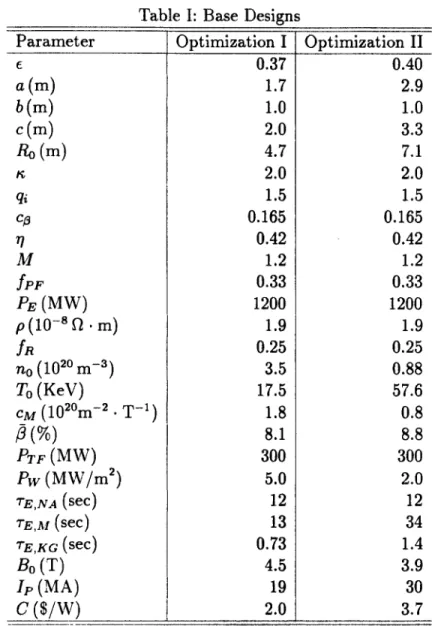
In Table I, designs resulting from the assumptions of both optimization procedures are displayed. These designs are quite dependent on the inequal-ities and constraints derived previously: application of a different set of as-sumptions could lead to a different and, perhaps, more desirable design. In the discussion to follow, we outline the analysis consistent with the assump-tions of Optimization I and examine the sensitivity of the results to variaassump-tions in the inequalities.
4.1
EbCalculation
The power balance constraint [Eq. (50)] allows one of the.variables to be calculated in terms of those remaining. For this analysis,. we choose to solve for eb. We see that Eq. (50) is a complicated transcendental equation which,
in general, must be solved numerically. However, it is possible to gain qual-itative insight about the behavior of 6b which will allow many of the
opti-mizations to be performed analytically.
Critical to the analysis is the observation that
C
[Eq. (51)] is a monoton-ically decreasing function of (b if c and K are assumed fixed. This behavior is shown in Fig. 2. On this plot, the power balance constraint is satisfied at the points of intersection between the decreasing function G(Cb) and the horizontal line G = E/W(To). These intersections give the value of (b for aparticular choice of the other parameters.
Two important facts can be inferred from Fig. 2. First, Eb is maximized by reducing the value of E/W(To). Second, the resulting value of 6b varies less
than linearly with E/W(To). These observations, which hold for all values of c and K, will be used extensively in the optimizations to follow.
4.2
e Optimization
For many of the independent variables, C is shown to vary monotonically. Hence, it is possible to perform design optimizations by invoking the ap-propriate engineering and physics inequalities. In the case of c, however, C exhibits a minimum. By a straightforward calculation of the partial deriva-tive of
C
with respect to e, an approximate expression for the value of the 'optimum' inverse aspect ratio ct has been derived (see appendix). The critical F is given byC
E::
(53)
W W(To~r
The existence of ept is explained by Eq. (51) which suggests that as F ap-proaches either zero or one, Eb must decrease accordingly in order for the power balance constraint to be satisfied. Decreasing Eb is equivalent to in-creasing Ro so the volume of the fusion island and C increase correspondingly. Physically, in the limit of small F, both a and the allowed 0 decrease. Thus, a larger major radius is required to maintain a constant fusion power. In the limit of large r a smaller relative fraction of the space on the inboard side of the device is available for the TF coil. Hence, a larger major radius is required to keep the recirculating power constant. Fig. 3 is a plot of C vs. F with rb varying so as to satisfy Eq. (50) and all other variables taking on the values shown in Table I. This curve shows that the minimum in cost/watt is quite strong.
The existence of an optimal aspect ratio is not a unique feature of resistive tokamak reactors. Freidberg and Wesson
[17]
have demonstrated that in a superconducting tokamak reactor the cost is minimized for %,t = 1/6. This result is a consequence of a constraint on superconducting magnets that requires that the field at the coil be less than some critical field (usually 10-12 T).On the basis of the 3-limit alone, one might conclude that it is desirable to make the aspect ratio as tight as technologically possible. However, the introduction of the power balance constraint leads to an optimum 6 which, for the parameters assumed here, generally lies in the range :,,t :: 0.3-0.5. Furthermore, Eq. (53) shows that this value is a slowly varying function of the other parameters so it would not be expected to change greatly upon application of different assumptions. Alternatively, optimizations on other reactor parameters can yield a significant reduction in the cost/watt without the need for tight aspect ratio. Since operation at e,,t appears to be desirable from the point of view of minimizing the cost, this model suggests that ultra-tight aspect ratio might not be necessary for improving resistive tokamak reactor performance.
4.3
qj,
co,
p, and
fPFOptimizations
From Eq. (46) we see that the variables qj, c,6, p, and fPF do not appear explicitly in the expression for C. Instead, they enter the calculation only indirectly through 6b. Since C is a monotonically decreasing function of Eb, the cost/watt can be be minimized with respect to these variables by maximizing
Cb. From the discussion above, this is accomplished by minimizing E. In particular, Eq. (52) implies that qj, p, and fPF must be minimized and co maximized. Since E varies monotonically with respect to these quantities, the inequalities given in Eqs. (31), (32), (41), and (43) must be invoked. This leads to values qj = 1.5, p = 1.88 x 10⁻⁸ 0 -m, fPF = 33 %, and cp = 0.165 used in the base design.
A large value of the ratio co/qj is desirable because of the resulting
favor-able effects on the maximum allowed 3. In particular, the sensitivity of C to
co/qj is given in Fig. 4. In this plot, C is seen to decrease monotonically with
c5/qi with all other variables except for c and eb fixed at the values given in
of c9/qi. Thus, each point on the curve represents an optimized design for a given c9/qi. Note, however, that not all of these designs are acceptable since
they would lead to violation of the wall loading inequality [Eq. (36)].
Fig. 4 shows that C is a moderately strong function of qi and c9. Even so, we see that there appears to be little improvement in reactor performance to be gained by relaxing the limits on these physics parameters somehow (possibly through the judicious use of plasma shaping and profile control). On the other hand, if the base design values cannot be realized, a substantial cost penalty must be paid. This point is particularly important given the current ambiguity associated with the statement of the MHD kink limit. One should note that qi and co only appear in the calculation as a consequence of the introduction of the first-stability 0-limit. Hence, in this case, increasing
3 actually does result in the total cost being lowered although the effect
becomes less pronounced once some minimum level of performance (more or less specified by the base design values) is obtained.Small values of p are clearly desirable since they reduce the coil volume needed to achieve a given
fR.
One might thus be tempted to speculate that resistive magnet tokamak reactors with TF coils operating at cryogenic temperatures would realize a large increase in performance in view of the resulting large reductions in coil resistivity. The present formulation of the model is unable to adequately address this question because of the additional requirement to include the (adverse) effects of cryogenic cooling systems on the cost and the power balance relations. However, more detailed studies show this cost to be prohibitive [2]. Note also that the model presented here cannot be applied to reactors with superconducting coils since an entirely different set of inequalities and constraints would be required.Decreasing fPF allows a larger value of PTF for a given value of fR thus
reducing the coil volume and
C.
This effect, although favorable, is relatively small for reasonable variations infPF-4.4
PE Optimization
E decreases with increasing PE so, consequently, eb is an increasing function of PE. In addition, Eq. (46) shows that the cost/watt of the balance of plant is independent of PE. As a result, we recover the usual result that the cost/watt is minimized by setting PE to its maximum allowable value which, from Eq. (42), is PE = 1200 MW. The fact that Eb increases with PE is somewhat surprising in that this implies that the fusion island volume actually decreases with increasing PE. This occurs because fR is held constant as PE is varied. Hence, small values of PE necessarily require small values of PR. To attain small recirculating powers requires a large coil volume. Since the volume of the nuclear island is dominated by the volume of the coils, the fusion island volume increases accordingly. The variation of C with PE is shown in Fig. 5. In general, a fairly large penalty must be paid if operation at low power outputs is desired. At the same time, C is not significantly reduced by increasing PE over the base design value.
4.5
b Optimization
From Eq. (52), E is seen to be a function of 1/b. This, in turn, implies that Eb is a decreasing function of b. As previously stated, Eb(E) increases at a rate less than linear. Hence, the ratio b/tb, which appears in the fusion island contribution to the cost/watt, is actually an increasing function of b. Thus, unsurprisingly, we find that minimizing b minimizes C. Invoking the inequality given in Eq. (40) gives the design value b = 1.0 m. The sensitivity of the cost/watt to b is shown in Fig. 6.
4.6
r7 and M Optimizations
In Eq. (46) we see that maximizing the quantity
rM
reduces the cost of both the fusion island and the balance of plant. This, along with Eqs. (38) and (39), leads to the choices q = 42 % and M = 1.2 for the design. Large values of r1 are beneficial because they reduce the amount of fusion power thatmust be generated to produce a given PE. This, in turn, reduces the plasma volume and the turbine plant size.
4.7
K Optimization
Eq. (51) shows that eb is an increasing function of K. Hence, Eq. (46) predicts that C is minimized by operation at large vertical elongations. Referring to Eq. (33), the base design is characterized by . = 2.0.
The Troyon limit suggests that values of r. above the vertical stability limit might be beneficial for reactor performance in that larger values are then allowed. However, vertical stability issues aside, it may be too optimistic to assume that 3 increases linearly with K for large values of n. Some authors have reported that the n scaling in the Troyon limit may saturate or even eventually decrease with n
[5].
We model this effect by writing the f-limit in the form CK = c)(t, no) - (54) CO qj where 1 + Ko(55)
n + no
and no is a parameter which reflects the saturation of
$
with increasing K.eb,
., o) 4(1 - f -Eb)2(1 + Ko)2(56)
G'(, n no2 E, 2r56
EbGT F(K + Ko)2
Note that as Ko approaches infinity (i.e. no saturation) we see that
G'
reduces to G.Fig. 7 shows that, in the case where Ko = oo, increasing the elongation always improves reactor performance. This is due to the favorable r scaling of the -limit. However, the decrease in C becomes less pronounced as K
increases and
C
becomes almost constant when K - 3. The reason for this is that as the plasma elongates, the length of the inner TF leg also tends to increase. The resulting increase in coil resistance partially cancels the beneficial contribution of increased /.Unsurprisingly, Fig. 7 also shows that the benefits of high elongations are reduced as the value of the parameter r0 decreases. In fact, for moderate values of r0 a broad minimum in the cost is observed; that is, there is an optimum n. The observation that the C vs. K curve saturates or even displays a minimum are, again, unexpected from considerations of the /-limit alone.
4.8
fR Optimization
The value of C exhibits a minimum for some fR between zero and one. This
behavior is explained as follows. In the limit of large fR,
C
is dominated byCBp which, from Eq. (46), is seen to increase with fR. Specifically, increasing
fR at constant PE necessitates a corresponding increase in PR. Power balance
then requires that PF increase as well. This increased thermal output leads
to the need for larger thermal conversion facilities which, in turn, causes
CBP to increase. In the limit of small fR, CFI dominates C since the TF coil thickness must be increased in order to attain small values of PR. This leads to an increase in the volume and cost of the fusion island.
As Fig. 8 shows, C is minimized for a value
fR
= 0.32. Unfortunately, this optimum design is characterized by a wall loading which exceeds themaximum value given by Eq. (36). We thus choose fR = 0.25 to satisfy that constraint. Because of the broad nature of the minimum, this choice results in only a marginally higher value of C.
In the context of this model there are relatively large uncertainties asso-ciated with the optimization of fR. First, the wall loading inequality used here is not a sharp limit; there is a substantial variation in the maximum Pw allowed by different scientists working in the field. Second, the exact loca-tion of the minimum is actually not well known anyway since it is sensitive to the details of the costing model which is highly idealized in this analysis. Finally, the model does not consider factors (such as the cost of TF magnet power supplies) which might further limit the desirability of large values of fR. However, even with these considerations, the base design value
fR
= 0.25 is consistent with results obtained by more sophisticated studies [2].4.9
To Optimization
We see from Eq. (50) that eb increases with
W(To).
Eq. (46) then suggests that W(To) should be maximized in order to yield the lowest cost. Inte-grating Eq. (5) numerically shows that W(To) has a broad maximum at To = 17.5 KeV whereW(To)
= 2.25 MW - m- - T4 . Clearly, this is the desired operating point in the absence of other constraints.4.10
Calculation of Derived Variables
Given the independent variables, it is now possible to complete the design by calculating the derived quantities (including, in this case, cm). These values are shown in Table 1. These results show that resistive-magnet toka-mak reactors possess several unique features. In particular, we see that the base design is characterized by low field
(Bo
= 4.5 T), moderate beta ( 8.1 %), moderate wall-loading(Pw
= 5.0 MW/m 2), and large plasma current (Ip = 19 MA). We also notice that both Neo-Alcator and Mirnovscaling predict longer confinement times than that required by the ignition constraint, Eq. (37). However, ignition is clearly not possible according to
Kaye-Goldston scaling. Finally, we see that resistive-magnet tokamak reac-tors are particularly vulnerable to the Murakami limit due to the low values of Bo. Specifically, cm a 1.8 x 10²⁰ m-2 T-1 is required to allow operation at the maximum W(To).
5
Optimization
II
The value of cM calculated in the previous section is approximately a factor of two higher than that obtainable in present-day experiments. In view of the experimental progress already made towards extending the Murakami limit, it does not seem unreasonable to assume that eventually values of cm of this magnitude might be achievable in tokamaks. If, on the other hand, cm cannot be increased, then Eq. (35) becomes an additional constraint on the design, To is eliminated as an independent variable, and the optimization procedure is again performed. Qualitatively, the procedure is identical to that just presented so the details are omitted. The results of this modified optimization are shown in Table I for cm = 0.8 x 10²⁰ m-2 -T-1.
In Table I we see that a significant rise in To has accompanied the decrease in cm. This effect is explained on the basis of Eq. (34). As cm decreases no must decrease accordingly. Since PE is fixed, is more or less fixed and To must rise to produce the necessary plasma pressure. Reducing (by raising qi for example) would lower To but, as the previous results have shown (see Fig. 4 for example), this would lead to a large increase in C.
Table I also shows that, in addition to imposing stiffer requirements on plasma heating technology, the temperature increase causes the reactor to become larger and costlier due to a decrease in W(To). Despite this, the ignition inequality is still satisfied if either Neo-Alcator or Mirnov scaling applies although the ignition margin is smaller. The sensitivity of
C
tovariations in cm is shown in Fig. 9. The economic penalty for operation at low values of cm is seen to be substantial.
6
Discussion
We have developed a simple analytic model which provides reliable qualita-tive and semi-quantitaqualita-tive information about the design of a fusion reactor. As a specific example, a resistive-magnet tokamak reactor has been investi-gated. Our goal has been the design of a reactor, optimized with respect to cost and subject to the constraints of favorable plant power balance and first region of stability
f
scaling.As a general comment, the results show that resistive-magnet tokamak reactors are somewhat more compact than their superconducting counter-parts primarily because less shielding is required. The design is to a large measure dominated by the ohmic losses in the central leg of the TF coil. To keep the losses to an acceptable level, the toroidal field in the center of the plasma is approximately 3-5 T, a noticeably smaller value than anticipated in superconducting reactors. Thus, the resistive coils are not dominated by stress or current density considerations. Also, the low field may require op-eration at lower densities and hyigher temperatures than are optimal from the (v) reaction rate curve because of the Murakami density limit. These high temperatures have been shown to have a significant adverse effect on overall reactor performance. Experimental progress in raising the critical Murakami density could greatly enhance the prospects for resistive-magnet tokamak reactors.
The primary focus of the analysis has been the investigation of the de-sirability of high-Q in an overall reactor design as achievable by different methods suggested by a first region of stability 0 limit [Eq. (27)]. The re-sults from the analysis are as follows:
1. Raising the coefficient ca is desirable. However, ca = 0.165 used in the design is already near its maximum value since it has been determined by an optimization over profiles and cross-sections. In practice, it is more likely that co will be somewhat lower than 0.165 because the opti-mized profiles may not be realized. If the achievable value is much less than the base design value a large economic penalty could be paid. On the other hand, once the design value is obtained further improvements yield small cost savings.
2. Increasing c raises the
3 limit but has a serious adverse effect when
the aspect ratio becomes too tight. Specifically, as E increases at fixed major radius, the cross-sectional area of the central TF leg decreases. This, in turn, raises the the ohmic power dissipated leading to an un-favorable plant power balance. In practice, there is an optimum aspect ratio which balances the favorable c scaling of a with the unfavorable c scaling of PR. For our design, the optimum is a relatively steep function of c and has a value c = 0.37.3. Increasing K raises the / limit and, for K < 2, has a strong favorable effect on overall reactor performance. However, these desirable effects become less pronounced at high elongations. As K. increases, the center leg of the TF coil becomes longer. This leads to an increase in the ohmic dissipation. For very large K the gains in fusion power due to increased K are essentially canceled by the increased ohmic losses. Consequently, once K > 3, the net gain in reactor performance due to
elongation saturates and further increases in K do not lead to reduced costs. The benefits of elongation are further reduced by the possibility of a saturation in the
/
limit for large K. In this case there is an optimum elongation although the optimum is quite broad as a function of K. Finally, high elongation may be difficult to achieve in an actual4. In general, operation at low qj is desirable for improved reactor per-formance since increased toroidal current leads to higher values of 3.
This effect is relatively strong until the base design value, qi = 1.5, is obtained. Then, lowering qj does not significantly reduce plant costs. However, there are large uncertainties as to whether the base design value could be obtained in practice. First, large plasma currents could greatly complicate the design of the EF and OH coil systems, an effect not addressed here. Second, and perhaps more important, there is some confusion as to whether qj or q, is the critical parameter for stability. In large aspect ratio circular plasmas these quantities are identical. In tight aspect ratio non-circular plasmas they are quite different and can lead to dramatically different design strategies. Because of arguments concerning the presence of a separatrix near the plasma surface, it ap-pears that qj is the relevant stability parameter. Finally, the scaling for the minimum of qj for stability is not well established at present. The determination of the true form of the MHD kink/disruption limit, which might be a function of E and ri, remains an important problem for the fusion physics community.
In summary, our simple analytic model demonstrates how theoretical and experimental physics laws impact the design of a tokamak reactor. We have investigated various paths to high-3 based on first stability scaling laws and determined which of these is most promising from the viewpoint of overall reactor desirability. Perhaps surprising to some, our results show that, in certain cases, raising 3 can lead to a negligible or even adverse effect on overall reactor performance.
Acknowledgement
This research was performed in part in conjunction with the Magnetic Fusion Energy Technology Fellowship program which is administered for the U. S. Department of Energy by Oak Ridge Associated Universities.
Appendix
Here we derive the approximate formula for et given in Eq. (53). First, we notice that most of the ohmic power dissipated in the TF coils is due to the inner TF leg. Hence, with little error, it is possible to neglect the contributions of the top and outside TF legs. This yields the simplified expression for GTF
GTF -- 1 + (2r - 1)E + Eb
(Al)
1 - E -- b
Plugging Eq. (Al) into the plant power balance constraint and solving for Eb
gives
Eb1 -
[wr
E
{(1
+
(2K - )E + Eb) 2E}] (A2) e [W(To)r.We now neglect the variation of the quantity (1 + (2K - 1)F
+
-b)2Fb since itdoes not contribute in any fundamental way to the existence of the minimum in C. This turns out to be a good approximation for a fairly wide range of elongations and aspect ratios if we take (1
+
(2n - l)E + eb)2Eb - 1. Withthis,
E - - -
[
]
4 (A3)EI
W(To)K3
Finally, we note from Eq. (46) that, except at large elongations, the minimum in C with respect to E largely corresponds to the maximum in Eb. Thus, setting the derivative of Eq. (A3) with respect to E to zero yields the desired result
FoPt E 1/8
(M)
References
[1]
BAKER, C.C., ABDOU, M.A., DEFREECE, D.A., TRACHSEL,
C.A., GRAUMANN, D.W., et al., STARFIRE, A Commercial
Toka-mak Power Plant Study, Argonne National Lab. Report ANL/FPP-80-1
(1980).
[2] LECLAIRE, R.J., Conceptual Design of a Commercial Reactor Using
Resistive Magnets, M.I.T. Plasma Fusion Center Report RR-86-17
(1986).
[3] TROYON, F., GRUBER, R., SAURENMANN, H., SEMENZATO, S.,
SUCCI, S., Plasma Physics and Controlled Fusion 26 1A (1984) 209.
[4] BERNARD, L.C., HELTON, F.J., MOORE, R.W., TODD, T.N., Nucl.
Fusion
23
(1983) 1475.
[5] YAMAZAKI, K.,
AMANO,
T., NAITOU, H.,
HAMADA,
Y.,
AZUMI, M., Nucl. Fusion 25 (1985) 1543.
[6] STAMBAUGH, R.D., MOORE, R.W., BERNARD, L.C.,KELLMAN,
A.G., in Controlled Fusion and Plasma Physics (Proc. 10th Europ. Conf.
London, 1984), Vol. 1, European Physical Society (1984) 217.
[7]
HIVELY, L.M., Nucl. Fusion 17 (1977) 873.
[8] PARKER, R.R., GREENWALD, M., LUCKHARDT, S.C., MARMAR,
E.S., PORKOLAB, M., WOLFE, S.M.,Nucl. Fusion 25 (1985) 1127.
[9] SCHMIDT, J.A., SHEFFIELD, G.V., BUSHNELL, C., CITROLO, J.,
FLEMING, R., et al., in Controlled Fusion and Plasma Physics (Proc.
10th Europ. Conf. London, 1984), Vol. 3, European Physical Society
(1984) 297.
[10] KAYE, S.M., GOLDSTON, R.J., Nucl. Fusion 25 (1985) 63.
[11] BORRASS, K., Nucl. Eng. Design/Fusion, Vol. 4, No. 3 (1987) 247.
[12] SPEARS, W.R., WESSON, J.A., Nucl. Fusion 20 (1980) 1525.
[13] SYKES, A., TURNER, M.F., PATEL, S., in Controlled Fusion and
Plasma Physics (Proc. 11th Europ. Conf. Aachen, 1983), Vol. 2,
Euro-pean Physical Society (1983) 363.
[14] OKABAYASHI, M., SHEFFIELD, G., Nucl. Fusion 14 (1974) 263.
[15] MURAKAMI, M., CALLEN, J.D., BERRY, L.A., Nucl. Fusion 16
(1976) 347.
[16] SMITH, D.L., MORGAN, G.D., ABDOU, M.A., BAKER, C.C.,
BERWALD, D.H., et al., Blanket Comparison and Selection Study Final
Report, Argonne National Lab. Report ANL/FPP-84-1 (1984).
Table I: Base Designs
Parameter
Optimization I Optimization II
0.37
0.40
a (m)
1.7
2.9
b (m)
1.0
1.0
c (m)
2.0
3.3
Ro (m)
4.7
7.1
rK 2.0 2.0qj
1.5
1.5
CO
0.165
0.165
r7
0.42
0.42
M
1.2
1.2
fPF0.33
0.33
PE
(MW)
1200
1200
p (10~' Q m)
1.9
1.9
R0.25
0.25
no (10
20 m-3)
3.5
0.88
To (KeV)
17.5
57.6
CM (10 20m-2 .T-')
1.8
0.8
O
8.1
8.8
PTF (MW)
300
300
Pv (MW/M
2)
5.0
2.0
TENA (sec) 12 12 TEA(sec)
13
34
TE,KG(sec)
0.73
1.4
Bo (T)
4.5
3.9
Ip(MA)
19
30
C ($/W)
2.0
3.7
Figure Captions
Fig. 1: Resistive-magnet tokamak reactor geometry.
Fig. 2: Graphical representation of the power balance constraint.
Fig. 3: Dependence of C and VFI on E for cm = 1.8 x 10²⁰ m-2 -T with
Eb chosen to satisfy the power balance constraint and all other parameters fixed at their base design values.
Fig. 4: Sensitivity of C to variations in c/q; for cM = 1.8 x 10²⁰ m~ .T and other parameters fixed at their base design values.
Fig. 5: Sensitivity of C to variations in PE for cM = 1.8 x 10² 0 m-2 T and other parameters fixed at their base design values.
Fig. 6: Sensitivity of C to variations in b for cM 1.8 x 10²⁰ m-2 . T and other parameters fixed at their base design values.
Fig. 7: Sensitivity of C to variations in r, and .0 for cM = 1.8 X
1020 m-2-T and other parameters fixed at their base design values.
Fig. 8: Sensitivity of C to variations in fR for cm = 1.8 x 10²⁰ m-2 -T and other parameters fixed at their base design values.
Fig. 9: Sensitivity of