HAL Id: hal-00107357
https://hal.archives-ouvertes.fr/hal-00107357
Submitted on 20 Nov 2018
HAL is a multi-disciplinary open access
archive for the deposit and dissemination of
sci-entific research documents, whether they are
pub-lished or not. The documents may come from
teaching and research institutions in France or
abroad, or from public or private research centers.
L’archive ouverte pluridisciplinaire HAL, est
destinée au dépôt et à la diffusion de documents
scientifiques de niveau recherche, publiés ou non,
émanant des établissements d’enseignement et de
recherche français ou étrangers, des laboratoires
publics ou privés.
percolation models
Renaud Toussaint, Steven R Pride
To cite this version:
Renaud Toussaint, Steven R Pride. Interacting damage models mapped onto Ising and percolation
models. Physical Review E : Statistical, Nonlinear, and Soft Matter Physics, American Physical
Society, 2005, 71 (4), pp.046127. �10.1103/physreve.71.046127�. �hal-00107357�
Interacting damage models mapped onto Ising and percolation models
Renaud Toussaint*
Department of Physics, University of Oslo, P. O. Box 1043 Blindern, 0316 Oslo, Norway Steven R. Pride†
Earth Science Division, Lawrence Berkeley National Laboratory, 1 Cyclotron Road, MS 90-1116, Berkeley, California 94720, USA 共Received 16 March 2004; revised manuscript received 1 February 2005; published 21 April 2005兲
We introduce a class of damage models on regular lattices with isotropic interactions between the broken cells of the lattice. Quasistatic fiber bundles are an example. The interactions are assumed to be weak, in the sense that the stress perturbation from a broken cell is much smaller than the mean stress in the system. The system starts intact with a surface-energy threshold required to break any cell sampled from an uncorrelated quenched-disorder distribution. The evolution of this heterogeneous system is ruled by Griffith’s principle which states that a cell breaks when the release in potential共elastic兲 energy in the system exceeds the surface-energy barrier necessary to break the cell. By direct integration over all possible realizations of the quenched disorder, we obtain the probability distribution of each damage configuration at any level of the imposed external deformation. We demonstrate an isomorphism between the distributions so obtained and standard generalized Ising models, in which the coupling constants and effective temperature in the Ising model are functions of the nature of the quenched-disorder distribution and the extent of accumulated damage. In par-ticular, we show that damage models with global load sharing are isomorphic to standard percolation theory and that damage models with a local load sharing rule are isomorphic to the standard Ising model, and draw consequences thereof for the universality class and behavior of the autocorrelation length of the breakdown transitions corresponding to these models. We also treat damage models having more general power-law interactions, and classify the breakdown process as a function of the power-law interaction exponent. Last, we also show that the probability distribution over configurations is a maximum of Shannon’s entropy under some specific constraints related to the energetic balance of the fracture process, which firmly relates this type of quenched-disorder based damage model to standard statistical mechanics.
DOI: 10.1103/PhysRevE.71.046127 PACS number共s兲: 46.50.⫹a, 46.65.⫹g, 62.20.Mk, 64.60.Fr
I. INTRODUCTION
The physics of breakdown processes that lead, for ex-ample, to stress-induced catastrophic failure of both man-made and geological structures, remains an ongoing subject of research. Stress-induced fracture of a homogeneous mate-rial containing a geometrically simple single flaw has been studied since the work of Griffith关1兴 and is now well under-stood. However, the breakdown of heterogeneous structures, in which the local mechanical properties are randomly dis-tributed in space and/or time, continues to present challenges despite the many advances over the last 15 years 关2兴. The difficulty is in characterizing and quantifying the effects of interaction between the multitude of constituents.
Most of the knowledge about these types of systems has been obtained from lattice network simulations. One of the most well-studied lattice network models is the 80 year old fiber bundle model共FBM兲 关3–6兴 that describes the rupture of bundles of parallel fibers. This model originally considered elastic fibers of identical elastic constant, breaking when their elongation exceeds individual thresholds distributed ac-cording to a given uncorrelated random distribution. A global
load sharing rule共GLS兲 is assumed by which the load carried by a fiber is uniformly distributed to the surviving fibers when it breaks. Analytical results for this model have been obtained 关7–11兴 that concern the average load-deformation properties关7–9兴, the distribution of avalanches 关10兴, or the relationship between such quenched-disorder based models and standard statistical mechanics关11兴.
The original FBM model with global load sharing has been generalized to allow for nonuniform load sharing rules, considered either as purely local load sharing 共nearest-neighbor interactions兲, in which case distribution of ava-lanches and mechanical properties have been analytically studied关12–14兴, or as power laws of distance from the failed fiber, which have been studied numerically关15,16兴.
Closely related to these models of fiber bundles in elastic interaction, many studies have addressed fuse networks
关17–25兴, or networks of isotropic damage with interactions
having the range of the elastostatic Green function关26–28兴. The classification of lattice breakdown processes as critical-point phenomena is still subject to debate关9,29–37兴. Local load sharing models are usually understood as break-ing through a process similar to a first-order transition关29兴, while models with long-range elastic interactions or GLS are analyzed either as a critical-point transition关9,29,30,35兴, or as a spinodal nucleation process关31,38兴. The issue depends on whether the accumulated damage has a correlation length that diverges as a power law of the average deformation in the approach to macroscopic failure. Numerical evidence in *Electronic address: [email protected]; URL: http://
folk.uio.no/renaud/
†
the literature suggests that the nature of the correlation length in the approach to failure depends on the specific model be-ing analyzed, the damage interaction range, and the type of quenched-disorder distribution considered. A major difficulty of such attempts to classify the breakdown process is that no analytical form for the distribution of the damage configura-tions at a given external load is available共at least that has a firm basis兲. Numerical simulations of the scaling behavior of avalanches are limited in size due to computational restric-tions which makes critical-point analysis difficult.
It is proven here that quasistatic interacting damage mod-els such as the FBM, that possess randomly quenched local breaking thresholds, can be mapped onto percolation, Ising, or generalized Ising models depending on the range of the damage interaction. Our demonstration holds in the limit of small damage; i.e., under the restriction that the stress per-turbation emanating from each broken cell is much smaller than the average stress in the system. More specifically, the change in elastic energy in the system at fixed imposed boundary deformation due to damage that arrives is the sum of a mean-field softening term proportional to the number of damaged cells, and an additive function over pairs of dam-aged cells that is small compared to the mean-field softening terms. This corresponds to the general validity conditions of a Born approximation. In real solids accumulating damage, the cracks represent only small local changes in the elastic moduli, and so this weak perturbation limit has direct prac-tical importance.
The stress-induced emergent-damage distribution is proven to be a Boltzmannian with a temperature 共probabilis-tic energy scale兲 that is an explicit analytical function of both the applied deformation and the quenched-disorder threshold probability distribution funtion 共PDF兲. The damage-model Hamiltonian is shown to have an Ising form with coupling constants that have explicit functional dependence on the applied deformation, the quenched-disorder PDF, and the na-ture of the damage interaction 共nearest neighbor or long range兲. The critical point of the Ising model is of course well known. So for a given numerical simulation or laboratory experiment, one can use the expressions for the coupling constants developed here to determine how the system is evolving in coupling-parameter space as deformation in-creases and thus be able to predict the nature of any phase transition that might arrive 共first order, continuous, or no transition兲. Knowing whether catastrophic failure 共i.e., dam-age correlation-length divergence兲 is an imminent possibility has practical application.
We have recently proposed a statistical theory for the lo-calization of oriented fractures that emerge and elastically interact when the system has a shear stress applied to it
关39–41兴. The distribution of the emergent crack states was
obtained using the postulate that the fracture arrival would maximize Shannon’s entropy under constraints representing the energetic balance of the process. In the present work, we do not make this postulate but instead prove its validity by direct integration over the damage evolution. The present work also presents more general ranges of interaction. How-ever, unlike our previous work, the present analysis is for a purely isotropic 共scalar兲 description of damage interaction. The interaction of real fractures in an anisotropic load, where
microfractures present high aspect ratios, necessarily re-quires a tensorial elastic description as in our earlier work
关39–41兴.
The organization of the paper is as follows. In Sec. II, we introduce共and justify in the Appendix兲 the general type of scalar damage models that are considered. In Sec. III, the probability of each damage configuration is obtained by in-tegrating over all paths that lead to it. In Sec. IV, we establish the relationship between these configurational distributions and standard statistical mechanics, which allows the standard toolbox of statistical mechanics to be applied to damage models entirely based on quenched disorder. These analytical developments will then be utilized in Sec. V to establish that fracture processes in such damage models are isomorphic to percolation for GLS 共Sec. V A兲, or to the Ising model for nearest-neighbor interactions 共Sec. V B兲. This allows us to isolate some transition points in these models, and to predict the nature of the correlation length in the approach to the transition. We will also discuss in Sec. V C the case of dam-age models with arbitrary power-law decay of the interac-tions, and show how they are related to generalized Ising models, which can themselves be mapped onto standard ones via renormalization of the coupling constants. The results are summarized and discussed in a concluding section.
II. DEFINITION OF THE DAMAGE MODELS CONSIDERED
Our models reside on a regular lattice of dimension D
共e.g., a square lattice in D=2兲. Each cell of the lattice has a
location x within the set⍀ of cells making up the lattice, and has a state described by a local order parameterx, where x= 0 if the cell is intact andx= 1 if it is broken. There is a
local stress and strain associated with each cell. The cells elastically interact with each other; however, such interaction must be isotropic for the present analysis to apply. A configu-ration of damage is described as a damage field corre-sponding to the set of N local variables ⬅兵x其x苸⍀ where
N = N共⍀兲 is the total number of cells in the system.
Our systems are initially uniform by hypothesis; i.e., they have a homogeneous damage field = 0 at zero strain and stress and each cell starts with the same elastic moduli. Strain is progressively applied through the application of a uniform normal displacement l at the edges of the system. A cell breaks at constant applied l when the energy required to break it 共which is a random quenched threshold sampled from a probability distribution function兲 just equals the re-duction in stored elastic energy in the lattice due to the break. A key requirement of the models treated here is that the stress perturbation emanating from a broken cell must be weak enough that a first Born approximation holds; i.e., stress interaction between any two broken cells is allowed for while simultaneous interaction between three or more broken cells is not. This approximation is valid whenever the stress perturbation due to a broken site is much smaller than the mean stress in the system.
One specific realization of such a “weak damage” model is an appropriately defined fiber bundle model. In the model, a set of N elastic fibers are stretched between a free rigid
plate and an elastic half space. The rigid plate is displaced by a controlled amount l that puts the fibers in tension. Once fibers begin to break, elastic interactions occur through the elastic solid. As demonstrated in the Appendix, such interac-tions will be weak if either共1兲 the elastic solid is much stiffer than the fiber material, or共2兲 the fibers are much longer than wide and are sufficiently widely placed. In the limit that the elastic half space becomes rigid, this model reduces to the classic global load sharing fiber bundle.
Another realization is a uniform isotropic solid divided into N cells. Uniform displacements l are applied to the lim-iting faces of the lattice in such a way that the material is in a state of uniform dilation. The damage that arrives is as-sumed to change the isotropic moduli without creating aniso-tropy in the process. For example, the damage might be modeled as a spherical cavity that opens at the center of the cell thus reducing the elastic moduli of that cell. The weak interaction is guaranteed if the change in the cell modulus is small. We emphasize that the assumption of weak damage holds for any configuration of damage over the underlying lattice, including damage states with large fractions of bro-ken cells.
As demonstrated in the Appendix, the energy Ep
revers-ibly stored in such systems when the system is in a damage stateat the applied loading level l is
Ep关,l兴 = 共C0+ C1+ C2兲l2, 共1兲 C0= N, 共2兲 C1= − c
兺
x苸⍀ x, 共3兲 C2= −兺
x,y Jxyxy, 共4兲where c is a positive constant in the range 0⬍c艋1 that is independent of the damage or deformation state, is a small positive parameter in the range 0⬍/cⰆ1 that controls the strength of the stress perturbations, and Jxyare O共1兲 coupling
constants that allow for the load redistribution between cells at positions x and y when a cell is broken. Various spatial ranges for Jxyare considered including共1兲 global load
shar-ing in which case Jxy= 0;共2兲 local load sharing in which case
Jxy=␣⬎0 is a constant of order unity for pairs xy of nearest
neighbors, 0 otherwise;共3兲 elastic load sharing in which case
Jxy⬃共ᐉ/兩x−y兩兲D where ᐉ is the lattice step size; and 共4兲
fiber-bundle elastic sharing with fibers interacting through an elastic plate in which case D = 2 and Jxy⬃ᐉ/兩x−y兩 共see the Appendix兲.
The local load sharing case共2兲 can in principle happen in a fiber bundle stretched between plates enduring both elastic and plastic deformations capable of screening the stress per-turbations caused by broken fibers to only nearest neighbors, which always can carry some load if damaging them only decreases their elastic constant共i.e., c⬍1兲. We treat case 共2兲 for the sake of generality and do not specify the detailed constitutive relations required for it to be realized in practice. The cost in surface energy to break any of the cells共which represents either the energy required to create new surface
area within a cell or to break a fiber兲 is a random variable fixed ab initio, with no spatial correlations between the dif-ferent cells. The breaking energy is thus a quenched uncor-related disorder, described by a probability distribution func-tion p共e兲 for which p共e兲de is the probability that a cell’s surface energy is in关e,e+de兴, and having a cumulative dis-tribution P共e兲=兰0ep共z兲dz. For a given realization of each
cell’s surface energy ex, there is thus a certain total surface
energy
Es关兴 =
兺
x苸⍀ex共1 −x兲 共5兲
associated with each damage field=兵x其x苸⍀.
Given that B傺⍀ is a certain subset of locations, the no-tationBrefers to the state where this subset is broken and
its complementary intact; i.e., xB= 1 for every x苸B, and
x
I= 0 for every x苸I=BC.
As the external deformation l is increased, damage evolu-tion is ruled by Griffith’s principle: Given the system in a certain configurationBand deformation l, it can undergo a transition towards a more broken state B艛兵x其 that differs
from the previous state by one additional broken cell at x, if the release in potential energy is equal to the surface energy cost of the new break; i.e., if
⌬Ep关B,x,l兴 = ex, 共6兲 where ⌬Ep关B,x,l兴 = Ep关B,l兴 − Ep关B艛兵x其,l兴 =
冉
c +兺
y Jxyy冊
l2. 共7兲If ex⬎⌬Ep关B, x , l兴 for any surviving cell x苸I, there is no
break and the deformation can be further increased while the system remains in the same stateB. If a break happens in
cell x, which leads to the new state E where E = B艛兵x其
while the external deformation l is kept constant, there is a possibility of avalanche at fixed l if there is some y苸EC
such that
⌬Ep关E,y,l兴 艌 ey. 共8兲
If there is more than one possible location satisfying Eq.共8兲, the one that breaks is determined by maximizing the energy release; i.e., its location corresponds to
⌬Ep关E,y,l兴 − ey= maxz苸EC共⌬Ep关E,z,l兴 − ez兲. 共9兲
The avalanche test关Eq. 共8兲兴 is then computed again until the system stabilizes in a given configuration.
Eventually, although we have chosen to base the evolution of our damage model on minimization of energy, we note that the formal integration of path probabilities presented in the following sections could similarly be obtained as well for the case of a rule based on force thresholds, with at any given external deformation a force carried per intact fiber equal to an average one, plus perturbations due to the already broken fibers. However, this approach will not be pursued here.
III. PROBABILITY DISTRIBUTION OF DAMAGE STATES The probability of occurrence of any damage configura-tion is now determined when the system is at a given external deformation l that was reached monotonically共l as defined here does not include any elastic unloading兲.
More specifically, in the previous section, we have de-fined a deterministic rule for the evolution of our studied systems. Given a particular realization of the quenched dis-order共QD兲 over each lattice cell, and an initially intact state, the system experiences a progressive damage that builds up as the external deformation is increased. Given a specific emergent damage configuration over the lattice, and a final elongation l, we determine here what fraction of all possible realizations of the QD lead to the given damage state at the given deformation. By definition, this probability of occur-rence integrates over all possible ways共and orders兲 through which this configuration arises at final l. Consequently, the probability distribution over configurations that we obtain contains no information about the order at which the cells broke.
The PDF we obtain thus corresponds to the classical quantity estimated in numerical simulations of deterministic systems with QD in the damage thresholds; namely, given Nr
realizations of the QD, a specific damage configuration is realized nr times, and the probability of occurrence of this configuration is estimated as the fraction nr/ Nr at large Nr.
We will first summarize the results for the simplest case, global load sharing, which was performed in关11兴, and which will serve as a basis for a perturbative treatment to include the effect of interactions.
A. Global load sharing
In this case, the interaction term of Eq.共4兲 is C2= 0 for any configuration, and from Eq.共7兲, ⌬Ep关, x , l兴=cl2
regard-less of the state and new break location x considered. Each of the cells then shares the same level of deforma-tion l, and the probability for any one of them to be broken is simply共from the cumulative surface energy distribution兲
P0= P共e ⬍ cl2兲 =
冕
0cl2
p共z兲dz, 共10兲
independently of the state of the other cells since there are no interactions between them, and each fiber simply sustains the mean-field deformation l, which was reached monotonically from zero.
The probability of being in a given configurationwith n cells broken out of N is then
P关,l兴 = P0共l兲n关1 − P0共l兲兴N−n. 共11兲 This corresponds to the behavior of a so-called “two-state system” in which each of the N independent sites has a prob-ability P0共l兲 of being broken and 1− P0共l兲 of being intact.
To avoid confusion, note that the above probability is the probability of reaching a specific configurationat l, which specifies the state of every cell, and depends only on the number of broken cells n in the state in this GLS case. Accordingly, the probability P关n,l兴 of reaching any state
with n broken cells can be obtained by adding this probabil-ity P关, l兴 for every state containing n broken cells out of
N, so that P关n,l兴=N!/关共N−n兲!n!兴P0共l兲n关1− P0共l兲兴N−n. The consequences of this distribution function for the me-chanical behavior and correlation length at the transition point of macroscopic rupture will be developed in Sec. V A As a consistency check, we will then show that the derived ensemble-averaged mechanical response of the system has exactly the known form关7兴 for a fiber bundle in global load sharing, in the limit of large sizes N.
Note that working at an imposed deformation level l, rather than an imposed total forceover the bundle, results in the local deformation level of each cell being that imposed on the entire system. Considering instead an imposed total forcecarried by the bundle would require global informa-tion on the total number of broken cells n in order to know the elongation of each cell 共and hence the force carried by each surviving cell兲. In the present notation, the force carried by an intact cell is dE / dl = 2l, the one carried by a damaged cell is similarly 2共1−c兲l, so that the total force carried by the bundle is=共N−nc兲2l. If we impose the total forceon the bundle as an external control parameter, the probability for any cell to break would depend both on and on the past history of the bundle, through the dependence of the indi-vidual elongations 共or forces兲 on the number n of already broken cells, since l =/关2共N−nc兲兴. Considering the imposed total forceas a control parameter allows us to compute the statistics of avalanches 关10,12,13兴, but involves more com-plicated expressions to obtain the probability of states at a fixed global force level 关7兴. This led us to choose here to work instead at imposed global deformation l, which imme-diately makes the states of the cells at given elongation in-dependent random variables from each other in the GLS case. The advantage of this choice in the case of interactions of variable ranges, where these events are no longer statisti-cally independent, is that we will be able to analytistatisti-cally ex-plore the effect of these interactions by a perturbative treate-ment from the simple Eq.共11兲 above.
B. Local load sharing
1. Damage-state probability distribution
We now consider the case where each broken cell in-creases the local deformation by an amount␣l on each of its nearest neighbors; i.e., Jxy=␣ for each nearest-neighbor
pair, or Jxy= 0 for more distant cells.
Note that for a given cell x, the potential energy release defined in Eq.共7兲, ⌬Ep关, x , l兴, is a growing function of both
the deformation l and the subset of cracked cells consid-ered; i.e., if we consider two subsets B傺D and x苸DC, then
⌬Ep关D, x , l兴艌⌬Ep关B, x , l兴. Physically, this inequality
means that the local load over each cell increases with the external load imposed, and that any cell breaking anywhere else induces an additional increase in local load. This in-equality will play a key role in obtaining the damage-state probability distribution.
To aid the pedagogic development, we first derive the probability of occurrence of a configurationB with n
iso-lated broken cells forming a subset B, which do not share any common nearest neighbors. There are zn nearest neigh-bors to these n cells 共in a subset F corresponding to the boundary of broken cells兲 where z is the coordination num-ber of the lattice considered. There are then N −共z+1兲n cells completely isolated from the broken ones in the subset
共B艛F兲C. For a cell x having broken from an intermediate
stage A with A傺B, at an intermediate external load h
苸关0,l兴, the change in the stored energy satisfies ⌬Ep关A, x , h兴=ch2艋cl2. For every cell having survived, we
have either ⌬Ep关B, x , l兴=共c+␣兲l2 if x苸F 共x is on the
boundary of the broken cell set兲, or ⌬Ep关B, x , l兴=cl2 if x
苸共B艛F兲C 共x is completely disconnected from the broken
cell set兲. Applying Griffith’s principle 关Eq. 共6兲兴 to every cell and intermediate deformation h苸关0,l兴, and using the mo-notony of⌬Ep关, x , l兴 in both l and, we obtain that a nec-essary and sufficient condition for all cells in B to be broken is that their surface-energy thresholds were below cl2, while those of their neighbors in F were above共c+␣兲l2, and the
remaining ones in共B艛F兲Cabove cl2. Defining
P1共l兲 = P„e ⬍ 共c +␣兲l2… =
冕
0 共c+␣兲l2
p共z兲dz, 共12兲
this then implies that
P关,x兴 = P0n共1 − P1兲zn共1 − P0兲N−共z+1兲n 共13兲 is the probability of occurrence of such a configuration.
We now pass to the more general case. In the argument, we obtain upper and lower bounds for the probability of some arbitrary damage state, and then demonstrate that in the limit/cⰆ1, the two bounds converge to the unique prob-ability distribution of interest.
For any configuration , uk is defined as the number of
intact cells with k broken nearest neighbors and nk as the
number of broken cells with k broken neighbors. If n out of the N cells are broken, we have兺knk= n and兺kuk= N − n. The
way the above quantities are associated with any particular configuration is illustrated in Fig. 1.
For a cell x that broke from an intermediate state傺 with k already broken neighbors in, at an external load h, we have
⌬Ep关,x,h兴 = 共c + k␣兲h2. 共14兲
Using again the monotony of⌬Ep, a necessary and sufficient
condition for any intact cell y苸BC to have survived is that
its threshold exceeded⌬Ep关, y , l兴. The probability for each
of these independent statistical events to occur is expressed as 1 − Pk共l兲, where
Pk共l兲 = P„e ⬍ 共c + k␣兲l2…. 共15兲
For any cell that broke x苸B, we note that they have broken with certainty at the ultimate deformation l if the external load was sufficient to trigger their break without the help of overload due to breaks of the other ones; i.e., they have broken with certainty if their energy threshold was below
⌬Ep共0”, x , l兲=cl2 where 0” denotes the empty set 共no broken
cells兲. Furthermore, if every threshold in B was below cl2,
except a particular one x苸B which has kxbroken neighbors
in the considered configurationBand has a breaking energy
between cl2and共c+k
x␣兲l2, the kxneighbors of this
consid-ered cell x will have broken with certainty at the ultimate load l, so that x will also break with certainty under the effect of the overload due to its broken neighbors. The probability that this individual threshold broke under the sole effect of the overload due to its neighbors can be expressed
⌬Pkx= Pkx共l兲 − P0共l兲. 共16兲
Thus, a lower bound for the probability of occurrence of the configurationB can be expressed as
P关B,l兴 ⬎
冋
P0n+冉
兺
x苸B
P0n−1⌬Pkx
冊
册
兿
k苸N共1 − Pk兲uk, 共17兲
where the index k runs formally to N; however, uk= 0 when
k⬎z 共the coordination number of the lattice兲.
For any cell x苸B that broke, its associated energy thresh-old was necessarily lower than⌬Ep关B\兵x其, x , l兴 where B\兵x其
denotes the set B with cell 兵x其 excluded from it. Thus, an upper bound for the probability of occurrence of the configu-ration under study is
P关B,l兴 ⬍
冋
兿
x苸B Pkx册
兿
k 共1 − Pk兲uk =冋
兿
x苸B 共P0+⌬Pk x兲册
兿
k 共1 − Pk兲uk. 共18兲For a continuous PDF over thresholds共which guarantees no FIG. 1. Typical configuration and associated connectivity measures.
jumps in the cumulative distribution P and is the only restric-tion placed on the PDF兲, ⌬Pkis a quantity of order, and P0
is of order 1. In the limit of a Born model 共weak stress perturbations for which/cⰆ1兲, the upper and lower bounds for the probability of occurrence are identical to order. We have thus established in this framework that
P关,l兴 =
兿
m=0 ⬁ Pmnm兿
k=0 ⬁ 共1 − Pk兲uk. 共19兲2. Identification of a surface tension and cohesion energy
The above can be reexpressed for small interactions
Ⰶ1 by a Taylor expansion of the cumulative QD distribution
as
⌬Pk共l兲 =␥共l兲k, where␥= p共cl2兲␣l2. 共20兲
Then, Eq.共19兲 becomes
ln P关,l兴 = ln
冋
兿
m=0 ⬁ 共P0+␥m兲nm兿
k=0 ⬁ 共1 − P0−␥k兲uk册
共21兲 ⯝n ln P0+共N − n兲ln共1 − P0兲 + ␥ P0m=1兺
⬁ mnm− ␥ 1 − P0兺
k=1 ⬁ kuk = n ln P0+共N − n兲ln共1 − P0兲 + 2␥ P0 nI− ␥ 1 − P0 nS, 共22兲where in the state considered, n is the number of broken sites, and nI and nS refer, respectively, to the number of
in-ternal bonds between pairs of broken cells and the number of boundary bonds between broken and intact cells.
These probabilities are thus of the form
P关,l兴 = P关0”兴en ln关P0/共1−P0兲兴+2nI␥/P0−nS␥/共1−P0兲 共23兲
with the probability of the intact state
P关0”兴 = 共1 − P0兲N. 共24兲 The probabilities are thus classic Boltzmann distributions
P关0”兴e−Hwhere − H关,l兴 = ln
冋
P0 共1 − P0兲册
n + 2 ␥ P0 nI− ␥ 1 − P0 nS. 共25兲For no interactions,␥= 0 and the above reduces to the global load model of Eq.共11兲. Since n and nI can be formally
in-terpreted as volume integrals over the interior of clusters of broken cells, and nSas a surface integral along the boundary of these clusters, we can make the following analogies to the quantities of classical statistical physics:
ln关P0/共1 − P0兲兴 → −/T 共chemical potential兲, 共26兲 2 ␥ P0 →− e T 共bulk energy兲, 共27兲 ␥ᐉ 1 − P0 →␥S T 共surface tension兲, 共28兲
where ᐉ is the lattice step size. The first term in Eq. 共25兲 accounts for the average energy required to break a cell, the second term for an increase in the probability of finding some clusters of connected cracks due to positive interac-tions between them, and the third term for a decrease in the probability of finding clusters with a long interface between cracked and noncracked regions due to the fact that intact cells along the boundary are more likely to have broken from overloading from cracked neighbors, thus leading to even more fractured states.
In the beginning of the process, the two first terms domi-nate, and to leading order
− H关,l兴 = 共ln P0兲n + 2␥
P0nI. 共29兲
C. Arbitrary-range interactions
As long as screening effects are absent or neglected共as they are in the present model of weak interactions兲, the above arguments based on Griffith’s principle and the mo-notony of ⌬Ep in and l extend directly to the case of
arbitrary ranges of interactions.
At external deformation l, a cell x 共1兲 has broken with certainty if the external load alone could break it, i.e., if its associated surface energy is lower than cl2; and共2兲 is intact
with certainty if the external load plus the load perturbation due to the broken cells in the final configuration could not break it at final deformation, i.e., if its surface energy is higher than共c+兺yJxyy B兲l2. Denoting P0= P共e ⬍ cl2兲, 共30兲 ⌬Px= P
冠
e⬍冉
c +兺
y Jxyy B冊
l2冡
− P共e ⬍ cl2兲 = p共cl2兲l2兺
y JxyyB, 共31兲a necessary condition to end up at a certain configurationB
at deformation l is that all surviving cells x苸BCin that
con-figuration have their threshold above共c+兺yJxyy
B兲l2, and all
cells that broke x苸B have their threshold below 共c +兺yJxyy B兲l2. Thus, P关B,l兴 ⬍
兿
x苸B 共P0+⌬Px兲兿
z苸BC 共1 − P0−⌬Pz兲 共32兲provides an upper bound for the probabilities in the case of arbitrary ranges of interaction.
Conversely, a sufficient condition to end up in this con-figuration is that all surviving cells have their threshold above 共c+兺yJxyy
B兲l2, and that the broken cells either 共1兲
have all their thresholds below cl2; or共2兲 all but one located at x have such thresholds, the last one breaking only due to the overload from the others; i.e., the last one has its thresh-old bounded by cl2⬍e⬍共c+兺yJxyy
bound for the probability of the configurationB, P关B,l兴 ⬎
兺
x苸B 共P0+⌬Px兲兿
y苸B\兵x其 P0兿
z苸BC 共1 − P0−⌬Pz兲. 共33兲As earlier, both lower and upper bounds coincide to order, so that upon Taylor expanding ln P关, l兴 to this order, we again obtain the Boltzmannian P关, l兴= P关0”兴e−H关,l兴with an
intact probability given again by P关0”兴=共1− P0兲Nand
− H关,l兴 = ln关P0/共1 − P0兲兴n +p共cl 2兲l2 P0
兺
xy Jxyxy −p共cl 2兲l2 1 − P0兺
Jxyx共1 −y兲. 共34兲In the beginning of the process, the two first terms once again dominate and
− H关,l兴 = ln关P0兴n +
p共cl2兲l2
兺
xyJxyxyP0
. 共35兲 This expresses the equivalence between this most general weakly interacting damage model and an Ising model with generalized interaction rules.
IV. EQUIVALENCE WITH A MAXIMUM ENTROPY POSTULATE
We now obtain these same probability distributions using the standard entropy maximization argument. The reason for doing this is to make explicit connection to usual thermosta-tistics and to define a partition function from which all ther-modynamic properties of interest may be obtained through differentiation.
It is convenient to introduce the index j to denote each possible damage configuration. We postulate that the prob-ability distribution function over configurations j maximizes Shannon’s disorder关42兴
S = −
兺
j
pjln pj 共36兲
subject to the constraints
兺
j pjEj= U,兺
pjnj= n,兺
j pj= 1, ∀ j, lj= l, 共37兲where U is the total average energy that has been put into the system and n is again the average number of broken cells. The validity of this maximization postulate will be directly demonstrated in what follows. However, independent of the formal demonstration, one can anticipate that Shannon en-tropy should be maximized since the initial quenched disor-der in the breaking energies allows each possible damage configuration to be accessible. The constraints allow for the content of the Griffith principle and are what make certain emergent damage states more probable than others.
Throughout the remainder of the paper, pj denotes the
probability of finding a configuration j over all possible
re-alizations of the qd, when the system has been brought to average deformation l starting from an initially intact state. The term nj now refers to the total number of cracks in the
configuration j, while n is the statistical average of nj. A few
classical results can directly be derived from these assump-tions: pj= e−共Ej−nj兲 Z , 共38兲 Z⬅
兺
j e−共Ej−nj兲,where 兩=S /U兩l,n and 兩= −S /n兩l,U. From these one
further has G⬅ − ln共Z兲/, G = U − S/−n, dG =dl − Sd共1/兲 − n d, dU =dl + dS/+dn, 共39兲 where =
兺
j pjj and j⬅ dEj dl . 共40兲The thermodynamic parameters  and are obtained here by comparing Eq.共38兲 to the earlier probabilities obtained by direct integration over the microstate space.
The PDF over configurations is a maximum of Shannon’s entropy under the above constraints, if and only if there are two constants共,兲 such that
Hj−共Ej−nj兲 = const ∀ j 共41兲
with Hj given by Eq.共34兲. From Eqs. 共1兲–共4兲 and Eq. 共34兲, we have − Hj= ln
冉
P0 1 − P0冊
nj+ p共cl2兲l2 P0兺
xy Jxyxy −p共cl 2兲l2 1 − P0兺
xy Jxyx共1 −y兲, Ej=冉
N − cnj−兺
xy Jxyxy冊
l2,兺
xy Jxyx共1 −y兲 = −兺
xy Jxyxy+ nj兺
r Jr, 共42兲where translational invariance of Jxy= Jr=兩y−x兩 has been as-sumed. Equation共41兲 then requires
= p共cl
2兲
P0共1 − P0兲, 共43兲
= 1  ln
冋
P0 共1 − P0兲册
− l 2冉
c +P0兺
r Jr冊
. 共44兲 Thus, the PDF over configurations indeed maximizes en-tropy关Eq. 共36兲兴 under the constraints of Eq. 共37兲, with no unknowns. The inverse temperature and chemical potential depend on the deformation level through Eqs.共43兲 and 共44兲. They are well defined analytical functions of l and the model parameters considered, the qd distribution via P0, and theinteraction coupling Jr. So the usual machinery of equilib-rium statistical mechanics 关Eqs. 共38兲 and 共39兲兴 is valid and can be used for any of our damage models.
The autocorrelation function具xy典 can therefore be
ob-tained in the standard way by共1兲 defining a new Hamiltonian
E
⬘
j= Ej+兺xQxx that incorporates a coupling with a formal external field Qx; 共2兲 evaluating the associated generalizedpartition function Z
⬘
; and 共3兲 performing second-order de-rivatives with respect to the external field,具xy典 = 1 2Z
⬘
冏
2Z⬘
QxQy冏
Q⬅0 . 共45兲Second-order derivatives of the free energy G with respect to
andcan also be directly related to variances of the num-ber of broken cracks njand the potential energy Ej, but these
standard derivations are left to the reader.
Note that the coupling constants Jrabove are nonrandom
functions of r. All randomness has been integrated over, giv-ing rise to the Boltzmann distribution and the two statistical parameters and. An alternative approach used by other authors on similar systems, namely, random fuse networks, would be to not integrate over the underlying quenched dis-order, but to instead map the quasistatic evolving system onto a random field Ising model关43兴 with zero temperature. In this case, the underlying quenched disorder would mani-fest as randomness in the coupling parameters of some Hamiltonian function that must be minimized to obtain the realized configurations. This is an alternative approach quite distinct from the one used here. Our approach is the usual one of equilibrium statistical mechanics, in which the cou-pling constants are nonrandom functions, but there are many configurations in the neighborhood of the minimum of the Hamiltonian H that are of statistical importance in determin-ing the average properties of the system.
The energy yardstick 1 / 共temperature兲 that decides whether a given configuration is statistically significant be-haves regularly throughout the damage process共at least for continuous QD distributions兲. In the case of a uniform QD on 关0,1兴, it will take the particularly simple form 1/ = P0共1− P0兲, starting from zero and going back to it, with a maximum when P0= 1 / 2. The chemical potential behaves
regularly as well.
V. APPLICATIONS A. Global load model
A consistency check of the results in Sec. IV is now per-formed for the case of the simple global load sharing model. From Eqs.共43兲 and 共44兲 with Jr= 0, we have
Ej=共N − cnj兲l2, 共46兲 共Ej−nj兲 = − ln
冋
P0 1 − P0册
nj+ p共cl2兲 P0共1 − P0兲关共N − cnj兲l 2 + cnjl2兴 = ln冋
P0 1 − P0册
nj+ f共l兲. 共47兲 Independently, we also have the direct result from Eq.共11兲pj= P0
nj共1 − P0兲N−nj= P
0e−njln关P0/共1−P0兲兴. 共48兲
Thus, the Boltzmann distribution Eq.共38兲 with temperature and chemical potential given by Eqs.共43兲 and 共44兲 is indeed identical to the known solution Eq.共48兲, which confirms the validity of the expressions for and.
It is also instructive to look at all terms in the first law Eq.
共39兲 to see exactly what they represent. The values of the
average quantities in this simplest model can be obtained using the lemma
兺
j P0nj共1 − P0兲N−njnj= NP0,
which is demonstrated by applying the operator x/x to the
binomial theorem, 共x + y兲N=
兺
n=0 N N! 共N − n兲!n!xnyN−n=兺
j njxnjyN−nj,and then taking x = P0 and y = 1 − P0. Using Eqs. 共36兲, 共37兲,
共40兲, 共46兲, and 共48兲, one obtains
n = P0N, 共49兲 U =
兺
j P0nj共1 − P0兲N−nj共N − cn j兲l 2= N共1 − cP0兲l2, 共50兲 S = − N关P0ln P0+共1 − P0兲ln共1 − P0兲兴, 共51兲 j= dEj dl =共N − cnj兲2l, 共52兲 = N共1 − cP0兲2l. 共53兲Taking the derivatives of these quantities yields
dn = N dP0, 共54兲 dS = ln
冋
P0 1 − P0册
dP0, dn =冉
P0共1 − P0兲 p共cl2兲 ln冋
P0 1 − P0册
− cl2冊
N dP0, dS  = − P0共1 − P0兲 p共cl2兲 ln冋
P0 1 − P0册
N dP0, dn +dS  = − cl2N dP0,dl = N共1 − cP0兲2l dl, dn +dS  +dl = N共1 − cP0兲2l dl − cl 2N dP 0, = d关N共1 − cP0兲l2兴 = dU,
which is a consistency check for the validity of the first law
关Eq. 共39兲兴. The average mechanical behavior of this model,
as well as the evolution of entropy and formal temperature, are illustrated in Fig. 2 for flat QD distributions between 0 and lmaxand for various values of c共the parameter that
con-trols the relative change in stiffness due to a cell breaking兲. Most importantly for our present purposes, since the probabity P0 of having a site broken in this model is
inde-pendent of the configuration and site location, the global load sharing damage model is exactly equivalent to the percola-tion model with occupapercola-tion probability P0共l兲. There is a critical-point phase transition in this model, when P0共lc兲 = 1 / 2, for which S goes through a maximum S = N ln 2. The correlation length diverges then as
⬃ 兩P0共l兲 − 1/2兩− 共55兲
with= 4 / 3 in dimension D = 2关44兴. We have in general
P0共l兲 − P0共lc兲 ⬃ p共clc
2兲共l − l
c兲 共56兲
and thus
⬃ 兩l − lc兩−4/3. 共57兲
In pathological cases, special QD distributions satisfy
p共clc2兲=0 so that P0共l兲− P0共lc兲⬃共l−lc兲␣ with␣⫽1. This re-sults in
⬃ 兩l − lc兩−4␣/3. 共58兲
Note that in Ref. 关11兴, we have treated this model with c = 1, which did not change anything in the nature of the tran-sition, but only changed the minimum stiffness associated with the most damaged configuration where min= 2N共1
− c兲l, and, consequently, the position or existence of a peak stress in the average mechanical response共l兲. This is seen in Fig. 2共b兲: the existence, and the position of a possible peak-stress position relative to the percolation transition共black dot
l / lmax= 1 /
冑2
兲, depends on the particular model considered.However, the divergence of the correlation length and the associated critical-point nature of the percolation transition are insensitive to c.
The present approach does not allow a direct exploration of the avalanche distributions as the critical point is ap-proached. This is because the probability distribution over configurations was obtained at each elongation l by averag-ing over all realizations of the quenched disorder. To obtain directly a result on avalanches, on the contrary, correlations between successive elongations should be considered for each realization of the QD, and the average over the QD should only be considered afterward. Our damage model nonetheless behaves as a fiber bundle with GLS for which results about the avalanche distribution have been deter-mined关10,12,13兴.
B. Local load model
In this case, Jxy=␣ when x , y are nearest neighbors, and
zero otherwise. To make explicit connection to the Ising model in its usual form, we map the order parameter onto
兵−1,1其 by defining = 2− 1. The probability distribution over configurations is then
P关,l兴 = exp
冋
冉
E兺
x
x+ J
兺
具xy典xy
冊
册
冒
Z, 共59兲
where具xy典 denotes a sum on nearest neighbors only. This is exactly the classical Ising model, with coupling constant and external field given by
J = ␣p共cl 2兲l2 4P0共1 − P0兲, 共60兲 E =1 2ln
冋
P0 1 − P0册
+2␣p共cl 2兲l2 P0 . 共61兲The critical point of this model is at关45兴
共Jc,E兲 = 共Ac,0兲
with Ac= ln共1+
冑2
兲/2. The external field E starts atinfi-nitely negative values, and ends up at infiinfi-nitely positive ones. It evolves continuously and thus necessarily crosses E = 0 at the lcsatisfying, from Eq. 共61兲,
P0共lc兲兵ln关1 − P0共lc兲兴 − ln关P0共lc兲兴其 = 4␣p共clc
2兲l
c
2
. 共62兲 The mean-field percolation result of P0共lc兲=1/2 is thus re-covered when the coupling vanishes共␣= 0兲, which is a con-sistency check.
More generally, for nonzero nearest coupling constants␣, the system will undergo a first-order transition if at lc
satis-fying Eq.共62兲 the formal inverse temperature satisfies
共lc兲J = ␣p共clc2兲lc2 4P0共lc兲关1 − P0共lc兲兴 =ln关1 − P0共lc兲兴 − ln关P0共lc兲兴 16关1 − P0共lc兲兴 ⬎ Ac. 共63兲
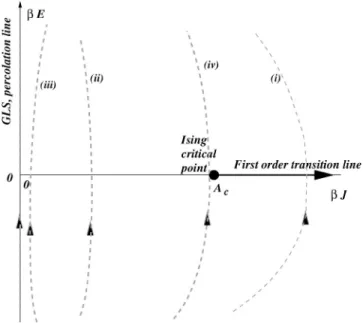
Depending on the value of 共lc兲J, the system can display four types of behavior, which are schematically depicted in Fig. 3.
共i兲 For many QD distributions, the first value of lc
satis-fying Eq.共62兲 occurs for very small values of P0共lc兲, which
correspond to small values of 2␣p共clc2兲lc2, since x ln关共1 − x兲/x兴→0+ when x→0. In this case, ln兵关1 − P0共lc兲兴/ P0共lc兲其/关1− P0共lc兲兴⯝−ln关P0共lc兲兴艌1, and the
condi-tion of Eq.共63兲 is satisfied. The system thus goes through a first-order phase transition at this lcand there is a
discontinu-ous jump in the average number of broken cells and the average stress 共which are related to first derivatives of the free energy with respect to l or , and are similar to the average number of spins up in an Ising model兲 关46兴. The correlation length increases up to the transition but remains finite. All of this behavior for such local load models has been documented in the literature关12,13,15兴.
However, three other behaviors are also possible if
共lc兲J⬍Acat the point lcat which the external field vanishes
关Eq. 共62兲兴. Whether this occurs is controlled by the type of
QD distribution and the value of the coupling constant ␣. When共lc兲J⬍Ac, no first-order transition is encountered and
one can further classify the transition into three subcatego-ries.
共ii兲 If共lc兲 has a finite value of order unity, significantly
below Ac, the system simply goes continuously through lc,
without discontinuity in sustained load or average number of cracks. The correlation length remains finite.
共iii兲 If共lc兲JⰆ1 共which should happen for vanishing␣兲,
the distribution over configurations is dominated by the ex-ternal field, and the system essentially behaves as a percola-tion model going through the percolapercola-tion transipercola-tion. Al-though there should be corrections due to the nonzero character of共lc兲J, these might be smaller than the finite size
corrections in numerical realizations, and the correlation length would then be found to diverge up to the system size as⬃兩l−lc兩−4/3.
共iv兲 Finally, if共lc兲J⬃Ac
−
, the system comes close to the critical point of the Ising model at lc, and the correlation
length should diverge correspondingly as in an Ising system whose temperature comes close to 1 / Ac= Tc from above,
while the external field changes sign. The slope of the aver-age mechanical curve共l兲 should also locally diverge around
lc. The exponents associated with the divergence of as a
function of 共l−lc兲 depend on the way the critical point is
approached as a function of l. For values of l such that
E共l兲Ⰶ1, we write 1/共l兲J⬃Tc+ f共l兲, and ⬃兩T共l兲−Tc兩−
=兩f共l兲兩− where = 1 for the two dimensional 共2D兲 Ising
model. The correlation length therefore diverges as兩l−lc兩−,
unless the temperature has a quadratic minimum in l close to
lcin which case it diverges as兩l−lc兩−2.
C. Power-law decay
We last consider the general case of stress perturbations decaying as power laws of the distance to broken cells, FIG. 2. Thermodynamic and mechanical response as a function
of imposed deformation for the global load sharing model:共a兲 the difference between the average Young’s modulus/l and the mini-mum Young’s modulusmin/ l共which holds in the entirely damaged
configuration兲; 共b兲 average stress for a few particular models 共the black dot is the percolation critical-point transition兲; 共c兲 Shannon entropy; and共d兲 temperature.
FIG. 3. Possible paths in the space of coupling constants of Ising models, under increasing imposed elongation associated with different local load sharing damage models.
J共x兲⬃␣共x/d兲−␥/⌽共␥兲, where ␣ is of order unity, d is the
lattice constant, and⌽共␥兲=兺y⫽x共兩y−x兩/d兲−␥is a normalizing
factor共which depends on the lattice size if␥⬎D, where D is the system dimension兲. To be consistent, the models consid-ered here are biperiodic of linear size L, and the interactions are put to 0 for distances above L. This type of model, con-sidered for example by Hidalgo et al. 关15,16兴, allows us to span ranges between purely global sharing共when ␥= 0兲 to the local sharing limit 共␥→⬁兲. Equations 共42兲–共44兲 show that this model leads to probability distributions over con-figurations of the form
P关,l兴 = exp
冋
冉
E兺
x x+兺
x⫽y J共兩x − y兩兲xy冊
册
冒
Z, 共64兲which is a generalized long-range Ising model with coupling constants and external field given by
J共r兲 = ␣p共cl 2兲l2 4P0共1 − P0兲 共r/d兲−␥ ⌽共␥兲 , 共65兲 E =1 2 ln
冉
P0 1 − P0冊
+␣p共cl 2兲l2 2P0 . 共66兲Note that although the case␥→⬁ is isomorphic to the local load sharing model introduced in the previous section, the global load sharing model of Sec. V A corresponds to␣= 0, but not to the exponent␥= 0. The presence of the quadratic coupling makes this latter case isomorphic to a Curie-Weiss model, which is the mean-field theory of Ising models.
Such long-range Ising models are still an open area of research, with the precise value of the critical point for any power-law interaction not precisely known. Nonetheless, it has been proposed关46–48兴 that one can classify the critical-ity into two categories depending on whether ␥⬎D or ␥
⬍D. In the shorter-range case, ␥⬎D, this model admits a
traditional thermodynamic limit when L→⬁. Although ⌽共␥兲 diverges when L→⬁, the thermodynamic limit is well de-fined once ⌽共␥兲 is introduced into the coupling constants
J共r兲=共r/d兲−␥/⌽共␥兲. Thus, the free or internal energy per lat-tice site, entropy, and magnetization all admit a finite limit when L→⬁, and are functions ofand the external field E. As␥→⬁ in the thermodynamic limit, Eq. 共65兲 reduces to the result of the standard Ising model关Eq. 共60兲兴 and so
lim
␥→⬁c= ln共1 +
冑
2兲/2.It has also been shown关48兴 that as␥→D+,
c⬃1. Thus, for ␥/ D in the range 关1+,⬁兴, c is bound between 1 and ln共1
+
冑2
兲/2. However, more precise details of how c varieswith␥ in this range are not presently available.
In the other category of longer-range interactions where
␥/ D lies in关0,1−兴, the only thing certain is that when ␥/ D = 0, the Curie-Weiss model is obtained for whichcis also
of order unity. It has thus been conjectured that all power-law interactions for which␥/ D⬍1 should be in the Curie-Weiss universality class关49兴. The Curie-Weiss model corresponds to the mean-field coupling Jxy= 1 / N, independently of
x and y, where N is the total number of cells in the system.
For the Curie-Weiss model, the PDF over state configurations is P关兴⬀exp关共E兺xx+兺xyxy/ N兲兴
⬀exp兵关E兺xx+共兺xx兲2/ 2N兴其.
All this suggests the following classifications of our dam-age models.
共1兲 If the coupling constant is small 共␣Ⰶ1兲, the damage
model is close to the percolation model so that in the ap-proach to the transition at elongation lc, the correlation
length behaves as⬃兩l−lc兩−, with= 4 / 3.
共2兲 For non-negligible coupling constants ␣, in the shorter-range case␥⬎D, we recover the same three possible behaviors as described above for the local load sharing rule.
共3兲 In the longer-range case where ␥⬍D, we again
re-cover the same four types of scenarios depending on the ratio
共lc兲/Ac 共as discussed in the local load sharing case兲. The
model behaves as percolation when ␣Ⰶ1. Otherwise, the behavior is determined by the ratio共lc兲/Ac. Note that Acis of order unity, but depends on the particular exponent␥and on the system size. If共lc兲/Ac⬍1, the system behaves
con-tinuously and no transition is observed. If共lc兲/Ac⬎1, there
is a discrete jump in both the average number of broken cells and the sustained load. The correlation length remains finite in both of these two cases. Only the limiting case of
共lc兲/Ac⬃1 corresponds to a second-order phase transition.
In any of these cases, for large enough systems, the Curie-Weiss description holds according to Refs.关46–48兴. Accord-ingly, if there is any divergence of correlation length due to the system coming close to共lc兲/Ac⬃1 at E=0, the
associ-ated exponents should be those of the Curie-Weiss mean-field critical point共= 1 / 2兲, and not the Ising one.
These results can be compared to numerical-simulation results in the literature for related models. In fiber-bundle models with power-law interactions 关15兴, a transition has been found as a function of the interaction exponent␥that is consistent with the above analysis, predicting mean-field be-havior for the long-range case␥⬍D, and Ising-like behavior in the short-range case␥⬎D. Typical configurations prior to breakdown for this type of system are displayed in Fig. 5 of Ref.关15兴, and look very similar to percolation configurations close to the transition in the case ␥= 0, displaying smaller and smaller cluster sizes共characteristic of the autocorrelation length兲 and compact configurations as␥ increases above D. This is coherent with a mean-field behavior close to perco-lation transition in the first case, as opposed to a first-order transition共analogous to Ising model crossing E=0 below Tc兲
when ␥⬍D. This analogy is even more apparent in Fig. 7, bottom, of Ref.关16兴, where an extension of this model was considered, with time-delayed fiber breaking process in ad-dition to power-law decaying interactions关16兴.
Burned fuse models, in which the interactions between burned fuses decay as 1 / rD, exhibit diverging autocorrelation lengths at breakdown, with ⬃兩l−lc兩−, where l is the
im-posed voltage, and is equal to the percolation exponent
关44兴,= 4 / 3 in 2D 关22,50兴 or 0.88 in 3D 关51兴. Roux et al.
关50兴 showed that in the limit of “infinitely large” disorder,
such models are isomorphic to percolation models. When the disorder is less pronounced, stress concentration leads to re-gimes of localizing damage. At low disorders, stress concen-tration entirely dominates, and fuses burn in clusters of size 共2005兲
scaling as the lattice step, leading to a so-called “total local-ization regime.” At intermediate disorders, fuses burn essen-tially in regions that scale as the lateral size of the system
共size in the direction perpendicular to the main current flow兲,
a priori much larger than the lattice step, which constitutes
the “soft localization regime” 关22,52兴. It has been shown
关22,51兴 that such a process is still in the percolation
univer-sality class, in the sense that there is still a growing autocor-relation length with an exponent identical to the percolation one. Based on the fact that these soft localizing regimes are in the percolation universality class, coupled with the large-scale profile of damage in the system, Hansen et al. 关22兴 related the roughness of the final fracture spanning through the system to the autocorrelation length exponent, based on arguments of percolation in a gradient, and this properly pre-dicts the Hurst exponent of the final damage fronts, in both 2D and 3D. The morphology of the connected “fracture” at breakdown is oriented, and different from percolating clus-ters in the percolation model. This is related to the aniso-tropic character of interactions in the burned fuse model; i.e., the current perturbation from a burned fuse varies as a dipo-lar field decaying as 1 / rD, but also having an orientational aspect not included in the models under study in this paper. This anisotropic aspect is absent from the models discussed here, but the fact that the autocorrelation length exponent is similar to the ones of percolation is coherent with the fact that long-range systems are in the percolation universality class. Burned fuse systems are at the overlap between short-and long-range interactions, in the sense that they correspond to␥= D.
Last, fiber bundles connected to elastic plates, where ␥ = 1 and D = 2, have been numerically studied in Ref.关28兴 and an autocorrelation length exponent of ⯝1.54 numerically determined. The discrepancy between this result and the per-colation or Curie-Weiss critical-point result might presum-ably result from finite-size effects making this model 共␥ = 1兲 still significantly different from the Curie-Weiss one
共␥= 0兲, or from the fact that the stress perturbation in this numerical model might have been too large for the interac-tions to be considered weak共a requirement for the validity of the present analysis兲.
VI. CONCLUSIONS
We have treated a class of damage models having weak isotropic interactions between cells that become damaged in the lattice. A quenched disorder is present in the rupture en-ergies for each lattice cell, and the evolution of damage is ruled by the Griffith principle. Averaging over all possible realizations of the underlying quenched disorder, the prob-ability distribution of each possible damage configuration was obtained as a function of the deformation externally ap-plied to the system.
The exact calculation is analytically tractable in the case of a global load sharing model, and it has been shown to be isomorphic to a percolation model. This corresponds to the behavior of a system totally dominated by the underlying disorder, where the next cell to break is always the weakest one. Spatial interactions added to the system modify this
picture, since the overload created by broken cells induces some degree of spatial ordering that competes with the weak-est cell mechanism. By limiting ourselves to small overloads compared to the average load of the system, it was possible to obtain the probability of damage configurations as inte-grated over all realizations of the quenched disorder.
In this weak interaction limit, the resulting probability distributions were shown to be Boltzmannians in the number of broken cells and in the stored elastic energy. This type of distribution maximizes Shannon’s entropy under constraints related to the energetic balance of the fracture process, and we have demonstrated the formal relationship between our quenched-disorder damage models and the standard distribu-tions arising in equilibrium statistical mechanics. This then allows the standard toolbox of statistical mechanics to be applied to our damage models.
Our systems map onto three types of possible behaviors:
共1兲 percolation models in the case of interactions so weak
they may be neglected; 共2兲 Ising models for non-negligible short-range interactions; and 共3兲 Curie-Weiss mean-field theory for non-negligible long-range interactions. The tem-perature and external field in the partition function of our models are analytical functions that depend on the particular sharing rule, on the type of quenched disorder considered, and on the average elongation 共or deformation兲 externally loaded onto the system. The path followed in the Ising con-trol parameter space when the load is increased from 0 de-pends on the qd distribution and the load sharing rule. When the formal external field changes sign, a phase transition is possible. This can correspond to a first-order phase transi-tion, a percolationlike transitransi-tion, or an Ising critical-point transition, depending on the value of the formal temperature during the transition.
The systems studied here are limited to isotropic load per-turbations. We have earlier studied oriented crack models in
关39–41兴, which correspond to anisotropic load perturbations
that depend on the orientation of the crack opened in the lattice. Those earlier studies were based on an entropy-maximum assumption. The hypotheses of the present work extend directly to oriented systems, and so the present paper justifies the entropy-maximum assumption postulated in our earlier work. The precise value of the temperature, and the physical interpretation of the functional forms given in
关39–41兴, should be modified according to the results of this
paper. Such modifications will, however, result in identical functional forms relating the configuration space and the PDF over configurations, and thus the present work confirms the existence of a phase transition in such an oriented crack model, with an associated divergence exponent of the auto-correlation length= 2.
Experimentally, the emergence of correlated damage at large scale has an important influence on the macroscopic rupture of a heterogeneous object. For example, the rough-ness of natural fracture surfaces, whose universality has long been observed experimentally关53兴, has recently been related to the behavior of the divergence of the damage correlation length at the approach to breakdown关22兴. Damage correlated at large scale should also leave a signature on elastic wave scattering through the damaged material. The knowledge of the behavior of a damage autocorrelation function, as