HAL Id: hal-00480707
https://hal.univ-brest.fr/hal-00480707
Submitted on 4 May 2010HAL is a multi-disciplinary open access
archive for the deposit and dissemination of sci-entific research documents, whether they are pub-lished or not. The documents may come from teaching and research institutions in France or abroad, or from public or private research centers.
L’archive ouverte pluridisciplinaire HAL, est destinée au dépôt et à la diffusion de documents scientifiques de niveau recherche, publiés ou non, émanant des établissements d’enseignement et de recherche français ou étrangers, des laboratoires publics ou privés.
Long term and recent climate changes recorded in North
Atlantic oceanic archives around iceland
Frédérique Eynaud
To cite this version:
Frédérique Eynaud. Long term and recent climate changes recorded in North Atlantic oceanic archives around iceland. Iceland in the Central Northern Atlantic : hotspot, sea currents and climate change, May 2010, Plouzané, France. �hal-00480707�
LONG TERM AND RECENT CLIMATE CHANGES RECORDED
IN NORTH ATLANTIC OCEANIC ARCHIVES AROUND ICELAND
Frédérique EYNAUD
Université Bordeaux I, Laboratoire EPOC , UMR CNRS 5805, Avenue des facultés , 33405 Talence cedex – France
Abstract
This contribution will compile paleoceanographic and paleoclimatic works which, over the last decades, provided major insights in our understanding of the Earth’s climate natural variability and the underlying forcing mechanisms. A focus will be made on peri-icelandic marine records which document the climatic pace at different time-scales and are supported by multiproxy evidences. A special attention to the link in between the ocean and the cryosphere will be done.
1. Interest of the Icelandic sector 1.1. A “hot spot” for oceanographers!
The North Atlantic Ocean has always been the focus of extensive researches regarding modern and past oceanographic processes. This ocean is actually one of the world key areas to tackle the question of the thermohaline conveyor (THC) efficiency throughout time, as it houses important components of this major climatic artery (e.g. Broecker, 1997; Rahmstorf, 1997, Broecker, 1999). Iceland represents a topographic barrier at the confluence of the Greenland, Iceland and Norwegian seas (GIN seas, also called the Nordic seas), and major surface and deep gateways thus bracket this domain.
Figure 1 : (a) Schematic view (after Blindheim et al., 2000; McCartney and Mauritzen, 2001) of the North Atlantic major surface currents (NAD, North Atlantic Drift; NAC, Norwegian Atlantic Current; IC, Irminger Current) and the intermediate Mediterranean Outflow Water current (MOW). Source: Eynaud et al. (2007)
(b) Modern sea-surface hydrographic conditions of the North Atlantic Ocean. The SST isotherms are from Tchernia, 1978 (SST annual mean). Dotted lines locate the major hydrographic fronts: PF: Polar Front, AF: Arctic Front, SAF: Sub-Arctic Front, after Dickson et al. (1988). Source: Eynaud et al. (2009).
In the vicinity of Iceland, the duality of the cold currents originating from the Arctic basin versus the northward warm Atlantic inflow (Figure 1a) is plainly expressed at the surface and generates persistent hydrographic structures (Figure 1b) which constrain the distribution of the different water masses. This has direct repercussion on the planktonic living populations and, of course, on their fossil remains through sedimentary archives. Contrasted biological assemblages thus relay throughout time, from the seasonal time scale of the modern ocean, to the orbital scale of the Quaternary sediments.
Deep currents aliment the deposit of giant edifices along the complex bathymetry and physiography of this area (Figure 2). In the South Icelandic basin, especially, the Gardar Drift has furnished high quality sedimentary sequences that helped to better constrain the long term and recent climatic changes of the north hemisphere. Sedimentary archives around Iceland furthermore benefit of invaluable
chronostratigraphical indicators with the repetitive deposits of ash layers which constitute excellent age tie-points for paleoceanographers.
Figure 2 : Major physiographic provinces around Iceland (after Faugères et al., 1999). SOURCE : Eynaud PhD thesis 1999
1.2. A “hot spot” for paleoclimatologists!
One of the major finding in Paleoclimatology over the last decades has been revealed both in ice cores and in sediment cores with the evidence of large variations of air temperature over millennial and sub-millennial periods, coupled to major North-Atlantic hydrological changes (Dansgaard et al., 1993, Figure 3).
Figure 3 : Climatic evolution of the last 50 ka as depicted by the Greenland ice core record ( 18O NGRIP) compared to the summer insolation values at 65°N. Numbers on the Figure identify the Dansgaard-Oeschger warm interstadials. HEs : Heinrich events, B/A = Bölling-Alleröd oscillation, YD = Younger Dryas oscillation, TI = Terminaison I.
These rapid climatic oscillations, the so called Dansgaard–Oeschger (D–O) events, occur as cyclic but non-periodic phenomenon and represent abrupt and drastic flips of the climate system. They are major challenges regarding our comprehension of the Earth’s climate variability and stability. The abrupt cold excursions, i.e. stadial events (Dansgaard et al., 1993) or Heinrich events (Heinrich, 1988), which occurred during the last glacial period (Figure 3), provide excellent archives of Pleistocene rapid climatic transitions. They, furthermore, raised major questions about the pace of the natural system.
The extreme Heinrich events result from a massive calving of icebergs in relation to the sudden collapse of the peri-arctic ice-sheets during the last glacial period (e.g. Heinrich, 1988; Bond et al., 1993, Hemming, 2004). They took place at the end of a saw-tooth shaped cooling cycle of 4 successive stadials/interstadials (e.g. Bond cycles: Bond et al., 1993). However, the triggering of these events is still a matter of debate, as they imply complex mechanisms linking ice-sheet, atmosphere and ocean dynamics. Their impact was recognized worldwide (e.g. Leuschner and Sirocko, 2000; Wang et al., 2001) and each of the Earth's surface reservoirs, i.e. the cryosphere, atmosphere, oceans, and biosphere, was affected. Some of the most severe Heinrich events impacted dramatically on the North Atlantic's overturning circulation (e.g. Zahn et al., 1997; Curry et al., 1999; Roche et al., 2004). These events potentially constitute catastrophic analogues of modern or near-future ice-sheet (Antarctic especially) collapses in the context of global warming.
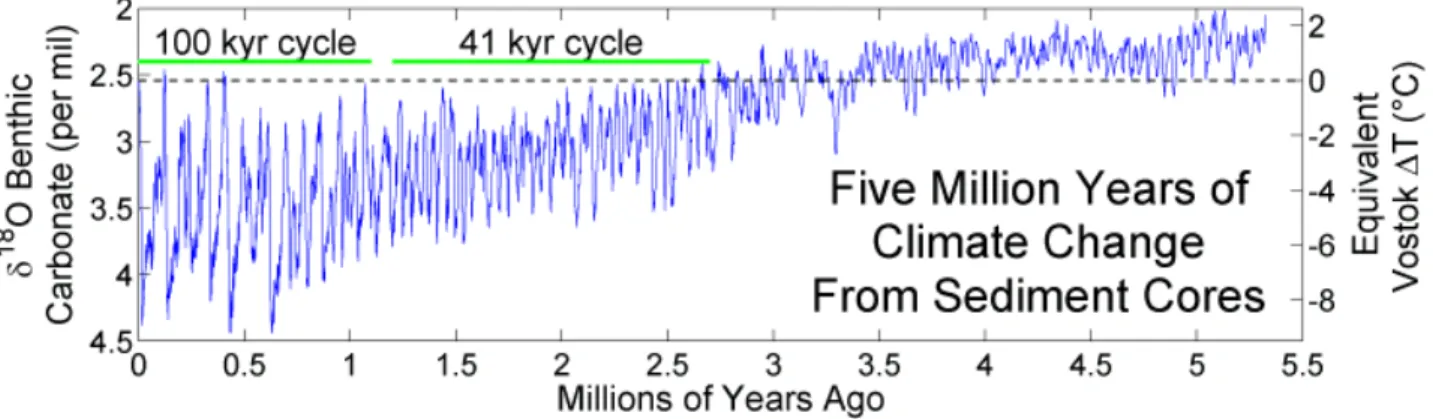
Regarding its geographical position, the Icelandic sector appears as a strategic sector to study this kind of climatic variability. This is also true regarding long term timescales (Figure 4), as Iceland is surrounded by major gateways which have played a crucial role in the evolution of the climate of the last million years.
Figure 4 : Robert Rohde's Temperature Record Series over the last 5.5 millions years.
Several questions are raised on long term climate evolution, they are (1) the origin of the transition, approximately 4 million years ago, of Earth’s climate into a state characterized by significant Northern Hemisphere (NH) continental glaciation; (2) the link in between the pace of Earth’s climate and the orbital parameters (3) the shift at 900 ka from a 41-kyr obliquity cycle towards a 100 ka quasi-periodic cycle that has since dominated the Earth’s climate history (e.g. Raymo, 1998). All these questions can be treated from an “Icelandic point of view”!
2. some critical illustrations of the long term and recent climate changes around Iceland 2.1. about the THC variability
Thanks to the focus that has been put on giant contourite drifts, themselves built by the deep components of the THC, a significant number of sequences now exist in the south Icelandic basin, which furnish excellent documents of the THC variability throughout time. These sequences further served as supports of data compilation to better monitor paleoclimatic and paleoceanographic evolutions at the North Atlantic basin scale and thus represent excellent time –constrained records, tied to ice-core stratigraphies through regional climatic and ash layer tie-points and supported by traditional marine stratigraphic (δ18O) and dating techniques (14C). This was the case, at suborbital time-scales, with the construction of the North Atlantic geomagnetic paleointensity stack (NAPIS, Laj et al., 2000; 2002; Stoner et al., 2002). In the same way, the “famous ‘LR04’’ stack of benthic δ18O Pliocene-Pleistocene records, compiled by Lisiecki and Raymo (2005), also benefits for the North Atlantic sector from sequences retrieved in the south Icelandic basin.
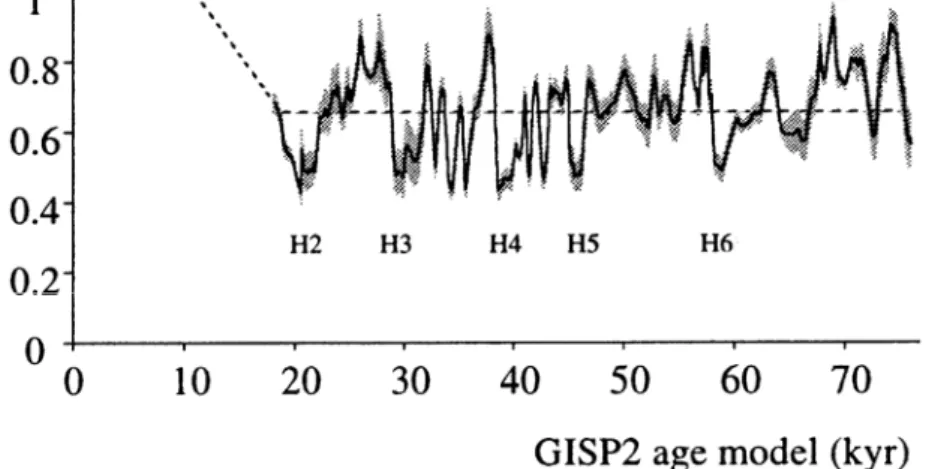
These efforts contributed to the construction of a robust picture of the THC variability for the last 75 ka (Figure 5). Merged to the simulation works, they all showed its extreme sensitivity to freshwater inputs and challenged our understanding of abrupt climate changes, a major feature to prescribe its future evolution.
This is on this dynamic component that we will focus part of the discussion. The THC variability, as deduced from peri-Icelandic marine archives, will then be documented at different time-scales (from the sub-millennial one to the orbital one), furthermore using the largest set of paleoceanographic proxies yet available.
Figure 5 : Schematic profile of North Atlantic deep-water (NADW) changes in the past 75 kyr (normalized to unity for modern times) based on ARM (anhysteretic remanent Magnetization)results from North Atlantic cores. Laj et al. (2002).
2.2. migration of the polar front and its relation to icebergs surges : from glacial to modern features Intimely coupled to the dynamic of the THC is the evolution of the latitudinal position of the Polar Front (PF). At Present, the PF closely follows the Greenland and eastern Canadian continental margins (Figure 1b). In the ocean it is defined as a physical oceanographic structure with high temperature and salinity gradients, which separates two different surface-water masses: the relatively warm, high-salinity Atlantic Water, and the cold low-salinity modified Polar Water carried southwards by the East and West Greenland and Labrador currents (Holliday et al., 2007). This front constitutes a strong ecological barrier in the North Atlantic Ocean and also physically constrains sea-ice and iceberg drifting. The latitudinal migration of the Polar Front as south as 40°N during late Pleistocene cold events has been documented by numerous studies (e.g. McIntyre et al. 1976; Ruddiman and McIntyre, 1981; Duprat, 1983; Bard et al., 1987; Abrantes et al., 1998). We will build an inventory of its impact over Icelandic and peri-icelandic environments and paleoenvironments.
References
Abrantes, F., J. Baas, H. Haflidason, T. Rasmussen, D. Klitgaard, N. Loncaric, and L. Gaspar (1998), Sediment fluxes along the northeastern European Margin: Inferring hydrological changes between 20 and 8 kyr, Marine Geology, 152, 7-23.
Bard, E., M. Arnold, P. Maurice, J. Duprat, J. Moyes, and J.C. Duplessy (1987), Retreat velocity of the North Atlantic polar front during the last deglaciation determined by 14 C accelerator mass spectrometry, Nature, 328, 791–794.
Blindheim, J., V. Borokov, B. Hansen, S.A. Malmberg, W.R. Turrell, and S. Osterhus (2000), Upper layer cooling and freshening in the Norwegian Sea in relation to atmospheric forcing, Deep-Sea Research Part I, 47, 655-680.
Bond, G., W. Broecker, S. Johnsen, J. McManus, L. Labeyrie, G. Jouzel, and G. Bonani (1993), Correlations between climate records from North Atlantic sediments and Greenland ice, Nature, 365, 143-147. Broecker, W. (1997). Thermohaline Circulation, the Achilles Heel of Our Climate System: Will Man-Made
CO2 Upset the Current Balance? Science 278, 1582 -1588.
Broecker, W. (1999). What if the conveyor were to shut down? GSA Today 9, 1–6.
Curry, W. B., T. M. Marchitto, J. F. McManus, D. W. Oppo, and K. L. Laarkamp (1999), Millennial-scale changes in ventilation of the thermocline, intermediate, and deep waters of the Glacial North Atlantic, in Mechanisms of Global Climate Change at Millennial Time Scales, edited by P. U. Clark, R. S. Webb and L. D. Keigwin, AGU, Washington, D.C., pp. 59–76.
Dansgaard, W., S. J. Johnsen, H. B. Clausen, D. Dahl-Jengen, N. S. Gundestrup, C. U. Hammer, C. S. Hvidberg, J. P. Steffensen, A. E. Sveinbjörnsdottir, J. Jouzel, and G. Bond (1993), Evidence for general instability of past climate from 250-kyr ice-core record, Nature, 364, 218-220.
Dickson, R. R., J. Meincke, S.-A. Malmberg and A. J. Lee (1988), The "Great Salinity Anomaly" in the Northern North Atlantic 1968-1982, Prog. Oceanog., 20, 103-151.
Duprat, J. (1983), Les foraminifères planctoniques du Quaternaire terminal d’un domaine péricontinental (Golfe de Gascogne, Cote Ouest Ibérique, Mer d’Alboran) Ecologie-Biostratigraphie, Thesis Univ. Bordeaux I, 177 pp.
Faugères, J.-C., Stow, D.A.V., Imbert, P., Viana, A., 1999. Seismic features diagnostic of contourite drifts. Mar. Geol. 12, 1–38.
Eynaud, F. (1999), Kystes de Dinoflagellés et Evolution paléoclimatique et paléohydrologique de l'Atlantique Nord au cours du Dernier Cycle Climatique du Quaternaire, PhD thesis, 291 pp. University of
Bordeaux 1
Eynaud, F., Zaragosi S., Scourse J., Mojtahid M., Bourillet J-F., Hall I. R., Penaud A., Locascio M., Reijonen A., 2007. Deglacial laminated facies on the NW European continental margin: the hydrographic significance of British-Irish Ice Sheet deglaciation and Fleuve Manche paleoriver discharges. G3, v. 8, DOI:10.1029/2006GC001496
Eynaud F., L. de Abreu, A. Voelker, J. Schönfeld, E. Salgueiro, J.-L. Turon, A. Penaud, S. Toucanne, F. Naughton, M.-F. Sanchez-Goñi, B. Malaizé, and I. Cacho: Position of the Polar Front along the western Iberian margin during key cold episodes of the last 45 ka, Geochem. Geophys. Geosyst., 10, Q07U05, doi:10.1029/2009GC002398. Highlight dans Nature Geoscience 2, (30 June 2009)
doi:10.1038/ngeo575
Heinrich, H. (1988), Origin and Consequences of Cyclic Ice Rafting in the Northeast Atlantic Ocean during the Past 130,000 Year, Quaternary Research, 29, 142-152.
Hemming, S. R., (2004), Heinrich events: Massive late Pleistocene detritus layers of the North Atlantic and their global climate imprint, Reviews of Geophysics, 42, RG1005 1-43.
Holliday, N.P., Meyer, A., Bacon, S., Alderson, S.G. and B. de Cuevas (2007), Retroflection of part of the east Greenland current at Cape Farewell, Geophysical Research Letters, 34, 7, L07609
Laj, C., Kissel C., Mazaud A., Channell J.E.T., and J. Beer (2000), North Atlantic palaeointensity stack since 75 ka (NAPIS-75) and the duration of the Laschamp event, Philosophical Transactions of the Royal Society A: Mathematical, Physical and Engineering Sciences, 358 (1768), 1009-1025.
Laj, C., Kissel C., Mazaud A., Michel E., Muscheler R., and J. Beer (2002) Geomagnetic field intensity, North Atlantic Deep Water circulation and atmospheric Δ14C during the last 50 kyr, Earth and Planetary Science Letters 200: 177-190
Lisiecki, L. E., Raymo, M. E., 2005. A Pliocene-Pleistocene stack of 57 globally distributed benthic δ18O records. Paleoceanography 20, PA1003, doi:10.1029/2004PA001071.
McCartney, M. S., and C. Mauritzen (2001), On the origin of the warm inflow to the Nordic Seas, Progress in Oceanography, 51, 125-214.
McIntyre, A., N.G. Kipp, A.W.H. Be, T. Crowley, T. Kellogg, J.V. Gardner, W. Prell, and W.F. Ruddiman (1976), Glacial North Atlantic years ago: a CLIMAP reconstruction. In: Cline, R.M., Hays, J.D. (Eds.), Investigation of Late Quaternary Paleoceanography and Paleoclimatology, Mem. 145. Geol. Soc. Am, Boulder, CO, pp. 43-76.
Penaud A. (2009), Interactions climatiques et hydrologiques du système Méditerranée/ Atlantique au Quaternaire, PhD thesis, 331 pp. University of Bordeaux 1
Raymo, M.E., 1998. Glacial puzzles. Science 281, 1467–1568.
Rahmstorf, S., 1997: Risk of sea-change in the Atlantic. Nature 388, 825-826.
Roche, D., D. Paillard, and E. Cortijo (2004), Constraints on the duration and freshwater release of Hein rich event 4 through isotope modelling, Nature, 432, 379-382.
Robert Rohde's Temperature Record.
http://www.globalwarmingart.com/wiki/Image:Short_Instrumental_Temperature_Record.png Ruddiman and McIntyre, 1981;
Leuschner, D. C., and F. Sirocko (2000), The low-latitude monsoon climate during Dansgaard-Oeschger cycles and Heinrich Events, Quaternary Science Reviews, 19, 243-254.
Stonner, J.S., C. Laj, J.E.T. Channell, C. Kissel, South Atlantic and North Atlantic geomagnetic
Paleointensity Stacks (0-80ka): implications for inter-hemispheric correlation, Quaternary Science Reviews 21: 1141–1151
Tchernia, P. (1978), Océanographie Régionale, Description Physique des Océans and des Mers, In: Ecole Nationale Supérieure des Techniques Avancées, Paris, 257 pp.
Wang, Y. L., H. Cheng, R. L. Edwards, Z. S. An, J. Y. Wu, C.-C. Shen, and J. A. Dorale (2001), A High-Resolution absolute-dated Late Pleistocene monsoon records from Hulu Cave, China, Science, 294(5550), 2345-2348.
Zahn, R., J. Schönfeld, H.-R. Kudrass, M.-H. Park, H. Erlenkeuser, and P. Grootes (1997), Thermohaline instability in the North Atlantic during meltwater events: stable isotope and ice-rafted detritus records from core SO75-26KL, Portuguese margin, Paleoceanography, 12, 696-710.