Modeling of static and dynamic behaviour of 2.9THz Quantum Cascade Lasers
Yoann PETITJEAN SUPAERO / MOSE Email: [email protected]
Fabien DESTIC SUPAERO / MOSE Email: [email protected]
Jean-Claude MOLLIER SUPAERO /MOSE
ONERA / DOTA
Email: [email protected]
Abstract—Based on simplified rate equations, both static and dynamic behaviour have been studied in order to characterize 2.9THz QCLs that will be used in detection or transmission sys- tems. Comparison of expected static behaviour and experimental one shows good correspondence. We have been able to extract a semi-empirical law of evolution of the threshold current with temperature and link it with the optical gain. About the dynamic behaviour, theoretical simulations show that bandwidth of more than 150GHz is attainable during direct intensity modulation (IM), with a response without any peak of resonance (due to the different estimated lifetimes of the tested QCL).
I. I
NTRODUCTIONNowadays, Quantum Cascade Lasers (QCLs) are at the same point of development that the first semiconductor lasers in the 1960’s were. Indeed they still need to be cooled at cryogenic temperatures (between 4K and 70K for 2.9 THz QCLs, even though some could be used at room temper- ature with decreased output power). Moreover, the recent demonstrations of far infrared Quantum Cascade Lasers have increased significantly the interest in the THz frequency range.
Consequently, studies must be done on this component in order to improve what is, at present, the most promising source of Terahertz radiation.
In this work, we have modeled the static and dynamic behaviour of our 2,9 THz QCL. We have studied the vari- ations of both the static behaviour with temperature and the dynamic behaviour with bias current. Experimental studies are in progress to confront our theoretical static results. About the dynamics, we are afraid that we are unable to verify the theoretical previsions with experimental results...
June 11, 2007
II. R
ATE EQUATIONSThe rate equations are based on a three level classical scheme which leads to a 4 equations system (3 for electrons and 1 for photons) [1]. For a QCL of N
pperiods, the equations are written as :
∂N
3(j)∂t = η I
in(j)q − N
3(j)τ
3− G
(j)(N
3(j)− N
2(j))S
∂N
2(j)∂t = N
3(j)τ
32− N
2(j)τ
2+ G
(j)(N
3(j)− N
2(j))S
∂N
1(j)∂t = N
3(j)τ
31− N
2(j)τ
21− I
out(j)q
∂S
∂t =
Np
X
j=1
G
(j)(N
3(j)− N
2(j))S + n
spN
3(j)− N
2(j)τ
sp− S
τ
swhere N
iis the number of electrons in the i
thlevel, S is the number of photons, G
(j)is the optical gain of the j
thperiod, τ
ij−1is the rate of transition from level i to level j, τ
iis the electron lifetime in level i, and τ
sis the photon lifetime. n
spis the spontaneous emission coefficent and I
inand I
outare respectively the input and output currents.
To simplify this system, we assume that the optical gain is the same in all the periods, and so is the difference N
3− N
2. This approximation, which is in fact, the hypothesis of non- spatial saturation of the optical gain, leads to these new rate equations :
∂N
3∂t = η I q − N
3τ
3− G · (N
3− N
2) · S (1)
∂N
2∂t = N
3τ
32− N
2τ
2+ G · (N
3− N
2) · S (2)
∂S
∂t = N
p· G · (N
3− N
2) · S − S τ
s+ β · N
3τ
sp(3) We have also removed the equation describing the first level because it is of no consequence to study the photon-current behaviour. Finally, considering these equations is analogous to studying the rate equations of one period, but with a stimulated emission term multiplied by the number of periods N
pdue to the cascade effect.
III. S
TATIC BEHAVIOURIn order to study the static behaviour of the QCL, we
have written a Matlab program enabling us to compute the
optical power P versus the bias current I (P(I) curves) at
different temperatures. Then, we have compared these curves
with the experimental ones given by Carlo SIRTORI et al.,
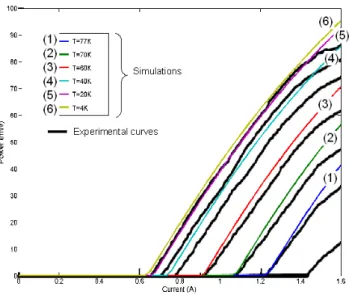
Fig. 1. Optical power versus bias current for several temperatures
and corresponding to this specific 2.9THz QCL [2] [3]. Fig.1 shows that they match quite perfectly, both in threshold current and optical power. This result demonstrates that our simplified rate equations are accurate enough to make predictions on the variations of the reachable output optical power and threshold current with the temperature.
We have extracted a semi-empirical law on the evolution of the threshold current I
thwith the temperature T , and linked it with the optical gain G. Indeed, a well-known law of variation for Quantum Cascade Laser is [4] :
I
th= I
th1+ I
th2exp T
T
0where T
0is the so-called characteristic temperature.
We can show that this variation of the threshold current could be linked to a variation of the optical gain from the rate equations. The threshold current varies as the inverse of the optical gain. So, we can express it as :
G = G
0. 1 + δ 1 + δ. exp
T T0
where δ =
IIth2th1
and G
0is the optical gain at 0K.
IV. D
YNAMIC BEHAVIOURThe results show that the dynamic behaviour can only be studied theoretically. Indeed, with some approximations, the direct intensity modulation response could be first modeled by a 3
rdorder transfer function, then simplified, by assuming a pole and a zero to be approximately equal, in a 2
ndorder transfer function. This modeling leads to a fundamental frequency f
0of 100 GHz (cf. Fig.2) for a bias current of 1.25A and a threshold current of 0.65A.
Fig. 2. Modeled Bode diagrams of a 2.9THz QCL biased at 1.25A
Moreover, this bandwidth is bias dependent, and varies as
√ I − I
thwhere I
this the threshold current. The study of the damping factor shows that it is a non-resonant 2
ndorder system whatever the bias current be, for the QCL we have modeled.
V. C
ONCLUSION ANDP
ROSPECTSWe have reported the simulation of both static and dynamic behaviour of the QCLs that will be used in a near future for terahertz imaging. The results allowed a prediction of the QCL behaviour as function of current and temperature. Furthermore, the bandwidth prediction in direct intensity modulation is quite encouraging and lets us think that studies could be done in this direction. Finally, further experiments are intended with QCLs of different geometries in order to improve the model
A
CKNOWLEDGMENTThe authors would like to thank Professor Carlo SIRTORI et al. (Universit´e Paris VII, FRANCE) for providing the QCL and Jean LEOTIN and Jean GALIBERT (Laboratoire National des Champs Magn´etiques Puls´es, Toulouse, FRANCE) for their help on the cryogenic facilities.
R
EFERENCES[1] F. Rana and R. J. Ram, “Current noise and photon noise en quantum cascade lasers,”Physical Review B, vol. 65, Mars 2002.
[2] C. Sirtori, “Quantum cascade laser : fundamentals and performances,” in EDP sciences, 2002.
[3] S. Barbieri, J. Alton, H. E. Beere, J. Fowler, E. H. Linfield, and D. A.
Ritchie, “2,9thz quantum cascade laser operating up to 70k in continuous wave,”Applied Physic Letters, vol. 85, Septembre 2004.
[4] C. A. Evans, V. D. Jovanovi´c, D. Indjin, Z. Ikoni´c, and P. Harrisson,
“Investigation of thermal effect in quantum cascade laser,”IEEE Journal of Quantum Electronics, vol. 42, Septembre 2006.
[5] L. A. Coldren and S. W. Corzine,Diode Lasers and Photonic Integrated Circuits. Wiley-Interscience, 1995.
[6] J. Faist, F. Capasso, D. L. Sivco, C. Sirtori, A. L. Hutchinson, and A. Y.
Cho, “Quantum cascade laser,”Science, vol. 264, Avril 1994.
[7] S. Kumar, B. S. Williams, S. Kohen, Q. Hu, and J. L. Reno, “Continuous wave operation of quantum cascade laser above liquid nitrogen tempera- ture,”Applied Physic Letters, vol. 84, Avril 2004.