arXiv:nucl-ex/0609026v1 16 Sep 2006
(will be inserted by the editor)
First measurement of the ρ spectral function in nuclear collisions
S. Damjanovic1 for the NA60 Collaboration CERN, Geneva, Switzerland
Received: date / Revised version: date
Abstract. The NA60 experiment at the CERN SPS has studied low-mass muon pairs in 158 AGeV
In-In collisions. A strong excess of pairs is observed above the yield expected from neutral meson decays. The unprecedented sample size close to 400K events and the good mass resolution of about 2% made it possible to isolate the excess by subtraction of the decay sources. The shape of the resulting mass spectrum shows some non-trivial centrality dependence, but is largely consistent with a dominant contribution from π+
π− → ρ → µ+µ− annihilation. The associated ρ spectral function exhibits considerable broadening,
but essentially no shift in mass. The pT-differential mass spectra show the excess to be much stronger at
low pT than at high pT. The results are compared to theoretical model predictions; they tend to rule out
models linking hadron masses directly to the chiral condensate.
PACS. 25.75.-q Relativistic heavy-ion collisions – 12.38.Mh Quark-gluon plasma – 13.85.Qk Lepton Pairs
1 Introduction
Thermal dilepton production in the mass region <1 GeV/c2
is largely mediated by the light vector mesons ρ, ω and φ. Among these, the ρ(770 MeV/c2
) is the most impor-tant, due to its strong coupling to the ππ channel and its short lifetime of only 1.3 fm/c, much shorter than the lifetime of the fireball. These properties have given it a key role as the test particle for “in-medium modifications” of hadron properties close to the QCD phase boundary. Changes both in width and in mass were originally sug-gested as precursor signatures of the chiral transition [1]. There seems to be some consensus now that the width of the ρ should increase towards the transition region, based on a number of quite different theoretical approaches [1, 2,3,4,5]. On the other hand, no consensus exists on how the mass of the ρ should change in approaching the transi-tion: predictions exist for a decrease [1,6,7,8], a constant behavior [4,5], and even an increase [3].
Experimentally, low-mass electron pair production was previously investigated at the CERN SPS by the CERES /NA45 experiment for p-Be/Au, S-Au and Pb-Au colli-sions [9,10,11]. The common feature of all results from nuclear collisions was an excess of the observed dilepton yield above the expected electromagnetic decays of neutral mesons, by a factor of 2-3, for masses above 0.2 GeV/c2.
The surplus yield has generally been attributed to direct thermal radiation from the fireball, dominated by pion annihilation π+
π− → ρ → l+l− with an intermediate ρ
which is strongly modified by the medium. Statistical ac-curacy and mass resolution of the data were, however, not sufficient to reach the sensitivity required to assess in detail the character of the in-medium changes. The new
experiment NA60 at the CERN SPS has now achieved a decisive breakthrough in this field.
2 Apparatus and data analysis
The apparatus is based on the muon spectrometer pre-viously used by NA50, and a newly added telescope of radiation-tolerant silicon pixel detectors, embedded inside a 2.5 T dipole magnet in the vertex region [12,13]. Match-ing of the muon tracks before and after the hadron ab-sorber, both in angular and momentum space, improves the dimuon mass resolution in the region of the light vec-tor mesons from ∼80 to ∼20 MeV/c2
and also decreases the combinatorial background of muons from π and K de-cays. Moreover, the additional bend by the dipole field leads to a strong increase of the detector acceptance for opposite-sign dimuons of low mass and low transverse mo-mentum. The rapidity coverage is 3.3<y<4.3 for the ρ, at low pT (compared to 3<y<4 for the J/ψ). Finally, the
se-lective dimuon trigger and the fast readout speed of the pixel telescope allow the experiment to run at very high luminosities.
The results reported here were obtained from the anal-ysis of data taken in 2003 with a 158 AGeV indium beam, incident on a segmented indium target of seven disks with a total of 18% (In-In) interaction length. At an average beam intensity of 5·107 ions per 5 s burst, about 3·1012
ions were delivered to the experiment, and a total of 230 million dimuon triggers were recorded on tape. The data reconstruction starts with the muon-spectrometer tracks. Next, pattern recognition and tracking in the vertex tele-scope are done; the interaction vertex in the target is
reconstructed with a resolution of ∼200 µm for the z-coordinate and 10-20 µm in the transverse plane. Only events with one vertex are kept; interaction pileup and reinteractions of secondaries and fragments are thus re-jected. Finally, each muon-spectrometer track is extrapo-lated to the vertex region and matched to the tracks from the vertex telescope.
The combinatorial background of uncorrelated muon pairs mainly originating from π and K decays is deter-mined using a mixed-event technique [14]. Two single mu-ons from different like-sign dimuon triggers are combined into muon pairs in such a way as to accurately account for details of the acceptance and trigger conditions. The qual-ity of the mixed-event technique can be judged by com-paring the like-sign distributions generated from mixed events with the measured like-sign distributions. It is re-markable that the two agree to within ∼1% over a dy-namic range of 4 orders of magnitude in the steeply falling mass spectrum [14]. After subtraction of the combinato-rial background, the remaining opposite-sign pairs still contain “signal” fake matches, i.e. associations of muons to non-muon tracks in the pixel telescope. This contribu-tion is only 7% of the combinatorial background level. It has been determined in the present analysis by an over-lay Monte Carlo method. We have verified that an event-mixing technique gives the same results, both in shape and in yield, within better than 5%. More details on the experimental apparatus and data analysis will be given in a forthcoming extended paper; for now see [14,15].
3 Results
A significant part of the results presented in this paper has recently been published [16]. That part will therefore be less extensively treated than other parts published here for the first time.
Fig. 1 shows the opposite-sign, background and sig-nal dimuon mass spectra, integrated over all collision cen-tralities. After subtracting the combinatorial background and the signal fake matches, the resulting net spectrum contains about 360 000 muon pairs in the mass range 0-2 GeV/c2
of Fig. 1, roughly 50% of the total available statistics. The average charged-particle multiplicity den-sity measured by the vertex tracker is dNch/dη =120, the
average signal-to-background ratio is 1/7. For the first time in nuclear collisions, the vector mesons ω and φ are completely resolved in the dilepton channel; even the η→µµ decay is seen. The mass resolution at the ω is 20 MeV/c2. The subsequent analysis is done in four classes
of collision centrality defined through the charged-particle multiplicity density: peripheral (4-30), semiperipheral (30-110), semicentral (110-170) and central (170-240). The signal-to-background ratios associated with the individual classes are 2, 1/3, 1/8 and 1/11, respectively.
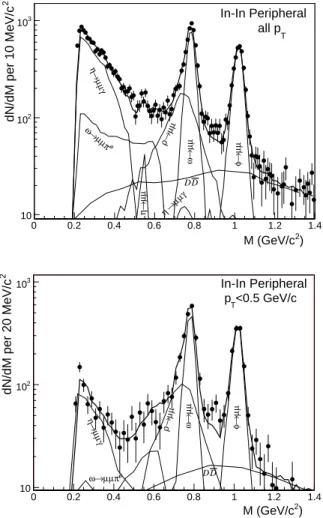
The peripheral data can essentially be described by the expected electromagnetic decays of the neutral mesons. Muon pairs produced from the 2-body decays of the η, ρ, ω and φ resonances and the Dalitz decays of the η, η′ and
0 0.2 0.4 0.6 0.8 1 1.2 1.4 1.6 1.8 2 3 10 4 10 2 dN/dM per 10 MeV/c ) 2 M (GeV/c No centrality selection S=360000 <S/B>=1/7 η ω φ
Fig. 1. Mass spectra of the opposite-sign dimuons (upper
histogram), combinatorial background (dashed), signal fake matches (dashed-dotted), and resulting signal (histogram with error bars).
ω were simulated using the improved hadron decay gen-erator GENESIS [17], while GEANT was used for trans-port through the detectors. Four free parameters (apart from the overall normalization) were used in the fit of this “hadron decay cocktail” to the peripheral data: the cross section ratios η/ω, ρ/ω and φ/ω, and the level of D meson pair decays; the ratio η′/η was kept fixed at 0.12 [9,17]. The fits were done without pT selection, but also
indepen-dently in three windows of dimuon transverse momentum: pT<0.5, 0.5<pT<1 and pT>1 GeV/c. Data and fits,
in-cluding an illustration of the individual sources, are shown in Fig. 2 for all pT (upper) and for the particular selection
pT<0.5 GeV/c (lower). The fit quality is good throughout,
even in the critical acceptance-suppressed η-Dalitz region at low mass and low pT.
The quantitative fit results in terms of the cross section ratios, corrected for acceptance and extrapolated to full phase space (meaning here full ranges in y and pT) are
dis-played in Fig. 3 (upper), where the horizontal lines (with the label <>) indicate the fit values without pT selection,
and the data points (with statistical errors) the values obtained from the three different pT windows. The
sys-tematic errors are of order 10% in all cases, dominated by those of the branching ratios. The η/ω ratio agrees, within <10%, with the literature average for p-p, p-Be [9]. The φ/ω ratio is higher than the p-p, p-Be average, reflecting some φ enhancement already in peripheral nuclear colli-sions. Both ratios are, within 10%, independent of the pair pT. This implies that the GENESIS input assumptions
(used in the extrapolation to full pT) as well as the
accep-tance corrections vs. pT are correct on the level of 10%.
0 0.2 0.4 0.6 0.8 1 1.2 1.4 10 2 10 3 10 ) 2 M (GeV/c 2 dN/dM per 10 MeV/c In-In Peripheral T all p 0 π µ µ → ω γµ µ →η µµ →φ µµ →ω µµ →ρ µµ →η γ µ µ → ’ η D D 0 0.2 0.4 0.6 0.8 1 1.2 1.4 10 2 10 3 10 ) 2 M (GeV/c 2 dN/dM per 20 MeV/c In-In Peripheral <0.5 GeV/c T p 0 π µ µ → ω γµ µ →η →ρµµ →ωµµ µµ→φ D D
Fig. 2. Fits of hadron decay cocktail to the peripheral data
for all pT (upper) and pT<0.5 GeV/c (lower), showing also the individual contributions.
pT are minor for the ω and the φ, but very strong, over
two orders of magnitude, for the η Dalitz mode (M<0.4 GeV/c2
). The accuracy level of 10% reached in under-standing the acceptance is therefore truly remarkable.
The particle ratio ρ/ω behaves in a different way rel-ative to the other two. It decreases with pT, but remains
significantly higher than the p-p, p-Be average [9] through-out. This suggests that some ππ annihilation, enhancing the yield of the ρ, contributes already in peripheral colli-sions (see below).
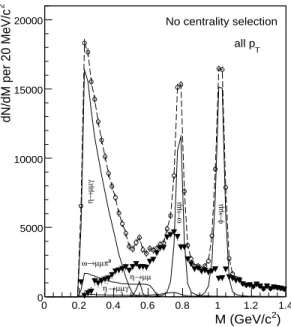
In the more central bins, a fit procedure is ruled out, due to the existence of a strong excess with a priori un-knowncharacteristics. We have therefore used a novel pro-cedure as shown in Fig. 4, made possible by the high data quality. The excess is isolated by subtracting the cocktail, without the ρ, from the data. The cocktail is fixed, sep-arately for the major sources and in each centrality bin, by a “conservative” approach. The yields of the narrow vector mesons ω and φ are fixed so as to get, after sub-traction, a smooth underlying continuum. For the η, an upper limit is defined by “saturating” the measured data in the region close to 0.2 GeV/c2
; this implies the excess
-1 10 1 Becattini pppp,pBe Becattini extrap pp,pBe ω / ρ ω / η ω / φ (GeV) T p particle ratios InIn Peripheral < > < > < > 0 0.5 1 2 0 0.5 1 1.5 2 -4 10 -3 10 -2 10 -1 10 0.20 < M < 0.40 0.40 < M < 0.60 0.60 < M < 0.80 0.80 < M < 1.00 1.00 < M < 2.00 Acceptance (GeV/c) T p h_Cocktail_vtmuongen_mass_pt
Fig. 3.Upper: Particle cross-section ratios for all pT(<>) and
for three pT windows, extrapolated to full phase space. Lower:
NA60 acceptance relative to 4π for different mass windows.
to vanish at very low mass, by construction. The η reso-nance and ω Dalitz decays are now bound as well; η′/η is fixed as before. The cocktail ρ (shown in Figs. 5, 6, 8 and 9 for illustration purposes) is bound by the ratio ρ/ω=1.2. The accuracy in the determination of the ω and φ yields by this subtraction procedure is on the level of very few %, due to the remarkable local sensitivity, and not much worse for the η.
The excess mass spectra for all 4 multiplicity bins, re-sulting from subtraction of the “conservative” hadron de-cay cocktail from the measured data, are shown in Figs. 5 and 6 for all pT and the particular selection pT<0.5 GeV/c,
respectively. The cocktail ρ and the level of charm decays, found in the three upper centrality bins to be about 1/3 of the measured yield in the mass interval 1.2<M<1.4 GeV/c2 [14], are shown for comparison. The qualitative
features of the spectra are striking: a peaked structure is seen in all cases, broadening strongly with centrality, but remaining essentially centered around the position of the nominal ρ pole. At the same time, the total yield increases relative to the cocktail ρ, their ratio (for M<0.9 GeV/c2)
0 0.2 0.4 0.6 0.8 1 1.2 1.4 0 5000 10000 15000 20000 No centrality selection ) 2 M (GeV/c dN/dM per 20 MeV/c T all p γµ µ →η µµ → ω µµ→φ 0 π µ µ → ω µ µ → η γ µ µ → ’ η
Fig. 4.Isolation of an excess above the hadron decay cocktail
(see text). Total data (open circles), individual cocktail sources (solid), difference data (thick triangles), sum of cocktail sources and difference data (dashed).
GeV/c, in the most central bin. Such values are consis-tent with the CERES [11] results, if the latter are also referred to the cocktail ρ and rescaled to In-In. The er-rors shown are purely statistical. The systematic erer-rors are dominantly connected to the uncertainties in the level of the combinatorial background, less so to the fake matches. For the data without pT selection, they are estimated to
be about 3%, 12%, 25% and 25% for the 4 centralities in the broad continuum region, while the ρ-like structure above the continuum is much more robust. Uncertainties associated with the subtraction of the hadron decay cock-tail reach locally up to 15%, dominated by those of the ω-Dalitz form factor. For the data with pT<0.5 GeV/c,
the systematic errors are still under investigation.
0 0.2 0.4 0.6 0.8 1 1.2 1.4 0 200 400 600 800 In-In Peripheral T all p 2 dN/dM per 20 MeV/c ) 2 M (GeV/c 0 0.2 0.4 0.6 0.8 1 1.2 1.4 0 1000 2000 In-In Semi-Peripheral T all p 2 dN/dM per 20 MeV/c ) 2 M (GeV/c 0 0.2 0.4 0.6 0.8 1 1.2 1.4 0 1000 2000 In-In Semi-Central T all p 2 dN/dM per 20 MeV/c ) 2 M (GeV/c 0 0.2 0.4 0.6 0.8 1 1.2 1.4 0 500 1000 In-In Central T all p 2 dN/dM per 20 MeV/c ) 2 M (GeV/c
Fig. 5. Excess mass spectra of dimuons without pT selection.
The cocktail ρ (solid) and the level of uncorrelated charm de-cays (dashed) are shown for comparison. For errors see text.
For the data without pT selection, a quantitative
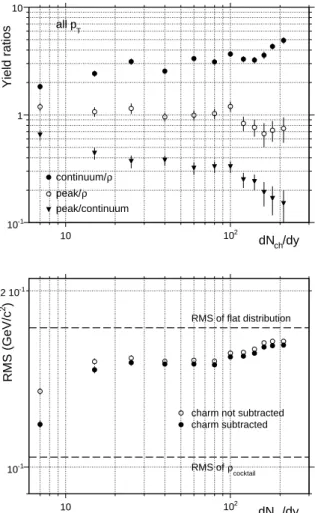
anal-ysis of the shape of the excess mass spectra vs. centrality has been performed, using a finer subdivision into 12 cen-trality bins. Referring to Fig. 5, the data were subdivided into three mass windows with equal widths: 0.44<M<0.64 (L=Lower), 0.64<M<0.84 (C=Center), and 0.84<M<1.04 GeV/c2 (U=Upper). From the yields in these windows,
a peak yield R = C - 1/2(L+U) and a continuum yield 3/2(L+U) can be defined. Fig. 7 (upper) shows the ra-tios of peak/ρ (R/ρ), continuum/ρ (3/2(L+U)/ρ), and peak/continuum (RR), where ρ stands for the cocktail ρ. The errors shown are purely statistical. The relative sys-tematic errors between neighboring points are small com-pared to the statistical errors and can therefore be ignored, while the common systematic errors are related to those discussed in the previous paragraph and are of no rele-vance here. The ratio peak/ρ is seen to decrease from the most peripheral to the most central bin by nearly a factor of 2, ruling out the naive view that the shape can simply be explained by the cocktail ρ residing on a broad con-tinuum, independent of centrality. The ratio continuum/ρ shows a fast initial rise, followed by a more flat and then another more rapid rise beyond dNch/dy = 100; this
be-havior is statistically significant. The sum of the two ratios is the total enhancement factor relative to the cocktail ρ; it reaches about 5.5 in the most central bin. The ratio of the two ratios, peak/continuum, amplifies the two sepa-rate tendencies: a fast decay, a nearly constant part, and a decline by a further factor of 2 beyond dNch/dy = 100,
though with large errors due to R.
A completely independent shape analysis was done by just evaluating the RMS = phM2i − hM i2 of the mass
spectra in the single total mass interval 0.44<M<1.04 GeV/c2. The results are shown in Fig. 7 (lower), both
for the full data and after subtraction of charm on the level discussed for Figs. 5, 6 (except for the most periph-eral bin where the continuum yield above 1 GeV/c2
was assumed to be 100% charm). They are in perfect qualita-tive agreement with the more “microscopic” shape
analy-0 0.2 0.4 0.6 0.8 1 1.2 1.4 0 100 200 300 400 500 In-In Peripheral <0.5 GeV/c T p 2 dN/dM per 20 MeV/c ) 2 M (GeV/c 0 0.2 0.4 0.6 0.8 1 1.2 1.4 0 200 400 600 800 1000 1200 In-In Semi-Peripheral <0.5 GeV/c T p 2 dN/dM per 20 MeV/c ) 2 M (GeV/c 0 0.2 0.4 0.6 0.8 1 1.2 1.4 0 200 400 600 800 1000 1200 1400 In-In Semi-Central <0.5 GeV/c T p 2 dN/dM per 20 MeV/c ) 2 M (GeV/c 0 0.2 0.4 0.6 0.8 1 1.2 1.4 0 100 200 300 400 500 600 In-In Central <0.5 GeV T p 2 dN/dM per 20 MeV/c ) 2 M (GeV/c
Fig. 6. Excess mass spectra of dimuons for pT<0.5 GeV/c.
The cocktail ρ (solid) and the level of uncorrelated charm de-cays (dashed) are shown for comparison. For errors see text.
10 102 -1 10 1 10 ρ continuum/ ρ peak/ peak/continuum T all p /dy ch dN Yield ratios 10 102 -1 10 /dy ch dN ) 2 RMS (GeV/c RMS of flat distribution cocktail ρ RMS of
charm not subtracted charm subtracted
-1
2 10
Fig. 7. Upper: Yield ratios continuum/ρ, peak/ρ, and
peak/continuum; see text for definition and errors. Lower: RMS of the excess mass spectra in the window 0.44<M<1.04
GeV/c2
.
sis discussed before, rising from values close to the cocktail ρ all the way up to nearly a flat-continuum value. The ex-tra rise beyond dNch/dy = 100 is highly significant here,
due to the very small statistical and systematic errors.
4 Comparison to theoretical models
The qualitative features of the excess mass spectra shown in Figs. 5 and 6 are consistent with an interpretation as direct thermal radiation from the fireball, dominated by ππ annihilation. A quantitative comparison of the data to the respective theoretical models can either be done at the input of the experiment, requiring acceptance correction of the data, or at the output, requiring propagation of the theoretical results through the experimental acceptance. All the data contained in this paper have so far not been corrected for acceptance, and therefore only the second al-ternative is available at present (the first one being under preparation). To help intuition, Fig. 8 illustrates the ef-fects of acceptance propagation for the particularly trans-parent case of q ¯q annihilation, associated with a uniform
spectral function [18]. By coincidence, without pT
selec-tion, the resulting mass spectrum at the output is also uniform within 10% up to about 1.0 GeV/c2, resembling
the shape of the spectral function at the input. In other words, the always existing steep rise of the theoretical in-put at low masses (Fig. 8), due to the photon propagator and a Boltzmann-like factor [4,5,6,7], is just about com-pensated by the falling acceptance in this region as long as no pT cut is applied. Variations of the input pT spectrum
within reasonable physics limits affect the flatness of the output by at most 20%. Strong cuts in pT like <0.5 or >1
GeV/c, however, completely invalidate the argument. On the basis of this discussion, the excess mass spectra shown in Fig. 5 can approximately be interpreted as spec-tral functions of the ρ, averaged over momenta and the complete space-time evolution of the fireball. The broad continuum-like part of the spectra may then reflect the early history close to the QCD boundary with a nearly divergent width, while the narrow peak on top may just be due to the late part close to thermal freeze-out, ap-proaching the nominal width. The pT-cut data shown in
Fig. 6, on the other hand, do not allow such interpreta-tion, due to the extreme acceptance cut on the low-mass side of the ρ; compare also Fig. 3 (lower).
Among the many different theoretical predictions for the properties of the intermediate ρ mentioned in the in-troduction, only few have been brought to a level suitable for a quantitative comparison to the data. Before the first release of the present data in 2005, the in-medium broad-ening scenario of [4,5] and the moving mass scenario re-lated to [6,7] were evaluated for In-In at dNch/dη=140,
using exactly the same fireball evolution model extrapo-lated from Pb-Pb, and taking explicit account of temper-ature as well as of baryon density [18]. In Fig. 9, these predictions (as well as the unmodified ρ) are confronted with the data for the semicentral bin. The integrals of the theoretical spectra are independently normalized to the data in the mass interval M<0.9 GeV/c2 in order to
concentrate on the spectral shapes, independent of the
un-0 0.2 0.4 0.6 0.8 1 1.2 1.4 0 0.02 0.04 0.06 0.08 0.1 0.12 -3 10 × 2 dN/dM per 20 MeV/c ) 2 M (GeV/c q thermal q input
output after acceptance white spectral function
Fig. 8. Propagation of thermal q ¯q radiation, based on a
uni-form spectral function, through the NA60 acceptance without
any pT selection. The resulting spectrum is, by coincidence,
0 0.2 0.4 0.6 0.8 1 1.2 1.4 0 200 400 600 800 1000 1200 In-In SemiCentral <0.5 GeV/c T p dN/dM per 20 MeV/c ) 2 M (GeV/c 0 0.2 0.4 0.6 0.8 1 1.2 1.4 0 500 1000 1500 2000 2500 3000 In-In SemiCentral T all p dN/dM per 20 MeV/c ) 2 M (GeV/c 0 0.2 0.4 0.6 0.8 1 1.2 1.4 0 500 1000 1500 2000 In-In SemiCentral >1 GeV/c T p dN/dM per 20 MeV/c ) 2 M (GeV/c
Fig. 9. Comparison of excess mass spectra for pT<0.5, all pT and pT>1 GeV/c to model predictions, made for In-In at
dNch/dη=140 (semicentral bin). Cocktail ρ (thin solid), unmodified ρ (dashed), in-medium broadening ρ [4, 5] (thick solid),
in-medium moving ρ related to [6, 7] (dashed-dotted), uncorrelated charm (thin dashed). The errors are purely statistical; for systematic errors see text. The open data points show the difference spectrum resulting from a decrease of the η yield by 10% (which should also be viewed as a systematic error).
certainties of the fireball evolution. Note again that data and predictions can only be interpreted as space-time av-eraged spectral functions for the part without pT selection
(Fig. 9, center), but not for the other two. Irrespective of the choice of the pT window, however, some general
con-clusions can be drawn. The unmodified ρ is clearly ruled out. The moving mass scenario related to Brown/Rho scal-ing, which fit the CERES data [5,11], is also ruled out, showing the much improved discrimination power of the present data. Only the broadening scenario appears to be in fair agreement with the data.
In the meantime, the release of the data in 2005 has triggered a number of new theoretical developments. Con-trary to initial critics [19], Brown/Rho scaling could not be saved by varying fireball and other parameters within extremes, including switching out the effects of tempera-ture altogether [20,21]. The excess of the data at M>0.9 GeV/c2may be related to the prompt dimuon excess found
by NA60 in the intermediate mass region [14]. It is not accounted for by the model results shown in Fig. 9, and it is presently (nearly quantitatively) described either by hadronic processes like 4π, 6π.. (including vector-axial-vector mixing) [22], or by partonic processes like q ¯q anni-hilation [23]. This is a challenging theoretical ambiguity to be solved in the future. A chiral virial approach has also been able to nearly quantitatively describe the data [24].
5 Conclusions
The data unambiguously show that the ρ primarily broad-ens in In-In collisions, but does not show any shift in mass. Consequently, model comparisons favor broadening sce-narios, but tend to rule out moving-mass scenarios cou-pled directly to the chiral condensate. The issue of vector-axialvector mixing, also sensitive to chiral restoration, re-mains somewhat open at present. We expect that precise pT dependences, presently under investigation, will give
more insight into the different sources operating in differ-ent mass regions.
References
1. R. D. Pisarski, Phys. Lett. 110B, 155 (1982)
2. C. A. Dominguez, M. Loewe and J. C. Rojas, Z. Phys. C59, 63 (1993)
3. R. D. Pisarski, Phys. Rev. D 52, R3773 (1995)
4. G. Chanfray, R. Rapp and J. Wambach, Phys. Rev. Lett. 76, 368 (1996); R. Rapp, G. Chanfray and J. Wambach, Nucl. Phys. A617, 472 (1997)
5. R. Rapp and J. Wambach, Adv. Nucl. Phys. 25, 1 (2000) 6. G. E. Brown, M. Rho, Phys. Rev. Lett. 66, 2720 (1991);
G. Q. Li, C. M. Ko and G. E. Brown, Phys. Rev. Lett. 75, 4007 (1995)
7. G. E. Brown and M. Rho, Phys. Rept. 363, 85 (2002) 8. T. Hatsuda and S. H. Lee, Phys. Rev. C 46, 34 (1992) 9. G. Agakichiev et al. (CERES Collaboration), Eur. Phys. J.
C4, 231 (1998)
10. G. Agakichiev et al. (CERES Collaboration), Phys. Rev. Lett. 75, 1272 (1995)
11. G. Agakichiev et al. (CERES Collaboration), Phys. Lett. B422, 405 (1998); B. Lenkeit et al., Nucl. Phys. A661, 23c (1999); G. Agakichiev et al., Eur. Phys. J. C41, 475 (2005) 12. G. Usai et al. (NA60 Collaboration), Eur. Phys. J. C43,
415 (2005)
13. M. Keil et al., Nucl. Instrum. Meth. A539, 137 (2005) and A546, 448 (2005)
14. R. Shahoyan et al. (NA60 Collaboration), Eur. Phys. J. C43 (2005) 209; Quark Matter, Budapest, 2005
15. A. David, PhD Thesis, Instituto Superior T´ecnico, Lisbon, 2006; CERN-THESIS-2006-007
16. R. Arnaldi et al. (NA60 Collaboration), Phys. Rev. Lett.
96(2006) 162302
17. S. Damjanovic, A. De Falco and H. W¨ohri (NA60
Collab-oration), NA60 Internal Note 2005-1 18. R. Rapp, private communication (2003)
19. G. E. Brown and M. Rho, arXiv:nucl-th/0509001 and nucl-th/0509002
20. H. van Hees and R. Rapp, arXiv:hep-ph/0604269
21. V. V. Skokov and V. D. Toneev, Phys. Rev. C 73 (2006) 021902
22. H. van Hees and R. Rapp, arXiv:hep-ph/0603084 23. T. Renk and J. Ruppert, arXiv:hep-ph/0605130.
24. K. Dusling, D. Teaney and I. Zahed,