HAL Id: halshs-01589617
https://halshs.archives-ouvertes.fr/halshs-01589617
Submitted on 25 Sep 2017HAL is a multi-disciplinary open access archive for the deposit and dissemination of sci-entific research documents, whether they are pub-lished or not. The documents may come from teaching and research institutions in France or abroad, or from public or private research centers.
L’archive ouverte pluridisciplinaire HAL, est destinée au dépôt et à la diffusion de documents scientifiques de niveau recherche, publiés ou non, émanant des établissements d’enseignement et de recherche français ou étrangers, des laboratoires publics ou privés.
So long blades...
Laurence Manolakakis
To cite this version:
Laurence Manolakakis. So long blades... : Materiality and symbolism in the north-eastern Balkan Cop-per Age. L. Manolakakis, N. Schlanger, A. Coudart. European Archaeology - Identities & Migrations. , pp.265-284, 2017, 978-90-8890-520-9. �halshs-01589617�
9 789088 905209
ISBN 978-90-8890-520-9 ISBN: 978-90-8890-520-9
Sidestone Press
Le passé sous diverses formes – et notammentcelle d’un récit fondateur – est au cœur du fonctionnement de toute société humaine. L’idée que le passé puisse être connaissable par une recherche scientifique est un enjeu essentiel, particulièrement abordé par les sociétés occidentales et notamment par des chercheurs européens, toutes disciplines confondues. Par sa pratique de l’archéologie et son érudition, le chercheur et le professeur Jean-Paul Demoule a su élaborer un tableau global des cultures européennes et de leurs transformations, incluant autant les origines néolithiques des inégalités sociales que l’émergence du mythe indo-européen ou encore les rapports entre patrimoine et politique. Dans cet ouvrage, ses collègues allemands, britanniques, bulgares, danois, espagnols, français, néerlandais, nord-américains, russes, suisses et tchèques prolongent et enrichissent – en anglais ou en français – sa vision. Ils y apportent leurs réflexions et leurs données concernant les perspectives de l’archéologie du XXIe siècle, les processus de la construction identitaire à différentes échelles, les mouvements migratoires de l’Europe, le statut du genre, le rôle des objets de prestige et des monuments mégalithiques dans l’émergence de la hiérarchisation sociale et de la sémiologie du pouvoir… sans oublier la mythologie et les réalités du phénomène indo-européen.
IDENTITIES & MIGRATIONS
edited by
Laurence Manolakakis, Nathan Schlanger, Anick Coudart
European Archaeology
Sides
to
n
e
IDENTITÉS & MIGRATIONS
Archéologie européenne
HOMMAGES À JEAN-PAUL DEMOULE
As it appears in diverse guises – and notably as a founding narrative – the past is at the core of every functioning human society. The idea that the past can be known through scientific research has long been a fundamental challenge for western societies and for European researchers, from all disciplines concerned. Through more than four decades of outward-looking archaeological practice, the scholar, teacher and intellectual Jean-Paul Demoule has elaborated a truly global approach to European cultures and their transformations, spanning from the social inequality in Neolithic times to Indo European research to contemporary links between heritage and politics. His colleagues – British, Bulgarians, Czechs, Danes, Dutch, French, Germans, North-Americans, Spaniards, Swiss and Russians – seek to extend and enrich his vision. With contributions (written in French and in English) spanning from prehistory to the modern world, they bring in this volume new insights and data to such issues as the processes of identity construction at different scales, migratory movements in Europe, the status of gender, the role of prestige objects and megalithic monuments in the emergence of social hierarchy and in the semiology of power… without forgetting the myths and realities surrounding the Indo-European phenomenon.
IDENTITIES & MIGRATIONS
European Archaeology
IDENTITÉS & MIGRATIONSArchéologie européenne
HOMMAGES À JEAN-PAUL DEMOULE
IDEN
T
IT
IE
S
&
MIG
RA
T
IONS
E
ur
o
p
e
an Ar
c
h
a
e
o
lo
gy
IDEN
T
IT
É
S
&
MIG
RA
T
IONS
Ar
c
h
é
o
lo
gi
e e
ur
o
p
é
enn
e
This is a digital offprint from:
Manolakakis, Schlanger and Coudart (eds.) 2017: European Archaeology -
Identities & Migrations. Hommages à Jean-Paul Demoule. Leiden:
Sidestone Press
A new generation of Publishing
*
www.sidestone.com/books
This is a free offprint, read the entire book at the
Sidestone e-library!
You can find the full version of this book at the Sidestone
e-library. Here most of our publications are fully accessible for
free. For access to more free books visit:
www.sidestone.com
Download Full PDF
Visit the Sidestone library to browse our e-books. For a minimal fee
you can purchase a fully functional PDF and by doing so, you help
to keep our library running.
© 2017 Individual authors
Published by Sidestone Press, Leiden www.sidestone.com
Lay-out & cover design: Sidestone Press
Photograph cover: Detail of the Christine Kühn’s work Touch the Wall (1990, 2009), East Side Gallery, Berlin Wall (photo Coudart).
ISBN 978-90-8890-520-9 (softcover) ISBN 978-90-8890-521-6 (hardcover) ISBN 978-90-8890-522-3 (PDF e-book)
Contents
Jean-Paul Demoule, un intellectuel… au-delà de l’archéologie 10 européenne / Jean-Paul Demoule, an intellectual scholar…
beyond European archaeology
Anick Coudart, Laurence Manolakakis, Nathan Schlanger & Sander van der Leeuw
Archéologie européenne : Identités & Migrations – Hommages à 24 Jean-Paul Demoule / European Archaeology: Identities & Migrations
– Homage to Jean-Paul Demoule
Laurence Manolakakis, Nathan Schlanger & Anick Coudart
PART ONE : LA PRATIQUE DE L’ARCHÉOLOGIE – PERSPECTIVES 29
CONTEMPORAINES ET HISTORIQUES / ARCHAEOLOGY IN PRACTICE – HISTORICAL AND CONTEMPORARY PERSPECTIVES
It is all a question of discipline … 31
Sander van der Leeuw
Reflections on a 1992 tour of the “New East Europe” 43
Ruth Tringham
Collective representations and identity construction: The material 69 constraints of archaeology
Marc-Antoine Kaeser
Culture and collective identity construction 85
Anick Coudart
Le postmodernisme en archéologie : vingt-cinq ans d’une aporie 99 paralysante
Patrice Brun
De l’empire à la nation, de la nation aux régions : constructions du 113 patrimoine et de l’archéologie préventive au Japon
Laurent Nespoulous
Les ruines comme instrument de renouveau dans l’Europe de la 131 pré-Renaissance
Alain Schnapp
La main, ses doigts, ce qu’ils fabriquent dans la disruption et au-delà 145
Bernard Stiegler
Dire l’archéologie en Européen : vers une terminologie comparée 157
Archéologie du merveilleux : La fouille d’un conte de fées 171 (Peau d’âne, J. Demy 1970)
Olivier Weller
PART TWO: LA MULTIPLICITÉ DE L’ÉMERGENCE EUROPÉENNE / 185
THE MANY FORMS OF EUROPEAN EMERGENCE
Quand le front néolithique passait par Dikili Tash et Kovačevo : une 187 vision géo-archéologique de la néolithisation des Balkans méridionaux
Jean-François Berger
Des migrations, oui, mais point trop n’en faut ! 207
Catherine Perlès
Kovačevo et ses femmes : représentations et symboles 217
Marion Lichardus-Itten
The Durankulak cemetery – signs of changing gender tensions 229
John Chapman
On the South and Southwest boundaries of the Varna Culture 251
Vladimir Slavčev
So long blades…Materiality and symbolism in the north-eastern 265 Balkan Copper Age
Laurence Manolakakis
The Europe of jade: From the Alps to the Black Sea 285
Pierre Pétrequin, Serge Cassen, Michel Errera, Alison Sheridan, Tsoni Tsonev, Senica Turcanu & Valentina Voinea
Large-scale excavations to understand the past 299
Ivan Pavlů, Petr Květina1 & Radka Šumberová1
Modélisation, simulation et scénarios d’expérimentation : La 315 colonisation LBK de l’Europe tempérée (5550-4950 av.n.e.)
Jérôme Dubouloz, Jean-Pierre Bocquet-Appel & Richard Moussa
Ni anges ni démons : de la violence chez les premiers agriculteurs 339 de l’Europe du Nord-Ouest
Vincent Blouet
The representation of violence in the rock art of the Sahara and the
Spanish Levant 371
Roberto Risch& Harald Meller
Aux origines du phénomène mégalithique dans l’Ouest de la France 387
Sémiologie du pouvoir. Dominants chalcolithiques de l’Europe du Sud 409
Jean Guilaine
PART THREE: MYTHES ET RÉALITÉS À PROPOS DES INDO-EUROPÉENS / 429
MYTHS AND REALITY AROUND THE INDO-EUROPEANS
Enduring conundrum – Indo-European relationships 431
Colin Renfrew
Origins of the Indo-Europeans and archaeology 439
Leo S. Klejn
Genetics, migrations and language dispersals: re-theorizing mobility 459 and the formation of culture and language among the Corded Ware
Cultures in Europe
Kristian Kristiansen
The passion for origins between language and nation 477
Maurice Olender
PART FOUR: BIBLIOGRAPHIE DE JEAN-PAUL DEMOULE / 491
BIBLIOGRAPHY OF JEAN-PAUL DEMOULE
265 manolakakis
So long blades…
Materiality and symbolism in the north-eastern
Balkan Copper Age
Laurence Manolakakis
1Résumé
De si longues lames… Matérialité et symbolisme dans le Chalcolithique des Balkans nord-orientaux
Avec plus de vingt ans de recul, le besoin s’est fait sentir d’un réexamen des industries lithiques chalcolithiques des Balkans nord-orientaux, passé au crible des nouvelles données publiées et d’une chronologie affinée. Il s’agit ici d’observer plus finement la place économique et sociale des différentes productions laminaires de ces sociétés hiérarchisées, selon les découpages chronologiques de la région et les différents groupes culturels identifiés par la céramique. Ainsi, les traditions lithiques définissent deux aires de productions domestiques, l’une par percussion indirecte, grossièrement au sud du Danube oriental, l’autre par percussion directe au nord, qui restent stables durant toute la période. En parallèle, sont mises en évidence des productions spécialisées à vocation d’exportation, qui concernent tant des lames débitées par percussion indirecte issues de sites miniers spécialisés, que des lames débitées par pression au levier et des lames débitées par pression debout. Sont examinés l’évolution, la place et le rôle des différentes productions lithiques sur les quelques siècles qui courent de l’étape ancienne au début de l’étape récente de l’Enéolithique.
Mots-clefs : Chalcolithique, productions laminaires, Balkans nord-orientaux, réseaux, économie, biens de prestige
266 european archaeology: identities & migrations
Abstract
With the benefit of more than 20 years of hindsight, the time is ripe for a re-examination of Chalcolithic lithic industries of the north-eastern Balkans in the light of newly published data and a more accurate chronology. In this study, we present a detailed examination of the economic and social position of the various blade productions of these hierarchized societies, following the regional chronological sequences and the various cultural groups identified on the basis of ceramics. In fact, the lithic traditions define two areas of domestic production which remained unchanged throughout the period: the first, characterized by indirect percussion, lies broadly to the south of the eastern Danube while the other, involving direct percussion, lies to the north. In addition, there is evidence for parallel specialized productions, intended for export, which comprise blades manufactured by indirect percussion on specialized mining sites, as well as blades manufactured using lever pressure debitage and blades produced using standing pressure debitage. The evolution, position and role of the various lithic productions are examined for the centuries spanning the Early Chalcolithic to the beginning of the Late Chalcolithic.
Keywords: Copper Age, Chalcolithic, blade production, north-eastern Balkans, networks, economy, prestige goods
1. Introduction
In European societies which had long been neolithised, archaeological evidence reveals the emergence of economic, social, political and symbolic upheavals, collectively referred to by the term Chalcolithic, or chalcolithisation when referring to the process itself. While these changes take different forms and follow different timeframes depending on the region of the European continent involved, one of the major upheavals common throughout Europe is the emergence of vertical, structural and long-lasting social hierarchies. The question of power and the degree to which it was concentrated in the hands of elites has been the subject of several works by Jean-Paul Demoule (see for example Demoule 2002). He questions its supposed historical inevitability, advocated by evolutionist theories, as well as the conditions under which this power develops, which have been examined in particular in functionalist theories. From a historical point of view, on the European continent, durable social hierarchies, which are evident in physical space (for example, in the form of monumentality) and in symbolic space (most notably in funerary practices), emerged in societies that had long adopted agropastoralism and sedentism. Beyond the multiple factors often invoked to explain the phenomenon (demographic, environmental, climatic factors, etc.), this change clearly involved major changes in the political organisation of these societies. The earliest European evidence for hierarchies occurs during the first half of the Vth millennium BC in Bulgaria: here the appearance of ostentatious, heritable
power statuses within cemeteries (for example Demoule, Ivanov 1979), indicate the existence of an elite that controlled dense, far-reaching exchange networks and that invested in prestige goods. The evidence is particularly strong within the technical domain: the appearance of gold working and copper metallurgy, and the
267 manolakakis
production of prestige goods that reflect very specialised and complex skills and/or the use of rare materials, among which we can include long blades manufactured by lever pressure debitage.
In the mid-1980s, thanks to Jean-Paul Demoule, I had the opportunity to develop an interest in long blades and the Chalcolithic lithic industries of Bulgaria. Throughout the Chalcolithic of north-eastern Bulgaria, a period spanning some 700 years, two types of lithic blade production were identified as early as 1994: debitage using a punch and pressure debitage using a lever (Manolakakis 1996). A third type of debitage was also suspected, standing pressure debitage, the existence of which will be further discussed below. With the benefit of insights acquired over the 20 years since I first started working on these lithic industries, I feel it is now necessary to re-examine them in the light of newly published data and a chronology which has been fine-tuned by a growing number of new and more accurate radiocarbon dates. Since my objective in the early 1990s was to produce a first ever summary of the Bulgarian Copper Age, the socio-economic interpretation dealt with a broad time period and a wide geographical area, i.e. the two main periods of the Chalcolithic (Early and Late), which are common to Bulgaria as a whole, and inter-regional comparisons. In contrast, the current study concentrates on the region of the north-eastern Balkan (north-eastern Bulgaria and south-eastern Romania) in order to observe in greater detail the economic and social position of blade productions in these hierarchized societies, in accordance with the regional chronological sequence – which includes a Middle period –, and in terms of the various cultural groups identified on the basis of ceramics. As mentioned above, the term “hierarchy” is used here to designate a social, economic and political organization that is vertical, long-lasting and structural. In contrast to cemeteries, particularly those at Varna (see among others Ivanov 1978a, 1986, 1988, 1989) and Durankulak (Todorova 2002), settlement sites reveal little evidence of hierarchical organisation in the form of differentiation between houses (Chapman 1990). However, with the identification of “flat” sites at the foot of tells (see for example Durankulak, Todorova 1997; and Pietrele, Hansen et al. 2005: 4-8), or within the same micro-region (e.g. Bem 2011; Krauß 2009), it is now possible to see a hierarchy between sites and to interpret certain tells as acropolis-type sites (Reingruber 2014). This is an important indicator of social differentiation that previously went un-noticed as archaeologists tended to focus their attention on tells which were immediately identifiable in the landscape. This evidence now links the social hierarchy of cemeteries to that of settlements.
The Balkan chronology that provides the framework for this study centres on the Early, Middle and Late Chalcolithic (also known as Copper Age or Eneolithic), which correspond to the Late Neolithic and the beginning of the Early Chalcolithic in the European chronology (Lichardus et al. 1985). In the eastern Balkans (Slavchev 2010: 9), alternating instances of syncretism and fragmentation of the geographical extents of the various cultures over a relatively short period undoubtedly reflect social, economic and political instability at this time. While the dating of the transitions between periods (Early, Middle and Late) is still poorly documented, particularly for the end of Copper Age in Bulgaria, recent dating using AMS (http://14sea.org/) and focusing on contextualised artefacts
268 european archaeology: identities & migrations
has provided greater detail regarding certain subdivisions within the Chalcolithic (Fig. 1):
- The Early Copper Age, which began around 5000/4900 BC, lasted no more than two centuries (Fig. 1-a). The Boian III culture spread within Muntania, the Hamangia III culture occupied Romanian Dobrogea and the extreme north of Bulgarian Dobrudja, the Poljanica I-III culture covered the county of Šumen and part of Razgrad and Silistra (mostly Ludogorie area) while the Sava I-III culture occupied Varna county.
- The Middle Copper Age, which began around 4800 BC, reached its high point around 4750 BC and only lasted 100 to 150 years (Fig. 1-b). The Boian (IV) culture now extended as far as Dobrogea and the Poljanica (IV) culture also encompassed the counties of Razgrad and Ruse in Bulgaria, while a Sava IV-Hamangia syncretism developed in southern Dobrogea, in coastal Dobrudja and in the Varna region.
- At the very beginning of the Late Copper Age (4700-4650 BC) (Fig. 1-c), the process of syncretism continued and for a brief period gave rise to the great “Eastern Balkan Late Copper Age Complex” (Slavchev, comm. pers.), which extended from the Ukraine to Thrace and from the Black Sea to the central Balkans. As the Late Chalcolithic progressed (after 4600 BC) (Fig. 1-d), a reconfiguration took place with, on the one hand, the Kodžadermen-Gumelnița-Karanovo VI (KGK) complex occupying the eastern half of Bulgaria, Muntenia, southern Moldova and the north of Romanian Dobrogea, and on the other, the Varna culture extending from the lakes of Varna to southern Romanian Dobrogea (Slavčev this volume). The end of Chalcolithic remains poorly documented in Bulgaria (see in particular Krauß 2008): some researchers believe that it ended in the third quarter or the last quarter of the Vth millennium BC while others believe that it lasted until the beginning of the
IVth millennium BC. However, on the north side of the Danube, the final phase
of the Gumelnița culture is represented by a large number of sites which in recent years have repeatedly produced dates indicating that they were occupied up until 4000/3900 BC (the inventory of sites carried out in Dobrogea provides good examples; Bem 2011: 141-143.).
2. Not just long blades
In archaeological literature, the use of the terms “long blades” or “superblades”, obviously based on their length, is subject to variations inherent in the notion of size, which by its very nature is relative. This relativity, which is a function of the dimensions of predominant local products, leads to long-blade lengths that differ according to the period and the region in which they occur. Compared to many European lithic blades, all Balkan blades measuring 15 cm in length, particularly blades manufactured using a punch, may be considered as long blades. In addition, from a strictly technical point of view, if we base our analysis solely on the criterion of length, a blade of about 20 cm in length could be the product of any one of a number
269 manolakakis
of reduction process: punch debitage2, standing pressure debitage, or lever pressure
debitage. The example of the blades from Grand-Pressigny, measuring up to 30 cm length and produced using punch debitage, is sufficient to illustrate this point.
Clearly, it is not a question of disputing the phenomenon of sought-after length, especially as the valorisation of length has been clearly demonstrated on the basis of grave goods from Varna (Manolakakis 1996). But to use only the dimensional criterion to define “long blades” gives rise to confusion: certain authors apply the term to any complete blade measuring more than 14 cm in length, for others the term is applied to blades measuring 20 cm or more (e.g. Klimscha 2010: 64; Hansen
2 The term debitage refers here to the standard technological definition : the method used to produce blanks for tools, including all the steps of the chaîne opératoire.
Figure 1: Maps of the cultural groups in Eastern Balkans (after Slavchev 2010, this volume and personal communication).
270 european archaeology: identities & migrations
et al. 2007: 64-67, Hansen 2015: 277; Gurova 2010: 3), and so on. Worse still, some authors infer the original total length from a blade fragment. The addition of a technical criterion, such as the method of debitage, therefore allows a clearer and more homogenous definition of Balkan “long blades”: in this study the term will be reserved for blades manufactured by lever pressure debitage. These long blades on their own do not account for the totality of Balkan lithic production and it is the evolution of all of the productions which will be dealt with there.
2.1. Debitage by indirect percussion (using a punch)
This technique produces regular, wide (1.5 to 4.5 cm), thick blades with parallel edges and arrises, curved profiles, thick flat platforms and with a length of c.12 cm (for more technical details, see Manolakakis 2005). Throughout Chalcolithic, blade debitage using a punch is characteristic of the Sava (I to IV) and Poljanica (I to IV) cultures and subsequently of the Kodžadermen (KGK) and Varna cultures. This production represents about 90% of the lithic assemblage for any given settlement site and the products served as blanks for all flint tool types. Flakes produced during the preparation or maintenance phases of blade debitage are also used to manufacture other tools without a specific flake reduction sequence. Flakes and blades, often in the form of tools, are deposited as grave goods. The production is carried out in, or very close to, each settlement, using flint from Ludogorie (Nachev & Nachev 1989, Nachev 2009: 57; Načev in press). There is no evidence that either cores or pre-forms were heat-treated. The blades tend to become lighter from Middle Chalcolithic onwards and can reach up to 18 cm in length. Regardless of whether they were produced by each household or by a small number of knappers in each village, the majority of the blades can be considered to be the products of domestic production, destined for local consumption. However, from Late Chalcolithic onwards, and perhaps even earlier, specialised sites operated in parallel to the domestic production, as evidenced in the Ravno 3 mine-shaft where all of the knapping waste present resulted from indirect percussion. Blades produced by indirect percussion on Ludogorie flint (or similar to Ludogorie flint, see also Ciornei 2015) are also known from Gumelnița settlement sites such Pietrele (Hansen et al. 2012: 35-40), Gumelnița (Dumitrescu 1924, fig. 1; 1966, fig. 5), Căsciocarele (Ștefan 1925:146-152; Dumitrescu 1965: 36), Sultana (Andrieșescu 1924), and from Taraschina where they are accompanied by flakes (Furestier & Mihail 2011). This suggests that the products of specialised sites such as Ravno 3 were destined for export. The export of blades produced by indirect percussion probably began in the Early Chalcolithic as blades of this kind are occasionally found in Hamangia III settlements and graves (Cearmurlia de Jos, Berciu 1966: 176-189; Durankulak, Sirakov 2003) and in Boian (III and IV) settlements (Comșa 1974: 71 and fig.16; Berciu 1961: fig.166-6). Moreover, it appears that these blades (by punch) circulated northwards as far as the Lower Danube and into the Ukraine and Moldova (Kiosak & Subbotin 2016). To the south, in eastern Greek Macedonia, indirect percussion blades have apparently been identified at Kryoneri (Malamidou 2016), although it remains to be confirmed if they are made from the same types of flint.
271 manolakakis
From an economic point of view, it appears that there are two modes of production for blades manufactured using a punch: on the one hand, locally-based domestic production intended for local consumption and perhaps for export, on the other, production on specialised sites intended for export. From the evidence of cores found in the Ravno mine-shaft, it would appear that the latter production reached a high level of excellence in terms of the regularity and straightness of the blanks produced. From a cultural point of view, indirect percussion is a strong and stable technical tradition within the Poljanica-Sava cultural realm, a tradition that persisted until the latest phase despite various reconfigurations of the cultural groups in this area (Fig. 2).
Figure 2: Chrono-cultural map of local lithic productions.
272 european archaeology: identities & migrations
2.2. Debitage by direct percussion
Small blades produced using direct percussion on local chalcedonies or chert (including nodules of Ludogorie type flint in the banks of the Danube river, Ciornei 2015) constitute the predominant production throughout Chalcolithic in settlements on the north side of the eastern Danube, within the Boian culture (Haită 2011: 79-88; Comșa 1974) and subsequently within the Gumelnița culture (Andrieșescu 1924; Dumitrescu 1924, 1965, 1966; Furestier & Mihail 2011, 2015: 97, Ștefan 1925). This production is also attested in the early stage of the Hamangia (III) at Cearmurlia de Jos (Berciu 1966: 176-189), but is replaced by indirect percussion when this culture fuses with the Sava (IV) culture during Middle Chalcolithic. Although the raw material available is abundant, nodules are often of medium knapping quality and/or medium size (Ciornei 2015). This may explain the production of small items.
Thus, a north-south polarisation, loosely located on either side of the eastern Danube, is evident in local lithic practices throughout Chalcolithic (Fig. 2): on the one side we have indirect percussion within the Poljanica and Sava cultures and then the Kodžadermen and Varna cultures; on the other, we have direct percussion within the Boian and Hamangia III cultures and the subsequent Gumelnița culture. These practices span different cultural groups and unite them within a single, strong lithic tradition. In other words, the alternating cultural regroupings and fragmentations that are observed in the ceramic record do not impact upon lithic operational practices. Only the Hamangia culture appears to have escaped this marked stability: favouring direct percussion debitage during the Early Copper Age, this culture apparently assimilated the Sava technical tradition (indirect percussion) in the Middle Chalcolithic at the time when the two cultures merged. Simultaneously, blades produced using punch debitage by cultures located to the south of the Danube were exported to sites to the north of the river. 2.3. Lever pressure debitage (long blades)
This form of debitage produces very regular, broad (1.5 to 3.9 cm) blades that are relatively fine and regular in thickness and that can vary in length from about 18 cm to 43.5 cm. The edges and arrises are parallel and the profile is straight with a slight curvature at the distal end. The platform is small to very small. The cores are prepared with 3 or 4 crests (2 lateral and 1 posterior, or 2 lateral and 2 postero-lateral). Full debitage is unipolar and takes place on a narrow front, rarely close to semi-peripheral, and on a flat pressure core platform. The pressure point is prepared by suppressing and lightly abrading the overhang. Residues on a number of blade platforms, observed using a binocular microscope, and the frequent occurrence of typical cracks on the platform, allow us to affirm that the tip of the crutch was made of copper. There is no evidence that the flint was heat-treated during the debitage process.
This production was carried out using Ludogorie flint at a handful of deposits capable of providing very large, good quality nodules. Not only were such blocks of flint rare, but the know-how necessary for the manufacture of such long, regular, light blades required long apprenticeships and a high level of competence. This high degree of technicity is essentially characteristic of the beginning of
273 manolakakis
the reduction sequence, the step in which the core is prepared, a real “strategic moment” as defined by P. Lemonnier (1976: 143-144, 1983: 54). As highlighted by D. Binder and C. Perlès (1990: 263), the actual full debitage is facilitated, better controlled and often more standardised. In the case of lever debitage, a kind of “automatization” of full debitage starts, even though the preparation of the pressure point and the immobilisation of the core are delicate steps. In addition, it has been observed that the preparation of the edge angle reveals considerable technical skill on the part of the knappers allowing them to proceed, without being overly meticulous, with the removal of the overhang and the light abrasion. The
Figure 3: Chrono-cultural maps of blades made by lever pressure.
274 european archaeology: identities & migrations
site of Kamenovo, located close to the Ravno flint deposit, has produced the first excavated evidence for a Late Copper Age workshop specialised in lever pressure debitage (Manolakakis 2008). However, Early and Middle Chalcolithic workshops have yet to be found and published.
While, to date, no examples of complete long blades are known from Early Chalcolithic contexts (Fig. 3-a), used fragments are known from the Sava culture. It is therefore important to determine if fragments of long blades have also been found in the Poljanica culture (stages I-III), at Poljanica itself, for example, or at Radingrad. In the case of Hamangia III settlements, the literature does not suggest the presence of blades, or even of blade fragments, manufactured using lever pressure although it is clear that long blades have been recorded in funerary contexts in Durankulak (Sirakov 2003: 304-305). There is also an absence of long blades in published records for Boian III settlements on the north side of the Danube.
In Middle Chalcolithic (Fig. 3-b), long blades in the form of used fragments are present on Poljanica (IV) and Sava (IV) settlement sites. In funerary contexts, fragments were deposited in the cemetery of Durankulak (Sirakov 2003) and, for the first time, a complete example has been found at Varna II (Tomb 1, Ivanov 1978b, Manolakakis 2005). Information regarding long blades in Boian IV settlements is still lacking in the published sources.
In Late Chalcolithic (East Balkan Complex and subsequent KGK and Varna cultures, Fig. 3-c-d), long blades continue to appear in the form of used segments, but complete, unused long blades are now also present in settlements, often in “stockpile” form as at Sava (levels I-II), Smjadovo, and Hotnica (Level III). They are best represented in funerary contexts at Varna and Durankulak. These blades are now, at last, also well attested on the other side of the Danube, specifically on Gumelnița settlement sites (e.g. Gumelnița and Pietrele; Dumitrescu 1925: fig. 15; Hansen et al. 2007: 64-66) where they are sometimes complete and unused or grouped together in batches (as at Pietrele, Gatsov & Nedelcheva 2015).
Long blades manufactured using lever pressure were also diffused further afield (Fig. 3), particularly to Thrace but also to Macedonia and northern Greece and, to a lesser extent, to north-western Bulgaria. A small number of fragmented and used examples have been found on Early and Middle Chalcolithic sites belonging to the Marica-Karanovo V, Gradešnica and Dikili Tash-Slatino cultures, but only in settlement contexts (Fig. 3-a-b). This diffusion continues in the same manner into the late period (Karanovo VI, Krivodol and Sitagroi IIIB-C cultures) (Fig. 3-c, d). Tell Azmak in Thrace stands apart in that it has yielded three complete long blades (unused).
This brief overview indicates a general rise in the frequency of long blades made by lever pressure debitage. During Early and Middle Chalcolithic, only small numbers are in circulation: they are found, in fragmented form, in both domestic and funerary contexts over an area stretching from the Danube to the Aegean (Fig. 3). There remains doubt regarding their diffusion within the Boian cultural realm where they do not appear to be attested. As early as Middle Chalcolithic we see that complete, unused long blades had acquired a social value which is reflected in their deposition as grave goods in the rich burial of Varna II: this practice becomes more common in Late Copper Age. It is quite possible that this valorisation occurred in the early period but it is not reflected in known funerary assemblages.
275 manolakakis
The long blades reach their apogee in Late Chalcolithic when they are widely distributed, including to the north of the Danube. At this time, long blades clearly have a strong social function which is evident in their presence in the rich tombs of cemeteries located on the Black Sea coast, in their overvalued length and in the creation of “stockpiles” or “caches” on certain settlements. It comes as no surprise that these “stockpiles” are found on tells which recent research suggests acted as acropolises, i.e. as centres of power. All available evidence – rare extraction sites, specialised knapping workshops, high level of technicity – points to specialised production limited to a small number of workshops. The example of the Ravno 3-Kamenovo production complex shows that these workshops were located close to suitable sources of flint. The relatively small quantity of long blades produced raises questions regarding the mechanisms of apprenticeship, transmission and maintenance of know-how throughout the entire Chalcolithic.
2.4. Standing pressure debitage (or small lever debitage?)
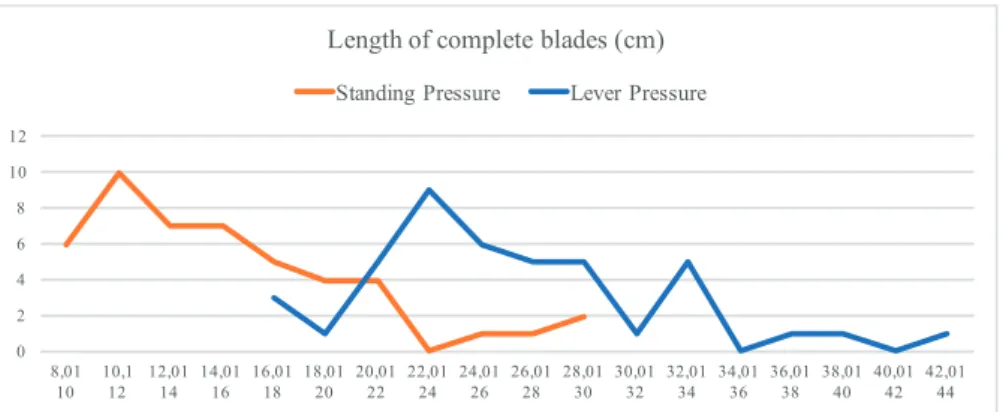
The hypothesis of standing pressure debitage emerged in the course of studies of the blades deposited in graves within the Varna cemetery. Very regular and narrow (1 to 2.10 cm in width), these blades are fine and have a constant thickness. The edges and arrises are parallel and rectilinear (more so than is the case for blades produced by lever pressure), the profile is straight with slight curving at the distal end, and the platform is very small. They are made in Ludogorie flint. There is no evidence that the flint was heat-treated. These blades measure between 8 and 25 cm in length, but the bulk of this production consists of relatively short or medium length blades (between 8 and 18 cm) with blades measuring more than 20 cm in length being very rare. Within assemblages from settlement contexts, distal and mesial fragments are difficult to distinguish from those produced by skilful punch debitage and lever pressure debitage. This explains why this type of production is undoubtedly underestimated in settlement contexts where complete blades are rarely found. Even in the case of complete blades, the technical scars left by standing pressure debitage are very difficult to distinguish from those left by lever pressure debitage. In fact, distinction is largely made on the basis of blade width. Knapping experiments on the various modes of pressure debitage produce different ranges of blade width, with some overlapping, depending on the mode employed (Pelegrin 2012: Fig. 18.12). In fact, lever pressure does not permit the production of blades that are narrow in proportion to their length, while, in contrast, it proves difficult to exceed a 2.2 cm blade width using standing crutch pressure. Nonetheless, debitage using a small lever is feasible (Abbes 2013) and could be envisaged. Unfortunately there is no published experimental data on this technique and the width spectrum of the blades produced is unknown.
Therefore, the question remains as to whether a standing crutch or a small lever was used in the reduction sequence for pressure debitage in the Balkans. In the hypothesis involving a small lever, the core would first be knapped using (large) lever pressure and then when a certain lower length threshold is reached, the knapper would change tools and the system for holding the core in place, and would continue debitage of the core using a small lever. In the second hypothesis, a specific reduction sequence for standing pressure debitage using a crutch would
276 european archaeology: identities & migrations
be applied either to specifically shaped-out cores or to large lever production cores after a complete re-shaping out. In any case, the lower length thresholds for blades manufactured by lever pressure are around 18 to 22 cm while blades manufactured by standing pressure debitage rarely exceed these same lengths (Fig. 4).
Although poorly recognised on settlement sites, these blades resulting from standing pressure debitage have been identified throughout the Chalcolithic, from early period onwards, in settlement contexts and not just in a fragmentary used state; indeed, a group of complete blades has been discovered at Sava, within the Early Chalcolithic layers. They also occur, more often fragmented than complete, in funerary contexts in the Hamangia I-III zone at Durankulak (Sirakov 2003). As is the case for long blades, it will be essential to determine if these blades exist in Poljanica I-III settlements. They are best represented, quantitatively and qualitatively (the longest examples), in Late Chalcolithic contexts in the Varna cemetery but overall they remain rare.
All of the characteristics of these blades point to close similarities with the long blades made by lever pressure: deposits of good quality raw material, high level of technicity, limited production. These blades were clearly produced in specialised workshops by specialists with a high level of know-how. It is therefore tempting to link these two productions and to suggest that they were produced by the same craftsmen. This hypothesis would explain how a high level of competence was maintained and transmitted to apprentices against a background of limited production.
3. Materiality and symbolism
At the time when there is archaeological evidence for social hierarchy, the economy of the lithic production also reveals a high level of complexity, both in its organisation and in its functions, with the intertwining of local domestic productions and various specialised productions, for the most part circulating over quite long distances.
Certain products are exported in order to respond directly to utilitarian needs: for example, blades made by punch were exported to sites located north of the Danube, and even to eastern Greek Macedonia, making up for a lack of good quality and large nodules of raw material in these areas. However, as early as the
0 2 4 6 8 10 12 8,01 10 10,1 12 12,01 14 14,01 16 16,01 18 18,01 20 20,01 22 22,01 24 24,01 26 26,01 28 28,01 30 30,01 32 32,01 34 34,01 36 36,01 38 38,01 40 40,01 42 42,01 44
Length of complete blades (cm)
Standing Pressure Lever Pressure
277 manolakakis
Early Copper Age the circulation of long blades made by lever pressure is clearly not a response to this necessity as can be seen in their export to sites in north-eastern Bulgaria, an area which has no shortage of good quality raw material. On the contrary, they appear to be even more valued as they are found complete and unused (at least from the Middle Chalcolithic onwards), like rare prestige items, in tells (possible centres of power) and in the graves of individuals of high socio-economic status. The circulation of long blades by lever pressure appears initially restricted to the “South Danube”, in the Sava-Poljanica cultural area, in the Early and Middle Chalcolithic but already extending towards Thrace, western Bulgaria and northern Greece. Export rapidly expanded to the “North Danube” at the time when syncretism peaked (Eastern Balkan LCA Complex and KGK) during the Late Copper Age, a period that coincides with the widest geographical extent of long blade diffusion. The Varna cemetery remains exceptional in terms of long blades: complete examples are most frequent here, certain blades are particularly long, and it has been possible to demonstrate that the longest blades are associated with the richest graves. It is thus at the very end of the Sava IV-Hamangia culture, and especially during the Varna culture, that complete long blades are deposited in graves and are associated with elites. In the same period, “stockpiles” of unused long blades appear in KGK tells, which were possibly the seats of elite power. In parallel, throughout the Chalcolithic, long blades are more often broken into segments, integrating the cycle of the domestic tools and presenting no obvious differences with local productions.
Clearly the long blades play a role that is more symbolic and social than economic since they are not used in the form in which they were produced: they are made to obtain a maximum length but are intentionally segmented or accidentally broken before being actually used. Their economic function appears to be indirect, embedded in exchange networks, relationships and alliances, while their social and symbolic function, which is linked to social elites, is evident.
The role of blades produced by standing pressure debitage are still ill-defined. Between the two types of exported products – namely, blades produced by punch debitage and blades made by lever pressure – blades manufactured by standing pressure debitage certainly appear to have been valued but occupy an intermediate position which encompasses utilitarian products in the case of short and medium-length blades and products that are closer to prestige items in the case of the longest blades.
At the same time, the stability of exports of punch produced blades is also remarkable and could be interpreted as a sign of the stability of the economic networks and the alliance networks that they underpin. Thus, while the rapid succession of episodes of syncretism and fragmentation visible in the ceramic traditions reveal a degree of instability, the domestic lithic productions remain very stable over the long term, even when examined at a more detailed spatio-temporal scale. In fact, the “North Danube” and “South Danube” traditions are split between Boian-Gumelnița direct percussion and Sava-Poljanica-Kodžadermen-Varna indirect percussion (the coastal Hamangia culture switching from the former to the latter). In this case we are witnessing stability in the modes of traditional know-how and apprenticeship, confirmed by homogeneity in the details of the reduction sequence of punch debitage.
278 european archaeology: identities & migrations
As in all societies, cultural traditions define geographical spaces that vary depending on the productions being considered. The mutual exclusive spatial distribution of lever pressure long blades and obsidian artefacts, despite the fact that the latter are ubiquitous in the surrounding area, has already been highlighted (Manolakakis 1996: 123). This pattern of mutual exclusion has been interpreted as an expression of identity. Studies carried out at Sitagroi, on the north coast of the Aegean, add weight to this hypothesis: here obsidian is present in the early levels but disappears in the levels that are clearly related to the KGK culture and that contain fragments of long blades, only to reappear in later levels (Tringham 2003: 83). When examined at the scale, the distribution of long blades corresponds to the spatial extent of ware decorated with graphite, which Jean-Paul Demoule (Demoule 1991:233) has refered to as the “graphite zone”. Here we are comparing stylistic traditions (ceramic shapes and decoration) with technical traditions (lithic productions). Although beyond the scope of the present study, it would indeed be interesting to be able to compare the lithic stylistic traditions with those of the ceramics on which Jean-Paul Demoule has carried out much work (see for example Demoule 2004), and to compare the ceramic technical traditions, a field of study largely undeveloped in the north-eastern Balkans, with those of the lithics. Several forms of integration could thus emerge and account for the various expressions of “cultural identity”.
Based on currently available data, it appears that the small number of workshops of “master knappers” of long blades were associated with the very localised flint sources known in the Razgrad region. They are therefore located a considerable distance (125 km) from the Varna cemetery which, nevertheless, has yielded the majority of identified long blades.
On the one hand, questions arise regarding the social status of these master knappers. To date, no rich or very rich burials have been discovered in the area occupied by the flint sources/workshops, and certainly no cemeteries as rich as Varna. At Varna itself, it has been possible to show (Manolakakis 2004) that the elites buried in the rich and very rich tombs display their social and economic status by the ostentatious accumulation of goods which are both numerous and of multiple types: thus the grave goods include large quantities of objects, among which we find the longest examples of long blades as well as copper tools and weapons, gold ornaments and symbols of power in gold or copper (sceptres, diadems). But it is not possible to recognise master knappers through these grave goods. It is therefore tempting to think that the master knappers of long blades produced for the elite but did not themselves belong to that elite, a situation which in any case is fairly common!
On the other hand, we may wonder about the fact that the long blade workshops seem to be invariably located close to the flint sources. Indeed, the attractiveness, both economic and social, of centres like Varna is also conveyed by the establishment in these areas of workshops producing prestige goods for the elites. We could therefore envisage the presence of workshops producing long blades close to Varna, just as we have evidence for the presence of various gold-working and copper metallurgy workshops here (Rusev et al. 2010, Dimitrov 2013, Leusch et al. 2015). In such a set-up, a small number of master knappers would be installed, on a more or less permanent basis, at Varna where they practiced
279 manolakakis
their lever debitage. They would have either procured their raw material (perhaps as pre-forms) from itinerant craftsmen (e.g. Hirth 2008) or by travelling from time to time in order to obtain it themselves at the source. This is a plausible and coherent hypothesis given the social and economic organisation at the time but unfortunately the absence of a settlement associated with Varna means that the question remains unanswered.
More generally, as we have seen, Ludogorie flint circulates throughout the area from the Aegean to Moldova over the entire Chalcolithic period. It circulates in various forms: blades manufactured by indirect percussion and blades made by lever pressure debitage. This leads to protean circulations that certainly do not conform to a single model but rather to combinations of most of the models proposed by C. Renfrew (1984, Chapter 4). For the sake of speculation, and without getting involved in calculations and curves, the following hypotheses can be proposed:
- The settlements may have functioned according to the models of “direct acquisition” (Model 1) and “reciprocity” within the “home base” (Model 2) or at the “territorial boundary” (Model 3) for domestic production (local direct percussion and local indirect percussion).
- The more distant settlements, such as those in the Danube delta or in Ukraine, may have relied on the activities of “middlemen traders” (“freelance trading”, Model 7) for the acquisition of indirect percussion blades (and flakes ?), as suggested by the distance, and the small quantities and poorer quality of the goods involved. Indeed, it should be remembered that, according to Renfrew, Model 4, the down-the-line model, does not allow circulation over long distances.
- The “down-the-line” model (Model 4) could be envisaged for the circulation of long blades and blades made by standing pressure debitage in north-eastern Bulgaria.
- The tells with “stockpiles” of long blades (e.g. Pietrele, Smjadovo or Azmak) could be interpreted in terms of two models which are not mutually exclusive: “central places” (Model 5) that would have redistributed long blades produced by lever pressure debitage and standing pressure debitage, and centres of elite power on which “middlemen” (“freelance trading”) would have converged. Indeed, the establishment of master knappers at the centres of power is completely plausible and could have attracted “middlemen”, or “emissaries”, who would have provided supplies of pre-formed cores (models 7 and 8). Clearly, these are just working hypotheses but, in our opinion, the complexity of productions, the intensity and scope of circulation, the diversity in roles of lithic artefacts and their valorisation, underpin a complex framework of exchange and circulation networks within hierarchized societies in the north-eastern Balkans of the Vth millennium.
280 european archaeology: identities & migrations
References
http://14sea.org/ Reingruber A. & Thissen L., 14C database for Southeast Europe
and Anatolia.
Abbès F. 2013. Quelques réflexions sur les débitages de silex par pression. ArchéOrient-Le Blog, https://archeoroent.hypotheses.org/1672.
Andrieșescu I. 1924. Les fouilles de Sultana. Dacia I, 51-107.
Bem C. 2011. Vision d’ensemble de l’occupation Gumelnița en Dobroudja. In Carozza L., Bem C., & Micu C. (eds). Société et environnement dans la zone du Bas Danube durant le 5e millénaire avant notre ère. Iași, Ed. Universității Alexandru Ioan Cuza, 131-197.
Berciu D. 1961. Contribuții la probleme neoliticului în România în limuna noilor cercetari. București, Editura Academiei Republicii Populare Romîne.
– 1966. Cultura Hamangia. Noi Contribuții. București, Editura Academiei Republicii Socialiste România.
Binder D. & Perlès C. 1990. Stratégies de gestion des outillages lithiques au Néolithique. Paléo 2, 257-281.
Chapman J. 1990. Social inequality on Bulgarian tells and the Varna problem. In Samson R. (ed.). The social archaeology of houses. Edinburgh, Edinburgh University Press, 49-92.
Comșa E. 1974. Istoria comunităților culturii Boian. București, Editura Academiei Republicii Socialiste România.
Ciornei A. 2015. On the so-called “Kriva Reka type” of Ludogorie chert: a petrographic perspective from the Upper Palaeolithic sites in the Giurgiu-Călărași area (Southern Romania). Studii de Preistorie 12, 31-80.
Demoule J.P. 1991. Les recherches récentes en Grèce septentrionale et les problèmes chronologiques et régionaux des cultures à céramique au graphite. In Lichardus J. (ed.). Die Kupferzeit als historische Epoche. Saabrücken, Saarland Museum. Saarbrücker Beiträge zum Altertumskunde 55, 227-236.
– 2002. Naissance du pouvoir et des inégalités. In Ruano-Borbalan J.-C. & Choc B. (eds). Le Pouvoir, des rapports individuels aux relations internationales. Auxerre, Editions Sciences Humaines, 19- 25.
– 2004. La céramique du Néolithique récent. In Treuil R. (dir.). Dikili Tash village préhistorique de Macédoine orientale (Fouilles Jean Deshayes 1961-1975). Vol. 1.2. Paris, De Boccard, Ecole Française d’Athènes, 63-270.
Demoule J.P. & Ivanov I.S., 1979. L’or de la nécropole de Varna. Archéologia 137, 52-59.
Dimitrov K. 2013. Technological development of the gold working techniques in Varna. In Angelova H. & Özdoğan M. (eds). Where are the sites? Research, protection and management of cultural heritage. International conference, 5-8 december 2013, Sozopol. Sozopol, Centre for Underwater Archaeology, 55-80. Dumitrescu V. 1924. Découvertes de Gumelnița. Dacia I, 325-342.
– 1925. Fouilles de Gumelnița. Dacia II, 29-103.
– 1965. Căsciocarele, a late neolithic settlement on the lower Danube. Archaeology 18, 34-40.
– 1966. Gumelnița sondajul stratigrafic din 1960. Studii și Cercetari de Istorie Veche 17.1, 51-100.
281 manolakakis
Furestier R. & Mihail F. 2011. L’industrie lithique taillée de Taraschina. In Carozza L., Bem C., & Micu C. (eds). Société et environnement dans la zone du Bas Danube durant le 5e millénaire avant notre ère. Iași, Ed. Universității Alexandru Ioan Cuza, 365-384.
– 2015. L’industrie lithique taillée de Taraschina – Zone 2. In Carozza L. & Micu C. (eds). Archéologie du delta du Danube. Société et environnement durant le Néolithique et les âges des Métaux dans le delta du Danube (Roumanie). Rapport de mission archéologique, 93-121.
Gatsov I., Nedelcheva P. 2015. Flint caches in the Eneolithic settlement Pietrele Măgura Gorgan, Romania. In Hansen S., Raczky P., Anders A. & Reingruber A. (eds). Neolithic and Copper Age between the Carpathians and the Aegean Sea. Chronologies and technologies from the 6th to the 4th millennium BC. Bonn, Habelt Verlag, DAI, Archäologie in Eurasien 31, 295-299.
Gurova M. 2010. Connotations fonctionnelles des grandes lames chalcolithiques : exemples de la Bulgarie. Archaeologia Bulgarica XIV.2, 1-10.
Haită C. 2011. Esquisse géographique et géologique de Dobroudja. Les zones-sources du matériel lithique. In Carozza L., Bem C. & Micu C. (eds). Société et environnement dans la zone du Bas Danube durant le 5e millénaire avant notre ère. Iași, Ed. Universității Alexandru Ioan Cuza, 79-88.
Hansen S. 2015. Pietrele, a lakeside settlement, 5200-4250 BC. In Hansen S., Raczky P., Anders A. & Reingruber A. (eds). Neolithic and Copper Age between the Carpathians and the Aegean Sea. Chronologies and technologies from the 6th to the 4th millennium BC. Bonn, Habelt Verlag, DAI, Archäologie in Eurasien 31, 273-293.
Hansen S., Dragoman A., Reingruber A., Benecke N., Gatsov I., Görsdorf J., Nedelcheva P., Oanță-Marghitu S. & Song B. 2005. Der kupferzeitliche Siedlung Pietrele an der Unteren Donau. Bericht über die Ausgrabungen im Sommer 2004. Berlin, Verlag Philipp von Zabern / DAI. Eurasia Antiqua 12, 341-396.
Hansen S., Toderaș M., Reingruber A., Gatsov I., Georgescu C., Görsdorf J., Hoppe T. & Nedelcheva P. 2007. Pietrele, Măgura Gorgana. Ergebnisse der Ausgrabungen im Sommer 2006. Berlin, Verlag Philipp von Zabern / DAI. Eurasia Antiqua 13, 43-111.
Hansen S., Toderaș M., Reingruber A., Wunderlinich J., Benecke N., Gatsov I., Marinova E., Müller M., Nachev C., Nedelcheva, Nowacki D., Röpke A., Wahl J. & Zäuner S. 2012. Pietrele an der Unteren Donau. Bericht über die Ausgrabungen und geomorphologischen Untersuchungenim Sommer 2011. Berlin, Verlag Philipp von Zabern / DAI. Eurasia Antiqua 18, 1-68. Hirth K. 2008. The economy of supply: modeling obsidian procurement and craft
provisioning at central urban Mexican center. Latin American Antiquity 19.4, 435-457.
Ivanov I.S. 1978a. Иванов И.С. 1978a. Les fouilles archéologiques de la nécropole de Varna (1972-1975). In Варнеиский некрополь и проблемы Халколита [The Varna necropolis and the problems of Copper Age]. International Symposium, Varna, 19-23 April 1976. Studia Praehistorica 1-2, 13-26.
282 european archaeology: identities & migrations
– 1978b. Раннохалколитни гробове до град Варна. [Early Copper Age graves from Varna]. Известия на Народния Музей Варна XIV (XXIX), 81-83. – 1986. Le Chalcolithique en Bulgarie et dans la nécropole de Varna. In Poulter
A.G. (ed.). Ancient Bulgaria. Papers presented to the International Symposium on the Ancient History and Archaeology of Bulgaria, 1981. Nottingham, Department of Classical and Archaeological Studies, Archaeology Section, vol. 1, 154-163. – 1988. Die Ausgrabungen des Gräberfeldes von Varna (1972-1986). In Macht,
Herrschaft und Gold. Das Gräberfeld von Varna (Bulgarien) und die Anfänge einer neuen europaïschen Zivilisation. Saarbrücken, Moderne Galerie des Saarland-Museums, 49-66.
– 1989. La nécropole chalcolithique de Varna et les cités lacustres voisines. In Le premier or de l’Humanité en Bulgarie, 5e millénaire. Catalogue de l’exposition du Musée des Antiquités Nationales, Saint-Germain-en-Laye, 1989. Paris, Editions de la Réunion des Musées Nationaux, 49-56 et inventaire 75-151. Kiosak & Subbotin 2016. Киосак Д. & Субботин Л. 2016. О технике скола
пластин болградского варианта культуры Гумелница. [On the blade detachment technique in the Bolgrad variant of Gumelnița Culture]. In Țerna S. & Govedarica B. (eds). Interactions, changes and meanings. Essays in honour of Igor Manzura on the occasion of his 60th birthday. Kishinev, University of High Anthropological School, 93-106.
Klimscha F. 2010. Production and use of flint and ground-stone axes at Măgura Gorgana near Pietrele, Guirgiu county, Romania. Lithics 31, 55-67.
Krauß R. 2008. Karanovo und das südosteuropäische Chronologiesystem aus heutiger Sicht. Berlin, Verlag Philipp von Zabern / DAI. Eurasia Antiqua 14, 115-147.
– 2009. Copper Age settlement on the Lower danube river. Results of Bulgarian and German field surveys. Известия на Регионален Музей Благоевград 5, 167-181.
Lemonnier P. 1976. La description des chaînes opératoires. Contribution à l’analyse des systèmes techniques. Techniques et Culture ancienne série n°1, 101-150. – 1983. L’étude des systèmes techniques, une urgence en technologie culturelle.
Techniques et Culture 1, 11-34.
Leusch V., Armbuster B., Pernicka E. & Slavčev V. 2015. On the invention of gold metallurgy: the gold objects from the Varna I cemetery (Bulgaria). Technological consequence and inventive creativity. Cambridge Archaeological Journal 25.01, 353-376.
Lichardus J., Lichardus-Itten M., Bailloud G. & Cauvin J. 1985. La protohistoire
de l’Europe. Néolithique et Chalcolithique. Paris, PUF, Nouvelle Clio 1bis.
Malamidou D. 2016. Kryoneri, Nea Kerdyllia: a settlement of the Late Neolithic and Early Bronze Age on the lower Strymon vallee, Eastern Macedonia. In Tsirtsoni Z. (ed.). The human face of radiocarbon. Reassessing chronology in prehistoric Greece and Bulgaria. 5000-3000 cal BC. Lyon, Travaux de la Maison de l’Orient et de la Méditerranée 69, 299-315.
Manolakakis L. 1996. Production lithique et émergence de la hiérarchie sociale : l’industrie lithique de l’Enéolithique en Bulgarie. Bulletin de la Société Préhistorique Française 93.1, 119-123.
283 manolakakis
– 2004. Les très grandes lames de la nécropole de Varna. Essai d’interprétation de la valeur d’un mobilier funéraire. In Baray L. (dir.). Archéologie des pratiques funéraires. Approches critiques. Actes de la table-ronde de Bibracte 2001. Glux-en-Glenne, Bibracte, Centre Archéologique Européen, Bibracte 9, 289-301. – 2005. Les industries lithiques énéolithiques de Bulgarie. Rahden, Verlag Marie
Leidorf, Internationale Archäologie 88.
– 2008. Open-cast flint mining, long blade production and long distance exchange: an example from Bulgaria. In Allard P., Bostyn F., Giligny F. & Lech J. (eds). Flint mining in Prehistoric Europe, interpreting the archaeological
records. EAA 12th annual meeting, Cracow, Poland, 19th-24th September 2006.
Oxford, Archeopress. BAR, i.s. 1891, 111-121.
– 2011. A flint deposit, a tell and a shaft: a lithic production complex at Ravno3-Kamenovo? (Early Chalcolithic, North-East Bulgaria). In Nikolov V., Bačvarov K., Gurova (eds). Festschrift for Marion Lichardus-Itten. Studia Praehistorica 14, 225-244.
Nachev C. 2009. Flint raw materials in Bulgaria. In Gatsov I. & Boyadzhiev Y. (eds). The first Neolithic sites in Central/South-East European Transect. Vol. I. Early Neolithic sites on the territory of Bulgaria. Oxford, Archeopress. BAR, i.s. 2048, 57-58.
– Načev Č. in print. Начев Ч. Седимент-петрографиско изучаване на кремъчни артефакти от варненския енеолитен некропол [Sedimentary petrographic analysis of flint artefacts from the Varna Eneolithic necropolis]. In Slavchev V. (ed.). The Varna Necropolis. Volume II. Berlin, DAI, Archäologie in Eurasien, in print, 11 p.
Nachev I.K. & Nachev C. 1989. Distribution and evolution of siliceous rocks in Bulgaria. In Hein J.R. & Obradovic J. (eds). Siliceous deposits of the Tethys and Pacific regions. New York, Springer, 81-92.
Pelegrin J. 2012. New experimental observations for the characterization of pressure blade production techniques. In Desrosiers P.M. (ed.). The emergence of pressure blade making. From origin to modern experimentation. New York, Springer, 465-500.
Reingruber A. 2014. The wealth of the tells: complex settlement patterns and specialisations in the West Pontic area between 4600 and 4250 calBC. In Horejs B. & Mehofer M. (eds). Western Anatolia before Troy. Proto-urbanisation in the 4th millennium BC? Proceedings of the international symposium, Wien, 21th-24th Nov. 2012. Wien, Austrian Academy of Sciences Press, 217-241.
Renfrew C. 1984. Approaches to social archaeology. Cambridge-Ma., Harvard University Press.
Rusev R., Slavčev V., Marinov G. & Bojadžiev I. 2010. Русев Р., Славчев В., Маринов Г. & Бояджиев Й. 2010. Варна – Праисторически център на металообработката [Varna, prehistoric centre for metallurgy]. Варна, Данграфик.
Sirakov N. 2003. Flint artefacts in prehistoric grave-goods assemblages from the Durankulak necropolis. In Todorova H. (ed.). Durankulak Band II. Die prähistorischen Gräberfelder. Teil 2. DAI, Berlin-Sofia, Anubis, 299-322.
284 european archaeology: identities & migrations
Slavchev V. 2010. The Varna Eneolithic cemetery in the context of the Late Copper Age in the East Balkans. In Anthony D.W. (ed.). The lost world of Old Europe. The Danube valley, 5000-3500 BC. New York, Institute for the Study of the Ancient World/Oxford, Princeton University press, 192-210.
Ștefan G. 1925. Les fouilles de Căsciocarele. Dacia II, 138-197.
Todorova H. 1997. Tellsiedlung von Durankulak. Köln, Fritz Thiessen Stiftung Jahresbericht 1995/96.
– (ed.). 2002. Durankulak Band II. Die prähistorischen Gräberfelder. Teil 1. DAI, Berlin-Sofia, Anubis.
Tringham R. 2003. Analysis of the flaked stone assemblage from Sitagroi. In Elster E. & Renfrew C. (eds). Prehistoric Sitagroi, excavations in northeast Greece 1968/1970, vol. 2. The final report. Los Angeles, UCLA, Cotsen Institute of Archaeology, Monumenta Archaeologica 20, 81-126.
9 789088 905209
ISBN 978-90-8890-520-9 ISBN: 978-90-8890-520-9
Sidestone Press
Le passé sous diverses formes – et notammentcelle d’un récit fondateur – est au cœur du fonctionnement de toute société humaine. L’idée que le passé puisse être connaissable par une recherche scientifique est un enjeu essentiel, particulièrement abordé par les sociétés occidentales et notamment par des chercheurs européens, toutes disciplines confondues. Par sa pratique de l’archéologie et son érudition, le chercheur et le professeur Jean-Paul Demoule a su élaborer un tableau global des cultures européennes et de leurs transformations, incluant autant les origines néolithiques des inégalités sociales que l’émergence du mythe indo-européen ou encore les rapports entre patrimoine et politique. Dans cet ouvrage, ses collègues allemands, britanniques, bulgares, danois, espagnols, français, néerlandais, nord-américains, russes, suisses et tchèques prolongent et enrichissent – en anglais ou en français – sa vision. Ils y apportent leurs réflexions et leurs données concernant les perspectives de l’archéologie du XXIe siècle, les processus de la construction identitaire à différentes échelles, les mouvements migratoires de l’Europe, le statut du genre, le rôle des objets de prestige et des monuments mégalithiques dans l’émergence de la hiérarchisation sociale et de la sémiologie du pouvoir… sans oublier la mythologie et les réalités du phénomène indo-européen.
IDENTITIES & MIGRATIONS
edited by
Laurence Manolakakis, Nathan Schlanger, Anick Coudart
European Archaeology
Sides
to
n
e
IDENTITÉS & MIGRATIONS
Archéologie européenne
HOMMAGES À JEAN-PAUL DEMOULE
As it appears in diverse guises – and notably as a founding narrative – the past is at the core of every functioning human society. The idea that the past can be known through scientific research has long been a fundamental challenge for western societies and for European researchers, from all disciplines concerned. Through more than four decades of outward-looking archaeological practice, the scholar, teacher and intellectual Jean-Paul Demoule has elaborated a truly global approach to European cultures and their transformations, spanning from the social inequality in Neolithic times to Indo European research to contemporary links between heritage and politics. His colleagues – British, Bulgarians, Czechs, Danes, Dutch, French, Germans, North-Americans, Spaniards, Swiss and Russians – seek to extend and enrich his vision. With contributions (written in French and in English) spanning from prehistory to the modern world, they bring in this volume new insights and data to such issues as the processes of identity construction at different scales, migratory movements in Europe, the status of gender, the role of prestige objects and megalithic monuments in the emergence of social hierarchy and in the semiology of power… without forgetting the myths and realities surrounding the Indo-European phenomenon.
IDENTITIES & MIGRATIONS