READ THESE TERMS AND CONDITIONS CAREFULLY BEFORE USING THIS WEBSITE. https://nrc-publications.canada.ca/eng/copyright
Vous avez des questions? Nous pouvons vous aider. Pour communiquer directement avec un auteur, consultez la première page de la revue dans laquelle son article a été publié afin de trouver ses coordonnées. Si vous n’arrivez pas à les repérer, communiquez avec nous à [email protected].
Questions? Contact the NRC Publications Archive team at
[email protected]. If you wish to email the authors directly, please see the first page of the publication for their contact information.
NRC Publications Archive
Archives des publications du CNRC
This publication could be one of several versions: author’s original, accepted manuscript or the publisher’s version. / La version de cette publication peut être l’une des suivantes : la version prépublication de l’auteur, la version acceptée du manuscrit ou la version de l’éditeur.
Access and use of this website and the material on it are subject to the Terms and Conditions set forth at
Axial compression tests on masonry walls and prisms
Maurenbrecher, A. H. P.
https://publications-cnrc.canada.ca/fra/droits
L’accès à ce site Web et l’utilisation de son contenu sont assujettis aux conditions présentées dans le site LISEZ CES CONDITIONS ATTENTIVEMENT AVANT D’UTILISER CE SITE WEB.
NRC Publications Record / Notice d'Archives des publications de CNRC:
https://nrc-publications.canada.ca/eng/view/object/?id=3f66585b-14e5-46e6-83c6-e1ea1981c896 https://publications-cnrc.canada.ca/fra/voir/objet/?id=3f66585b-14e5-46e6-83c6-e1ea1981c896N21d
4National Research
Conseil national
LO.
1303
I+
council canada
de recherches Canada
<
EmX3
IDivision of
Division des
- - --
Building Research
recherches en batiment
Axial Compression Tests on
Masonry Walls and Prisms
ANALYZED
Appeared in
Proceedings Third North American Masonry Conference
University of Texas at Arlington
June 3-5,1985
p. 19-1 - 19-14
Reprinted with permission
DBR Paper No. 1303
Price $1.50
NRCC 24710
Des essais de compression axiale ont dtg effectugs sur des
murets et des prismes constitugs de quatre types d'glgments de
ma~onnerie
:brique d'argile
comprimge, brique d'argile
extrudge, bloc d'argile extrudg creux et bloc de bgton creux.
Les essais avaient pour but de fournir des informations sur la
rgsistance
B la compression et le module de compression des
dchantillons de petite taille (prismes) et de grande taille
(murs), et de permettre d'effectuer un contr8le ponctuel des
valeurs contenues dans les tableaux et relatives
B la
rgsistance
B la compression des glgments de ma~onnerie. Les
essais confirment que des prismes de magonnerie peuvent ?tre
utilisgs pour dgterminer la valeur de base de r6sistance
3la
compression si les mgthodes dlessai sont convenablement
suivies.
D'autres recherches seraient ngcessaires en ce qui
concerne lleffet de l'humidit6 sur la rgsistance des blocs de
bgton et la rgsistance des blocs alvgolaires li6s au mortier et
charggs sur la face extgrieure (charges excentrges).
AXIAL COMPRESSION TESTS ON MASONRY WALLS AND PRISMS
A.H.P.
Maurenbrecher
Division of Building Research
National Research Council of Canada
Ottawa, Canada, K1A OR6
ABSTRACT
Short walls and prisms have been tested under axial compressive load
using four types of masonry units: a pressed clay brick, an extruded
clay brick, an extruded hollow clay block, and a hollow concrete block.
The tests were designed to provide information on compressive strength
and compressive modulus of both small (prisms) and large (walls)
specimens.and to act as a spot check on tabular values relating masonry
to unit compressive strength. They confirm that masonry prisms may be
used for determining basic compressive strength if proper test
procedures are followed. Areas needing further investigation include
the effect of moisture on the strength of concrete blocks and the
strength of eccentrically loaded face-shell mortar-bedded hollow
blockwork.
AXIAL COMPRESSION TESTS ON MASONRY WALLS
AND
PRISMS
A.H.P.
Maurenbrecher
INTRODUCTION
Tests on short walls and prisms have been carried out using two types
of clay brick, a concrete block, and a clay block. The objectives were
to provide information on the compressive strength and compressive
modulus of small (prisms) and large (walls) specimens and to act as a
spot check on tabular values in the Canadian masonry design standard
relating masonry to unit compressive strength. It was hoped, in
addition, that the tests would provide a better understanding of test
procedures and workmanship.
Small, single-wythe walls in running bond with height-to-thickness
ratios of
10
and prisms with height-to-thickness ratios varying from
2.8 to 5 were built by a mason. As a check on workmanship a technician
also built prisms. The specimens were tested in axial compression to
failure, with compressive strain measured on all walls and on most
prisms. Many replicates were tested for variability to improve the
accuracy of the results.
MATERIALS
Brick and Block
A high-strength extruded clay brick, a low-strength pressed clay brick,
an autoclaved hollow concrete block, and an extruded hollow clay block
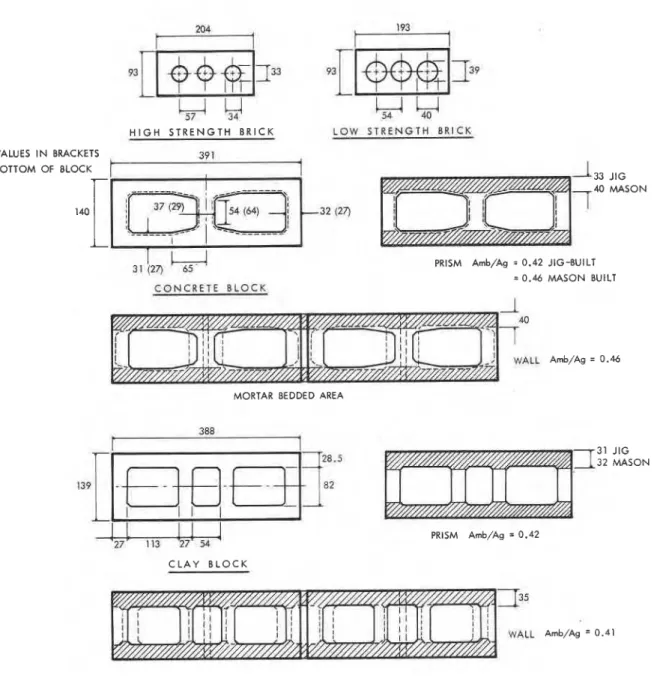
were used (Fig.
1).
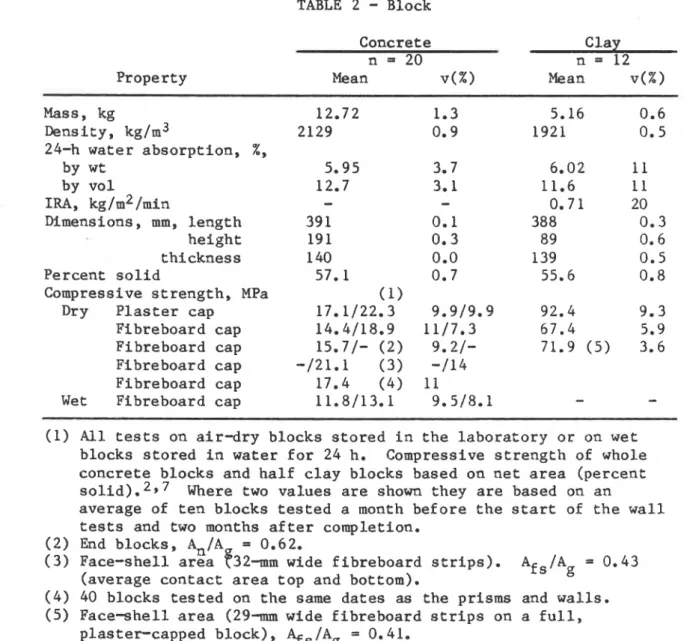
Their properties are listed in Tables
1
and 2.
Mortar
Types S and N mortar were used for the clay and concrete masonry,
respectively; proportions of the ingredients by volume were
1:0.63:4.25,
1:0.5:4.5,
and 1:1:6 portland cement to hydrated lime to
sand for clay block, bricks, and concrete block, respectively. The
mortar was batched by weight and mixed in a standard mortar mixer.
Water was added to suit the mason, who sometimes added more later on
(re-tempering).
The average strength of moist-cured 50-
cubes at
7days was 6.4 to 6.8 MPa for the
S
mortar and 4.1 MPa for the N
mortar.
lCONSTRUCTION
The high-strength bricks were removed from the pallets, as received,
when the walls and prisms were being built. They were dipped in water
(30 s) and allowed to stand 5 to 15 min. The other units, laid dry,
were randomly redistributed to ensure a uniform distribution. The
mason was told to build according to his normal practice, with the
proviso that the specimens should be plumb. Normal practice consisted
of deeply furrowing the mortar joints for the brickwork and face-shell
mortar bedding for the blockwork. When plumbing sections of the wall,
the mason sometimes tapped a unit already in position. Walls were
built on levelled, ground steel plates covered with polyethylene. The
brickwork walls and prisms were kept level and plumb using a level.
A
course rod was provided. The blockwork walls were built to a line.
Half units, needed at the ends of every second course, were cut using a
chisel for high-strength bricks, but the other units were cut by saw.
m
t
1931
.MI.
I
r
.rm~~
I
+
Q
-rljrl
H I G H S T R E N G T H B R I C KY Y
L O W S T R E N G T H 8 R I C K VALUES I N BRACKETS 39 1 BOTTOM OF BLOCK 1 3 3 ,I, 140 32 (27)7"
"'ON I 31 (27) C O N C R E T E BLOCKPRISM Amb/Ag = 0.42 JIG-BUILT
= 0.46 M A S O N BUILT
1
i0
WALL Amb/Ag = 0.46
MORTAR BEDDED AREA
31 JIG 32 MASON 3 I I 4 I I 1 I
!
1 k I PRISM Amb/Ag = 0.42 27' 113 27' 54'
C L A Y B L O C K 5 WALL Amb/Ag ' 0.41Figure 1. Unit dimensions and mortar-bedded a r e a
To make t h e w a l l s more r e p r e s e n t a t i v e of a longer w a l l t h e h a l f u n i t s were placed w i t h t h e c u t end exposed, except f o r t h e high-strength b r i c k w a l l s and t h e f i r s t
s i x
low-strength b r i c k w a l l s where t h e un-cut end was exposed. This counteracted t h e mason's tendency t o provide a f u l l mortar j o i n t a t t h e ends of t h e wall.The t e c h n i c i a n b u i l t h i s prisms i n a j i g a t t h e same t i m e ; t h e s e prisms
w i l l be designated " j i g - b u i l t . " F u l l j o i n t s were obtained by use of a metal mortar template 11 mm deep, allowing t h e mortar t o be screeded f l a t before t h e next u n i t was placed. The u n i t s were tapped down t o -
g i v e a 10- t h i c k mortar j o i n t .
Brickwork and c l a y blockwork specimens were cured under polyethylene bags f o r seven and t h r e e days, r e s p e c t i v e l y , then allowed t o s t a n d i n
t h e l a b o r a t o r y a i r u n t i l t e s t e d . Concrete masonry specimens were cured
i n
a i r
u n t i l t e s t e d . The w a l l s and s t r e t c h e r bond prisms were cappedw i t h Types S o r N mortar. The cap
was
screeded f l a t w i t h t h e h e l p oftwo aluminum g u i d e s clamped t o t h e s i d e s of t h e specimen. Walls and
some prisms were whitewashed f o r e a s i e r d e t e c t i o n of cracks. TEST PROCEDURE
Prisms were t e s t e d i n a 1.8-MN R i e h l e h y d r a u l i c t e s t machine and w a l l s
were t e s t e d i n a 7-MN t e s t frame (Fig. 2, 3 ) . A l l specimens were
capped t o p and bottom w i t h ll-mm t h i c k f i b r e b o a r d over t h e whole
c r o s s - s e c t i o n f o r t h e brickwork and on t h e f a c e - s h e l l s o n l y f o r t h e
blockwork. The l o a d i n g r a t e f o r prisms where s t r a i n was n o t measured
w a s s e t s o t h a t t h e t e s t d u r a t i o n from h a l f t o maximum l o a d would t a k e
approximately 1 t o 2 min. Other specimens were t e s t e d a t a lower r a t e
t o a l l o w f o r s t r a i n measurements and c r a c k d e t e c t i o n . A t f a i l u r e t h e
l o a d c o n t r o l s were n o t a l t e r e d . S t r a i n was measured w i t h 200, 300 and
600 mm handheld, mechanical gauges (Demec).
F i g u r e 2. Walls a f t e r f a i l u r e F i g u r e 3. Concrete b l o c k p r i s m a t
( a ) c o n c r e t e block f a i l u r e
TEST RESULTS
U l t i m a t e S t r e n g t h
F a i l u r e s t r e s s e s (Tables 3-5) a r e based on g r o s s a r e a f o r brickwork and on mortar-bedded a r e a f o r blockwork. The mortar-bedded a r e a , used f o r hollow blockwork i n t h e new e d i t i o n of t h e Canadian masonry d e s i g n s t a n d a r d s 5 i s t h e h o r i z o n t a l a r e a of m o r t a r i n f u l l c o n t a c t w i t h b l o c k s above and below. For c o n c r e t e blockwork where mortar was l a i d on t h e f a c e - s h e l l s o n l y , t h e mortar-bedded a r e a f o r t h e mason-built specimens was e s t i m a t e d t o be 1.19 x a r e a , based on t h e minimum f a c e - s h e l l w i d t h F i g . 1 For j i g - b u i l t prisms t h e i n c r e a s e was 1.09 x a r e a . For c l a y blockwork w i t h s q u a r e c o r e s and uniform f a c e - s h e l l w i d t h s t h e a r e a was based on t h e a c t u a l f a c e - s h e l l w i d t h ( t h e c r o s s webs do n o t a l i g n i n t h e w a l l (Fig. 4 ) ) . The webs i n t h e prisms do o v e r l a p and a s a r e s u l t t h e r e i s a small i n c r e a s e i n mortar-bedded a r e a , b u t f o r s i m p l i c i t y i t
h a s n o t been t a k e n i n t o account. Cracking
V e r t i c a l c r a c k s were f i r s t observed on t h e s i d e s of t h e brickwork w a l l s a t 82% of t h e u l t i m a t e l o a d and a t t h e ends a t 92% ( v = 9
-
13%). The low-strength b r i c k w a l l s o f t e n showed minor l o c a l c r a c k s a t lower l o a d s( u s u a l l y a l o n g t h e t o p c o u r s e ) . The c o n c r e t e blockwork w a l l s developed v e r t i c a l c r a c k s a t t h e ends, down t h e c e n t r e of t h e webs, a t 58% of u l t i m a t e
(v
= 9%); t h e c l a y b l o c k w a l l s developed v e r t i c a l c r a c k s i n t h e webs a t t h e i n t e r f a c e w i t h t h e f l a n g e s a t 70% of u l t i m a t e (60-70%). The c l a y b l o c k w a l l s f i r s t cracked on t h e s i d e s a t 76% of u l t i m a t e (62-84%), b u t no c r a c k s were observed on t h e c o n c r e t e block walls b e f o r e f a i l u r e . F i n a l f a i l u r e was i n b o t h c a s e s caused by v e r t i c a l s p l i t t i n g w i t h i n t h e f a c e - s h e l l of t h e block a t t h e mortar j o i n t (Fig. 2, 3).The brickwork p r i s m s b u i l t i n running bond cracked a t s i m i l a r l o a d l e v e l s , but w i t h g r e a t e r v a r i a t i o n . Stack-bonded prisms a r e n o t a good i n d i c a t o r of c r a c k l o a d s s i n c e t h e y cracked a t h i g h e r l o a d s ( c r a c k s were n o t monitored i n t h e blockwork prisms).
S t r e s s - S t r a i n R e l a t i o n
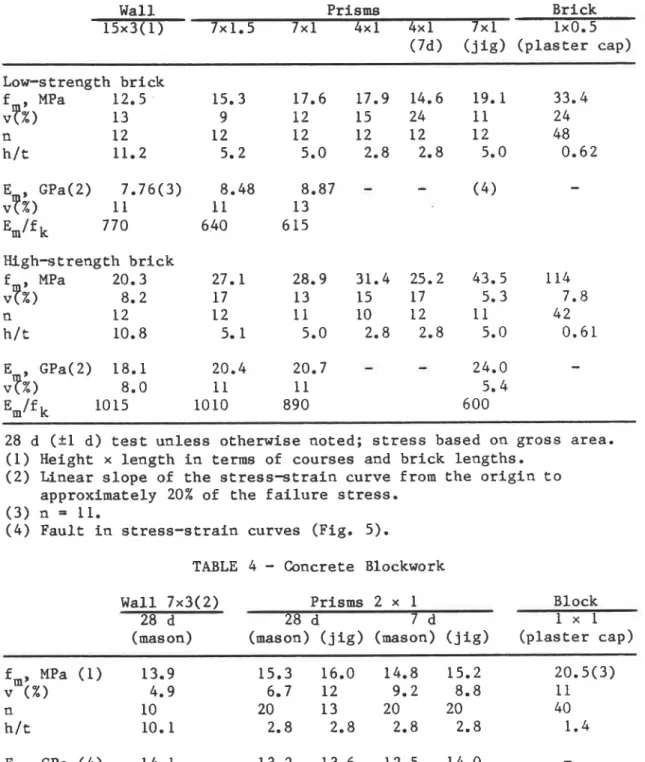
The s t r e s s - s t r a i n c u r v e s f o r a l l t h e specimens t e s t e d a r e shown i n F i g u r e s 5 and 6. The a v e r a g e i n i t i a l e l a s t i c moduli a r e g i v e n i n Tables 3 t o 5. Some c u r v e s f o r c o n c r e t e block prisms show a sudden change i n s l o p e , probably due t o f o r m a t i o n of a v e r t i c a l c r a c k i n t h e webs of t h e blocks. The l a r g e i n i t i a l concave p o r t i o n of t h e curve of some j i g - b u i l t , low-strength b r i c k p r i s m s i s probably due t o a n
incomplete bond between b r i c k and mortar caused, i n t u r n , by t h e h i g h s u c t i o n r a t e of some of t h e b r i c k s . J i g - b u i l t prisms t o o k l o n g e r t o b u i l d , g i v i n g more time f o r t h e mortar t o l o s e w a t e r b e f o r e t h e next b r i c k was placed. The s t r e n g t h of t h e prisms d i d n o t seem t o be
a f f e c t e d ; t h e one w i t h t h e l a r g e s t i n i t i a l concave curve f a i l e d a t t h e second h i g h e s t load. T h i s problem d i d n o t o c c u r w i t h t h e mason-built prisms. A s i m i l a r , s m a l l e r c u r v a t u r e may be s e e n w i t h t h e hollow c l a y blockwork. I n c o n t r a s t , h i g h - s t r e n g t h brickwork f o r which b r i c k s were dipped i n water beforehand shows very c o n s i s t e n t curves. The c o n c r e t e blockwork, l a i d w i t h d r y b l o c k s , a l s o shows c o n s i s t e n t c u r v e s . l---. 1.0 S T R A I N , m m l m 14 COURSES NIGH) 0
u
1.0 S T R A I N , m m l m Figure 5. S t r e s s - s t r a i n c u r v e s , brickwork; ( a ) h i g h s t r e n g t h b r i c k ; ( b ) low s t r e n g t h b r i c kFigure 6. S t r e s s - s t r a i n c u r v e s , blockwork; ( a ) hollow c o n c r e t e b l o c k ; ( b ) hollow c l a y block
DISCUSSION Workmanship
Incomplete f i l l i n g of t h e c e n t r a l p a r t of t h e mortar j o i n t due t o furrowing of mortar (Fig. 7) reduced t h e s t r e n g t h of t h e mason-built, high-strength b r i c k prisms t o 66% of t h a t of t h e j i g - b u i l t prisms. This was not unexpected. 3 , l 1 A s a check on workmanship, a second
mason b u i l t four-course, stack-bonded prisms s i n g l y and i n rows of f i v e t o s i m u l a t e w a l l c o n s t r u c t i o n . The s i n g l e prisms were n e a r l y a s s t r o n g a s t h e j i g - b u i l t ones ( r a t i o of 0.92). Prisms b u i l t i n a , l i n e were weaker; t h e end prisms i n t h e row were 3% weaker, while t h e middle t h r e e
were
9% weaker, i n d i c a t i n g t h a t furrowing i n s i n g l e prisms i s n o t s o complete a s i n walls. Prisms should t h e r e f o r e be b u i l t i n a l i n e t o s i m u l a t e w a l l c o n s t r u c t i o n more c l o s e l y . The A u s t r a l i a n brickwork code r e q u i r e s t h i s ; t h e Canadian standard recommends it.*
The low-strength brickwork was less a f f e c t e d by workmanship, probably because of i t s l a r g e c e n t r a l p e r f o r a t i o n s ( r a t i o of mason-built t o j i g - b u i l t , 0.92). The f a c e - s h e l l mortar-bedded blockwork was a l s o l e s s a f f e c t e d ; r a t i o s of mason-built t o j i g - b u i l t were 0.96 and 0.84 f o r c o n c r e t e and c l a y blockwork, r e s p e c t i v e l y ( a d i f f e r e n t mason was used f o r t h e c o n c r e t e blockwork).
Capping
Fibreboard was used a s a capping f o r t h e w a l l s and prisms because i t
was simple and quick. I n comparison t o a hard capping such a s d e n t a l p l a s t e r , f i b r e b o a r d reduces f r i c t i o n a l r e s t r a i n t , thereby lowering t h e compressive s t r e n g t h of masonry u n i t s ; t h e r a t i o of f i b r e b o a r d t o t h a t of plaster-capped u n i t s ranged from 0.82 t o 0.85, except f o r hollow c l a y block where t h e lower r a t i o of 0.73 may be due t o warped s u r f a c e s of some of t h e blocks. This r e d u c t i o n i n f r i c t i o n a l r e s t r a i n t was n o t s i g n i f i c a n t f o r masonry prisms s i n c e f a i l u r e
i s
i n i t i a t e d a t t h e mortarjoint^,^
but t h e r e can be a r e d u c t i o n i n s t r e n g t h i f t h e prism s u r f a c e i s uneven. I f s u r f a c e s a r e o u t of p l a n e (say, by more t h a n 1 mm), a hard capping should be used w i t h o r without fibreboard. The w a l l s and running bond prisms were capped w i t h mortar, while some hollow c l a y block prismswere
capped w i t h d e n t a l p l a s t e r .Where f a c e - s h e l l mortar bedding i s used t h e f i b r e b o a r d should be placed on t h e f a c e - s h e l l s only; otherwise, premature f a i l u r e may o c c u r O 8
As
furrowing of t h e m o r t a r could be c o n s i d e r e d e q u i v a l e n t t o f a c e - s h e l l m o r t a r bedding, t h e f u l l f i b r e b o a r d c a p s used on t h e brickwork prisms may have caused a r e d u c t i o n i n s t r e n g t h . Checks of prisms w i t h mortar s t r i p s on e i t h e r s i d e of t h e b r i c k showed a l a r g e r e d u c t i o n i n s t r e n g t h f o r low-strength brickwork (33%) b u t n o t f o r h i g h - s t r e n g t h brickwork (9%). The l a r g e r e d u c t i o n d i d n o t o c c u r f o r t h e mason-built prisms i n t h e p r e s e n t t e s t s , s o t h a t f u r t h e r s t u d y i s needed t o v e r i f y t h e e f f e c t of f u l l f i b r e b o a r d capping. Even w i t h t h e p o s s i b l e n e g a t i v e e f f e c t s of furrowed mortar and f u l l f i b r e b o a r d caps, t h e low-strength brickwork prisms gave f a i l u r e s t r e s s e s w e l l i n e x c e s s of t h e code t a b u l a r v a l u e s .
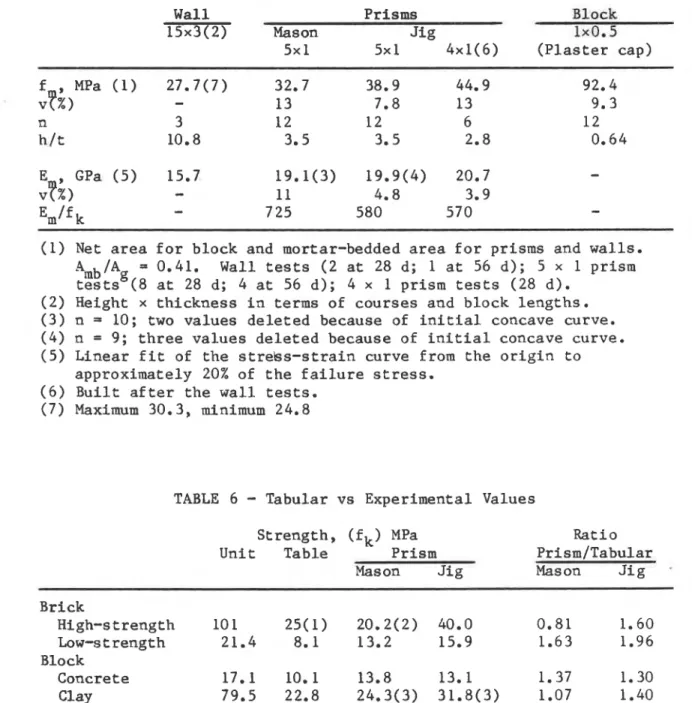
Code Tabular Values
Values f o r compressive s t r e n g t h i n t h e Canadian d e s i g n s t a n d a r d a r e based on t y p e of m o r t a r and c h a r a c t e r i s t i c compressive s t r e n g t h , f k , of t h e b r i c k o r block.5 These v a l u e s a r e compared w i t h t h o s e of t h e prisms, which may a l s o be used t o determine compressive s t r e n g t h
(Table 6 ) . Prism s t r e n g t h i s based on prisms w i t h a h e i g h t - t o - . t h i c k n e s s r a t i o of 5; lower r a t i o s a r e p e r m i t t e d , b u t a r e d u c t i o n
f a c t o r i s a p p l i e d t o t h e compressive s t r e n g t h obtained.
The t a b u l a r v a l u e s a r e l e s s t h a n t h e e x p e r i m e n t a l ones e x c e p t f o r t h e mason-built, h i g h - s t r e n g t h b r i c k prisms. Those f o r brickwork a r e t h e same a s t h o s e f o r i n s p e c t e d workmanship i n t h e B I A brickwork c o d e , l l and assume f u l l mortar j o i n t s w i t h no gaps from furrowing such a s
o c c u r r e d i n t h e p r e s e n t t e s t s . This i l l u s t r a t e s t h e importance of good j o i n t s i n load-bearing brickwork i f t a b u l a r v a l u e s a r e used. The
low-strength b r i c k prisms, on t h e o t h e r hand, gave much h i g h e r v a l u e s . Large p e r f o r a t i o n s i n t h e s e b r i c k s may make them l e s s s e n s i t i v e t o furrowing of t h e m o r t a r ; a s w e l l , t h e i r h i g h l y v a r i a b l e s t r e n g t h
( v = 24%) means t h a t c h a r a c t e r i s t i c s t r e n g t h i s low. The high
v a r i a b i l i t y w a s n o t r e f l e c t e d i n t h e w a l l s and l a r g e r p r i s m s , which had c o e f f i c i e n t s of v a r i a t i o n ranging from 9 t o 13%.
There a r e no t a b u l a r v a l u e s f o r hollow c l a y block. The v a l u e s i n t h e brickwork t a b l e were s u g g e s t e d f o r p o s s i b l e u s e , l but f u r t h e r t e s t s a r e n e c e s s a r y t o check t h e behaviour of hollow b l o c k under e c c e n t r i c l o a d , where e c c e n t r i c i t y i s d i f f e r e n t t o p and bottom. Some p r e l i m i n a r y p r i s m t e s t s u s i n g c l a y b l o c k gave approximately o n e - t h i r d of t h e
expected f a i l u r e l o a d (sudden s h e a r f a i l u r e i n t h e c r o s s webs). F u r t h e r t e s t s a r e planned.
The masonry s t a n d a r d assumes t h a t a n i n c r e a s e i n h e i g h t - t o - t h i c k n e s s r a t i o from 5 t o 10 h a s no e f f e c t on t h e s t r e n g t h of a x i a l l y loaded w a l l s w i t h f l a t end c o n d i t i o n s . I n t h e p r e s e n t t e s t s , however, t h e r e
w a s a r e d u c t i o n ; t h e mean s t r e n g t h of t h e brickwork walls ( h / t = 10) was 74 and 82% of t h e s t r e n g t h of running bond prisms. S i m i l a r
r e d u c t i o n s were found i n o t h e r t e s t s . 1 2 The mean s t r e n g t h of t h e c o n c r e t e b l o c k w a l l w a s 91% of t h e p r i s m s t r e n g t h , w h i l e t h a t of t h e c l a y block w a l l was 92% (based on a d j u s t e d prism s t r e n g t h ) . The block
w a l l s had a more uniform s t r a i n on e a c h s i d e of t h e w a l l t h a n d i d t h e b r i c k w a l l s . The m o r t a r j o i n t s on one s i d e of t h e b r i c k w a l l s had a concave f i n i s h ; t h i s may e x p l a i n t h e g r e a t e r s t r a i n d i f f e r e n c e f o r t h e two s i d e s and, e f f e c t i v e l y , t h e l a r g e r e c c e n t r i c i t y of load.
Moisture Content
The compressive s t r e n g t h of c o n c r e t e block i s s e n s i t i v e t o m o i s t u r e
$ on tent.^
Blocks, b o t h a i r - d r y and soaked i n w a t e r f o r 24 h , weret e s t e d i n September b e f o r e t h e w a l l t e s t s and a g a i n i n January a f t e r t h e t e s t s (Table 2). The r a t i o of t h e compressive s t r e n g t h of soaked t o a i r - d r y b l o c k s changed from 0.82 t o 0.69 over t h i s period. The a i r - d r y b l o c k i n c r e a s e d i n s t r e n g t h by 31% compared t o 11% f o r t h e soaked block. Humidity o v e r t h e same p e r i o d changed from 50-60% t o 20-30%. This probably meant a lower m o i s t u r e c o n t e n t i n t h e a i r - d r y block and a r e s u l t i n g i n c r e a s e i n s t r e n g t h . Blocks used a s c o n t r o l specimens s h o u l d t h e r e f o r e be t e s t e d a t t h e same t i m e a s w a l l s and prisms ( a requirement i n c o r p o r a t e d i n t h e new CSA prism s t a n d a r d 6 ) . For q u a l i t y c o n t r o l , more c o n s i s t e n t r e s u l t s w i l l be o b t a i n e d i f t h e b l o c k s a r e t e s t e d i n t h e s a t u r a t e d c o n d i t i o n ( r e q u i r e d i n t h e B r i t i s h s t a n d a r d 4 ) ; oven d r y i n g of b l o c k s i s n o t p r a c t i c a l . Moisture c o n t e n t h a s much less e f f e c t on c l a y u n i t s (Table 1 ) .
E l a s t i c Modulus
The Canadian d e s i g n s t a n d a r d g i v e s t h e e l a s t i c modulus i n terms of c h a r a c t e r i s t i c f a i l u r e s t r e s s , f k : E = 1000 f k
<
20 GPa. This a g r e e s w i t h v a l u e s f o r t h e hollow c o n c r e t e blockwork and mason-built,h i g h - s t r e n g t h brickwork, b u t i t o v e r e s t i m a t e s t h e modulus f o r t h e o t h e r specimens where t h e r a n g e i s 570 t o 770 fk. The A u s t r a l i a n brickwork code u s e s a v a l u e of 750.
CONCLUSIONS
The s t r e n g t h of c o n c r e t e b l o c k s can vary w i t h age and m o i s t u r e c o n t e n t . It i s t h e r e f o r e i m p o r t a n t t h a t t h e y s h o u l d be t e s t e d a t t h e same t i m e a s w a l l s o r prisms t o e n s u r e good c o r r e l a t i o n .
Fibreboard capping makes t e s t i n g e a s i e r , b u t i t i s i m p o r t a n t f o r t h e cap t o have a c o n f i g u r a t i o n s i m i l a r t o t h a t of t h e mortar j o i n t . For example, i f f a c e - s h e l l bedding i s u s e d , f i b r e b o a r d s h o u l d be p l a c e d only on t h e f a c e - s h e l l a r e a . Stack-bonded prisms should be b u i l t i n a l i n e t o s i m u l a t e w a l l c o n s t r u c t i o n . This b e t t e r r e f l e c t s f a c t o r s s u c h a s furrowing of t h e mortar j o i n t and l e n g t h of time t h e mortar i s l e f t exposed b e f o r e t h e n e x t u n i t i s placed. Although t h e i r e f f e c t on
s t r e n g t h h a s n o t been shown t o be s i g n i f i c a n t , c u t ends of h a l f u n i t s s h o u l d f a c e outward a t t h e ends of t e s t specimens s o t h a t t h e w a l l o r p r i s m w i l l be more r e p r e s e n t a t i v e of a l a r g e r specimen.
The p r e s e n t t e s t s c o n f i r m p r e v i o u s work showing t h a t masonry prisms p r o v i d e a good b a s i s f o r determining compressive s t r e n g t h i f p r o p e r t e s t procedures a r e followed. T e s t s a r e normally c a r r i e d o u t 03
a x i a l l y loaded prisms, b u t t h e y a r e n o t always a good i n d i c a t o r of how masonry behaves under e c c e n t r i c load. A f u r t h e r t e s t on a n
e c c e n t r i c a l l y loaded prism should be i n c o r p o r a t e d i n any prism s t a n d a r d t o be used f o r new t y p e s and s h a p e s of u n i t . The l o a d s h o u l d be
e c c e n t r i c a t t h e t o p ( s a y , t / 6 ) and a x i a l a t t h e bottom.
For load-bearing masonry b u i l d i n g s , e s p e c i a l l y t h o s e u s i n g s o l i d
masonry u n i t s , it i s important t h a t t h e r e be i n s p e c t i o n t o e n s u r e f u l l m o r t a r j o i n t s i f s t r e s s e s a r e based on t a b u l a r v a l u e s o r on prisms w i t h f u l l mortar j o i n t s .
F a c t o r s t h a t need f u r t h e r i n v e s t i g a t i o n i n c l u d e :
1) The e f f e c t of humidity on t h e s t r e n g t h of c o n c r e t e b l o c k s : i n c r e a s e d humidity can reduce s t r e n g t h .
2) The s t r e n g t h of e c c e n t r i c a l l y - l o a d e d , hollow blockwork w i t h m o r t a r on t h e f a c e s h e l l s only: l o a d s may be much lower t h a n expected i f t h e e c c e n t r i c i t y i s d i f f e r e n t t o p and bottom.
3 ) The e x p e r i m e n t a l e l a s t i c modulus f o r masonry u s i n g c l a y u n i t s i s lower t h a n t h e recommended v a l u e i n t h e Canadian s t a n d a r d : a v a l u e s u c h a s 700 f k may be more a p p r o p r i a t e .
4 ) The s l e n d e r n e s s r e d u c t i o n f a c t o r s f o r low s l e n d e r n e s s r a t i o s may need t o be changed ( w a l l s l e s s t h a n s t o r e y h e i g h t ) .
ACKNOWLEDGEMENT
T h i s paper i s a c o n t r i b u t i o n from t h e D i v i s i o n of B u i l d i n g Research, National Research Council of Canada, and i s p u b l i s h e d w i t h t h e a p p r o v a l of t h e D i r e c t o r of t h e Division.
APPENDIX 1
-
REFERENCES1. ASTM C109-77, Compressive s t r e n g t h of h y d r a u l i c cement m o r t a r s , 1977.
2.
ASTM
C140-75, Sampling and t e s t i n g c o n c r e t e masonry u n i t s , 1975.3. Anderson, G.W., Small specimens of brickwork a s d e s i g n and c o n s t r u c t i o n c r i t e r i a , Department of Works, Commonwealth
Experimental B u i l d i n g S t a t i o n , A u s t r a l i a , S p e c i a l Report No. 24, 1970.
B r i t i s h S t a n d a r d s I n s t i t u t i o n , BS6073: P a r t 1: 1981, S p e c i f i c a t i o n f o r p r e c a s t c o n c r e t e masonry u n i t s , 1981.
Canadian S t a n d a r d s A s s o c i a t i o n , CAN3-S304-M84, Masonry d e s i g n f o r b u i l d i n g s , 1984.
Canadian S t a n d a r d s A s s o c i a t i o n , CAN3-A369.1-M84, Method of t e s t f o r compressive s t r e n g t h of masonry p r i s m s , 1984.
Canadian S t a n d a r d s A s s o c i a t i o n , CAN3-A82.2-M78, Method of sampling and t e s t i n g b r i c k , 1978.
Maurenbrecher, A.H.P., E f f e c t of t e s t procedures on compressive s t r e n g t h of masonry p r i s m s , Proceedings, Second Canadian Masonry Symposium, Ottawa, 1980, pp. 119-132.
S e l f , M.W., S t r u c t u r a l p r o p e r t i e s of load-bearing c o n c r e t e masonry, S M a s o n r y : P a s t and P r e s e n t , ASTM, STP 589, 1975, pp. 233-254.
Standards A s s o c i a t i o n of A u s t r a l i a , AS1640-1974, SAA Brickwork Code, 1974.
S t r u c t u r a l Clay Products I n s t i t u t e (now Brick I n s t i t u t e of America), Recommended p r a c t i c e f o r e n g i n e e r e d b r i c k masonry, McLean, VA, 1969.
S t r u c t u r a l Clay P r o d u c t s Research Foundation (now BIA),
Compressive, t r a n s v e r s e and r a c k i n g s t r e n g t h t e s t s of four-inch b r i c k w a l l s , SCPRF, Geneva, Ill., Research Report No. 9, 1965. S t r u c t u r a l Clay Products Research Foundation, Compressive, t r a n s v e r s e and s h e a r s t r e n g t h t e s t s of s i x and e i g h t - i n c h
s i n g l e - w y t h e w a l l s b u i l t w i t h s o l i d and heavy-duty hollow c l a y masonry u n i t s , SCPRF, Geneva, Ill., Research Report No. 16, 1969.
APPENDIX 2
-
NOTATION Afs = f a c e - s h e l l a r e a Ag = g r o s s a r e a Amb = mortar-bedded a r e a = n e t a r e a Em = mean i n i t i a l e l a s t i c modulus f m = mean compressive s t r e n g t h f k = c h a r a c t e r i s t i c compressive s t r e n g t h = f m ( l-
1.5 v ) h = h e i g h t n = number of r e p l i c a t e s t = t h i c k n e s s v = c o e f f i c i e n t of v a r i a t i o n APPENDIX 3-
TABLES TABLE 1-
Brick High S t r e n g t h Low S t r e n g t hn
= 30 n = 48 P r o p e r t y Mass,
kg Density,
kg /m3 24-h w a t e r a b s o r p t i o n , %, by w t by v o l IRA, kg/m2 /min Dimensions, mm, l e n g t h h e i g h t t h i c k n e s s P e r c e n t s o l i d Compressive s t r e n g t h , MPa Dry P l a s t e r cap F i b r e board cap Fibreboard capWet Fibreboard cap
( 1 ) n = 42; ( 2 ) n = 82; ( 3 ) n = 30
A l l t e s t s on a i r - d r y b r i c k s s t o r e d i n t h e l a b o r a t o r y o r on w e t b r i c k s t o r e d i n w a t e r f o r 24 h.
IRA based on n e t a r e a . Compressive s t r e n g t h based on g r o s s a r e a of h a l f b r i c k s e 7
TABLE 2
-
Block P r o p e r t y Concrete Clay n = 20 n = 12 Mean v ( % > Mean v ( % ) Mass, kg Density, kg/m3 24-h w a t e r a b s o r p t i o n , %, by w t by v o l IRA, kg/m2 /min Dimensions, mm, l e n g t h h e i g h t t h i c k n e s s P e r c e n t s o l i d Compressive s t r e n g t h , MPa Dry P l a s t e r cap F i b r e b o a r d cap F i b r e b o a r d cap F i b r e b o a r d c a p F i b r e b o a r d capWet Fibreboard cap
( 1 ) A l l t e s t s on a i r - d r y b l o c k s s t o r e d i n t h e l a b o r a t o r y o r on wet b l o c k s s t o r e d i n w a t e r f o r 24 h. Compressive s t r e n g t h of whole c o n c r e t e b l o c k s and h a l f c l a y b l o c k s based on n e t a r e a ( p e r c e n t s o l i d ) , 2 , Where two v a l u e s a r e shown t h e y a r e based on a n
a v e r a g e of t e n b l o c k s t e s t e d a month b e f o r e t h e s t a r t of t h e w a l l
t e s t s and two months a f t e r completion. ( 2 ) End b l o c k s , An/A = 0.62.
( 3 ) Face-shell a r e a f32-mm wide f i b r e b o a r d s t r i p s ) . Afs/Ag = 0.43 (average c o n t a c t a r e a t o p and bottom).
( 4 ) 40 b l o c k s t e s t e d on t h e same d a t e s a s t h e prisms and w a l l s . ( 5 ) Face-shell a r e a (291nm wide f i b r e b o a r d s t r i p s on a f u l l ,
plaster-capped b l o c k ) ,
AFS /A
= 0.41. gTABLE 3
-
Clay BrickworkWall Prisms Brick
15x3( 1 ) . . 7x1.5 7x1 4x1 4x1 7x1 1x0.5 (7d) ( j i g ) ( p l a s t e r cap) Low-strength b r i c k f MPa 12.5 - 15.3 v?;) 13 9 n 12 12 h / t 11.2 5.2 High-strength b r i c k f MPa 20.3 27.1 v?; ) 8.2 17 n 12 12 h / t 10.8 5.1 28 d ( + I d ) t e s t u n l e s s o t h e r w i s e n o t e d ; s t r e s s based on g r o s s a r e a . ( 1 ) Height x l e n g t h i n terms of c o u r s e s and b r i c k l e n g t h s .
( 2 ) L i n e a r s l o p e of t h e s t r e s s - s t r a i n c u r v e from t h e o r i g i n t o approximately 20% of t h e f a i l u r e s t r e s s .
( 3 ) n = 11.
( 4 ) F a u l t i n s t r e s s - s t r a i n c u r v e s (Fig. 5).
TABLE 4
-
Concrete BlockworkWall 7x3(2) Prisms 2 x 1 Block
28 d 28 d 7 d 1 x 1
(mas on) (mason) ( j i g ) (mason) ( j i g ) ( p l a s t e r c a p )
f m , MPa ( 1 ) 13.9 v
( % I
4.9n 10
h / t 10.1
( 1 ) Net a r e a f o r b l o c k and mortar-bedded a r e a f o r w a l l s and prisms.
h b / A = 0.42 ( j i g - b u i l t ) and 0.46 (mason-built).
( 2 ) I-Ieighf x l e n g t h i n terms of c o u r s e s and b l o c k l e n g t h .
( 3 ) Assumed f o r p l a s t e r capping = 1.18 x 17.4 ( f i b r e b o a r d capping). ( 4 ) L i n e a r f i t of t h e s t r e s s - s t r a i n c u r v e from t h e o r i g i n t o
TABLE 5
-
Clay BlockworkWall Prisms Block
15x30
aso on
J i g 1x0.5 5x 1 5x 1 4 ~ 1 ( 6 ) ( P l a s t e r cap) f MPa (1) 27.7(7) 32.7 38.9 44.9 92.4 v s )-
13 7.8 13 9.3 n 3 12 12 6 12 h / t 10.8 3.5 3.5 2.8 0.64 E GPa (5) 15.7 19.1(3) 19.9(4) 20.7-
v?;)-
11 4.8 3.9 Em/f k-
7 25 580 570-
(1) Net a r e a f o r b l o c k and mortar-bedded a r e a f o r prisms and walls.
Amb/Ag = 0.41. Wall t e s t s (2 a t 28 d; 1 a t 56 d ) ; 5 x 1 prism t e s t s ( 8 a t 28 d; 4 a t 56 d ) ; 4 x 1 prism t e s t s (28 d ) .
(2) Height x t h i c k n e s s i n terms of c o u r s e s and b l o c k l e n g t h s . ( 3 ) n = 10; two v a l u e s d e l e t e d because of i n i t i a l concave curve. (4) n = 9; t h r e e v a l u e s d e l e t e d because of i n i t i a l concave curve. (5) L i n e a r f i t o f t h e s t r e k s - s t r a i n curve from t h e o r i g i n t o
approximately 20% of t h e f a i l u r e s t r e s s . ( 6 ) B u i l t a f t e r t h e w a l l t e s t s .
(7) Maximum 30.3, minimum 24.8
TABLE 6
-
Tabular v s Experimental ValuesS t r e n g t h , ( f k ) MPa R a t i o
U n i t Table Prism Prism/Tabular
Mason J i g Mason J i g
-
B r i c k High-strength 101 25(1) 20.2(2) 40.0 0.81 1.60 Low-strength 21.4 8.1 13.2 15.9 1.63 1.96 Block Concrete 17.1 10.1 13.8 13.1 1.37 1.30 Clay 79.5 22.8 24.3(3) 31.8(3) 1.07 1.40 (1) For b r i c k s t r e n g t h>
90 MPa. (2) Running bond prisms.T h i s , p a p e r , w h i l e being d i s t r i b u t e d i n r e p r i n t form by t h e D i v i s i o n of B u i l d i n g Research, remains t h e c o p y r i g h t of t h e o r i g i n a l p u b l i s h e r . It s h o u l d n o t be reproduced i n whole o r i n p a r t w i t h o u t t h e p e r m i s s i o n of t h e p u b l i s h e r . A l i s t of a l l p u b l i c a t i o n s a v a i l a b l e from t h e D i v i s i o n may be o b t a i n e d by w r i t i n g t o t h e P u b l i c a t i o n s S e c t i o n , D i v i s i o n of B u i l d i n g R e s e a r c h , N a t i o n a l R e s e a r c h C o u n c i l of C a n a d a , O t t a w a , O n t a r i o ,
KlA
0R6.C e document est d i s t r i b u g s o u s forme de tirC-3-part par l a D i v i s i o n d e s r e c h e r c h e s e n b l t i m e n t . L e s d r o i t s d e r e p r o d u c t i o n s o n t t o u t e f o i s l a p r o p r i C t Q de 1 ' C d i t e u r o r i g i n a l . C e document n e p e u t S t r e r e p r o d u i t en t o t a l i t 6 ou en p a r t i e s a n s l e consentement de l ' d d i t e u r . Une l i s t e des p u b l i c a t i o n s de l a D i v i s i o n p e u t Ctre obtenue en Q c r i v a n t