ChemWARD: Extracting Chemical Structure
from Printed Diagrams
by
Angelique Moscicki
LL
S.B. CS, M.I.T., 2008
Submitted to the Department of Electrical Engineering and Computer Science
in Partial Fulfillment of the Requirements for the Degree of
Master of Engineering in Electrical Engineering and Computer Science
at the Massachusetts Institute of Technology
September, 2009
ARC
@2009 Massachusetts Institute of Technology.
All rights reserved.
MASSACHUSETTS INS11T TE OF TECHNOLOGY
AUG 2 42010
IBRARIES
HNES
Department of Electrical Engineering and Computer Science September 7, 2009 C ertified by ... ...--... ---... ---...---...--- ...
Prof. Randall Davis Thesis Supervisor Accepted t - - -
-\
~Dr.
Christopher J. Terman3
ChemWARD: Extracting Chemical Structure
from Printed Diagrams
by
Angelique Moscicki Submitted to the
Department of Electrical Engineering and Computer Science September 7, 2009
In Partial Fulfillment of the Requirements for the Degree of Master of Engineering in Electrical Engineering and Computer Science
ABSTRACT
Over the years, a vast amount of literature in the field of chemistry has accumulated, and searching for documents about specific molecules is a formidable task. To the extent that the literature is textual, services like Google enable relatively easy search. While search indexes like Google are very good at finding such things, its difficult to describe molecules completely using text because text can't easily indicate molecular structure, and molecular structure defines chemical properties. ChemWARD is a system that extracts the molecular structure from the printed diagrams that are ubiquitous in chemistry literature and converts them to a machine readable format in order to allow chemists to search the literature by drawing a molecular structure instead of typing a chemical formula. We describe the architecture of the system and report on its performance, demonstrating its ability to achieve an overall accuracy rate of 85.5% on printed diagrams extracted from published chemical literature.
Thesis Supervisor: Randall Davis Title: Professor, MIT EECS
Acknowledgments
Ilya Baran, for contributing to the vectorization algorithm, and most importantly for being helpful even when it was difficult to be helpful.
The mathematicians at church, for their insights in geometry.
All the other people I have encountered who unknowingly turned an aimless wanderer into an engineer.
Contents
1 Introduction ...
8
2 Architecture ...
18
3 Optical Character Recognition in ChemWARD ...
30
4 Character Aggregation ...
44
5
V ectorization ...
50
6 Vectorization Refinement ...
67
7 Using Chemical Knowledge ...
90
8 Limitations and Future W ork ...
96
9 R esults ...
105
10 Contributions ...
109
Appendix ...
Ill
References ...
117
Chapter 1
Introduction
Over the years, a vast amount of literature in the field of chemistry has accumulated, and searching for documents about specific molecules is a formidable task. To the extent that the literature is textual, services like Google enable relatively easy search. While search indexes like Google are very good at finding such things, its difficult to describe molecules completely using text because text can't easily indicate molecular structure, and molecular structure defines chemical properties. Molecular structure includes information about the geometry of the atoms, including such things as angles between bonds and the spatial arrangement of the atoms involved. It also includes topological information like the connectivity between atoms and the degree of each bond (i.e., a single bond, a double bond, etc.). It is far easier to represent this type of information in diagrams like the one shown in Figure 1.1 and such diagrams are ubiquitous in chemical literature.
H 'OH
IUPAC Name: Formic Acid
Chemical Formula: CH2O2
SMILES:
O=CO
Figure 1.1: Example of a diagram showing molecular structure, as is commonly found in chemistry papers. Below the diagram are several text representations of the molecule.
Textual descriptions of molecules are also present in chemistry papers, but the most common ones do not communicate information about molecular structure. The chemical formula, for example, just lists the number of each type of atom present in the molecule without specifying anything about connectivity. Another standard nomenclature, IUPAC, has the same problem and can in addition generate rather verbose names for molecules. SMILES is a text based representation that conveys topological information by representing atoms by their atomic symbols and bonds by other symbols like ='. SMILES, however, is not very human readable for large molecules with many ringlike substructures in them. It also contains no information about geometry.
For all these reasons, the most complete description of a molecule that a trained human can understand at a glance is the structural diagram. The task of searching chemistry literature would be much easier if it were possible to search by drawing the structure of interest because the chemist would be spared the difficulty of having to convert to a less intuitive textual
representation. Another advantage is that chemistry papers often include diagrams for molecules that are not explicitly named in the text. It would also enable chemists to search for partial
structures as opposed to whole molecules.
Search by structure would certainly be a valuable tool, but what is required to make it possible? There are two parts to the problem; first it must be possible for chemists to quickly and easily create machine understandable structure diagrams that specify the molecule of interest. This is analogous to the task of typing the key word into the search box on Google. One particularly intuitive way to accomplish this is by using a sketch interface on a tablet PC; several systems have been constructed to do this [1] [2]. The other part of the problem is finding the diagrams in printed chemistry papers and interpreting them to retrieve the molecular structure they depict.
Extracting a complete description of a molecule from a diagram is sizable task. I break down into several subtasks. The first necessary step is to convert the chemistry papers to a digital format. Many new papers are already in digital formats, but older and historical documents exist only on paper, often with poor print quality. The pages of paper need to be scanned. The output of a scanner, however, is merely bitmap image data; it contains no information about whether the image contains text or numbers or a diagram or a photo, so the next step is to find the diagrams in the scanned pages and isolate them for interpretation. After the images have been found, they need to be interpreted to find the molecular structure, which is the focus of this work. Finally, the molecular structures must be integrated into a search index that chemists can make use of. The search index, combined with the sketch interface mentioned earlier would enable chemists to search for molecules by their structure.
This brings us to the central theme of this paper, which is to extract the molecular structure from chemical diagrams represented as bitmap images, which I will call the molecule recognition problem. After having read this thesis, you will understand in detail the challenges
associated with the molecule recognition problem, and how to build a system to solve it. In order to make the task a bit better defined, I will now present a brief overview the anatomy of a molecular structure diagram.
Structure diagrams obey a standard set of conventions when depicting atoms and bonds. Atoms are represented straightforwardly by their atomic symbols. Sometimes diagrams will also contain standard chemical shorthand for simple common molecules that are part of the substructure, like 'Me' for a methyl group. Ions are indicated by a plus or minus superscript next to the atomic symbol. Aside from atomic symbols, structure diagrams also contain bonds. Single, double, and triple bonds are typically drawn as one, two, or three straight lines, respectively, between the atoms they connect. Sometimes, however, depictions of bonds are slightly more complicated due to the fact that molecules have a three dimensional structure that must be represented on paper. Conventions exist for drawing bonds that extend into the plane of the paper away from the viewer, and out of the paper towards the viewer. These are called hash bonds and wedge bonds, respectively, and are shown in Figure 1.2. Sometimes it is not possible to draw a molecular structure on paper without bonds crossing each other, so chemists express this by drawing split bonds, also shown in Figure 1.2. Atomic symbols, common shorthand, and they types of bond depictions shown in Figure 1.2 together make up the graphical vocabulary used to draw molecular structure, and consequently determine the types of symbols any system attempting to solve the molecule recognition problem must understand. Understanding the symbols in structural diagrams is a challenging problem that can itself be broken down into three general components:
-~ ~Effi DI
N+
H
H
H CH
3
-o
(a) (b) (c)40p
N
-N
S
N
(d) (e) (f)Figure 1.2: Shown in red are common ways of drawing bonds. (a) is a single
bond, (b) shows single bonds extending out of the paper towards the viewer, (c)
shows single bonds extending out of the paper away from the viewer. (d) is a
double bond, (e) is a triple bond, and (f) is a single bond that crosses another
single bond, so it is drawn in two pieces.
Recognizing Letters: The problem of recognizing text in images, or optical character recognition
(OCR) has been studied since the 1960s [3]. Some high performance solutions have been
developed in industry such as ABBYY FineReader, ReadIris and others. But, conventional OCR
engines are not well suited to the molecule recognition problem because they are designed to
read long blocks of text arranged in lines, of the type that would be found in a novel, and not the
sparse, isolated characters found scatted throughout molecular diagrams. Superscripts and
subscripts also present problems for conventional OCR engines because they tend to be small and
difficult to read.
Recognizing Bonds: Because bonds are drawn as a line or a collection of lines, the problem of
recognizing bonds is intimately related to the task of locating lines in the bitmap data. Regions
of pixels that appear to be lines in structure diagrams are often noisy rectangular shapes at the
pixel level, like the single bond shown in Figure 1.3 (a). Noise effectively makes it impossible to
get a perfect correspondence between the pixels and a set of lines, so some amount of
approximation is necessary. Approximating a bitmap image with a set of lines is also an old
problem, called vectorization. As was the case with OCR, there exist vectorization algorithms
that produce aesthetically beautiful results, but once again the type of output they generate is not
well suited to the molecule recognition problem. This is because most vectorization algorithms
seek to approximate the pixels of the image as accurately as possible, while in the molecule
recognition problem, the real goal is to recognize structure. Complete and accurate pixel
coverage should be sacrificed when it conflicts with extracting molecular structure. In particular,
in a noisy image a region of pixels that a chemist understands to be a single line because it is a
single bond ought not be approximated as two lines even if two lines more accurately cover the
pixels.
(a)
(b)
(c)
Figure 1.3: (a) is a noisy set of pixels that is really a single bond. It takes two
rectangles to cover all foreground the pixels while covering as few of the
background pixels as possible, as shown in (b). Because (a) is really a single
bond, the desired outcome is to approximate the region with a single rectangle like
(c), even if the pixel coverage is not as good as in (b).
Handling Noise: Both poor print quality and poor scanning introduce noise into the bitmap data.
Some examples are shown in Figure 1.4. Letters often are merged with other letters and bonds,
bonds are merged with other bonds. In particular, when letters and bonds merge, the resulting
shape resembles neither a letter nor a bond, so some type of segmentation technique must be
employed.
A
0-
w
Figure 1.4: Examples of how noise can corrupt a diagram. The leftmost symbol is the letter 'A', the others show how noise can connect characters and bonds, a particularly difficult problem to address.
As mentioned earlier, search by structure requires both an interface for chemists to enter diagrams and a method to find, recognize, and index the diagrams already existing in the literature. In particular, the molecule recognition problem must be solved by both the interface for chemists and the program that processes diagrams in the literature. On the surface it may seem that since high performance systems already exist to solve the interface problem, it should be possible to reuse them to solve the molecule recognition problem. In fact this is not the case; recognizing molecular structure entered via a sketch interface is a very different problem from recognizing molecular structure in print. These problems are so different first because in a
sketch interface there is a notion of temporal data that allows the system to separate the user input into lines and symbols according to when the pen is active. Information like the fact that users usually draw single bonds as a single pen stroke can be effectively exploited to make the recognition task easier. Sketch interfaces also have their own host of problems that do not occur in print, most notably the unpredictable user. Finally, sketch interfaces must run in real time in order to be useful, printed diagrams can be processed offline, and the processing need only be faster than a trained human in order to be useful. The problems are thus different enough that techniques that have been successfully used in sketch recognition can not be used with diagrams from printed sources.
The remainder of the chapter focuses on the approach that ChemWARD employs to solve the molecule recognition problem. One of the key ideas it uses is that interpretation occurs at
multiple stages on the way from pixels to molecular structure.
Pixels must be grouped into sets that correspond to meaningful symbols. - Symbols must be recognized as either letters or bonds.
- Connectivity between symbols must be established.
- Chemical knowledge can be brought to bear to ensure that the resulting graph of symbols is chemically valid.
While there is a certain degree of modularity between these levels of interpretation, they are also often related, with information at higher levels used to correct mistakes at lower levels. In ChemWARD, specific recognition tasks are delegated to special interpreters called "senses" that each operate only at the level or levels appropriate to their task, but can provide suggestions or corrections to other senses. For example, a sense responsible for checking that a particular atom does not have more bonds than chemically makes sense should operate on graphs, not pixels. Similarly, in order to keep complexity manageable, a sense responsible for OCR should not be concerned with bonds connected to the character it is recognizing. At the same time, it should be possible for high level senses to correct mistakes that low level senses made because they did not have enough information at the time they were first applied. Just as human perception is influenced by what we expect to perceive, ChemWARD uses high level reasoning to guide the more generic low level reasoning. Figure 1.5 illustrates an example of this type of reasoning.
Observed Letter: 'A' Expected Vectorization:
Pixels:
AObserved
vectorization:
Conclusion: There are not enough Vectorization: rectangles to be 'A'. OCR error.
Figure 1.5: Example of how a high level sense that considers both vectorization and
OCR can correct mistakes in the lower level OCR.
The idea of senses influencing each other in this way is described in more detail by Coen
[4], and even earlier in the blackboard metaphor [5]. It is the guiding philosophy in
ChemWARD. To summarize Coen's idea, in classical artificial intelligence, perception systems
have senses built in a linear fashion, where each successively higher sense builds only upon the
previous one. This forces the system to commit to decisions early on with too little information
and does not allow for making corrections later when more information comes to light. It also
clearly demonstrates another guiding principle in ChemWARD: it is better to remain
uncommitted to an interpretation and retain ambiguity than it is to commit and allow mistakes to
propagate. The classical linear sense architecture also reduces the efficacy of high level senses
because they have access only to whatever the next lowest sense provided them; all intermediate
representations are destroyed and can no longer be leveraged. According to Cohen, perception
should not be a system where information flows strictly upwards. Downward information flow
and horizontal information flow should also take place. Figure 1.6 shows a perception system
according to Cohen's scheme of influence networks. ChemWARD consists of a similar network of senses that bootstrap off each other and correct each other in order to reach a consistent final interpretation of the molecular structure in a diagram. How each of the senses work, and how they interact, is described in detail in the rest of the thesis.
Chapter 2 describes the architecture and design philosophy of ChemWARD, and establishes the principles common throughout the entire system. Look here to see a zoomed out view of the entire system. Chapter 3 focuses on OCR, what problems I encountered when working with traditional OCR engines, and the steps ChemWARD takes to correct the inevitable OCR mistakes even the best engines will make. Grouping letters together into atomic symbols, chemical shorthand, and chemical formulas that appear as part of the overall molecular structure is the subject of chapter 4. Chapter 5 discusses vectorization and presents ChemWARD's novel algorithm that is designed to overcome the shortcomings of traditional ones. After that, chapter 6 describes the senses that refine the vectorization output, which due to noise is necessarily imperfect. Here ChemWARD makes extensively uses drafting knowledge about how structural diagrams are drawn. Chapters 3 and 4 can be read independently of Chapters 5 and 6. Chapter 7 covers how chemical knowledge is used to resolve inconsistencies in the ChemWARD's final output. Limitations of the current incarnation of ChemWARD are discussed in chapter 8, along with the direction of future work. To date, there are several other systems that attempt to solve the molecule recognition problem, including CliDE [6][7], ChemOCR[8], and OSRA[9]. Results and comparison with existing systems is the subject of Chapter 9. Finally, Chapter 10 summarizes the contributions ChemWARD has made to the molecule recognition problem.
Chapter 2
Architecture
In this chapter, I describe the architecture used in ChemWARD and the decisions that led to it. First I point out a few principles used throughout, and then I present some examples to show where simple approaches fail and to provide motivation for the architecture that I chose. I describe the stages of interpretation that ChemWARD operates on, and the intermediate
representations that ChemWARD constructs while working toward a final understanding of the molecular structure in a given diagram. Finally I describe the representation that ChemWARD uses to cope with the specific challenges that arise as a result of using influence networks.
Several ideas are so central to the design used in ChemWARD that they should be kept in mind throughout the rest of this thesis. These are:
- Use high level information to correct low level mistakes.
- The further a mistake propagates, the more difficult it is to correct.
- It is better to remain uncertain about an interpretation and maintain ambiguity than to commit early to a mistake.
- It is easier to rule out possible interpretations of a symbol than to commit to one.
A concrete example will help motivate the architecture used in ChemWARD. Let us assume for the moment that there is very little noise in the input image and there are only single bonds in the plane of the paper (no hash, wedge or split bonds). Figure 2.1 shows such a molecule. Let's walk through the steps needed to interpret it.
H
2
N
**
C
00-1e
C2H
Figure 2.1: A very simple molecule entirely in the plane of the paper.
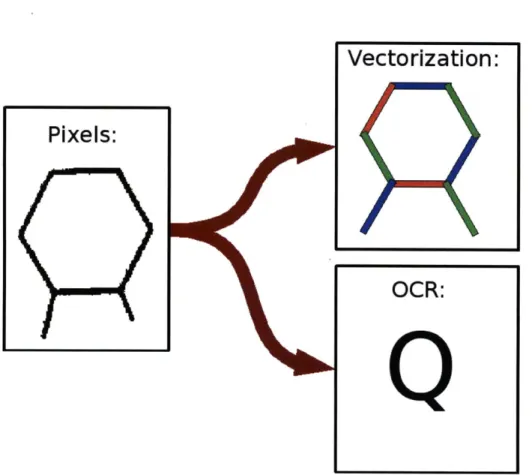
Let's start by assuming that every connected black region of pixels corresponds to an interesting symbol like a letter, a bond, or a group of bonds. In Figure 2.1 there are seven of these connected regions that are letters or digits that make up the formulas in the molecule, and one that is a large group of bonds. Let us also assume that we have at our disposal an OCR sense that proposes one or more alphanumeric guesses for what a connected region of pixels might be, and a vectorization sense that approximates a connected component with a set of rectangles. In a high quality vectorization, each rectangle will correspond to a single bond. Figure 2.2 shows the type of output each of these senses produces.
Figure
2.2:
On the left is the pixel input, on the right are the types of
output from the vectorization and OCR senses, respectively.
At this point we can classify the symbols of interest into two broad categories:
alphanumeric symbols, and bonds. But which type should we try to identify first?
Let's first try applying OCR to every connected region of pixels, and trust that it will pick
out all the letters in the image. The remaining connected regions must then be bond groups, and
the vectorization sense should be able to pick out the rectangles that correspond to the individual
bonds in each one. As described in the previous chapter, however, OCR does not perform as well
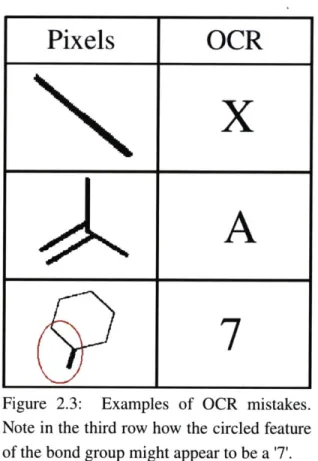
as hoped. Figure 2.3 shows some mistakes that ChemWARD's unaided OCR sense made in real
images. Even if OCR were designed to perform well in a domain like molecular structure
diagrams, bond groups in the diagram sometimes legitimately look like letters when considered
out of context, as shown in Figure 2.2 with the
'Q'.
Hastily classifying them as letters would be a
mistake, and mistakes are harder to correct the farther they propagate.
Figure 2.3: Examples of OCR mistakes.
Note in the third row how the circled feature
of the bond group might appear to be a '7'.
If applying the OCR sense first didn't achieve a very good result, lets try the opposite
approach: use the vectorization sense first and try to pick out the bonds. Apply OCR only to
those connected components whose vectorization contains many relatively small rectangles, or
exhibit some cues to indicate that the vectorization is poor according to some metric we can
devise.
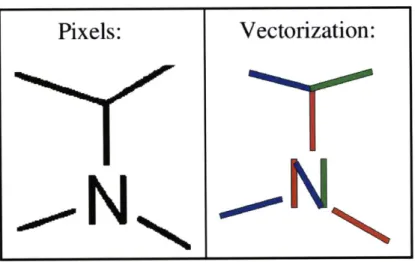
Figure 2.4 shows the problem with this approach; that even though the 'N' is
distinguishable by the arrangement of the rectangles that form its vectorization with respect to
each other, it is not distinguishable by any information in the vectors themselves. In order to
recognize the 'N', contextual information has to be leveraged, and at such a low level as
vectorization, this information has not been computed yet. The vectorization in Figure 2.4 is
nearly perfect; in images with more noise and consequently worse vectorizations, the
arrangement of rectangles becomes an unreliable indicator as to whether or not a connected
region is a letter, so OCR will have to be used anyway.
Ir
N
Figure 2.4: The vectorization on the right is very accurate,
but the rectangles in the 'N' are the same size as the bond
rectangles around them. There is no way to determine
which rectangles are bonds, and which are the 'N'.
The message to take away from this example is that even with very little noise and only
the simplest chemical symbols, there is enough genuine ambiguity in molecular structure
diagrams to require a more complex model than a linear application of senses. An influence
network would not suffer from this handicap because information can be shared across senses.
But in order to build an effective influence network, senses must be able to extract from the
image cues that are truly indicative of the molecular structure, and that do not try to do too much
at once. For example, it might be a bit of a leap to assume that every rectangle produced by the
vectorization sense really is a single bond, especially when hash, wedge, and split bonds are
considered.
With this in mind, I now present an overview of the stages of interpretation used in
ChemWARD. Each stage of interpretation is an intermediate representation somewhere between
pixels and molecular structure, and has one or more senses responsible for producing it. Each
one summarizes the state of the knowledge computed so far, and adds to it. After I've defined the
stages of interpretation, I show how the senses associated with each one interact to form an
influence network. The stages of interpretation are: Pixels: Pixel level operations are vectorization and OCR.
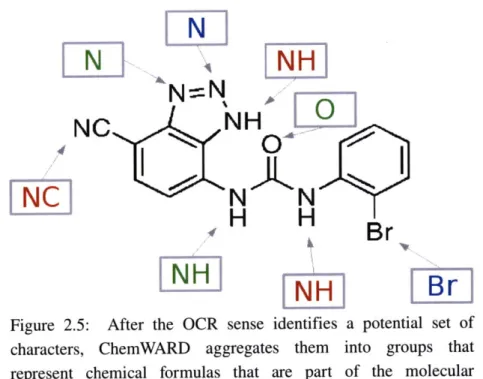
Vectors: Because the vectorization problem was first explored for converting bitmap images to vector graphics, the rectangles produced by a vectorization algorithm are called vectors. The algorithm used in ChemWARD identifies both rectangles, and circular annuli. Once ChemWARD has vectorized an image, it uses knowledge about drafting to refine the vectorization by eliminating or merging vectors that seem spurious, grouping sets of vectors that form specific shapes together into vector sets, and by identifying regions that are possibly letters. Characters: After a preliminary pass of OCR, its possible to roughly estimate the height and width of a character and eliminate mistakes like the 'Q' from Figure 2.2. At this stage, ChemWARD also aggregates characters together into groups that make up chemical formulas that are part of the overall chemical structure, as shown in Figure 2.5.
IIN
11-
I
NH]
N
N
NCN
NC
N
NH
_ _ N NH
H
Br
INJHI
INHI
B I
Figure
2.5:
After the OCR sense identifies a potential set of
characters, ChemWARD aggregates them into groups that
represent chemical formulas that are part of the molecular
structure. Notice how sometimes chemical formulas are written
vertically instead of the usual horizontal left to right way.
Vector Topology: After the vectors have been refined, ChemWARD overlays a graph on top of
them to indicate which vectors are adjacent to each other. Adjacent in this context means that the
vectors have overlapping area. Every pair of adjacent vectors are connected in the graph.
Vector Sets: Because some chemical symbols like split bonds and hash bond are made of more
than one vector, it is more appropriate to think of bonds as sets of vectors (and in the case of a
standard single bond the set has only one vector in it). These sets can be converted into a bond
representation where the notions of bond degree (i.e., single, double, etc.) and stereochemistry
(i.e., whether the bond is in the plane, extends out of the plane, or into it) are added.
Formulas: After characters are grouped together into formulas, the formulas must be checked for
syntactical errors. While some formulas are ambiguous, it is often possible to calculate how
many bonds to expect. For example, a Nitrogen atom ('N') usually supports 3 bonds, where the
formula C3H80 (isopropyl alcohol) is ambiguous because there are multiple isomers of the
formula.
Chemical Topology: At this point enough low level interpretation has taken place to construct the graph that represents the actual molecule. Vector sets that have been converted into bonds and characters that have been aggregated into chemical formulas are connected to make a chemical graph that describes both the geometry and the topology of the molecule. Only now can the highest level senses check for consistent valence information, logical bond connectivity, etc. When such a sense discovers an inconsistency it can either modify the chemical graph to repair the problem, or point out the problem to the user for manual correction.
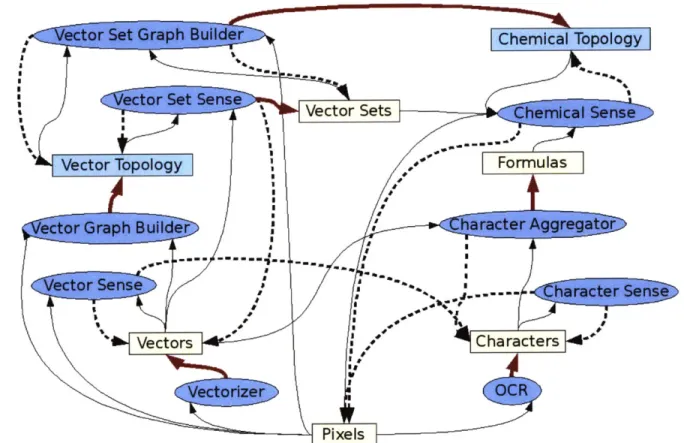
These are the intermediate knowledge representations ChemWARD uses. Figure 2.6 shows them as part of ChemWARD's influence network, and also shows the senses that produce, examine, and modify them. Subsequent chapters describe in detail each part of the network in Figure 2.6. Looking back at the guiding principles used in ChemWARD, the influence network provides several advantages. First, it clearly shows that high level senses can correct low level mistakes, as the Character Aggregator can be used to correct noise in the Pixels. Secondly, it facilitates the ability to avoid committing to a particular interpretation because as more information comes to light, senses can hand off data to one another. Thirdly, because high level senses can make changes downward, mistakes can be corrected at their source, and the corrections can bubble upwards through the usual processing pathways. For example, in Figure 2.6, the Vector Set Sense might correct a mistake in the Vectors, which triggers the Vector Sense and the Vector Graph Builder to re-examine the modified region and make their own changes in light of new information. Finally, the Vector Set Sense can observe the effects of the modification that it made, and possibly make further modifications. Throughout the rest of the thesis, there will be many concrete examples of precisely this behavior.
Pixels
Figure 2.6: Influence network used in ChemWARD. Each oval is a sense, each rectangle is an
intermediate knowledge representation.
Green rectangles identify topological information
whereas yellow ones identify classification information. The heavy red arrows trace the flow of
information from pixels to chemical topology, from which the molecular structure is simply read
off. The heavy dashed arrows trace the modifications that senses make to lower level
intermediate representations. The thin black arrows identify the intermediate representations
that each sense uses as input.
On the other hand, managing complexity that results from this and any other substantial
influence network is a challenging task. It is critical that the intermediate representations remain
consistent with one another, and there must be a mechanism for resolving conflicts between
senses. In order to deal with these concerns, ChemWARD uses a special representation, called a
column.
A column is a mechanism to propagate the changes made by one sense to the data
structures used by all the other senses. As more and more senses process the image, each
intermediate representation described above is computed. That means that each connected region of pixels is both vectorized and run through the OCR sense. On top of these layers, the vector graph (that indicates which vectors are adjacent) and the chemical graph (that reflects the chemical structure) are formed. Inconsistencies can easily arise between the layers; for example when a chemical sense finally commits to interpreting a region of pixels as a character and has to remove any vectors associated with the region from the vector graph so senses operating on the vector graph don't inadvertently identify any of the vectors computed earlier for the region as a bond. But, a high level sense should not need to operate on low level representations;
semantically the low level representation is unintelligible to it, and practically it breaks the very abstraction barriers put in place to reign in complexity. Additionally, for each intermediate representation there are only a few types of permissible modifications. For example, a Vector Set supports only adding and removing vectors as possible modifications to it. Instead of having each sense explicitly worry about how the modifications it makes at the level it is built to reason at may affect representations above and below, it is better to have all the senses interact with the data via an intermediary that knows how to propagate all the changes up and down. This intermediary is the column. When a sense modifies the top layer, the column propagates up and down all the changes in a way appropriate to each intermediate representation. The column also specifies concrete interfaces by which senses are allowed to modify data, and these interfaces can be turned on and off. A visualization of a column is shown in Figure 2.7.
Figure 2.7: Conceptual diagram of a column. At the bottom is a region of pixels,at the top is the final interpretation of the pixels. In the middle are some of the interfaces that the senses are able to access when considering that region of pixels. Changes made via one interface are reflected in the data exposed at all of the interfaces, the column internally propagates the modifications.
With the problem of propagating data changes handled, there remains the task of resolving conflicts when senses disagree about the interpretation of a region of pixels. This is where the fourth guiding principle in ChemWARD becomes important: It is easier to rule out possible interpretations than to commit to one. Senses are allowed to generate their own interpretations for pixel regions and the column keeps track of them all. Other senses primarily reject interpretations until no more computation can be performed. Pixel regions for which all possible interpretations are eliminated are rejected as noise. If at the highest level there are still
multiple interpretations, the Chemical Sense is the final arbiter in choosing among them. The
best example of ambiguity that can be resolved only by the Chemical Sense is an Iodine atom in a
molecule. In sans-serif font, the capital T symbol for Iodine becomes a single rectangle. Figure
2.8 shows an example. It is impossible to determine whether the symbol is an T or a single bond
joining two chemical formulas by looking at the symbol in isolation. The deciding information is
the presence of chemical formulas on the top and bottom of the symbol on the right and the lack
of them on the left (the single bond connected to the T on the left side of Figure 2.8 is not a
reliable indicator because it does not actually touch the T).
I
NH
I(
(H
2
C)
,
4
Figure
2.8:
Two possible
interpretations
of
a
single
rectangle. On the left, it is an
Iodine atom as context indicates.
On the right, it is a single bond.
In this chapter, I presented the guiding principles used in ChemWARD and the influence
network that ChemWARD uses. I've described the different stages of interpretation that are
important in understanding molecular structure and presented a representation that allows
ChemWARD to successfully manage the complexity that influence networks can create. Over
the next few chapters, I will focus on specific parts of Figure 2.6 and explain how each of them
works.
Chapter 3
Optical Character Recognition in ChemWARD
This chapter discusses the optical character recognition (OCR) subsystem used in ChemWARD. I begin by explaining more precisely what the OCR problem in general is and some of the challenges associated with it. Then I present some brief background information about solutions to the OCR problem and the state of the art today. I then explain how OCR in molecular diagrams is different from the general OCR problem and show examples of how traditional OCR engines failed on diagram input. Finally, I explain how ChemWARD solves the OCR problem.
Optical character recognition is the task of translating written, printed, or digital image text into editable text of the sort produced by word processors. While early OCR machines were truly optical in that they operated by shining light through slits onto printed documents, most applications today involve digital images. OCR has proven to be a difficult task for many reasons:
Noise: Digital images containing text come from two sources; either they are scans of printed documents or they are produced entirely on a computer but are exported into a format that does not preserve the text as such, e.g. image objects embedded in PDFs. The process of converting the original text into a digital medium in both cases can introduce noise from sources ranging from dirt on the scanner to a lossy image format. Some example of noisy characters are shown in Figure 3.1. As you can see, noise can alter both the appearance and the topology of a letter. The most common type of noise involves spurious dark pixels, sometimes merging characters together. Other problems include breaking a single letter into multiple pieces, and noise that makes the outlines of the letters fuzzy.
(see
text) a
i
e
3'
b
(a) (b) (C)
Figure 3.1: Types of noise in images of text. (a) shows characters merged with each
other. Also note how noised joined the tail to the top half of all three examples of the
letter 'e'. (b) shows how the edges of letters can become ragged. Letters broken by
missing pixels are shown in (c).
Font: The same letter can look very different in different fonts. For example both 'E and
E
are
examples of the letter 'E', but the appearance is radically different. Whether or not the font has
serifs has huge implications in this regard. In order to make the font more aesthetically pleasing,
many fonts also intentionally join characters together using ligatures(Figure 3.2).
fi
fi
Figure 3.2: Font ligatures
Ambiguity: In some fonts, particular characters become nearly or totally indistinguishable. In
many sans-serif fonts of the type commonly used in molecular structure diagrams, the characters
upper case T and lower case '' are identical. Similarly, zero can be nearly identical to upper case
'o'.
In spite of all these problems, researchers took an early and eager interest in OCR, and by
the 1990s a prodigious number of techniques had been developed, including matching the
characters to templates, analyzing the structure of the image data, and applying finely tuned
neural nets. A very complete and detailed survey of the history of OCR can be found in [3].
While there is still some research on the problem in academia, the current state of the art in OCR
is found in industry. Among the current top performers are FineReader [10], OCR Xpress [11],
and ReadIris [12]. There are also open source OCR engines available [13][14], but they do not
meet the same standard of performance as the commercial engines.
Today's OCR engines work best when faced with the task of converting images of documents with large amounts of text into machine editable ones. They can read most fonts, can often identify non-text regions of the image, and even preserve formatting and layout. In order to improve accuracy, many of them take advantage of contextual information like the language the document is written in. This allows the use of a dictionary to correct mistakes. As mentioned, OCR engines use the fact that text is arranged in lines on the page. They may also employ clustering techniques that can learn about the appearance of letters from numerous examples in the image. Under these favorable conditions, FineReader claims an accuracy rate of 99.995%;
other commercial OCR engines are competitive with it.
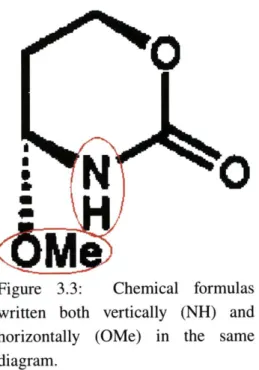
Unfortunately, such conditions do not exist in molecular structure diagrams. In the first place, the characters in molecular structure diagrams are sparse and scattered, so there are no reliable lines of text to latch onto, presenting problems for OCR engines. In addition, chemical formulas in molecular structure diagrams are sometimes they are drawn top to bottom (Figure 3.3). The sparsity of characters also means that there aren't enough characters to use clustering techniques successfully. Constraining the allowable combinations of alphanumeric characters to those found in a dictionary would cause mistakes in this case rather than prevent them, because there are very few restrictions on what values the subscripts in a chemical formula can take. Finally, molecular structure diagrams contain many superscripts and subscripts that are particularly susceptible to noise because they are so small.
M
Figure 3.3:
Chemical formulas
written both vertically (NH) and
horizontally (OMe) in the same
diagram.
To measure the extent to which these shortcomings affect performance, I tested the demo
versions of five OCR engines; FineReader, ReadIris, SimpleOCR [15], SoftiOCR (powered by
Tesseract) [16], and PdfCompressor [17]. These engines span the spectrum from high end,
expensive OCR engines to open source engines. I tested three aspects of performance: the
ability to pick characters out of an image, accuracy in identifying subscripts and superscripts, and
accuracy in the presence of noise. Figure 3.4 shows two of the test images that exemplify the
challenges presented the OCR engines.
None of the OCR engines were able to extract the characters from the first test image
reliably. As predicted, they were often able to identify the characters in the parts of the image
that are arranged in a line, like "fast".
+ HN02 37' - i Fast CH 3 HH
H
+ HNO2 25s t f as t CH(CH30
+ HNO2 25 0 CH<-'Ha f a s t3 (3)OCH
2CH
Et
2NH n-C
6H
13
(R
2)n
HA
HO Mgc
R
5R
40CO(CH2)
1CH
3Figure 3.4: Test images. The top image contains characters that are merged with bonds as well as some fairly clean characters. The object was to test how well the OCR engines could identify characters in the image without any external help. The purpose of the bottom image was to test performance on subscripts, an integral part of molecular structure diagrams. It also contains characters that have been merged by noise. The text is arranged in a line in order to present the OCR engines input of the type they are designed to handle.
Subscripts were particularly problematic. On the second image, only FineReader and ReadIris were able to detect any subscripts at all. The others either misidentified the subscript characters or identified them correctly, but treated them as normal characters. ReadIris performed the best, correctly recognizing 37 out of the 47 symbols in the image. FineReader and
(1)
(2)
H HH
35
PdfCompressor were second and third best, respectively. Clearly none of these engines can be used unaided to identify text in molecular structures.
There are other problems associated with using out of the box commercial OCR engines. One of them that turned out to be of practical importance for ChemWARD is cost. Licenses for the best commercial OCR engines are quite expensive and even then in some cases it is possible to process images only on the company's servers. Another was user interface. All of these OCR engines are distributed in the form of an application with a graphical user interface that is difficult to integrate into a larger system. In light of this, for ChemWARD, there were really only two options: either choose an existing OCR engine for which the source code is available and compensate for the poor performance, or write an OCR engine specific to the molecular structure domain. While it is my opinion that the second option would be by far preferable, due to time constraints I chose the first.
ChemWARD uses the OCR engine in SimpleOCR because it turned out to be the highest performance engine for which the source code is available within the price range I was constrained to. The OCR engine itself uses a finely tuned neural network to identify characters and a dictionary file to correct mistakes. In ChemWARD, the dictionary is disabled for the reasons noted above.
I now focus on ChemWARD's OCR subsystem, shown in Figure 3.5. It operates on connected regions of pixels, produces characters, and contains an OCR engine and a Character Sense that work together to identify characters. First I describe each of the two modules, and then their interaction using an example.
Characters
Pixels
Figure
3.5:
ChemWARD's OCR subsystem.
OCR engine: The test demonstrated that it is not possible to rely on an OCR engine to extract the
characters from the image by itself; some external mechanism must be responsible for providing
the regions of pixels that might be characters. The default strategy in ChemWARD is to break
the image into connected components of pixels and apply OCR to each one. That means that in
ChemWARD, each character is recognized independently; there is no concept of a "word", that is
a chemical formula all at once. I found this strategy to be appropriate because in order to
recognize an entire chemical formula, ChemWARD must be able to group unidentified regions of
pixels together, which his difficult given how scattered the characters are. Because there is no
concept of a word, a dictionary file is not useful to the OCR engine.
That means that
ChemWARD's OCR engine is essentially the character recognition neural network used in
SimpleOCR. Given a region of pixels, the OCR engine will produce a distribution over the set of
all possible characters that might be found in a molecular structure diagram. This set includes
the letters A-Z, a-z, the digits 0-9, and the common symbols
(, ), +, -.
The OCR engine also has
the option of producing an empty distribution, which means that the region of pixels looks
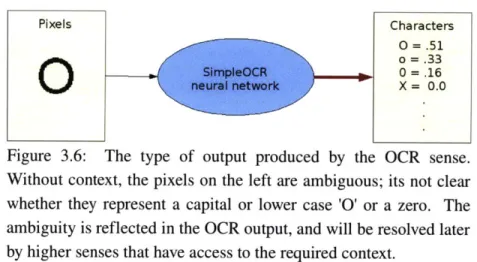
nothing like any character that the OCR engine is aware of. By producing a distribution instead
of a single hypothesis, ChemWARD avoids mistakes that result from committing to a particular
letter (Figure 3.6).
Figure 3.6:
The type of output produced by the OCR sense.
Without context, the pixels on the left are ambiguous; its not clear
whether they represent a capital or lower case '0' or a zero. The
ambiguity is reflected in the OCR output, and will be resolved later
by higher senses that have access to the required context.
Character Sense: The first pass of OCR on all the connected components of pixels will be
imperfect for the following reasons:
-
OCR was applied to all connected regions, including those that are actually bonds or
bond groups, and it will generate false positives.
-
Characters that are merged by noise will be a single connected component and the OCR
sense can not perform any segmentation.
-
Some characters are so noisy due to poor print or scan quality that the OCR sense will
simply misinterpret them.
-
Some characters look so similar that its impossible to make a decision with high
confidence.
The
job
of the Character Sense is to refine this poor quality output as much as possible by
learning as much as possible from it, correcting mistakes, and updating. In particular, the
Character Sense is responsible for three tasks: rejecting false positives, segmenting merged
characters, and introducing hypotheses for characters that look similar to the set of characters that
the OCR engine generated. It does not try to correct misidentified characters because it does not
use any contextual information; its only input is the character hypotheses themselves and the
width and height of the pixel regions that the hypotheses are generated from. I now explain each
of theses tasks in turn.
As mentioned, some characters are indistinguishable depending on the font. Because the OCR engine is unreliable, the Character Sense compensates by defining sets of similar characters and enforcing that if a set of hypotheses contains one of them, it must contain all of them. The Character Sense also defines special characters that correspond to bond types. In this way it is possible to specify that the pixel region might also be a bond, information that is useful to other senses. The sets of similar characters defined in ChemWARD include
{
'i', T, 'T', '1', the single bond character1, {
'-', the single bond character}, {'o', '0', '0'},
and{
'C', 'c', 'G'1.
To accomplish the other two tasks, the Character Sense uses the widths and heights of the pixel regions that the OCR engine has identified as characters to estimate the average character size. Using estimates of the character size is consistent with the guiding principle of ChemWARD that it is easier to reject possible interpretations than to commit. In the case of character hypotheses, the Character Sense expects that connected components that are too tall are false positives, and connected components that are too wide are either also false positives, or they are characters that have been merged by noise. First I will explain how the Character Sense makes an estimate of the expected character width and height, and then I will explain exactly how it is used.
In estimating the character size, ChemWARD makes the assumption that of all the connected components that the OCR engine proposed hypotheses for, most of them are in fact characters, although they may be misidentified. False positives will be significantly larger or smaller (either in width or height) than actual characters. Each dimension, height and width, are considered independently. A simple average in a particular dimension is not a very robust estimate because the false positives can skew the estimate up or down. Similarly, the variance is sensitive to outliers. A better estimate would be the average measurement excluding outliers that are either too small or too large, but without any other information about how big a character is,
its difficult to distinguish outliers from true characters.
The assumption that the number of false
positives is smaller than the number of properly flagged characters implies that if the
measurements for the characters are plotted on an axis, the true estimate of a character size will
be near the greatest density of points. Such a plot for character heights is shown in Figure 3.7. In
order to locate the greatest density of points, consider each character height to be a point on the
height axis. For each point, count how many points fall inside a box filter of the appropriate
width centered on the point. If the assumption that there are relatively few false positives holds,
and if the box filter is sized appropriately, then the points with the most neighbors in the box will
be the ones that are closest together, and can be used to construct an average. It remains to define
what is an "appropriate width" for a box filter. ChemWARD solves this problem by setting the
width to be a fixed percentage of the average over all the proposed character measurements in the
dimension (height or width).
0 20 40 60
Height in Pixels
Figure 3.7: For each proposed character, plot the height. The bars circled
in red represent outliers due to false positives. The true estimate for
character height is the average of the bars in the middle.
ChemWARD models character height and width falling in a uniform distribution centered
on the most up to date estimates. The decision to use a uniform distribution as opposed to a
Gaussian is justified by the assumption that the characters typed in the underlying image were all
originally typed in the same font size, so there simply are no long tails for characters to fall in.
The exact width of the uniform distribution ChemWARD assumes is percentage of each estimate,
a constant parameter to the system. Pixel regions whose heights fall outside this uniform
distribution are rejected as false positives. To combat merged characters, ChemWARD tries to
segment pixel regions whose widths are too large to fall within the distribution. Segmentation is
the most important task the Character Sense is responsible for, and is a typical example of how a
high level sense can correct low level mistakes; in this case how the Character Sense can correct
mistakes in the pixels that occurred during digitization of the original document.
Figure 3.8 shows a particularly insidious example of merged characters.
It is a
challenging image because there are multiple characters involved and one of them is a
parenthesis, a relatively narrow character. ChemWARD uses the character width estimate to
identify the region of pixels corresponding to the blob of merged characters as too wide to be a
single character, but having approximately the right height to be text. This combination of
indicators suggests the presence of merged characters, and that segmentation should be
attempted. In addition to the width estimate, ChemWARD makes the assumption that the noise
that merged the characters consists of only a few pixels, similar to a the font ligatures shown
above, or the noise in Figure 3.8.
N
O
3
Figure 3.8: This example shows a chemical formula where noise has
merged three characters together in the two places indicated by the red
circles.
estimate to guess approximately where the break should occur, splitting the connected component
of pixels by erasing vertical runs of pixels, and re-applying the OCR engine to the newly formed
connected components. Figure 3.9 shows an example. The pixels to the left are the merged
characters from Figure 3.8. The first step in segmentation is to use the width estimate, shown by
the red arrow, to guess approximately where the merge noise is. Then ChemWARD defines a
region around the estimate to search for potential ligatures, shown by the double headed arrow
above the pixels. The width of the search region is a constant parameter.
2.
3.
H
+)C
4.
+)
Figure 3.9: Steps to segment merged characters.
In the second step, ChemWARD sorts the vertical pixel runs by length, and hypothesizes
that the noise is actually the shortest vertical run. The pixels are split at the vertical run, and the
left connected component is passed to OCR in the third step. If OCR identifies the left region as
a character, the pixels are permanently split at that vertical run, shown in step 4. This is how the Character Sense corrects pixel level mistakes. The segmentation procedure is repeated on the right half of the remaining pixels to separate the '(' and the 'C'. If OCR does not identify a character, ChemWARD tries the rest of the vertical runs. If OCR still does not find a character, ChemWARD declares the segmentation operation a failure.
In the case of more than two characters as in Figure 3.8, ChemWARD searches for characters by repeatedly applying the segmentation process from left to right until every connected component of pixels is identified as an appropriately sized character. If the segmentation fails, then ChemWARD rejects the original wide connected component as a false positive. One final technique that ChemWARD uses to improve segmentation performance is to sort the vertical runs of pixels by length and erase the shortest ones first, following the assumption that the noise merging the characters is small like a ligature. If ChemWARD successfully separates the merged characters by identifying subregions of the connected components that the OCR engine believes are characters, the pixel region is permanently split at the vertical runs identified during the segmentation process. By doing this, the Character Sense has just corrected a very low level mistake in the pixels; i.e., the noise that caused the characters to be merged in the first place. This correcting behavior is used in many more instances in ChemWARD that will be pointed out in future chapters.
The segmentation example also demonstrates the problem of keeping intermediate representations consistent; when the Character Sense splits the pixels, how does that affect the vectorization? If the Character Sense splits the pixels through the middle of a rectangle, clearly that rectangle is no longer valid. In fact, the correct behavior is to compute separate vectorizations for each of the newly formed pixel regions. What actually happens in ChemWARD is that when the Character Sense splits the pixels, it assigns each pixel region to a new column. The column then keeps track of the new vectorization, the new character
hypotheses, and eventually all the rest of the information that becomes associated with each pixel
region. That is precisely the power of the column representation.
In this chapter, I have explained the OCR problem and how it is related to the molecule
recognition problem. I have highlighted some of the challenges specific to the molecular
structure domain, and described ChemWARD's response to them; namely the OCR engine and
the Character Sense. Figure 3.10 summarizes the interactions between the components of the
OCR subsystem. It is the OCR subsystem that creates the character level representation, which
we have seen consists of the distributions generated by the OCR engine and refined by the
Character Sense. How to resolve those distributions into final character interpretations is the
subject of the next chapter.
Segments R c B e
Characters Rejects By Height Generates Hypotheses
Pixels
3.10: The OCR subsystem with labels indicating the types
of interaction taking place. Unlabeled arrows mean that the
sense simply examines the data.
Chapter 4
Character Aggregation
After the characters have been identified by the OCR subsystem, they must be grouped together into chemical formulas. The process of constructing and verifying the chemical
formulas is carried out by the Character Aggregator.
The biggest difference between chemical formulas in a molecular structure diagram and lines of text written in a novel is that the letters (and super/subscripts) in chemical formulas are not always written left to right. Sometimes they are right to left, and sometimes top to bottom. The reason for this difference is clarity in depicting the molecular structure; sometimes it is easier to depict critical geometry by writing the characters in the chemical formula wherever there is space. Figure 4.1 illustrates this: if the NH were written left to right, it might make the hexagonal bond structure less apparent.
0
N
0
OMe
Figure 4.1: There is not enough space to write the NH left to right without obscuring the hexagonal bond structure.
the meaning of the formula remains unchanged; H20 and 0H2 are equally valid ways of writing the chemical formula for water. In general, it is permissible to write the atoms in a chemical formula in any order. While subscripts must always appear to the right of the atomic symbol or shorthand they refer to, superscripts may appear either on the left or on the right, though it is more common for them to appear on the right. This makes using a dictionary to aid character aggregation impractical because each formula has many legitimate ways of being written.
Aside from challenges inherent in the way molecular structure diagrams are drawn, there is one additional challenge that is a result of ChemWARD's guiding principle of committing to an interpretation only at the last possible moment. At the time when the Character Aggregator processes the image, the characters have not yet been resolved into their final interpretations. Each character consists of a set of hypotheses, each of which is assigned a probability, which all together form a distribution. These distributions contain both alphanumeric characters, and special characters that indicate that the region of pixels may be a single bond that is not part of a larger bond group. Thus it is in principle possible for the Character Aggregator to mistakenly collect a single bond together with a group of real characters and designate them as a chemical formula, as in Figure 4.2. This possibility necessitates a resolution step to check the validity of the formulas that the Character Aggregator produces and at the same time resolve characters into their final interpretations. I describe the resolution step after the aggregation step.