HAL Id: hal-01580065
https://hal.inria.fr/hal-01580065
Submitted on 1 Sep 2017
HAL is a multi-disciplinary open access
archive for the deposit and dissemination of
sci-entific research documents, whether they are
pub-lished or not. The documents may come from
teaching and research institutions in France or
abroad, or from public or private research centers.
L’archive ouverte pluridisciplinaire HAL, est
destinée au dépôt et à la diffusion de documents
scientifiques de niveau recherche, publiés ou non,
émanant des établissements d’enseignement et de
recherche français ou étrangers, des laboratoires
publics ou privés.
Deploy a 5G network in less than 5 minutes: Demo
Abstract
Mohamed Naoufal Mahfoudi, Thierry Parmentelat, Thierry Turletti, Walid
Dabbous, Raymond Knopp
To cite this version:
Mohamed Naoufal Mahfoudi, Thierry Parmentelat, Thierry Turletti, Walid Dabbous, Raymond
Knopp. Deploy a 5G network in less than 5 minutes: Demo Abstract. ACM SIGCOMM Posters
and Demos, Aug 2017, Los Angeles, United States. �hal-01580065�
Deploy a 5G network in less than 5 minutes
Demo Abstract
Mohamed Naoufal Mahfoudi
Thierry Parmentelat
Thierry Turletti
Walid Dabbous
Universit ´e C ˆote d’Azur, Inria, France
mohamed- [email protected] [email protected]
Raymond Knopp
Eurecom, France [email protected]ABSTRACT
We describe a demonstration run on R2lab, an anechoic chamber lo-cated at Inria Sophia Antipolis, France. The demonstration consists in deploying a standalone 5G network in less than 5 minutes. All the network components (base station, subscriber management, serving and packet gateways, network traffic analyzers) were run automat-ically using the nepi-ng experiment orchestration tool. Download and upload performance to the Internet from a commercial phone located in the anechoic chamber are shown.
1
INTRODUCTION
Open Air Interface (OAI) [2] is an open-source software-based LTE ecosystem for prototyping 5th Generation Mobile Networks and de-vices. OAI currently provides a standard-compliant implementation of a subset of Release 10 LTE for UE (User Equipment), eNB (LTE Base station), MME (Mobility Management Entity ), HSS (Home Subscriber Server), SGW (Serving Gateway) and PGW (Packet Data Network Gateway) on standard Linux-based computing equipment (Intel x86 PC architectures). It is therefore possible to run advanced experiment scenarios such as Cloud Radio Access Network (C-RAN) with different functional splits, Beamforming or Coordinated Mul-tipoint.
However, several challenges need to be tackled to ease the de-ployment of such scenarios:
• Cost and hardware availability: to build such an exper-imentation scenario, it is required to dedicate a handful of PCs with the right OS and proper low-latency flavored kernel. A typical deployment will require one box to host an eNB (e-NodeB, or base station), another box to host the HSS (Home Subscriber Service), and a last box to run the MME (Mobility Management Entity) and SGW and PGW (Serving and Packet gateways, respectively).
As far as the base station is concerned, the right kind of ET TUS Universal Software Radio Peripheral (USRP) device is required as well such as a B210 or a X210 board. Further-more, when using a USRP B210 board, a duplexer band 7 needs to be attached, as the distance between the RX and TX antenna SMA connectors on the USRP B210 board is such that the TX antenna generates too much interferences to the RX channel.
Finally, whether the UE (User Equipment) is imple-mented on a commercial phone, or as a software compo-nent, each option comes with its own set of challenges. The
former option requires a dummy SIM card while the latter requires proper configuration and another B210 board with a duplexer band 7 attached differently than for the one for the base station.
• Licensed frequency spectrum: the 2.6GHz band 7 is dedicated to LTE and LTE Advanced operators. So, running an LTE experimentation without authorization license is problematic. On the one hand, production LTE networks will add noise to the experimentation scenario and on the other hand, the experimentation may prevent legitimate LTE users from reaching their network.
• High complexity to set up the OAI demo: even if the hardware is available and a license is obtained, there is a long list of operations to perform in order to deploy OAI scenarios1.
2
DEPLOYMENT IN R2LAB
In this demonstration2, we use the FIT R2lab [1] wireless testbed to overcome the above mentioned challenges and provide an exper-imentation environment with a much lower barrier to entry.
The R2lab testbed is an anechoic chamber located at Inria Sophia Antipolis, offering 37 remotely accessible PCs and equipped with different wireless technologies, for instance Wi-Fi a/b/g/n cards, 5 USRP B210 with duplexer band 7 attached, plus a dozen of USRP2/-N210/USRP1 that could be used for spectrum analysis or noise generator. In addition, R2lab also exposes a commercial Nexus 5 Phone, with OAI SIMcard, and programmable with Android Debug Bridge. In addition, the testbed provides hardware and software support for OAI. Therefore R2lab would allow to control the entire chain in a complex 5G scenario from the C-RAN to the RF front-ends. This addresses the first challenge mentioned above.
R2lab provides a controlled environment, shielded from the out-side interferences, and thus allows to test wireless experimental setups that uses licensed bands without the need for any special authorization. This solves the second challenge mentioned above. In addition, easy reservation of the whole testbed is also supported through the R2lab website. This allows avoiding interference from other experiments possibly running in parallel.
We also developed efficient scripts that automate the whole OAI demo set-up in few minutes using nepi-ng3. Network Experiment
1
See the full list of these operations at https://gitlab.eurecom.fr/oai/openairinterface5g/ wikis/HowToConnectCOTSUEwithOAIeNBNew
2See https://www.youtube.com/watch?v=N1nl PqWlKw
3
Programming Interface - new generation is a tool for orchestrat-ing network experiments in an automated and efficient way. It is mainly used for alleviating problems related to provisioning the environment and running all the different steps of the wireless scenarios. This allows for a limited human intervention and thus less manipulation errors. We used nepi-ng to write and automate the whole experimentation scenario, including collection of all log files. 17/05/2017, 20)48 DOA Page 1 of 2 https://www.gliffy.com/go/html5/11160615 fit-16 USRP Spectrum analyzer - downlink fit-34 fit-35 UE SGW HSS MME PGW Internet Nexus 5 R2lab fit-11 USRP Spectrum analyzer - uplink fit-23 USRP eNB USB/ adb EPC
Figure 1: OAI-based 5G network deployed in R2lab
3
EXPERIMENT SCENARIO
The experiment scenario consists of creating a standalone 5G net-work, testing the upload and download speed of a UE, and visualiz-ing the correspondvisualiz-ing spectrum in real-time.
As mentioned earlier, the base station and the core network are implemented on Intel x86 machines using OAI; a commercially available unmodified Nexus 5 with an OAI SIMcard is used as a user equipment (UE), see Figure 1. We chose to use a B210 ET TUS USRP with a duplexer band 7 as a radio front-end for the eNB hosted on fit-23 node. We allocate node fit-35 for the (HSS), this node is dedicated to authenticating. On node fit-34, we run other pieces of the LTE infrastructure, namely the MME, as well as the SGW and PGW gateways, that primarily implement external connectivity to UE terminals.
Figure 2: R2lab scenario
All these elements are depicted in Figure 2. Additionally, during the experiment we also dedicate two other USRPs for analyzing the spectrum, called watchers; it is very easy to use such nodes to generate controlled interferences, using respectively gnuradio’s uhd fft and siggen.
As mentioned before, we reserve the whole testbed in our exper-iments to avoid interference from other users, and we only setup resources dedicated to the experiment to avoid problems of unin-tended RF activities from idle nodes. We also make sure to provision the infrastructure in the right order: first the HSS; then the MME, the SGW and the PGW; then only the eNodeB; and finally the phone connects to the network. This allows to avoid problems related to synchronization. During this phase, the UE remains in airplane mode until the provisioning is finished.
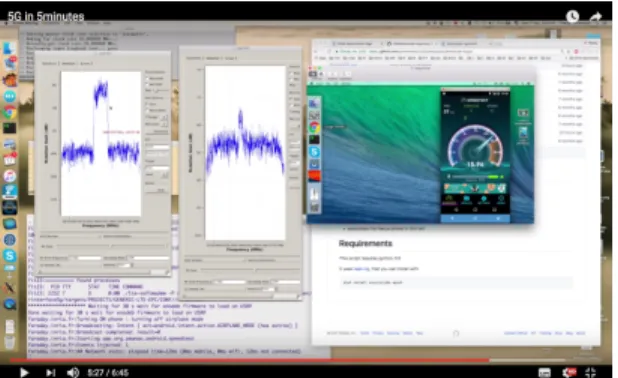
In order to measure the upload and download speed of the UE through the deployed 5G network, we use the speedtest.net ap-plication. Figure 3 provides a screen shot with the speedtest App interface on the right and the output of two traffic analyzers on the left side, showing the activity one for the downlink and the other for the uplink.
Figure 3: Download performance and traffic analyzer
4
CONCLUSIONS
This demonstration shows that advanced realistic 5G scenarios can be easily and rapidly deployed with OAI software support in the R2lab anechoic chamber. Several scenarios can be run in this environment, thus exploiting the full control of end-to-end scenarios.
Debugging OpenAirInterface can be tricky, even for experts. The anechoic R2lab testbed offers a controlled environment that is key in reproducing experiments and debugging. Indeed, using the R2lab utilities, it is straightforward to run the same experimentation scenario with two versions of OAI and compare the performance obtained or analyze logs, e.g., pcap traces to find out and solve possible issues.
ACKNOWLEDGMENTS
Research and development leading to these results have received funding from the French Government (National Research Agency, ANR) through the fiInvestments for the Futurefi Program reference ANR-11-LABX-0031-01.
REFERENCES
[1] Inria. FIT R2lab: Reproducible Research Lab. at Inria, Sophia Antipolis, France.
http://fit- r2lab.inria.fr/.
[2] Nikaein, N., Marina, M. K., Manickam, S., Dawson, A., Knopp, R., and Bonnet,
C. Openairinterface: A flexible platform for 5g research.ACM SIGCOMM Computer
Communication Review 44, 5 (2014), 33–38. 2
Technical requirements for the demo: • Equipment to be used for the demo: None • Space needed: regular
• Setup time required : 5 minutes
• Additional facilities needed: power and Internet access are needed.