Title: Linking radial growth patterns and moderate-severity disturbance dynamics in boreal old-growth forests driven by recurrent insect outbreaks: a tale of
opportunities, successes, and failures
Authors: Maxence Martin1,2,3*, Cornélia Krause1,3, and Hubert Morin1,3
1 Département des Sciences fondamentales, Université du Québec à Chicoutimi, 555 boul. de l’Université, Chicoutimi, Québec G7H 2B1, Canada; [email protected] (C.K.); [email protected] (H.M.)
2 Institut de recherche sur les forêts (IRF), Université du Québec en Abitibi- Témiscamingue, 445 boul. de l’Université, Rouyn-Noranda, QC J9X 5E4, Canada
3 Centre d’étude de la forêt, Université du Québec à Montréal, P.O. Box 8888, Centre- ville Station, Montréal, Québec H3C 3P8, Canada
* Corresponding author: [email protected]; Tel.: +1-581-882-8651 1
2 3 4 5 6 7 8 9 10 11 12 13 14 15
Abstract
In boreal landscapes, emphasis is currently placed on close-to-nature management strategies, which aim to maintain the biodiversity and ecosystem services related to old-growth forests. The success of these strategies, however, depends on an accurate understanding of the dynamics within these forests. While moderate-severity disturbances have recently been recognized as important drivers of boreal forests, little is known about their effects on stand structure and growth. This study therefore aims to reconstruct the disturbance and post- disturbance dynamics in boreal old-growth forests that are driven by recurrent moderate-severity disturbances. We studied eight primary old-growth forests in Québec, Canada, that have recorded recurrent and moderately severe spruce budworm (Choristoneura fumiferana [Clem.]) outbreaks over the 20th century. We applied an innovative dendrochronological approach based on the combined study of growth patterns and releases to reconstruct stand disturbance and post- disturbance dynamics. We identified nine growth patterns; they represented trees differing in age, size, and canopy layer. These patterns highlighted the ability of suppressed trees to rapidly fill gaps created by moderate-severity disturbances through a single and significant increase in radial growth and height. Trees that are unable to attain the canopy following the disturbance tend to remain in the 16
17 18 19 20 21 22 23 24 25 26 27 28 29 30 31 32 33 34 35 36 37
lower canopy layers. This combination of a low stand height typical of boreal forests, periodic disturbances, and rapid canopy closure often resulted in stands constituted mainly of dominant and codominant trees, similar to even-aged forests. Overall, this study underscored the resistance of boreal old-growth forests owing to their capacity to withstand repeated moderate-severity disturbances. Moreover, the combined study of growth patterns and growth release demonstrated the efficacy of such an approach for improving the understanding of the fine-scale dynamics of natural forests. The results of this research will thus help develop silvicultural practices that approximate the moderate-severity disturbance dynamics observed in primary and old- growth boreal forests.
Résumé
Dans les paysages boréaux, l'accent est désormais mis sur des stratégies de gestion proches de la nature afin de maintenir la biodiversité et les services écosystémiques liés aux vieilles forêts. Le succès de ces stratégies dépend toutefois d'une compréhension fine de la dynamique de ces forêts. Les perturbations de sévérité modérée ont ainsi été récemment reconnues comme étant d’importants moteurs de la dynamique des forêts boréales, mais l’on sait encore peu de choses de leur influence sur la structure et la croissance des peuplements. Par conséquent, l'objectif de cette étude est de reconstruire les 38
39 40 41 42 43 44 45 46 47 48 49
50
51 52 53 54 55 56 57 58 59
dynamiques de perturbation et post-perturbation dans les vieilles forêts boréales causées par des perturbations récurrentes de sévérité modérée. Nous avons étudié huit vieilles forêts primaires au Québec, Canada, ayant enregistré des épidémies de tordeuse des bourgeons de l'épinette (Choristoneura fumiferana [Clem.]) récurrentes et de sévérité modérée au cours du 20ème siècle. Nous avons utilisé une approche dendrochronologique innovante combinant l’étude des patrons et des reprises de croissance pour reconstruire la dynamique de perturbation et post-perturbation de ces forêts. Nous avons identifié neuf patrons de croissance, observés dans des arbres d'âge, de taille ou de strate de canopée différents, indiquant des dynamiques particulières. Ces patrons ont mis en évidence la capacité des arbres opprimés à rapidement combler les trouées dans la canopée en un unique et significatif accroissement de circonférence et de hauteur. En revanche, les arbres déjà situés dans la canopée ont eu peu d'influence sur la fermeture de ces trouées. En conséquence, les arbres dominants et codominants étaient les plus fréquents dans la canopée. Les résultats de cette étude soulignent la résistance des vieilles forêts boréales aux perturbations récurrentes et de sévérité modérée, car les arbres du sous-étage peuvent rapidement combler les trouées qui en résultent.
Cependant, les arbres incapables d’atteindre le sommet de la canopée à la suite d’une perturbation resteront ensuite souvent dans les strates inférieures de la canopée. La combinaison de la faible hauteur des 60
61 62 63 64 65 66 67 68 69 70 71 72 73 74 75 76 77 78 79 80 81 82
arbres typique des forêts boréales, des perturbations périodiques et de la rapide fermeture des trouées forme des peuplements avec une structure verticale ressemblant à celle des forêts équiennes.
Globalement, cette étude souligne la résistance des vieilles forêts boréales en raison de leur capacité à supporter des perturbations répétées de sévérité modérée. De plus, l’étude combinée des patrons et des reprises de croissance démontre l’efficacité de cette approche pour reconstruire la dynamique à échelle fine des forêts naturelles. Les résultats de cette recherche contribueront ainsi à développer des pratiques sylvicoles analogues à la dynamique de perturbation de sévérité modérée observée dans les vieilles forêts primaires des paysages boréaux.
Keywords: spruce budworm (Choristoneura fumiferana [Clem.]); old- growth forest; natural disturbance; ecosystem-based management;
radial growth pattern; moderate-severity disturbance; forest dynamics;
dendroecology
Introduction
Anthropogenic activities over the last centuries have increased pressure on forest ecosystems, causing a significant loss of natural forest areas (Aksenov et al. 1999; Achard et al. 2009; Watson et al.
2018). Forest artificialization, fragmentation, and deforestation 83
84 85 86 87 88 89 90 91 92 93 94
95 96 97 98 99 100
101 102 103 104
threaten numerous species and ecosystem services, including carbon sequestration and water supply (Karjalainen et al. 2010; Watson et al.
2018). Climate change is expected to increase the frequency and severity of natural disturbances and extreme weather conditions, thereby further stressing forest ecosystems (Gauthier et al. 2015; Seidl et al. 2017; Jandl et al. 2019). To address these issues, researchers have emphasized forest management strategies that aim to mimic natural forest structures and dynamics (Kuuluvainen and Gauthier 2018; Franklin et al. 2019; Eyvindson et al. 2021). Reducing the difference between managed and natural forests is expected to offset the loss of biodiversity and ecosystem services while increasing the resistance and the resilience of forest ecosystems to climate change (Puettmann et al. 2009; Park et al. 2014).
The desire to reduce differences between managed and natural forests has led to a heightened focus on old-growth forests—forests in the final stage of forest succession, driven by secondary disturbances (Oliver and Larson 1996; Wirth et al. 2009). These forests are often the most threatened by human activities, their area greatly reduced through deforestation and intensive forest management (Potapov et al. 2017; Grondin et al. 2018; Martin et al. 2020a). Many of the structural attributes that generally define these ecosystems, such as structural and compositional complexity, large trees, and high deadwood volume, are rare, if not absent, in younger or managed 105
106 107 108 109 110 111 112 113 114 115 116 117
118 119 120 121 122 123 124 125 126
structural features provide essential habitats for many species (Winter and Möller 2008; Boudreault et al. 2018; Tremblay et al. 2018).
Similarly, the temporal continuity of old-growth forests, where the last primary disturbance often occurred centuries ago, is vital for many low-dispersal (e.g., lichen and bryophyte species) or disturbance- sensitive species (e.g., woodland caribou (Rangifer tarandus caribou)) (Faille et al. 2010; Fenton and Bergeron 2011; Barbé et al. 2017). Old- growth forests also play a key role in the offering of ecosystem services, including carbon storage and water flux (Kenina et al. 2019;
Warren et al. 2019; Keeton 2019). Maintaining remnant old-growth forests or enhancing old-growth attributes in managed stands has become, therefore, a common priority for forest and environmental managers (Bauhus et al. 2009; Kuuluvainen 2009; Thom and Keeton 2019). The success in achieving conservation objectives related to old-growth forests depends heavily, however, on fine- and multiscale (i.e., at the tree, stand, and landscape scales) knowledge of the dynamics of these ecosystems. Inappropriate management practices, based on superficial knowledge and/or simplification of natural dynamics, may produce limited and even no ecological benefits (Puettmann et al. 2009;
Fenton et al. 2014; Venier et al. 2018).
Studies have increasingly highlighted the differences in diversity among stands of old-growth forests in terms of structure and
composition, even within a relatively restricted landscape; this view of old-growth forests contrasts with the idea of these stands as being 128
129 130 131 132 133 134 135 136 137 138 139 140 141 142 143 144 145 146
147 148 149 150
homogeneous (Fenton and Bergeron 2011; Meigs et al. 2017; Martin et al. 2018). Variations in the nature, severity, and recurrence of
secondary disturbances play a major role in forming these complex matrices (Svoboda et al. 2014; Portier et al. 2018; Martin et al. 2020b).
In particular, recent emphasis has been placed on the importance of moderate-severity disturbances—also known as intermediate-severity disturbances; a disturbance that exceeds the gap scale without being catastrophic (Hart and Kleinman 2018)—on the dynamics of these ecosystems (Kuuluvainen et al. 2014; Meigs et al. 2017; Martin et al.
2019). Although their existence and importance have been
established, knowledge remains nevertheless limited in regard to the consequences of recurrent moderate-severity disturbances on the structure and dynamics of old-growth forests. Most research on forest disturbance regimes has generally focused on low-severity
disturbances, i.e., gap-dynamics, or on catastrophic, stand-replacing disturbances (Hart and Kleinman 2018). Many silvicultural treatments considered as "close to nature" are more similar to moderate-severity disturbances than to gap-dynamics, particularly in boreal forests where continuous-cover forestry practices often harvest a marked proportion (i.e., >30%) of the basal area (Bose et al. 2014; Fenton et al. 2014). In this context, it is therefore important to determine how disturbances of moderate severity influence the structure, resilience, and resilience of old-growth forests to ensure their sustainable management.
151 152 153 154 155 156 157 158 159 160 161 162 163 164 165 166 167 168 169 170 171 172 173
Dendrochronological analysis is an effective tool for reconstructing disturbance dynamics and the associated response of the understorey.
This reconstruction is usually done by identifying growth releases, i.e., abrupt changes in tree-ring width (Nowacki and Abrams 1997; Fraver and White 2005; Trotsiuk et al. 2014). Growth releases nevertheless highlight only punctual changes in growth. They therefore do not make it possible to determine precisely the manner and rate at which a tree grew before and after a disturbance. The study of a tree’s growth patterns, i.e., the changes in tree-ring width from the pith to the last formed ring, help to overcome this problem by making it possible to identify growth releases and also determine how the tree reacted to this release (Martin et al. 2020b; Trotsiuk et al., 2016). However, the identification of growth patterns has tended to be, at least partially, based on a subjective process, thereby limiting its use (Lorimer and Frelich 1989; Frelich 2002; Niukkanen and Kuuluvainen 2011). Martin et al. (2020b) highlighted that the use of machine-learning algorithms provides an effective solution for identifying growth patterns both accurately and objectively. The combined analysis of growth releases and growth patterns therefore offers much promise for reconstructing the dynamics of old-growth forests driven by natural disturbances.
The boreal forests of eastern Canada offer an ideal territory for addressing questions related to moderate-severity disturbances because remnant primary forests remain abundant and are dominated 174
175 176 177 178 179 180 181 182 183 184 185 186 187 188 189 190 191 192 193
194 195 196
by stands at the old-growth stage (Cyr et al. 2009; Grondin et al. 2018;
Watson et al. 2018). As well, these stands continue to be driven by natural disturbances, in particular by spruce budworm (Choristoneura fumiferana [Clem.]) outbreaks, which occur over an approximate 30- year cycle (Jardon and Morin 2003; Morin et al. 2009; Martin et al.
2019). Although boreal old-growth forests are abundant in eastern Canada, they are nonetheless highly threatened by human activities.
Forest management based on short-rotation (70−100 years) clearcutting is the main cause of old-growth forest loss because these stands are harvested first and at rate greater than that of primary disturbances (Bergeron et al. 2017; Barrette et al. 2018; Martin et al.
2020a). In the boreal regions, climate change is also expected to increase the recurrence and severity of disturbances, in particular spruce budworm outbreaks (De Grandpré et al. 2018; Bouzidi et al.
2019; Pureswaran et al. 2019). Hence, a better understanding of the resistance and resilience of boreal old-growth forests in eastern Canada to recurrent moderate-severity disturbances is vital to better evaluate the projected consequences of climate change and propose alternatives to clearcut-based forest management. This knowledge would also add to existing research on old-growth forests and therefore contribute to finding relevant management solutions, including for forests situated outside of the boreal regions of eastern Canada.
197 198 199 200 201 202 203 204 205 206 207 208 209 210 211 212 213 214 215 216 217 218
This study focused on the boreal forests of eastern Canada, and more specifically, within a territory subjected to moderate-severity secondary disturbances caused by spruce budworm outbreaks over the 20th century (Morin, 1994; Morin & Laprise, 1990; Navarro, Morin, Bergeron, &
Montoro Girona, 2018). Innovative dendrochronological analyses, combining the study of growth releases and growth patterns, are used to reconstruct the disturbance regime of the studied stands and evaluate the success of understorey and overstorey trees in filling the gaps created by secondary disturbances. This study aims to reconstruct the disturbance and post-disturbance dynamics in boreal old-growth forests driven by moderate-severity disturbances. We hypothesize that (1) radial growth in the studied trees can be divided into several distinct growth patterns shaped by the secondary disturbance regime, and (2) each of these growth patterns corresponds to trees defined by specific characteristics (e.g., age, canopy layer), making it possible to reconstruct the post-disturbance dynamics of the forests that they constitute. In this study, we highlight the impacts of recurrent moderate-severity disturbances on the dynamics and structure of boreal old-growth forests. Our results will contribute to the development of sustainable development strategies that better correspond to the processes driving these ecosystems.
Materials and methods 219
220 221 222 223 224 225 226 227 228 229 230 231 232 233 234 235 236 237 238 239
240
Study territory
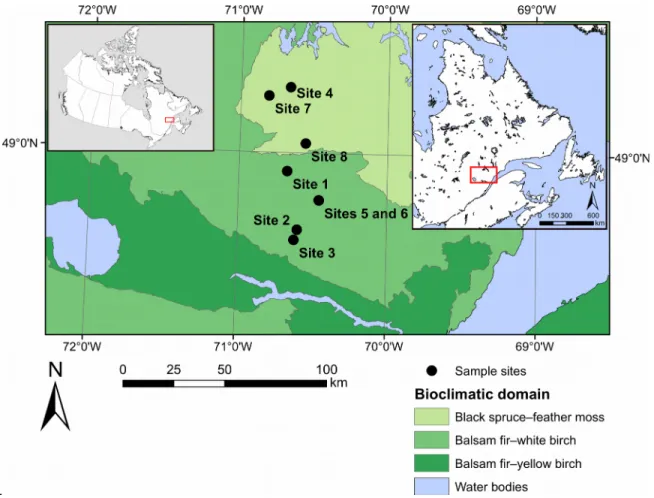
Our study took place in the natural boreal forest stands within the Monts-Valin region of Québec, Canada (Figure 1). The studied area ranges from 48°61′N to 49°30′N and from 70°34′W to 70°82′W in the balsam fir (Abies balsamea (L.) Mill.)–white birch (Betula papyrifera Marsh.) and the eastern black spruce (Picea mariana (Mill.) B.S.P.)–
feather moss bioclimatic zones (Saucier et al. 2009). Mean annual temperature, recorded at a weather station located in the study area (Bernatchez station), is between 0.4 and 1.8°C and mean temperature during the growing season (May−September) is between 12.6 and 13.5°C. Average annual rainfall varies between 886 and 1109 mm, with an average daily precipitation during the growing season of approximately 2.93 mm/day (Rossi et al. 2015; Buttò et al. 2020).
Regional topography is dominated by a hilly relief, and the elevation ranges between 400 and 1,000 m a.s.l. Forest is the main form of vegetation cover across this territory; black spruce, balsam fir, white birch, and aspen (Populus tremuloides Michx.) are the most common tree species.
European settlement officially started in the region in 1842, but logging activities were mainly concentrated around inhabited areas and rivers before the second half of the 20th century (Girard and Perron 1989). In black spruce forests, clearcutting was and still is favoured because of 241
242 243 244 245 246 247 248 249 250 251 252 253 254 255 256 257 258
259 260 261 262
the small size of the trees. The old-growth forests still present in the study area can therefore be considered as primary or virgin forests, as no logging activity has directly affected them.
Sampling
We randomly selected eight old-growth stands across the study territory using a stratified random sampling protocol. We based our sampling criteria on attributes derived from aerial forest survey maps, and these attributes were then verified in the field. We aimed to sample old-growth forests in this region that had been markedly disturbed by the last spruce budworm outbreak at the time of sampling. The last outbreak occurred between 1972 and 1984 (Morin and Laprise 1990; Krause 1997). We initially classified stands characterized as old (i.e., >100 years old), coniferous-dominated, and defined by a canopy containing at least 20% gaps; we considered this last factor as an indicator of a moderate-severity disturbance caused by spruce budworm outbreaks, as the stands still present marks of this disturbance several decades later. We also confirmed that all study stands were undisturbed by human activities, implying that all the selected sites were primary forests.
Sampling occurred in 2009. In each selected stand, we established a 400-m2 (20 × 20 m) plot within which we surveyed all merchantable trees (diameter at breast height [DBH] ≥ 9 cm), alive or dead. For each 263
264 265
266
267 268 269 270 271 272 273 274 275 276 277 278 279 280 281
282 283 284
tree, we identified the attributes of species, DBH, height, vitality (alive or dead), and crown status (the stem bearing the apical meristem as either intact or broken). We then felled all merchantable trees within the 400-m2 plots to obtain a more accurate measurement of height and to sample basal disks for subsequent dendrochronological analysis. We only selected basal disks from living coniferous trees, and we rejected any disks marked by substantial amounts of decay that prevented tree- ring analysis. We obtained 381 basal disks: 290 black spruce and 91 balsam fir. Finally, we also sampled saplings (living trees with a DBH
<9 cm and a height ≥1.3 m) in two square 5-m2 plots situated at opposite sides and outside of each 400-m2 plot. For each sapling, we recorded its species, DBH, and height.
For each living tree, we also defined its position in the canopy (hereafter, the “canopy layer,” i.e., dominant, codominant, intermediary, and suppressed) following the methodology of the Québec Ministry of Forests, Wildlife and Parks (MRNF, 2008). The canopy layers are based on the dominant height (DH), i.e., the mean height of the 100 tallest trees per hectare; therefore, in our case, we used the four tallest trees in each 400-m2 plot. We defined dominant trees as having a height greater or equal to DH, whereas codominant trees have a height less than DH but greater or equal to 2/3 DH. We defined intermediary trees as having a height less than 2/3 DH but 285
286 287 288 289 290 291 292 293 294 295 296
297 298 299 300 301 302 303 304 305 306
greater than 1/2 DH, and suppressed trees have a height less than 1/2 DH.
Data preparation
The 381 basal disks were air-dried and sanded mechanically in preparation for tree-ring measurements. We measured tree rings along two radii (radius series) to the nearest 0.01 mm using a manual Henson micrometer (Fred C.
Henson, Mission Viejo, CA, USA) or a LINTAB measurement table and TsapWin software (Rinntech, Heidelberg, Germany). We used a combination of visual cross-dating and the COFECHA computer program (Holmes 1983) to correct the tree-ring series. We then obtained a single tree-ring series for each tree (tree series) by taking the mean value of each tree ring measured in the radius series of the corresponding tree.
To identify a tree’s radial growth pattern, i.e., the main radial growth trends over time, we used the methods established by Martin et al.
(2020b). Each tree series was divided into 20 segments (20-segment series), each segment containing a similar number of tree rings—the difference in the number of rings per segment for the same tree never exceeded one ring. The first segment began at the first ring after the pith, and the last segment ended at the last ring produced by the tree.
This method allowed us to compare trees of different ages by smoothing interannual growth changes and keeping only the overall 307
308
309 310
311 312 313 314 315 316 317 318 319
320 321 322 323 324 325 326 327 328
trend in radial thickness. The age of sampled trees ranged from 55 to 271 years (mean: 143 ± 39.2 years), and the mean number of tree rings per section was 7.13 ± 2 rings.
For each tree, we also computed the following attributes, hereafter qualified as “growth attributes,” on the basis of the tree series: age, mean tree-ring width, ring-width standard deviation, 5th percentile ring width, and 95th percentile ring width. To reconstruct the disturbance history of the sample sites, we used the methods of Nowacki & Abrams (1997) to identify the annual percentage of growth change (%GC) of the 381 tree series, using the equation:
%GC=
{ (
M2−M1)
/M1×100}
,where M1 is the mean ring width for the first 10-year period, and M2 is the mean ring width for the subsequent 10-year period. We defined a major release when %GC ≥50%, a minor release when 50% > %GC ≥ 25%, a minor suppression when -25% ≥ %GC > -50%, and a major suppression when %GC was lower or equal to -50%. For each site, we then computed the percentage of trees experiencing a major release, minor release, minor suppression, and major suppression for each year covered by the chronologies. Changes in the annual percentage of growth release between sites were then observed using a locally weighted regression (Trexler and Travis 1993) and smoothed with a 329
330 331
332 333 334 335 336 337 338
339
340 341 342 343 344 345 346 347 348 349
50% span using the ggplot package (Wickham 2016) in R software, version 3.3.1 (R Core Team 2019).
To estimate the succession stage of each study stand, we calculated the cohort basal area proportion (CBAP) of each stand as defined by Kneeshaw and Gauthier (2003), using the methodology of Martin et al.
(2018) and Martin et al. (2020b). CBAP indicates the replacement of the first cohort after the last primary disturbance by successive new cohorts of shade-tolerant species, and its value ranges between 0 and 1. A CBAP ≈ 0 represents a stand where all trees belong to the first cohort, and a CBAP ≈ 1 represents a stand where the first cohort has almost been entirely replaced by new cohorts, i.e., a true old-growth forest sensu Oliver and Larson (1996).
Analysis
To address our hypothesis that radial growth in the studied stands can be divided into several distinct growth patterns, we first identified tree- ring growth patterns. We used a k-means clustering algorithm (Hartigan and Wong 1979) on the 381 20-segment series by applying the Martin et al. (2020b) methodology. We based the k-means clustering on the mean ring width for each of the 20 segments, preliminarily scaled and centred, with each segment considered as a different explanatory variable. To ensure the robustness of the obtained clusters, we performed 1,000 iterations of the k-means 350
351
352 353 354 355 356 357 358 359 360 361
362
363 364 365 366 367 368 369 370 371
algorithm. We determined the optimal number of clusters (radial growth patterns) using the simple structure index (SSI; Dolnicar, 1999) criterion, with the highest SSI value indicating the optimal k-means partition.
To address our second hypothesis that each of these growth patterns corresponds to specific layers of the canopy, we then compared the differences in growth attributes, DBH, and height between the growth patterns using mixed-effect analyses of variance (mixed ANOVA). The fixed effects were the growth attributes, DBH, and tree height; we used sample sites as the random effect. The use of sites as a random variable limited their potential influence (e.g., in terms of fertility) on the size and growth of the trees studied. When necessary, we log- transformed the data or removed outliers (i.e., values below the 1st percentile and above the 99th percentile) to respect the requirements of mixed ANOVA (i.e., homoscedasticity and the normality of the independent variable for each group). In the case of tree height, we considered broken tree canopies as a possible source of bias because the measured height was, in our case, not the actual tree height. We therefore only considered trees having an intact canopy when comparing tree height between the various growth patterns. When the mixed ANOVA produced significant results, we performed a Tukey post hoc test (Tukey 1977). The distributions of the species and the canopy 372
373 374 375
376 377 378 379 380 381 382 383 384 385 386 387 388 389 390 391 392 393
layers were also compared between the growth patterns using Fisher’s tests.
For all analyses, we used R software (R Core Team 2019), version 3.3.1, and the vegan (Oksanen et al. 2018), nlme (Pinheiro et al. 2016), emmeans (Russel 2018), sjPlot (Lüdecke 2020), and TRADER (Altman et al. 2014) packages, applying a p-threshold for significance of 0.05.
Results
Overall stand characteristics
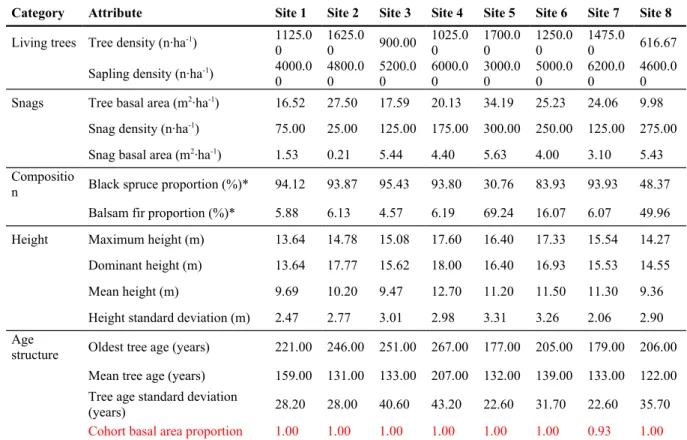
In general, black spruce dominated the sampled stands with a minor (<10%) contribution of balsam fir (Table 1). The exceptions were Site 5, where balsam fir dominated, and Site 8, where both species had a similar abundance. The mean tree age of the stands ranged between 122 and 207 years, and tree age varied considerably within stands, with several trees older than 200 years. CBAP values were mainly equal to 1, indicating stands where no first cohort trees remained. The exception was Site 7, for which the CBAP value was 0.93. Therefore, all studied stands were old-growth forests, defined by a complex age structure with multiple shade-tolerant cohorts, including several very old trees
(Appendix A). The diametric structure was generally complex, with sapling density 1.75× to 7.5× that of trees. Dominant height ranged between 13.6 and 17.1 m, and mean tree height ranged between 9.4 and 12.7 m.
394 395
396 397 398 399
400
401 402 403 404 405 406 407 408 409 410 411 412
Radial growth patterns
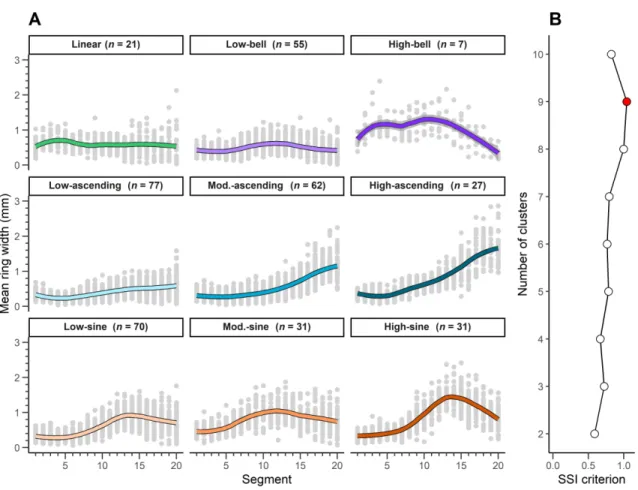
The SSI criterion reached a maximum at nine clusters (SSI criterion = 1.04; Figure 2B) for the 20-segment series. We therefore divided the 20-segment series into nine clusters (Figure 2A), which could be, in turn, grouped into four categories: 1) narrow and constant radial increments along all the sections (linear); 2) increasing or large radial increments along the first half of the chronology, followed by decreasing radial
increments for the remaining portion (bell); 3) narrow radial increments over the first half of the chronology, followed by increasing radial increments within the remaining portion (ascending); and 4) narrow radial increments over the first third of the chronology, then an increase in radial increments within the second third, and finally a decrease in radial increments over the last third (sine). Growth patterns belonging to the ascending and sine groups were divided into three growth patterns distributed along a mean ring-width gradient (narrow, moderate, and large). For the bell group, we identified two growth patterns, one marked by a low growth rate (low-bell) and the other by a high growth rate (high-bell). The number of trees per growth pattern generally exceeded 20; the sole exception was for the high-bell, a pattern that we only observed for seven trees. Due to the high specificity of this growth pattern relative to the others, however, we kept this pattern for the further analyses.
Growth patterns belonging to the sine and ascending patterns presented mainly growth releases, with a predominance of major releases (Figure 3). Suppressions were less frequent in these patterns, and there were almost no major suppressions. In general, we observed opposite trends for growth release and suppression. For the ascending patterns, suppressions were mainly observed in the first sections, whereas releases were observed 413
414 415 416 417 418 419 420 421 422 423 424 425 426 427 428 429 430 431 432 433 434 435
in the others. We observed the opposite trends for the sine patterns, although some suppression could also be seen in the first sections. These results were generally consistent with the growth trends observed for each of these growth patterns. Growth releases and suppressions presented a more complex distribution for the linear, low-bell, and high-bell patterns. Growth suppressions were particularly dominant in the high-bell pattern, even though some growth releases can be observed in the first sections. For the low-bell patterns, growth releases were generally the most frequent, but they were progressively replaced by growth suppression in the final sections. Finally, the linear pattern presented an alternance between growth release and suppression. These results highlight that low-bell and linear patterns are defined by complex dynamics. Yet, the slow growth rate of these trees made these variations less marked than those defined by a sine or ascending pattern.
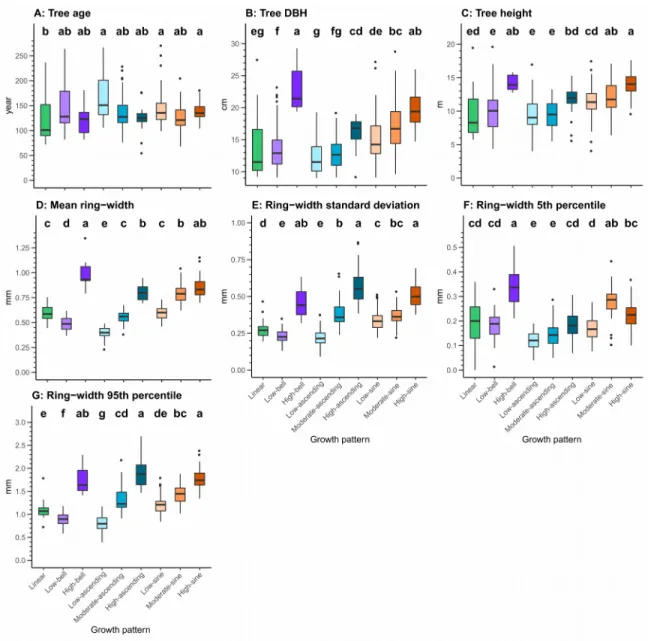
We observed significant differences between patterns for all growth and tree attributes (Figure 4). There was, however, little difference between the ranges of tree age per growth pattern, although trees defined by low-ascending, low-sine, and high-sine patterns were, on average, significantly older than trees defined by the linear pattern. Trees defined by the high-bell and high-sine patterns included the larger and taller trees. In contrast, the linear, low-bell, low-ascending, and moderate-ascending patterns contained the smallest trees, in terms of both DBH and height. High-bell, high-ascending, and high- sine patterns were defined by the largest mean ring width, ring-width standard deviation, 5th percentile ring width (high-ascending excepted), and 95th percentile ring width. In contrast, the low-ascending pattern was generally characterized by the smallest mean ring width, ring-width standard deviation, 5th percentile ring width, and 95th percentile ring 436
437 438 439 440 441 442 443 444 445 446 447 448 449 450 451 452 453 454 455 456 457 458
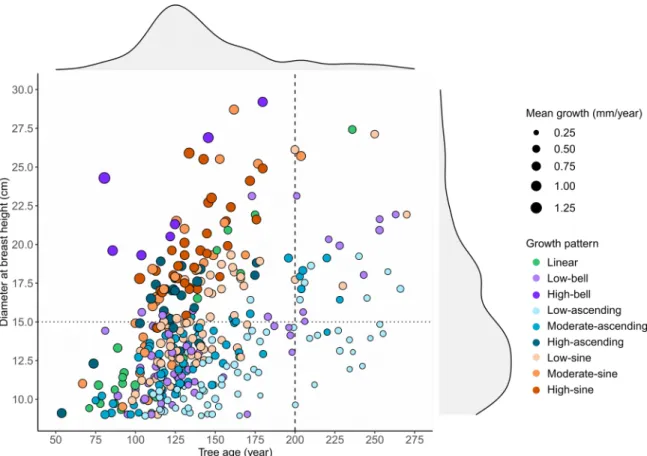
width. The other growth patterns presented intermediate results. The largest trees (DBH
>15 cm) were generally defined by a mean tree-ring width >1 mm/year but also by an age
<200 years (Figure 5). We observed almost all the high-sine, high-ascending, high-bell, and moderate-sine patterns in these trees. In contrast, trees older than 200 years were uncommon and variable in size and growth, with the low-ascending pattern being most frequent. Trees younger than 200 years and having a DBH <15 cm were characterized by diverse growth patterns and variable mean ring widths. Finally, we observed no
significant differences in growth pattern occurrence between black spruce and balsam fir (Fisher’s p = 0.132; Appendix B).
Distribution of the radial growth patterns in the canopy
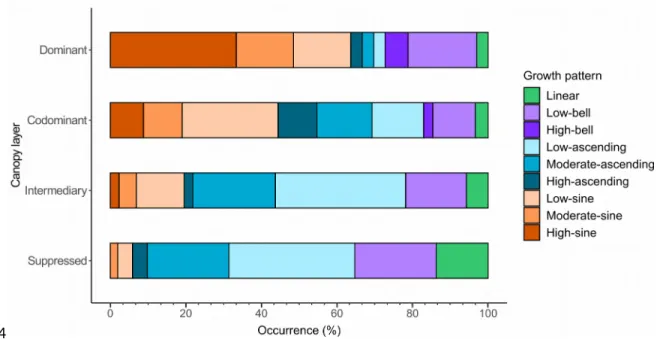
The occurrence of specific growth patterns differed significantly between the various canopy layers (Fisher’s p < 0.001; Figure 6). In the dominant layers, growth patterns from the sine group were the most common, with the high-sine pattern being observed the most often, followed by growth patterns from the bell group. In the codominant layer, sine patterns were again the most abundant (with the low-sine pattern most dominant), but ascending patterns were the second most common group. For the intermediary and suppressed layers, the ascending patterns dominated, particularly the low- and moderate- ascending patterns. In the suppressed layer, however, the low-bell and linear patterns were the second and third most common patterns, with sine patterns almost absent.
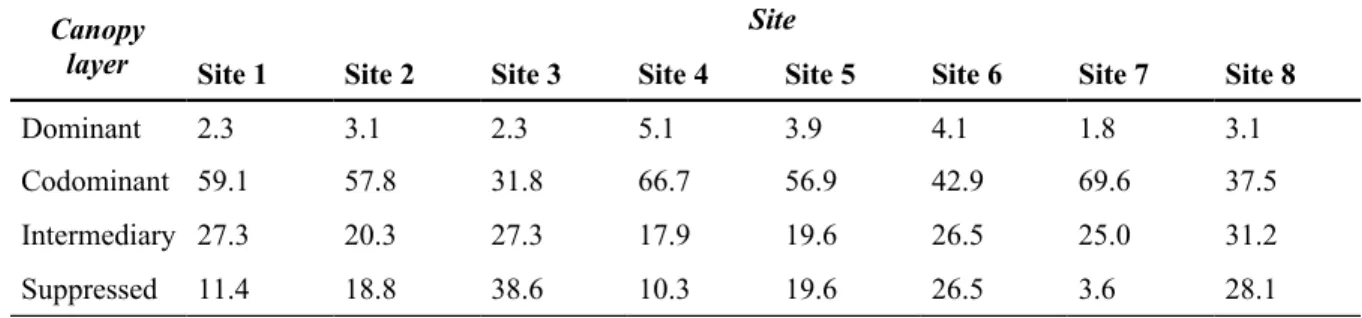
Overall, the codominant layer was the most common layer (53.2 ± 14% of the sampled trees; Table 2). For five of the sample sites (sites 1, 2, 4, 5, and 7), the majority of trees belonged to the codominant 459
460 461 462 463 464 465 466 467
468 469 470 471 472 473 474 475 476 477
478 479 480
layer. At the other sites, the intermediary and suppressed layers contained more than half of the sampled trees. Nonetheless, codominant and dominant trees still represented at least one third of living trees within the stands. Moreover, saplings were always more abundant than trees (Table 1), indicating a dense regeneration in the understorey.
Disturbance dynamics
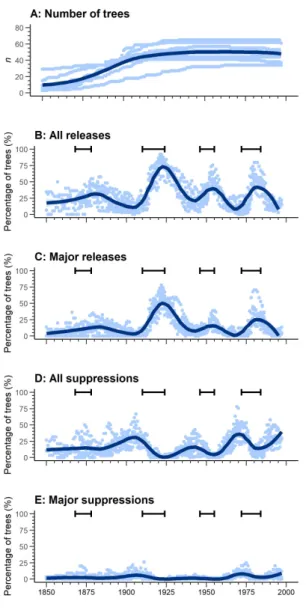
At all sites, we observed four distinct peaks of growth release (1870–
1890, 1910–1940, 1950–1960, 1975–1990) between 1850 and 1999 (Figure 7). All peaks occurred during or after a spruce budworm outbreak period and were preceded by a period of suppression. The 1870–1890 peak was the least distinct, characterized by many simultaneously suppressed trees and marked differences in the percentage of released trees between sites. In contrast, the highest and longest peak was that of 1910–1940, when approximately 75% of the trees presented a growth release, two thirds of these were considered as major growth releases. This period was, however, preceded by the second-highest peak of trees experiencing suppression; these suppressions were, however, generally minor. The 1950–1960 and 1975–1990 peaks shared similar percentages of trees undergoing release (approximately 40%); however, most releases for the 1975–1990 peak were major, whereas the majority in the 1950–
481 482 483 484 485 486
487
488 489 490 491 492 493 494 495 496 497 498 499 500 501 502
1960 peak were minor. The 1975–1990 peak was preceded by the highest suppression peak (approximately 35% of trees), whereas the percentage of suppressed trees before the 1950–1960 peak was relatively low (approximately 20% of trees). The study sites therefore appeared mainly driven by recurrent spruce budworm outbreaks, particularly related to a high mortality caused by the outbreak that occurred between 1910 and 1924 in this region.
Discussion
Tree radial growth was divided into nine distinct growth patterns. These patterns corresponded to four dominant groups that each contained one to three growth patterns, organized generally along a forest productivity gradient. This result supported our first hypothesis, highlighting that secondary disturbances have diverse impacts on overstorey tree growth. Canopy layers were each defined by specific radial growth patterns, thereby supporting our second hypothesis.
Overall, spruce budworm was the main driver of secondary disturbance within the study sites. Therefore, our study clarifies how secondary disturbance dynamics shape the vertical structure of boreal old-growth forests that are driven by recurrent and severe insect outbreaks.
503 504 505 506 507 508 509
510
511 512 513 514 515 516 517 518 519 520 521
Reaching the top of the canopy: a once-in-a-lifetime opportunity
Most of the studied trees were defined by a sine or ascending growth pattern, indicating that black spruce and balsam fir reacted vigorously to the canopy openings caused by spruce budworm outbreaks. Both patterns are generally defined by a major increase in radial growth, a phenomenon observed in coniferous-dominated old-growth forests in North America and Europe (Martin et al., 2020b; Morin, 1994; Trotsiuk et al., 2016). Trees defined by a linear pattern were generally the smaller and younger individuals, reflecting suppressed trees that did not benefit from a canopy opening (Rossi et al. 2009; Trotsiuk et al.
2016) or that were unable to sufficiently increase their growth following gap creation. Trees defined by a low-bell pattern were similar in size to those presenting a linear pattern albeit slightly older than the low-bell- pattern individuals. The minimal and short-duration increases in radial growth observed for this pattern also related to trees failing to significantly increase their growth following a disturbance. Finally, the high-bell pattern was highly specific, characterized by a marked growth and no identified juvenile suppression. This pattern was, however, very rare (7 occurrences within 381 studied trees), testifying to its limited influence on stand dynamics and structure.
The identified growth patterns separated among the various canopy layers. Sine patterns were observed most commonly in the dominant 522
523 524 525 526 527 528 529 530 531 532 533 534 535 536 537 538 539 540 541
542 543
and codominant layers, whereas ascending patterns were most frequent in the intermediary and suppressed layers. This distribution of patterns implies that trees defined by sine patterns had reached the top of the canopy already for several years, whereas trees sharing the ascending pattern continue to attempt to attain the highest layers.
Considering the size and the age of the trees, those defined by the high-ascending or moderate-ascending patterns were likely to eventually reach the dominant and codominant layers. However, trees in the lower canopy layers and defined by slow growth were unlikely to benefit from the death of taller trees to access the upper layers (Montoro Girona et al. 2016). Therefore, trees defined by a low- ascending or low-bell pattern had missed out on the opportunity of reaching the top of the canopy; these trees remain as part of the intermediary or suppressed layers.
Identifying the factors that determine a tree’s success or failure in reaching the upper canopy is challenging because these factors are dependent on conditions at the tree, stand, and disturbance levels. For example, local variations in microsite quality significantly influence regeneration growth and density (Leroy et al. 2016; Jayen et al. 2017).
Similarly, the spatial patterns of mortality caused by secondary disturbances are often complex, leaving survivor trees in the canopy (Hytteborn and Verwijst 2014; De Grandpré et al. 2018; Hart and 544
545 546 547 548 549 550 551 552 553 554 555 556 557
558 559 560 561 562 563 564 565
observed little difference in species composition between the growth patterns, testifying to the similar behaviours of black spruce and balsam fir regeneration under moderate secondary disturbances. Our results therefore highlight that black spruce and balsam fir regeneration can significantly increase their growth after a secondary disturbance and rapidly fill the created gaps. Nonetheless, the time window for attaining the upper layers of the canopy is short, and trees unable to grow sufficiently fast are generally confined to the lower layers. In general, the dynamics observed in this study differ slightly from those identified in broadleaved or mixed temperate forests, where growth patterns can be more complex; for example, trees may access the canopy over several steps (Lorimer and Frelich 1989; Nowacki and Abrams 1997; Frelich 2002). Our results illustrate how moderate- severity disturbances are a once-in-a-lifetime opportunity for suppressed coniferous trees to access the top of the canopy in boreal old-growth forests.
Recurrent moderate-severity disturbances are an intrinsic part of old-growth forest dynamics
The impact of spruce budworm outbreaks on boreal landscapes is highly heterogeneous, ranging from the punctual death of isolated trees to the death of large and continuous forest areas (Kneeshaw et al. 2009; Morin et al. 2009; Kulha et al. 2019). Hence, some regions are 567
568 569 570 571 572 573 574 575 576 577 578 579 580 581 582
583 584
585 586 587 588
marked by significantly higher mortality rates than other areas for a given outbreak (Pureswaran et al., 2015; Navarro et al., 2018). The three 20th-century spruce budworm outbreaks that occurred within the study territory are characterized by their severity (Morin, 1994; Morin
& Laprise, 1990; Navarro et al., 2018), which produced recurrent and significant mortality in the study stands. The peaks in the percentage of trees undergoing release following these outbreaks ranged between 50% and 75% across the study territory, with 20% to 55% of the trees presenting major releases. In contrast, for the same outbreaks, old- growth forests situated approximately 150 km to the north experienced a percentage of trees in release between 20% and 40%, with 15% to 25% of these trees presenting a major release (Martin et al. 2019).
Martin et al. (2019) determined, therefore, that true old-growth forests in this territory were driven almost equally by low-severity and moderate-severity secondary disturbances. In contrast, spruce budworm outbreaks in our study territory were twice as severe as the outbreaks documented by Martin et al. (2019), suggesting that all our study stands were driven primarily by secondary disturbances of moderate severity (Hart and Kleinman 2018; Martin et al. 2019). In some cases, recurrent and severe secondary disturbances may override stand resistance, thereby reinitiating forest succession (Donato et al. 2012; Meigs et al. 2017; De Grandpré et al. 2018). Yet, the structural attributes of the study stands matched those observed in other boreal old-growth forests in eastern Canada (Harper et al. 2005;
589 590 591 592 593 594 595 596 597 598 599 600 601 602 603 604 605 606 607 608 609 610 611
Martin et al. 2018; Moussaoui et al. 2019). This implies that the forests observed in this study maintained an old-growth structure despite the presence of a stressful disturbance regime. Approximately 30 years separated the outbreaks, a period that corresponds to the dynamics and periodicity of this insect in eastern Canada (Morin et al. 2009).
Therefore, it suggests that boreal forests in this region are sufficiently resistant to recurrent, moderate-severity disturbances if these events are sufficiently spaced apart in time.
Complex disturbance and growth processes produced simple vertical structures
Codominant and dominant trees were generally the most common layers in the canopy of the study stands, although the density of saplings was often high. A vertical structure characterized by a majority of dominant and codominant trees is expected in even-aged forests, whereas old-growth forests should normally be defined by a complex, multi-layered vertical structure (Oliver and Larson 1996;
Franklin et al. 2002). Our results showing a simpler vertical structure matched those of Martin et al. (2020c), which showed that the vertical structure of dense black spruce−dominated old-growth forests was often similar to that of even-aged stands.
A factor that may explain this counterintuitive result is the low height of boreal stands, which limits the development of complex, stratified vertical structures, such as those observed in temperate and tropical 612
613 614 615 616 617 618 619
620
621 622 623 624 625 626 627 628 629 630
631 632 633
forests (Bergeron and Harper 2009). In addition, the government of Québec established the height threshold between regeneration and canopy layers at 7 m for Québec (MRNF, 2008). The dominant height of the study stands varied, however, between 13 and 18 m, implying that suppressed trees had maximum heights ranging between 6.5 and 9 m.
It is therefore likely that trees below this height threshold were generally too small to be considered as merchantable trees (i.e., DBH
≥9 cm) and were therefore classified as regeneration (saplings).
Because of the low height and small diameter of boreal trees, the thresholds used to define the different layers may overrepresent codominant trees. In contrast, most suppressed trees are ignored because they do not attain a sufficient height and/or DBH.
Moreover, black spruce regenerates mainly through layering in old- growth forests (Harvey et al. 2002). Martin et al. (2020d) hypothesized that these layers are under the hormonal control of the mother tree; the process of apical dominance can inhibit layers vertical growth because they are still partially connected to the mother tree as branches. Therefore, the death of the mother tree is often required for layers to increase their vertical growth. Similarly to black spruce, balsam fir can regenerate by layers in old-growth forests (Bakuzis and Hansen 1965; Sirois 1997; Krause 2006), suggesting, a priori, similar dynamics. Knowledge related to the importance of layering in balsam fir regeneration remains fragmentary and requires further research. Balsam fir also regenerates by seed under its own 634
635 636 637 638 639 640 641 642 643 644 645
646 647 648 649 650 651 652 653 654 655
cover (Greene et al. 1999; Harvey et al. 2002; Rossi et al. 2012).
Balsam fir seedlings can remain suppressed for decades (Morin and Gagnon 1991; Parent et al. 2000; McCarthy and Weetman 2006), and their growth rapidly increases only once a gap is created in the canopy (Morin, 1994; Wilson & MacLean, 2015). Generally, the smallest black spruce and balsam fir seedlings present the greatest increases in growth (Parent and Ruel 2002; Martin et al. 2019). As indicated by our results, the accession to the canopy is therefore often made in one major step rather than over several moderate ones. As a result, old- growth forests in this region are often defined by dense regeneration layers that increase minimally in height as long as the canopy is not disturbed (Martin et al. 2020d).
Finally, spruce budworm outbreaks were periodic disturbances that caused phases of regular and significant mortality in the study stands.
This secondary disturbance regime is therefore different from that regularly observed in old-growth forests, generally defined by a background noise of small-scale mortality punctuated at random by more severe disturbances (Kuuluvainen et al. 2014; Trotsiuk et al.
2014; Hart and Kleinman 2018). For this reason, Shorohova et al.
(2011) hypothesized that many boreal old-growth forests of eastern Canada are defined by cohort dynamics, i.e., regeneration of new cohorts under the cover of old cohorts due to moderate-severity disturbances (Angelstam and Kuuluvainen, 2004), similar to Scots pine 657
658 659 660 661 662 663 664 665 666 667 668
669 670 671 672 673 674 675 676 677 678 679
(Pinus sylvestris L.) stands in Fennoscandia or Russia (Angelstam and Kuuluvainen 2004; Shorohova et al. 2009). Most studied trees presented evidence of juvenile suppression, implying that most seeds or layers appeared before the disturbances. Spruce budworm outbreaks are “top-to-down” disturbances, which kill trees in the canopy but preserve some regeneration (De Grandpré et al. 2018;
Lavoie et al. 2019). Therefore, in coniferous forests recently disturbed by spruce budworm outbreaks, most of the observed regeneration germinated decades before the disturbance and not immediately after (Parent et al. 2003; Rossi and Morin 2011; Martin et al. 2019). We therefore consider that the dynamics observed in the study stands likely do not correspond to cohort dynamics. We suggest rather that the dynamics of these forests result from the combination of several interdependent processes: (i) a slow vertical growth of the understorey as long as the canopy is not disturbed; (ii) a disturbance regime driven by periodic and moderate-severity disturbances that preserve the regeneration layer; (iii) after a disturbance, understorey trees reaching the canopy in one major increase in height and diameter; and (iv) once the canopy is attained, the trees changing minimally in height.
Conclusion
This study underscored the resistance of boreal old-growth forests to recurrent moderate-severity disturbances. Three notable insect 680
681 682 683 684 685 686 687 688 689 690 691 692 693 694 695 696 697 698
699
700 701
outbreaks have marked the history of the studied stands over the last century, with an interval of about 30 years between each outbreak.
The growth patterns of the trees indicated that a major portion of the suppressed trees to rapidly reach the upper layers of the canopy and fill the gaps created following the disturbances. The structure of the stands at the time of the sampling was similar to that commonly observed in primary boreal forests driven by a less severe secondary disturbance regime. Hence, the studied old-growth forests demonstrated their ability to withstand repeated moderate-severity disturbances. The combination of low stand height, periodic disturbances, and rapid canopy closure often resulted, however, in relatively simple vertical structures, with a high frequency of dominant and codominant trees. This particularity in the structure of boreal old- growth forests should therefore be better acknowledged to avoid their misclassification as even-aged forests in aerial forest surveys.
Several forestry practices have been proposed to maintain old-growth structures and attributes in boreal landscapes (e.g., partial and stem- selection cuts). Because of limited tree size and volume, however, foresters generally harvest at least a third of the stand basal area. The effect of such practices can be considered as equivalent moderate- severity disturbances, with uncertain long-term impacts on the forests.
Our results nevertheless highlight that such silvicultural practices may be close to the natural disturbance dynamics observed in some 702
703 704 705 706 707 708 709 710 711 712 713 714 715 716
717 718 719 720 721 722 723 724
primary boreal forests. Although complementary research is required, continuous-cover forest treatments appear as plausible and sustainable alternatives to clearcutting in boreal old-growth forests.
Authors contribution
MM and HM conceived the ideas and designed methodology; HM organized and supervised the data collection; MM prepared and analysed the data; CK and HM supervised the analysis and interpretation of the results; MM led the writing of the manuscript. All authors contributed critically to the drafts and gave final approval for publication.
Acknowledgements
We would like to thank Moussa Marou-Dodo, Émilie Lessard, Marie- Josée Girard, Isabelle Grenon, Sergio Rossi, Marie-Josée Tremblay, and Jean-Guy Girard for their contributions during data collection and preparation. We also thank Jean Bégin, scientific collaborator on the project, and Damien Côté and Serge Gosselin, collaborators from the Ministère de la Forêt, de la Faune et des Parcs du Québec, for their assistance with this project. This research was funded by the Fonds Québécois de la Recherche sur la Nature et les Technologies (FQRNT), project no. 2008-FS-124391.
725 726 727
728
729 730 731 732 733 734
735
736 737 738 739 740 741 742 743 744
In the case that the article is accepted for publication, the data used for this article will be archived in the institutional repository of the Université du Québec à Chicoutimi. If the institutional repository is not considered acceptable according to the Journal of Ecology policy, we could otherwise use a public repository (e.g., Figshare or Dryad).
References
Achard F, Eva H, Mollicone D, Popatov P, Stibig H-J, Turubanova S, Yaroshenko A.
2009. Detecting intact forests from space: hot spots of loss, deforestation and the UNFCCC. In: Wirth C, Gleixner G, Heimann M, editors. Old-growth forests: Function, fate and value. Ecological Studies 207. Berlin: Springer-Verlag. p. 411–428.
Aksenov D, Karpachevskiy M, Lloyd S, Yaroshenko A. 1999. The last of the last: the old-growth forests of boreal Europe. Taiga Rescue Network, 67p.
Altman J, Fibich P, Dolezal J, Aakala T. 2014. TRADER: A package for tree ring analysis of disturbance events in R. Dendrochronologia. 32(2):107–112.
doi:10.1016/j.dendro.2014.01.004. http://dx.doi.org/10.1016/j.dendro.2014.01.004.
Angelstam P, Kuuluvainen T. 2004. Boreal forest disturbance regimes, successional dynamics and landscape structures : A European perspective. Ecol Bull.(51):117–136.
Bakuzis E V., Hansen HL. 1965. Balsam Fir, Abies balsamea (Linnaeus) miller: A monographic review. Minneapolis, MN: University of Minnesota Press. 468p.
Barbé M, Fenton NJ, Bergeron Y. 2017. Boreal bryophyte response to natural fire edge creation. J Veg Sci. 28(5):915–927. doi:10.1111/jvs.12552.
Barrette M, Tremblay S, Auger I. 2018. Commercial thinning that maintained species diversity of a mixed black spruce–jack pine stand enhanced productivity. Scand J For Res. 33(8):756–763. doi:10.1080/02827581.2018.1495254.
Bauhus J, Puettmann K, Messier C. 2009. Silviculture for old-growth attributes. For Ecol Manage. 258(4):525–537. doi:10.1016/j.foreco.2009.01.053.
Bergeron Y, Harper KA. 2009. Old-growth forests in the Canadian boreal: the exception rather than the rule? In: Wirth C, Gleixner G, Heimann M, editors. Old-growth forests:
function, fate and value. Ecological Studies 207. New York: Springer. p. 285–300.
Bergeron Y, Vijayakumar DBIP, Ouzennou H, Raulier F, Leduc A, Gauthier S. 2017.
Projections of future forest age class structure under the influence of fire and harvesting:
Implications for forest management in the boreal forest of eastern Canada. Forestry.
90(4):485–495. doi:10.1093/forestry/cpx022.
Bose AK, Harvey BD, Brais S, Beaudet M, Leduc A. 2014. Constraints to partial cutting in the boreal forest of Canada in the context of natural disturbance-based management: A review. Forestry. 87(1):11–28. doi:10.1093/forestry/cpt047.
Boudreault C, Paquette M, Fenton NJ, Pothier D, Bergeron Y. 2018. Changes in 746
747 748 749 750 751 752 753 754 755 756 757 758 759 760 761 762 763 764 765 766 767 768 769 770 771 772 773 774 775 776 777 778 779 780 781