HAL Id: inria-00511118
https://hal.inria.fr/inria-00511118
Submitted on 23 Aug 2010
HAL is a multi-disciplinary open access
archive for the deposit and dissemination of
sci-entific research documents, whether they are
pub-lished or not. The documents may come from
teaching and research institutions in France or
abroad, or from public or private research centers.
L’archive ouverte pluridisciplinaire HAL, est
destinée au dépôt et à la diffusion de documents
scientifiques de niveau recherche, publiés ou non,
émanant des établissements d’enseignement et de
recherche français ou étrangers, des laboratoires
publics ou privés.
for Java
Arnaud Fontaine
To cite this version:
Arnaud Fontaine. Integration of XML streams in information flow analysis for Java. [Technical
Report] RT-0387, INRIA. 2010, pp.37. �inria-00511118�
a p p o r t
t e c h n i q u e
N 0 2 4 9 -0 8 0 3 IS R N IN R IA /R T--0 3 8 7 --F R + E N GPrograms, Verification and Proofs
Integration of XML streams in information flow
analysis for Java
Arnaud Fontaine
N° 0387
Centre de recherche INRIA Lille – Nord Europe Parc Scientifique de la Haute Borne 40, avenue Halley, 59650 Villeneuve d’Ascq
Arnaud Fontaine
Theme : Programs, Verification and Proofs Équipe-Projet POPS
Rapport technique n° 0387 — août 2010 — 37 pages
Abstract: In this report we present an extension of an existing flow-sensitive analysis for secure information flow for Java bytecode that deals with flows of data from and to XML streams governed by an access control mechanism. Our approach consists in computing, at different program points, an abstract XML content graph (AXCG) which tracks data read from and written to XML streams relying on data tracked in the existing information flow analysis. The extension we propose to manage XML content is generic enough to permit connection with any role-based access control mechanism for XML. On the contrary to many information flow techniques, our approach does not require security levels to be known during the analysis: security aspects of information flow and access control mechanisms
for XML are checked a posteriori with security levels either inferred from access control
policies for XML streams, or given by the information flow policy for the rest of the program. Key-words: information flow, Java, XML, security, confidentiality
Résumé : Nous présentons dans ce rapport une extension d’une analyse de flot d’information existante pour le bytecode Java qui permet d’intégrer les flots de données de et vers des flux XML soumis à un mécanisme de contrôle d’accès. Notre approche consiste à calculer, à différentes positions d’un programme, un graphe pour suivre les données lues et écrites dans les flux XML en se basant sur les flots de données suivis dans le modèle existant. L’extension que nous proposons est suffisamment générique pour permettre l’utilisation de n’importe quel mécanisme de contrôle d’accès pour XML de type RBAC. Contrairement à la plupart des techniques d’analyse flot d’information existantes, notre analyse ne nécessite
pas l’assignement de niveaux de sécuritéa priori : l’absence de fuite d’information est
véri-fiéea posteriori au regard des politiques de contrôle d’accès assignées aux flux XML et de
la politique de sécurité relative aux flots d’information du reste du programme. Mots-clés : flot d’information, Java, XML, sécurité, confidentialité
Contents
Introduction i
1 Preliminaries 1
1.1 Notations . . . 1
1.2 Related work . . . 2
1.2.1 Role-Based Access Control (RBAC) . . . 2
1.2.2 Enforcement of access control policies for XML . . . 3
1.2.3 Information flow and XML data . . . 3
2 Reading and writing XML in Java 5 2.1 XML as flat text . . . 5
2.2 XML API: DOM versus SAX . . . 5
2.3 The XMLPull API . . . 6
2.4 Contraints for static analysis purpose . . . 7
3 XML content and information flow 13 3.1 Abstract XML content graph . . . 13
3.2 Abstract states . . . 14
3.3 Transformation rules . . . 16
3.3.1 Transformation rules for XML writing . . . 16
3.3.2 Transformation rules for XML parsing . . . 19
4 Secure information flow and AXCG 25 4.1 Interface between information flow policy and access control for XML . . . 25
4.1.1 Security oracles . . . 26
4.1.2 Access control policy of an XML input/output stream . . . 27
4.1.3 Matching XPath descriptors . . . 27
4.2 Example of access control mechanisms for XML . . . 28
4.2.1 Lattice of security levels . . . 29
4.2.2 Security oracles build from access control policies . . . 29
Conclusion 33
Introduction
Information flow issues for streaming have not yet been addressed by the community. In this report, we focus on XML streaming, a widely used technology in modern pervasive applications. Hence, it is now quite common within applications using external data to replace heavy databases systems by XML, which offer a light system to store information. XML files are used to store data of small or medium size such as application configuration
files, user profiles,etc. A flow of information into a file or sent along a socket is considered
as insecure for common static analysis; conversely, information read from files or sockets is usually considered as public. We aim to consider specific cases where such streams could be considered as safe with respect to information flow.
The solution we propose in this report is build on previous works on abstract inter-pretation through static analysis for Java bytecode. We keep track of the security levels considered in the program, and use an external access control model for XML for describ-ing at which security level the information can be accessed. We combine the rich theory of information flow with the recent researches on access control for XML to obtain analy-sis where XML streams are properly taken into account. Read and write operations can be considered as dual with respect to information flow: when an information is recovered from a file, the security level attached to it must correspond to the level of all places in which it will be stored during the execution of the program; conversely, when a private/secure information is written in a file, it has to be done at a position that is considered/tagged by a high security level. One may expect from the program that it behaves safely according to this policy.
In Chapter 1 we first introduce some notations and the basis of access control mech-anisms for XML required to understand encountered issues. We investigate in Chapter 2 the most common APIs used to read/write XML content in Java in order to choose the most appropriate to conduct an abstract interpretation in a static way, but also suitable for small constrained devices, which are the main targets of pervasive applications. Then, we de-scribe in Chapter 3 how data read from and written to XML streams are tracked using Abstract XML Content Graph (AXCG). Finally, we introduce in Chapter 4 security oracles that ensure the connection between the security levels of the existing information flow layer and access control flow policies attached to XML input/output streams.
Chapter 1
Preliminaries
The work presented in the following chapters of this report builds on previous work bear-ing on flow-sensitive analysis for Java bytecode [16, 21]. In this chapter we introduce in Section 1.1 some notations specific to the work detailed in this report. Then we give in Section 1.2 an overview of some relevant works.
1.1 Notations
The numerous definitions and notations introduced in [16, 21] are not reminded in this report. We complement this set of definitions and notations with some new additional defi-nitions and notations used in the remaining parts of this report.
For a function
f
, we denote byf
·
x
7−−→ y
φ(x)¸
the function
f
′ such thatf
′(x) = y
ifφ(x)
holds and
f
′(x) = f (x)
otherwise.We denote by
Chars
the finite set of characters defined in UTF-8 charset1. We denote byN onEmptyStrings
the infinite set of string values of finite non-null length,i.e. the infinite set of characters tuples:N onEmptyStrings
= {(c
0, . . . , c
n) | n ∈ N, 0 ≤ i ≤ n, c
i∈ Chars}
We denote by
Strings
= N onEmptyStrings ∪ {ǫ}
the infinite set of strings values offinite length where
ǫ
denotes the empty string (of length null). For simplicity, a strings
= (c
0, . . . , c
n) ∈ Strings
can also be written “c
0. . . c
n”, andǫ
can be written “”. We denoteby
StringsPool
the finite subset ofStrings
extracted from the constant pools of all classesin the set
Classes
. Letstring
be a function to retrieve a string value fromStringsPool
corre-sponding to an abstract constant value in a given AMG
G
= (V , E)
:string
: {ω
i.cst
j| ω
i.cst
j∈ V } −→ StringsPool
We denote by
TagNames
the finite subset ofStrings
such thatTagNames
= StringsPool ∪ {concat(n, a) | n ∈ StringsPool , a ∈ StringsPool }
where
concat
is the function defined as follows:concat
: StringsPool × StringsPool −→ Strings
(ǫ, ǫ) 7−→ ǫ
(ǫ, (c
10, . . . , c
1n)) 7−→ (:, c
10, . . . , c
1n)
((c
10, . . . , c
1n), ǫ) 7−→ (c
10, . . . , c
1n,
:)
((c
10, . . . , c
1n), (c
20, . . . , c
2m)) 7−→ (c
10, . . . , c
1n,
:, c
20, . . . , c
2m)
1.2 Related work
Secure information flow enforcement is a well studied area. A considerable amount of work on information flow control, based on static analysis and on theoretical foundations, has been achieved in the last decades. We choose not to detail secure information flow enforcement as it is discussed in articles and reports [16, 21] presenting the information flow analysis we rely on in the following chapters.
Access control mechanisms for XML is also a well studied area. In this section, we give only a short overview of access control mechanisms for XML. For a detailed survey, we encourage the reader to refer to [26, 12].
Historically, access control for XML is a topic strongly related to the database commu-nity [28, 14]. Most access control mechanisms for XML consequently inherit some of its paradigms from the definition of access control policies to their enforcement. Most
ac-cess control mechanisms for XML follow theRole-Based Access Control (RBAC) model,
de-scribed in Section 1.2.1, to define access control policies usingad hoc languages or a more
standard language such as XACML [4] or XACL [23]. The enforcement of access control policies on XML documents can then be done in two ways described in Section 1.2.2:
com-puting adocument view or limiting access to the document via XPath (or another language)
queries only.
1.2.1 Role-Based Access Control (RBAC)
Access control mechanisms that follow the Role-Based Access Control (RBAC) model [15,
34] rely on three sets of entities to define access control policies: roles, objects and access
modes. A rule of an RBAC policy is simply a triplet
(role, object, access)
that defines thatrole
can
access
toobject
.The roles set contains values describing who are the subjects of a rule. Roles can for
instance map to a set of concrete users of a system, groups of users or (groups of) programs. The set of all available roles may be partially or totally ordered according to the semantics it is given. The mapping between roles and their corresponding concrete entities is a relevant
problem that is not addressed here since this is anauthentication problem.
Theobjects set is the critical part of RBAC, especially for XML documents and data.
In-deed, the originality of a RBAC policy enforcement tool mostly resides in the expressiveness of the language used to describe objects. XPath [2, 3] is widely employed to describe XML elements as it is highly expressive and is a W3C standard.
The access modes set contains at least the “read” operation, i.e. read access to an object’s content. More refined read accesses also include “navigation” operation to control access to the structure of a protected XML document. Techniques devoted to XML-based databases also include “write” accesses such as deletion, insertion and updates of XML content, attributes and tags.
Frequent problems arising when trying to enforce RBAC policies is how to propagate rules and resolve conflicts between rules. Because of the tree structure of XML documents, it is mandatory to precisely define how a rule applying to a tag influences its attributes and child tags, and how to treat conflicts and contradictions between several applicable rules for the same set of objects.
1.2.2 Enforcement of access control policies for XML
Enforcement of an access control policy on an XML document can be achieved by computing a view of the document according to the requesting user [19, 34, 9, 8, 31, 5, 7, 13, 17, 29]. This method consists in pruning the document tree so as to contain only parts that the
requesting user is allowed to access. The resulting document is referred to as document
view. The main problem of this approach is that the document view may not be valid with the
structure descriptor (DTD, XML schema, etc) of the original document, or an appropriate
structure descriptor may need to be rebuild [25, 22, 27].
Enforcement of access control policies on XML content can also be achieved by secure querying instead of view computation [10, 18, 14, 28, 24, 30]. In this case, either non-violating (valid) queries are answered and result of applying the user query to the entire database.
We do not investigate further on both approaches as they are not appropriate in our con-text where raw documents must be directly accessed without, possibly heavy, computations such view computing or embedded query engine. In addition, none of these approaches deals with the enforcement of security policies on generated XML documents.
1.2.3 Information flow and XML data
At that time, we identified no work from the literature that tries to include readings and/or writings of XML documents with attached access control policies in an information flow analysis. Nevertheless, we identified some works [11, 33] focusing on semi-automatic ob-ject serialization into XML documents that could lead to elegant solutions. Access control policies attached to these documents could be automatically inferred from or injected to the information flow model. This approach is however limited since it could be impossible
to deal with documents with an arbitrary structure, i.e. not mapped to/from objects
hier-archy . To solve this issue, we could use on the fly XML transformations using the work
of Castagna et al. [5] that deals with the enforcement of property equivalent to the
non-interference property of information flow over XML transformations defined in CDuce [6] according to security labels inserted in the original XML document.
Chapter 2
Reading and writing XML in Java
Many ways can be used to read or write XML [1] in Java. However, not all these means are appropriate to study relevant information flow issues for small constrained Java-enabled de-vices. In this chapter we detail advantages and disadvantages of commonly used solutions in such context.
2.1 XML as flat text
In constrained environments, it is likely to read/write XML documents as flat text with pro-cedures of standard input/output stream classes (namely InputStream and OutputStream). Since these classes are part of the Java runtime environment, no extra class (or library) needs to be deployed, which implies no additional memory consumption overhead. The main disadvantage of this mean is that it does not guarantee that XML content read or writ-ten is syntactically nor semantically correct. The programmer is in fact fully responsible to ensure these properties himself.
From the static information flow analysis point of view, dealing with characters se-quences is not easy for several reasons. Difficulties encountered are actually exactly the same than those encountered with arrays of primitive values having different security lev-els: each sequence needs to be partitioned into parts with different security levels. This
topic is still an open problem that is not adressed in this report 1. Besides these
difficul-ties, an XML content abstracted as a flat unidimensional structure is too rough to be able to later reason on tags scope and inclusion, and thus to permit any later connection with access control mechanisms for XML that mostly rely on the structure of XML documents.
2.2 XML API: DOM versus SAX
Besides simple text input/output streams, there exist many means to produce syntactically correct XML content, but also semantically valid with respect to a given grammar. Two different models are commonly used: DOM (Document Object Model ), where XML docu-ments are represented as trees, and SAX (Simple Api for Xml ), where XML docudocu-ments are
1Some refinements of static information flow analysis of arrays and hashed structures are investigated in the
considered as sequences of opening/closing tags, i.e. a depth first traversal of XML tree structures.
The tree abstraction of DOM is the web-standard abstraction of XML documents (HTML,
XHTML, etc) promoted by the W3C (World Wide Web Consortium). DOM is likely to be
best suited for applications where the document must be accessed repeatedly and/or out of sequence order as it supports navigation in any direction. In fact, DOM paradigm implies a complete abstract representation of XML documents in memory before (resp. after) writing (resp. reading) them. This property makes DOM implementations not really appropriate in memory-constrained devices.
Implementations that follow the SAX model are generally preferred in constrained Java environments because they consume less memory than the DOM ones. XML elements are simply read and written sequentially without traceback facilities, which avoids the need to keep whole XML documents in memory.
The concept of the SAX approach is to produce a sequence ofevents (tag opening, tag
closing, etc) corresponding to structural elements (enclosing tag, tag attributes,etc)
en-countered during the parsing of an XML document. Implementations of parsers that follow the SAX approach can be partitionned in two groups: event-driven implementations (“push-parsers”), where each event encountered fires a callback to a specific method, and lazy implementations (“pull-parsers”), where the programmer is in charge to enumerate the se-quence of events. Between these two sets of implementations, lazy implementations are clearly more likely to be used for a static analysis simply because the structure of a read-/written XML document is not obfuscated by non predictable runtime callbacks. The struc-ture of read/written XML documents clearly emerges in the code where lazy implementa-tions are used, which simplifies static analysis and allow the inference of whole documents structures.
2.3 The XMLPull API
JavaSE and JavaME include a lazy SAX implementation (Sun XML API 1.0), but unfortu-nately signatures of its classes have not be generalized to make a clean API that could lead to easily substitutable alternative implementations. Moreover, this library has the same disadvantage as the StAX one: special events for comments and whitespaces occuring in XML documents that unnecessarily complicate lazy parsing. The most practical remaining libraries are implementations of the XMLPull API (version 1). Several implementations of the XMLPull API exist, among which the kXML (version 2), specially designed for JavaME environments, perfectly fits our requirements.
Basically, the XMLPull API defines two interfaces: a pull-parser (XmlPullParser) and a push-writer (XmlSerializer). The most useful methods of the parser are given Figure 2.2, including the five predefined constants that denote considered events encountered during parsing of XML documents. Forward iterations over an event sequence are controlled by the next method, while the nextTag method iterates over the super-sequence of opening and closing tags only. The require method is the most important one for the static analysis of parsed documents as its invocation only succeeds if the current event matches the criteria
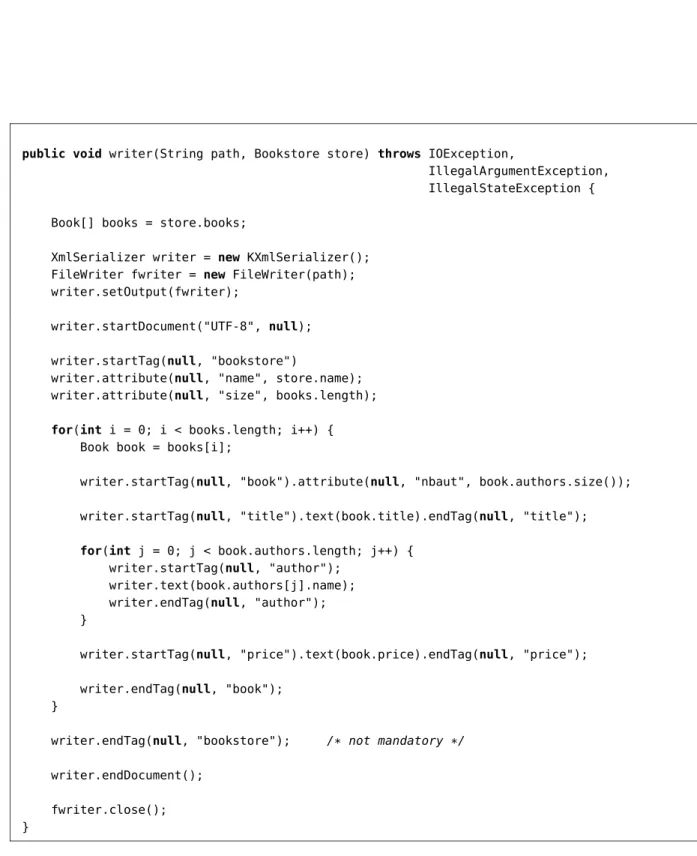
given in parameters, and throws an exception if these criteria are not satisfied2. The two remaining methods getText and getAttributeValue are used to retrieve respectively a text content and an attribute value of the currently opened tag. Figure 2.4 illustrates how to use a XmlPullParser instance to parse the sample XML document of Figure 2.1. The most useful methods of the writer are given Figure 2.3. Each of these methods produces an XML event in the underlying output stream. These events naturally correspond to the events mentionned previously for the parser. The example displayed on Figure 2.5 illustrates how to use the XmlSerializer to generate the document of Figure 2.1.
<?xml version="1.0" encoding="UTF-8"?> <bookstore name="iBook store" size="2">
<book nbauth="1"> <title>Titre 1</title> <author>Auteur 1</author> <price>10</price> </book> <book nbauth="2"> <title>Title 2</title> <author>Author 1</author> <author>Author 2</author> <price>20</price> </book> </bookstore>
Figure 2.1: Example of XML content generated by the code displayed on Figure 2.5 and that can be parsed by the code displayed on Figure 2.4.
2.4 Contraints for static analysis purpose
Relying on the SAX approach, even with lazy implementations, is not sufficient to track data flows from/to XML documents in a pure static way. In fact, even if XML documents are sequentially read/written, this does not guarantee that the structure of the read/written XML document can be inferred, even partially. Some additional constraints must be applied on the use of methods from the XMLPull API in order to be able to detect XML markups and their scopes.
Lazy parsing of XML content using the XMLPull API strongly relies on the require method. We constrain its invocation with two pratical requirements. The first parameter (the expected type of the current event) must be one of the five constants (symbols, not concrete values) defined in the XmlPullParser. These constants are final static fields de-clared in this interface. However, our abstract interpretation model supports only non-static fields. For this reason, we reconsider the XmlPullParser interface to alter the definition of these fields from static to non-static, instance fields. The two remaining parameters of
/* Event constants */
static final int START_DOCUMENT, /* first event */
START_TAG, /* opening tag */
TEXT, /* text content within opened tag (PCDATA) */
END_TAG, /* closing tag */
END_DOCUMENT; /* last event */ /* Sets the underlying input stream reader */
void setInput(Reader reader);
/* Enforces the event currently processed */
void require(int type, /* event type */
String namespace, /* namespace of the event */
String tag) /* local name of the tag */
throws XmlPullParserException,
IOException;
/* Advances to the next event */
int next() throws XmlPullParserException, IOException;
/* Advances to the next tag opening or closing, skipping other events */
int nextTag() throws XmlPullParserException, IOException;
/* Reads the value of an attibute of the currently opened tag */
String getAttributeValue(String namespace, /* namespace of the attribute */
String name); /* local name of the attribute */ /* Reads the text content of the currently opened tag */
String getText();
/* Sets the underlying output stream writer */
void setOuptut(Writer writer);
/* Opens a XML document for writing at URL location */
void startDocument(String enc, /* charset encoding used */
boolean standalone) /* is the document as an extrenal DTD ? */
throws IOException,
IllegalArgumentException, IllegalStateException;
/* Writes an opening tag within the currently opened tag */
XmlSerializer startTag(String namespace, /* namespace of the opening tag */
String name) /* local name of the opening tag */
throws IOException,
IllegalArgumentException, IllegalStateException;
/* Adds an attribute to the currently opened tag */
XmlSerializer attribute(String namespace, /* namespace of the attribute */
String name, /* local name of the attribute */
String value) /* value to associate to this attribute */
throws IOException,
IllegalArgumentException, IllegalStateException;
/* Writes some content to the currently opened tag */
XmlSerializer text(String text) throws IOException,
IllegalArgumentException, IllegalStateException;
/* Writes the closing tag that corresponds to the currently opened tag */
XmlSerializer endTag(String namespace, /* namespace of the closing tag */
String name) /* local name of the closing tag */
throws IOException,
IllegalArgumentException, IllegalStateException;
/* Closes a previously opened XMLOutputStream */
void endDocument() throws IOException,
IllegalArgumentException, IllegalStateException;
1 public void reader(String path) throws IOException,
2 XmlPullParserException {
3
4 XmlPullParser reader = new KXmlParser(); 5 FileReader freader = new FileReader(path); 6 reader.setInput(freader);
7
8 reader.require(reader.START_DOCUMENT, null, null); 9
10 reader.nextTag(); reader.require(reader.START_TAG, null, "bookstore"); 11 System.out.println("BOOKSTORE " + reader.getAttributeValue(null, "name")); 12 int nbbooks = Integer.parseInt(reader.getAttributeValue(null, "size"));
13
14 for(int i = 0; i < nbbooks; i++) {
15 reader.nextTag(); reader.require(reader.START_TAG, null, "book"); 16
17 int nbaut = Integer.parseInt(reader.getAttributeValue(null, "nbaut"));
18
19 reader.nextTag(); reader.require(reader.START_TAG, null, "title"); 20
21 reader.next(); reader.require(reader.TEXT, null, null); 22 System.out.println("BOOK + " + reader.getText()); 23
24 reader.nextTag();
25 reader.require(reader.END_TAG, null, null); /* title */ 26
27 for(int j = 0; j < nbauth; j++) {
28 reader.nextTag(); reader.require(reader.START_TAG, null, "author"); 29
30 reader.next(); reader.require(reader.TEXT, null, null); 31 System.out.println("AUTHOR + " + reader.getText()); 32
33 reader.nextTag();
34 reader.require(reader.END_TAG, null, null); /* author */
35 }
36
37 reader.nextTag(); reader.require(reader.START_TAG, null, "price"); 38
39 reader.next(); reader.require(reader.TEXT, null, null); 40 System.out.println("PRICE + " + reader.getText()); 41
42 reader.nextTag();
43 reader.require(reader.END_TAG, null, null); /* price */ 44
45 reader.nextTag();
46 reader.require(reader.END_TAG, null, null); /* book */ 47 }
48
49 reader.nextTag();
50 reader.require(reader.END_TAG, null, null); /* bookstore */ 51
52 reader.next(); reader.require(reader.END_DOCUMENT, null, null); 53
54 reader.close(); freader.close(); 55 }
1
2 public void writer(String path, Bookstore store) throws IOException,
3 IllegalArgumentException,
4 IllegalStateException {
5
6 Book[] books = store.books; 7
8 XmlSerializer writer = new KXmlSerializer(); 9 FileWriter fwriter = new FileWriter(path); 10 writer.setOutput(fwriter);
11
12 writer.startDocument("UTF-8", null); 13
14 writer.startTag(null, "bookstore")
15 writer.attribute(null, "name", store.name); 16 writer.attribute(null, "size", books.length); 17
18 for(int i = 0; i < books.length; i++) {
19 Book book = books[i]; 20
21 writer.startTag(null, "book").attribute(null, "nbaut", book.authors.size()); 22
23 writer.startTag(null, "title").text(book.title).endTag(null, "title"); 24 25 for(int j = 0; j < book.authors.length; j++) { 26 writer.startTag(null, "author"); 27 writer.text(book.authors[j].name); 28 writer.endTag(null, "author"); 29 } 30
31 writer.startTag(null, "price").text(book.price).endTag(null, "price"); 32
33 writer.endTag(null, "book"); 34 }
35
36 writer.endTag(null, "bookstore"); /* not mandatory */
37
38 writer.endDocument(); 39
40 fwriter.close(); 41 }
the require method (the namespace and the name) must be plain string values (or null), i.e. that can be resolved into constants of the constant pool. The example displayed on Figure 2.4 fulfill all these constraints.
For XML content generation, methods signatures of the XmlSerializer class are explicit enough to determine the kind of structural element written. However, the same constraint on namespace and name parameters have to be applied. The example displayed on Fig-ure 2.5 fulfill these constraints.
Chapter 3
XML content and information flow
In the previous chapter we have described some means to deal with XML content in Java. In this chapter we describe how to deal with XML data flows read/written with the XMLPull API in our static information flow model. We first describe in Section 3.1 a structure called Abstract Xml Content Graph (AXCG) to represent a set of XML documents in this context. Then, we detail in Sections 3.2 and 3.3 the modifications applied to our information flow model to include data flows from/to XML documents.
3.1 Abstract XML content graph
To catch the structure of parsed/written XML documents, we use a directed graph called Abstract Xml Content Graph (AXCG) build in parallel of the AMG during the analysis of a method’s bytecode. Informally, vertices of an AXCG represent structural elements of XML:
Root
denotes the virtual root of a document,Child
denotes an enclosing tag,Text
denotesa text content within an enclosing tag, and
Attr
denotes an attribute of an enclosing tag.Edges of an AXCG describe arrangement of these structual elements. For instance, an edge
from a
Child
vertexv
to anAttr
vertexa
means that the attributea
is defined in the openingmarkup of
v
and is so an attribute of the tagv
.Since XML content, anda fortiori structural elements, can be parsed/written in loops
whose bounds can be unknown during static analysis, the set of vertices of an AXCG is build by an approach equivalent to the allocation site model already used to build the set of vertices of an AMG. Each vertex is thus a pair of two values: the type of structural element (
Root
,Child
,etc), and the position of the bytecode instruction where it is parsed/written.The content of all documents read and written by the set of classes analysed is gathered in a single AXCG. To get the arrangement of XML elements within each XML document, each edge between two vertices is labelled with an abstract instance of parser/writer.
The link between the XML parts abstracted in an AXCG and abstract values from the
original information flow analysis is ensured by the vertex labelling function
η
. Followingthe way flows of data are tracked in the existing information flow model,
η
associates toeach vertex of the AXCG (given an abstract instance of parser/writer) two sets of vertices from the related AMG: the first one contains the abstract values of the tag name (only for
Child
andAttr
vertices), and the second one abstract values its “content” depends on,Definition 3.1.1 (Abstract XML Content Graph (AXCG)). An abstract XML content graph
(AXCG)is a finite directed graph
G
X= (ν, ξ, η)
build upon an AMGG
= (V , E)
of a methodC
0.m
0 for the call graphCG
= (V
CG, E
CG)
whereν
= ν
r∪ ν
w is the set of vertices andξ
= ξ
r∪ ξ
w is the set of edges withν
r∪ ν
w⊆ {Root, Child, Text, Attr} × V
CGξ
r⊆ {((v
1, mpc
1), (v
2, mpc
2), o) | (v
1, mpc
1) ∈ ν
r∧ (v
2, mpc
2) ∈ ν
r∧ o ∈ Readers(V )
∧ ((v
1= Root ∧ v
2= Child) ∨ (v
1= Child ∧ v
2∈ {Child, Text, Attr}))}
ξ
w⊆ {((v
1, mpc
1), (v
2, mpc
2), o) | (v
1, mpc
1) ∈ ν
w∧ (v
2, mpc
2) ∈ ν
w∧ o ∈ Writers(V )
∧ ((v
1= Root ∧ v
2= Child) ∨ (v
1= Child ∧ v
2∈ {Child, Text, Attr}))}
η
: (Readers(V ) × ν
r) ∪ (Writers(V ) × ν
w) −→ ℘((V(V ) ∪ {null}) × V(V )) × ℘(V × F)
where
Readers(V ) = {o | o ∈ O(V ), Type(o) ≤
XmlPullParser}
denotes the set ofver-tices of the AMG corresponding to instances implementing the XmlPullParser interface, and
Writers
(V ) = {o | o ∈ O(V ), Type(o) ≤
XmlSerializer}
denotes the set of vertices of the AMG corresponding to instances implementing the XmlSerializer interface.In the same way as the set of AMG vertices, the set of AXCG vertices is built before
abstract analysis of bytecode, i.e. application of transformation rules described in
Sec-tion 3.3.
Root
vertices are “initial” vertices: no edge points to them. Reciprocally,Attr
and
Text
vertices are “terminal” ones: there is no outgoing edge from these vertices.Child
vertices can have both incoming and outgoing edges. For an inter-procedural call graph
V
ICF G= {(ω
i, v) | ω
i∈ V
CG, v
∈ V
meth(ωi)}
, the set of AXCG vertices is defined as follows:ν
w= {(Root, (ω
i, j)) | (ω
i, j) ∈ V
ICF G, P
meth(ωi)[j] =
invokeinterface startDocument}
∪ {(Child, (ω
i, j)) | (ω
i, j) ∈ V
ICF G, P
meth(ωi)[j] =
invokeinterface startTag}
∪ {(Text, (ω
i, j)) | (ω
i, j) ∈ V
ICF G, P
meth(ωi)[j] =
invokeinterface text}
∪ {(Attr, (ω
i, j)) | (ω
i, j) ∈ V
ICF G, P
meth(ωi)[j] =
invokeinterface attribute}
ν
r= {(Root, (ω
i, j)) | (ω
i, j) ∈ V
ICF G, P
meth(ωi)[j] =
invokeinterface require(START_DOCUMENT,. . .
)}
∪ {(Child, (ω
i, j)) | (ω
i, j) ∈ V
ICF G, P
meth(ωi)[j] =
invokeinterface require(START_TAG,. . .
)}
∪ {(Text, (ω
i, j)) | (ω
i, j) ∈ V
ICF G, P
meth(ωi)[j] =
invokeinterface getText}
∪ {(Attr, (ω
i, j)) | (ω
i, j) ∈ V
ICF G, P
meth(ωi)[j] =
invokeinterface getAttributeValue}
3.2 Abstract states
Abstract interpretation consists in computing the abstract states of the virtual machine before and after the execution of instructions of the analysed bytecode. The abstract state from the original model is extended to include AXCG’s building.
Definition 3.2.1 (Abstract state). Let
(Q, R) = ((ρ, s, (V , E)), (δ
r, δ
w,
(ν
r∪ ν
w, ξ, η)))
be anabstract state where
Q
is the original abstract state part,(ν, ξ, η)
is an AXCG, andδ
r (resp.δ
w) is a mapping that gives for each XML parser (resp. writer) the current position withinthe AXCG structure (last opened tags not yet closed).
δ
r: Readers(V ) −→ ℘({(v, mpc) | (v, mpc) ∈ ν
r, v
∈ {Root, Child}}
δ
w: Writers(V ) −→ ℘({(v, mpc) | (v, mpc) ∈ ν
w, v
∈ {Root, Child}}
Two distinct mappings are used to mark the current position within a XML input/output stream to be able to deal with a single instance that implements both XmlSerializer and XmlPullParser interfaces.
To maintain the ascending chain property of the original model, the ordering relation and the join operation between abstract states have to be amended.
Definition 3.2.2 (Ordering relation
⊑
on property spaceS
). LetS
1= (Q
1, R
1,
Γ
1) ∈ S
andS
2= (Q
2, R
2,
Γ
2) ∈ S
be two abstract states withQ
1= (ρ
1, s
1,
(V
1, E
1))
,R
1= (δ
r1, δ
w1,
(ν
1, ξ
1, η
1))
,Q
2= (ρ
2, s
2,
(V
2, E
2))
andR
2= (δ
r2, δ
w2,
(ν
2, ξ
2, η
2))
.S
1 is smaller thanS
2, denotedS
1⊑ S
2,if and only if
Q
1⊑ Q
2,R
1⊑ R
2 andΓ
1⊆ Γ
2.R
1⊑ R
2 holds iffδ
r1⊑ δ
r2,δ
w1⊑ δ
w2,ν
1⊆ ν
2,ξ
1⊆ ξ
2andη
1⊑ η
2 whereδ
r1⊑ δ
r2⇔ ∀o ∈ dom(δ
r1) o ∈ dom(δ
r2) ∧ δ
r1(o) ⊆ δ
r2(o)
δ
w1⊑ δ
w2⇔ ∀o ∈ dom(δ
w1) o ∈ dom(δ
w2) ∧ δ
w1(o) ⊆ δ
w2(o)
η
1⊑ η
2⇔ ∀(o, (t, i)) ∈ dom(η
1) (o, (t, i)) ∈ dom(η
2) ∧ η
1(o, (t, i)) ⊑ η
2(o, (t, i))
and the relation
⊑
in the formulaη
1(o, (t, i)) ⊑ η
2(o, (t, i))
is the component-wise applicationof the relation
⊆
.Definition 3.2.3 (Join operation
⊔
on property spaceS
). LetS
1= (Q
1, R
1,
Γ
1) ∈ S
andS
2=
(Q
2, R
2,
Γ
2) ∈ S
be two abstract states withQ
1= (ρ
1, s
1,
(V
1, E
1))
,R
1= (δ
r1, δ
w1,
(ν
1, ξ
1, η
1))
,Q
2= (ρ
2, s
2,
(V
2, E
2))
andR
2= (δ
r2, δ
w2,
(ν
2, ξ
2, η
2))
. The join operation ofS
1 andS
2,de-noted
S
1⊔ S
2, is defined as follows:S
1⊔ S
2⇔ (Q
1⊔ Q
2, R
1⊔ R
2,
Γ
1∪ Γ
2)
⇔ (Q
1⊔ Q
2,
(δ
r1⊔ δ
r2, δ
w1⊔ δ
w2, ν
1∪ ν
2, ξ
1∪ ξ
2, η
1⊔ η
2), Γ
1∪ Γ
2)
where(δ
r1⊔ δ
r2)(o) =
δ
r1(o) ∪ δ
r2(o)
ifo
∈ dom(δ
r1) ∩ dom(δ
r2)
δ
r1(o)
ifo
∈ dom(δ
r1) r dom(δ
r2)
δ
r2(o)
ifo
∈ dom(δ
r2) r dom(δ
r1)
(δ
w1⊔ δ
w2)(o) =
δ
w1(o) ∪ δ
w2(o)
ifo
∈ dom(δ
w1) ∩ dom(δ
w2)
δ
w1(o)
ifo
∈ dom(δ
w1) r dom(δ
w2)
δ
w2(o)
ifo
∈ dom(δ
w2) r dom(δ
w1)
(η
1⊔ η
2)(o, (t, i)) =
η
1(o, (t, i)) ⊔ η
2(o, (t, i))
if(o, (t, i)) ∈ dom(η
1) ∩ dom(η
2)
η
1(o, (t, i))
if(o, (t, i)) ∈ dom(η
1) r dom(η
2)
and the operation
⊔
in the formulaη
1(o, (t, i))⊔η
2(o, (t, i))
is the component-wise applicationof the operation
∪
.3.3 Transformation rules
Evolutions from some constant initial state are dictated by the application of transformation
rules, one for each bytecode instruction, until a fixed point is reached, i.e. abstract states
at each bytecode position are unchanged by the application of transformation rules. The original set of rules is extended to build the AXCG, but rules that do not contribute or interfere with its build do not need to be modified: the new part added to an abstract state is simply copied as is. New transformation rules are added to specialize invocation of methods from the XMLPull API.
The two following sections introduce the transformations rules applying to XML writing (Section 3.3.1) and XML parsing (Section 3.3.2). In order to simply transformation rules definition we introduce the two following predicates and a function to deal with string values of tags and attributes names.
Definition 3.3.1 (Predicate
pre
).pre((ν, ξ, η), δ, x, T )
, ∀(o, d) ∈ x ∅ ⊂ δ(o) ⊆ {(t, p) | t ∈ T, (t, p) ∈ ν}
Definition 3.3.2 (Predicate
prematch
).prematch((ν, ξ, η), δ, x, T, na)
, pre((ν, ξ, η), δ, x, T )
∧ (∀(o, d) ∈ x ∃(c, δ(o), o) ∈ ξ)
∧ (na = {(null, null)} ∨
∀(o, d) ∈ x ∀c ∈ δ(o) (N , .) = η(o, c) ∧ qnames(na) ⊆ qnames(N ))
Definition 3.3.3 (Function
qnames
). Letqnames
be a function to build fully qualified namesof XML tags and attributes (e.g. namespace:localname) from string values contained in constant pools.
qnames
: ℘((V(V ) ∪ {null}) × V(V )) −→ ℘(TagNames)
N
7−→
[
(n,a)∈N
qnames(n, a)
qnames
: (V(V ) ∪ {null}) × V(V ) −→ TagNames
(n, a) 7−→
(
string(a)
ifn
= null
,concat(string(n), string(a))
otherwise.3.3.1 Transformation rules for XML writing
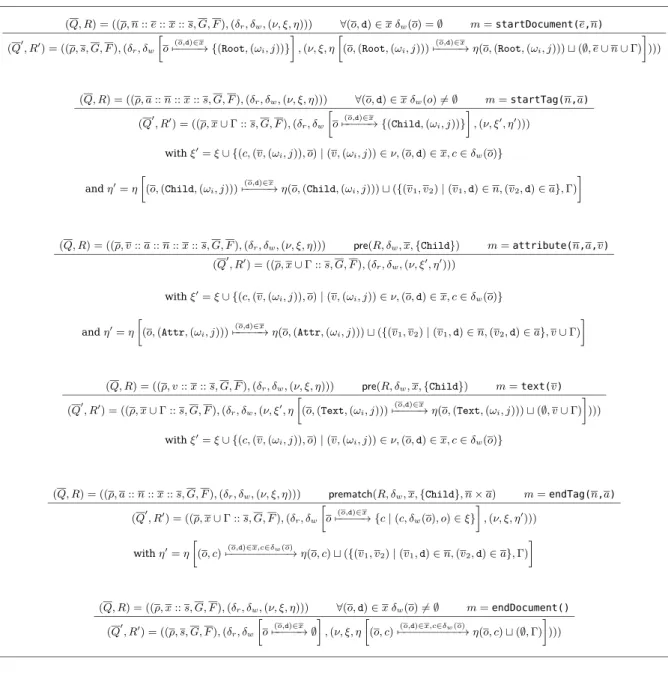
The Figure 3.1 contains the transformation rules corresponding to invocations of methods used to write XML content. The generic rules for method invocation is actually bypassed
is left as is since their bytecode is not analysed. These methods have to be invoked on a valid instance of the class XmlSerializer with an underlying output stream set (method setOutput). If the reference to the instance of XmlSerializer is null, the underlying output stream has not been set or if it is not writable, an exception is raised and the output stream is untouched since it is assumed that no exception occurs during execution.
(Q, R) = ((ρ, n :: e :: x :: s, G, F ), (δr, δw,(ν, ξ, η))) ∀(o, d) ∈ x δw(o) =∅ m=startDocument(e,n)
(Q′ , R′) = ((ρ, s, G, F ), (δ r, δw · o7−−−−−→ {(Root, (ω(o,d)∈x i, j))} ¸ ,(ν, ξ, η · (o, (Root, (ωi, j))) (o,d)∈x 7−−−−−→ η(o, (Root, (ωi, j)))⊔ (∅, e ∪ n ∪ Γ) ¸ )))
(Q, R) = ((ρ, a :: n :: x :: s, G, F ), (δr, δw,(ν, ξ, η))) ∀(o, d) ∈ x δw(o)6= ∅ m=startTag(n,a)
(Q′, R′ ) = ((ρ, x∪ Γ :: s, G, F ), (δr, δw · o7−−−−−→ {(Child, (ω(o,d)∈x i, j))} ¸ ,(ν, ξ′ , η′ ))) withξ′= ξ∪ {(c, (v, (ω i, j)), o)| (v, (ωi, j))∈ ν, (o, d) ∈ x, c ∈ δw(o)} andη′ = η · (o, (Child, (ωi, j))) (o,d)∈x
7−−−−−→ η(o, (Child, (ωi, j)))⊔ ({(v1, v2)| (v1, d)∈ n, (v2, d)∈ a}, Γ)
¸
(Q, R) = ((ρ, v :: a :: n :: x :: s, G, F ), (δr, δw,(ν, ξ, η))) pre(R, δw, x,{Child}) m=attribute(n,a,v)
(Q′, R′ ) = ((ρ, x∪ Γ :: s, G, F ), (δr, δw,(ν, ξ′, η′))) withξ′ = ξ∪ {(c, (v, (ωi, j)), o)| (v, (ωi, j))∈ ν, (o, d) ∈ x, c ∈ δw(o)} andη′= η · (o, (Attr, (ωi, j))) (o,d)∈x
7−−−−−→ η(o, (Attr, (ωi, j)))⊔ ({(v1, v2)| (v1, d)∈ n, (v2, d)∈ a}, v ∪ Γ)
¸
(Q, R) = ((ρ, v :: x :: s, G, F ), (δr, δw,(ν, ξ, η))) pre(R, δw, x,{Child}) m=text(v)
(Q′, R′ ) = ((ρ, x∪ Γ :: s, G, F ), (δr, δw,(ν, ξ′, η · (o, (Text, (ωi, j))) (o,d)∈x 7−−−−−→ η(o, (Text, (ωi, j)))⊔ (∅, v ∪ Γ) ¸ ))) withξ′= ξ∪ {(c, (v, (ω i, j)), o)| (v, (ωi, j))∈ ν, (o, d) ∈ x, c ∈ δw(o)}
(Q, R) = ((ρ, a :: n :: x :: s, G, F ), (δr, δw,(ν, ξ, η))) prematch(R, δw, x,{Child}, n × a) m=endTag(n,a)
(Q′, R′ ) = ((ρ, x∪ Γ :: s, G, F ), (δr, δw · o7−−−−−→ {c | (c, δ(o,d)∈x w(o), o)∈ ξ} ¸ ,(ν, ξ, η′ ))) withη′ = η ·
(o, c) (o,d)∈x,c∈δw(o)
7−−−−−−−−−−→ η(o, c) ⊔ ({(v1, v2)| (v1, d)∈ n, (v2, d)∈ a}, Γ)
¸
(Q, R) = ((ρ, x :: s, G, F ), (δr, δw,(ν, ξ, η))) ∀(o, d) ∈ x δw(o)6= ∅ m=endDocument()
(Q′, R′) = ((ρ, s, G, F ), (δ r, δw · o7−−−−−→ ∅(o,d)∈x ¸ ,(ν, ξ, η ·
(o, c) (o,d)∈x,c∈δw(o)
7−−−−−−−−−−→ η(o, c) ⊔ (∅, Γ) ¸
)))
Figure 3.1: Abstract semantic rules XML output related methods where
(Q
′, R
′) =
instr
(ωi,j)invokeinterface XmlSerializer.m
(Q, R, Γ)
.The method startDocument(
e
,n
) writes the header (<?xml version=...) of the XMLdocument, with encoding
e
and namespacen
applying to the whole content. This methodshould be called on instances that have not already been previously opened,i.e.
δ
w(o) = ∅
for each instance
o
on which it is potentially called. No edge needs to be created in thebytecode instruction, and the label of this vertex is updated to include AMG vertices from
e
and
n
, for each referenced output stream.The method startTag(
n
,a
) writes an opening tag nameda
in namespacen
(if not null).As a result, an edge from the currently pointed vertex(vertices) to the
Child
vertex attachedto the current bytecode instruction is added to the AXCG for each implied stream. The label
of this
Child
vertex is also updated for each stream to includen×a
, couples of AMG verticesthat denote its fully qualified name(s).
The method attribute(
n
,a
,v
) writes a new attribute to the last opened tag(s) withname in
a
, namespace inn
(possibly null), and string value inv
. An edge from the currentlypointed vertex(vertices) to the
Attr
vertex attached to the current bytecode instruction isadded to the AXCG for each implied stream. The label of this
Attr
vertex is also updated foreach stream to include
v
, abstract values of the written content, as well as its fully qualifiedname(s)
n
× a
.The method text(
v
) writes the string value(s) inv
to the last opened tag(s). An edgefrom the currently pointed vertex(vertices) to the
Text
vertex attached to the currentbyte-code instruction is added to the AXCG for each implied stream. The label of this
Text
vertexis also updated for each stream to include
v
, abstract values of the written content.The method endTag(
n
,a
) writes a closing tag nameda
in namespacen
(if not null).This method succeeds only if there is a last unclosed tag with the same name, that is why the name given to this closing tag is compared to all possible names of the last identified opened tag(s) for each related stream. In return, the position in each stream is updated to the corresponding parent tag(s).
The method endDocument() simply closes all unclosed start tags and flushes the under-lying output stream. In order to reuse the XmlSerializer instances on which this method has been called, it is mandatory to call the method setOutput to reset the underlying output stream.
At the end of the analysis, when a fixed point is reached and the abstract state of the last method’s instruction is correct, we can additionally check that all opened tags in XML output streams have been explicitly closed:
∀o ∈ Writers(V ) δ
w(o) = ∅
The Figures 3.2 shows the AXCG resulting of the analysis of the method writer whose source code is given in Figure 2.5. The graph (a) shows the edges added during its
anal-ysis: there is only one instance of XmlSerializer in this method created at line 71 of this
method abstracted by the AMG’s vertex
ω
0.o
7. On this graph clearly appears the treestruc-ture of the generated XML content because the control flow of the method is very simple:
opening tags and their corresponding closing tags are written in a non-ambiguous way,i.e.
they are written in sequence in the same enclosing conditional branch. The graph (b) is the same graph where vertices have been replaced by their labels for the single XmlSerializer
instance
ω
0.o
7. On this graph, we can notice the second component of the label of thevertex
(Text, (ω
0,
30))
. This set consists in three values that have to be interpreted asfol-lows:
(ω
0.p
2.
books.
price, d)
denotes that the written content directly depends on the field1For easier understanding, positions of bytecode instructions have been replaced by their related line
price of a Book instance stored in the array-field books of the second parameter of the
method,
(ω
0.p
2.
books.
length, i)
denotes that the written content implicitly depends on thefield length of a Book instance also stored in the array-field books of the second parameter
of the method, and
(ω
0.cst
18, i)
denotes that the written content also implicitly depends onthe constant appearing at line 18
3.3.2 Transformation rules for XML parsing
The Figure 3.3 contains the transformation rules corresponding to invocations of methods used to read XML content. As previously, the generic rule for method invocation is bypassed for these methods that have to be invoked on a valid instance of the class XmlPullParser with an underlying input stream set (method setInput).
To infer the structure of parsed XML we strongly rely on invocations of the method require (Section 2.4). Several transformation rules are defined according to the value of the first parameter that denotes the expected kind of event. As it is assumed from hypoth-esis that method calls succeed without throwing exceptions, each encountered invocation of the method require permits to infer the existence of the structural element described by the first parameter value. No ambiguity is consequently permitted for the value of this parameter since it would result in intricate XML structures.
The method getAttributeValue(
n
,a
) permits to retrieve the string value of anat-tribute named
a
in namespacen
(or null if outside a namespace) defined in the lastcur-rently opened tag, and puts the corresponding abstract value
ω
0.o
j on the top of the stack,or
null
if there is no such attribute. An edge from the currently pointed vertex(vertices)to the
Attr
vertex attached to the current bytecode instruction is added to the AXCG foreach implied stream, and the label of this
Attr
vertex is also updated with the abstractstring value returned to permit its a posteriori identification. The behaviour of the method
getText() is exactly equivalent with
Text
vertices, except that no parameter is needed toidentify the value to be retrieved.
The methods next() and nextTag() have no impact on the AXCG. From the abstract in-terpretation point of view, they just return one of the constants defined in the XmlPullParser interface (Figure 2.2).
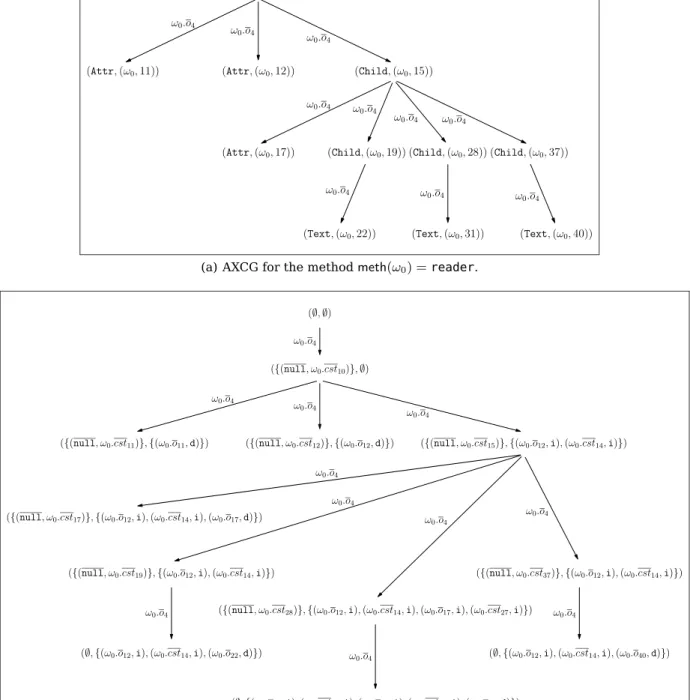
The Figures 3.4 shows the AXCG resulting of the analysis of the method writer whose source code is given in Figure 2.4. The graph (a) shows the edges added during its analysis:
there is only one instance of XmlPullParser in this method created at line 42of this method
and abstracted by the value
ω
0.o
4. On this graph clearly appears the tree structure of thegenerated XML content because the control flow of the method is very simple: opening tags
and their corresponding closing tags are read in a non-ambiguous way,i.e. they are read in
sequence in the same enclosing conditional branch. The graph (b) is the same graph where
vertices have been replaced by their labels for the single XmlPullParser instance
ω
0.o
4. Onthis graph, we can notice the second component of the label of the vertex
(Text, (ω
0,
40))
.This set consists in three values that have to be interpreted as follows:
(ω
0.o
40, d)
denotesthe string content read,
(ω
0.o
12, i)
denotes that the read content implicitly depends on an2For easier understanding, positions of bytecode instructions have been replaced by their related line
(Root, (ω0,11))
(Child, (ω0,13))
(Attr, (ω0,14)) (Attr, (ω0,15)) (Child, (ω0,20))
(Attr, (ω0,20)) (Child, (ω0,22)) (Child, (ω0,25)) (Child, (ω0,30))
(Text, (ω0,22)) (Text, (ω0,26)) (Text, (ω0,30))
ω0.o7 ω0.o7 ω0.o7 ω0.o7 ω0.o7 ω0.o7 ω0.o7 ω0.o7 ω0.o7 ω0.o7 ω0.o7
(a) AXCG for the methodmeth(ω0) =writer.
(∅, ∅)
({(null, ω0.cst13)}, ∅)
({(null, ω0.cst14)}, {(ω0.p2.name, d)}) ({(null, ω0.cst15)}, {(ω0.p2.books.length, d)}) ({(null, ω0.cst20)}, {(ω0.p2.books.length, i), (ω0.cst18, i)})
({(null, ω0.cst20)}, {(ω0.p2.books.length, i), (ω0.cst18, i)})
({(null, ω0.cst22)}, {(ω0.p2.books.length, i), (ω0.cst18, i)})
({(null, ω0.cst25)}, {(ω0.p2.books.length, i), (ω0.cst18, i), (ω0.p2.books.authors, i)})
({(null, ω0.cst30)}, {(ω0.p2.books.length, i), (ω0.cst18, i)})
(∅, {(ω0.p2.books.length, i), (ω0.p2.books.title, d)})
(∅, {(ω0.p2.books.length, i), (ω0.cst18, i), (ω0.p2.books.authors.length, i), (ω0.p2.books.authors.name, d)})
(∅, {(ω0.p2.books.length, i), (ω0.cst18, i), (ω0.p2.books.price, d)})
ω0.o7 ω0.o7 ω0.o7 ω0.o7 ω0.o7 ω0.o7 ω0.o7 ω0.o7 ω0.o7 ω0.o7 ω0.o7
(b) AXCG where vertices have been replaced by their label for the streamω0.o7 (∀x ∈ νwx7→ η(ω0.o7, x)).
Figure 3.2: Example of AXCG build for the code displayed on Figure 2.5. Bytecode instruc-tion posiinstruc-tions have been replaced by corresponding source code line numbers for easier understanding.
(Q, R) = ((ρ, a :: n :: t :: x :: s, G, F ), (δr, δw,(ν, ξ, η))) ∀(o, d) ∈ x δr(o) =∅ td={o.START_DOCUMENT| (o, d) ∈ x} (Q′, R′ ) = ((ρ, s, G, F ), (δr · o7−−−−−→ {(Root, (ω(o,d)∈x i, j))} ¸ , δw,(ν, ξ, η · (o, (Root, (ωi, j))) (o,d)∈x 7−−−−−→ η(o, (Root, (ωi, j)))⊔ (∅, Γ) ¸ )))
(Q, R) = ((ρ, a :: n :: t :: x :: s, G, F ), (δr, δw,(ν, ξ, η))) ∀(o, d) ∈ x δr(o)6= ∅ td={o.START_TAG| (o, d) ∈ x}
(Q′, R′ ) = ((ρ, s, G, F ), (δr · o7−−−−−→ {(Child, (ω(o,d)∈x i, j))} ¸ , δw,(ν, ξ′, η′))) withξ′
= ξ∪ {(c, (Child, (ωi, j)), o)| (Child, (ωi, j))∈ ν, (o, d) ∈ x, c ∈ δr(o)}
andη′
= η ·
(o, (Child, (ωi, j))) (o,d)∈x
7−−−−−→ η(o, (Child, (ωi, j)))⊔ ({(v1, v2)| (v1, d)∈ n, (v2, d)∈ a}, Γ)
¸
(Q, R) = ((ρ, a :: n :: t :: x :: s, G, F ), (δr, δw,(ν, ξ, η))) prematch(R, δr, x,{Child}, n × a) td={o.END_TAG| (o, d) ∈ x}
(Q′, R′ ) = ((ρ, s, G, F ), (δr · o7−−−−−→ {c | (c, v, o) ∈ ξ, v ∈ δ(o,d)∈x r(o)} ¸ , δw,(ν, ξ, η′))) withη′ = η ·
(o, c) (o,d)∈x,c∈δr(o)
7−−−−−−−−−−→ η(o, c) ⊔ ({(v1, v2)| (v1, d)∈ n, (v2, d)∈ a}, Γ)
¸
(Q, R) = ((ρ, a :: n :: t :: x :: s, G, F ), (δr, δw,(ν, ξ, η))) pre(R, δr, x,{Root}) td={o.END_DOCUMENT| (o, d) ∈ x}
(Q′, R′ ) = ((ρ, s, G, F ), (δr · o7−−−−−→ ∅(o,d)∈x ¸ , δw,(ν, ξ, η ·
(o, c) (o,d)∈x,c∈δr(o)
7−−−−−−−−−−→ η(o, c) ⊔ (∅, Γ) ¸
)))
(a) Transformation rules form=require(t,n,a) andtd={o | (o, d) ∈ t}
(Q, R) = ((ρ, a :: n :: s, G, F ), (δr, δw,(ν, ξ, η))) pre(R, δr, x,{Child}) m=getAttributeValue(n,a)
(Q′, R′
) = ((ρ,{(null, d), (ωi.oj, d)} ∪ Γ :: s, G, F ), (δr, δw,(ν, ξ′, η′))) withξ′
= ξ∪ {(c, (Attr, (ωi, j)), o)| (Attr, (ωi, j))∈ ν, (o, d) ∈ x, c ∈ δr(o)} andη′
= η ·
(o, (Attr, (ωi, j))) (o,d)∈x
7−−−−−→ η(o, (Attr, (ωi, j)))⊔ ({(v1, v2)| (v1, d)∈ n, (v2, d)∈ a}, {(ωi.oj, d)} ∪ Γ)
¸
(Q, R) = ((ρ, x :: s, G, F ), (δr, δw,(ν, ξ, η))) pre(R, δr, x,{Child}) m=getText()
(Q′, R′
) = ((ρ,{(null, d), (ωi.oj, d)} ∪ Γ :: s, G, F ), (δr, δw,(ν, ξ′, η′))) withξ′
= ξ∪ {(c, (Text, (ωi, j)), o)| (Text, (ωi, j))∈ ν, (o, d) ∈ x, c ∈ δr(o)} andη′ = η · (o, (Text, (ωi, j))) (o,d)∈x 7−−−−−→ η(o, (Text, (ωi, j)))⊔ (∅, {(ωi.oj, d)} ∪ Γ) ¸
(b) Attribute and text content rules
(Q, R) = ((ρ, x :: s, G, F ), (δr, δw,(ν, ξ, η))) ∀(o, d) ∈ x δr(o)6= ∅ m=next()
(Q′, R′
) = ((ρ, Vdoc∪ Vtag∪ Vtext∪ Γ :: s, G, F ), (δr, δw,(ν, ξ, η)))
(Q, R) = ((ρ, x :: s, G, F ), (δr, δw,(ν, ξ, η))) ∀(o, d) ∈ x δr(o)6= ∅ m=nextTag()
(Q′, R′
) = ((ρ, Vtag∪ Γ :: s, G, F ), (δr, δw,(ν, ξ, η)))
with Vdoc={o.START_DOCUMENT, o.END_DOCUMENT| (o, d) ∈ x} Vtext={o.TEXT| (o, d) ∈ x}
Vtag={o.START_TAG, o.END_TAG| (o, d) ∈ x}
(c) Event forwarding functions
Figure 3.3: Transformation rules for invocation of methods from the XmlPullParser inter-face where
(Q
′, R
′) = instr
(ωi,j)instance created at line 12 of this method, and
(ω
0.cst
14, i)
denotes that the read content(Root, (ω0,8))
(Child, (ω0,10))
(Attr, (ω0,11)) (Attr, (ω0,12)) (Child, (ω0,15))
(Attr, (ω0,17)) (Child, (ω0,19)) (Child, (ω0,28)) (Child, (ω0,37))
(Text, (ω0,22)) (Text, (ω0,31)) (Text, (ω0,40))
ω0.o4 ω0.o4 ω 0.o4 ω 0.o4 ω0.o4 ω0.o4 ω0.o4 ω0.o4 ω0.o4 ω0.o4 ω0.o4
(a) AXCG for the methodmeth(ω0) =reader.
(∅, ∅)
({(null, ω0.cst10)}, ∅)
({(null, ω0.cst11)}, {(ω0.o11, d)}) ({(null, ω0.cst12)}, {(ω0.o12, d)}) ({(null, ω0.cst15)}, {(ω0.o12, i), (ω0.cst14, i)})
({(null, ω0.cst17)}, {(ω0.o12, i), (ω0.cst14, i), (ω0.o17, d)})
({(null, ω0.cst19)}, {(ω0.o12, i), (ω0.cst14, i)})
({(null, ω0.cst28)}, {(ω0.o12, i), (ω0.cst14, i), (ω0.o17, i), (ω0.cst27, i)})
({(null, ω0.cst37)}, {(ω0.o12, i), (ω0.cst14, i)})
(∅, {(ω0.o12, i), (ω0.cst14, i), (ω0.o22, d)})
(∅, {(ω0.o12, i), (ω0.cst14, i), (ω0.o17, i), (ω0.cst27, i), (ω0.o31, d)})
(∅, {(ω0.o12, i), (ω0.cst14, i), (ω0.o40, d)}) ω0.o4 ω0.o4 ω0.o4 ω0.o4 ω0.o4 ω0.o4 ω0.o4 ω0.o4 ω0.o4 ω0.o4 ω0.o4
(b) AXCG where vertices have been replaced by their label for the streamω0.o4(∀x ∈ νw, x7→ η(ω0.o4, x)).
Figure 3.4: Example of AXCG build for the code displayed on Figure 2.4. Bytecode instruc-tion posiinstruc-tions have been replaced by corresponding source code line numbers for easier understanding.
Chapter 4
Secure information flow and AXCG
The AXCG resulting of the abstract analysis of a method contains all the links between XML content read/written through the XML API and values abstracted in the related AMG. In this chapter we extend the original application of the information flow analysis to secure information flow to connect it to access control mechanisms for XML. Actually, we focus on security policies that apply only to XML documents instances and not to their structures. We describe in Section 4.1 an abstract way to connect our extended information flow model to access control mechanisms for XML based on XPath descriptors, and illustrate how this can be instantiated for a concrete access control mechanism in Section 4.2
4.1 Interface between information flow policy and access
con-trol for XML
Many definitions of (secure) information flow exist in the literature from traditional non-interference from the earliest years to notions related to software engineering like [32]. The basic idea of all the approaches is to define a lattice of security levels and to control the flows of data between the different security levels. Previous works on non-interference require the lattice of security levels and the model for security policy to be known from the beginning. This requirement is avoided with AMG since it contains points-to and de-pendency between data, and can thus be labeled by security levels and non-interference
checkeda posteriori . The main advantage of this approach is to support changes of
secu-rity levels without reanalyzing programs.
Since AXCG reuses AMG’s vertices to keep track of data flows from/to XML streams, it is natural to extend to AXCG the scheme of labelling used for AMG with the same security
lattice
(L, ⊔, ⊑)
. For the purpose of connecting secure information flow and access controlmechanisms for XML, we introduce security oracles. We describe the type of security oracle functions and introduce several facilities to instantiate these oracles, such as a simple way to practically set the access control policy of an XML parser/serializer and an algorithm to identify AXCG vertices matching a XPath descriptor.
4.1.1 Security oracles
Security oracle for data written to XML streams
Attribute and content values written to XML streams identified in the AXCG have security levels coming directly from the information flow model and its security policy. The security
level of an AXCG vertex, given by the function
λ
νw, is inferred using the least upper boundof security levels of abstract values representing its content.
Definition 4.1.1 (Security function
λ
νw). Letλ
νw be a function that assigns a security levelto the vertices of the AXCG related to XML output streams using security levels assigned to
AMG’s vertices by the function
λ
v [16, 21].λ
νw: Writers(V ) × ν
w−→ L
(o, v) 7−→
G
(N ,C)∈η(o,v),x∈{n,a|(n,a)∈N }∪{c|(c,.)∈C}
λ
v(x)
We have to ensure that the security level inferred for each written data is coherent with the expected security level coming from its related access control policy. The expected security level of an AXCG vertex is given by the security oracle function
Ω
w: Writers(V ) × ν
w−→ L
Assuming that access control is enforced on all XML output streams produced, we can amend the original definition of secure information flow to check access control policies
specified by the security oracle
Ω
w.Definition 4.1.2 (Secure information flow). A method has secure information flow
ac-cording to the Definition 6.1 of [21] with the additional constraint related to XML output streams:
∀o ∈ Writers(V ) ∀v ∈ ν
wλ
w(o, v) ⊑ Ω
w(o, v)
Security oracle for data read from XML streams
XML documents parsed have access control policies that need to be integrated into the in-formation flow policy. Basically, data read from XML streams have security levels that need to be mapped to their corresponding abstract values generated during AMG’s computation and positioned in XML streams thanks to AXCG. The mapping of access control mechanisms for XML to information flow is concretely ensured by the oracle function
Ω
r: Readers(V ) × {ω
i.o
j| ∃(Attr, (ω
i, j)) ∈ ν
r∨ ∃(Text, (ω
i, j)) ∈ ν
r} −→ L
Properly speaking, the assignment of security levels to abstract values corresponding to XML data read (attribute and content values) requires to slightly modify the original
security function
λ
v. Because of approximations in the static analysis, especially becauseof the allocation site model, different data coming from an XML input stream can have been abstracted with the same abstract value. For instance this case occurs if the same code (same invocation instruction in the bytecode) is used to acquire the value of attributes with the same name but attached to different opening tags. In this case it is mandatory to compute the least upper bound of corresponding security levels given by access control policies.
Definition 4.1.3 (Security function
λ
v). The functionλ
v from Definition 6.1 of [21] ismod-ified to include security levels of data incoming from XML streams:
λ
v: V −→ L
v
7−→
(F
(.,.,ωi.oj)∈ξ
Ω
r(ω
i.o
j, v)
ifv
= ω
k.o
l and∃(t, (ω
k, l)) ∈ ν
r andt
∈ {Attr, Text}
F
(v′,v,hf,xi)∈E
λ
t(f, T ype(v
′))
otherwise.Since the security function now includes access control policies for XML data, the defi-nition of secure information flow is untouched.
4.1.2 Access control policy of an XML input/output stream
The first argument of the security oracle functions is an abstract instance of XmlPullParser
for
Ω
r, and an abstract instance of XmlSerializer for the functionΩ
w. Outside the staticanalysis context, it is not convenient to deal with such entities, especially because it de-pends on the positions of their allocation in bytecode instructions.
As mentioned in the previous section, all access control policies applied to the XML input/output streams existing in analysed methods must share the same security lattice. Upon this lattice, each policy defines its own set of rules. To simplify the assignment of an access control policy to an XML stream, we rely on the namespace feature of the XML language.
Each access control policy is assigned a unique namespace, and each XML input/output stream must refer to elements within a unique namespace. Since access control policies are strongly related to the structure of XML documents on which they are applied, such constraints can be easily achieved in practice. Once each access control policy refers to a unique namespace, we can merge all access control policies into a unique one. In addition, a default access control policy can be appended for elements without a namespace or not matching any available access control policy.
4.1.3 Matching XPath descriptors
Most access control mechanisms for XML rely on XPath descriptors to identify parts of XML documents. We provide an algorithm to identify the set of AXCG’s vertices matching a XPath descriptor.
XPath restrictions
All features of the XPath language cannot be supported because of approximations in the abstract analysis and unknown run-time control flow paths. First, we only consider
abso-lute path descriptors to avoid cross-documents requests,i.e. path descriptors only starting
with “/”. Then, because of the loss of elements ordering,i.e. order between tags with the
same parent tag, we are not able to use the following navigation and position-dependent operations and tests:
• preceding: selects the elements that are descendants of the root of the tree in which the context element is found, are not ancestors of the context element, and occur before the context element in document order;