HAL Id: hal-02394890
https://hal.inria.fr/hal-02394890
Submitted on 5 Dec 2019
HAL is a multi-disciplinary open access
archive for the deposit and dissemination of
sci-entific research documents, whether they are
pub-lished or not. The documents may come from
teaching and research institutions in France or
abroad, or from public or private research centers.
L’archive ouverte pluridisciplinaire HAL, est
destinée au dépôt et à la diffusion de documents
scientifiques de niveau recherche, publiés ou non,
émanant des établissements d’enseignement et de
recherche français ou étrangers, des laboratoires
publics ou privés.
Multi-Carrier Spread-Spectrum Transceiver for WiNoC
Joel Ortiz Sosa, Olivier Sentieys, Christian Roland, Cédric Killian
To cite this version:
Joel Ortiz Sosa, Olivier Sentieys, Christian Roland, Cédric Killian. Multi-Carrier Spread-Spectrum
Transceiver for WiNoC. NOCS 2019 - 13th IEEE/ACM International Symposium on
Networks-on-Chip, Oct 2019, New York, United States. pp.1-2, �10.1145/3313231.3352373�. �hal-02394890�
Multi-Carrier Spread-Spectrum Transceiver for WiNoC
Joel Ortiz, Olivier Sentieys
{joel.ortiz-sosa,olivier.sentieys}@ inria.fr
Univ Rennes 1, Inria, CNRS/IRISA Lannion, France
Christian Roland
[email protected] UBS - Lab-STICC Lorient,FranceCedric Killian
[email protected] Univ. Rennes 1, Inria, CNRS/IRISALannion,France
ABSTRACT
In this paper, we propose a low-power, high-speed, multi-carrier reconfigurable transceiver based on Frequency Division Multiplex-ing to ensure data transfer in future Wireless NoCs. The proposed transceiver supports a medium access control method to sustain unicast, broadcast and multicast communication patterns, provid-ing dynamic data exchange among wireless nodes. The proposed transceiver designed using a 28-nm FDSOI technology consumes only 2.37 mW and 4.82 mW in unicast/broadcast and multicast modes, respectively, with an area footprint of 0.0138 mm2.
CCS CONCEPTS
• Networks → Network on chip; • Hardware → Radio fre-quency and wireless interconnect.
KEYWORDS
Wireless Network-on-Chip, WiNoC Channel, Communication Reli-ability, Digital Transceiver Architecture
1
INTRODUCTION
Massive parallelism in manycore architectures for emerging high-performance computing applications requires the use of an efficient interconnection system. However, current electrical interconnec-tions are not efficient enough to support an increasing number of cores while ensuring high performance and energy efficiency. For this reason, on-chip wireless interconnection technologies can provide a promising solution for a massive number of cores requir-ing a large Network-on-Chip (NoC), especially when considerrequir-ing broadcast/multicast system requirements. Nevertheless, the band-width needed to reach very high-speed data rate for each wireless link, highly increases the power consumption in all the Wireless NoC (WiNoC) transceivers. In order to keep a reasonable trade-off between power consumption and data rate, WiNoC designers have decreased the minimum required bandwidth to support a given data rate (e.g. 16 Gbps). However, this reduction produces significant communication errors that have to be compensated by increasing the transmission signal power and the receiver sensitivity.
Permission to make digital or hard copies of all or part of this work for personal or classroom use is granted without fee provided that copies are not made or distributed for profit or commercial advantage and that copies bear this notice and the full citation on the first page. Copyrights for components of this work owned by others than ACM must be honored. Abstracting with credit is permitted. To copy otherwise, or republish, to post on servers or to redistribute to lists, requires prior specific permission and/or a fee. Request permissions from [email protected].
NOCS ’19, October 17–18, 2019, New York, NY, USA © 2019 Association for Computing Machinery. ACM ISBN 978-1-4503-6700-4/19/10...$15.00
https://doi.org/10.1145/3313231.3352373
Current Single-carrier Non-Coherent On-Off Keying (SNC-OOK) transceiver architectures are designed to reach a communication link of 20 mm with a data transfer rate of 16 Gbps. The SNC-OOK transmitter output power Ptrequired to establish a wireless link
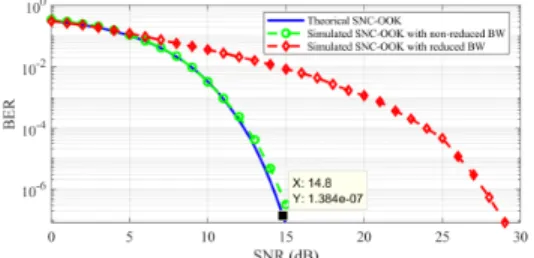
into a noisy wireless channel is −14 dBm. However, as a large receiver bandwidth (BW) can reach prohibited levels of power con-sumption [3], designers have reduced the 3 dB receiver BW required to achieve 16 Gbps, from 16 GHz to 9.2 GHz [6]. This reduction in-tensifies the bit error rate (BER) at the receiver side and necessitate to increase Pt = −0.5 dBm to reach the same BER = 10−15. This
problem was modeled in MATLAB to verify the effects of the re-ceiver BW reduction, using a second-order band-pass Butterworth filter configured with the parameters described above. As shown in Fig.1, the system SNR is degraded by 14 dB at 10−7, which is
traduced in a high Ptto reach the same BER. In order to overcome
this performance degradation, this work proposes a Multi-carrier NC-OOK (MNC-OOK) transceiver architecture, which allows to avoid BW reduction.
Figure 1: Single-carrier non-Coherent OOK system model
2
PROPOSED MULTI-CARRIER WIRELESS
INTERFACE ARCHITECTURE
The MNC-OOK transceiver is based on Frequency Division Mul-tiplexing (FDM) and Direct Sequence Spread Spectrum (DSSS) to overcome bandwidth reduction problems. The FDM technique is used as a mean to divide the total bandwidth into four different car-rier frequencies with shorter bandwidth, e.g., 10 GHz/4 = 2.5 GHz. On the other hand, the DSSS technique enables parallel channel access, reusing existing frequencies.
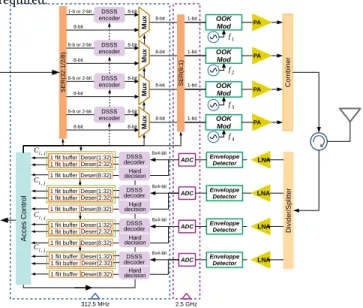
Digital Transmitter Architecture.A transmitter assigned to a carrier frequency fiis composed of three blocks: a serializer SER(32:1/2/8),
a DSSS encoder, and an SER(8:1), as illustrated in Fig.2. The DSSS encoder is designed using 8-bit and 4-bit registers initialized by the considered Hadamard codes (Ci). The output of this sub-block
is a specific code (Ci) or its complement (Ci). The SER (32:1/2/8)
2-bit output is associated with a 4-bit code, and the 1-bit output is related with an 8-bit code. In case of a simple point-to-point communication, no code is necessary and the system therefore
configures the SER 8-bit output. Hadamard codes are only used for multicast(all/many-to-one, many-to-many, and multiple-unicast) communications. Otherwise, in unicast/broadcast mode, no code is required.
Figure 2: Proposed MNC-OOK transceiver architecture. Digital Receiver Architecture.A receiver sub-block tuned for a cer-tain carrier frequency fi, receives an analog signal and converts it
into eight 4-bit words using its respective ADC, as depicted in Fig.2. Afterwards, this digitized signal is forwarded to the DSSS decoder and hard decision sub-blocks. The DSSS decoder follows the archi-tecture from [5], but without considering the channel compensation techniques. Each DSSS decoder and hard decision sub-block out-puts are forwarded into their respective deserializer DESER(1:32), DESER(2:32), DESER(8:32) and buffer blocks. The access control sub-block deactivates unused sub-blocks during the configuration phase of the communication patterns, to save energy.
3
RESULTS
In order to evaluate the BER, the end-to-end system is modeled in MATLAB using the channel model provided by [4]. This channel model consists of 4 antennas tuned at 200 GHz with a frequency range of 62 GHz, which is used by the FDM scheme. The non-overlapping frequency bands are distributed using different carrier frequencies: f1 = 195 GHz, f2 = 200 GHz, f3 = 205 GHz, and
f4 = 210 GHz. Simulation results are reported in Fig.3for
uni-cast/broadcast and multicast communications. The modeled com-munication system comprises four wireless nodes, which requires three codes (i = 1 . . . 3) by each code size group j. The first group j= 1 provides a Processing Gain PG = 6 dB using a 4-bit code size, and the second group j = 2 brings a PG = 9 dB for 8-bit code size. The PG has two applications [2]. The first one is to improve the signal resilience providing better BER with the same Pt, and the
second one aims at reducing Ptkeeping the same BER. However, in
order to make a fair comparison between both code sizes in terms of BER, the PG effects was suppressed during simulation. The dif-ferent communication patters based on the MNC-OOK scheme are compared with the theoretical BER for SNC-OOK. As shown in Fig-ure3, the average BER for each communication pattern is slightly
different from the theoretical BER for SNC-OOK. Consequently, the Pt does not require to be highly incremented, as previously
explained. Moreover, in case of multicast mode, an 8-bit code size will provide better signal resilience considering the PG effects, as well as it can allocate more parallel channels [5].
11 12 13 14 15 SNR (dB) 10-7 10-6 10-5 10-4 10-3 BER SNC-OOK theory Code 1 Code 2 Code 3 X: 14.4 Y: 5.227e-07 (a) 11 12 13 14 15 SNR (dB) 10-7 10-6 10-5 10-4 10-3 BER SNC-OOK theory Code 1 Code 2 Code 3 X: 14.4 Y: 5.227e-07 (b) 11 12 13 14 15 SNR (dB) 10-7 10-6 10-5 10-4 10-3 BER SNC-OOK theory Unicast Broadcast X: 14.4 Y: 5.227e-07 (c)
Figure 3: BER performance for multicast with (a) PG= 6 dB, (b) PG= 9 dB, and (c) unicast/broadcast.
The digital transceiver architecture is modeled in C/C++, syn-thesized from C to RTL by Catapult HLS and to the gate level by Synopsys Design Compiler. A 28-nm FDSOI technology library is used during hardware synthesis as a target with a supply voltage of 1 Volt. Data interfaces with the router/switch have 32-bit width. Synthesis results of the digital transceiver are detailed in Table1, which reports both static and dynamic power consumption of each component.
Table 1: Area and power consumption of digital transceiver architecture designed using 28-nm FDSOI.
WI Block Area (𝜇m2) Power (mW) clock (GHz)
DSSS encoder 121 0.03
0.3125
DSSS decoder and Hard Decision 150 0.04
Serializer 32:1:2:8-bit (312.5 Mbps) 391 0.16 Serializer 8:1-bit (2.5 Gbps) 94 0.27 2.5 Deserializer 8:32-bit (312.5 Mbps) 190 0.082 0.3125 Deserializer 2:32-bit (312.5 Mbps) 200 0.089 Deserializer 1:32-bit (312.5 Mbps) 221 0.093
Access Control Block 500 0.7
The area overhead of the MNC-OOK digital transceiver for a four-cluster architecture is around 0.0138 mm2, which is 17 times smaller than the digital transceiver proposed in [1] for multicast communications. Unfortunately, the authors do not provide the power consumption, however, the large area overhead suggests a high power consumption compared to our proposition, which consumes only 2.37 mW in unicast/broadcast mode and 4.82 mW for the full multicast mode.
REFERENCES
[1] K. Duraisamy, Y. Xue, et al. Multicast-aware high-performance wireless network-on-chip architectures. IEEE Trans. onVLSI Systems, 25(3):1126–1139, 2017. [2] J. Fakatselis and M. Belkerdid. Processing gain for direct sequence spread spectrum
communication systems and prism®. Appli. Note AN9633, Intersil, four pages, 1996. [3] H. Hsieh, P. Wu, C. Jou, F. Hsueh, and G. Huang. 60ghz high-gain low-noise amplifiers with a common-gate inductive feedback in 65nm cmos. In IEEE Radio Freq. Integ. Circ. Sympo., pages 1–4, 2011.
[4] I. E. Masri et al. Accurate channel models for realistic design space exploration of future wireless nocs. In IEEE/ACM Inter. Symp. on (NOCS), pages 1–8, 2018. [5] J. O. Sosa et al. A Diversity Scheme to Enhance the Reliability of Wireless NoC in
Multipath Channel Environment. In Int. Symp. on NOCS, pages 1–8, 2018. [6] X. Yu et al. A 1.2-pJ/bit 16-Gb/s 60-GHz OOK Transmitter in 65-nm CMOS for
Wireless Network-On-Chip. IEEE Trans. on MTT, 62(10):2357–2369, 2014. 2