HAL Id: inria-00134699
https://hal.inria.fr/inria-00134699v5
Submitted on 30 Aug 2007
HAL is a multi-disciplinary open access
archive for the deposit and dissemination of
sci-entific research documents, whether they are
pub-L’archive ouverte pluridisciplinaire HAL, est
destinée au dépôt et à la diffusion de documents
scientifiques de niveau recherche, publiés ou non,
version)
Andrew W. Appel, Sandrine Blazy
To cite this version:
Andrew W. Appel, Sandrine Blazy. Separation Logic for Small-step Cminor (extended version).
[Research Report] RR-6138, INRIA. 2007, pp.34. �inria-00134699v5�
a p p o r t
d e r e c h e r c h e
ISRN
INRIA/RR--6138--FR+ENG
Thème SYM
Separation Logic for Small-step Cminor
(extended version)
Andrew W. Appel — Sandrine Blazy
N° 6138 — version 4
Andrew W. Appel
∗†, Sandrine Blazy
‡†Th`eme SYM — Syst`emes symboliques Projets Gallium et Moscova
Rapport de recherche n 6138 — version 4§ — version initiale Mars 2007 — version
r´evis´ee Aout 2007 — 31 pages
Abstract: Cminor is a mid-level imperative programming language (just below C), and there exist proved-correct optimizing compilers from C to Cminor and from Cminor to ma-chine language. We have redesigned Cminor so that it is suitable for Hoare Logic reasoning, we have designed a Separation Logic for Cminor, we have given a small-step operational semantics so that extensions to concurrent Cminor will be possible, and we have a checked proof of soundness of our Separation Logic. This is the first large-scale machine-checked proof of a Separation Logic w.r.t. a small-step semantics, or for a language with nontrivial reducible control-flow constructs. Our sequential soundness proof of the sequen-tial Separation Logic for the sequensequen-tial language features will be reusable change within a soundness proof of Concurrent Separation Logic w.r.t. Concurrent Cminor. In addition, we have a machine-checked proof of the relation between our small-step semantics and Leroy’s original big-step semantics; thus sequential programs can be compiled by Leroy’s compiler with formal end-to-end correctness guarantees.
Key-words: program proof, formal semantics, imperative language, separation logic
∗Princeton University; supported in part by NSF Grant CCF-0540914 †This work was done, in part, while both authors were on sabbatical at INRIA ‡ENSIIE
R´esum´e : Cminor est un langage de bas niveau proche de C, utilis´e comme langage in-term´ediaire dans un compilateur optimisant du langage C certifi´e en Coq. Ce rapport pr´esente le d´eveloppement en Coq d’une s´emantique axiomatique pour Cminor ainsi que les preuves de correction associ´ees. Cette s´emantique constitue un premier lien entre la preuve de programmes et certification de compilateurs. Elle utilise la logique de s´eparation pour raisonner sur la m´emoire et les pointeurs. Elle est d´efinie selon un style `a petits pas afin de pouvoir enrichir dans le futur le langage Cminor par des traits concurrents. Cette s´emantique est ´egalement une s´emantique `a continuations, ce qui a facilit´e les preuves de correction.
Mots-cl´es : s´emantique formelle, langage imp´eratif, preuve de programmes, logique de s´eparation
Cminor is a mid-level imperative programming language (just below C), and there exist proved-correct optimizing compilers from C to Cminor and from Cminor to machine lan-guage. We have redesigned Cminor so that it is suitable for Hoare Logic reasoning, we have designed a Separation Logic for Cminor, we have given a small-step operational semantics so that extensions to concurrent Cminor will be possible, and we have a machine-checked proof of soundness of our Separation Logic. This is the first large-scale machine-checked proof of a Hoare Logic w.r.t. a small-step semantics. Our sequential soundness proof of the sequential Separation Logic for the sequential language features will be usable without change within a soundness proof of Concurrent Separation Logic w.r.t. Concurrent Cminor. In addition, we have a machine-checked proof of the relation between our small-step semantics and Leroy’s original big-step semantics; thus sequential programs can be compiled by Leroy’s compiler with formal end-to-end correctness guarantees.
1
Introduction
The future of program verification is to connect verified source programs to machine-verified compilers, and run the object code on machine-machine-verified hardware. To connect the verifications end to end, the source language should be specified as a structural operational semantics (SOS) represented in a logical framework; the target architecture can also be specified that way. Proofs of source code can be done in the logical framework, or by other tools whose soundness is proved w.r.t. the SOS specification; these may be in safety proofs via type-checking, correctness proofs via Hoare Logic, or (in source languages designed for the purpose) correctness proofs by a more expressive proof theory. The compiler—if it is an optimizing compiler—will be a stack of phases, each with a well specified SOS of its own. There will be proofs of (partial) correctness of each compiler phase, or witness-driven recognizers for correct compilations, w.r.t. the SOS’s that are inputs and outputs to the phases.
Machine-verified hardware/compiler/application stacks have been built before. Moore described a verified compiler for a “high-level assembly language” [1]. Leinenbach et al. have built a compiler for C0, a small C-like language, and have demonstrated correctness (machine-checked proofs largely complete) of source programs, Hoare Logic, compiler, micro-kernel, and RISC processor [2]. These are both simple one- or two-pass nonoptimizing compilers.
Leroy [3] has built and proved correct in Coq [4] a compiler called CompCert from a high-level intermediate language Cminor to assembly language for the Power PC architecture. This compiler has 5 phases (with 4 intermediate languages), allowing for optimizations at several natural levels of abstraction. Blazy et al. have built and proved correct a translator from a subset of C to Cminor [5]. Another compiler phase on top (not yet implemented) will then yield a proved-correct compiler from C to machine language. We should therefore reevaluate the conventional wisdom that an entire practical optimizing compiler cannot be proved correct.
A software system is often a mixture of components written in different languages—the run-time system of an ML system is often written in C—and we would like end-to-end correctness proofs of the whole system. For this, we propose a new variant of Cminor as a machine-independent intermediate language that can serve as a common denominator between several high-level languages. In this report, we will show that Cminor has a usable Hoare Logic, so that correctness proofs for some components can be done directly at the level of Cminor.
Cminor has a “calculus-like” view of local variables and procedures (i.e. local variables are bound in an environment), while C0 has a “storage-allocation” view (i.e. local variables are stored in the stack frame). The calculus-like view will lead to easier reasoning about program transformations and easier use of Cminor as a target language, and fits naturally with a multi-pass optimizing compiler such as Leroy’s; the storage-allocation view suits the one-pass nonoptimizing C0 compiler and can accommodate in-line assembly code.
Therefore we consider Cminor a promising candidate as a common intermediate language for end-to-end correctness proofs. But we have many demands on our new variant of Cminor, only the first three of which are satisfied by Leroy’s Cminor.
• Cminor has an operational semantics represented in a logical framework. • There is a proved-correct compiler from Cminor to machine language. • Cminor is usable as the high-level target language of a C compiler.
◦ Our semantics is a small-step semantics (SOS), to support reasoning about input/output, concurrency, and nontermination.
◦ Cminor is machine-independent over machines in the “standard model” (i.e. 32- or 64-bit single-address-space byte-addressable multiprocessors).
◦ Cminor can be used as a mid-level target language of an ML compiler [6], or of an OO-language compiler, so that we can integrate correctness proofs of ML or OO programs with the proofs of their run-time systems and low-level libraries.
◦ As we show in this report, Cminor supports an axiomatic Hoare Logic (in fact, Sep-aration Logic), proved sound with respect to the SOS, for reasoning about low-level (C-like) programs so we can prove correctness of the run-time systems and low-level libraries.
◦ In future work, we plan to extend Cminor to be concurrent in the “standard model” of thread-based preemptive lock-synchronized weakly consistent shared-memory pro-gramming. We aim at reusing our soundness proofs for the sequential part of the language in a concurrent setting.
Leroy’s original Cminor had several Power-PC dependencies, is slightly clumsy to use as the target of an ML compiler, and is a bit clumsy to use in Hoare-style reasoning. But most
important, because Leroy’s SOS is a big-step semantics, it can be used only to reason about terminating sequential programs.1
We have redesigned Cminor’s syntax and semantics to achieve all of these goals. That part of the redesign to achieve target-machine portability was done by Leroy himself. Our redesign to ease its use as an ML back end and for Hoare Logic reasoning was fairly simple. In the sequel of this report, Cminor will refer to the new version of the Cminor language. The main contributions of this report are:
A sequential small-step SOS suitable for compilation and for Hoare Logic.
A machine-checked proof of soundness of our sequential Hoare Logic of Separation (Separation Logic) w.r.t. our small-step semantics. Schirmer [8] has a machine-checked big-step Hoare-Logic soundness proof for a control flow much like ours, extended by Klein et al. [9] to a C-like memory model. Ni and Shao [10] have a machine-checked proof of soundness of a Hoare-like logic w.r.t. a small-step semantics, but for an assembly language and for much simpler assertions than ours.
A machine-checked big-step/small-step equivalence proof that allows us to use Leroy’s existing proved-correct Cminor compiler for (terminating sequential) programs proved correct in Separation Logic.
2
Big-step Expression Semantics
The C standard [11] describes a memory model that is byte- and word-addressable (yet portable to big-endian and little-endian machines) with a nontrivial semantics for uninitial-ized variables. Blazy and Leroy formaluninitial-ized this model [12] for the semantics of Cminor. In C, pointer arithmetic within any malloc’ed block is defined, but pointer arithmetic between different blocks is undefined; Cminor therefore has non-null pointer values comprising an abstract block-number and an int offset. A NULL pointer is represented by the integer value 0. Pointer arithmetic between blocks, and reading uninitialized variables, are undefined but not illegal: expressions in Cminor can evaluate to undefined (Vundef) without getting stuck. Each memory load or store is to a non-null pointer value (i.e. a block and an offset) with a “chunk” descriptor ch specifying number of bytes, signed or unsigned, int or float. Storing as 32-bit-int then loading as 8-bit-signed-byte leads to an undefined value. Load and store operations on memory, m " v1
ch
#→ v2 and m! = m[v1 ch
:= v2], are partial functions that yield
results only if reading (resp., writing) a chunk of type ch at address v1 is legal. We write
m" v1 ch
#→ v to mean that the result of loading from memory m at address v1a chunk-type
ch is the value v.
1Leroy has experimented in Coq coinductive big-step semantics for simple languages, that describe
non-terminating executions of programs in addition to non-terminating executions [7]. But proving semantic preser-vation properties such as those required in a certified compiler is difficult, especially for a language such as Cminor. Thus, for the time being, it has been decided to avoid the use of coinductive big-step semantics in CompCert. Furthermore, coinductive big-step semantics are not adapted to concurrency.
The values of Cminor are undefined (Vundef), integers, pointers, and floats. The int type is an abstract data-type of 32-bit modular arithmetic. The expressions of Cminor are literals, variables, primitive operators applied to arguments, and memory loads.
i : int ::= [0, 232)
v : val ::= Vundef | Vint (i) | Vptr (b, i) | Vfloat (f) e : expr ::= Eval (v)| Evar (id) | Eop (op, el) | Eload (ch, e) el : exprlist ::= Enil | Econs (e, el)
There are 33 primitive operation symbols op; two of these are for accessing global names and local stack-blocks, and the rest is for integer and floating-point arithmetic and compar-isons. For instance, the boolean negation operator Oneg 2 is used in expressions such as
Eop (Oneg, Econs (e, Enil)). In the sequel of this report, we will use the C notation !e for such an expression.
Cminor has an infinite supply ident of variable and function identifiers id. As in C, there are two namespaces—each id can be interpreted in a local scope (using Evar (id)) or in a global scope (using the operation symbol for accessing global names).
Expression evaluation in Leroy’s Cminor is expressed by an inductive big-step rela-tion. Big-step statement execution is problematic for concurrency, but big-step expression evaluation is fine—as long as we prove noninterference—and has the advantage of simplicity. Evaluation is deterministic. Leroy chose to represent evaluation as a relation because Coq had better support for proof induction over relations than over function definitions. We have chosen to represent evaluation as a partial function; this makes some proofs easier in some ways: f(x) = f(x) is simpler than f x y ⇒ f x z ⇒ y = z. We have developed a tactical technique for proofs over functions with case analysis. 3 Although we specify
expression evaluation as a function in Coq, we present evaluation as a judgment relation in Figure 1. Our evaluation function is (proved) equivalent to the inductively defined judgment Ψ; (sp; ρ; φ; m) " e ⇓ v where:
Ψ is the “program,” consisting of a global environment (ident → option block) 4
map-ping identifiers to function-pointers and other global constants, and a global mapmap-ping (block → option function) that maps certain (“text-segment”) addresses to function definitions.
sp : block. The “stack pointer” giving the address of the memory block for stack-allocated local data in the current activation record.
ρ : env. The local environment, a finite mapping from identifiers to values.
2The Oneg operator doesn’t exist in Cminor but it can be defined from more primitive operators. 3Our tactic was written in a previous version of Coq. It can be considered as an instantiation of the new
tactic called functional induction.
4In a global environment, an identifier is mapped either to Some b if there exists an address b for this
Ψ; (sp; ρ; φ; m) " Eval (v) ⇓ v x∈ dom ρ
Ψ; (sp; ρ; φ; m) " Evar (x) ⇓ ρ(x) Ψ; (sp; ρ; φ; m) " el ⇓ vl Ψ; sp " op(vl) ⇓eval operationv
Ψ; (sp; ρ; φ; m) " Eop (op, el) ⇓ v
Ψ; (sp; ρ; φ; m) " e1⇓ v1 φ" loadchv1 m" v1#→ vch
Ψ; (sp; ρ; φ; m) " Eload (ch, e1) ⇓ v
Figure 1: Expression evaluation rules
φ : footprint. A mapping from memory addresses to permissions. Leroy’s Cminor has no footprints, as these are needed only for Separation Logic reasoning.
m : mem. The memory, a finite mapping from block to blockcontents [12]. Each block represents the result of a C malloc or a stack frame, a global static variable, or a function code-pointer. A block content consists of the dimensions of the block (low and high bounds) plus a mapping from byte offsets to byte-sized memory cells. e : expr. The expression being evaluated.
v : val. The value of the expression.
The footprint φ is a mapping from memory addresses to permissions. Loads outside the footprint will cause expression evaluation to get stuck. Since the footprint may have different permissions for loads than for stores to some addresses, we write φ " loadchv (or
φ" storechv) to mean that all the addresses from v to v +|ch| − 1 are readable (or writable).
To model the possibility of exclusive read/write access or shared read-only access, we write φ0⊕ φ1 = φ for the “disjoint” sum of two footprints, where ⊕ is an associative and
commutative operator with several properties such as φ0 " storechv ⇒ φ1 *" loadchv,
φ0 " loadchv ⇒ φ " loadchv and φ0 " storechv ⇒ φ " storechv. One can think of φ as a
set of fractional permissions [13], with 0 meaning no permission, 0 < x < 1 permitting read, and 1 giving read/write permission. A store permission can be split into two or more load permissions, which can be reconstituted to obtain a store permission. Parkinson [14, Ch. 5] defines a more sophisticated and general model. Either of those models can be used with our Separation Logic, but our initial prototype proof uses a simpler model without fractional permissions.
Most previous models of Separation Logic (e.g., Ishtiaq and O’Hearn [15]) represent heaps as partial functions that can be combined with an operator like ⊕. Of course, a partial function can be represented as a pair of a domain set and a total function. Similarly,
we represent heaps as a footprint plus a Cminor memory. We do this for compatibility with Leroy’s Cminoroperational semantics; carrying footprints separately from memories does not add any particular difficulty to the soundness proofs for our Separation Logic.
To perform arithmetic and other operations, in the third rule of Figure 1, the judgment Ψ; sp " op(vl) ⇓eval operationv takes an operator op applied to a list value vl and (if vl contains
appropriate values) produces some value v. The operators for accessing global names and local stack-blocks make use of Ψ and sp respectively to return the global meaning of an identifier or the local stack-block address.
States. We shall bundle together (sp; ρ; φ; m) and call it the state, written as σ. We write Ψ; σ " e ⇓ v to mean Ψσ; (spσ; ρσ; φσ; mσ) " e ⇓ v.
Notation. We write σ[:= ρ!] to mean the state σ with its environment component ρ
replaced by ρ!, and so on (e.g. see Figure 3).
Fact. Ψ; sp " op(vl) ⇓eval operation v and m" v1 #→ v are both deterministic relations, i.e.ch
functions.
Lemma 1. Ψ; σ " e ⇓ v is a deterministic relation. (Trivial by inspection.) Lemma 2. For any value v, there is an expression e such that ∀σ. (Ψ; σ " e ⇓ v).
Proof. Obvious; e is simply Eval v. But it is important nonetheless: reasoning about programs by rewriting and by Hoare Logic often requires this property, and it was absent from Leroy’s Cminor for Vundef and Vptr values.
An expression may fetch from several different memory locations, or from the same location several times. Because ⇓ is deterministic, we cannot model a situation where the memory is updated by another thread after the first fetch and before the second. This is deliberate. But on the other hand, we want a semantics that describes real executions on real machines. The solution is to evaluate expressions in a setting where we can guarantee noninterference. We will do this (in our extension to Concurrent Cminor) by guaranteeing that the footprints φ of different threads are disjoint.
The Cminor compiler (CompCert) is proved correct with respect to an operational seman-tics that does not use footprints. Any program that successfully evaluates with footprints will also evaluate ignoring footprints. Thus, it is sound to prove properties in a footprint semantics and compile in an erased semantics. We formalize this as follows.
Definition 1 (Erased expression evaluation). Let Ψ; (sp; ρ; m) " e ˙⇓v be the relation defined by rules just like those for e ⇓ v except that φ is removed, as is the premise φ " loadchv1 of the rule for Eload expressions.
Definition 2 (Erased expression state). We define an erased state ˙σ as (Ψ, sp, ρ, κ); that is, just like a sequential state but without φ.
Lemma 3. If Ψ; σ " e ⇓ v then Ψ; ˙σ " e ˙⇓v.
Proof. Trivial; in the case for Eload it is strictly easier to derive e ˙⇓v than e ⇓ v. Lemma 4. If pure (e) then Ψ; ˙σ " e ˙⇓v ⇒ Ψ; σ " e ⇓ v.
Lemma 5. If Ψ; σ " e ⇓ v and φσ⊂ φ! then Ψ; σ[:= φ!] " e ⇓ v.
3
Small-step Statement Semantics
The statements of sequential Cminor are:
s : stmt ::= x := e| [e1]ch:=e2| loop s | block s | exit n
| call xl e el | return el| s1; s2| if e then s1else s2 | skip.
The assignment x := e puts the value of e into the variable x. The store [e1]ch:=e2 puts
(the value of) e2 into the memory-chunk ch at address given by (the value of) e1. Local
variables are not addressable; global variables and heap locations are memory addresses. To model exits from nested loops, block s runs s, which should not terminate normally but which should exit n from the (n + 1)th enclosing block, and loop s repeats s infinitely or
until it returns or exits. call xl e el calls function e with parameters (by value) el and results returned back into the variables xl. 5 return el evaluates and returns a sequence of results,
(s1; s2) executes s1 followed by s2 (unless s1 returns or exits), and the statements if and
skip are as the reader might expect.
Combined with infinite loops and if statement, blocks and exits suffice to express effi-ciently all reducible control-flow graphs, notably those arising from C loops. The C state-ments break and continue are translated as appropriate exit statestate-ments. [5] details the translation of these C statements into Cminor.
Figure 2 shows the translation in Cminor of a general C while loop with continue and break statements in its body: the loop becomes a block consisting of an infinite loop, and the loop body becomes also a block. The statements continue and break are translated as appropriate exit constructs. A C while loop (written as while e s) without continue and break statement in its body s is thus a Cminor loop written as block {loop {if (!e) then exit 0 else s}}. In the sequel of this report, we will use the notation while e s for such a loop. In Figure 2 we assume e is a C expression without side-effect, so it translates as itself.
5 Each function in the real Cminor also has a signature that specifies the int/floatness of the parameters;
block { loop {
while (e) { if (! e) exit 0; block { ... ... continue; exit 0; ... ... break; exit 1; ... ... } } } }
Figure 2: Translation of a C while loop into a Cminor infinite loop
Function definitions. A Cminor program Ψ is really two mappings: a mapping from function names to memory blocks (i.e., abstract addresses), and a mapping from memory blocks to function definitions. Each function definition f = (xl, yl, n, s), where params(f) = xl is a list of formal parameters, locals(f) = yl is a list of local variables, stackspace(f) = n is the size of the local stack-block to which sp points, and the statement body(f) = s is the function body.
Operational semantics. Our small-step semantics for statements is based on continua-tions, mainly to allow a uniform representation of statement execution that facilitates the design of lemmas. Such a semantics also avoids all search rules (congruence rules) and simplifies reasoning in the soundness proof for the Hoare Logic (and for the compiler). In section 7 we will describe the big-step semantics and prove equivalence of the two semantics (for programs that terminate).
Definition 3 (Continuation). A continuation k has a state σ and a control stack κ. There are sequential control operators to handle local control flow (Kseq written as ·), intraprocedural control flow (Kblock), and function-return (Kcall); this last carries not only a control aspect but an activation record of its own. The control operator Kstop represents the safe termination of the computation.
κ : control ::= Kstop| s · κ | Kblock κ | Kcall xl f sp ρ κ k : continuation ::= (σ, κ)
The sequential small-step function takes the form Ψ " k #−→ k! (see Figure 3), and
we define as usual its reflexive transitive closure #−→∗. As in C, there is no boolean type
(resp. false).6 A store statement [e
1]ch:=e2 requires the corresponding store permission
φσ" storechv1.
Given a control stack block s · κ, the small-step execution of the block statement block s enters that block: s becomes the next statement to execute and the control stack becomes s· Kblock κ.
Exit statements are only allowed from blocks that have been previously entered. For that reason, in the two rules for exit statements, the control stack ends with (Kblock κ) control. A statement (exit n) terminates the (n + 1)th enclosing block statements. In such a block,
the stack of control sequences s1· · · sj following the exit statement is not executed. Let us
note that this stack may be empty if the exit statement is the last statement of the most enclosing block. The small-step execution of a statement (exit n) exits from only one block (the most enclosing one). Thus, the execution of an (exit 0) statement updates the control stack (exit 0 · s1· · · · sj· Kblock κ) into κ. The execution of an (exit n + 1) statement updates
the control stack (exit (n + 1) · s1· · · · sj· Kblock κ) into exit n · κ.
The small-step execution of a call statement allocates the memory required in order to execute the called function. It also initializes formal parameters to their corresponding actual parameters and local variables to the Vundef value. It steps to the body of the callee. As for exit and block statements, a return statement must be related to a call statement. Thus, in the return rule, the control stack κ must terminate by a Kcall control operator that is compatible with the list elargs of the return elargs statement. The control operators
that precede this Kcall correspond to statements that are not executed since they follow the return statement in the body of the called function. The allocated memory is freed at the end of the execution of the return statement.
The small-step execution of a program Ψ is of the form Ψ " (σ0, s0·Kstop) #−→∗(σ, Kstop)
where s0 is a call statement to the “main” function of Ψ.
Lemma 6. If Ψ; σ " e ⇓ v then Ψ " (σ, (x := e)·κ) #−→ k!iff Ψ " (σ, (x := Eval v)·κ)) #−→
k! (and similarly for other statement forms containing expressions or expression lists). Proof. Trivial: expressions have no side effects. A convenient property nonetheless, and not true of Leroy’s original Cminor.
Definition 4 (Stuck continuation). A continuation k = (σ, κ) is stuck if κ *= Kstop and there does not exist k! such that Ψ " k #−→ k!.
Definition 5 (Safe continuation). A continuation k is safe (written as Ψ " safe(k)) if it cannot reach a stuck continuation in the sequential small-step relation #−→∗.
6True values are non null integer values and pointer values. Only the integer 0 is interpreted as a false
Ψ " (σ, (s1; s2) · κ) #−→ (σ, s1· s2· κ) Ψ; σ " e ⇓ v ρ ! = ρ σ[x := v] Ψ " (σ, (x := e) · κ) #−→ (σ[:= ρ!], κ) Ψ; σ " e1⇓ v1 Ψ; σ " e2⇓ v2 φσ " storechv1 m!= mσ[v1 ch := v2] Ψ " (σ, ([e1]ch:=e2) · κ) #−→ (σ[:= m!], κ) Ψ; σ " e ⇓ v is true v
Ψ " (σ, (if e then s1else s2) · κ) #−→ (σ, s1· κ)
Ψ; σ " e ⇓ v is false v
Ψ " (σ, (if e then s1else s2) · κ) #−→ (σ, s2· κ) Ψ " (σ, skip · κ) #−→ (σ, κ)
Ψ " (σ, (loop s) · κ) #−→ (σ, s · loop s · κ) Ψ " (σ, (block s) · κ) #−→ (σ, s · Kblock κ) j≥ 1
Ψ " (σ, exit 0 · s1· · · · sj· Kblock κ) #−→ (σ, κ)
j≥ 1
Ψ " (σ, exit (n + 1) · s1· · · · sj· Kblock κ) #−→ (σ, exit n · κ)
Ψ; σ " efun⇓ vfun Ψ; σ " elargs ⇓ vlargs
Ψσ(vfun) = f alloc(mσ, stackspace(f )) = (m!, sp!)
ρ! = [params(f) #→ vlargs][locals(f) #→ Vundef] φ!= φσ⊕ [sp!, sp!+ stackspace(f))
Ψ " (σ, call xl efunelargs· κ) #−→ (σ[:= sp!, ρ!, φ!, m!], body(f) · Kcall xl f spσρσκ)
κ = any sequence of· and Kblock operators terminating in Kcall xl f sp!ρ!κ!
Ψ; σ " elargs⇓ vlargs |params(f)| = |vlargs|
ρ!!= ρ![xl := vl
args] φ!= φσ\[spσ, spσ+ stackspace(f)) free(mσ, spσ) = m!
Ψ " (σ, return elargs· κ) #−→ (σ[:= sp!, ρ!!, φ!, m!], κ!)
Figure 3: Sequential small-step relation
Erasure. We define an erased continuation as a pair ( ˙σ, κ). We define the erased small-step relation .
#−→ derived by erasing from the #−→ any mention of φ and any premises depending on φ.
Lemma 7 (Erasure). If Ψ " k #−→ k! then Ψ " k #−→ k· !.
Proof. The φ’s can at most cause a computation to get stuck; they never affect the contents of memories or environments.
emp =def λΨσ. φσ = ∅ P∗ Q =def λΨσ.∃φ1.∃φ2. φσ= φ1⊕ φ2 ∧ P (σ[:= φ1]) ∧ Q(σ[:= φ2]) P∨ Q =def λΨσ. P σ ∨ Qσ P∧ Q =def λΨσ. P σ ∧ Qσ P ⇒ Q =def λΨσ. P σ ⇒ Qσ ¬P =def λΨσ.¬(P σ) ∃z.P =def λΨσ.∃z. P σ
3A4 =def λΨσ. A where σ does not appear free in A
true =def 3True4 false =def 3False4
e⇓ v =def emp ∧ 3pure(e)4 ∧ λΨσ. (Ψ; σ " e ⇓ v)
3e4expr=def ∃v. e ⇓ v ∗ 3is true v4
defined(e) =def 3e int == e4expr ∨ 3e float == e4expr e1 ch #→ e2=def ∃v1.∃v2.(e1⇓ v1) ∧ (e2⇓ v2) ∧ (λσ, mσ" v1 ch #→ v2∧ φσ" storechv1) ∧ defined(v2)
Figure 4: Main operators of Separation Logic
4
Separation Logic
Hoare Logic uses triples {P } s {Q} where P is a precondition, s is a statement of the pro-gramming language, and Q is a postcondition. The assertions P and Q are predicates on the program state. The reasoning on memory is inherently global. Separation Logic is an extension of Hoare Logic for programs that manipulate pointers. In Separation Logic, rea-soning is local [16]; assertions such as P and Q describe properties of part of the memory, and {P } s {Q} describes changes to part of the memory. We prove the soundness of the Separation Logic via a shallow embedding, that is, we will give each assertion a semantic meaning in Coq. That is, we have P, Q : assert where assert = state → Prop. So P Ψσ is a proposition of logic and we say that σ satisfies P .
Assertion operators In Figure 4, we define the usual operators of Separation Logic: the empty assertion emp, separating conjunction ∗, disjunction ∨, conjunction ∧, implication ⇒, negation ¬, and quantifier ∃. A state σ satisfies P ∗ Q if its footprint φσ can be split into
φ1and φ2such that σ[:= φ1] satisfies P and σ[:= φ2] satisfies Q. We also define some novel
operators such as expression evaluation e ⇓ v and base-logic propositions 3A4. Imprecise true and false are defined from the Coq propositions True and False.
O’Hearn and Reynolds specify Separation Logic for a little language in which expressions evaluate independently of the heap [16]. That is, their expressions access only the program
variables and do not even have read side effects on the memory. Memory reads (i.e. loads, written as mσ" v1#→ vch 2) are done by a command of the language, not within expressions.
In Cminor we relax this restriction; expressions can read the heap. But we say that an expression is pure if (syntactically) it contains no Eload operators—which guarantees that it does not read the heap.
In Hoare Logic one can use expressions of the programming language as assertions— there is an implicit coercion. We write the assertion e ⇓ v (defined in Figure 4) to mean that expression e evaluates to value v in the operational semantics. This is an expression of Separation Logic, in contrast to Ψ; σ " e ⇓ v which is a judgment in the underlying logic. In a previous experiment, our Separation Logic permitted impure expressions in e ⇓ v. But, this complicated the proofs unnecessarily. Having emp ∧ 3pure(e)4 in the definition of e ⇓ v leads to an easier-to-use Separation Logic.
Hoare Logic traditionally allows expressions e of the programming language to be used as expressions of the program logic. We will define explicitly 3e4exprto mean that e evaluates
to a true value (i.e. a nonzero integer or non-null pointer). Following Hoare’s example, we will usually omit the 3 4expr braces in our Separation Logic notation.
Cminor’s integer equality operator, which we will write as e1 int
== e2, applies to integers
or pointers, but in several cases it is “stuck” (expression evaluation gives no result): when comparing a nonzero integer to a pointer;7when comparing Vundef or Vfloat(x) to anything.
Thus we can write the assertion 3e== e4int expr (or just write e int
== e) to test that e is a defined integer or pointer in the current state, and there is a similar operator e1
float
== e2. Finally, we
have the usual Separation Logic singleton “maps-to”, but annotated with a chunk-type ch : e1
ch
#→ e2means that e1evaluates to v1, e2evaluates to v2and at address v1in memory there
is a defined value v2 of the given chunk-type. Let us note that in this definition, defined(v1)
is implied by the third conjunct. defined(v2) is a design decision. We could leave it out and
have a slightly different Separation Logic.
Memory-supported assertions. In Separation Logic, some assertions are supported by a nonempty footprint; for example a #→ b holds only on states whose footprint φ contains just exactly a. (More precisely, e1 #→ ech 2 holds when φ is exactly the chunk ch starting at
address a.) Assertion emp is supported exactly by the empty footprint. Assertions such as 3x > 24 (where x is a variable of logic, not of Cminor), are supported by any footprint. Thus it makes sense to write ∃x.3x > 24 ∧ 10 #→ x to assert that m[10] > 2.
In one set of implementation experiments with semiautomatic tactics for manipulating Separation Logic assertions in Coq [17], we find it convenient to uniformly use ∗ as a con-junctive combinator, instead of arbitrary mixtures of ∗ and ∧. There we might choose a convention in which 3e4 is always written in the context emp ∧ 3e4; then we can write, for example, (emp ∧ 3x > 24) ∗ 10 #→ x, which we syntactically sugar as (x > 2) ∗ 10 #→ x.
7Integers may be compared for equality to integers, and pointers to pointers; and the NULL value, which
The Hoare sextuple. In Cminor there are commands that call functions, and commands that exit (from a block) or return (from a function). Thus, we extend the Hoare triple {P } s {Q} with three extra contexts to become Γ; R; B " {P }s{Q} where:
Γ : assert describes context-insensitive properties of the global environment;
R : list val→ assert is the return environment, giving the current function’s postcondition as a predicate on the list of returned values; and
B : nat→assert is the block environment giving the exit conditions of each block statement in which the statement s is nested.
The rules of sequential Separation Logic are given in Figure 5. The rule for [e]ch:=e1
requires the same store permission than the small-step rule, but in Fig. 5, the permission is hidden in the definition of e ch
#→ e2.
The rules for [e]ch:=e1 and if e then s1else s2 require that e be a pure expression. To
reason about an such statements where e is impure, one reasons by program transformation using the following rules. It is not necessary to rewrite the actual source program, it is only the local reasoning that is by program transformation.
x, y not free in e, e1, Q Γ; R; B " {P } x := e; y := e1; [x]ch:=y {Q}
Γ; R; B " {P }[e]ch:=e1{Q}
x not free in s1, s2, Q Γ; R; B " {P } x := e; if x then s1else s2{Q}
Γ; R; B " {P } if e then s1else s2{Q}
As a (loop s) statement is an infinite loop, we can write any assertion as postcondition of the (loop s) rule. We have chosen to write the false assertion. In the same way, any assertion can be the postcondition of an exit or return statement and we have written the false assertion in the corresponding rules.
The statement exit i exits from the (i + 1)thenclosing block. A block environment B is a
sequence of assertions B0, B1, . . . , Bk−1 such that (exit i) is safe as long as the precondition
Bi is satisfied. We write nilB for the empty block environment and B! = Q · B for the
envi-ronment such that B!
0= Q and Bi+1! = Bi. Given a block environment B, a precondition P
and a postcondition Q, the axiomatic semantics of a (block s) statement consists in execut-ing some statements of s given the same precondition P and the block environment Q · B (i.e. each existing block nesting is incremented). The last statement of s to be executed is an exit statement that yields the false postcondition. An (exit n) statement is only allowed from a corresponding enclosing block, i.e. the precondition B(n) must exist in the block environment B and it is the precondition of the (exit n) statement.
A function precondition P (vlargs) is parameterized by the function argument values, and
P⇒ P! Γ; R; B " {P!}s{Q!} Q! ⇒ Q Γ; R; B " {P }s{Q} Γ; R; B " {P }skip{P } Γ; R; B " {P }s1{P!} Γ; R; B " {P!}s2{Q} Γ; R; B " {P }s1; s2{Q} ρ!= ρσ[x := v] P = (∃v. e ⇓ v ∧ λσ. Q σ[:= ρ!]) Γ; R; B " {P }x := e{Q}
pure (e) pure (e2) P = (e ch
#→ e2 ∗ defined(e1))
Γ; R; B " {P }[e]ch:=e1{e ch
#→ e1}
pure (e) Γ; R; B " {P ∧ e}s1{Q} Γ; R; B " {P ∧ ¬e}s2{Q}
Γ; R; B " {P }if e then s1else s2{Q}
Γ; R; B " {I}s{I} Γ; R; B " {I}loop s{false}
Γ; R; Q · B " {P }s{false} Γ; R; B " {P }block s{Q}
Γ; R; B " {B(n)}exit n{false} Γ; R; B " {∃vl. el ⇓ vl ∗ R(vl)}return el{false}
P = (efun→ {Pfun f}{Qf} ∗ ∃vl. elargs⇓ vl ∗ Pf(vl))
Γ; R; B " {P }call xl efunelargs{∃vl!. xl⇓ vl! ∗ Qf(vl!)}
Γ; R; B " {P }s{Q} modified vars(s) ∩ free vars(A) = ∅ Γ; (λvl.A ∗ R(vl)); (λn.A ∗ B(n)) " {A ∗ P }s{A ∗ Q}
Q must be otherwise closed, i.e. have no free (program) variables—because variable names would have different (local) interpretations for the function caller and callee.
A function can be described by its precondition and postcondition (each parameterized as described), so we can write the function specification {P }{Q} to characterize a function. But sometimes we want to express, in logic, that the result of a function somehow depends on the value of its arguments. For this we want a (logical, not program) variable common to both P and Q; we write ∀z : τ.{P }{Q}, where τ is any Coq type (that is, “τ : Set”). The assertion for functions is e fun
→ Θ meaning that the pure expression e evaluates to a function-pointer that is callable with pre and postconditions given by Θ.
Θ : fun spec ::= {P }{Q} | ∀z : τ.Θ
Frame Rules. The most important feature of Separation Logic is the frame rule, usually written
{P } s {Q} {A ∗ P } s {A ∗ Q}
The appropriate generalization of this rule to our language with control flow is the last rule of Figure 5. We can derive from it a special frame rule for simple statements s that do not exit or return:
∀R, B.(Γ; R; B " {P } s {Q}) modified vars(s) ∩ free vars(A) = ∅ Γ; R; B " {A ∗ P } s {A ∗ Q}
If s does not exit or return (even if it has internal call-return and block-exit), then its Hoare triple is independent of B and R as indicated by the quantification ∀R, B in the premise. This rule is easily derivable from the general frame rule shown in Figure 5.
Free Variables. We use a semantic notion of free variables: x is not free in assertion A if, in any two states where only the binding of x differs, A gives the same result. However, we found it necessary to use a syntactic (inductive) definition of the variables modified by a command. One would think that command c “modifies” x if there is some state such that by the time c terminates or exits, x has a different value. However, this definition means that the modified variables of if false then B else C are not a superset of the modified variables of C; this lack of an inversion principle led to difficulty in proofs.
Auxiliary Variables. It is typical in Hoare Logic to use auxiliary variables to relate the pre- and postconditions, e.g., the variable a in {x = a} x := x + 1 {x = a + 1}. In our shallow embedding of Hoare Logic in Coq, the variable a is a Coq variable, not a Cminor variable; formally, the user would prove in Coq the proposition, ∀a, (Γ; R; B " {P }s{Q}) where a may appear free in any of Γ, R, B, P, s, Q. The existential assertion ∃z.Q is useful in conjunction with this technique.
Assertions about functions require special handling of these quantified auxiliary variables. The assertion that some value f is a function with precondition P and postcondition Q is
written f : ∀x1∀x2. . .∀xn,{P }{Q} where P and Q are functions from value-list to assertion,
each ∀ is an operator of our separation logic that binds a Coq variable xi using higher-order
abstract syntax.
In the next section we show how the Separation Logic (rules of Figure 5) can be used to prove partial-correctness properties of programs; then in the following section we show how to prove soundness of the Separation Logic.
5
An Example.
This section details through the classical in-place list-reversal example [18, 19, 20] how Cminor programs can be proved using Separation Logic.
The following recursive formula defines a singly linked list in Separation Logic. The singly list is represented by a pointer i to its first cell. 8 contents list relates a singly linked
list on the heap to a Coq list. For instance, a Coq list hd :: tl corresponds to a singly linked list on the heap i iff
i points to hd ,
there exists a pointer j such that i + 1 points to j,9
the list starting at j corresponds to the Coq list tl,
in the heap, the cell at address i is separated from the cell at address i + 1 and both cells are separated from the rest of the list.
Pointer values are stored and loaded as 32-bit integer values and the corresponding chunk is Mint32 .
contents list([], i) =defemp ∧ i = 0
contents list(hd :: tl, i) =def∃j.iMint32#→ hd ∗ i + 1Mint32#→ j ∗ contents list(j, tl)
Given a singly linked list v, the following Cminor program reverse list(v, w, t) reverses all the tail-pointers in place, leaving a pointer to the reversed list in variable w. In this program, w denotes the pointer to the previous list cell and t denotes the pointer to the next list cell.
w := 0 (* the previous list cell is initialized to NULL *) while (v *= 0) do (* non empty list *)
t := Eload Mint32 (v + 1) (* new value of the next list cell *)
[v + 1]Mint32:=w (* new value of the pointer to the next list cell *) w := v (* previous := current *)
v := t (* current := next*)
80 represents a NULL pointer and thus an empty list, see section 2.
Lemma 8 (Correctness of the list-reversal program). If v, w and t are distinct variables, then Γ; R; B " {contents list(l, v)} reverse list(v, w, t) {contents list (rev(l), w)}.
This lemma states that if v points to a Coq list l, then after execution of reverse list(v, w, t), w points to the reversed Coq list rev(l) 10. To prove this lemma, we apply the axiomatic
semantics rules for each statement of reverse list program. The invariant of the loop rule is defined as follows. It states that the current list l may be separated in two lists l1 and l2
such that firstly, the concatenation of l1 and l2 is l, and secondly, v corresponds to l2 and
the reverse of l1 corresponds to w.
invariant (l, v, w) =def ∃l1.∃l2.contents list (l2, v)∗ contents list (rev(l1), w) ∗ 3l = l1+ +l24
Tactics for Separation Logic. We have a set of tactics, programmed in the tactic-definition language of Coq, to serve as a proof assistant for Cminor Separation Logic proofs. We have used the tactics to prove small examples such as the list-reversal program [17].
6
Soundness of Separation Logic
Soundness means not only that there is a model for the logic, but that the model is the operational semantics for which the compiler guarantees correctness! In principle we could prove soundness by syntactic induction over the Hoare Logic rules, but instead we will give a semantic definition of the Hoare sextuple Γ; R; B " {P } s {Q}, and then prove each of the Hoare rules as a derived lemma from this definition.
A simple example of semantic specification is that the Hoare Logic P ⇒ Q is defined, using the underlying logical implication, as ∀Ψσ. P Ψ σ ⇒ Q Ψ σ. From this one could prove soundness of the Hoare Logic rule,
P ⇒ Q Q⇒ R P ⇒ R
(where the ⇒ is a symbol of Hoare Logic) by expanding the definitions into the lemma, ∀σ.(P σ ⇒ Qσ) ∀σ.(Qσ ⇒ Rσ)
∀σ.(P σ ⇒ Rσ) which is clearly provable in higher-order logic.
Definition 6 (Equivalence between states). (a) Two states σ and σ! are equivalent
(written as σ ∼= σ!) if they have the same stack pointer, extensionally equivalent
environ-ments, identical footprints, and if the footprint-visible portions of their memories are the same. (b) An assertion is a predicate on states that is extensional over equivalent environ-ments (in Coq it is a dependent product of a predicate and a proof of extensionality).
Definition 7 (Safe assertion). For any control κ, we define the assertion safe κ to mean that the combination of κ with the current state is safe:
safe κ =def λΨσ.∀σ!. (σ ∼= σ! ⇒ Ψ " safe (σ!, κ))
Definition 8 (Guard). Let A be a frame, that is, a closed assertion (i.e. one with no free Cminor variables). An assertion P guards a control κ in the frame A (written as P 78Aκ)
means that whenever A ∗ P holds, it is safe to execute κ. That is, P78Aκ =def A∗ P ⇒ safe κ.
We extend this notion to say that a return-assertion R (a function from value-list to asser-tion) guards a return, and a block-exit assertion B (a function from block-nesting level to assertions) guards an exit:
R78rAκ =def ∀vl.R(vl) 78Areturn vl· κ B78bAκ =def ∀n.B(n) 78Aexit n· κ
We extend this notion to say that a return-assertion R (i.e. a function from value-list to assertion) guards a return, and a block-exit assertion B (i.e. a function from block-nesting level to assertions) guards an exit:
R78rAκ =def ∀vl, R(vl) 78Areturn vl· κ B78bAκ =def ∀n, B(n) 78Aexit n· κ
Lemma 9. If P 78As1· s2· κ then P 78A(s1; s2) · κ.
Lemma 10.
1. If R78rAκ then∀s, R78rAs· κ.
2. If B78bAκ then∀s, B78bAs· κ.
Definition 9 (Hoare sextuple). The Hoare sextuples are defined in “continuation style”, in terms of implications between continuations, as follows:
Γ; R; B " {P } s {Q} =def ∀A, κ.
R78rframe(Γ,A,s)κ∧ B78bframe(Γ,A,s)κ ∧ Q 78frame(Γ,A,s)κ ⇒ P 78frame(Γ,A,s)s· κ
From this definition we prove the rules of Fig. 5 as derived lemmas.
Remark. It should be clear from the definition—after one gets over the backward nature of the continuation transform—that the Hoare judgment specifies partial correctness, not total correctness. For example, if the statement s infinitely loops, then the continuation (σ, s · κ) is automatically safe, and therefore P 78As· κ always holds. Therefore the Hoare
Sequence. The soundness of the sequence statement is the proof that if the hypotheses H1 : Γ; R; B " {P } s1{P!} and H2 : Γ; R; B " {P!} s2{Q} hold, then we have to prove
Goal : Γ; R; B" {P } s1; s2{Q} (see Fig. 5). If we unfold the definition of the Hoare sextuples,
H1, H2 and Goal become:
(∀A, κi)
R78rframe(Γ,A,si)κi B78bframe(Γ,A,si)κi P!78frame(Γ,A,si)κi
P78frame(Γ,A,si)si· κi
Hi, i = 1, 2
(∀A, κ) R
r
7
8frame(Γ,A,(s1;s2))κ B78bframe(Γ,A,(s1;s2))κ Q78frame(Γ,A,(s1;s2))κ
P78frame(Γ,A,(s1;s2))(s1; s2) · κ
Goal
We prove P 78frame(Γ,A,(s1;s2))(s1; s2) · k using Lemma 6:11
R78 kr R78 sr 2· k Lm. 6 B78 kb B78 sb 2· k Lm. 6 R78 k Br 78 k Q 7b 8 k P!78 s 2· k H2 P78 s1· s2· k P78 (s1; s2) · k Lm. 6 H1
Loop rule. Another proof example is the loop rule. The loop rule turns out to be one of the most difficult ones to prove. A loop continues executing until the loop-body performs an exit or return. If loop s executes n steps, then there will be 0 or more complete iterations of n1, n2, . . . steps, followed by j steps into the last iteration. Then either there is an exit
(or return) from the loop, or the loop will keep going. But if the exit is from an inner-nested block, then it does not terminate the loop (or even this iteration). Thus we need a formal notion of when a statement exits.
Consider the statement s = if b then exit 2 else (skip; x := y), executing in state σ. Let us execute n steps into s, that is, Ψ " (σ, s · κ) #−→n(σ!, κ!). If n is small, then the behavior
should not depend on κ; only when we “emerge” from s is κ important. In this example, if ρσb is a true value, then as long as n≤ 1 the statement s can absorb n steps independent of
κ; if ρσb is a false value, then s can absorb up to 3 steps. To reason about absorption, we
define the concatenation κ1◦ κ2 of a control prefix κ1 and a control κ2 as follows:
Kstop◦ κ =def κ (Kblock κ!) ◦ κ =def Kblock (κ!◦ κ)
(s · κ!) ◦ κ =
def s· (κ!◦ κ) (Kcall xl f sp ρ κ!) ◦ κ =def Kcall xl f sp ρ (κ!◦ κ)
Kstop is the empty prefix; Kstop◦ κ does not mean “stop,” it means κ.
Definition 10 (Statement absorption). A statement s in state σ absorbs n steps (writ-ten as absorb(n, s, σ)) iff ∀j ≤ n. ∃κprefix.∃σ!.∀κ. Ψ " (σ, s · κ) #−→j(σ!, κprefix◦ κ).
11We will elide the frames from proof sketches by writing #
$ without a subscript; this particular proof relies on a lemma that closemod(s1, closemod((s1; s2), A)) = closemod((s1; s2), A).
Example. An exit statement by itself absorbs no steps (it immediately uses its control-tail), but block (exit 0) can absorb the 2 following steps:
Ψ " (σ, block (exit 0) · κ) #−→ (σ, exit 0 · Kblock κ) #−→ (σ, κ) Lemma 11.
1. absorb(0, s, σ).
2. absorb(n + 1, s, σ) ⇒ absorb(n, s, σ).
3. If ¬absorb(n, s, σ), then ∃i < n.absorb(i, s, σ) ∧ ¬absorb(i + 1, s, σ). We say s absorbs at most i steps in state σ.
Definition 11. We write (s·)ns! to mean s · s · . . . · s ·
! "# $
n
s!.
Lemma 12. Γ; R; B " {I}s{I} Γ; R; B " {I}(s·)nloop skip
{false}
Proof. For n = 0, the infinite-loop (loop skip) satisfies any precondition for partial correct-ness. For n+1, assume κ, R78κ, Br 78κ; by the induction hypothesis (with Rb 78κ and Br 78κ) web
know I 78(s·)nloop skip·κ. We have R7r
8(s·)nloop skip·κ and B78(s·)b nloop skip·κ by Lemma 10.
We use the hypothesis Γ; R; B " {I}s{I} to augment the result to I 78 (s; (s; )nloop skip)· κ.
Theorem 13. Γ; R; B " {I}s{I} Γ; R; B " {I}loops{false}
Proof. Assume κ, R78 κ, Br 78 κ. To prove I 7b 8 loop s · κ, assume σ and Iσ and prove
safe (σ, loop s· κ). We must prove that for any n, after n steps we are not stuck. We unfold the loop n times, that is, we use Lemma 10 to show safe (σ, (s·)nloop skip
· κ). We can show that if this is safe for n steps, so is loop s · κ by the principle of absorption. Either s absorbs n steps, in which case we are done; or s absorbs at most j < n steps, leading to a state σ!
and a control (respectively) κprefix◦ (s·)n−1loop skip· κ or κprefix◦ loop s · κ. Now, because
s cannot absorb j + 1 steps, we know that either κprefix= Kstop (because s has terminated
normally) or κprefixstarts with a return or exit, in which case we escape (past the loop skip or
the loop s, respectively) into κ. If κprefix= Kstop then we apply induction on the case n − j;
if we escape, then (σ!, κ) is safe iff (σ, loop s· κ) is safe. (For example, if j = 0, then it must
be that s = return or s = exit , so in one step we reach κprefix◦ loop s · κ with κprefix= return
7
Semantic Small-step/Big-step Equivalence
Leroy’s big-step semantics of Cminor is of the form Ψ " ( ˙σ, s) ⇓out σ!, where the outcome
out expresses how the statement s has terminated [3]: either normally (Outnormal) by falling
through the next statement or prematurely through either an exit (Outexitn) or a return
statement (Outreturnvl).
out : outcome ::= Outnormal | Outexitn| Outreturnvl
Thanks to the erasure lemma 7, we can reason on the big-step semantics extended with footprints (i.e. Ψ " (σ, s) ⇓out σ!). In previous sections, we showed that Cminor programs
can be proved correct in Separation Logic; that Separation Logic is sound with respect to a small-step semantics. Leroy has shown that the CompCert compiler is correct with respect to big-step semantics. Therefore, a proof of semantics equivalence between small-step and big-step semantics allows end-to-end correctness proofs from source programs to machine code.12
The semantic equivalence (for programs that terminate) between the small-step and the big-step semantics was helpful to us in debugging our attempts (e.g. pure small-step se-mantics with contexts, reduction sese-mantics, transition sese-mantics) to specify the small-step semantics. Our criteria for choosing a small-step semantics was the ability to reason induc-tively about nonlocal control constructs (return and exit statements) mixed with structured programming (e.g. loops).
The semantic equivalence is defined by two theorems using two functions stmt of outcome and outcome of statement. The two functions express that the statements skip and exit n correspond respectively to the outcomes Outnormal and Outexitn. We also have:
stmt of outcome (Outreturnvl) = return (Evalvl)
outcome of stmt (return le) = (Outreturnvl) ∀vl such that Ψ; σ " e ⇓ vl.
Definition 12. Consider a statement s and a control κ. The big-step semantics accounts for some part of the effect s · κ in the outcome of s, but what remains (not accounted for by the outcome) is a control that we write as s # κ. Formally it is defined by these rules:
skip # κ =def κ
exit 0 # s1· . . . sj· (Kblock κ) =def κ
exit (n + 1) # s1· . . . sj· (Kblock κ) =def exit n· κ
return l # s1· . . . sj· (Kcall xl f sp ρ κ) =def κ
s # κ =def s· κ when s *= skip, exit , return
Lemma 15 (Big-step implies small-step, induction lemma). If Ψ " (σ, s) ⇓out σ!,
then ∀κ, Ψ " (σ, s · κ) #−→∗(σ!, stmt of outcome (out ) # κ).
12In future work, we hope to extend this to nonterminating or concurrent programs by directly proving
Proof. By induction on the derivation of ⇓ and case analysis on s.
Ψ " (σ, Kstop); out ! σ; out
Ψ " (σ, s) ⇓out1 σ1
Ψ " (σ1, κ); out1 !σ!; out!
Ψ " (σ, (s · κ)); Outnormal!σ!; out!
κ = s1· s2· . . . sj· Kblock κ1
out1= if (n = 0)then Outnormalelse Outexit(n − 1)
Ψ " (σ, κ1); out1!σ!; out!
Ψ " (σ, κ); Outexit(n) ! σ!; out!
κ = any sequence of· and Kblock operators terminating in Kcall xl f sp1ρ1κ1
ρ1= ρ1[x := vl] φ1= φσ\[sp1, sp1 + stackspace(f))
σ1= (sp1, ρ1, φσ, free(mσ, spσ)) Ψ " (σ1, κ); Outnormal!σ!; out
Ψ " (σ, κ); Outreturn(vl) ! σ!; out
Ψ " (σ, s) ⇓out1 σ1 Ψ " (σ1, κ); out1 !σ2; out2
Ψ " (σ, s · κ) ⇓out2 σ2
Figure 6: Big-step semantics with control stack
The reverse induction lemma relies on a big-step semantics with control stacks (belonging to continuations) that is defined by the following rule. The control stack κ represents the statements that need to be executed after s in order to get the outcome out2. The judgment
Ψ " (σ1, κ); out1!σ2; out2allows the execution of the statements that belong to the control
stack κ and can be read as: the outcome out1 transmitted to the control stack κ yields an
outcome out2.
Ψ " (σ, s) ⇓out1 σ1 Ψ " (σ1, κ); out1 !σ2; out2
Ψ " (σ, s · κ) ⇓out2 σ2
Figure 6 defines judgments of the form Ψ " (σ, κ); out ! σ!; out! that are called from
the big-step semantics with control stacks.
Lemma 16 (Small-step implies big-step, main induction lemma). If Ψ " (σ, s · κ)#−→∗(σ!, s!· κ) then Ψ " (σ, s) ⇓
out σ!∧ out = outcome of stmt(s!).
Proof. This proof relies on the following lemma and on an induction on the length of the reduction sequence (σ, s · κ) #−→∗(σ!, s!· κ).
Lemma 17. If Ψ " (σ, s · κ) #−→ (σ1, s1· κ1) and Ψ " (σ1, s1· κ1) ⇓out σ! then Ψ "
Proof. By induction on the derivation of #−→, using lemmas such as the following one. Lemma 18. If Ψ " (σ, exit n · κ) ⇓out σ! then Ψ " (σ, exit (n + 1) · (Kblock κ)) ⇓out σ!.
Proof. By case analysis.
Theorem 19 (Semantic preservation). For all safe program P , the big-step execution of P is equivalent to the small-step execution of P .
Theorem 20 (Compiler correctness [Leroy]). For all program P , if the CompCert compiler transforms P into machine code C without reporting errors, and P has well-defined semantics, the C has the same semantics as P .
Proof. Proved in Coq. In addition, the compiler is always observed empirically to produce a result—1000-lines programs have been compiled—so the partial-correctness proof is not vacuous.
Corollary 21. If a program is correct and terminates in our small-step continuation se-mantics, then CompCert correctly compiles it to equivalent (therefore safe and correct) machine code.
8
The Machine-checked Proof
We have proved in Coq the soundness of Separation Logic for Cminor. Each rule is proved as a lemma; in addition there is a main theorem that if you prove all your function bodies satisfy their pre/postconditions, then the program “call main()” is safe. We have informally tested the adequacy of our result by doing tactical proofs of small programs [17].
Lines Component
41 Axioms: dependent unique choice, relational choice, extensionality 8792 Memory model, floats, 32-bit integers, values, operators, maps
(ex-actly as in CompCert [3])
4408 Sharable permissions, Cminor language, operational semantics 462 Separation Logic operators and rules
9874 Soundness proof of Separation Logic
These line counts include some repetition of specifications (between Modules and Module Types) in Coq’s module system.
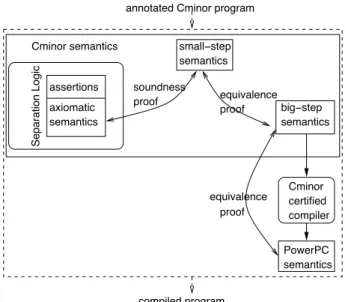
Figure 7 shows the architecture of our Coq development and the connection between our Separation Logic with the CompCert certified compiler. The next section describes how we plan to connect a Cminor certified compiler directly to the small-step semantics, instead of going through the big-step semantics.
Cminor certified compiler PowerPC semantics small!step semantics big!step semantics axiomatic semantics assertions
annotated Cminor program
compiled program proof equivalence proof Separation Logic Cminor semantics equivalence soundness proof
Figure 7: Architecture of the Coq development
9
Sequential Reasoning about Sequential Features
Concurrent Cminor, like most concurrent programming languages used in practice, is a sequential programming language with a few concurrent features (locks and threads) added on. We would like to be able to reason about the sequential features using purely sequential reasoning, then add the concurrent reasoning as an afterthought. If we have to reason about all the many sequential features without being able to assume such things as determinacy and sequential control, then the proofs become much more difficult.
One would expect this approach to run into trouble because critical assumptions under-lying the sequential operational semantics would not hold in the concurrent setting. For example, on a shared-memory multiprocessor we cannot assume that (x:=x+1; x:=x+1) has the same effect as (x:=x+2); and on any real multiprocessor we cannot even assume sequential consistency—that the semantics of n threads is some interleaving of the steps of the individual threads.
Brookes [21] proposes a solution with his “footprint semantics,” in which all the steps from one synchronization to another can be (semantically) collapsed into one step. One key idea in that work, which we adopt in a different way, is that the operational semantics “gets stuck” if there’s interference, so we need not reason about racy programs. Brookes writes, “One can use more elementary reasoning techniques to deal with synchronization-free code, such as the familiar Hoare-style inference rules for sequential programs.” But this is not enough! Consider a multi-exit loop whose body contains a lock/unlock synchronization.
This is not synchronization-free code, and yet we still want to use sequential reasoning to handle the complicated (sequential) multi-exit feature.
We will solve this problem in several stages.
1. We give a sequentially consistent small-step operational semantics for Concurrent Cmi-nor that assumes noninterference (and gets “stuck” on interference) [22].
2. From this semantics, we calculate a single-thread small-step semantics equipped with an oracle ω that predicts the effects of synchronizations (it is not just for running synchronization-free code). The oracular step (ω, σ, κ) #−→ (ω!, σ!, κ!) is almost the
same as the (σ, κ) #−→ (σ!, κ!) that we define in the present report. In fact, for all of
the sequential operators defined in this report, (σ, κ) #−→ (σ!, κ!)
(ω, σ, κ) #−→ (ω, σ!, κ!)
that is, the oracle is not consulted. For the concurrent operators [22] it is still the case that (ω, σ, κ) #−→ (ω!, σ!, κ!) is deterministic (because ω records the order in which
threads interleave—see Appendix).
3. We define a Sequential Separation Logic and prove it sound w.r.t. the (oracular) sequential small-step.
4. We define a Concurrent Separation Logic for Cminor as an extension of the Sequential Separation Logic. Its soundness proof uses the sequential soundness proof as a lemma [22].
5. (Future work.) We will use Concurrent Separation Logic to guarantee noninterference of source programs. Then (x:=x+1; x:=x+1) will have the same effect as (x:=x+2). (Brookes can actually say something slightly stronger: (x:=x+1; x:=x+1) is semanti-cally equal to (x:=x+2).)
6. To compile Concurrent Cminor, we will use a sequential Cminor compiler equipped with a proof that it compiles noninterfering source threads into equivalent noninter-fering machine-language threads. Leroy’s compiler of today is proved correct w.r.t. a big-step semantics, but perhaps the same compiler can be proved correct w.r.t. the deterministic (oracular) sequential small-step semantics given in this report.
7. We will demonstrate, with respect to a formal model of weak-memory-consistency microprocessor, that noninterfering machine-language programs give the same results as they would on a sequentially consistent machine.
Stages 1 and 3 of this plan are the main results of the current report. Previous machine-verified soundness proofs for Hoare Logic [8] and Separation Logic [23] cannot be used in this way, because they are with respect to big-step semantics. Brookes’s footstep semantics cannot be used (in its current form) because it does not support the massively sequential reasoning that we need for such features as the nonlocal-exit loop.
10
Conclusion
In this report, we have defined a formal semantics for the language Cminor. It consists of a big-step semantics for expressions and a small-step semantics for statements. The small-step semantics is based on continuations mainly to allow a uniform representation of statement execution. Then, we have defined a Separation Logic for Cminor. It consists of an assertion language and an axiomatic semantics. We have extended classical Hoare triples to sextuples in order to take into account nonlocal control constructs (return, exit). From this definition of sextuples, we have proved the rules of axiomatic semantics, thus proving the soundness of our Separation Logic. We have also proved the semantic equivalence between our small-step semantics and the big-step semantics of the CompCert certified compiler.
Small-step reasoning is useful for sequential programming languages that will be extended with concurrent features; but small-step reasoning about nonlocal control constructs mixed with structured programming (loop) is not trivial. We have relied on the determinacy of the small-step relation so that we can define concepts such as absorb(n, s, σ).
Of course, sequential threads are not deterministic in the presence of concurrency. There-fore, in our extension to concurrency we will rely on determinizing oracles (see Appendix) which will allow the theorems in this report to be used even in a concurrent language. We strongly recommend this approach, as it cleanly separates the difficult problems in nonlocal control flow from the problems of concurrent access to shared memory.
References
[1] J Strother Moore. A mechanically verified language implementation. Journal of Auto-mated Reasoning, 5(4):461–492, 1989.
[2] Dirk Leinenbach, Wolfgang Paul, and Elena Petrova. Towards the formal verification of a C0 compiler: Code generation and implementation correctness. In IEEE Conference on Software Engineering and Formal Methods (SEFM’05), 2005.
[3] Xavier Leroy. Formal certification of a compiler back-end, or: programming a compiler with a proof assistant. In POPL’06, pages 42–54. ACM Press, 2006.
[4] The Coq proof assistant. http://coq.inria.fr.
[5] Sandrine Blazy, Zaynah Dargaye, and Xavier Leroy. Formal verification of a C compiler front-end. In Symp. on Formal Methods (FM’06), volume 4805 of Lecture Notes in Computer Science, pages 460–475, 2006.
[6] Zaynah Dargaye. D´ecurryfication certifi´ee. In JFLA (Journ´ees Fran¸caises des Langages Applicatifs), pages 119–133, 2007.
[7] Xavier Leroy. Coinductive big-step operational semantics. In European Symposium on Programming (ESOP 2006), volume 3924 of Lecture Notes in Computer Science, pages 54–68. Springer-Verlag, 2006.
[8] Norbert Schirmer. Verification of Sequential Imperative Programs in Isabelle/HOL. PhD thesis, Technische Universit¨at M¨unchen, 2006.
[9] Gerwin Klein, Harvey Tuch, and Michael Norrish. Types, bytes, and separation logic. In POPL’07, pages 97–108. ACM Press, January 2007.
[10] Zhaozhong Ni and Zhong Shao. Certified assembly programming with embedded code pointers. In POPL’06, pages 320–333. ACM Press, January 2006.
[11] American National Standard for Information Systems – Programming Language – C. American National Standards Institute, 1990.
[12] Sandrine Blazy and Xavier Leroy. Formal verification of a memory model for C-like imperative languages. In Formal Engineering Methods, volume 3785 of Lecture Notes in Computer Science, pages 280–299, 2005.
[13] Richard Bornat, Cristiano Calcagno, Peter O’Hearn, and Matthew Parkinson. Permis-sion accounting in separation logic. In POPL’05, pages 259–270, 2005.
[14] Matthew J. Parkinson. Local Reasoning for Java. PhD thesis, University of Cambridge, 2005.
[15] Samin Ishtiaq and Peter O’Hearn. BI as an assertion language for mutable data struc-tures. In POPL’01, pages 14–26. ACM Press, January 2001.
[16] Peter O’Hearn, John Reynolds, and Hongseok Yang. Local reasoning about programs that alter data structures. In CSL’01, volume 2142 of Lecture Notes in Computer Science, pages 1–19, September 2001.
[17] Andrew W. Appel. Tactics for separation logic. http://www.cs.princeton.edu/∼appel/papers/septacs.pdf, January 2006.
[18] T.Weber. Towards mechanized program verification with separation logic. In CSL, number 3210 in Lecture Notes in Computer Science, pages 250–264, 2004.
[19] Richard Bornat. Proving pointer programs in hoare logic. In MPC, pages 102–126, 2000.
[20] John Reynolds. Separation logic: A logic for shared mutable data structures. In LICS 2002: IEEE Symposium on Logic in Computer Science, pages 55–74, July 2002. [21] Stephen Brookes. A grainless semantics for parallel programs with shared mutable data.
In Mathematical Foundations of Programming Semantics, May 2006.
[22] Andrew W. Appel, Aquinas Hobor, and Francesco Zappa Nardelli. Oracle semantics for Concurrent C minor. Submitted for publication, July 2007.
[23] Reynald Affeldt, Nicolas Marti, and Akinori Yonezawa. Towards formal verification of memory properties using separation logic. 22nd Workshop of the Japan Society for Software Science and Technology, 2005.